The Youth’s Instructor, Vol. XLIX, No. 47

A BASKET SALE

The Youth’s Instructor

November 28, 1901

Review and Herald Publishing Company · Battle Creek, Michigan · November 28, 1901

A BASKET SALE

Old Mrs. Langley, with a happy light in her eyes, bent over her lapboard. It was covered with all sorts of gay little pictures, and a host of wee paper stars, conscientiously five-pointed, but of anomalous colors,—green, lavender, and scarlet. She was making one now of royal purple, and singing softly to herself. One who did not know her might have thought her at the stage of life when childish joys come into use again.
In the sunshine at her feet a blue-eyed kitten frisked and tumbled, and chased impartially the gay bits of waste paper and its own little pointed tail.
There was a light tap at the half-open door, and a cheery, “May I come in?” followed by the entrance of a sunshiny head. “O, how cozy you look! and what wonderful thing are you doing now?”
Mrs. Langley looked up from her fifth point, which she was making with much care and precision. “Come in, dear, come in. How good of you to come! Draw up that little rocker, and sit down.”
But first, with the step of one accustomed there, Selma was placing a bunch of pansies in the tiny vase on the mantel. Then she brought it to the window. “There!” she said, “they look like a crowd of children jostling each other, don’t they?” The old eyes looked from the girlish face to the little, puckered ones in the vase, and the lines made by long years of storm and sunshine deepened around the mouth and eyes. One with a keen eye for resemblances might have thought her not unlike the pansy-faces,—the same long crow’s-feet, and a late, elderly bloom in the soft old cheeks like the velvet of the petals.
“Thank you, dear,” she said; “you never forget me and my likings, do you? But you oughtn’t to’ve done it.”
“Now,” said Selma, with a pat on the alpaca shoulder, “are you going to relieve my curiosity, and tell me what you are doing?”
“Why, yes, dear, of course I am. You see it’s this way,” and the old voice dropped; “and, first of all, I guess I don’t need to say that John ’n’ Marthy are as good and generous to me as heart could wish for—you must have seen that yourself many and many a time.”
“Why, of course I have,” said Selma, wonderingly, “and how could they help it, with such a treasure as you?”
The heavens were gray and dull and low,
The earth was old and stained and sere,
When God outspread his spotless snow,—
A carpet for the coming year.

Above it, sunshine came again,
Beneath it, many a weary thing
From summer heat and autumn rain
Found rest and waited for the spring.
—Selected.
The heavens were gray and dull and low, The earth was old and stained and sere, When God outspread his spotless snow,— A carpet for the coming year. Above it, sunshine came again, Beneath it, many a weary thing From summer heat and autumn rain Found rest and waited for the spring. —Selected.
“No, no, dear,” deprecatingly, “I ain’t that; but—well, it’s this way. You see, John and Marthy don’t have any too easy a time to get along. I know it, though, bless their hearts, they wouldn’t for worlds do or say a thing to make me feel it, and it—it sort of hurts to be a burden on them.”
“A burden!” indignantly. “You a burden! But, Mrs. Langley, when I said I was curious to know what you were doing, I—I didn’t think—I didn’t really mean it. So don’t, please—”
“I want you should know all about it,” the soft voice interrupted. “You know I always was real handy with such work, and it struck me the other day I’d make a lot of these little baskets; they’re different from any I’ve made before, dear, more fancy; and I’d put them down in the store, and let John sell ’em. I think they ought to fetch—perhaps ten cents apiece, don’t you?”
“It’s so much work for only ten cents,” said the girl, her hand involuntarily pressing her well-rounded pocketbook, with a quick, helpless feeling that it was so powerless here. Mrs. Langley would be crushed to the earth if she presented herself as a purchaser. Well, it should be managed some way; she would have to think out a way.
“John ’n’ Marthy didn’t like the idea a mite at first. ‘Why, mother,’ said John, ‘you don’t need to tire yourself out so, and don’t you ever call yourself a burden!’ says he; and so it was with Marthy. ‘A burden!’ says she, ‘mother a burden!’ I will say, there never was better children than John ’n’ Marthy.” She had to take her glasses off now, and rub them carefully with her clean, black-bordered handkerchief. Selma stooped suddenly, and made a lunge at the blue-eyed kitten, which stared wildly in return.
Mrs. Langley took a lighter tone. “I just enjoy this work, dear; it ain’t as if I didn’t love to do it. You know I always keep something of this sort on hand anyway.” Yes, Selma knew, so many queer little presents had found their way to her from time to time. She thought of them when she had said good-by, and gone soberly home.
A day or two later saw an array of finished baskets on Mrs. Langley’s table. She gathered them one by one into her apron with fresh delight. “They’re as neat as pinks,” she said, “if I do say it myself.” Her step was so buoyant as she went down the back stairs and into the shop that John looked up wonderingly. “Why, mother, you’re getting as spry as a cricket. Well, well, I declare! Those are fine!” for she was spreading out her baskets in an empty space on one of the counters.
It was part of a deep-laid scheme—the placing of the baskets on this particular corner, for it was very near a certain homely rocker sheltered by a screen and known as “mother’s chair.” It was her delight to bring some bit of work to that corner, holding herself in readiness to call John or Martha, or, on rare occasions, to find it necessary to trot behind the counter herself and so help “the children.” From this vantage-ground she could keep watch of her baskets. “In the sweet by and by,” she was singing to herself, as she arranged them, singing out of the fullness of a happy heart.
John watched her silently. “They’re fine” he said, trying hard to crush down a misgiving that others might be less appreciative. “If she’s disappointed, ” he said to himself, “dear old mother,” and then, “Her a burden! Bless her heart. Such fool notions.”
She made excuses to sit there most of the afternoon, it was “so pleasant” by the area; and Martha, with no visible sign of seeing deeper, patted her shoulder, with a “Yes, mother, and then you can be on hand to call John when he’s needed. He’s got to be in the kitchen a while fixing those shelves.”
No one heeded her work all that afternoon, though John did his best to attract attention to it, more than once picking up an especially gay basket, and ostentatiously clearing it of invisible dust.
The next morning she was there again in her rocker. Hope had returned bright and strong with the cheer of the new day, and she was in a little flutter of expectation when two pretty girls sauntered toward her counter. John was busy at the other end of the store with an exacting customer. Mrs. Langley peered out eagerly. Yes, they were really looking at her baskets. The girl in the blue dimity was holding one in her hand, and turning it slowly for a complete inspection. Her face was turned away. Mrs. Langley could see only soft coils of brown hair surmounted by a white sailor hat. She looked anxiously toward John; then a sudden resolve seized her. She would step forward herself. But just then the girl in the blue dimity turned her head; Mrs. Langley could see her face for the first time, and something in its expression made her sink quickly back into her chair.
“Madge, will you look?” An intense silence back of the screen, then a girl’s gay laugh from the other side. “What grotesque things! Look at those stars, green, and red, and O, here’s a purple one. Did you ever see anything so outlandish?”
“Hush, Nell,” a low-spoken warning from the girl in pink, for Mr. Langley was at last coming toward them. If they could only have seen that crouching figure back of the screen, the drawn face, and the old hands pressed tight together!
They passed out with their purchases, with a flutter of gay ribbons and crisp ruffles; and noiselessly a little, drooping figure stole from behind a screen and made its escape up the back stairs. She sunk trembling into the low rocker by the window. The two girls in the fluttering dimities were going, light-hearted and light-footed, down the linden-bordered street; but she hardly saw them. Half an hour later she went to the glass, and mechanically arranged her soft, gray hair.
“I’ll have to go down to supper,” she said. “They’d be worried if I didn’t, but I ain’t hungry, not a mite.” There was a pitiful, sinking sensation in her chest, so real that more than once she put up her hand to quiet it. “I guess I must have tired myself working over them so long,” she told herself, and tried to believe it.
“Mother’s chair” behind the screen was empty the next day. She was up in her room, wishing she could get her luckless handiwork out of sight, and yet fearing to make any move toward it for fear her pitiful little secret should be found out. She would let them stay there just a day or two longer, and then make some excuse to give them to the children, perhaps. They had some already, but none quite “so fancy.” It was late in the afternoon when a young girl came into the store,—a pretty girl with a tender, oval face and soft eyes. She made one or two careless purchases; and while Mr. Langley’s face was turned away, her eyes searched insistently for something. Then she made a quick step toward the table where the paper baskets were spread out.
“Why!” she said, “this is just exactly what I want; only I shall need more than you have here.”
Mr. Langley’s eyes opened wide; he was a large, heavy man, and it took his words a long time to come to the surface.
The girlish face was bending over the baskets, taking in all the pathetic details of their decoration. She was silent for a minute. Then she looked up with a straightforward, businesslike expression. “How much are they?” she asked. “Only ten cents apiece? I’ll tell you just what I want; perhaps you can manage it for me. I want them for the children’s hospital, to hold their pictures and paper dolls, and other little things, you know; but there are at least thirty children, and you have only nine baskets here.”
Then Mr. Langley found speech. “That would be easy fixed,” he said, and his face was beaming, “if you wasn’t in a great hurry.”
“Why, no,” said the girl; “if I could have them by the first of the month, when I visit the hospital, I would not need them before that.”
“I’ll call mother,” said Mr. Langley; “she makes ’em.” And he disappeared to the back regions. The girl could hear his deep voice. “Mother! Moth-er!” and a gentle answer, “Yes, John.”
“Come on down, mother; there’s a customer wants to see you.”
She came down the stairs in a little tremor of excitement. If it could be—but no, it couldn’t; probably it was some old friend who wished to see her. But it was an unfamiliar face that confronted her, and an unfamiliar voice that spoke. “I hope you can help me out. I was just explaining to your son that I want thirty of these baskets. You see they’re for the children’s hospital,” and the young eyes looked away for a moment, that gleam of incredulous joy in the old eyes was so hard to meet. “The little things have so many cards and paper dolls, and nothing to keep them in; and when I saw these baskets, I knew they were just exactly what we wanted. Those bright pictures alone would make them happy for days. Do you suppose—” the brisk business tone was a relief to the girl—“do you suppose you could make me—let’s see, twenty-one more? That would be just thirty all together.”
Mrs. Langley laughed, a chirpy, radiant little laugh. “Of course I could,” she said, “and I’d love to do it.”
“Well,” said the girl, “if you can manage to let me have them by the first of the month—will that be hurrying you too much?”
“O, no, not a bit. I can make three a day easy.”
“Then, that’s all arranged. May I take these nine now? Ten cents apiece, aren’t they?”
“O, no,” very earnestly, “not when you take so many; ’twouldn’t be right at all.”
“Yes, it would,” said the girl; “you really ought not to make them for any less. It is so much work. A friend and I buy them together. We’ve been wanting something of this kind for the hospital, and expected to pay at least as much as three dollars for them.”
Three dollars! What a magnificent sum it seemed to her listener!
She told it all to Selma a few evenings later, when they sat on the little side porch together in the sweet summer dusk. Selma’s eyes were very bright, and once she turned them quickly away, leaning her head against the wall up which the honeysuckle climbed, fondling her cheek with its little hands.
“A little pleasure limbers mother up wonderfully,” John had once said. Selma thought of it now, as she listened to the pleased, excited voice.
“Did you ever hear of such good luck, dear?” she said at last; “but,” with sudden gravity, “I don’t believe there was much luck about it, either. I guess God’s not so far away but he cares about such things as my baskets even, don’t you?”
“Yes,” said Selma, “I do.” And neither spoke again for a minute. From the long row of lindens came the ceaseless murmur of crickets and tree-toads.
“I couldn’t hardly wait to tell you about it,” Mrs. Langley observed for the third time. “I knew you’d be mightily surprised; weren’t you, dear?”
But Selma, leaning forward to kiss the soft old cheek, did not seem to hear the question. “I’m just happy over it,” she said, “and so glad I came over to hear all about it.”—Bertha Gernaux Woods, in Christian Endeavor World.

ALL'S WELL

What's the word to-day—all's well? That's the news we're listening for From the boy whose plans foretell He's to be a conqueror All day long, in thought and deed, Where the bravest captains lead.
All is well, lad; that's the word Everybody wants to hear; And it is not always heard— So one need not have a fear, When he has good news to tell, Just to say that all is well.
FRANK WALCOTT HUTT.

WHAT MORAL COURAGE AND TRUE CONSECRATION MAY ACCOMPLISH

If you have only a vague comprehension of what God can do through a single individual when he is willing to be a man of God’s opportunity, read the experience of Jonathan and his armor-bearer at a time when the people of God were in a most distressing and critical condition. The Philistines with an overpowering army were crushing the very spirit and power of Israel, and they had to hide themselves “in caves, and in thickets, and in rocks, and in high places, and in pits.” The Philistines had taken away from Israel all their implements of war, so when it came to the day of battle “there was neither sword nor spear found in the hand of any of the people that were with Saul and Jonathan.”
There was nothing to anticipate but defeat. It was then that a great ambition was born in the heart of Jonathan,—just such an ambition as the Spirit of God is putting into the hearts of thousands of young people to-day, but they merely pass on and smother it, little realizing what wonderful experiences might be theirs if they would cultivate these divine instincts instead of crushing them before they have time even to take root.
Jonathan said to his armor-bearer, “Let us go over to the Philistines’ garrison.” Now the road they had to pass over had “a sharp rock on the one side, and a sharp rock on the other side.” Just so to-day, the experiences that we must be willing to pass through to be used by God to make a master stroke in this world have sharp rocks and difficulties on either side. But Jonathan had come into possession of that great principle, “There is no restraint to the Lord to save by many or by few.” Verse 6. The skilled workman can employ a very imperfect tool, and yet produce a masterpiece with it. So the Lord can take a very weak vessel, and pour through it marvelous possibilities from his great reservoir of power.
In order for Jonathan to reach the Philistines, it was necessary for him to climb “upon his hands and upon his feet.” The man who becomes filled with an ambition to accomplish something for God will have to spend much time upon his knees, and while in this attitude, his soul is being filled with a divine illumination.
There is a tremendous power in personal effort. When these two men reached the camp of the Philistines, with unparalleled nerve and courage they fell upon the host, and the result was that “there was trembling in the host, in the field, and among all the people. The garrison, and the spoilers, they also trembled, and the earth quaked: so it was a very great trembling.”
When our young people become as thoroughly imbued with the spirit of service for the Master, and are willing to begin to do personal work for their friends and associates, we shall see that God will raise up men and women who will repeat the experience of Jonathan and his armor-bearer. The hosts of the enemy will tremble and melt away, and what such valiant young people shall accomplish for the Master will inspire thousands of others to take up active warfare.
May God speed the day when such Christians as Joseph, Daniel, Jonathan, and John the Baptist shall not at all be a scarcity among us. Then the pulse-beat of Christian activity will be quickened, the gospel message will soon be carried to thousands who know it not, the earth will be lightened with the glory of the Master, and we shall soon be at home on that evergreen shore of which we have sung so often, but have done so little to win. DAVID PAULSON, M. D.

MY THANKSGIVING

My Heavenly Father has been good to me Through all the changes of another year; Through all the days of darkness and of cheer His love has fed and clothed me, and I see The year pass onward to its destiny Without a heart pang or a falling tear, Without a worry or an anxious fear, But in a happy psalm of jubilee; For this is mine—my part—to offer praise, To think whence all these stores of love are given, To scatter sunshine for the stumbling feet, To sing of love, through all the joyous days,— My part, to cast reflected light of heaven, And plant and reap love’s fields of golden wheat.
B. F. M. Sours.

DIVISION I—GEOLOGY

Chapter XI—The Sea

§ 108. THE surface of our earth is estimated at 196,800,000 square miles, of which only 51,500,000 square miles is land, leaving a total of 145,300,000 square miles of water; so that the proportion of land and water stands at the ratio of 1 to 2.84. The area of the five oceans is roughly estimated as follows: Arctic, 5,000,000 square miles; Antarctic, 10,000,000; Indian, 20,000,000; Atlantic, 40,000,000; and Pacific, 70,000,000. The average depth of the seas for sixty degrees north and sixty degrees south latitude is about three miles. All together, they are estimated as containing 300,000,000 cubic miles of water.
§ 109. Sea-water weighs 64.25 pounds for each cubic foot, or 1.75 pounds more than fresh water. The amount of salt in each cubic foot of sea-water accounts for the difference in weight. The pressure of the sea at a depth of 31.1 feet is 2,000 pounds to the square foot.
The decrease in marine temperature, as we descend, is decidedly marked. With a surface temperature of eighty-six degrees the mercury lowers to forty-five degrees upon being submerged to a depth of 2,144 feet. As stated before (Section 91), were it not for the extreme saltness of the water, to which might be added its constant movement, the bottoms of our oceans would be one solid floor of ice.
§ 110. There are three general movements of sea waters; namely, waves, tides, and currents. The waves of the sea are merely local, surface affairs, caused by the friction of the winds. The measurements of Scoresby, which are regarded as very accurate, prove that during storms, waves in the Atlantic rarely exceed forty-three feet from hollow to crest, the distance between the crests being five hundred and sixty feet, and their speed being thirty-two and one-half miles an hour. The greatest height of waves on the British coast was of those observed at Wick Bay, so famous for its heavy seas, where they reached a height of from thirty-seven to forty feet. The statement that the waves “roll mountain high” is based more upon fear and excitement than upon actual measurement. In the heaviest storms the waters are disturbed but little below the actual hollow of the wave.
§ 111. The tides, however, are vastly different, every particle of water, to the very bottom of the deepest levels, being disturbed by the attracting force of both the sun and the moon; for the tides are but the manifestation of a most interesting force, which we shall enjoy studying, further on, under its proper heading. The alternate rising and falling of the waters, in the coming in and going out of the tide, follow each other with marked regularity at periods of about six hours each. The moon attracts the tides three times as much as does the sun, and raises the tidal wave correspondingly higher. The highest tides occur at new and full moon. When the sun and the moon are at quadrature, or ninety degrees apart, each raises a tide of its own, thus correspondingly lowering the tide of the other.
§ 112. Tides vary in height according to the depths of the sea and the conformation of the coast. In the open sea the water seldom rises more than two or three feet; but when the channels converge where the tide rushes in, the height of the wave is greatly increased. At St. Malo it exceeds fifty feet. In the Bay of Fundy, where it reaches its highest known point, a wave one hundred feet high rushes in upon the shore.
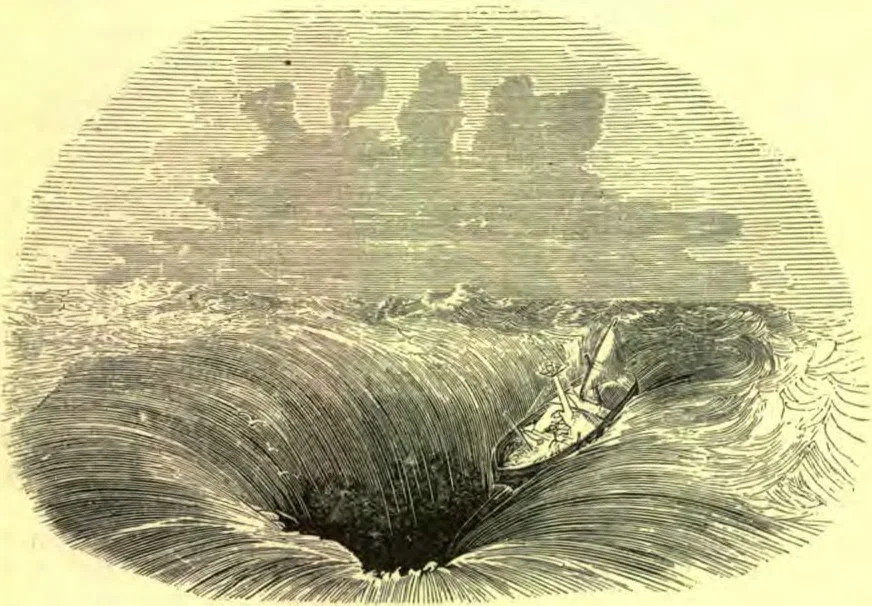
§ 113. As an explanation of some of the most noted tidal phenomenon with which all are more or less acquainted, we quote the following from Guyot’s Physical Geography, page 64: “Differences in level, produced by high tides, cause currents which vary in force and direction with the condition of the tide, producing, in some cases, dangerous whirlpools. The famous Maelstrom, off the coast of Norway, is but a tidal current. Such is, also, the famous whirlpool of Charybdis, in the Strait of Messina, and many others of less note.” There is no such thing as a great hole in the bottom of the sea, as is popularly believed, into which these maelstroms pour their waters. Terrible and disastrous as they are to ships that chance to be caught in their jaws, yet they are but the coming together of two different tidal currents, which flow with different rates of speed.
§ 114. There are two general oceanic movements that affect the whole body of salt water; namely, the polar and equatorial currents. The direct rays of the sun upon the equator so heat the earth’s great body of water that, in expanding, it rises and flows off either way from the equator toward the poles. These currents do not flow directly north and south; but the warm, upper surface water is drawn toward the east, and consequently hugs the western borders of our continents, crowding the cold, lower currents to the westward as they creep along the ocean’s bottom on their journey toward the equator. This being an important point in our future study, we quote from page 65 of the above-mentioned work: “The polar and return currents, were they acted upon by no external force, would move in the line of the meridians, taking the shortest course between the poles and the equator. Both are, however, deflected from this course by the unceasing action of the earth’s rotation,—the polar currents, as they advance, tending more and more toward the west, and the return currents toward the east; and this direction is still further modified by the forms of the basins of the several oceans, and the influence of the prevailing winds in the different zones.”
A MAELSTROM
A MAELSTROM
§ 115. Currents such as the Gulf Stream are nearly as marked in the waters of the ocean as are the streams of water coursing through our lands. The Gulf Stream flows by Florida at the rate of from three to five miles an hour; then on to the northeast, past Sandy Hook at the rate of one and one-half miles an hour; thence past Newfoundland, on to the northeast toward the European shores; then the western portion bends to the southwest, and joins the return tropical current. The eastern portion continues on past the British Isles toward the pole. From the polar region it returns by eastern Greenland, Davis’s Strait, and other passages pressing against the North American coast, throwing cold water into the Gulf of St. Lawrence, and bringing icebergs to the banks of Newfoundland.

QUESTIONS

What proportion of the earth’s surface is land? What proportion is water? Give the estimate of the area of the five oceans. What pressure would a water-tight box, one cubic foot in dimension, sustain if sunk to a depth of thirty-one feet? What effect does depth have upon oceanic temperature? By what three general movements is the sea affected? Tell what you can of the cause and height of waves. What cause the tides? Tell what you can of their height and movements. Explain the phenomenon of maelstroms. What are oceanic currents? Give the different causes of these. What effect does the Gulf Stream have upon the climate of Europe? Are the upper, warm waters from the equator drawn toward the eastward or to the westward as they move toward the poles?
DR. O. C. GODSMARK.
2005 Magazine St., Louisville, Ky.

“AS A FATHER”

A GENTLEMAN of some wealth and high social position was taken ill. Being much troubled about the little love he found in his heart for God, he complained bitterly to one of his brethren. This is how he was answered:—
“When I leave you, I shall go to my home, and the first thing I expect to do is to call my baby. I expect to place her on my knee, and look down into her sweet eyes, and listen to her charming prattle; and, tired as I am, her presence will rest me, for I love that child with unutterable tenderness. But the fact is, she loves me little.
“If my heart were breaking, it would not disturb her sleep. If my body were racked with excruciating pain, it would not interrupt her play. If I were dead, she would be amused in watching my pale face and closed eyes. If any friends came to remove the corpse to the place of burial, she would probably clap her hands in glee, and in two or three days totally forget her father.
“Besides this, she has never brought me a penny, but has been a constant expense on my hands ever since she was born. Yet, though I am not rich, there is not money enough in the world to buy my baby. How is it? Does she love me, or do I love her? Do I withhold my love until I know she loves me? Am I waiting for her to do something worthy of my love before extending it to her?”
“O, I see it!” said the sick man, while the tears ran down his cheeks, “I see it clearly. It is not my love to God, but God’s love to me I should be thinking about. And I do love him now as I never loved him before.”
We think of our littleness, when we should remember our Father’s almightiness. We bewail our weak love, when we should be grateful for our Father’s great love. “Herein is love, not that we loved God, but that he loved us.”—Selected.

THANKSGIVING DAY

Bring an offering to the Master! What, beloved, shall it be Worthy of his wondrous kindness, Who has given all to thee?
Bring thy best, for he is kingly; Bring thy offering full and free; Thou canst never match his bounty, For he gave his life for thee.
He has filled thy hands with blessings, Which he bids thee scatter wide; Calls thee friend, and not a servant,— Friend to labor at his side.
O to give with glad thanksgiving! Freely, freely we receive, Counting this our crowning blessing, That he gives us power to give.
—Selected.

GOD-GIVEN OPPORTUNITIES

(December 1-7)

SUGGESTIONS FOR THE STUDY

1. Let each try to find some truth that has been written on the subject of opportunities.
2. Let every member personally construct an outline of each of the Bible characters mentioned, and others that may occur to him as perhaps being more striking examples. This outline should embody—
(a) A brief statement of the early life of this Bible character.
(b) The circumstances that bring him prominently to our attention.
(c) His leading God-given opportunities.
(d) What we know of the last stage of his career.
(e) The similarity of our opportunities, even if on a much smaller scale.

SUGGESTIVE THOUGHTS

Our opportunities are exactly proportionate to our capacity to make use of them. “A man’s gift maketh room for him,” and the room is no greater than the gift. If we desire greater opportunities, we must cultivate our gifts more diligently.
In the parable, the least that any man received was one talent, and that was the gift of opportunities. So there is no one living who has not received this gift. But the man who received only one talent went and hid it in the earth. Every young person who fails to recognize his opportunities is doing the same thing. Grain that is not reaped when it is ripe, falls off and is lost. So opportunities, when they are not eagerly grasped, speedily vanish, and neither prayers, tears, nor fasting can bring them back again. There is an eternal loss for every wasted opportunity.

QUESTIONS

The difference between a man who is recognized as standing head and shoulders over his fellow men and the one who is a mental and moral dwarf, is largely due to the fact that one has acquired the divine art of recognizing great opportunities in the very things that were a blank to the other. Such tremendous possibilities are wrapped up in even this short life, that we ought to ask God daily to give us at least a partial glimpse of them. This will help us to seize our opportunities unhesitatingly.
“There is a tide in the affairs of men, which, taken at the flood, Leads on to fortune; omitted, all the voyage of their life is bound in shallows and in miseries.”

BIBLE CHARACTERS WHO RECOGNIZED THEIR OPPORTUNITIES

Joseph.—Try to determine in how many instances Joseph especially recognized his opportunities.
Gideon, Nehemiah, Daniel, John the Baptist.—These are all inspiring examples of men who recognized their opportunities. Suppose they had failed to do this, as so many of us have failed all these years,—how much of the Bible would have been left unwritten!

BIBLE CHARACTERS WHO FAILED TO RECOGNIZE THEIR OPPORTUNITIES

Sampson.—After slighting several grand opportunities, Sampson spent enough time to have preached the gospel to a whole nation in simply grinding corn for the Philistines. Are you overlooking similar opportunities to-day? Then remember that you may have to grind corn for the Philistines to-morrow.
Solomon.—The case of the Wise King is a good example of how easy it is for even those who have been wonderfully gifted to ignore their opportunities. Compare some of the sorrowful things found in the book of Ecclesiastes with the glorious triumphs of the book of Revelation.
Ananias and Sapphira.—These persons might have been pillars in the early church, and accomplished such mighty works for God that another book of the Bible would have been necessary to recount their deeds of spiritual valor; but instead they came to an untimely end, because they despised their God-given opportunities.

OUR OPPORTUNITIES

It would have been a great privilege to live at the time when Christ raised the dead; it would have been an inspiring and thrilling thing to hear Luther speak the words that shook the Vatican; but it is a far greater opportunity to live at this time, which is the culmination of all the ages. Priests and prophets have alike looked forward to the climax of all the lines of God’s providences as they center in this generation; and yet hundreds of our young people have become so thoroughly blinded by the devil that they actually see no special opportunities in being permitted to live at this particular time. O that such would allow the Lord to anoint their eyes with the heavenly eyesalve! Then where was seen only a wilderness, waters would break forth; where was discerned only a desert, opportunities would blossom as the rose:—
1. Educational Opportunities.—We may now acquire more useful facts in one evening than it would have been possible for some of our forefathers to secure in half a lifetime; and yet many of our young people are filling their brains so full of chaffy literature that they actually get less useful information into their minds than did their forefathers, with only a thousandth part of the same opportunities.
2. Opportunities for Physical Development.—With only a trifling expense and a few hours’ persevering study and practice, the necessary knowledge can be obtained to enable the average young man or woman in a year’s time to increase the chest capacity fully ten per cent. That would mean in most cases at least so much added to the years of their life. The same could be said of almost every function of the body. Still our young people are indifferent to these things, willing to drift along miserable physical wrecks, and then drop into untimely graves. Then some one will perhaps talk of a “dispensation of Providence,” when it was nothing but a failure to recognize God-given opportunities, and cultivate that which is within the reach of all; i. e., physical development.
3. Missionary Opportunities.—The world’s woes and sorrows constitute no small part of our opportunities. Have we learned to recognize that man’s disappointments are God’s appointments? If so, tell it to that discouraged soul who lives next door,—tell it with such convincing power that he will believe you. Is he sick? Think of what you can do to help him and improve his surroundings. If you can not think of anything, sit down, and try to figure out why.
4. Social Opportunities.—Satan always steals the livery of heaven to forward his purposes. That is why the visiting spirit is the open door through which so many souls pass to their eternal doom. But God’s children should utilize social advantages to aid them in coming in contact with humanity. Try to think of how many different ways you may reach humanity socially without forwarding the work of evil.
5. Poverty and Prisons.—Every needy soul whom Providence brings to our notice is a God-given opportunity. How have you regarded such in the past? Can you imagine the agony that you would experience if you were compelled to spend even one night in a prison cell? Do you know that there are two hundred thousand men occupying such cells in this country to-day? Have you any concern for them? Do you know whether there is any way you can be of service to them? If not, if you will send a two-cent stamp to the Life Boat, 2-33d Place, Chicago, you will receive the November Life Boat, which will offer you some practical suggestions in this direction.
DAVID PAULSON, M. D.

WAYSIDE WITNESSING

You may only be going to the grocery. Never mind. Along that way, if you look sharply, there will surely be some opportunity to acknowledge God. Bowing on the street to that poor woman may be made as much an acknowledgment of God as bowing in prayer at church. You can not go down-stairs without having a chance to acknowledge him. It may be by a snatch of cheery song. It may be by a merry hail or thoughtful inquiry, a word of sympathy or of praise. Keep your eyes open, Christian, as you walk along these ways of earth, and you will see chances of acknowledging God more numerous than the telephone poles, or the hitching-posts, or the signs above the shop-doors.
A reaping-machine proudly bears its maker’s name, and so it acknowledges him not only on the harvest field, but on the way thither; yes, and when laid up for the winter. Whoever looks upon it, whether it is in rest or motion, and whether wheat is near it or not, knows the name of the maker that was its owner’s choice.
And so whoever wears, definitely and frankly, the name of Christ, preaches a sermon as long as his daily walk, and sings through every conversation an anthem of praise. He can not pray, even, but it will be to the glory of God.
And of course, if thus we walk with God, we can not go astray; for God is not going astray. He directs our paths by directing his own.—Nutshell Musings.

AN INTERESTING REPORT

Of the Young People's work at College Place, Wash., during the past summer has been received, and will be given next week. Such reports are not only cheering to those who have this great work in charge, but they encourage other companies to faithful effort. We hope, as the winter's work is taken up, to receive many such reports.
Continue reading: Tobacco Pipe and Demi John's Boastful Rivalry