Your ShelfYour Projects

Signs of the Times, Vol. 21, No. 50.

THE GREAT THREE-FOLD MESSAGE

Signs of the Times

Dec 19, 1895

Pacific Press Publishing Company · Oakland, California · Dec 19, 1895

THE GREAT THREE-FOLD MESSAGE

The Hour of His Judgment Is Come

THE LEDGER OF HEAVEN.

BY MRS. L. D. AVERY STUTTLE.
O, the wonderful ledger the angels keep! And the watchful eyelids that never sleep, And the tireless penmen that watch and weep Over the words they write!
How oft are the hearts of the angels pained, And how oft are the pages soiled and stained! How much is lost and how little gained In struggling for the right!
'Tis thus I mused, in the twilight gray, In the deep'ning gloom at the close of day, Ere I rev'rently knelt by my couch to pray, And laid me down to rest. And I dreamed that a glorious angel fair Had borne me away through the boundless air, To the pearly gates of that city where Dwelt the good and blest.
O, the peace I felt, as my mortal tongue Joined in the songs that the seraphs sung, As back were the massive portals flung At the touch of the angel's hand! We stood on the banks of the river wide, Which flows from the throne in a crystal tide, And I safely followed my shining guide Over that blissful land.
Still on through the ambient air we sped, Till she laid her hand on my trembling head; “Behold the ledger of heaven,” she said— And quick on my wond'ring view There seemed to flash like a ray of light, The mystic pen of an angel bright, As he wrote in the ledger pure and white The record of life—so true!
And every deed of my life was there— The careless word and the honest prayer— And some of the pages were white and fair, And others were soiled with sin. And the thoughts of my heart that were long concealed Were written down and all revealed. And, O, how I wished that the book were sealed, And the record were hid within!
And my cheek was crimson, as, one by one, I read the record of deeds I'd done, And of victories lost that I might have won, In the hour of mortal strife, And of gentle words that I might have said; But, ah! there were hasty words instead; And now were the golden moments fled, And mine was a misspent life!
“O, had I but known!” in my grief I cried, And weeping turned to the angel's side. “I bring thee hope,” said the angel guide; “Thy Saviour has prayed for thee, And thou shalt return to the earth again, And dwell once more 'mong the sons of men. But, O, remember the angel's pen! Ah! what shall thy record be?”
With tears of joy at length I woke, And rose from my couch, for the morn had broke. “The Lord be praised!” were the words I spoke “For the beautiful lesson given I will guard my lips with a jealous care, I will keep my heart from the tempter's snare, Lest sin be found on the pages fair Of the record book of heaven.”
My soul, how oft have the angels wept Over the shameful record kept, While the daughters of Zion have idly slept, Nor dreamed of their fearful doom!
O, haste, for the moments are passing fast Ere the summer is ended, the harvest past. And the ledger of heaven is read at last, And the King of kings shall come!

THE IMPORTANCE AND TIME OF THE MESSAGE.
“SURELY,” says the prophet herdsman, “the Lord God will do nothing, but he revealeth his secret unto his servants the prophets.” Amos 3:7. It is in this way chiefly that God has sent messages of warning, reproof and consolation to his people and the world through the ages of the past. Each prophet prophesied and taught for the age in which he lived, but he wrote for the future ages. “For whatsoever things were written aforetime were written for our learning, that we through patience and comfort of the Scriptures might have hope.” Rom. 15:4.
Among the many faithful, solemn warnings found in the word of God none is more comprehensive, none more important, than the great threefold message of Rev. 14:6–12, which reads as follows:—
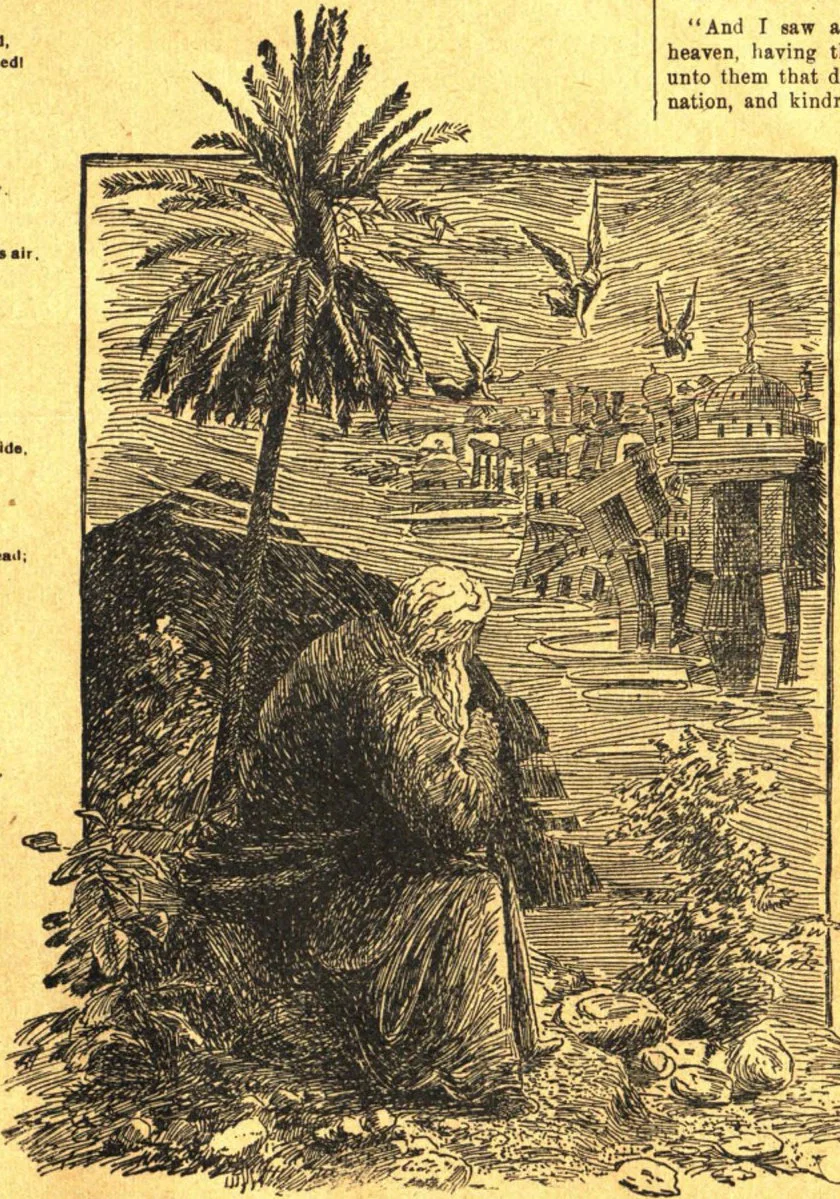
“And I saw another angel fly in the midst of heaven, having the everlasting Gospel to preach unto them that dwell on the earth, and to every nation, and kindred, and tongue, and people, saying with a loud voice, Fear God, and give glory to him; for the hour of his judgment is come; and worship him that made heaven, and earth, and the sea, and the fountains of waters.”
THE SEER OF PATMOS.
THE SEER OF PATMOS.
“And there followed another angel, saying, Babylon is fallen, is fallen, that great city, because she made all nations drink of the wine of the wrath of her fornication.”
“And the third angel followed them, saying with a loud voice, If any man worship the beast and his image, and receive his mark in his forehead, or in his hand, the same shall drink of the wine of the wrath of God, which is poured out without mixture into the cup of his indignation; and he shall be tormented with fire and brimstone in the presence of the holy angels, and in the presence of the Lamb; and the smoke of their torment ascendeth up forever and ever; and they have no rest day nor night, who worship the beast and his image, and whosoever receiveth the mark of his name. Here is the patience of the saints; here are they that keep the commandments of God, and the faith of Jesus.”
Note that it is one message, having three phases. The angels symbolize religious teachers. The first bears the everlasting Gospel to all the world. Every positive truth of God is comprehended in this message. The second message follows, or goes with, the first, showing the effect of its rejection. The same word, “follows,” is used repeatedly of Christ’s disciples following him, that is, going with him. The one leads out, the others follow. The last message is a decided protest against false worship, while verse 12 reveals to us the character of those developed by the soul-stirring truths of the entire message. While the beginning of the first precedes the other two, and the first and second the third, yet when the latter begins, the message becomes one—God’s great threefold message to the world.

The Time of the Message.

The time of the message, that is, the age to which it applies, is indicated by the language of the message itself, and by the context.
1. “The hour of his judgment is come.” Paul, speaking for his time, declared that God “hath appointed a day, in the which he will judge the world in righteousness.” Acts 17:31. But the judgment was then future. He therefore spoke of “judgment to come.” Chap. 24:25. But the message under consideration proclaims the judgment already come. It is pending when the message, in God’s providence, goes forth; the Court is then in session, the Judge is on the throne, the cases are called. Every probationary work closes with the examination of the cases of those who have been on trial and the rendering of decisions in respect to each one; and the Gospel is no exception to this. It closes with the judgment. This message is, therefore, the last phase of Gospel work to prepare men to stand in the judgment.
2. The unmixed wrath of God in the message of the third angel. In all ages of the past when special judgments have visited the earth, God’s wrath has been mingled with mercy, extended even to those of imperfect character. Thus it was with the sons of Noah; thus it was with Lot. But in that great day, though Noah, Daniel, and Job are in the land, they shall deliver only themselves by their righteousness. Eze. 14:19, 20. Now “in the hand of the Lord there is a cup, and the wine is red; it is full of mixture; and he poureth out of the same” (Ps. 75:8); but then the wicked will have rejected every manifestation of God’s mercy, and there will be nothing left them but that which they have chosen, the “dregs” of wrath; and “all the wicked of the earth shall wring them out, and drink them” (Id.). This will be the unmingled wrath of God, the time when “the Lord shall rise up . . . that he may do his work, his strange work, and bring to pass his act, his strange act. Now therefore be ye not mockers.” Isa. 28:21, 22. This is not because God would not save the wicked, but the wicked will not be saved. They have identified themselves with sin, and the inevitable fruitage of sin is death. James 1:15. All this will take place when men have fixed their characters by accepting or rejecting this last great message, and the declaration goes forth from God that it is so. “Quickly” afterward is the coming of Christ. “The time is at hand. He that is unjust, let him be unjust still; and he which is filthy, let him be filthy still; and he that is righteous, let him be righteous still; and he that is holy, let him be holy still. And, behold, I come quickly; and my reward is with me, to give every man according as his work shall be.” Rev. 22:10–12. This shows that the judgment has determined the cases of all just before Christ comes. The great threefold message is therefore the last message of mercy; for upon those who reject it will fall the unmixed wrath, which by rejecting the message they choose.
3. That this message immediately precedes the Lord’s coming is shown by the verses which follow the message quoted above. The next event the prophet sees is thus depicted:—
“And I looked, and behold a white cloud, and upon the cloud one sat like unto the Son of man, having on his head a golden crown, and in his hand a sharp sickle. And another angel came out of the temple, crying with a loud voice to him that sat on the cloud, Thrust in thy sickle, and reap; for the time is come for thee to reap; for the harvest of the earth is ripe.” Rev. 14:14, 15.
“The harvest is the end of the world” or age. Matt. 13:39. Thus is it demonstrated that the great threefold message of Rev. 14:6–12 has application in the very close of the Gospel dispensation, just before the coming of Christ; it is the last message of mercy to fallen man. It will be seen by other articles, and by our Sabbath school lesson on page 13, that we are living in that period of time when this message is due.

The Importance of the Message.

1. It is a part of the “Revelation of Jesus Christ, which God gave unto him, to show unto his servants things which must shortly come to pass.” Rev. 1:1. Concerning that Revelation the Lord declares: “Blessed is he that readeth and they that hear the words of this prophecy, and keep those things which are written therein; for the time is at hand.” Verse 3. And again, “Blessed is he that keepeth the sayings of the prophecy of this book.” Chap. 22:7. But he can not keep the sayings of the book who does not know them, understand them, and realize their import. And as some of these sayings are great prophecies, relating to the end, or last generation, connected with which are important practical duties, it follows that only the last generation will know these prophecies and have presented before it these duties. Upon the hearing-doers of this generation is, therefore, pronounced the blessings of the Revelation. They will be blessed in the doing, as thousands are now witnessing. On the other hand, those who despise the instruction of the Revelation, despise the blessings.
2. The importance of the message is shown by the message itself. It brings “the everlasting Gospel” of God instead of human tradition; the fear of God, which is wisdom, instead of that of man, which bringeth a snare; the glory and worship of the Creator, which transform, instead of the glory and worship of man, which perish. It reveals the true God, the fallen church, the cause of her fall, the false worship, the solemn and fearful warning, which is death to neglect, the sure refuge, the holy character bestowed of God in the Gospel. Truly the message is tremendously important. Who will dare disregard it? Who will desire to disregard it?

The Everlasting Gospel.

BY BETA.
The great positive, all-comprehending truth of the message of Rev. 14:6-12 is the everlasting Gospel. It is so called because it is the same Gospel which God has given to the world in all ages. It is the proclamation of “the everlasting covenant” of mercy. It has known no change in its principles since it was proclaimed to fallen men in a polluted Paradise. It is the same glad tidings of peace and good will from a God of love, the loving notes of which have rung down through the ages. It has, on God’s part, for its basis the power of God’s life in his Spirit and word; for its standard, the eternal righteousness of God; for its Author, Jesus Christ; for its object, the regeneration and salvation of sinful man; for its motive, everlasting love; on man’s part, it demands simple faith, receiving the word, voluntary submission to God’s will. This in brief sums up the Gospel.
The apostle Paul declares that it is “the power of God unto salvation; . . . for therein is the righteousness of God revealed from faith to faith; as it is written, The just shall live by faith.” Rom. 1:16, 17. Again, in Col. 1:23-27 it is called “the Gospel,” “the word of God,”
“The Mystery” of God,
“Christ in you, the hope of glory.” The righteousness which he gives is the righteousness of God, embodied in his holy law and perfectly manifest in life in the character of our Lord Jesus Christ. This is evident from the fact that the law of God witnesses to the righteousness received by faith. Rom. 3:21, 22. The law testifies that the righteousness received by faith is real and genuine. It counts the child of faith as though he had never sinned. But it is obvious that the law can not witness to that which is contrary to itself; and it therefore follows that the righteousness of God’s law is the same as that received by faith. This is further evident from the fact that Christ kept his Father’s commandments (Ps. 40:7, 8; John 15:15), and it is by Christ’s “obedience” that believers are “made righteous” (Rom. 5:19).
There is no difference between righteousnesses in God. He is ever the same, holy, unchangeable. His law is therefore ever the same. And while man has sinned, and the law of God’s life has become death to him (Rom. 7:10; 4:15), yet in his great mercy God gives us freely, in the Gospel of Christ Jesus, his righteousness (Rom. 3:22), writes upon our hearts the law of life (Rom. 8:2; Jer. 31:33), and places within us his Holy Spirit (Eze. 36:26; Rom. 8:9, 10), that we may by the power of his life keep all his commandments and walk even as Christ walked (Eze. 36:27; Rom. 8:4; 1 John 2:6).
All this is in Christ Jesus for the sinner. All this will be given to the one who will submit to receive it, accept it, do it. It can be given in no other way. God demands willing service, supreme love. And love can not be compelled; it can not be forced. It must willingly, longingly be received from God, willingly, gladly, freely be rendered to him and his creatures as he has commanded; for love is obedient before it is sacrificing. “To obey is better than sacrifice.” “He that saith, I know him, and keepeth not his commandments, is a liar, and the truth is not in him.” This, in fact, is the real test to us as to whether we know God. “And hereby do we know that we know him, if we keep his commandments.” If there is nothing in our heart or will opposed to God’s law or what he has commanded, we may know that we are in harmony with him, that we know him. But if we refuse to keep even the smallest command, we should know by that that our hearts are yet carnal, whatever may be our feelings or profession.
The Gospel of Christ if received will make us like Christ. Like him will we say, “I delight to do thy will, O my God; yea, thy law is within my heart.” Like David, his great ancestor, will we say, “O how love I thy law! it is my meditation all the day.” We will have the “faith which worketh by love” (Gal. 5:6), the love that keeps all of God’s commandments (1 John 5:3).
The receivers of this everlasting Gospel will fear God as the only Being worthy of reverence. He will give glory to God, not to men. He will worship the Creator of “heaven, and earth, and the sea, and the fountains of waters,” with all that is implied. He will do all this in view of coming judgment, and in love for God, who has saved him from its terrors. He will see in the Creator the Recreator, the Redeemer, the Sanctifier, the Saviour; and he will realize in himself, “If any man be in Christ, he is a new creature.” Knowing this power he desires no other.
It is this in brief that this part of the message in Rev. 14:6, 7 reveals to us. It goes to all the world, entreating men to look and live; to turn, and not die; to eat and be satisfied. “Ho, every one that thirsteth, come ye to the waters, and he that hath no money; come ye, buy, and eat; yea, come, buy wine and milk without money and without price. . . . Incline your ear, and come unto me; hear, and your soul shall live. . . . Let the wicked forsake his way, and the unrighteous man his thoughts; and let him return unto the Lord, and he will have mercy upon him; and to our God, for he will abundantly pardon.” Isa. 55:1-7. Sinner, this invitation is to you; will you not accept it?
CHRIST'S POWER TO SAVE.

The Present Truth of the Gospel.

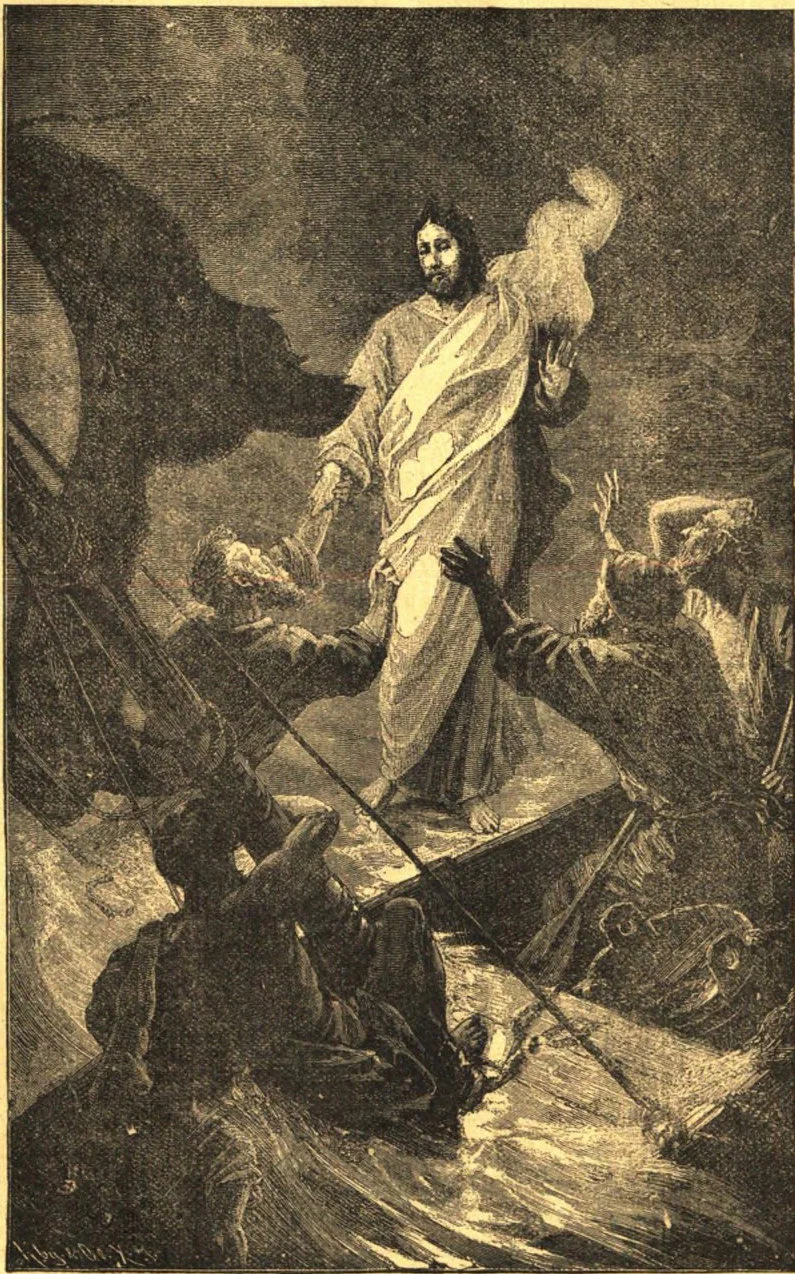
God’s message to the world at all times is the Gospel, glad tidings of salvation through our Lord Jesus Christ. Its principles are expressed in various ways, but the meaning is the same. For instance, Jesus is said to be “the way, the truth, and the life.” John 14:6. He is also said to be to us “wisdom, and righteousness, and sanctification, and redemption. 1 Cor. 1:30. But it is all the same in power, in object, in purpose, in ultimate result. On man’s part it is expressed by “repentance toward God, and faith toward our Lord Jesus Christ.” Acts 20:21. Sometimes the simple terms “believe,” “have faith,” “obey,” are used to express man’s part. They all mean the same thing, which is to submit absolutely and wholly to do God’s will, that he may work out in us his own righteousness and life, and that we may live forever. There is no other way of saving man than the Gospel way.
But connected with these great general truths, principles, facts, in different ages of the world, are truths applicable only to one period, tests which come only to one generation. The principle of faith, obedience, and righteousness is the same, but the test varies, and the test for that age or generation becomes a SPECIAL PRESENT TRUTH for that generation, which, if heeded, will prove salvation, if despised, it will prove destruction.
The coming of the deluge was a testing present truth to the generation which lived on the earth when the flood came. At that time the Lord said: “My Spirit shall never pronounce judgment on men unwarned. They are but flesh. Their days shall therefore yet be one hundred and twenty years.” Gen. 6:3, Boothroyd’s translation. The Lord then sent Noah, “a preacher of righteousness (2 Peter 2:5), and he “by faith . . . prepared an ark to the saving of his house; by the which he condemned the world, and became heir of the righteousness which is by faith” (Heb. 11:7). The righteousness which he preached was the same righteousness always revealed in the Gospel; his faith was the same faith; but the test was adapted to the time. The impending deluge was not a present truth in Enoch’s day, nor was it in Abraham’s; it was a present truth for Noah’s generation alone. He who truly believed the Gospel heeded Noah’s warning. He who did not believe, rejected the warning. But the heeding was life, the rejection was death.
It would not do for a man to say: “God did not require this of Seth or of Enoch; and I will go on in the good old way. If it was all right for them, I will risk it for myself.” Millions of those who perished doubtless reasoned in that way. Seth had his special tests of faith, so did Enoch, and the deluge was the special test of that generation. Noah believed, and his faith showed that others were justly condemned, for “God is no respecter of persons,” and his message was to all.
The present truth to Sodom that God would destroy it was given through Lot. He believed and lived; the people of Sodom despised it and died. Jonah preached a present truth to Nineveh, and it brought salvation because it was believed.
The faith of the Jews was tested by the present truth of the Gospel preached by John: “The kingdom of heaven is at hand,” or, as rendered by some, “The royal Majesty of Heaven has appeared.” The Christ of God was among them. “The fullness of time” had come. His coming had been predicted in the past, and the good of the preceding ages had believed it and lived. But in John’s day it was fulfilling, and the touchstone of genuine faith was the acceptance of the fact proclaimed in John’s message.
And therefore it is written:—
“And all the people that heard him, and the publicans, justified God, being baptized with the baptism of John. But the Pharisees and lawyers rejected the counsel of God against themselves, being not baptized of him.” Luke 7:29, 30.
The time of visitation had come, and the Jews knew it not. Their faith, if faith it might be called, was in a dead past, locked in the tombs of the prophets. Trusting in the glory of the ages gone, lifted up by their own righteousness, they rejected the greatest of all prophets, and finally Him whose Spirit had spoken through all the servants of God. They had a dead belief and the outward forms of piety, but living faith was wanting, and the message of God designed to develop and confirm it they rejected.
“In the fullness of time God” raised up Martin Luther and contemporaneous reformers to bring to his again fallen and apostate church a message of righteousness. Some accepted it and were saved; the great mass rejected the message and went into greater darkness, even to the extent of putting to death those who, according to their best light, followed and preached Christ.
Even as in other ages, so in this. The fullness of time has come for God to again warn the world. Nearly three thousand years ago the Lord gave these messages by his prophets:—
“The Spirit of the Lord God is upon me; because the Lord hath anointed me to preach good tidings unto the meek; he hath sent me to bind up the broken-hearted, to proclaim liberty to the captives, and the opening of the prison to them that are bound; to proclaim the acceptable year of the Lord, and the day of vengeance of our God.” Isa. 61:1, 2.
“O thou that tellest good tidings to Zion, get thee up into the high mountain; O thou that tellest good tidings to Jerusalem, lift up thy voice with strength; lift it up, be not afraid; say unto the cities of Judah, Behold, your God! Behold, the Lord God will come with strong hand, and his arm shall rule for him; behold, his reward is with him, and his work before him.” Isa. 40:9, 10, margin.
“Blow ye the trumpet in Zion, and sound an alarm in my holy mountain; let all the inhabitants of the land tremble; for the day of the Lord cometh, for it is nigh at hand.” Joel 2:1.
The first part of the first prophecy was fulfilled by our Lord, as recorded in Luke 4:18, 19; but the latter part, to proclaim “the day of vengeance of our God,” Jesus left till a later period for fulfillment. That message must be given to the world. The second and third quotations above refer to an announcement to the church and world that Christ is coming the second time. Glad tidings it indeed is to those who love him, for then, and not till then, will he reward his people. Compare with Matt. 16:27, Rev. 22:12.
But that time this generation has reached. Many lines of prophecy proclaim that the kingdom of God is now nigh at hand. Many special signs in the social, political, religious, celestial, and terrestrial worlds, proclaim that Christ’s coming is near, even at the doors. Turn where we will, listen to what we will, even to the cry of peace and safety, and the Lord has marked these things as evidences that Christ is soon coming. And, consonant with all these indications, there has been going to the world for the last fifty years, in more or less uncertain tone, through the servants of God in various denominations, the message that Christ Jesus is soon coming. True, there have been false messages, fanatical claims, but these do not invalidate the true warnings God has given in his word; rather, they are the counterfeits which prove the existence of the genuine. Christ is coming; his coming is near; and God in his mercy is giving to the world the great threefold message of Rev. 14:6-12 to prepare men for that coming. Turn from the fear and laudation of men; “fear God and give glory to HIM.” Turn from all false traditionary worship and institutions of men; worship the great Creator. The great divided church by rejecting the message has fallen and turned to the nations of earth. But even here God does not leave his people; he protests against the false worship, and pleads with men to turn to him.
This message, which this paper seeks in a small way to develop, is God’s present truth for this day and generation. Dead faith will cling to the creeds of the past. Living faith will show its genuineness by accepting the truth for the present. The herald of the Gospel will proclaim it. The wise householder will give his household “meat in due season.” He will not in time of early vegetables give them those preserved from the year before, insisting that they are good now because they served their purpose then. He will not place upon his table the dry and moldy fruit of last year when the fresh fruits of the season are in market. So God requires that his ministers should be “men that have understanding of the times, to know what Israel ought to do,” who will not feed the house of God on the dry cobs of bygone ages, but on the food for the season, the present truth. See Matt. 24:45, 46.
Dare we neglect the message? Dare we slight the warning? Will you, reader, like the foolish virgin depend upon the oil for light that has been burned out in the past, or like the wise virgins who for present light took present supply? We have the examples of the antediluvians, the Sodomites, the unbelieving Jews, on the one hand; we have Noah, Lot, Jesus Christ, and his disciples on the other. Whose course will you follow? On the one hand is popularity, disappointment, despair, death; on the other, persecution mayhap, the blessed hope, Jesus Christ, and eternal life and bliss. Which will you choose?

God Pardoneth Iniquity and Delighteth in Mercy

“Who is a God like unto thee, that pardoneth iniquity, and passeth by the transgression of the remnant of his heritage? he retaineth not his anger forever, because he delighteth in mercy.” Micah 7:18.
Continue reading: WHO IS REVEALED IN THE MESSAGE?