The Youth’s Instructor, Vol. LIII, No. 3

Visiting the Yosemite Valley

The Youth’s Instructor

January 17, 1905

Review and Herald Publishing Assn. · Washington, D. C. · January 17, 1905

Visiting the Yosemite Valley
As we stood on Inspiration Point, we could make out, far below us, the horses of other campers, grazing on the floor of the valley. The horses looked like ants, and the trees like sprigs of grass, or like the smallest of toy trees on a beautiful green carpet. At two o’clock we were in the valley, with a drive of four miles before us to reach the office of the superintendent, where every guest must register before he is allowed to pitch his tent.
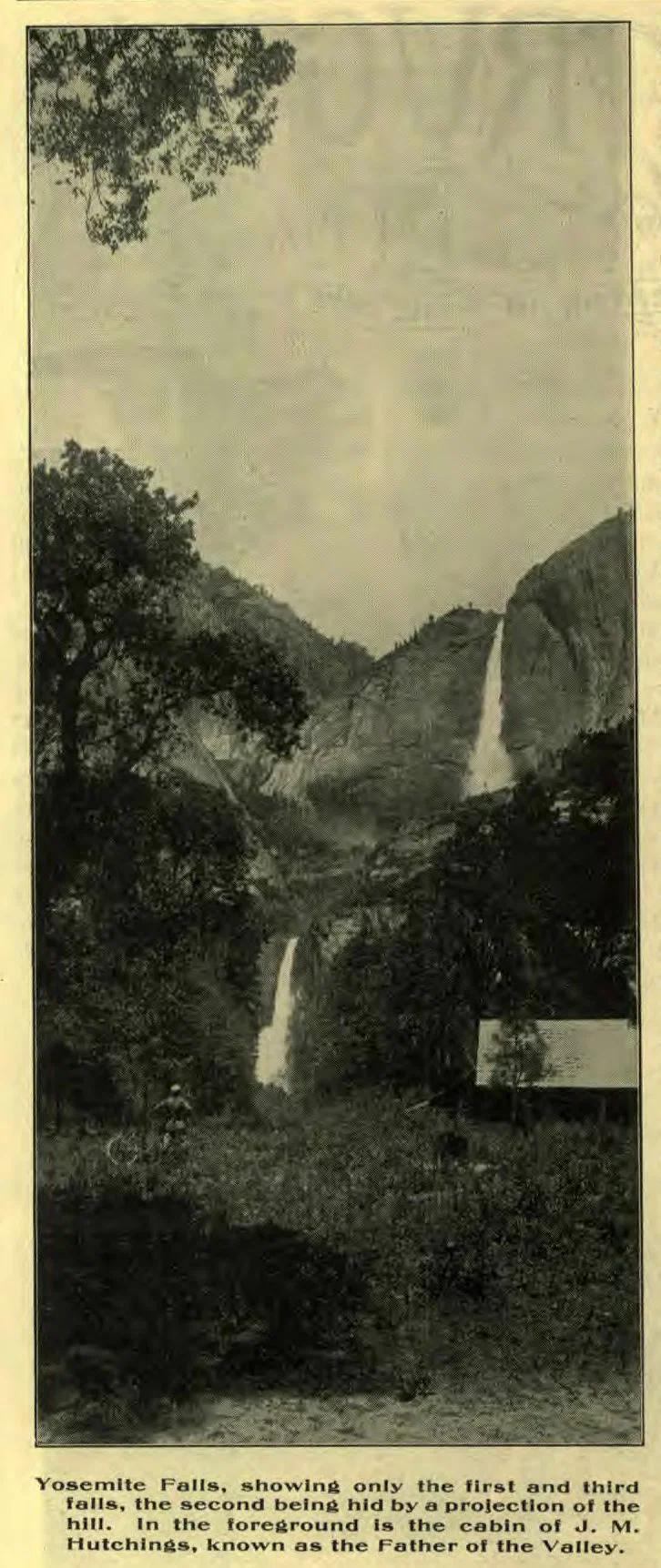
Beyond El Capitan are the Three Brothers, the tallest of which is known as Eagle Peak. On the right, again, is Sentinel Rock, reaching up, tall and silent, from the precipitous heights above us. On the left and beyond the Three Brothers, tumbles down the great Yosemite Falls, fairly dropping out of the clouds; for the water begins its descent twenty-six hundred feet above the floor of the valley. It was a wonderfully inspiring sight. The first section of the fall came down sixteen hundred feet, almost hid itself among the great boulders, and then took two more plunges to reach the pool at the foot of the cliff. This is one of the most beautiful sights of the valley. It is utterly impossible to describe the captivating beauty of Yosemite Fall as it swings and sways in misty festoons down the dripping face of the great black cliff. The wind plays with it as a romping child might play with a lace curtain, only the wind is never weary of the game. It really seems as if there were a great loom at the top of the cliff, weaving and flinging out this unending web of entrancing texture, whose warp is the mist, and into whose threads the shuttles of the sun are weaving the woof of rainbows.
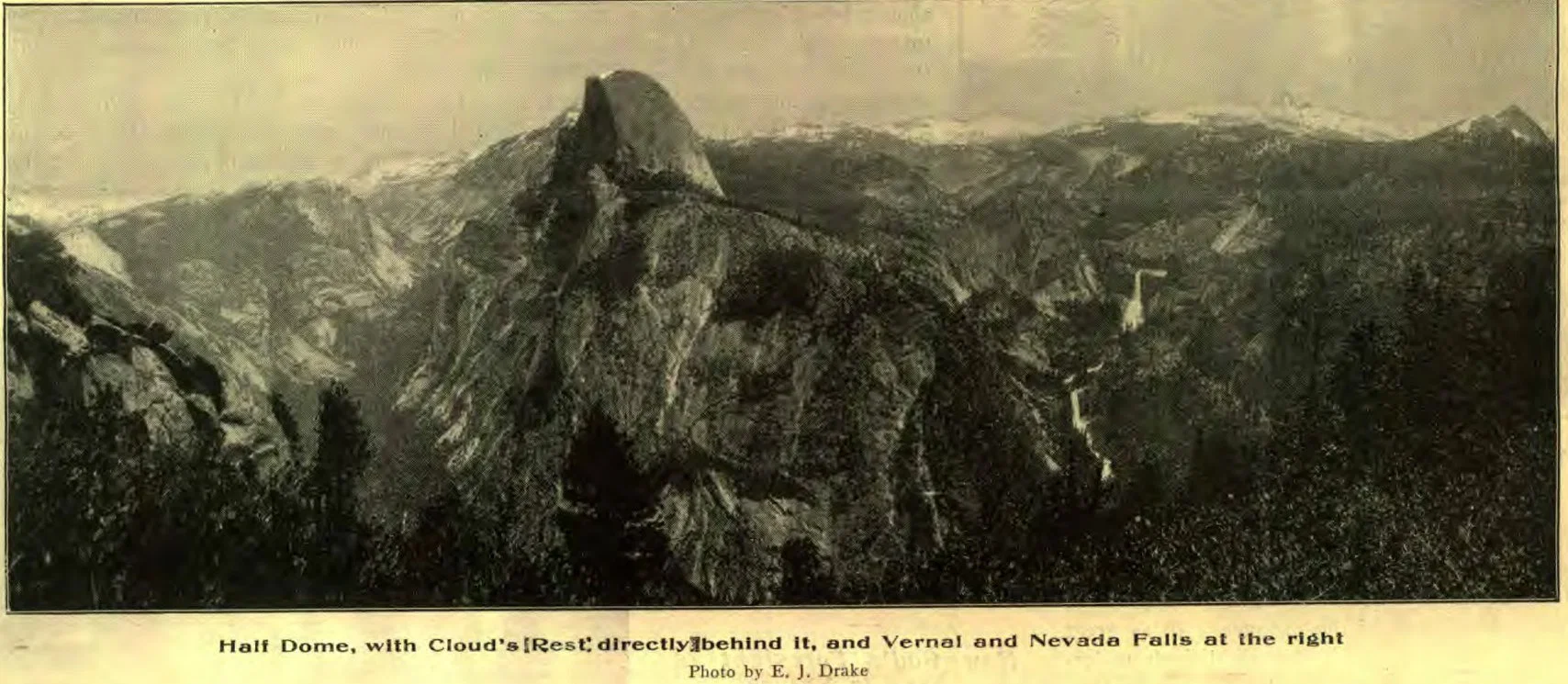
Half Dome, with Cloud's Rest directly behind it, and Vernal and Nevada Falls at the right
But we turn from the entrancing scene, cross the bridge over Merced River, and enter the village. There are about twenty buildings here, including hotels, post-office, express office, superintendent’s home and office, stores, and photograph galleries. There are also a school and a chapel in the valley, but these are not in the village. After registering, securing our location for a camp site, and patronizing the grocery, we returned across the bridge, and pitched our tent in a shady spot near the foot of Yosemite Fall, “next door” to the abode of Mr. E. S. Ballenger, who had entered the valley about one week in advance of us.
From our camping place we had a good view of the whole contour of the valley. Opposite our camp the valley takes a turn to the right, and there are the Royal Arches, the great Half Dome, North Dome, and Cloud’s Rest. The Royal Arches are simply great arch-like configurations of the north wall of the valley. During some cataclysm the sides of the cliff had split away and fallen off, leaving on the sides of the mountain the arch-like formations mentioned.
North Dome is a mountain peak, round and bald and gray, ever aging, but never crumbling. Half Dome is also round and smooth on its top and sides, but the half toward the valley has been split off, clean and perpendicular, down about two thousand feet. Its lower section slopes steeply into the valley floor, down to the very edge of Mirror Lake. But the latter is not visible from our camp. By the time we had finished making camp, the floor of the valley began to bloom with evening primroses. It did not take these flowers long to make a very perceptible change in the coloring of the valley carpet.
No tourist sees Yosemite Valley who does not take the trails to the different vantage points on the top of its ramparts. So at about eight o’clock we “struck” the Yosemite and Eagle Peak trail, which winds back and forth up the side of the mountain wall. It was a puzzle to us how the road builders ever found the way; for from the valley we could see no possible way of reaching the top of Yosemite Fall along the sides of the precipitous cliff. There is a way, however, but it is not down-hill. We hired no burros to carry us up. At eleven o’clock we relieved the lunch basket of its load, and as this distributed the weight more evenly among the members of the party, the writer also felt a sense of relief. As we had not yet reached the foot of the upper Yosemite Fall, we had over sixteen hundred feet of perpendicular climb still before us. As we mounted higher and higher, we got a better view of the valley, and this inspired us to keep on. The result more than paid for the exertion.
We rested for a time at the foot of the upper fall, and then pushed on; for we had to climb up all the distance that water was falling down. How we wished that we might accomplish at least a small part of the distance with as great ease as the water did. But all difficult undertakings come to an end in time, and so did this. When we reached the top, it was a dizzy and difficult climb down the sheer face of the cliff to the point where the water plunges over. There is an iron railing to prevent the dizzy tourist’s plunging over with the water. The view from this point comprehends all the valley, and is one of the grandest views on earth. One can see nearly all the great points of interest. No writer can give to any reader an adequate description of the scene laid out before him. It is an awe-inspiring spectacle to lean out over the iron railing and watch the mad plunge of the waters.
Yosemite Falls, showing only the first and third falls, the second being hid by a projection of the hill. In the foreground is the cabin of J. M. Hutchings, known as the Father of the Valley.
Across the valley, and at a greater height, are Glacier Peak and Glacier House. At that point adventurous tourists have their pictures taken on the large overhanging rock, where a misstep would send them down thirty-seven hundred feet to the valley floor.
But we had to continue the trail around to Eagle Peak to get a different view of the valley, and so could not spend all the time here that we would have been glad to. This part of the trail was not so difficult, and the view from Eagle Peak was another matchless one; but caution was necessary here, for there was much loose gravel and shale at the top, and no protecting rails to save one if he should step in a dangerous place.
After a half-hour’s rest we began the descent; but the sun was down long before we were, and being on the dark side of the valley, it was often difficult to retain one’s footing on the narrow, shaded trail. We were tired enough when we reached camp; for we had made a journey of sixteen miles, half of which was up, and sometimes our protesting knees almost made us wish that the other half was up too, instead of down. After a time, traveling down a steep incline is almost as hard as going up the same incline.
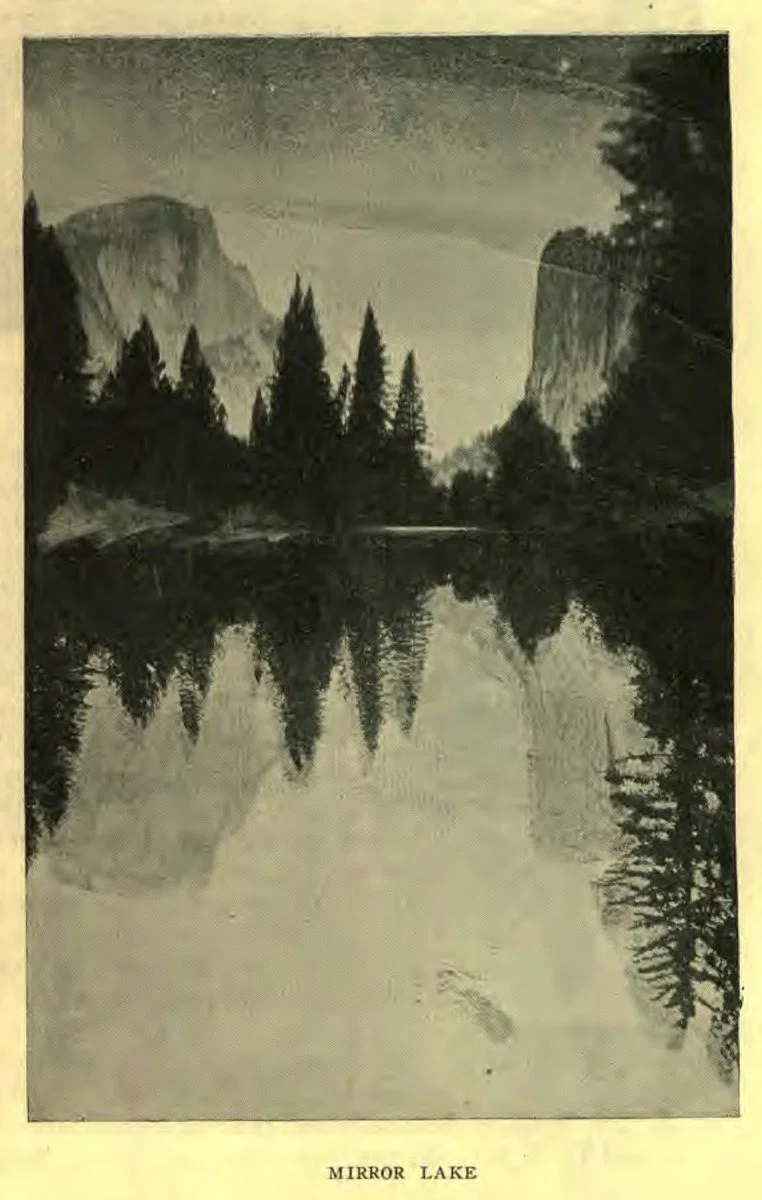
The trip to Mirror Lake, taken on the following day, was an easy one, as the lake is situated in a portion of the valley that is easy of access by team. The powers of this lake as a mirror are beyond comparison. No mirror we have ever seen could give a more perfect reflection. The great mountains and the trees are faithfully pictured there. We mounted a large rock at the edge of the lake, and noticed that some persons standing on another rock that projected out into the lake seemed to be making fun of us. It was some time before we realized what it was all about; but when we did, it was our turn to laugh. They were laughing at the ludicrous picture we all made standing on our heads in the water; but when we looked into the water below their standing place, we could see them in a similar position, and the amusement was mutual. But the picture of the mirrored mountains is one never to be forgotten. We saw the sun rise that morning several times in this little lake, as it came up over different mountain peaks. We decided that the reason for this lake’s being such a perfect mirror is because it is so completely surrounded by high mountainous walls.
MIRROR LAKE
MIRROR LAKE
C. M. Snow.
(To be continued.)

How God’s Foresight Is Seen in Nature

We may look through the volumes of history, and, looking through, see God’s foresight in many events that have taken place. But the view is so marred by man’s mistakes and attempted improvements that those who see only the surface do not see the underlying thread, and those who look deeply see much else that is sad. But this foresight can be seen by any one plainly in the natural world. Active with their wonderful life, yet passive because they have no will, plants give unimpeded flow to God’s will, and here we can see his thoughts and plans. Let us notice a few ways in which they are revealed.
Were the lessons that nature teaches us put there just for us who live now?—Ah, no. Away back in the dim past, when God made the grass and lilies, he gave them the lessons that they should carry to the man and woman soon to be formed. And as he looked down through the long avenue of years, his thought was so great and far-reaching that it extended to us, at the other end of time.
“But,” you say, “how can nature do it when marred and blighted by sin?” Stop a moment. At the fall, God’s thought traveled ahead to the time when men’s hearts should devise evil continually, and their hands should seek to accomplish it. Nature, bright and joyous, made life a round of ease. He saw that such a life would be his eternal ruin; and so he cursed the beautiful world, and the plants grew small or withered and died. Instead of finding all that he wanted prepared for him, man had to work to keep the life that God had given. His head and hands, and heart, too, were occupied with something besides evil continually. Does the blighted plant life of to-day show any foresight?
One of the sad things that our plant friends have to tell us is, “All flesh is as grass,” “As the flower of the grass he shall pass away.” The leaves fall and wither. Yet no bleeding, unhealed scar is left as they are whirled away by the autumn wind; for away back in the sunny days of spring God knew the lesson that they must teach. Accordingly he caused a little bud to grow in the axil of each leaf, and next summer will have even more leaves than this. Nor is that all. As the time drew on when the leaf should fall, a little layer of cells grew over the scar, and as it covered the last spot the leaf’s hold was loosened. It could give its lesson then, and with it the other one that God would have joined with every death, the resurrection through Christ, who healed the wound of sin before it was made.
Trees show foresight in their functions as well as their structure. Evaporation continues to take place in winter, but roots can not absorb much, if any, water then. Even if they could furnish sap, it would freeze, expand, and kill the trees. But this is provided for in advance. In the autumn the tiny root-hairs die. Then a corky layer grows over the whole tree,—root, trunk, branch, and tiniest twig,—preventing the slightest evaporation. The sap is drawn down into the trunk and roots. The north wind may blow as cold as it likes, the tree is safe and snug.
The same divine foresight is seen in the relation between foliage and evaporation. Notice the immense surface for evaporation that the eucalyptus, or even one of our common shade trees, offers. These trees grow in a comparatively humid atmosphere, where they have an abundant water-supply. The ferns and palms of the tropics, with their great surface for exposure show this even more plainly. But take a trip to the deserts of Arizona or New Mexico, and what do you see?—Only cacti. Far and near the thick, green trunks arise. No leaves, no graceful fronds there. The green trunk supplies coloring matter, that acts as the plants’ digestive juice, and leaves would only supply so many more inches to the scorching sun and fever-parched air.
Then, too, God saw the need of sunshine to work with the green coloring matter, the chlorophyll, and gave each plant—
“An instinct within it that reaches and towers, And groping blindly upward for light, Climbs to a soul in leaves and flowers.”
This tendency of the plant to reach toward light, to spread its leaves to the sun, is only another example of this foresight. The tree that grows in the forest with many supporting companions, grows up tall and slender in its effort to reach the light. By so growing, more room is left for the other dwellers in the dark, quiet depths of its sylvan home. But the oak that stands on the hillside is sturdy, gnarled, and spreading. Deep and wide spreading also are its roots. The oak would be sadly crushed in the forest depths, and the slender beauty from the deep woods would be wrenched, and twisted, and probably overthrown, by the first heavy wind. Their foreordained laws of growth fit each for its own place in life.
Even the hidden rootlets reveal this foresight. A calla needs much water, and from each of its great leaves water is led down through a conductor pipe in its stem. The trees send their rootlets far out to catch the drops that the leaves pass down, and the bellwort bows gracefully over its hidden rootstock. This same prescience is seen in the adaptation of plants to their habitat. Down under the pressure of the ocean are the algae, soft, pliable things that could only lie prostrate on land, beaten and whipped by every wind, but which float in dreamy fantastic beauty in the ocean currents. The lichens, almost structureless and functionless, are perfectly fitted to their arctic home.
Seeds show foresight in several ways. One is in the very fact that they exist. Then, as the tiny embryo, rootless and practically leafless, and so tender that the slightest thing would crush it, comes out of its brown home, it finds that provision has been made for its nourishment. When the plant was formed the preceding summer, a supply of food was put in the seed-coat with it. In some plants an excess is put in for the formation of extra leaves. God has also given the tiny plant a wonderful power of adaptation. It readily adapts itself to the soil, the humidity and temperature of the air, and to many things that tend to hinder its growth. The tiny plumule is extremely delicate, but the thick, strong cotyledons close over it to protect it from the heavy clods as it breaks through the earth, and from the chilling dew and frost.
The same thing is seen in the protection of buds. In our northern climes the delicate buds are wrapped in silk or woolen coverlets, and over them a shingled brown house is placed, nicely sealed by water-proof resin. No rain, no frost, no driving sleet, can injure them; but the buds of the summer flowers or conservatory plants, have none of this elaborate covering. It would only be unnecessary, extravagant, and worse than useless.
The tiny colored pathways leading down to the honeyed depths of some sweet flower are only these everlasting thought tracks. There the insect on his journey is brushed off by the waiting pistil. The same wonderful foresight is also seen in the way that pollen is protected. And so every nodding lily-bell breathes its message to the whispering wind, and the closing petals of the portulacas enclose a vital mystery in their depth—the mystery of the all-knowledge, all-fore-knowledge of God. BESSIE JACKSON.

“To Be Good Is to Be Happy”

WOULD you have a happy new year, go forth to scatter seeds of gladness in the sorrowing world around you, reach forth to lend a helping hand to relieve suffering humanity pleading on every side.
The world is dark with want and woe, but heaven is full of light and blessings, which God places at our disposal, to dispense to others. He makes us stewards of his bounty, and bids us go work in his vineyard. Do not delay to scatter broadcast deeds of kindness in every pathway, high or low, but especially in homes less favored than your own. Spread no feast for a rich neighbor, to win favor; but feed the hungry, and “clothe the naked.” Place the sweet morsel where luxury is unknown; listen to the wails of hunger and cold in the cheerless hovel, and share your bounty with the shivering child of poverty, giving warmth and comfort. Remember especially the untold sorrows of the fatherless, the homeless, the friendless. Smooth the couch of pain, inspire hope in the sinking heart, place a smile of joy on the tear-stained cheek, and waken a song of praise in the house of weeping. Walking thus in the Master’s steps, you will surely find the blessed reward.
MRS. S. M. SPICER.

Missionary Reports from Raiatea and God's Saving Power

Raiatea

We are greatly interested in the missionary reports in the INSTRUCTOR and the Review. It is encouraging to hear of the experiences of workers in other lands. By these reports we see God is no respecter of persons. He loves all alike, and is able to save to the uttermost. I have often been led to praise God when I see how his power raises men from the very depths of sin and heathenism to a noble Christian life. As I see the native in his ordinary every-day life, an indolent, careless creature, ignorant of all that is pure and elevating, I can not wonder that the people of the world say it is no use to try to convert him. This is true in ourselves, but with God all things are possible. I said that the native is ignorant of all that is pure and elevating. Perhaps I should not say this, but might better repeat these words of Geikie, which apply to them as well as to us: “We are not so much ignorant as perverted. We see through a prism. We are so entirely the creatures of education, of the opinions of our neighbors and of our family, and of the thousand influences of life, that the only way we can hope to see truth in its own light is, as Christ tells us, by our becoming little children.” There is a world of truth in these words. The natives are so entirely the creatures of the opinions of their neighbors and of their family and of the thousand influences of life, also of the opinions of the former missionaries, that they do not want to become as a little child, and be taught more. For this reason the work here is necessarily slow, and the way to best work for them is to begin while they are children in reality, and educate them into the truth. If this work is needed at home,— as all know it is,— it is doubly needed in these islands, where the children are not at all restrained by the parents, but left to run about in the streets in the midst of licentiousness and sin of every description.
This work has been begun in Fiji, in Rarotonga, Cook Islands, and here on Raiatea. Since coming I have been steadily engaged in training children and young people. Our home, as most of you know, was built with donations from the people in the States of Iowa, Minnesota, Wisconsin, California, Oregon, and some personal and miscellaneous donations. There is yet a debt of about three hundred dollars to be paid on it. The building is open, airy, and well suited to this climate and people. It has wide verandas on three sides. Much of our time is spent on these verandas, sewing, ironing, studying; here also is our recitation room all the time.
This Home stands on Elder B. J. Cady’s plantation. We have a large tract of land, furnishing an abundance of labor for the boys. There are two thousand cocoanut trees, yielding fruit every month in the year. Much of the land has not yet been cleared, but we want to have it cleared as fast as possible, and planted to sugar-cane, manioca, sweet potatoes, yams, and other things. The sugar-mill is running at present. Mr. Cady now superintends this work himself, but is instructing others that they may do it in the future.
There is another house on the plantation in which Leonard Christian (of Pitcairn) and family live. He looks after the place, working with the boys. Outside of their working hours the boys are in the Home also.
Our object is not to conduct an ordinary school, but to provide a home where children and youth may be taken in and taught the Bible and trained to be missionaries. These islands need true Christian men and women of their own people to go among them and teach them the way of life. We hope to develop just such workers in this Home. We have seen some encouraging results, and have strong hopes of more. We wish we could have many more young men here, but this would necessitate having more help. The demand for suitable workers is very great the world over, but especially outside of America. I am rejoiced to hear that Iowa has placed half of its laborers and half of its tithe at the disposal of the General Conference. I know God will bless the people in this, and will spread the work even faster in the home State. If others follow their example, we may hope for more workers in foreign fields in the near future.
Our general meeting was held here on the plantation. We enjoyed much of the blessing of God. At its close all declared it was one of the best meetings they had ever attended. This was neither because of great numbers nor unusual talent, but because of the presence of the Holy Spirit, as you will see if you read Sister Cady’s article in the Review. Before we separated, we had the blessed privilege of seeing five young persons baptized. Four were out of our number here, and one was a boy from Rarotonga.
May a new interest be aroused in your hearts for the far-away fields, where the work is progressing slowly because of a lack of laborers and means. If you can not go to these needy places, and have not much means to send, remember, you can pray. It has been said that the one who faithfully prays at home does as much for foreign missions as the one on the field.
ANNA M. NELSON.

Oil Springs Found in Gulf of Mexico

REPORTS of the existence of petroleum springs in the Gulf of Mexico were brought to New York on December 14 by Captain Risk, of the Mallory Line steamer “San Jacinto,” which arrived from Galveston that morning. Captain Risk says that while in latitude twenty-seven degrees twenty minutes and longitude ninety degrees fifteen minutes, the “San Jacinto” passed through a large field of crude petroleum. This crude oil was floating on the surface, and covered a large area. Plainly visible on both sides of the ship, the petroleum was bubbling to the surface, showing the existence of numberless oil springs in the submarine depths. This phenomenon was observed in the Gulf of Mexico on December 8, one day out from Galveston. It was the first time that Captain Risk had ever seen this field of crude petroleum, although he had sailed over the same course many times. A light north wind was blowing at the time, and the sun was shining, giving the sea a most peculiar, glassy effect with its coat of petroleum. It is thought that a slight earthquake released the oil.—Selected.

Like the Star: Steady Duty Poem

Like the star That shines afar, Without haste And without rest, Let each man wheel, with steady sway, Round the task that rules the day, And do his best. —Goethe.

Making a Dictionary Stand

DICTIONARIES have now become so bulky that there is more need than ever of some support for them while one is hunting for the desired information. There are patent dictionary holders, to be sure, but these are so expensive that most persons feel that enough money has been spent when the great dictionary has been bought.
One of the most satisfactory ways of handling such a heavy book is to have a stand with a sloping top just large enough to hold the book when it is lying open. Such a stand as is shown in the illustration can be made by a boy who has two broken bamboo fishing poles. These are for legs, the two rear legs being a few inches longer than those in front.
The top and shelves should be of single pieces of board, three quarters of an inch thick, fifteen inches from front to back, and twenty-five inches from side to side. The shelves will be an inch or so less than this from front to back, since they lie in a horizontal position. The sloping top requires a wider board than is needed for shelves. The two rear legs are fastened to the top by round-headed screws that pass through the side pieces. The hollow tops of the bamboo should have wooden plugs inserted in them, that the screws may hold the legs securely. The front legs enter little sockets bored in the under side of the top, as shown, and are also held by screws passing down through the top from above, these screws being later hidden by the strip of wood that holds the dictionary from slipping. Wooden plugs should also be inserted in the tops of these front legs, that the screws may have something to enter, since the bamboo is hollow. The two shelves are held in place by round-headed screws that pass through the legs, as shown. These shelves will be found very useful for magazines and papers, or for other books of reference that one may wish to consult as well as the dictionary. Any handsomely grained wood can be used for the top and shelves, and finished in oil in the natural color, while pine or whitewood will be found to “work” more easily than the hard woods, and these can be stained some attractive color when the table has been finished. The bamboo legs should be varnished, to bring out their own attractive color.—Webb Donnell, in Young People’s Weekly.

THE WEEKLY STUDY

Glimpses of Paul from His Epistles to the Thessalonians

OPENING EXERCISES.

SCRIPTURE FOR STUDY: 1 Thessalonians.
REFERENCE STUDY: “Sketches from the Life of Paul,” pages 109–116.
OUTLINE OF TOPICS:—
Sympathy for converts. 1 Thess. 2:7, 17.
Pastoral care. Chap. 2:11.
Self-denial for others. Chap. 2:9.
Gentleness. Chap. 2:7, 8.
Missed the companionship of others. Chap. 3:1.
Often desired to visit them. Chap. 2:17, 18; 3:10.
Exhorts to purity. Chap. 4:1–5.
To love. Chap. 4:9, 10.
To belief in spirit of prophecy. Chap. 5:20.
To faith in the coming of the Lord. Chap. 1:9, 10; 2:19, 20; 3:11–13; 4:13–18; 5:1–6.

Notes

The epistles to the Thessalonians are the first of his inspired letters which have been presented to us. They were written while his visit to Thessalonica was still fresh in his memory (Chap. 1:2), after he had been to Athens and left it (3:1), after he had been joined by Timothy and Silas (Chap. 1:1; Acts 18:5), while he could speak of having only left them for a short season. Chap. 2:17. He wrote both these epistles during his stay of a year and six months at Corinth.
The epistle to the church at Thessalonica is not one of special reproof, as are some of the epistles of this great apostle. It appears that this church had a genuine faith, manifesting itself in love, patience, and active work for lost souls. 1 Thess. 1:3, 8; 2:13. That they had a strong faith in the return of the Lord the second time is evident throughout the epistle.
“While Paul was still at Corinth, laboring in word and doctrine, and also in the workshop, Silas and Timothy came from Macedonia. The pleasure of meeting these two faithful colaborers gave him fresh zeal and courage to withstand the continually increasing opposition, which had greatly hindered his labors. . . . Paul had sent Timothy to revisit the places of his former labors, and to confirm and establish the church at Thessalonica.”—“Sketches from the Life of Paul.”
“His first and second epistles to the church are given us. His heart was drawn out in love to those who had embraced the doctrine of Christ, which subjected them to reproach and persecution heretofore unknown to them.”—Id.
“There was still another reason for Paul’s communication to these brethren. Some who were newly brought into the faith had fallen into errors in regard to those who had died since their conversion. They had hoped that all would witness the second coming of Christ. . . . Some who had fallen into the error that Christ was to come in their day, imbibed the fanatical idea that it was praiseworthy to show their faith by giving up all business, and resigning themselves to idle waiting for the great event which they thought was near. Others despised the gift of prophecy, exalting all other gifts above that.”—Id.
“The Thessalonians had eagerly grasped the idea that Christ was coming to change the faithful who were alive, and take them to himself. They had carefully guarded the lives of their friends, lest they should die, and lose the blessing which they anticipated at the coming of their Lord. But, one after another, death had laid their loved ones low; and they had buried them from their sight with fear and trembling. All their ancestors had thus been buried, and with anguish the Thessalonians looked upon the faces of their dead for the last time, never expecting to meet them again in a future life.”—Id.
“The reception of Paul’s epistle was to them a great event. Written communications passing between friends were of rare occurrence in those times. There was great joy in the church as the epistle was opened and read. What consolation was afforded them by those words which revealed the true state of the dead. . . . The hope and joy which this assurance gave to the young church at Thessalonica can scarcely be understood by us. . . . The darkness that had enshrouded the sepulcher of the dead was dispelled; for they now knew that their believing friends would be resurrected from the grave, and enjoy immortal life in the kingdom of God.”
G. B. T.

His Answer

I WORKED, but failure greeted me; At eve I watched the sun go down, And in the gath'ring darkness asked, “Why is my work without a crown?”
“My strength was offered willingly To right the wrongs, so hard to bear; Now tired, and hurt, I come to Thee With joyless heart. Dost thou not care?”
Under the pines his answer came, There in an open sunlit place, The mountain river meets with rocks Immovable in narrowed space.
Yet, to the murmur of the pines, Rises a full deep roundelay, As o’er the dark-gray rocks there sweeps The onward flow of flashing spray.
Ah, those hindering barriers! What meant they to its steadfast course? They but revealed, with subtle power, The water’s purity and force. — Mary B. Fowler.

The Love of God Is Broader

“For the love of God is broader Than the measure of man's mind; And the heart of the Eternal Is most wonderfully kind.”

God Will Not Change: A Verse on Constancy

“God will not change: the restless years may bring Sunlight and shade, the glories of the spring, And darkest gleam of sunless winter hours; Joy mixed with grief, sharp thorns with fragrant flowers. Earth’s light may shine awhile, and then grow dim: But God is true; There is no change in him.”
Continue reading: Elnathan’s Gold