The Youth’s Instructor, Vol. 29, No. 47.

BEAVERS AND THEIR HOMES

The Youth’s Instructor

Nov 23, 1881

S. D. A. Publishing Association · Battle Creek, Mich. · Nov 23, 1881

BEAVERS AND THEIR HOMES.

ONE bright October morning my uncle, whom I was visiting, said to me, “I must go to mill to-day; would n't you like to ride over to T—— with me?” Now the road to the village led for two miles through the pine woods; and though it was an old country all around, this road had never been settled, because the land was not worth the trouble of clearing, so uncle said.
Well, I shall never forget that ride, though it was years ago. The tall pines rose on either side of us, but along the roadside were shrubs and small maple trees, from which the bright leaves fell, and carpeted the winding road before us, while the yellow autumn sunlight fell in strange checkers on our path. We crossed some pretty brooks and one strong, dashing creek. On the bridge over it, uncle stopped his team, and pointed up the stream a little way. “There,” said he, “are the remains of an old beaver-dam.” As I looked, I could see it plainly, also on the edge of the creek were some strange grassy mounds, which he said had once been beavers' lodges; and when the dam was whole, and the stream high, they had been in the water. Uncle said that he well remembered, years before, when the country was new, that the beavers had had a prosperous settlement there. Never having heard of such a thing before, I was delighted with his description of these interesting animals and their strange ways.
The beaver is about two feet in length, and quite short in stature, its body being thick and heavy. It has small ears, and its eyes are small, and wide apart. The fur of the beaver is soft and close, and is considered very valuable. The tail, however, is the most curious part of the animal. It is broad and flat, nearly half as long as the body, and is covered with a kind of horny scales instead of fur like the rest of the body. The beaver lives mostly in the water, and when on land, has a slow, wriggling gait, which makes him appear quite awkward.
The beaver has many curious habits, and is withal a great builder; but he is very shy, and almost always works by night, so that those who would watch him must take some pains. The poet Longfellow intimates as much when he says of Hiawatha:—
“Of all beasts he learned the language, Learned their names and all their secrets,— How the beavers built their lodges, Where the squirrels hid their acorns, How the reindeer ran so swiftly, Why the rabbit was so timid,— Talked with them when e'er he met them, Called them ‘Hiawatha’s brothers.’”
Many marvelous stories are told about the wisdom of the beaver, some of which are doubtless too wonderful to be true; yet it cannot be denied that he seems to show much intelligence in his doings.
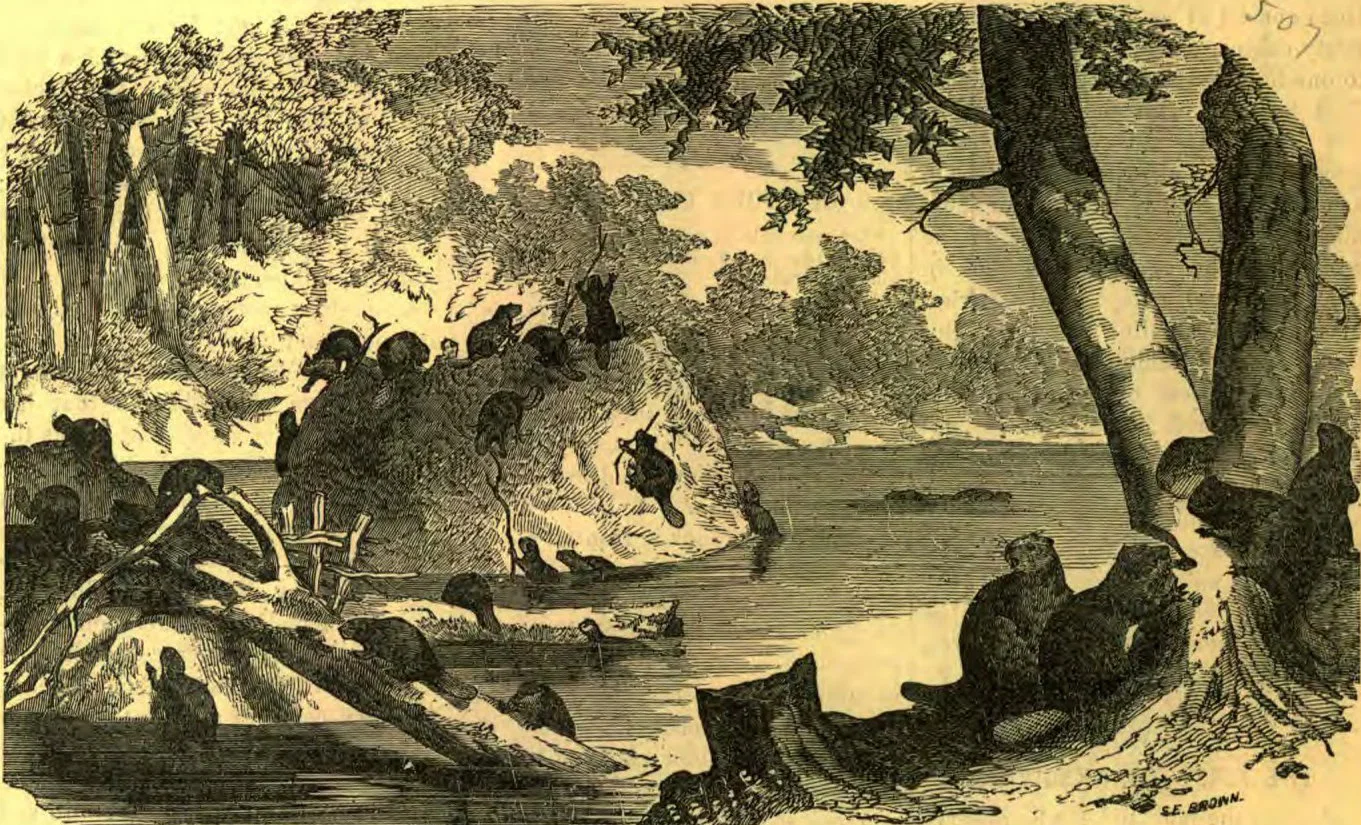
Beavers build in colonies, and usually choose the place for their homes on some shallow running stream, though they sometimes build on the borders of a lake. In the first instance, they have to construct a dam across the stream in order to make the water deep enough so it will not freeze to the bottom in winter. To do this they select a shallow part of the brook or river, and if they find on the margin a large tree of soft wood so situated as to fall across the stream readily, they at once commence to cut it down. If they do not find such a one convenient, and the stream be of considerable size, they go farther up, and cut one and bring it down with the current to the proper place.
Their front teeth answer the purpose of a wood-cutter's hatchet, and they begin the work of felling the tree about a foot and a half above the ground. The beaver lives on the bark of certain trees, such as the willow, birch, poplar, and alder; so they eat much of the bark and wood which they gnaw off in cutting down these trees. While some of the more able-bodied are employed in felling large timber, others traverse the banks and cut down smaller trees and poles, which they drag to the water with their teeth, and then float them to the place where the dam is to be built. Still others are employed in bringing earth, which they pack in among the trees and sticks, and thus make quite a solid dam. If at any time these dams are injured by a freshet, the busy architects repair them at once. It is such a dam that the poet again refers to in the following lines:—
“Over rock and over river, Through bush and brake and forest, Ran the cunning Pau-Puk-Keewis; Like an antelope he bounded, Till he came into a streamlet In the middle of the forest, To a streamlet still and tranquil, That had overflowed its margin, To a dam made by the beavers, To a pond of quiet water, Where knee-deep the trees were standing, Where the water-lilies floated, Where the rushes waved and whispered. On the dam stood Pau-Puk-Keewis, On the dam of trunks and branches, Through whose chinks the water spouted, O'er whose summit flowed the streamlet. From the bottom rose the beaver, Looked with two great eyes of wonder, Eyes that seemed to ask a question, At the stranger, Pau-Puk-Keewis.”
The beavers usually choose the site and commence their building in the latter part of August, though they sometimes begin earlier. Their greatest work is to make the dam, and this done, their next care is to go about building these houses. These are built partly in and partly above the water, near the edge of the pond, and have two openings, one facing the land and the other the water. These houses are usually in the shape of a dome, and the walls are frequently two feet thick, neatly plastered within and without, and so solid as to be impenetrable to the rain, and able to resist the strongest winds. Various materials are used in making these houses,—such as wood, stone, and a kind of sandy earth not easily soaked by water.
After their houses are done, the beavers spend their time until winter in gathering quantities of wood and bark, which they store in their curious huts. Sometimes these beaver villages consist of as many as twenty or thirty cabins, which often give homes to one hundred and fifty or two hundred beavers. But however numerous the colony, universal peace and good-will seem always to reign. On a sunny autumn day numbers of them may be seen sitting just outside the window of their cabins, half sunk in the water, and complacently gazing over the surrounding country. But let any sign of danger appear, and the one who first sees or hears it, strikes on the water with his tail; and lo, not a beaver is to be seen. In a moment they are gone,—some into the water and others behind their cabin walls, where they are safe from the attacks of other animals.
Might we not all learn useful lessons from these interesting creatures, with their peaceful, brotherly ways?
E. B.

The Reign of Autumn.

The rust is over the red of the clover, The green is under the gray, And down the hollow the fleet-winged swallow Is flying away and away.
Fled are the roses, dead are the roses, The glow and the glory done, And down the hollow the steel-winged swallow Flying the way o’ the sun.
In place of the summer, a dread new-comer His solemn state renews; A crimson splendor instead of the tender Daisy, and darling dews.
But oh, the sweetness, the full completeness, That under his reign are born! Russet and yellow in apples mellow, And wheat, and millet, and corn.
His frosts so hoary touch with glory Maple and oak and thorn; And rising and falling, his winds are calling, Like a hunter through his horn.
No thrifty sower, but just a mower, That comes when the day is done,— With warmth a-beaming and gold a-gleaming, Like sunset after the sun.
And while fair weather and frosts together Color the woods so gay, We must remember that chill December Has turned his steps this way;
And say, as we gather the house together And pile the logs on the hearth, Help us to follow the light little swallow E’en to the ends of the earth.
—Alice Cary.

SCENES IN THE LIFE OF CHRIST.

LESSON 44.—THE HEALING OF JAIRUS'S DAUGHTER.

We have been learning how Jesus, after teaching the people until he was weary, ordered the disciples to turn the boat from shore, and go over to the east side of the sea. He had been patiently feeding the waiting multitude with the bread of life,—his precious words,—giving them the parables of the sower, the tares and the wheat, the pearl of great price, the net and the fishes, and many more. But as night came on, he withdrew from them.
On the way across the sea he fell asleep in the boat. While he was sleeping, a furious tempest arose, dashing the water into the boat till it was about to sink. Then his disciples awoke him, saying, “Master! master! we perish!”
As soon as Jesus spoke to the winds and the sea, all was still as though there had been no storm. When they came to the other side, they were met by those fierce demoniacs from the tombs. These were healed by a word; and the devils, going into a herd of swine, caused them to run down a steep place into the sea. Then the people of that country wanted Jesus to go away. But the man who had been the fiercest before he was healed, and who had been such a terror to all who passed that way, wanted to go with Jesus wherever he went. Jesus, however, said to him, “Go home to thy friends, and tell them how great things the Lord hath done for thee.” So the man went his way, and told every one he met in city or country what a wonderful miracle had been performed on him.
Jesus and his disciples then took their boat, and went back to the western shore of the sea. There they found the people still waiting, and glad to welcome one who taught them as no man could ever teach. While Jesus was talking to the people, there came a man named Jairus, a ruler of the synagogue, and falling down at the feet of Jesus, begged that he would come to his house; for his only daughter, about twelve years of age, lay dying. His words were very touching, as he said with much earnestness, “My little daughter lieth at the point of death; I pray thee, come and lay thy hands on her, that she may be healed and live.”
As Jesus went toward the ruler's house, the people followed, and pressed upon him. And there was in the crowd a woman who had suffered for twelve years with a very troublesome disease, and had spent all she had with physicians; yet she was no better, but rather grew worse. Having heard what miracles Jesus performed, she pressed forward and touched his garment; for she said, “If I may touch but his clothes, I shall be whole.” And it was just as she had thought; for as soon as she had touched his garment, she felt that she was well. But Jesus said immediately, “Who touched me? When all denied, Peter and they that were with him said, Master, the multitude throng thee, and press thee, and sayest thou, Who touched me?” And Jesus said, “Somebody hath touched me; for I perceive that virtue is gone out of me.” And when the woman saw that she was not hid, she came trembling, and falling down before him, she declared unto him before all the people for what cause she had touched him, and how she was healed immediately. And he said unto her, “Daughter, be of good comfort: thy faith hath made thee whole; go in peace.”
While he was speaking, there came a man from the ruler's house, and said to Jairus, “Thy daughter is dead; trouble not the Master.” But Jesus said to him, “Fear not; believe only, and she shall be made whole.” When he came to the house, he allowed none to go in with him but Peter, James, and John, and the father and mother of the maiden. And the people who were in the room with the dead wept and bewailed; but Jesus said, “Weep not; she is not dead, but sleepeth.” But the mourners laughed with scorn, knowing that she was dead. Then he put these people all out, and taking the girl by the hand, said, “Maid, arise. And her spirit came again, and she arose straightway; and he commanded to give her meat.”

QUESTIONS.

  1. What orders did Jesus give his disciples, when he had taught the people until he was weary?
  2. With what had he been feeding the waiting multitude?
  3. How had he been making his teaching plain to them?
  4. At what time of day did he leave them?
  5. What did his weariness cause him to do as they were crossing the sea?
  6. Why did his disciples awake him?
  7. How did he still the tempest?
  8. Who met him as they landed on the eastern shore of the lake?
  9. Tell how these men were healed.
  10. What did the man who had been fiercest want to do?
  11. Would Jesus allow the man to follow him?
  12. What did he tell the man to do?
  13. How well did the man obey him?
  14. How did the people of the country feel about having Jesus remain with them?
  15. What did he and his disciples do?
  16. How were they met on the other side? Mark 5:22; Luke 8:40.
  17. Who came to Jesus as he was talking to the people?
  18. How did this man approach the Saviour?
  19. What did he say to him?
  20. Who followed Jesus as he went toward the ruler's house?
  21. Who pressed through the crowd to touch Jesus?
  22. How long had this woman suffered from a very troublesome disease?
  23. How had she tried to get cured?
  24. How well did the physicians succeed in her case?
  25. What did she say that showed how much faith she had in Jesus?
  26. Was she cured as soon as she touched his garment?
  27. What did Jesus say when she touched him?
  28. When all denied, what did Peter and others say to their Lord?
  29. How did he then explain his meaning?
  30. What did the woman do when she found that Jesus knew what she had done?
  31. What did Jesus then say to her?
  32. What happened while Jesus was yet speaking?
  33. What did Jesus then say to Jairus?
  34. When he had come to the house, whom did he allow to go in with him?
  35. What were the people doing who were in the room?
  36. What did Jesus say to them?
  37. How did the mourners receive this saying?
  38. What did Jesus then compel them to do?
  39. Describe the miracle that took place when all but the three disciples, and the parents of the child, had been shut out?

THE FIRST THANKSGIVING.

Among the multitudes who observe Thanksgiving, there are many who do not know when, where, or how the first was observed. It was in the autumn, one year after the landing of the Pilgrim Fathers.
During that year, sickness had taken many to their graves. They had suffered from famine, and their peace had been disturbed by Indians. But about this time the chiefs from all the country round came into the village, and made treaties of peace with the colonists.
Under these favorable circumstances the first harvest was gathered. When they saw the piled-up stores,—the first gathered in their new home,—they felt very thankful to God, who had so prospered them. Accordingly, Gov. Bradford proclaimed a Thanksgiving feast. The men went into the forest to shoot wild fowl, and although it had been scarce through the summer, they now found enough to last the whole settlement a week. Then in the houses and over fires in the open air, the work of cooking began.
The men, with their brave captain, Miles Standish, marched to the meeting-house. The sermon of Eld. Brewster was suited to the occasion. He was never known to preach a better nor a shorter discourse, although it would seem very long to us now.
It was a Thanksgiving dinner, although the tables were of the rudest kind, and there are many of the delicacies we have now which were entirely unknown to them. In the evening, Massasoit, the great Indian chief, came into the village with one hundred savages, who brought with them deer and a supply of other game. So the feast was continued another day. On the third day it was again resumed, as the Indians had gone out early in the morning, and returned with more venison. A council fire was built, and new treaties of peace were made. Then, with much ceremony, Massasoit took leave.
Thus ended the first Thanksgiving, and it has been observed with more or less ceremony every year since.—Selected.

LET YOUR LIGHT SHINE.

“Let your light so shine before men, that they may see your good works, and glorify your Father which is in Heaven.”
It was a sultry July night. The moon looked calmly down upon the throbbing heart of busy N—, and the lofty trees folded up their leaves as if they were weary of stretching out their tiny hands for the drops of rain that did not come.
Upon the veranda in front of a large brown house, a gentleman was pacing back and forth, holding his little daughter by the hand. Suddenly the little one darted from his side, and, running to her mother, clambered into her lap, as she exclaimed,—
“O mamma! how can you keep so still when it’s so very warm? And you look so cool and comfortable with your pretty white wrapper on! Nothing ever troubles you, I do believe.”
“Yes, Helen,” said the gentleman, pausing in his restless walk, “I have been thinking of the very same thing as I’ve watched you sitting in your easy-chair apparently at rest. You must tell Rubie and me the secret of your peace,” he added, as he came and stood with arms folded across the back of the easy-chair, looking down into the two faces that were the dearest of all the world to him.
“Thou wilt keep him in perfect peace whose mind is stayed on thee,” said Rubie’s mamma dreamily.
“I read such a pretty thought in a book to-day about the growing of grass and the budding of flowers: ‘That it is only because our eyes are not fine enough, that we do not see a lily open, or a clover bloom; and only because our ears are not delicate enough, that we do not hear the sap circulate in a rose-leaf, or the heart throb in the insect that alights upon it.’ And that set me to thinking how much there was in the world that we have the power to enjoy. Even to-night we can hear the cool plashing of the water in the fountain, raise our eyes to the grand old hills about us, watch the dancing fire-flies as they flash in and out; while there is many a sick and weary one thirsting for a glimpse of all these things that we pass by so carelessly.”
“But, mamma,” persisted Rubie, “don’t you ever feel so tired and cross?”
“Rubie, can you tell me the text I gave you on your last birthday to be the motto of your coming year?”
“Oh, yes, mamma, I remember!—‘Let your light so shine before men, that they may see your good works, and glorify your Father which is in Heaven.’ I thought I never could learn it, until you told me there was a story about it. Now you’ll tell me the story; won’t you, please?”
“When I was a little girl,” said Rubie’s mamma, “I used to be very fretful. One day, when I acted worse than usual, Aunt Rachel told me to put on my bonnet, and go with her to see a sick girl who had n’t been able to sit up or walk for sixteen years. I didn’t really want to go; for I thought she must feel so cross to have such a hard time as that. But when Aunt Rachel and I entered the room, she held out her hands to me, and smiled so sweetly that I forgot all about my fear of her; and I went right up to her, and was soon telling her all about my school and playthings, while she cut out of some pretty paper such wonderful men and boys and horses!”
“Then I asked her something about herself; and she told me that her spine was so crooked that it was the shape of the letter S. Then she showed me her hands and feet, that had never grown any since she was ten years old. I saw her pretty rolling-chair, that she could lie down in, and roll herself from one room to another. But she never complained at all; and when I asked Aunt Rachel, after we came away, what made her so happy, she said it was because she was a Christian. Then she told me how well people delighted to go and see her, because she was so patient, and interested in them. She was always letting her light shine. It taught me a lesson that I never can forget, for I found out that if we would find true happiness, we must make the most of all our pleasant things in life, and trust God in all our times of trouble.—Bernice M. Franklin.”

THERE IS A BOY I CAN TRUST.

I once visited a public school. At recess a little fellow came up and spoke to the teacher. As he turned to go down the platform, the master said, “There is a boy I can trust. He never failed me.” I followed him with my eye, and looked at him when he took his seat after recess. He had a fine, open, manly face. I thought a good deal about the master’s remark. What a character had that boy earned! He had already gotten what would be worth more to him than a fortune. It would be a passport into the best firm in the city, and, what is better, into the confidence and respect of the whole community. I wonder if the boys know how soon they are rated by other people. Every boy in the neighborhood is known, and opinions are formed of him: he has a character, either favorable or unfavorable. A boy of whom the master can say, “I can trust him, he never failed me,” will never want employment. The fidelity, promptness, and industry which he shows at school are in demand everywhere, and prized everywhere. He who will be faithful in little will be faithful in much.—Sel.

Thanksgiving Night Hymn of Grateful Praise

HERE on this blest Thanksgiving night, We raise to Thee our grateful voice; For what thou doest, Lord, is right, And this believing, we rejoice. —J. G. Holland.

NEW-TESTAMENT HISTORY.

LESSON 57.—TEACHING IN THE TEMPLE, CONCLUDED.

Jesus had just been assuring the believing Jews that, if they would be obedient and faithful, they should be his true disciples, and should come to a full knowledge of the truth, and thus be made free from the errors and superstition which had hitherto held them in bondage. It seems, however, that the unbelieving Jews took it upon themselves to answer, saying, “We be Abraham’s seed, and were never in bondage to any man: how sayest thou, Ye shall be made free?” Jesus answered them, Verily, verily, I say unto you, Whosoever committeth sin is the servant of sin. And the servant abideth not in the house forever; but the son abideth ever. If the Son therefore shall make you free, ye shall be free indeed. I know that ye are Abraham’s seed; but ye seek to kill me, because my word hath no place in you. I speak that which I have seen with my Father; and ye do that which ye have seen with your father. They answered, and said unto him, Abraham is our father. Jesus said unto them, If ye were Abraham’s children, ye would do the works of Abraham. But now ye seek to kill me, a man that hath told you the truth which I have heard of God; this did not Abraham. Ye do the deeds of your father. Then said they to him, We be not born of fornication; we have one father, even God. Jesus said unto them, If God were your father, ye would love me; for I proceeded forth and came from God; neither came I of myself, but he sent me. Why do ye not understand my speech? even because ye cannot hear my word. Ye are of your father the devil, and the lusts of your father ye will do: he was a murderer from the beginning, and abode not in the truth, because there is no truth in him. When he speaketh a lie, he speaketh of his own; for he is a liar, and the father of it. And because I tell you the truth, ye believe me not. Which of you convinceth me of sin? And if I say the truth, why do ye not believe me? He that is of God heareth God’s words; ye therefore hear [attend to] them not, because ye are not of God. Then answered the Jews, and said unto him, Say we not well that thou art a Samaritan, and hast a devil?
“Jesus answered, I have not a devil; but I honor my Father, and ye do dishonor me. And I seek not mine own glory: there is one that seeketh and judgeth. Verily, verily, I say unto you, If a man keep my saying, he shall never see death.
“Then said the Jews unto him, Now we know that thou hast a devil. Abraham is dead, and the prophets; and thou sayest, If a man keep my saying, he shall never taste of death. Art thou greater than our father Abraham, which is dead? and the prophets are dead: whom makest thou thyself? Jesus answered, If I honor myself, my honor is nothing: it is my Father that honoreth me; of whom ye say that he is your God. Yet ye have not known him; but I know him; and if I should say, I know him not, I should be a liar, like unto you; but I know him, and keep his saying:
“Your father Abraham rejoiced to see my day; and he saw it and was glad. Then said the Jews unto him, Thou art not yet fifty years old, and hast thou seen Abraham? Jesus said unto them, Verily, verily I say unto you, Before Abraham was, I am. Then took they up stones to cast at him; but Jesus hid himself, and went out of the temple, going through the midst of them, and so passed by.”

QUESTIONS.

  1. What assurance had Jesus just been giving the believing Jews? John 8: 30-32.
  2. Who took it upon themselves to answer?
  3. What did they say? Verse 33.
  4. What reply did Jesus make?
  5. Who can make us free indeed?
  6. Whom did Jesus mean by the Son?
  7. Why did these Jews seek to kill Jesus?
  8. What comparison did Jesus make between himself and these Jews? Verse 38.
  9. Whom did the Jews claim as their father?
  10. What evidence did they give that they were not at heart the children of this good patriarch?
  11. Whose deeds did Jesus accuse them of doing? Verse 41.
  12. What defense did they then make?
  13. How did Jesus disprove their claims?
  14. Why was it that these Jews could not understand and receive the words of Jesus?
  15. What clearer and stronger accusation did our Lord bring against them? Verse 44.
  16. How did he describe the character of the devil?
  17. In what sense may Satan be regarded as a murderer?—He brought sin into the world, and death is the consequence of sin.
  18. In what sense may he be regarded as the father of lies?
  19. Why could not these Jews believe Jesus when he spoke the truth? Verses 45-47.
  20. What taunting reply did the Jews make? Verse 48.
  21. What mild answer did Jesus give?
  22. What did he say about seeking his own glory?
  23. What caused the Jews to say, “Now we know that thou hast a devil”?
  24. What statement did they make for the purpose of showing that Christ’s words were false?
  25. What questions did they ask him? Verse 53.
  26. What did he say in regard to the source of his honor?
  27. If our divine Lord trusted wholly to God for the honor which he was to receive, what should be our course?
  28. What did Jesus say to the Jews about their knowledge of God?
  29. What evidence did Jesus give that he knew God?
  30. What did he say about Abraham?
  31. How did the Jews attempt to show that this statement was a falsehood?
  32. How did Abraham see the day of Christ?
  33. What caused the Jews to take up stones to stone Jesus?
  34. How did he escape?

JEWISH MOURNINGS.

At the time when our Lord was upon the earth, the Jews were in the habit of making great mournings when any of their family died. They invited their relatives to the house; and all present, with loud voices and bitter cries, bewailed and lamented the departed friend. Those families who had sufficient money hired professional mourners to join them in their expressions of grief. They were usually women, who dressed in torn garments, with their hair hanging in a loose and uncombed condition, and their faces daubed with paint and dirt. They would come to the house of mourning in large or small numbers, according to the amount the family were able to pay. There they would sing in weird, wild strains, praising the beauty, strength, wisdom, or goodness of the one who had died, and asking in piteous tones why he had left his friends and family. At intervals during the singing they would engage in a dance, keeping time to a melancholy tune on tambourines, meanwhile, beating their breasts, striking their hands together above their heads, and uttering piercing shrieks of anguish. These demonstrations would continue from seven to thirty days, according to the position the dead had occupied in society.
It is probable that it was these hired mourners that laughed Jesus to scorn when he told them that the maid was not dead but slept; for the parents and relatives would have been too full of genuine sorrow to have laughed on such an occasion. The professional mourners were, perhaps, displeased with the interruption of Jesus, thinking that their services would be dispensed with, and they would thus lose their pay.

NOTES ON THE LESSON.

We be Abraham’s seed and were never in bondage to any man.—The Jewish nation had repeatedly served the Egyptians, the Persians, and the Macedonians, and even at the time they made this declaration the Roman yoke bore heavily on their necks. If, then, their assertion be considered literal, it shows what false and ridiculous statements men will make in avoiding and opposing truth. Some, however, think that they meant to assert their freedom from the rule of the priests and Pharisees, of which they thought Christ was charging them.
And the servant abideth not in the house forever; but the son abideth ever.—As a servant has no legal right to remain in the family of his master, much less have those who are in bondage to sin a claim to a membership in God’s family; but as the son of the master, his heir, can at his will free any of his servants, and adopt them into the family, so Christ, the Son of God, can through his mediation break the yoke of all who will yield obedience to his requirements, and make them joint heirs with him of God’s eternal heritage.
Even because ye cannot hear my words.—The word “hear” in this place is to be understood in the sense of bear or tolerate. His doctrine was offensive to them. They hated it, and hence they perverted its meaning, and were resolved not to understand him.—Barnes.
Which of you convinceth me of sin?— Proveth me guilty of falsehood, is the meaning, as evidenced by the original and the words which follow.
Thou art a Samaritan, and hast a devil.—The point of contention between the Jews and Samaritans was, which of them worshiped God aright. Since Jesus had said, like the Samaritans, that the Jews were not of God, and had also, contrary to their views, preached to the Samaritans, the Jews sought to sustain the charge, which they had previously made of his having a devil, by showing that he had taken the side of the Samaritans, whom the whole Jewish nation denounced as actuated by the evil one. A Samaritan was a term of contempt among the Jews, and they no doubt delighted in applying it to Christ in revenge for his denial of their true descent from Abraham.
There is one that seeketh— i. e., my glory—and judgeth—will punish you for your determined obstinacy and iniquity.— Clarke.
Shall never see death.—He shall obtain eternal life, or he shall be raised up to that life where there shall be no death.—Barnes. They are perfectly delivered from eternal death, shall not be hurt by the second death. This is the death meant here, that death which is forever, which is opposed to everlasting life, this they shall never see, for they shall never come into condemnation; they shall have their everlasting lot where there shall be no more death, where they cannot die any more. Though now they cannot avoid seeing death, and tasting it too, yet they shall shortly be where it will be seen no more forever.—Henry.
Your father Abraham rejoiced to see my day.—The meaning of the original is that he earnestly and joyfully desired to see, or have a conception of the advent and the manner of life of the Messiah.
And he saw it.—He had a prophetic view of the manner and design of his coming, and in vision, as many suppose, saw Christ himself in human form.

PLAYING SCHOOL.

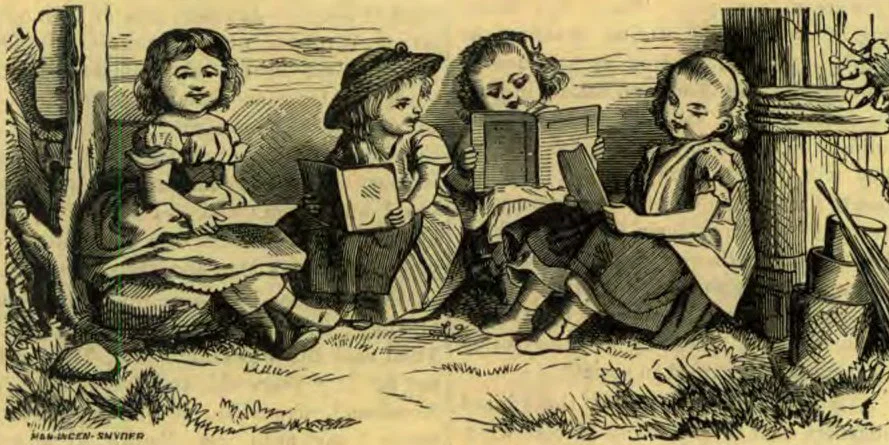
In a corner of the play-ground Sits a merry group of four. Dot, the hat-crowned, is the teacher; She has tried this game before.
Little Effie learns her lesson; Careless Bess thinks more of ease; Bright-eyed Kate is always laughing; She’ll do naught but turn the leaves.
Little Dot is wise and watchful; Lessons hard she gives to none; Plums and nuts she keeps for “merits,” If the tasks they do not shun.

SUSIE’S THANKSGIVING.

It was the day before Thanksgiving, but Susie was sure she had nothing to be thankful for, and all because mamma would not buy for her a beautiful new dolly, which she had hoped would be the envy of all her little cousins at grandma’s party next day. All the morning Susie had sulked, and mamma had taken no notice; but just after dinner she said, “Come, Susie, don’t you want to take a nice ride on the elevated railroad? I’ll take you as far as it goes.”
This offer proved a speedy cure to Susie’s troubles, and she tripped away to the station with a happy face, though she did feel a little bad when they turned into Sixth Avenue, and she saw in a shop window a pretty wax doll such as she had wanted for so long. But soon all else was forgotten in the pleasure of the rapid ride along the smooth airy track, now between the high houses, now looking out upon the broad Hudson, the long stretch of Central Park, or the funny towns of shanties perched upon the rocks, with all their geese and goats; then creeping round the great “double S,” and flying on past houses, woods, and open lots, till they at last stopped at the end of the road.
“Now,” said mamma, “we will take a little walk, and you shall see a boarding-school.” They soon came to a fine large building, with grand old trees all around it, and a lovely river-view before. A very pleasant gentleman welcomed them, and offered to show them the school. But what a funny school it was! Everybody busy—scholars studying, and teachers teaching, but nobody saying a word—only making signs and talking with their fingers and writing-boards and curious little writing-machines, but no sound at all. Susie knew it must be a school for those who cannot hear. Little children of her own age were learning to read and write, others were studying geography and history, and they all looked so happy. There were young ladies and gentlemen who could read aloud and speak beautifully; but what interested Susie most was a class of six dear little girls, who stood up in a row and recited the Lord’s Prayer in their beautiful language of signs and gestures. They recited “Home, Sweet Home,” too, in the same way, while the tune was played softly upon the piano. Oh, how sweet the tune sounded to Susie, as she thought with tearful eyes that those little girls had never heard a song in their lives, and never could!
She slipped away from her mamma’s side when the song was ended; she wanted to speak to those little girls. But she could not do that, so she gave each one a kiss; and one little girl wrote on a blackboard for Susie to read, “We are glad you came to see us, but you must not cry. We are not unhappy because we cannot hear. Some day, if we are good, we shall hear the angels sing.”
Then Susie’s mamma took her home; and the first thing the little girl did was to go to her playroom, and choosing from among her prettiest treasures, make up six neat little packages, to be sent as Thanksgiving presents to the little girls who could not sing. Susie never once thought while she was doing it of the beautiful dolly in the shop window; and when she joined her little cousins in their merry games next day, though no one knew her thoughts, she was thinking of how much she had to be thankful for.—Selected.
Continue reading: GOOD FOR EVIL