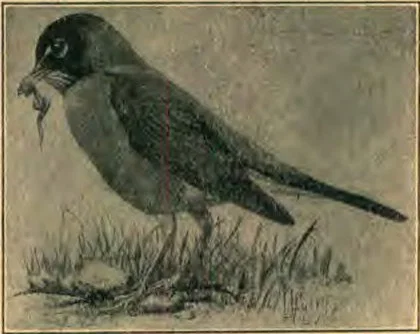
EVER since I read somewhere a charming sketch of a tame robin named Bob, all robins have been Bob to me, so when a baby of the family came into my bird room to spend the winter, his name was all ready for him.
That he was a baby I knew partly by his youthful ways, and partly by the fact that he had not entirely put off the spotted bib which marks the infancy of the thrush. He was a knowing youngster, however; he had his own opinions, and never hesitated to speak his mind, though I could not always understand him.
The robin had no notion of losing his interest in life and the world around him because fate had decreed that he should live in a house. On the contrary, he seemed much interested, and as eager to note the strange things that went on inside our walls, as we are to observe the manners of the foreign folk whose homes we visit. The doings of the people thus suddenly become his neighbors he studied with curiosity; but with one thing in his new world he was already familiar, and that was the birds. He realized at once that he must make and keep his place among them, and he proceeded to do this the moment he learned how to go in and out of his own particular apartment in that strange, new place. He had some difficulty at first, because the door to his cage was rather low,—as cage doors are apt to be,—and he stood up so straight that he passed it forty times before he saw that there was a door, and that it was wide open. He had to stoop a little to go in and out.
Getting Breakfast for the Little Ones.
The part of the room that the robin at once claimed as his own private property was the tops of two large cages which stood side by side on a shelf, and woe to the unlucky bluebird or oriole who dared to set foot upon the spot! Down upon him instantly came Master Bobby with fury in his eye, so big and bustling in manner that not one was brave enough to stay.
Bobby's Rival
It may seem strange that, being a robin and consequently fond of the ground, Bobby did not lay claim to the floor of his new territory. He did desire to do so, but there was a slight difficulty in the way. Another claimant was ahead of him, and one well able to maintain his ground—a blue jay.
This jay and Bobby shared the same broad, shallow bathtub on the floor, and when the jay got possession first Bob would dance around in a circle, quite frantic to go in; but his big rival usually kept him waiting some time. When at last the way was open, the robin would rush into the water, and on coming out usually fanned himself nearly dry, hopping about the floor and beating his wings.
He had a curious fancy for perching on a small stand near me to dress his plumage. It was not a good place at all, for there was no perch to which he could cling while he twisted about, and when he tried to reach his tail feathers his feet slipped and he turned round and round like a kitten chasing its own tail, making a laughable show of himself.
Bob, like all babies, was fond of play. A favorite game was trying to pull out the ends of strings that hung loose where the matting joined. Often he pulled so hard that he was jerked off his feet. The fact that he never got one out did not discourage him in the least.
A newspaper on the floor always furnished him with much entertainment. After jerking it about, and lifting it to peer under the edge, he would pounce into the middle, peck a hole, and then seize the edge of the opening and tear the paper into strips. The tearing sound always startled him and sent him off, but the fun of doing it was so great that he always came back and did it again.
As spring came Bobby grew restless, and worked off his energy on his roommates. He chased the birds about; he made war on a shy tanager; he performed war dances on the cages; and in fact became so troublesome in my little colony that I was glad when the first warm day came and I could take the robin—a baby no longer—out into the country and bid him farewell.—Adapted from “True Bird Stories,” by Olive Thorne Miller.
Why Johnny Failed
JOHNNY had a little mind;
It was his very own,
And nothing could be put in it
Except by him alone.
It wasn't very big, it's true,
But there was room inside
For lots of things, chosen out
As Johnny should decide.
Mother and father gave to him
All sorts of good advice;
But Johnny never put it in
Or thought about it twice.
But all the ugly things the boys
Upon the corners said,
Why, Johnny picked them up at once
And put them in his head.
At school the teacher tried her best
To give him facts and rules
Of every useful sort—but no,
For Johnny hated schools.
He picked up brag and vulgar slang,
Dime novels, too, ten deep.
And filled his mind till it was like
A tainted rubbish heap.
So when the day of manhood came,
When Johnny searched his mind
For skill and power, it played him false,
And nothing could he find
But worthless trash and ugly thoughts,
And so he failed, alas!
Is any other boy who reads
Coming to Johnny's pass?
— Exchange.
“Did I Not Do It Well?”
A RICH man went to Washington. Meeting a member of Congress whom he had known when a lad, he exclaimed: “Why, sir, are you a member of Congress? I remember when you used to black my boots.”
“Well, sir, did I not do it well?” was the prompt reply.
Boys, the great secret of success in life is doing well whatever one has to do; and that thing is not well done which is not done at the right time.
“Whatsoever thy hand findeth to do, do it with thy might,” and never put off till tomorrow what ought to be done today.
True and lasting success is not the result of chance, but of God’s blessing on well-directed effort.—Selected.
Who Was She?
By L. E. C.
JUST ninety-nine years ago a little girl was born in Florence, Italy. From a tiny lass she tended her large family of dolls most tenderly, nursing them through many an imaginary illness. Then one day as she was roaming the hills of Derbyshire, England, she chanced upon her first living patient, a shepherd’s dog with a broken leg, of which she took untiring care.
As she grew to womanhood she transferred her interest to human beings, and wherever there was sorrow or suffering she gladly ministered to those in need. Her father’s wealth opened to her the doors of kings and nobles, but she shrank from social obligations, and notwithstanding the protests of her family, entered a hospital for a nurses’ training. From this time until its close her life is a story of loving ministry and service.
She is known as the heroine of the Crimean War, and her work at the base military hospital in Scutari won her the lasting gratitude of kings and peasants, officers and common soldiers. After all was settled for the night, she frequently made a solitary round with a little lamp in her hand, going up and down the long rows of beds, making sure that all was well, “and,” said one poor fellow, “we could kiss her shadow as she passed.” Longfellow wrote of her:
“Lo, in that house of misery,
A lady with a lamp I see
Pass through the glimmering gloom,
And flit from room to room.13
“And slow, as in a dream of bliss,
The speechless sufferer turns to kiss
Her shadow as it falls
Upon the darkened walls.
“On England’s annals, through the long
Hereafter, of her speech and song,
That light its rays shall cast
From portals of the past.
“A lady with a lamp shall stand
In the great history of the land,
A noble type of good,
Heroic womanhood.”
When the war was over, Queen Victoria decorated her and presented to her a jewel of gold set with diamonds, inscribed with the words “Blessed are the merciful.” London conferred upon her the freedom of the city, an unusual honor, and the grateful nation gave her a thank offering of $250,000. This money she used for the establishment of a nurses’ training school which bears her name. To a friend she said during her last years of life: “I never knew what it was to be really happy until I undertook the work of relieving suffering; and I have never known an unhappy day since I accepted my mission.” She died Aug. 13, 1910, and all England mourned. Who can name her, “the lady with a lamp”? L. E. C.
Part II
NAME the following cities:
From what city do we get the name “calico” for print goods?
What city is called the “Athens of America”?
The entrance to the harbor of what city is called the “Golden Gate”?
What city is the greatest coffee market in the world?
What city in the United States is called the “City of Magnificent Distances”?
What city is noted for its dense fogs?
What large city is near Mt. Vesuvius?
Where was the World’s Fair held in 1893?
What city is famous for diamond cutting?
What city is the financial center of the Western Continent?
Answers to Questions Printed April 30, May 7, and May 14
Santo Domingo Paul
Missing Mountains
1. Hartz
7. Cenis
2. Ural
8. Alps
3. Pyrénées
9. Aloes
4. Apennines
10. Cévennes
5. Vesuvius
11. Nevada
6. Jura
12. Caucasus
13. Snowdon
Some Odd Questions
River; ocean.
Mountain; river.
River; mountain.
Peninsula; river.
Sandy Hook; river.
Sault Ste. Marie; on the shore.
River; Florida Keys.
Niagara Falls; earth.
Long Island; mountain.
North and South Poles.
Members of the 1918 Finding-Out Club
Stanley R. Altman
Edith D. Ohlson
Carol Crandall
Grace Pickard
Morley Eugene Evans²
DeLoras Pieruchi
Veva Flint
Mrs. W. F. Ray
Mrs. Norman Gartly
Emma Ramstead
Esther H. Gifford
Ione Robertson
Kenneth Wilson Gilstrap
Wilma Ray
Evelyn Henrietta Gilstrap
Lillian Rochambeau
Lois Lillian Gilstrap
Lester M. Roscoe⁵
Irma Halladay
Bessie Sargeant¹
Gracie Harrison
Stanley Sargeant¹
Mrs. Grace Hoover⁷
Elsa P. Thompson
Modette Hunt
W. C. Van Gorder
Leona Laird
Susan A. Walde⁴
Anna Nightingale
George F. Webb
My Riches
By Emily Tolman
MINE is the gold of sunset,
The glory of the dawn,
The splendid star that shines afar,
The dew-bejeweled lawn.
Mine are the pearls and opals
That fall from wayside spring,
The silvery notes from thrushes' throats
Through woodland aisles that ring.
Mine is the rare embroidery
Of lichen on the wall,
The airy grace of fair fern-lace,
Meet for a prince's hall.
Softer than Persian carpet
The moss beneath my feet,
In dewy dells, where floral bells
Toll out their perfume sweet.
Banks cannot hold my treasure;
It needs no lock nor key;
None 'neath the sky so rich as I,
Who hold the world in fee.
— Emily Tolman.
Where Camouflage Got Its Start
Camouflage is not new. It is as old as the first blade of grass that ever grew, as the first bird that ever took wing, as the first reptile that ever crawled. It was invented by divine providence when the world began, and we think it new only because some shrewd people have applied it to modern war. This natural camouflage, as explained by the American naturalist, Abbott H. Thayer, is far more wonderful than anything devised on the western front.
Did you ever notice that most creatures of forest, field, and stream are shaded dark above and light beneath? That reverses the rule of ordinary light and shadow, and gives its possessor a flat, disklike appearance. It fools the eye because its shadows are unlike those of ordinary objects.
Then, take the dappled, streaked, checkered, and blotched creatures, such as the dappled gray horse, the zebra, the diamond rattlesnake, and black-and-white cattle. Notice how much the dapple looks like light falling through leaves, the zebra’s stripes like the shadows of branches, the rattler’s skin like mottled undergrowth. Notice how blotches on cattle break the animal’s natural outline and blend with the landscape. That’s camouflage par excellence— protection from pursuers.
Everything the army camoufleur does today is imitation of this marvelous system. And he can’t do it so well as nature does, because he must work with inanimate objects to fool the thinking eye in the air above.— Every Week.
Why Dogs’ Noses Are Cold
WHEN your faithful dog pokes his nose into your hand, even your affection cannot prevent a little shiver, because the nose is so cold. Why is it? When the body of a dog is so warm, why should this one spot be different from all the rest of him? The coldness of a dog’s nose is due to the fact that it must be kept moist all the time in order to sharpen his sense of smell. And, of course, as the moisture is evaporating all the time, it keeps his nose cold. A dog depends a great deal on his powers of smell, especially in the wild state. In addition to the olfactory, or smelling, nerves inside a dog’s nostrils the whole black membrane around the nose is very sensitive, but this sensitiveness can only be retained by moisture. Thus it is that when a dog’s nose is dry and warm he is ill and needs doctoring.—Berwick Advertiser.
What to Do When Lost
By James Elmer Russell
BOYS,” said an experienced hunter, “if you ever get lost in the woods, be sure not to lose your heads.”
And then he went on to tell what he did on one occasion when he got lost in the Adirondacks while out deer hunting.
“When I realized that I was lost,” he said, “I did just what I told you not to do—I lost my head. I yelled, and fired off my gun, and ran, and tumbled over roots of trees, but after fifteen minutes of excitement I was no nearer to the trail than before.
“At last,” he went on, “I sat down and decided to think over the situation and see what I would better do. I was in a piece of timber of a triangular shape. On one side was the road, on the other two sides was water. All I had to do to get out of my predicament was to go in a straight line far enough, and I would sight some familiar landmark. But I had no compass with me, and what was to prevent me from wandering round and round in a circle, as people who are lost generally do, until I was tired out?
“Finally, an idea struck me. I had never heard of any one getting out of the woods by this plan, and I have never heard of any one else using the method, but it worked well in my case.
“From the root of a tree where I was sitting I sighted along two other trees that were in a straight line. Then I walked to the first of the two trees and sighted in a line along two other trees. In this way I was able to follow a course through the forest practically straight, and it was not very long before I came out upon the road and was then able to find my way quickly back to camp.”—James Elmer Russell.
Our Counsel Corner
[All our Missionary Volunteers are invited to contribute questions to Our Counsel Corner. The Young People’s Missionary Volunteer Department will be glad to answer, through these columns, questions on subjects of interest to young people.]
Is it allowable for members of the Senior Missionary Volunteer Society to take the Junior Standard of Attainment? E. T.
Certainly! “Whosoever will” may take it; but our Missionary Volunteers must not be content to stop there; for Junior Attainment membership is but a stepping-stone to Senior Attainment membership. No young person should be satisfied until he has reached the standard set for the Seniors. M. V. D.14
Does a Senior Standard of Attainment certificate count as school work done in a denominational school? That is, does one receive school credit for it? H. S.
No; but one who has passed the Standard of Attainment before entering one of our schools, will find these subjects of denominational history and Bible doctrines far more readily understood because of his previous study. M. V. D.
What is the total membership of Missionary Volunteer Societies throughout the United States? G. L.
The most recent reports give the combined membership of all Missionary Volunteer Societies in the United States as about 15,100. M. V. D.
Does the Missionary Volunteer Department offer a reward to any one earning a certain number of Reading Course certificates? E. T.
At the College View Missionary Volunteer Council, held in July, 1917, the following action was taken:
“Voted, That each one finishing five Senior Reading Courses shall be presented with a little gift book, to be written by Miss Erickson or selected by the Department. The new plan for presenting gifts for the completion of a certain number of Reading Courses shall go into effect Jan. 1, 1918. No certificates issued prior to this date shall count toward these gifts.” M. V. D.
Shall we consider members of the church school members of the Junior society if they do not sign a membership card? L. B.
In our church schools all the pupils are considered members, without reference to the Junior pledge. But the pledge should be made prominent in the society, carefully explained by the teacher, memorized by the pupils, and repeated often in the meetings. Those who desire to sign it will be given opportunity, just as opportunities are presented from time to time of signing the temperance pledge. E. I.
Saving Small Amounts for Thrift
Save
SAVE small amounts. The country's soft-drink bill is $120,000,000. Dimes are small spending, but the ten-cent stores' receipts last year were $135,000,000. A penny is trifling, but America's chewing-gum account is $12,000,000. New York street-car fares alone amount to $93,000,000. For thrift: walk, save, weigh a penny before spending. Save ten or twenty per cent by wise purchasing.—Association Men.
The Summary
By Milton E. Kern
OUR Missionary Volunteers will be glad to study the summary of work done by the young people for the fourth quarter of 1917. The report is on page fifteen of this INSTRUCTOR. What an encouragement there is in marking the progress of the work of God, and in recounting what he has been able to accomplish through us, his humble instruments.
As many tiny streams unite in their journey and help to form one strong and mighty river, so the littles that are reported by each one help to make up the grand total which is so encouraging to each of us. Missionary Volunteers, be faithful in reporting regularly the work you do. If you alone have done the work, let it drop; but if God has done it through you, tell it, and he will be glorified. M. E. KERN.
MEMORY VERSE: “Thou triest the heart, and hast pleasure in uprightness.” 1 Chron. 29: 17.
STUDY HELPS: “Patriarchs and Prophets,” pp. 229, 230; “Bible Lessons,” McKibbin, Book One, p. 127,
“Every day of youth is a testing day.”
Questions
1. How did Joseph instruct his steward to prepare for the homeward journey of his brothers? Gen. 44: 1, 2.
2. When were they sent away? Verse 3. Note 1.
3. What occurred soon after they left the city? Verses 4-6. Note 2.
4. How did they reason with the steward about the accusation? Verses 7, 8.
5. How did they bind themselves in case any one of their number should be found guilty? What obligation only did the steward accept? Verses 9, 10.
6. What did they then do? With whom was the cup found? Verses 11, 12.
7. How did the brothers express their grief? Verses 13, 14. Note 3.
8. What did Joseph say to them? Verse 15. Note 4.
9. What acknowledgment did Judah make? Verse 16. Note 5.
10. What did Joseph say they should do? Verse 17. Note 6.
11. When Judah saw that Benjamin was to suffer, what did he do? Verse 18.
12. In what tender way did Judah speak of his aged father and of Benjamin? Verses 19, 20.
13. Of what did he remind Joseph? Verses 21-23.
14. What did he say they had told their father? Verses 24-26.
15. What did Judah also relate which concerned Joseph himself? What pitiful plea made by the aged father did Judah now repeat? Verses 27-29.
16. What did he say would surely come to pass? Verses 30, 31.
17. What supreme sacrifice did Judah then make? Verses 32-34. Note 7.
Character
How is character developed in daily life?
What is a test?
What daily experience is necessary if one stands the test in a real crisis?
Which reveals character the more truly—a known test or a test that is not recognized as such?
Notes
1. “Joyfully they set out on their return. Simeon and Benjamin were with them, their animals were laden with grain, and all felt that they had safely escaped the perils that had seemed to surround them.”—“Patriarchs and Prophets,” p. 229.
“They were going gladly back to their own country with grain enough for their children, proud of their entertainment by the lord of Egypt; anticipating their father’s exultation when he heard how generously they had been treated and when he saw Benjamin safely restored, feeling that in bringing him back they almost compensated for having bereaved him of Joseph. Simeon is reveling in the free air that blows from Canaan and brings with it the scents of his native land, and breaks into the old songs that the strait confinement of his prison had so long silenced.”—Expositor’s Bible.
2. “Divination by means of a cup was a branch of ancient magic, and consisted in throwing fragments of gold and silver into a cup, and drawing conclusions from the arrangement into which they fell. We might compare telling fortunes by means of tea leaves or coffee grounds in a cup.”—New Century Bible. Such a cup “was supposed to possess the power of detecting any poisonous substance placed therein. At that day, cups of this kind were highly valued as a safeguard against murder by poisoning.”
3. “Here was the test. Would these ten men go away and leave Benjamin alone, in the grasp of Egyptian justice, to suffer for his supposed offense? Twenty-two years ago they would have done it.”—J. R. Miller.
“Had these men been of their old temper, their knives had very speedily proved that their contempt for the deed was as great as the Egyptian’s; by violence toward Benjamin they might have cleared themselves of all suspicion of complicity.”—Expositor’s Bible.
“Granting that despite appearances, they knew him to be innocent, why should they stand by him? At home he had been set before them as the favorite; nay, for fear of endangering him, their father had well-nigh allowed them all, their wives and their children, to perish from hunger. In Egypt also, he, the youngest, the son of another mother, had been markedly preferred before them. Must they now destroy their whole family, and suffer their little ones to perish, for the sake of one who, to say the best, seemed fated to involve them in misery and ruin? So they might have reasoned. But so they did not reason, nor, indeed, did they reason at all; for in all matters of duty reasoning is ever dangerous, and only absolute, immediate obedience to what is right is safe.”—Edersheim.
4. We cannot suppose that Joseph used the cup as the Egyptians used divining cups to read in it secrets and hidden things. In “Patriarchs and Prophets” we read: “Joseph had designed to draw from them an acknowledgment of their sin. He had never claimed the power of divination, but was willing to have them believe that he could read the secrets of their lives.”
5. “Judah cannot prove that his brother is not guilty, neither can he believe that he is guilty; he therefore leaves that question entirely aside.”—Robertson.
“He has no word of blame for Benjamin—a thing which in the circumstances was most remarkable, and speaks much for his confidence in his younger brother.”—Taylor.
6. “What proposal did Joseph make? Indignantly rejecting the injustice of making all eleven suffer for the crime of one, he bids them all return to their father, and leave Benjamin to his deserved fate. With these words Joseph brings his test of his brothers to the climax.”—Peloubet.
7. “In all literature there is nothing more pathetic than this appeal of Judah.”—F. B. Meyer.
“The speech is the finest specimen of dignified and persuasive eloquence in the Old Testament.”—International Critical Commentary.
“What was the essence of Judah’s plea?—Its self-sacrifice.”
“When Judah offered himself for slavery rather than that his father should suffer the grief of seeing them return without Benjamin, Joseph understood that Jacob’s anguish would be great beyond endurance, and he also became aware that his brethren were no longer so heartless as they had shown themselves of old.”—Ellicott.
Missionary Volunteer Work North American Division Quarter Ending December 31, 19
By M. E. Kern
Summary of the Missionary Volunteer Work of the North American Division Conference for Quarter Ending December 31, 1917
Conference
Number of Societies
Present Membership
No. Members Reporting
Missionary Letters Written
Missionary Letters Received
Missionary Visits
Bible Readings and Cottage Meetings
Subscriptions Taken
Papers Sold
Papers Lent and Given
Books Sold
Books Lent and Given
Tracts Sold
Tracts Lent and Given
Hours of Chr. Help Work
Articles Clothing Given
Value of Food Given
Treatments Given
Signers to Temperance Pledges
Bouquets Given
Scripture Cards Given
Offerings for Foreign Miss.
Offerings for Home Miss.
Conversions
ATLANTIC UNION
E. New York
8
107
33
51
24
137
18
15
368
3,255
42
48
..
159
136
59
$3.40
3
3
8
1
$110.11
$7.61
15
Gr. N. York
12
312
..
400
310
1,464
299
52
4,145
2,979
431
356
36
1,694
1,240
299
30.07
..
70
..
..
499.32
43.98
..
Maine
12
323
132
211
53
1,894
79
41
1,179
3,313
4,660
46
44
1,598
138
78
24.25
4
..
7
21
455.83
197.79
2
Mass.
19
393
300
625
371
1,005
325
214
4,722
3,647
655
1,213
1,472
2,048
368
344
16.64
25
64
16
64
1,137.28
114.93
26
N. New Eng.
4
52
14
121
5
51
1
2
793
325
82
29
24
18
138½
..
20
5
2
14
10
2.81
5.80
3
S. New Eng.
14
125
81
101
51
51
7
12
2,071
718
3,412
35
15
498
328
198
75
4
7
14
144
178.98
7.81
17
W. N. York
13
234
..
117
56
937
50
28
1,461
2,099
399
102
52
2,101
1,714½
176
1.66
..
..
52
360
364.30
31.02
1
Bermuda Mis.
..
..
..
..
..
..
..
..
..
..
..
..
..
..
..
..
..
..
..
..
..
..
..
..
CENTRAL UNION
Colorado
36
762
469
886
490
1,199
385
112
1,456
10,695
311
580
286
5,235
2,563
681
56.83
82
34
194
1,334
704.99
124.81
50
Kansas
71
879
496
164
75
470
70
22
1,209
5,221
303
153
37
561
850
225
16.00
40
19
62
527
1,509.41
76.46
19
Missouri
20
464
270
298
140
2,508
172
20
1,016
8,111
640
283
265
2,428
962
226
52.25
28
35
14
220
516.55
57.67
3
Nebraska
25
697
427
359
147
2,478
208
354
906
6,153
1,369
190
60
1,780
1,108
272
61.49
61
68
51
239
1,128.55
136.76
22
Wyoming
10
140
..
124
77
186
28
66
220
808
116
74
12
276
163
118
22.70
10
..
5
..
274.19
45.05
38
COLUMBIA UNION
Chesapeake
13
175
100
45
36
161
26
124
721
470
42
33
29
276
145½
189
7.00
10
21
10
75
403.55
53.41
6
Dist. of Col.
6
282
175
922
148
464
115
13
870
9,220
652
146
23
621
179
107
29.77
24
..
37
86
812.82
134.06
8
E. Pa.
12
194
112
217
102
1,202
50
2,200
1,712
849
301
282
1,852
1,445
329
50.72
9
3
42
355
1,104.87
100.62
19
New Jersey
25
351
269
170
72
703
421
49
2,702
4,426
290
124
12
1,497
734
271
26.85
33
..
325
578
1,204.06
115.86
32
Ohio
26
480
152
206
93
359
51
5
782
2,472
238
123
..
2,279
450
212
27.90
18
20
15
11
1,246.23
48.47
13
Virginia
8
303
..
51
14
542
34
2
763
227
455
14
36
109
539½
62
..36
26
..
5
75
6.32
4.48
12
W. Pa.
9
198
92
274
102
505
195
32
1,949
2,091
692
167
4
2,044
486
166
32.00
55
..
12
18
210.11
128.20
9
W. Virginia
4
46
25
113
84
28
4
9
27
466
11
55
28
2,063
111
50
4.00
22
10
3
..
106.57
5.35
1
LAKE UNION
E. Michigan
37
617
343
563
314
957
325
70
2,649
5,016
520
467
34
4,362
2,927
687
61.22
119
15
159
41
1,442.60
85.97
42
Indiana
44
562
200
461
177
1,007
299
98
19,742
24,607
562
384
311
1,509
894
368
12.50
45
21
70
32
855.52
61.30
10
N. Illinois
42
718
362
720
323
2,066
454
162
4,659
11,654
509
494
265
3,762
4,265
2,090
43.00
178
18
99
129
2,083.74
146.89
34
N. Michigan
25
195
100
62
18
249
7
21
500
3,371
204
83
5
703
242
95
2.00
1
1
12
46
585.65
58.99
..
N. Wisconsin
15
205
114
110
36
92
20
51
356
1,653
28
93
7
292
218
115
14.40
12
7
8
88
782.85
32.43
9
S. Illinois
13
164
108
168
55
396
122
5
183
1,110
148
59
89
1,271
191
107
1.50
3
..
4
9
282.78
..
..
S. Wisconsin
21
536
282
246
120
467
187
35
372
2,979
339
144
152
845
407
325
7.50
56
56
20
363
538.86
54.76
15
W. Michigan
49
1,177
756
431
245
1,288
220
49
1,517
8,471
1,069
428
1,574
3,139
1,767
494
35.15
57
52
246
656
2,223.01
359.18
22
NORTHERN UNION
Nebraska
20
550
348
389
178
465
76
63
635
4,008
190
173
..
2,175
841
261
29.55
91
..
24
181
1,200.35
108.06
2
Iowa
25
358
277
265
159
351
62
15
2,162
8,525
239
253
120
874
1,389
429
22.35
66
..
64
201
2,738.29
390.93
10
N. Dakota
17
428
200
333
55
194
45
27
185
2,172
117
94
..
1,359
68
67
4.10
113
120
..
50
257.42
61.10
36
S. Dakota
10
172
72
220
64
194
35
17
42
698
79
23
..
181
348
54
16.50
..
..
..
..
80.96
12.80
..
NORTH PACIFIC UNION
Montana
5
115
100
135
45
393
191
21
473
740
199
55
10
1,591
216
10
3.00
73
..
17
..
92.18
6.00
..
S. Idaho
15
339
200
120
51
152
20
12
198
1,948
246
159
14
1,218
315½
150
2.80
20
..
10
..
300.00
183.00
50
Iowa
12
215
139
112
58
44
27
77
157
1,500
54
75
18
357
158
50
8.00
9
3
38
180
543.61
9.31
23
Upper Col.
16
456
252
160
105
166
44
24
258
3,738
46
127
2
403
507
185
19.00
16
..
88
247
496.44
45.38
..
W. Oregon
13
293
93
101
17
165
3
2
308
5,033
124
90
..
208
533½
64
4.15
13
..
25
296
997.49
26.29
12
W. Wash.
18
295
200
59
28
84
28
..
193
2,425
37
57
37
394
121
110
3.80
5
..
145
10
104.26
63.03
..
PACIFIC UNION
Arizona
4
46
65
47
31
70
21
9
131
961
29
40
..
52
116
50
2.00
7
7
10
25
100.01
11.89
3
California
21
473
325
205
101
473
160
2
365
5,737
457
416
11
1,927
437
236
4.10
6
141
211
218
449.92
66.65
6
C. California
20
701
149
142
63
314
280
218
989
6,174
473
309
99
1,358
1,351
241
44.54
35
17
142
237
1,071.49
103.79
35
Inter-Mtn.
12
..
50
61
17
94
19
..
77
842
29
90
50
266
126½
37
3.50
1
..
13
15
106.24
25.76
..
Nevada
5
47
47
24
9
207
64
20
..
1,957
..
..
..
26
16
..
..
5
..
..
22
6.21
2.90
..
N. California
25
440
233
121
60
152
25
23
300
5,576
51
173
15
616
317
339
28.45
10
..
112
148
501.77
130.78
16
N. W. Cal.
22
453
70
217
141
305
53
13
726
9,319
502
193
7
627
642
209
22.70
14
2
218
179
1,154.69
131.46
27
S. California
22
514
238
255
98
1,986
186
5
932
3,275
56
522
54
3,397
7,264½
162
22.79
93
233
110
689
325.36
56.45
17
S. E. Cal.
23
500
200
50
23
62
24
5
75
794
30
67
16
88
121
320
45
..
35
..
..
107.83
..
..
SOUTHEASTERN UNION
Cumberland
3
118
118
93
35
173
32
..
9
9,423
924
60
..
51
306
37
8.50
29
..
..
63
47.25
15.06
..
Florida
11
137
66
146
45
152
76
5
881
1,693
162
39
..
494
196
21
2.62
6
..
27
1
112.90
105.91
3
Georgia
8
104
60
323
150
581
228
4
462
975
524
71
194
982
427
60
1.04
8
18
12
..
124.32
75.16
12
W. Carolina
10
165
10
106
32
214
18
4
1,757
785
250
175
3
305
961
48
16.00
..
..
21
..
75.44
..
..
S. Carolina
..
..
..
..
..
..
..
..
..
..
..
..
..
..
..
..
..
..
..
..
..
..
..
..
SOUTHERN UNION
Arkansas
4
116
90
321
130
416
95
9
1,071
1,365
147
113
..
192
780
56
32.00
6
5
74
32
298.02
25.73
..
Kentucky
5
62
50
73
30
158
6
5
188
1,464
19
44
7
175
1,325
22
55.16
..
16
5
255.75
6.06
15
Louisiana
7
85
47
46
24
1,379
104
6
1,385
784
437
24
..
88
311
77
10.55
12
10
67
..
282.19
7.05
17
Mississippi
..
87
33
11
4
104
11
24
96
2,427
683
21
20
70
..
..
4.20
4
..
..
..
47.00
..
..
Tenn. River
3
44
35
12
5
55
1
..
376
165
8
6
..
23
32
57
5.00
6
..
..
37
110.19
..
..
Total
1,063
19,871
10,480
14,350
5,978
34,472
6,677
2,407
61,259
236,615
26,310
9,502
5,055
74,915
40,366
11,578
81,189.97
1,915
1,210
2,070
8,772
839,033.41
35,337.41
816
M. E. Kern, Secretary of M. V. Dept. of the N. A. D. Conference.