The Bible—a most significant phrase; for it means THE Book. No ordinary book is The Book—it is distinct, unique, solitary. Aye, it is “the Word of God, which liveth and abideth forever.” This is its distinctive glory, that it is “not as the word of men, but as it is in truth, the Word of God.” Not Moses, not David, not Paul—but GOD is its Author!
The Bible has been hated and reviled as no other book has ever been, and yet it remains intact. It has been burned and pronounced dead, yet it lives—incomparably the greatest force on earth. Mighty kings and scheming priests have shrunk from no toil and no guilt in order to exterminate it; scholarly men have spared no eloquence of tongue or pen in order to refute it; science and infidelity have abolished it times without number; yet to-day it is spreading with unprecedented rapidity in multiplied millions of copies and in almost a half thousand languages. What is the secret of the inviolability of this Book? Why invulnerable to the poisoned shafts of men and devils?—Ah, it is of God; and, like God, it is imperishable, immortal, eternal!
A Fortress Impregnable
The Bible is a building that has for its foundation the Rock of Ages. Hence its impregnable strength. Thus sang the Spirit-quickened poet: “Forever, O Jehovah, Thy Word is SETTLED in heaven.” It was the Word Incarnate who declared, “The Scripture can not be broken.” As easily might the enemies of God shake down the illimitable structure of His universe as remove one stone from the structure of His Word. What multitudes of armed enemies have battered against the adamantine ramparts of God’s Word! But they have battered in vain. The Bible is not in danger, and never can be. Let its enemies rage, and dash themselves in pieces against it. Its timeless majesty, its silent rocky strength, bids them defiance. It were as easy to abolish God as to abolish His Book, “for Thou hast magnified Thy Word above all Thy name.” Ps. 138:2.
For Every Age
Yes, the Bible is a timeless book; it is of no age and of no place. Forever and everywhere it is in season—up to date. It is God’s revelation of Himself to man—to EVERY man. He has adapted it to the needs not only of every nation and kindred and tongue, but of every individual soul. Hence it is present to every age and potent in every clime. To me its message is just as fresh, beautiful, vital, and powerful as it was to Jeremiah or to Timothy. It must, in the very nature of things, be coeval with its Author, and He “inhabits eternity.” Most naturally, then, does Spirit-filled Peter declare, “The grass withereth, and the flower thereof falleth away: but the Word of the Lord endureth forever.” Like the sun, the Bible shines for rich and poor, white and black, literate and illiterate. It knows no caste, no occult order, no hieroglyphics or dark symbols. It is so simple and obvious that a child can grasp it, enjoy it, live it; so deep that the wisest sage can never fathom it. It is universally potent, perennially dynamic.
Living Words
God is life, “the fountain of life;” and when He speaks, He speaks not only the words of life, but words that live—words that are themselves the essential life of God. Jesus, who was the living, personal revelation of God, testified, “The words that I speak unto you, they are spirit, and they are life.” Of the same import is the testimony of His apostle: “The Word of God is living, and active, and sharper than any two-edged sword, . . . and quick to discern the thoughts and intents of the heart.” A.R.V. That the Bible is instinct with the life of God is evident not only because Jesus and His prophets so declared, but also because millions of sinful men bowed under the galling weight of guilt have been “born again, not of corruptible seed, but of incorruptible, by the Word of God, which liveth and abideth forever.” Innumerable men and women in all times have borne witness to the quickening, transforming power of the life of God in their own souls, brought to them through His blessed Word. Their own transfigured lives were to them the overwhelming proof that in the Scriptures we have “the words of ETERNAL LIFE.”
That the Bible is the living Word of God needs no rhetorical or formal proof. It evidences its divine life and potency by what it does, by its fruits. Think of its power to lift men out of the darkness and bondage of sin into the light and liberty of God—of its power to gladden, ennoble, and rehabilitate human lives! A stream can not rise higher than its source; and a Book that reclaims prodigal wanderers and brings them back to their divine Father’s house, must have come from the same supernal source. In countless instances this Book has demonstrated its power to lay hold on men and women in the lowest depth of iniquity and degradation, and lift them up, up, up into the light and life and love of God. Times without number this Word, instinct with spirit and life, has found its way into the heart of the proud, flippant, cynical, scoffing devotee of “fashion,” and transfigured her into a gentle, confiding, self-sacrificing, ministering daughter of the heavenly King.
The reader may recall the following historic illustration: Upon the urgent request of a friend, a splendor-loving lady in Geneva, Claudine Levet, about 1532, consented to hear the despised Froment preach. She put on amulets, rubbed virgin wax on her face, placed verbena leaves on her temples, as a safeguard against the sorcerer, and with an air of contempt sat immediately in front of the plain-looking preacher, crossing herself. But while he spoke, her whole expression and attitude changed. When he closed, she asked, “How do you know that what you said is true?” “Here it is written,” was his simple answer. “Give me the book.” Quietly she went home, and for three days read the Sacred Volume in seclusion. She came forth from her room a transformed woman. “She is lost to us,” her aristocratic friends lamented. “She no longer cares for festivities, rich apparel, and social gaieties, but spends her time visiting the sick, ministering to the needy, and reading the Bible.” It was through the message of the Old Book that the divine Spirit wrought this miracle of transformation.
Every observer knows that the nearer one gets to God, the nearer one gets to the Bible; the more one loves God, the more one loves the Bible; the deeper one’s knowledge of God, the deeper one’s knowledge of the Bible. There never has been and there never can be an exception to this rule. Why? Because the Holy Spirit, who alone can lead a soul to God, always leads that soul over the everlasting highway of the living Word of the living God.
Gems from the Ocean of Divine Truth
By Robert McCheyne
One gem from that ocean is worth all the pebbles from earthly streams.—Robert McCheyne.
Scriptures as the Most Sublime Philosophy
We account the Scriptures of God to be the most sublime philosophy.—Sir Isaac Newton.
The Bible
It furnishes us, when rightly interpreted, a laboratory note-book of the experiences of the greatest experts in religion the world has known. The nearer we come to the hearts of the men whose inmost experiences are here writ down, the greater will be the benefit accruing to us. We see them fighting unflinchingly the battle of faith against enemies as real and powerful as any that ever confront us, and with weapons no better and no worse than those available to us. We realize our oneness with them in the struggle that was, that is, and that ever shall be. We are emboldened by their triumphs and fortified by their example, so that we renew our own contest with an access of courage and strength.—Biblical World.
The Gideons Plan to Distribute Bibles in Hotels
“The Gideons,” a religious organization composed of traveling men, propose to celebrate the year by distributing 100,000 Bibles among the hotels of America. They recently placed 5,000 Bibles in the hotels of Chicago. Honor to Gideon’s Band.
Bible Type Calculated to Stretch 20 Million Miles
It is calculated that if the type used to produce the Bibles thus far printed were placed in a single line, it would extend more than 20,000,000 miles.
Living by the Word in Bible Anniversary Year
It is a good time, in this three hundredth year of Bible celebration, for us Protestants to ask ourselves how far away we are from that Book we are celebrating. Mere profession counts for less than nothing unless the Word lives in us.
The Bible as a Book of Faith and Doctrine
The Bible is a book of faith, and a book of doctrine, and a book of morals, and a book of religion, of especial revelation from God.—Daniel Webster.
The Bible as Antagonist to Human Opinion
The Bible alone of all the books in the world, instead of uttering the opinions of the successive ages that produced it, has been the antagonist of these opinions.— Stuart Robinson.
The Spirit-Filled Life
By Llewellyn A. Morrison
By Llewellyn A. Morrison
Jehovah, Thou God of Creation, around us
The beautiful wealth of Thy love we behold;
Tho aliens afar when the Holy One found us,
He brought us each into the heavenly fold;
He told us of Christ, who for sin had been smitten,—
Revealing the gifts that were ours through His name;
He sent a free pardon, death-sealed and blood-written;
He entered our names in the Book of the Lamb.
Refrain
Exalt we the Father, His fealty foretelling;
We glorify Jesus, Redeemer and Lord;
Sing praise to the holy Shekinah, indwelling,
And pray for the Spirit-filled life of the Word.
How broad are Thy blessings, Thou God of Salvation!
Thou madest Thy people to love and be free,
To joy and rejoice with supreme exultation,
And be in their purity like unto Thee.
Alas for their choosing! By baneful election,
Forsaking Thy fountains for waters of strife;
Refusing Thy counsel, restraint, and protection,
They sought ’mid the carnal for wisdom and life.
Thou God of Redemption, how full are Thy favors!
A ransom Thou gavest that saveth from doom,
Strong hope to inspire all our human endeavors,
And pain to put purpose and patience in bloom;
Thy promises loom with a luster supernal,
Omnipotent powers Thy pleasures display;
Time boons are but types of the glories eternal.
When Thou shalt have ransomed Thy people for ay.
The Power of the Word to Save
By C. L. Taylor
By C. L. Taylor
The Word of God . . . is powerful.” From Genesis to Revelation, the story of the Bible is the story of power. Beginning with the record of a mighty creation, when God “spoke, and it was,” and closing with the announcement, “Behold, I make all things new,” the Bible places before the mind of man, in panoramic view, a picture of manifested power.
The power of which the Scriptures speak, yea, better, the power which the Scriptures are, is the power of God. God’s power, first exercised in creating the world for man, and then in creating man for the world, has for six thousand years been put forth to save both world and man from the curse of sin.
God’s blessed Book, the “alpha and omega” of truth, is divinity clothed with humanity, and like the Lord Jesus, its Author, is brought to tabernacle among us, in order that it may forgive all iniquities and heal all diseases.
The Bible, the Word of God, is Heaven’s great message of glad tidings, “the power of God unto salvation to every one that believeth.”
But all power is invisible. The living power of God, like that mysterious something called electricity, which flows over or through the wire circuit, never really seen, but always readily known, is undiscernible, even as God is undiscernible; and yet its marvelous workings may be realized by those who will to have it.
The human words of the human Book are the metaphorical wires of the great spirit world,—the kingdom of God. And the moment faith makes the connection and forms the circuit, that moment the vitalizing principle of divine life flows through these words and enters into humanity, and man becomes the possessor of the divine nature. 2 Peter 1:4.
How simply and beautifully sweet and touching, therefore, is the record of faith as given in Hebrews 11! Men believed God’s Word and received God’s power. That power made and kept them upright, clean, and wholesome in their lives, enabling them to meet, without a word or even thought of murmuring, the most terrible sufferings, and to know the greatest triumphs, even in death.
Faith brought them into actual touch with the divine Presence and Power. Faith gave them the new vision that penetrated the veil and permitted them to see the invisible. Heb. 11:27.
The Word of God found in faith an open channel, and its power flowed into their lives, working miraculous changes in character, affording protection against disease, and delivering from enemies seen and unseen.
The Incarnate Word
But of all the glorious manifestations of the Word of God, the life of our Lord Jesus was the most concrete. He was the Word “made flesh.” He was the living fulness of that Word in human life. Through Him divinity flashed forth its sympathy, its kindness, its heavenly helpfulness. In Him God really and truly revealed what His Word is to be to mankind in all the world, in all ages, under all circumstances.
Jesus Christ was the Word of God translated into human experience. Surpassingly wonderful was His simple and earnest life of power. He “went about doing good, and healing all that were oppressed of the devil; for God was with Him.”
Follow this divine-human Being, this Man whose faith grasped fully the promises of God. See Him at the pool. Behold Him as He bends over the suffering invalid, and in his ear whispers, “Wilt thou be made whole?” And then when that emaciated face is turned to His, and the hopeless and helpless one breathes forth his despair, hear the blessed One say, “Rise, take up thy bed, and walk.”
Does the Word accomplish its mission? Ah, that was the Word of “authority.” The very “virtue” of the Godhead impregnated its every jot and tittle. “Immediately the man was made whole.”
Once more, dear reader, let your heart carry you to the Saviour’s side, as He is pressed hither and thither by a thronging multitude. Watch that woman of sorrow and trouble and pain as she strives in weakness to reach His side, saying to herself, as she works her way forward, “If I may but touch His garment, I shall be whole.” And note that when at last she is able to reach forth the hand and do what her heart had bidden, “immediately her issue of blood stanched.”
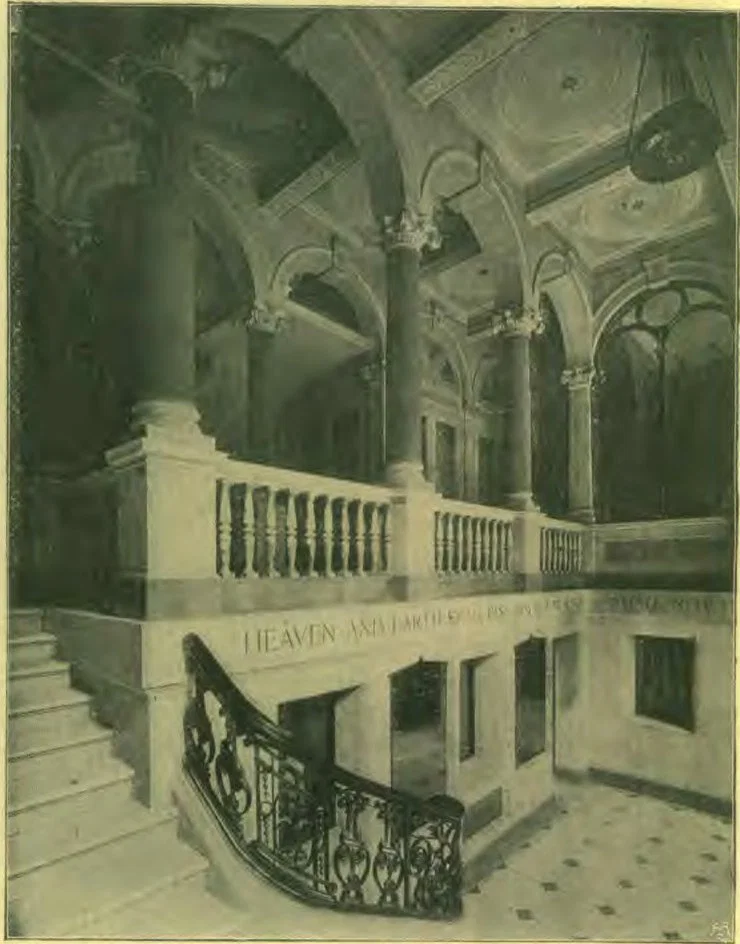
The great hall and staircase of the British and Foreign Bible Society House, London. Note the inscription, “Heaven and earth shall pass away, but My words shall not pass away.” The Bible House in San Francisco, opposite the City Hall, was wrecked by earthquake and burned by fire; but the corner-stone with the above inscription remained intact. God in His providence was giving the people of the afflicted city assurance of something better. He gives it to-day.
That was one of the supreme moments in the life of the Christ. Then and there the wonderful healing virtue of the Almighty Word had flowed forth in response to the call and the touch of faith.
O Word of God Incarnate! How matchless Thy beauty, how wondrous Thy power! Thou art the same yesterday, to-day, and forever!
Scientists may scoff, infidels deny, atheists blaspheme, at mention of miracle power as vested in the sacred Word. They do so only because their unbelief shuts them away from its invisible Presence. But here and there, the great world over, are those who can bear witness to its saving strength.
Ever the Same
Perhaps you have read of the poor India leper that heard about the Jesus whose word healed the sick and raised the dead. “Is this Jesus still alive?” he asked. “Yes,” was the missionary’s reply, “He is now in heaven above, and whoever asks Him for help receives it.” The leper believed the simple truth; and leaving the mission, he wended his way to his hovel, and there poured out his agony to that Jesus of whom he had learned. “O Jesus, heal me,” he cried.
A year later, he visited that same missionary, but no longer a leper. God’s Word had responded to his faith, and his flesh had become as the flesh of a child. And better than all this, the purifying, uplifting Word of God had found a large place in his life. He had become an intelligent, consistent Christian.
A few years ago I was called to the bedside of a very sick woman. She was a widow, and the mother of five beautiful little girls. She was afflicted with an incurable disease, and, among other troubles, with a very large abdominal abscess, upon which an operation was impossible. Her physician, one of the best in the State, informed her of her helplessness; and then it was that she went to God’s Word for hope and help. Believing that she must live for the sake of her children, she called for prayer. The promise of James 5 was offered in her behalf; and just as in the time of the Saviour, she was immediately healed. With heart full of praise, she arose from her sick-bed, and again took up the duties of life.
And how many, many times has God’s Word brought souls out of the bondage and darkness of sin into the freedom and light of the kingdom of heaven!
Blessed Bible, the gift of the ages to the sons of men! Unchangeable and unchanged it comes to the human heart, bringing in its bosom stores of heavenly comfort, heavenly healing, heavenly hope. It brings power to save from sin and from sinning; power to transform the soul, fashioning it after the image of the divine.
Reader, do you believe it? If not, delay no longer. This moment it waits a welcome. Accept it, receive it, and you, too, will find it “the power of God unto salvation,” a mighty fact of which you will never be ashamed.
Early English Bible Translations and Their Influence
Of the various early English versions that of Tyndale stands pre-eminent, and Tyndale was greatly influenced by Luther's translation.
In 1877 100 Bibles were printed at Oxford and finely bound in London within 12 hours from the time the work was begun in Oxford.
No work has had such influence upon the common law of all nations as has the Pentateuch.
The Bible in whole or in part has been printed in nearly 500 languages and dialects.
The first Bible printed in America was Eliot's Indian Bible, in the years 1661-63.
John Quincy Adams made it a practice to read the Bible through once a year.
The Bible
By Phoebe Palmer
Blessed Bible! how I love it!
How it doth my bosom cheer!
What hath earth like this to covet?
O, what stores of wealth are here!
Man was lost and doomed to sorrow;
Not one ray of light or bliss
Could he from earth’s treasures borrow,
Till his way was cheered by this!
Yes, I’ll to my bosom press thee,
PRECIOUS WORD, I’ll hide thee here;
Sure my very heart will bless thee,
For thou ever sayest “good cheer.”
Speak, my heart, and tell thy ponderings,
Tell how far thy rovings led,
When THIS BOOK brought back thy wanderings,
Speaking life as from the dead.
Yes, sweet Bible, I will hide thee
DEEP, yes, DEEPER in this heart;
Thou through all my life wilt guide me,
And in death we will not part.
Part in death?—No! never! never!
Through death’s vale I’ll lean on thee;
Then, in worlds above, forever,
Sweeter still thy truths shall be!
—Phoebe Palmer.
Blessings of Bible Study
By Ellen G. White
By Mrs. E. G. White
Those who boast of wisdom beyond the teaching of the Word of God, need to drink deeper of the fountain of knowledge, that they may learn their real ignorance.
Men boast of their wisdom when it is foolishness in the sight of God. Let no man deceive himself. “If any man among you seemeth to be wise in this world, let him become a fool, that he may be wise. For the wisdom of this world is foolishness with God. For it is written, He taketh the wise in their own craftiness.” The greatest ignorance that now curses the human race is in regard to the binding claims of the law of God; and this ignorance is the result of neglecting the study of the Word of God. It is Satan’s plan so to engage the mind that men shall neglect the great Guide-book, and thus be led into the path of transgression and destruction.
The Bible is not exalted to its place among the books of the world, altho its study is of infinite importance to the souls of men. In searching its pages the imagination beholds the Son of God, coming to our world, and engaging in the mysterious conflict that discomfited the powers of darkness. O, how wonderful, how almost incredible it is, that the infinite God would consent to the humiliation of His own Son, that we might be elevated to a place with Him upon His throne! Let every student of the Scriptures contemplate this great fact, and he will not come from a study of the Bible without being purified, elevated, and ennobled. The truth will be opened to the mind and applied to the heart by the Spirit of God.
Through connection with God the Christian will have clearer and broader views, unbiased by his own preconceived opinions. His discernment will be more penetrating, his judgment be better balanced and far-seeing. His understanding, exercised in contemplation of exalted truths, will be expanded; and in obtaining heavenly knowledge, he will better understand his own weakness, and grow in faith and humility.
When there is little attention given to the Word of God, divine counsels are in vain, grace and heavenly wisdom are not sought that past sins may be avoided and every stain of corruption may be cleansed from the character. David prayed: “Make me to understand the way of Thy precepts: so shall I talk of Thy wondrous works.” “Open Thou mine eyes, that I may behold wondrous things out of Thy law.”
There is a great work to be done by earnest Bible students; for gems of truth are to be gathered up, and separated from the companionship of error. Tho the Bible is a revelation from Heaven, yet many do not comprehend its divine teaching. We are to discover new aspects of truth in both Old and New Testaments, to behold the exceeding breadth and compass of truths which we imagine we understand, but of which we have only a superficial knowledge. He who earnestly searches the Scriptures, will see that harmony exists between the various parts of the Bible, will discover the bearing of one passage upon another, and the reward of his toil will be exceedingly precious.
The Divine Helper
All over the field of revelation are scattered glad springs of heavenly truth, of peace and joy. These glad springs of truth are within the reach of every seeker. The words of inspiration, pondered in the heart, will be as living streams flowing from the river of the water of life. Our Saviour prayed that the mind of His followers might be opened to understand the Scriptures. Whenever we study the Bible with a prayerful heart, the Holy Spirit is near to open to us the meaning of the words we read. The man whose mind is enlightened by the opening of God’s Word to his understanding, will feel not only that he must more diligently seek to understand the Word of God, but that he must have a better understanding of the sciences. He will feel that he is called to a high calling in Christ Jesus. The more closely connected man is with the Source of all knowledge and wisdom, the more he will be convinced that he must advance in intellectual and spiritual attainment. The opening of God’s Word is always followed by a remarkable opening and strengthening of man’s faculties; for the entrance of God’s words giveth light. By contemplation of great truths the mind is elevated, the affections purified and refined; for the Spirit of God through the truth of God quickens the lifeless spiritual faculties, and attracts the soul heavenward.
Then take your Bible and present yourself before your heavenly Father, saying, “Enlighten me; teach me what is truth.” The Lord will regard your prayer, and the Holy Spirit will impress the truth upon your soul. In searching the Scriptures for yourself, you will become established in the faith. It is of the greatest importance that you continually search the Scriptures, storing the mind with the Word of God; for you may be separated from the companionship of Christians, and placed where you will not have the privilege of meeting with the children of God. You need the treasures of God’s Word hidden in your heart, that when opposition comes upon you, you may bring everything to the Scriptures.
The Bible Alone
Truth is eternal, and conflict with error will only make manifest its strength. We should never refuse to examine the Scriptures with those who we have a reason to believe desire to know what is truth as much as we do. Suppose a brother holds a view that differs from yours, and he comes to you, proposing that you sit down with him and investigate that point in the Scriptures; should you rise up filled with prejudice, and condemn his ideas, while refusing to give him a candid hearing? The only right way would be to sit down as Christians and investigate the position presented, in the light of God’s Word, which will reveal truth and unmask error. To ridicule his ideas would not weaken his position, tho it were false, nor strengthen your position, tho it were true. If the pillars of our faith will not stand the test of investigation, it is time that we know it; for it is foolish to become set in our ideas, and think that no one should interfere with our opinions. Let everything be brought to the Bible; for it is the only rule of faith and doctrine.
We must study the truth for ourselves; no living man should be relied upon to think for us, no matter who he may be or in what position he may be placed. We are not to look upon any man as a perfect criterion for us. We are to counsel together, and be subject one to another; but at the same time we are to exercise the ability God has given us to learn what is truth.
Each one of us must look to God for divine enlightenment, that we may individually develop a character that will stand the test in the day of God.
We are living in the last days, when error of a most deceptive character is accepted and believed, while truth is discarded. Many are drifting into darkness and infidelity, picking flaws with the Bible, bringing in superstitious inventions, unscriptural theories, and speculations of vain philosophy; but it is the duty of every one to seek a thorough knowledge of the Scriptures. The importance and benefit of Bible study can not be overestimated. In searching the Scriptures our minds are caused to dwell upon the infinite sacrifice of Christ, on His mediation in our behalf. As we see His love, as we meditate upon His humiliation and sufferings, the same spirit of self-denial and sacrifice for the good of others will be kindled in our hearts. As we behold Jesus by the eye of faith, we shall be “changed into the same image from glory to glory, even as by the Spirit of the Lord.”
The Bible and Religious Liberty
By W. A. Colcord
Its Principles in National Life
By W. A. Colcord
Some seeds when planted spring forth quickly and bear fruit; others may lie dormant for years before germinating and yielding returns. So of Christ’s teachings: some took effect at once, while others were not to ripen for generations to come.
When, to silence the Pharisees, who were seeking to entangle Him in His talk, and to find a pretext for putting Him to death, Christ said, “Render to Cæsar the things that are Cæsar’s, and to God the things that are God’s.” He planted a seed that was not to spring forth and come to its full fruitage for nearly two thousand years. Not until these latter times was this truth to be so generally received as to find expression in a nation. All along the way, individuals, of course, had received it and acted upon it; but no nation. But Providence had ordained that before the close of the career of this sin-stricken world, mankind should see exhibited on a national scale, and before the whole world, a government founded and conducted upon this divinely enunciated principle.
As Christ came to bless men by turning them away from their sins; as His first discourse opened with benedictions, telling men how to be happy and blessed; and as all His teachings were designed to bless and uplift mankind, so this instruction was given to bless the world.
The Need of a New Nation
In consequence of this instruction’s not being heeded for long ages, the world was brought into a state of tyranny and bondage. Five years before the discovery of America, Pope Innocent VIII issued a bull for the subjection or extirpation of the Waldensian Christians from the Piedmont valleys. It brought no charge against them as lawless, idle, or dishonest. Their fault was that “they did not worship as Innocent worshiped.” If they refused to abjure their faith, said the Roman pontiff, let them “be crushed like venomous snakes.” See Wylie’s “History of Protestantism,” volume 2, page 435.
To Cardinal Thomas de Vio, his legate, Pope Leo X, in 1518, gave the following instruction concerning Luther and his followers:
If he should persist in his stubbornness, and you fail to get possession of his person, we give you power to proscribe him in all places in Germany; to put away, curse, and excommunicate all who are attached to him, and to enjoin all Christians to shun their society.—D’Aubigné’s “History of the Reformation,” book 4.
Three years later, 1521, Henry VIII of England wrote to the elector Palatine, of Germany, concerning Luther, thus:
Surely, it is no other than the devil, who, by the agency of Luther, has kindled this wide-spread conflagration. If Luther will not retract, let himself and his writings be committed to the flames.—Id., book 9.
And in his book “Defense of the Seven Sacraments, against Luther,” this King of England further said:
All the servants of Jesus Christ, whatever be their age, sex, or rank, should rise up against this common enemy of Christendom.—Id.
In 1604, King James of England said:
I will have none of that liberty as to ceremonies; I will have one doctrine, one discipline, one religion in substance and in ceremony.—Bancroft’s “History of the United States,” volume 1, page 196 (ed. 1888).
Instead of granting the Puritans permission occasionally to assemble, and at their meetings to have the liberty of free discussion, he said:
I will make them conform, or I will harry them out of the land, or else worse, . . . only hang them; that’s all.—Id.
Sixty years later, under Charles II, Bunyan was imprisoned for exercising his freedom in matters of religion. While in prison he was told that he must “leave off those meetings you were wont to have,” and “submit yourself to the laws of the land, or during the next session it will go worse with you.”—“Life and Times of John Bunyan.”
The Correct Principle Little Understood
Such was the general attitude of prelates and rulers in the Old World during the Dark Ages. Freedom of thought and opinion was not tolerated, nor the rights of conscience respected. Civil authority was substituted for Scriptural argument; and where conviction could not be produced, obedience was demanded. And so little did many even of the most devout followers of Christ understand the true meaning and the practical application of the great principle which He had enunciated, that those who had fled from the hand of oppression in the Old World at once proceeded to exercise it in the New. To quote the words of President Taft: “They came to establish freedom for their own religion, and not the freedom of anybody else’s religion. The truth is that in those days such a thing as freedom of religion was not understood.” “Freedom of conscience,” says Bancroft, “was in that age an idea yet standing on the threshold of the world, waiting to be ushered in; and none but exalted minds—Roger Williams and Penn, Vane, Fox, and Bunyan—went forth to welcome it.” There was need of a new nation, founded upon a new principle, and establishing “a new order of things.”
Slowly men emerged from the religious despotism of the middle ages into the light of the civil and religious liberty of modern times. Little by little they began to recognize the rights of men, and to see that “proscription and persecution are no part of the legitimate business of civil government,” that “the stake, the rack, the gibbet, the dungeon, thumbscrews, sword, pillory, and stocks have no rightful place in the machinery for the propagation of the Gospel.”
The New Nation Appears
Finally freedom came into full bloom. Despite the noxious plants brought over from the Old World, in the New World the seed of civil and religious liberty had taken deep root. From the virgin soil a nation arose in which there was “a church without a pope, and a State without a king.” Conscience was placed above the civil power, and the Word of God above the authority of the visible church. Its founders said: “We hold these truths to be self-evident: that all men are created equal; that they are endowed by their Creator with certain unalienable rights; that among these are life, liberty, and the pursuit of happiness.” They enacted that “Congress shall make no law respecting an establishment of religion, or prohibiting the free exercise thereof;” and that “no religious test shall ever be required as a qualification to any office or public trust” under the Government. The bell of “Liberty” rang out, on which were cast the words: “Proclaim liberty throughout all the land, unto all the inhabitants thereof.”
The story of all this has been told so well and so beautifully by Bancroft, that we quote him here. He says:
In the earliest States known to history, government and religion were one and indivisible. Each State had its special deity. . . . No one thought of vindicating liberty of religion for the conscience of the individual till a voice in Judea, breaking day for the greatest epoch in the life of humanity by establishing for all mankind a pure, spiritual, and universal religion, enjoined to render to Cæsar only that which is Cæsar’s. The rule was upheld during the infancy of the Gospel for all men. No sooner was the religion of freedom adopted by the chief of the Roman Empire, than it was shorn of its character of universality and enthralled by an unholy connection with the unholy State; and so it continued till the new nation—the least defiled with the barren scoffings of the eighteenth century, the most sincere believer in Christianity of any people of that age, the chief heir of the Reformation in its purest form—when it came to establish a government for the United States, refused to treat faith as a matter to be regulated by a corporate body, or as having a headship in a monarch or a State. Vindicating the right of individuality even in religion, and in religion above all, the new nation dared to set the example of accepting in its relations to God the principle first divinely ordained in Judea. It left the management of temporal things to the temporal power; but the American Constitution, in harmony with the people of the several States, withheld from the Federal Government the power to invade the home of reason, the citadel of conscience, the sanctuary of the soul; and not from indifference, but that the infinite spirit of eternal truth might move in its freedom and purity and power.—Bancroft’s “History of the United States,” volume 6, pages 443, 444.
The influence which this nation has exerted throughout the world in favor of religious freedom has been very great. Would that it might ever remain true to the great principle upon which it was founded. But, like a worm at the root of some beautiful plant, there are elements at work here to undermine this principle, and to undo all that the fathers and founders of it have done. And few realize how rapidly this work of destruction is going on. At the present rate of progress, a few years more will see its complete undoing.
The Golden Rule: Law and the Prophets
Therefore all things whatsoever ye would that men should do to you, do ye even so to them: for this is the law and the prophets. Matt. 7:12.
Render to Caesar the Things That Are Caesar's
Is it lawful to give tribute to Cæsar, or not? . . . And Jesus answering said unto them, Render to Cæsar the things that are Cæsar's, and to God the things that are God's. Mark 12:14-17.
Luther
By George E. Tack
By George E. Tack
Not his the dreamer's lot, idly to dwell
In pleasant fields, far from the strifes of men
Who vex their souls with trifling why and when,
And in the marts of Fame their conscience sell.
Nay, he had drunk from life's pure, sparkling well,
And felt the rapture of the life divine,
And with his eyes anointed held the shine
Of God's great glory, which he fain must tell.
Long years he labored in the realm of right,
The deathless right, and fought for conscience free
From priestly bondage, while blind Error's night
He flamed with heav'nly light, that all might see
The way to God, and like him fearless stand,
A freeman in God's faithful Christian band.
Who Enjoy Religion
Bishop C. H. Fowler in one of his sermons uses this illustration: “A preacher approaching his new appointment, asked a boy, ‘Do people at Millbrook enjoy religion?’ ‘Them that has it does,’ was the reply.”
American Bible Society Deserves Support Despite No Appeal
The American Bible Society is not asking for donations this year, because it does not wish to detract from the tercentenary celebration of the English Bible; but it deserves them just the same.