The Youth’s Instructor, Vol. LIII, No. 39

On the Desert

The Youth’s Instructor

September 26, 1905

Review and Herald Publishing Assn. · Washington, D. C. · September 26, 1905

On the Desert
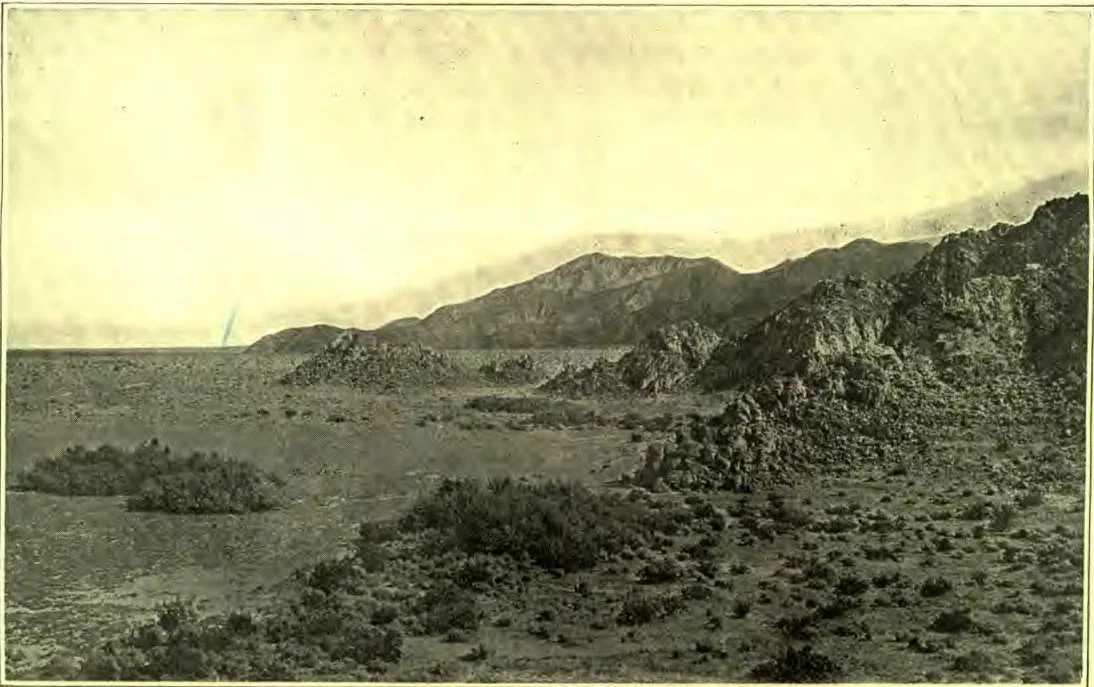
SOUTHERN California offers much of interest to tourist, student, or agriculturist. From Mecca, of Riverside County, we will take a look at one part of this land.
Mecca is on the Southern Pacific Railroad. The valley in which it is situated is known as Coachella Valley—meaning “valley of shells.” All of this area, like Imperial, is a part of the Colorado Desert. The branch of the sea which covered this country, formed a narrow neck, extending from the present Gulf of California in a northwesterly direction.
Indio is situated at the upper, or northwest, end of this dry sea basin, and is about fifteen feet below sea-level. Mecca is about one hundred eighty-seven feet; while Salton Sink, the lowest part of the valley, is nearly three hundred feet below the level of the sea.
Coachella Valley is bounded on the north and east by the San Bernardino Mountains, and on the southwest by the Santa Rose and San Jacinto ranges. A space between the mountains is left near Salton, where the railroad passes, and that opening connects Coachella Valley with Imperial Valley. This last-named valley exported over three hundred sacks of grain this last season. Imperial gets its water-supply from the Colorado River, while Coachella gets its supply from surface and deep artesian wells, which vary in depth from three hundred feet to six hundred feet, while the surface wells are only a few feet deep. In the lowest elevation the surface well usually gives out a stream like a spring.
There are millions of little white sea-shells of various shapes and sizes which were left here when the Gulf waters changed their course. The old beach line is very distinctly seen along the mountains’ side. Beautiful coral beds are found here. From Coral Point, which was once a small coral island, excellent pieces of coral may be obtained. A short distance from Coral Point is the Salton Sink, or Basin, where the Salton salt-works are located. Salton Sink can no longer be called a dry basin, but a lake, as about three hundred square miles are now under water, which is due to the great amount of waste water from Imperial Valley and the unusual amount of rain this last season, the rainfall having amounted to over twelve inches, while two inches is the average yearly fall. This increase of water has flooded the salt-works, and caused them to be closed, and has damaged the works considerably.
Fish Springs is another place of interest, and obtains its name from the many fish that are in this large flowing spring. No one has been able to tell how the fish got there. This spring is sometimes called a bottomless pit, as the longest testing cord that has been used in its measurement was two hundred fifty feet, but it did not reach the bottom. The spring is about twelve feet across at the top, but much wider underneath the rim, which is formed of coarse grasses that have grown up and matted together year after year. One may stand on the bank and reach a six-foot pole back under the crust of ground on which he stands, and a stamp of the foot will spring the ground for several feet back.
CORAL POINT — THE OLD BEACH LINE
The desert air is light and pure. Fogs are unknown in this desert, and there is seldom dew enough to moisten the grass. The temperature is very pleasant most of the year, though it gets as hot as one hundred twenty degrees in August. Freezes are few and light, seldom killing garden truck, as we had roasting ears in February. They were somewhat injured, however, by the frost. The best-paying crops are grain, alfalfa, sweet potatoes, asparagus, early melons, figs, oranges, and grapes. Summer squash and string beans were shipped out the middle of April, melons and corn the middle of May, and potatoes from July first till the following spring.
The government has started a date farm near Mecca, and it gives promise of a paying crop. Perhaps the INSTRUCTOR readers will be interested to know that southern California exported this season thirty thousand car-loads of oranges and four thousand car-loads of lemons. These bring an average of five hundred dollars a car-load.
MRS. JOCIE WALLACE.
If the reader is not familiar with the location of the places mentioned by Mrs. Wallace, he will find the use of a geography or atlas adds much to the interest of the article. The editor speaks from experience. The suggestion seems more pertinent because of the three articles on the same subject to follow the one that appears in this number.—Ed.

“Am I a Soldier of the Cross?”

ISAAC WATTS, who wrote our hymn for this month, was the father of hymn-writing in the English language, and author of many of our greatest hymns.
He was born in Southampton, England, July 17, 1674. His father was not a member of the state church, and was twice thrown into jail for opposing it, so that, when a baby, his mother often carried him in her arms to visit his father in prison.
There are remarkable stories of young Isaac’s boyhood, one of them declaring that he begged for books before he could talk plainly, and others asserting that he began Latin at the age of four, and wrote poetry at the age of seven!
He became a minister in London. He was a little man, only about five feet tall. His health was very poor all his life, but his church took loving care of him, for he was greatly loved. One day, when Watts was sick, Sir Thomas Abney invited him to his splendid home for a week. He became so dear to the household that they kept him there for the rest of his life,—thirty-six years!
Besides his preaching, Dr. Watts wrote much. He was a most zealous student of geography, astronomy, philosophy, and theology, and he wrote books on all these themes. His great life-work, however, as he himself saw, was his hymn-writing.
Early in life he became wearied with the versified Psalms which the churches used, and set out to compose hymns of his own. This was a new departure, and met with persistent opposition, but his hymns soon became widely popular in nearly all the churches. In 1707 Watts published his famous collection of original hymns, which he entitled “Hymns and Spiritual Songs.” Only two or three copies are now in existence, and one of these sold in 1901 for seven hundred dollars. There were two hundred and ten hymns in this first edition, and one hundred and forty-four were added to the second edition.
The greatest of Watts’s hymns is probably “When I survey the wondrous cross,” and many — Matthew Arnold among them — have called it the greatest hymn in the English language. Among the other great hymns of this splendid Christian poet are “Jesus shall reign where’er the sun,” “Before Jehovah’s awful throne,” “From all that dwell below the skies,” “Come, let us join our cheerful songs,” “There is a land of pure delight,” “Our God! our help in ages past,” “Alas! and did my Saviour bleed,” “Come, Holy Spirit, heavenly Dove,” “Give me the wings of faith to rise.” Many of Watt’s children’s hymns have become famous, such as “Let dogs delight to bark and bite,” “How doth the little busy bee,” and the sweet cradle song, “Hush, my dear, lie still and slumber.” Watts had no children of his own, but well did he know the child’s heart.
The poet died Nov. 25, 1748, and was buried at Bunhill Fields, London, near the graves of John Bunyan and Daniel Defoe. He is to be ranked with Charles Wesley, the two standing together at the summit of English sacred verse.
This noble hymn was written by Dr. Watts in 1709, to follow a sermon on 1 Cor. 16:13, “Watch ye, stand fast in the faith, quit you like men, be strong.” It is sometimes condensed to four stanzas, but surely we shall not wish to lose the last two. Here it is:—
“Am I a soldier of the cross, A follower of the Lamb? And shall I fear to own his cause Or blush to speak his name?”
“Must I be carried to the skies On flowery beds of ease, While others fought to win the prize, And sailed through bloody seas?”
“Are there no foes for me to face? Must I not stem the flood? Is this vile world a friend to grace, To help me on to God?”
“Sure I must fight, if I would reign; Increase my courage, Lord! I’ll bear the toil, endure the pain, Supported by thy word.”
“Thy saints, in all this glorious war, Shall conquer, though they die; They view the triumph from afar, And seize it with their eye.”
“When that illustrious day shall rise, And all thy armies shine In robes of victory through the skies, The glory shall be thine.”
—Amos R. Wells.

Harvest Ingathering Program

OPENING SONG.
REPEATING OF SCRIPTURE TEXTS.
SONG: “Crown Him Lord of All.”
PRAYER.
SONG: “We Praise Thee, O God.”
EXERCISE I: Annual Feasts.
EXERCISE II: Feast of Tabernacles.
SONG: “Count Your Many Blessings.”
RECITATION: “Harvest Ingathering.”
RECITATION: “The Harvest Time.”
CONCERT EXERCISE: “We Thank Thee.”
SONG BY CHILDREN: “‘Tis Shining Still.”
EXERCISE III: Water of Life.
EXERCISE FOR SIX GIRLS: “Nothing to Do.”
RECITATION: “A Talk on Giving.”
RECITATION: “A Little Pebble.”
COLLECTION.
PRAYER OF THANKSGIVING.
SOCIAL SERVICE.
SONG.
BENEDICTION.
The suggestions given by Miss Anna Hibben last year for directing those who have the responsibility of arranging for the Harvest Ingathering service are good enough to bear repeating this year. She says:—
“The program with suggestive exercises prepared for ‘Harvest Ingathering’ this year has been arranged with a desire to avoid anything that would lead the youth and children into the worldly ways of doing things. We trust that as it is carried out, or others arranged, all will be done with earnest prayer that nothing of the common may come in, but that God’s richest blessing may rest on all that is said and done. Anciently it was a time of rejoicing for young and old,—true, heartfelt joy and thanksgiving for the blessings of another year. Surely this of all other years is one of wonderful protecting care amid so many calamities by land and sea, through wrecks, storms, and fires.
“Again I would appeal to all who engage in arranging Harvest Ingathering exercises not to make it merely children’s day, but a day of rejoicing for all.
“From the light given regarding the arrangement for the ‘Feast of Tabernacles,’ anciently, we find special preparations were made for it,—that everything was brought from the woods that would please the eye and give expression to the universal joy of the people, and that the temple was the center of attraction. So it is in keeping with God’s plan to decorate the place of worship and in a way that he will be honored and the human eye pleased also. The things used should be natural, not artificial, and arranged tastily.”
The exercise calling for the repeating of texts of Scripture will depend for its interest and profit on a hearty response by the whole people. These texts should reveal the goodness of the Lord in a special way, and should be given promptly. Let the people be informed beforehand of what will be expected from them. Let not more than five or six minutes be consumed in this Scripture exercise.
Let the second song be started, without any announcement, immediately at the close of the exercise. Two stanzas are enough to sing. The third song should be begun immediately after the prayer. It is so familiar that no time need be consumed in its announcement, or turning to it in the song-book.
The exercises numbered I, II, III, are intended for class exercises, several pupils standing on the rostrum, and a young person acting as questioner, standing in the aisle. If this position is taken by the questioner, the audience will be much more likely to hear the answer. Impress upon the pupils that the only reason for their giving the exercise is that those in the congregation together with themselves may receive help; therefore each one wants to speak directly to the people, making sure that each listener feels anew the goodness of the Lord in crowning our lives with rich blessings.

The Jewish Annual Feasts

Exercise I
1. What were the three annual feasts of Israel?
These general assemblies were known as the Passover, Feast of Pentecost, and the Feast of Tabernacles.
2. At what place were they held?
After Jerusalem became the center of the nation's worship, the tribes gathered there for the celebration of the feasts.
3. Who were expected to attend?
All the able-bodied men, and all the people who could make the journey, were directed to attend.
4. Since “the people were surrounded by fierce, warlike tribes that were eager to seize upon their lands,” how could the men afford to leave their homes?
They could do so because God's promise was: “I will cast out the nations before thee, and enlarge thy borders: neither shall any man desire thy land, when thou shalt go up to appear before the Lord thy God thrice in the year.” Ex. 34:24.
5. At what time of year did the first of these meetings, the Passover, occur?
It occurred in the first month of the Jewish year, which corresponds to the last of our March and the first of April—the spring of the year.
6. In what words does Solomon beautifully describe this season?
“The winter is past, The rain is over and gone; The flowers appear on the earth; The time of the singing of birds is come, And the voice of the turtle is heard in our land: The fig-tree ripeneth her green figs, And the vines are in blossom, They give forth their fragrance.”
7. How did the people employ their time while journeying to Jerusalem?
The grand Hebrew psalms were chanted, exalting the glory and majesty of Jehovah. At the sound of the signal trumpet, with the music of cymbals, hundreds of voices united in singing:— “I was glad when they said unto me, Let us go unto the house of the Lord. Our feet shall stand Within thy gates, O Jerusalem . . . Whither the tribes go up, even the tribes of the Lord, To give thanks unto the name of Jehovah.”
8. As the holy city came into view, and the pilgrims saw the smoke of the incense ascending, and heard the trumpets of the Levites calling the people to the evening service, what response did they make?
They caught the inspiration of the hour, and together sang the words of Ps. 48:1, 2; 122:7; 118:19; 116:18, 19. (Let the words of these texts be repeated together as one selection.)
9. When did the Feast of Pentecost come?
Fifty days after the Passover, the Feast of Pentecost was held. Its celebration occurred but one day, and the religious exercises of the day were to express the gratitude of the people for the grain used for bread.

Feast of Tabernacles

Exercise II

1. What was the third and crowning festal gathering of the year?
It was the Feast of Tabernacles, and was held in the seventh month, or in the autumn.
2. What was the purpose of this meeting?
This feast acknowledged God's bounty in the products of the orchard, olive grove, and vineyard.
3. What things tended to make this a joyous occasion?
It came the day after the day of atonement, when the assurance had been given that their iniquity should be remembered no more. At peace with God they came before him to acknowledge his goodness and mercy, and to thank him for the bounteous harvests they had just garnered. It also was meant to commemorate their life in the wilderness.
4. What does the prophet of God say about the people of God now holding a Feast of Tabernacles, or Harvest Ingathering service?
“Well would it be for the people of God at the present time to have a Feast of Tabernacles,—a joyous commemoration of the blessings of God to them.” Then we should “gratefully call to mind the various ways God has devised for bringing us out from the world, and from the darkness of error, into the precious light of his grace and truth.”
(This last admonition gives a basis for a good social service of a few minutes' length at the close of the program.)
5. What was one way in which every one expressed his gratitude?
“Old and young, rich and poor, all brought some gift as a tribute of thanksgiving to Him who had crowned the years with his goodness.”

Harvest Ingathering

YEARS ago the Hebrew people, Led by God from Pharaoh’s hand, Dwelt in tents for many seasons Ere they reached the promised land.
Tenderly Jehovah led them Through the dangers of the way, Fed them with the bread of heaven, Gave them water day by day.
Then, when they had reached the haven, Gained at last the promised rest, Joyous feasts were celebrated By the ones whom God had blessed.
When the harvests all were gathered In the autumn of the year, Then the parents and the children, Old and young, would all draw near
To the city God had chosen, To the temple of his name; There, each one with branches laden, God’s own people gladly came.
With the branches they had gathered, Booths they made to celebrate How God brought them out of Egypt— Work so mighty and so great.
They recounted how he led them, How they dwelt in tents so long, How his love their needs remembered, Sang his praise in joyous song.
We, like Israel, were in bondage, Deep in sin, by Satan bound, Till our God, in love and mercy, Shed his light of truth around.
He has brought us out of Egypt, Led us gently all the way; And, to celebrate his goodness, We have gathered here to-day.
Let us each recount his dealings Till our hearts with gladness swell As we think about his mercy, And our lips his goodness tell.
He has sent his Son to save us; Jesus died that we might live. This alone, of all his blessings Calls for all that we can give.
He has sent the rain and sunshine, Causing fruits and flowers to grow; He has given food and clothing, Soothed us in our grief and woe.
And if we should name them over All the things that God has done, We could not begin to count them, And could never pay for one.
So our hearts would bow before him In the deepest gratitude; All we have and are we give him, For we know that God is good.
And when all his work is over, At the last great harvest time— That ingathering of his people When they come from every clime
To adore the dear Redeemer, And recount his dealings o’er— May each person here assembled Praise him there forevermore.
MRS. MINNIE EMBREE PARKER.

Exercise for Six Children: We Thank Thee

IN the exercise for six children all of them repeat together the title of the poem, “We Thank Thee,” and then the children in order each repeat a line. Then all together say the last line of the stanza. Each stanza is given in the same way.

A Chalk Talk on Giving

This may be given by a small boy with a toy blackboard. As he speaks the first six lines, he makes six small circles from right to left. As he says “head,” “hands,” and “feet,” he makes a straight perpendicular mark for each word. For “self” he places a large S over the last two marks, making a dollar mark. Completed, the figures read, $1,000,-000.
These are the pennies that I shall give To the cause of Jesus as long as I live.
But a penny is such a very little bit of money, do you think they’ll count it? I’ll make it count! I’ll give much more! How can I, though, from my scanty store?
I’ll give my head, my hands, my feet, I’ll give myself,—and it’s complete.
And, when I come with my gifts all told, My pennies will grow a millionfold! — Martha E. Race.

The Water of Life

Exercise III

1. What was the most impressive service of the Feast of Tabernacles?
It was the service that commemorated the gift of water in the wilderness from the smitten rock.
2. On what day of the feast did this event occur?
It came on the last day.
3. How was this great day welcomed?
“At the first dawn of day, the priests sounded a long shrill blast upon their silver trumpets, and the glad shouts of the people from their booths, echoing over hill and valley, welcomed the festal day.”
4. Describe the service.
The priest dipped from the flowing waters of the Kedron a flagon of water, and, lifting it on high, while the trumpets were sounding, he ascended the broad steps of the temple, keeping time with the music with slow and measured tread, chanting meanwhile, “Our feet shall stand within thy gates, O Jerusalem.”
He bore the flagon to the altar, and poured it into one of the two silver basins near the altar, and poured a flagon of wine into the other basin. The contents of both flowed into a pipe which communicated with the Kedron, and then into the Dead Sea. The water represented the fountain that at the command of God had gushed from the rock to quench the thirst of the children of Israel, and the wine the blood of Christ which was to flow for them. Then the jubilant strains rang forth, “The Lord Jehovah is my strength and my song; therefore with joy shall ye draw water out of the wells of salvation.”
5. What part did the Saviour take in the last Feast of Tabernacles preceding his death?
On the last day of the feast suddenly Jesus lifted up his voice, in tones that rang through the courts of the temple: “If any man thirst, let him come unto me and drink. He that believeth on me, as the Scripture hath said, out of his belly shall flow rivers of living water.”
6. What call ought we to hear to-day in our service?
“Jesus is still crying, ‘If any man thirst, let him come unto me, and drink.’”
7. What will this water of life do for us?
“Whosoever drinketh of the water that I shall give him, shall never thirst; but the water that I shall give him shall be in him a well of water springing up into everlasting life.” It will put within us a desire to pass the gospel light on to others; it will make us want to bring gifts to Jesus; it will fill our hearts with love so that we can not treat others unkindly.
8. What vision did Ezekiel have of the waters of life?
Ezekiel had lived in Jerusalem, but with others had been taken captive to Babylon by Nebuchadnezzar. Here he spent years exiled from his native land, but God gave him many visions for the encouragement of his people. Among them was one of the holy waters recorded in the forty-seventh chapter of Ezekiel. The prophet stood near the door of the temple, and saw a river start from under the sanctuary. A man stood by him, and together they followed the river. At first the water was only to the ankles; farther on it was knee deep, and the next time to the waist, and after that like a river that they could not pass over. Trees grew on both sides of the river, and wherever it went, it carried life and blessing. In the river were many fish, and the fishermen spread their nets along the shore. The trees bore many kinds of fruit, and their foliage never withered, because of the river, which was much like the one John describes in Revelation. “And he showed me a pure river of water of life, clear as crystal, proceeding out of the throne of God and of the Lamb. In the midst of the street of it, and on either side of the river, was there the tree of life, which bare twelve manner of fruits, and yielded her fruit every month: and the leaves of the tree were for the healing of the nations.”
9. What is the meaning of the vision of the Holy Waters?
“Ezekiel’s vision was to teach that once again blessing and life were to start from God’s house in Jerusalem, and go out, widening and deepening like a river. When the children of Israel forgot God and worshiped idols, they did not make God’s house a blessing, so he sent them to a strange land to stay until they were ready to take God back into their hearts and lives and do right. Wherever there is a house of God, it should be a blessing, because those who hear God’s word should carry it away and tell it to others, and the blessing should go on and on, widening and deepening all the time.”
10. I have read somewhere of Moffat and Livingstone sitting on a hillside in Africa overlooking jungle and plain, picturing to each other meadows and green fields, prosperous homes, with white church spires and schoolhouses. These two men and many others gave their lives to work such transformations, and their visions are already becoming real. In Africa, in Asia, and in great islands of the Pacific, the river flowing from beneath the spiritual temple is extending its healing waters. What personal lesson should these things bring home to the heart of each one who has a knowledge of this gospel of the kingdom?
It should make us more active in doing all we can to have the water of life that flows from the sanctuary of God have free course throughout the earth, and especially active that all about us should receive the blessing that comes from drinking at this fountain of life.

The Harvest Time

This is the gathering time of the year, And merry singing for harvest home, And the signs of plenty and right good cheer Ere the days that are dark and dreary come. These are the days of tranquil air, This is the time of an answered prayer.
Was ever such gold as the golden grain, Heaped in the fields for the needs of man? Warmed by the sunshine, watered by rain, It pays for all care as it only can. It has done its part, and its life it yields To the harvest song of the clean-swept fields.
Meadows and orchards and rich corn-lands Are wealthy with fruitage of all the year; And the world seems lifting its thankful hands For the needed blessings that aye are near; The year is glad when it gains its prime, And hearts are merry at harvest time.
Whoever is thankful let him come, With willing hands and a loyal heart, And help in another harvest home, Where the Master calls him to do his part; For he points to the whitened fields again, And the harvests he loves are the souls of men.
— Marianne Farningham.

Christ Gave His Life for the Race

“My life is not my own, but Christ’s who gave it, And he bestows it upon all the race.”

As the Stars of Heaven

The sky is full of star-worlds, and a little boy of mine With eyes that gleam and sparkle would count them as they shine. I watch, and soon a shadow o’erspreads his eager face. “I got to fifty, papa, and then I lost my place!”
Ah, little heaven-watcher! I, too, have sometimes thought To count the golden blessings that life to me has brought. But, while I’ve stood before them, sown wide as stars in space, I’ve cried unto my Father, “Dear God, I’ve lost my place!” —James Buckham.

An Exercise for Six

We Thank Thee

FOR the fruit upon the tree, For the birds that sing of thee, For the earth in beauty dressed, Father, mother, and the rest; For thy precious, loving care, For thy bounty everywhere, Father in heaven, we thank thee.
For the sunshine, warm and bright, For the day and for the night, For the lessons of our youth, Honor, gratitude, and truth; For the love that met us here, For the home and for the cheer, Father in heaven, we thank thee.
For our comrades, and our plays, And our happy holidays; For our lives but just begun, For the great gift of thy Son; For the joyful work and true That a little child may do, Father in heaven, we thank thee.
Continue reading: THE WEEKLY STUDY