The Youth’s Instructor, Vol. 27, No. 19.

Piute Indian Beliefs and Healing Practices in Carson Valley

The Youth’s Instructor

May 14, 1879

S. D. A. Publishing Association · Battle Creek, Mich. · May 14, 1879

Piute Indian Beliefs and Healing Practices in Carson Valley

FROM SEA TO SEA.—NO. 7.

In the present article we wish to speak more fully of the Piute Indians in the Carson Valley, Nevada. Some of their religious notions are very strange indeed. When one of their number is sick, they think it is a visitation of evil spirits; and although they use some remedies for the disease, their greatest concern is to drive the devil away from their wigwams. To do this, they beat themselves unmercifully, and keep up a piteous howling all night, very much resembling the barking of a pack of coyotes.
Besides the common Indian mode of severely sweating the sick and immediately plunging them into cold water, these Piutes have what they call “patting and sucking doctors.” Patting the body in a lively manner to relieve pain is a remedy which has been adopted by some physicians among the whites; but the Piute’s practice of sucking the affected parts is not so commendable.
A Piute doctor is supposed, by his tribe, to have power to drive away evil spirits. If one takes it upon himself to heal the sick, he is a great man, and his work is a solemn affair. If he promises to raise one who is sick, and fails to do it, the faith of his tribe in his power is greatly weakened; and when he fails the third time, they think it is sufficient proof that the spirits have a grudge against him, and his life is taken to satisfy them.
In most cases, when the Piutes find that their friends are about to die, they leave them to die alone. Especially is this course pursued with the aged and infirm among them. When a contagious disease breaks out, those who are attacked by it are often abandoned not only to die alone, but to be devoured by wild beasts. This is because their friends regard the presence of such a disease positive proof that Satan is very angry with them, and they hurry to get away from those who are the victims of his wrath.
When so situated that they can do it, they find a tree in some secluded spot, in which, with poles and brush, they construct a platform; on this, the dead, having been wrapped in blankets, are laid, and then covered with brush to keep ravenous birds from devouring them. Here they are allowed to remain several days and sometimes weeks, fresh food being placed by them occasionally. When it is thought that they have had sufficient time to make a safe journey to the “spirit land,” their bodies are taken down from the “burial tree,” and deposited in the earth in some spot where the whites will be unable to find them.
Their mode of mourning for their dead is very peculiar. For some time the air resounds with their doleful strains of lamentation; but this is not all. They smear their faces with pitch, as a sign of mourning; and what is still worse, they are not permitted to wash their faces while the least particle of this pitch remains upon them. It must be allowed to remain until it wears off. This requires three months, and sometimes longer, according to the power of the skin to work it off.
I should consider it quite an infliction to go such a length of time without washing my face, especially in a country where so much dust is flying as there is most of the time in this valley. When I was there about a year ago, I saw an old Indian who had lost a little boy several weeks before. It was truly a pitiable sight to see his face all covered with little hillocks of sand which had stuck to the pitch, and had even penetrated into his eyes, causing them to become much inflamed.
If an Indian loses his squaw, or a squaw her husband, they smear their faces with pitch, and mourn until it is all worn off; then they are free to marry again, if they choose. It is considered by them not only a mark of great disrespect for the dead, but also a great crime, to undertake to remove the pitch by washing.
With one more glance at this valley and its surroundings, we must leave the poor Piutes, pitying them for their darkness, and hasten on our journey.
There are marks which show that the valley immediately surrounding the sinks of the Carson and Humboldt Rivers was once a vast lake. As we look up along the mountain sides, we can distinctly trace a water line made by the washing of the waves of the lake. Sighting from point to point, and from one side of the valley to the other, I found that these water lines form a perfect level, as though they had been even with the surface of the lake. Besides, I was told that the Piutes have a tradition that this plain was once covered with water.
In the midst of this valley there is a great crack in the earth, extending a long way. This is evidently the work of an earthquake or some eruption. On either side of this crack are numerous small pieces of lava. The probabilities are that this eruption literally let the bottom out of the lake, and left some underground channel which carries off much of the water from the Carson and Humboldt Rivers.
J. N. LOUGHBOROUGH.

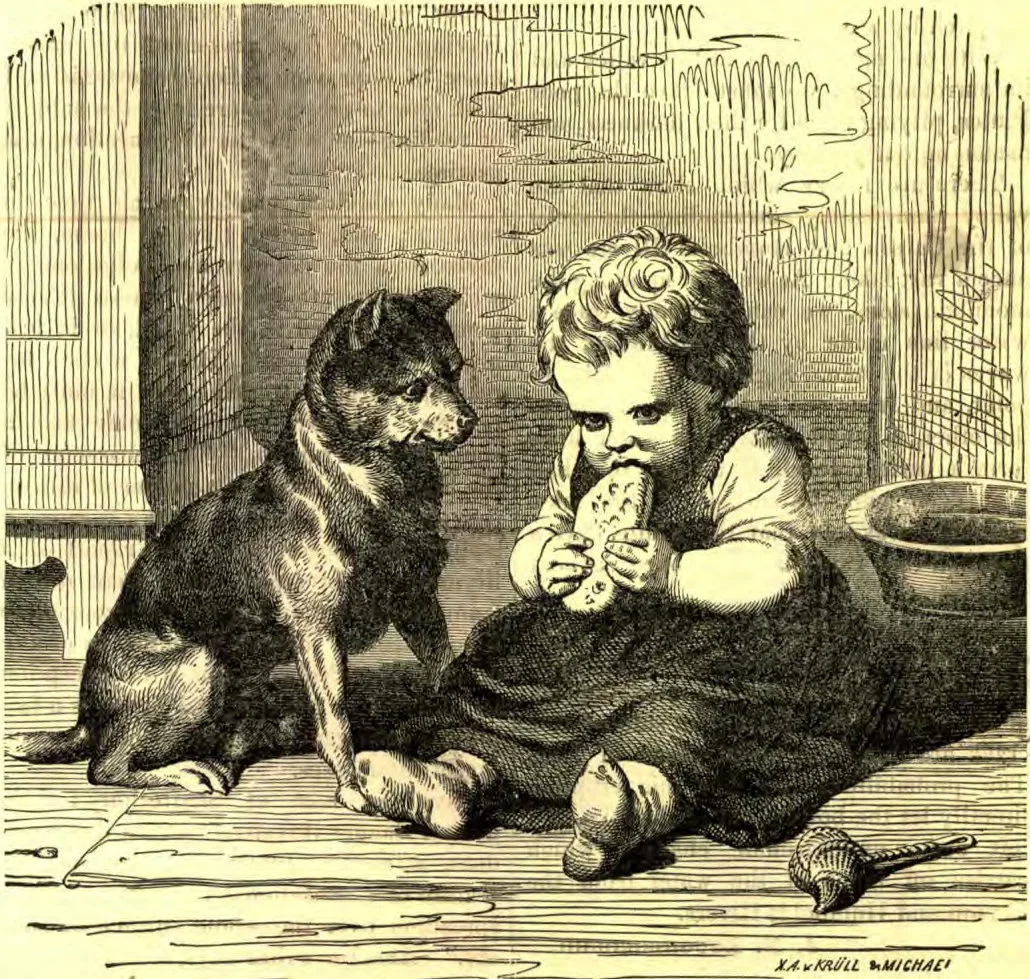
THE SELFISH BABY.

“PLEASE, baby,” says young Rover, “One little bite for me; The cake is such a big one, And full as it can be Of plums that would taste splendid To such a dog, you see.”
“No, no,” says selfish baby, “This cake is very nice, I cannot let you have a bit Of it at any price. My mamma knows how much I need, She gave me all the slice.”
“Then eat it,” says wise Rover, “I know ’t will make you sick, And I shall be revenged on you In that way, very quick; For too much cake will punish you As surely as a stick.
“And baby, you will learn at last, What all learn soon or late, That only sad unhappiness On selfishness can wait; For kindly angels never come To children through that gate.” —Myrtle.

MERCY AND WRATH.

Whenever Alexander, the monarch of the world, came to besiege a city, he would display his white flags or banners, in token of mercy; and so long as these were flying, there was opportunity for securing safety. But after a time those flags would go down, and in their place would go up the red flags, in token of wrath and blood, and then it was too late to be saved.”
How the above reminds us of the work of Christ, our great High Priest. He is now in the heavenly sanctuary, extending his white banners, upon which are written, Whosoever will, “let him take the water of life freely;” “him that cometh to me, I will in no wise cast out,” and many other such inducements to accept pardon while mercy is freely offered.
Christ’s position will not always remain the same, for the time will surely come, and we believe quite soon, when he will cease to officiate as priest; his priestly garments will be exchanged for those of the King of kings, when those offers of mercy will cease, and in their place will appear banners of justice and wrath.
Dear reader, dare we waste a moment when upon the verge of such a solemn event as that of Christ leaving the heavenly sanctuary? Let us shut our eyes to the allurements of Satan, and like Bunyan, “stop our ears and cry, Life, eternal life.” We must not squander precious time when such a prize is within our grasp. By the help of God we can enter the eternal city. Who will do it? Will you, and you, dear reader, every one, accept mercy before it is too late? M. J. C.
Hold on to your heart when evil associates seek your company and invite you to join in their mirth, games, and revelry.

“SLIDE ALONG A LITTLE.”

Viny wanted to take supper at grandpa’s. “But I don’t see how you can to-night, Viny,” said her grown-up cousin. “The table is all ready, and there are so many; and don’t you see there isn’t any room left?”
The grown-up cousin sat down in a chair and looked at the table, and then at the little pleader, as if to settle her convictions more firmly.
But was Viny vanquished? Not she! She climbed up beside the young lady, and, putting both arms about her neck, whispered,— “Nellie Bly, couldn’t you just slide the plates along a little, and make room for me?”
Of course she won; for who could resist that?
Thinking over the quaint little words, it came to me, how much pushing and crowding and spreading there is in the world; how our selfish selves keep saying,— “There is no room,—no room.”
Let us make room then. “Slide along a little,” and make a place for our neighbor. It isn’t worth while for one to enjoy all the good things at the feast. Christ says, “Whosoever will, let him come.”
Ah! does not that mean, “Move up, and show them you want them,—make a place for them?” Let us remember that there are other people in the world besides ourselves. “Slide along a little.”—Sel.

SOMETHING TO DO.

In the series under this heading, I have sought not only to impress upon the young the evils and dangers of idleness, but also to point out some of the most important things which should occupy their time. Having in my last presented the importance of improving school opportunities, I wish now to present more fully the subject of reading—as a means of education, and pastime.
Many children employ much time in reading; and, being thus at home, are saved from the dangers and pollutions to which those are exposed whose leisure hours are passed in the street, or in low places of amusement. Hence, a taste for reading is truly fortunate; still it must be properly guarded, lest it become also a source of corruption. The character of the books read becomes a matter of serious consideration. I recently read a paragraph stating that, according to the report of a librarian in Liverpool, there were drawn from the library during the past year three times as many volumes of fiction as of any other kind. Probably this is no exception to libraries in general, and hence is a fair index of the general character of the reading of the masses.
Says the Earl of Shaftesbury: “No greater danger threatens us than that abundant, attractive, idolatrous, poisonous literature of a sensational character which is spreading over the whole surface of society.” Another writer says, “The greatest danger of our times is the danger that threatens our youth from pernicious literature.” It must be acknowledged, however lamentable the fact, that a large share of our youth are being drawn into the current of fictitious reading. What will be the result?
Some may claim that there can be no harm in reading books and papers abounding in romance, if they also contain some lessons of truth. This is a serious mistake, for all the possible good thus gleaned is far outweighed by the sure effects of evil. It would certainly be very unwise and unsafe to mingle continually in the multitude of the base, hoping to meet occasionally a virtuous example. As truly as one is known by the company he keeps, his habitual thoughts and character may be known by the books he reads.
Why not seek truth where it is unmixed, untarnished by anything that can corrupt the imagination, feed the already perverted appetite for fiction, or destroy the taste for wholesome reading? “A person may be ruined by reading a single volume. Bad books, like ardent spirits, furnish neither aliment nor medicine,—they are poison. Both intoxicate—one the mind, the other the body. The thirst for each increases by being fed, and is never satisfied; both ruin—one the powers of mind, the other the health, and together they destroy the soul. The makers and the venders of each are equally guilty, equally corruptors of the community.” Young readers, don’t learn to love fiction. S. M. SPICER.

RELIGIOUS LIFE IN THE SABBATH-SCHOOL.

A NUMBER of things are essential to the largest success of a Sabbath-school. Brains, money, energy, tact, consecration, are required. The school should be held in the best part of the day; it should enlist the best talent of the church; it should be disciplined to perfect regularity and order; it should be provided with all needful appliances for doing Sabbath-school work; it should have the warm sympathy and earnest co-operation of the pastor; it should be held strictly to the diligent study of God’s word; it should be inspired with enlivening songs; it should be embalmed in the progress of the church; and, chiefest of all, it should have a definite, recognized purpose and mission. It should be a church institution, a missionary institution, and a thoroughly beneficent institution.
The church ought, of course, to sustain the school by its labors, contributions, sympathies, and prayers; and the school must often be established, especially in destitute and neglected portions of the land, by missionary zeal, and be maintained, built up, and rendered efficient by the toils and sacrifices of a practical beneficence. These things are granted; but in order to a large and permanent prosperity, a Sabbath-school must have a life of its own. Its heart must throb with a purpose; its brain must be worked to an end; its nerves must thrill with an inspiration, and its bone and muscle must be tasked for the production of a result. In other words, the religious life of a Sabbath-school is the very soul of the organization. Without this all else is a dead form and a useless display of machinery. The form is desirable and the machinery useful, just to the extent that they help the consummation of the chief object—the religious life; but when they obscure, smother, and destroy that life, they become a blight and a curse.
A result worthy of Sabbath-school efforts is only secured when pastor and superintendent, church and teachers, all interested and engaged in the exercises, regard the school as a means of grace, and expect to be enlightened and sanctified by the Holy Ghost through Scripture-study, prayer, and songs of praise. Then the conversion of the children is anticipated, and direct efforts made to bring them into the church. Then the Divine Presence is manifested in the school-room, and a sacred charm gathers about the place. Then both teachers and pupils are attracted to the school, they know not how, and absence is attended with a pang and felt as a loss. Our Sabbath-schools will not die out, if the salvation of God be in them. If the children are converted in the school, they will be bound to it by the strongest of ties and the most delightful memories. They will grow up in the school to become teachers in their turn, with holy sympathies and sanctified aims, bringing others also to Jesus.
A school must often get along as best it may, without many of the conveniences and appliances which are so desirable and which may often seem indispensable. But it need not be without a spiritual aim, an evangelical purpose, and a longing desire for the conversion of the children. The hearts of the superintendent and teachers may be hungry for the outpouring of the Spirit and the salvation of the school. In other words, it may have a genuine religious life and the manifest tokens of the Divine Presence. And, though many other things may be wanting, such a school will have abounding prosperity.—A. C. George, D. D.
IF you have great talents, industry will improve them; if moderate abilities, industry will supply the deficiency. Nothing is denied to well-directed labor; nothing is ever attained without it.

THE SABBATH-SCHOOL.

FOURTH Sabbath in May.

LESSONS FOR CHILDREN.

LESSON XIX.—GIDEON'S VICTORY.

“So THE people took victuals in their hand, and their trumpets: and he sent all the rest of Israel every man unto his tent, and retained those three hundred men: and the host of Midian was beneath him in the valley.
“And it came to pass the same night, that the Lord said unto him, Arise, get thee down unto the host; for I have delivered it into thine hand. But if thou fear to go down, go thou with Phurah thy servant down to the host: and thou shalt hear what they say; and afterward shall thine hands be strengthened to go down unto the host.
“Then went he down with Phurah his servant unto the outside of the armed men that were in the host. And the Midianites and the Amalekites and all the children of the east lay along in the valley like grasshoppers for multitude; and their camels were without number, as the sand by the seaside for multitude. And when Gideon was come, behold, there was a man that told a dream unto his fellow, and said, Behold, I dreamed a dream, and, lo, a cake of barley bread tumbled into the host of Midian, and came unto a tent, and smote it that it fell, and overturned it, that the tent lay along. And his fellow answered and said, This is nothing else save the sword of Gideon the son of Joash, a man of Israel; for into his hand hath God delivered Midian, and all the host.
“And it was so, when Gideon heard the telling of the dream, and the interpretation thereof, that he worshiped, and returned into the host of Israel, and said, Arise; for the Lord hath delivered into your hand the host of Midian. And he divided the three hundred men into three companies, and he put a trumpet in every man's hand with empty pitchers, and lamps within the pitchers. And he said unto them, Look on me, and do likewise: and, behold, when I come to the outside of the camp, it shall be that, as I do, so shall ye do. When I blow with a trumpet, I and all that are with me, then blow ye the trumpets also on every side of all the camp, and say, The sword of the Lord, and of Gideon.”
And every man did as Gideon had said, and their enemies were afraid, and the Lord set every man's sword against his fellow, even throughout all the host; and all the host ran, and cried, and fled.

QUESTIONS.

  1. Where were all the men sent except the three hundred that were chosen to go to battle? Judges 7:7.
  2. What did the three hundred take in their hands?
  3. Where were the Midianites encamped?
  4. What did the Lord tell Gideon to do that night?
  5. Who went with him?
  6. Why did the Lord wish Gideon and his servant to go alone by night into the camp of the Midianites?
  7. Describe the encampment of the Midianites. Verse 12.
  8. Relate the dream that Gideon heard a man telling to his fellow.
  9. What reply was made by the one to whom the dream was told?
  10. What did Gideon do when he heard this?
  11. What did he say to his men when he returned to them?
  12. How did they prepare for the battle?
  13. What did he tell the men to do when they should come to the camp of the enemy?
  14. What were they to say after blowing on the trumpets?
  15. When they did this, what effect had it upon the enemy? Verse 21.
  16. How did the Lord help to defeat the Midianites?
  17. What finally became of this mighty host?

Bible Lessons for Youth.

Lesson XLV.—The Spies, Continued.

  1. How were the people affected by the report of the spies? Num. 14.
  2. What did they say?
  3. What did Moses and Aaron do?
  4. What said Caleb and Joshua?
  5. How were they treated by the people?
  6. What did the Lord again propose to do?
  7. What plea did Moses make?
  8. Did God consent to spare the people?
  9. How were they to be punished for their rebellious conduct?
  10. What did he say of Caleb and Joshua?

Synopsis.

When the people had heard the report of those who had been sent to search the land, the whole congregation lifted up their voice, and wept that night. They murmured against Moses and Aaron, and said to them, “Would God that we had died in the land of Egypt! or would God we had died in this wilderness! And wherefore hath the Lord brought us into this land to fall by the sword, that our wives and our children should be a prey? were it not better for us to return into Egypt? And they said one to another, Let us make a captain, and let us return into Egypt.”
And Moses and Aaron fell on their faces before the congregation, and Caleb and Joshua rent their clothes and spake unto the children of Israel, “saying, The land which we passed through to search it, is an exceeding good land. If the Lord delight in us, then he will bring us into this land and give it us, . . . only rebel not ye against the Lord, neither fear ye the people of the land; for they are bread for us; their defense is departed from them, and the Lord is with us; fear them not.”
Instead of listening to these words of courage from Caleb and Joshua, the people hardened their hearts and bade them stone them with stones.
And the anger of the Lord was kindled against the people, and he said to Moses, “How long will this people provoke me! and how long will it be ere they believe me for all the signs which I have showed among them?” He said that he would smite the people with a pestilence and disinherit them, and make of Moses a greater nation. Again Moses was ready to plead for the erring people, and besought the Lord to pardon their iniquity according to the greatness of his mercy, even as he had forgiven them from Egypt even until then. He said that if the Lord were to destroy them, the nations round about would say that the Lord was not able to bring the people into the land that he had promised, therefore he had slain them in the wilderness.
So the Lord said that he would pardon the people according to the word of Moses, but yet he told Moses that those men, who, after seeing all his glory, and the miracles which he did for them in the land of Egypt and in the wilderness, had tempted him these ten times, and had not hearkened to his voice—they should not see the promised land; but that their children whom they had said should be a prey, should possess the land which their fathers had despised. He said that the people should wander in the wilderness until all those from twenty years old and upwards, who had murmured against him, should die; but that Caleb and Joshua, because they had had another spirit, they should enter into the land.
Now the men that brought back the evil report died by the plague before the Lord.
G. H. Bell.

LETTER BUDGET.

Pine Island, Minn.
Dear Editors: I take the INSTRUCTOR, and like it much. I am only six years old. I attend school in the summer, but this winter I am learning at home. I read in the First Reader. I got a prize at school. I have a pet colt whose name is Nell. I have three dolls whose names are Mamie, Nettie, and Katie. I live where I see the cars every day. Yours truly, Bessie Jewell.
Battle Creek, Mich.
Dear Editors: I am twelve years old, and have two sisters and two brothers, all younger than I. We went to Sabbath-school last summer; we could not go this winter, because we live so far from town, but we hope to go soon. I am very much pleased with the Tabernacle. I keep the Sabbath with my ma, grandma, sisters and brothers. Pa does not keep the Sabbath, but we hope he will some time. We take the weekly INSTRUCTOR, and I like it very much. We never went to day school, but ma teaches us at home. Your friend, Allie May Cummings.
Victory, Wis.
Dear Editors: I take the weekly INSTRUCTOR, and like it very much. I loan it to other children in the village, who like to read it. I am trying to read the Testament through. I have tried to keep the Sabbath with my mother ever since I can remember. I am a little boy eight years old. I would like to be good, and to be saved in the kingdom of God. Please pray for me. Genie Clark.
Otsego, Mich.
Dear Editors: I have been taking the INSTRUCTOR a long time. I am very much interested in it; think it the best paper I ever read; and as I am interested in the “Letter Budget,” thought I would like to take part in filling it up. Perhaps it would please you to know what I do with my papers. I read them, and then my brother lets me take his box of paints, and I paint the pictures very nicely and send them away to my cousin, hoping that he will be as much interested in them as I am. I am fourteen years of age. I go to Sabbath-school every Sabbath. Wish you could come into our Sabbath-school,—spectators say it is the best they ever visited. I hope we may so learn to live that we may see your faces in the world to come. Yours truly, Orletta Sterling.

CHANGES OF THE KALEIDOSCOPE.

THE following curious calculation has been made of the number of changes which this wonderful instrument will admit:—Supposing the instrument to contain twenty small pieces of glass, etc., and that you make ten changes in each minute, it will take the inconceivable space of 462,880,899,576 years and 360 days, to go through the immense variety of changes it is capable of producing, amounting, according to our frail idea of the nature of things, to an eternity. Or, if you take only twelve small pieces, and make ten changes in each minute, it will then take 33,264 days, or 91 years and 49 days, to exhaust its variations. However exaggerated this statement may appear to some, it is actually the case.
BENEFIT your friends, that they may love you still more dearly; benefit your enemies, that they may become your friends.

HANG-BIRDS

HERE is a beautiful group of American birds called Orioles, or Hang-Birds. They are so called because they hang their nests from branches of trees. The most noted of this group is the Baltimore Oriole, sometimes called Golden Robin; also Fire-Bird and Fire Hang-Bird, because its bright orange color seen through the leaves of the trees resembles flashes of fire.
These birds build their nests of different materials according to the temperature of the climate. In Louisiana its nest is made of moss, so woven that the air can pass easily through it, and is placed in the coolest position; in Pennsylvania and New York, the nest is built of the warmest and softest materials, and so placed as to be exposed to the sun’s rays. So firmly do they secure the nest that no wind can carry it off without breaking the branch to which it is suspended.
The song of this bird is a clear, mellow whistle. Its principal food consists of caterpillars, beetles, and bugs, particularly those of a brilliant, glossy green.

BE SURE YOUR SIN WILL FIND YOU OUT.

A LITTLE boy was once eating an apple, and was very much pleased when he found the seeds. His mother explained to him the use of seeds, and showed him how to plant them. They came up, and one of them became a fine, thrifty tree. This, his father taught him how to graft.
Soon after this, the boy received from his father a fine young horse as a birthday gift. Most boys can understand how much he prized the gift, and how he delighted in the frolics and docility of his colt.
One day his father was to be absent, and as he left home, he said, “Do not take your colt to the orchard; the young trees will be in danger.” The son, thinking himself for the time wiser than his father, took the colt there for his daily gambols; but to his sorrow he soon discovered that his own tree, which he had planted, grafted, and watched so carefully, until it had begun to bear fruit, was broken off directly above the graft. Poor boy! his sin had found him out. He went at once in tears to his mother to confess his fault. His mother grieved for his sin, and was sorry for his loss. She told him that sometimes there was a way to heal such wounds. With her advice and assistance he bound and splintered the broken tree, which grew and flourished again, and became fruitful.
Years afterward, when his father had gone to his rest, and the son had become a faithful minister, he came in the early autumn to visit his home and his mother. He was not long in finding the way to his own cherished tree, which he saw loaded with the finest apples, looking very beautiful. During that night there came a violent shower and tornado, and when he walked out in the morning, that tree, which he loved, was broken off and lay prostrate. As he examined, he found it broken in the very spot where so many years before it had been broken and bound up. Once more he wept, as his mother, standing beside him, said, “Do you remember how you disobeyed your father?” Yes, once more he felt that his sin had found him out.
M. A. C.

DO WHAT YOU CAN.

The little glow-worm by the road, Or sparkling in the meadow, Does what she can to beautify And cheer the evening shadow; And so may I, though small like her, And lowly in my station, If but my light be pure and true, Do good in my vocation.

The Children's Corner.

SHOWER AND FLOWER.

Down the little drops patter, Making a musical clatter, Out of the clouds they throng; Freshness of heaven they scatter Little dark rootlets among. “Coming to visit you, Posies! Open your hearts to us, Roses!” That is the raindrop’s song.
Up the little seed rises: Buds of all colors and sizes Clamber up out of the ground; Gently the blue sky surprises The earth with that soft, rushing sound. “Welcome!”—the brown bees are humming; “Come! for we wait for your coming!” Whisper the wild flowers around.
“Shower, it is pleasant to hear you!” Flower, it is sweet to be near you!” This is the song everywhere. Listen! the music will cheer you! Raindrop and blossom so fair Gladly are meeting together Out in the beautiful weather:— Oh, the sweet song in the air!
—Lucy Larcom, in St. Nicholas.

You have reached the end of this edition.

The Youth’s Instructor · May 14, 1879