The Youth’s Instructor, Vol. 35, No. 49.

THE ARK OF THE COVENANT

The Youth’s Instructor

Dec 7, 1887

S. D. A. Publishing Association · Battle Creek, Mich. · Dec 7, 1887

THE ARK OF THE COVENANT.
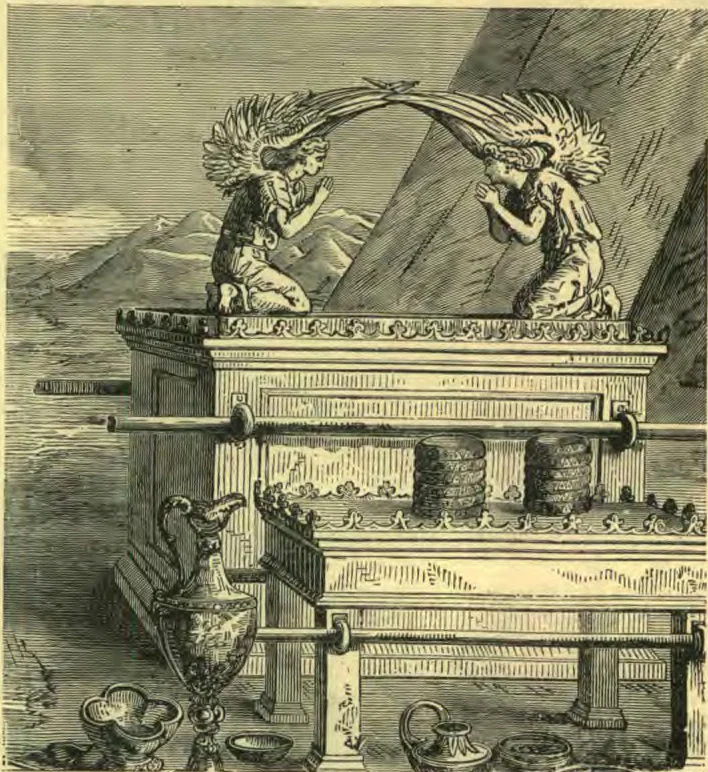
The ark was the most sacred object among the Hebrew people. It was a kind of chest of oblong shape, and was made of acacia wood. It was covered within and without with the purest gold, being nearly four feet in length, and about two feet and three inches in width and height. The ark was covered by a lid of solid gold, and extending around its upper surface was a border or crown. This cover was called the “mercy-seat.” On each end of the mercy-seat were two cherubim, with expanded wings, their faces looking downward. These angelic figures were made of beaten gold. The wings of the cherubim overshadowed the ark, and nearly touched, as seen in the illustration. In each of the four corners of the ark was attached a ring of gold, into which were placed staves, or poles, that were overlaid with the finest gold. By means of these staves the ark could be carried about. They were never to be removed from the rings under any circumstances. Ex. 25:15.
It was from between the covering wings of the cherubim, above the mercy-seat, that the Lord communed with his people. See Ex. 25:22. This passage says: “And there I will meet with thee, and I will commune with thee from above the mercy-seat, from between the two cherubim, which are upon the ark of the testimony, of all things which I will give thee in commandment unto the children of Israel.” In 1 Chron. 13:6 it is spoken of as “the ark of God the Lord, that dwelleth between the cherubim, whose name is called on it.” There are a number of texts which speak of God as dwelling between the cherubim.
The Lord was said to “dwell between the cherubim,” because it was here only that he taught the people through his chosen instrument. So we read, “And when Moses was gone into the tabernacle of the congregation to speak with God, there he heard the voice of One speaking unto him from off the mercy-seat that was upon the ark of the testimony, from between the two cherubim; and he spake unto him.” Num. 7:89. Thus it was that God communed with his ancient people from between the cherubim. It was over the cherubim and mercy-seat that the Shekinah, or divine presence, in the form of a luminous cloud, hovered perpetually, both in the tabernacle and the temple.
The ark was sometimes called the “ark of the covenant,” because it contained God’s law, the ten commandments, which was the basis or conditions of the covenant between him and his ancient people. See Ex. 19:5. It was called the “ark of the testimony,” because the two tables in it were witnesses against every transgression. The ten commandments are called the testimony in numerous passages. See Ex. 31:18. “And he gave unto Moses, when he had made an end of communing with him upon Mount Sinai, two tables of testimony, tables of stone, written with the finger of God.”
During the journeyings of the children of Israel in the wilderness, the ark was covered with a three-fold covering, the outer one of which was a canopy of blue. Num. 4:5, 6. Whenever it was moved, it was always carried, with the greatest reverence, upon the shoulders of the Kohathites, a branch of the family of Levi; and even these persons could not touch it under pain of death. Num. 4:15, 20. Except at stated times, even the high priest could not come into the presence of the ark, lest he should die. Lev. 16:2.
The history of the ark from the time that the Israelites crossed the Jordan till the destruction of Solomon’s temple may be briefly stated.
When the ark reached the River Jordan, the waters divided, and when the host had passed on, the river closed up again. Joshua, chaps. 3, 4. Before the ark the walls of Jericho fell down, and the city was taken. Josh. 6:4–12. After the entrance of the Jews into Canaan, the ark remained awhile at Gilgal, where there was an encampment of the people. Josh. 4:19; 10:43. After the land was subdued, the tabernacle was first set up at Shiloh, and the ark rested for about three hundred years. Josh. 18:1. In a war with the Philistines, at a time when the people had greatly departed from God, the ark was taken from the tabernacle to the Hebrew camp; but in the engagement that followed, it was taken into captivity by the enemy. 1 Sam. 4:3–11. The triumph of these poor pagans was, however, very short. They were so sorely afflicted by the judgments of God that they were glad to restore the ark to the Hebrews, which they did in a very ingenious way, after having kept it seven months. 1 Sam. 5:7. As the ark came back by the way of Bethshemesh, a number of the people were smitten for looking into this sacred depository. 1 Sam. 6:19. Then it was removed to Kirjath-jearim, where it remained separate from the tabernacle a number of years, and the people mourned that God had left them. 1 Sam. 7:1, 2. This was in the time of Samuel the prophet.
When David became established in the kingdom, he assembled a body of thirty thousand men, and attempted to bring the ark of God up to Jerusalem. They placed the ark upon a new cart, but as the oxen shook it, Uzzah stretched forth his hand to steady it. For this rash act he was smitten with death. David, in his terror, then left the ark at the house of Obed-edom the Gittite. 2 Sam. 6:1–12. The king afterwards acknowledged that this judgment occurred because they “did not seek God after the due order.” 1 Chron. 15:13. After three months, hearing that the Lord had greatly blessed Obed-edom and all his house, David, with great reverence and caution, brought the ark of God up to the city of David, Jerusalem, and placed it in a tent which he had prepared for it. And there they offered burnt offerings and peace offerings before God. 1 Chron. 16:1. Nearly forty years later, when the magnificent temple of Solomon was erected, the ark, with great devotion and circumstance, was deposited in the holy of holies. 1 Kings 8:6–9. Toward four hundred years after this, in the days of good King Josiah, when a great reform was in progress, he commanded the Levites to put the “holy ark” back into the house which Solomon had built. 2 Chron. 35:1–3. From this it is supposed that during the reign of the idolatrous kings, the pious priests had removed the ark to preserve it from sacrilege. Or it may be that wicked King Manasseh removed it himself to give place to the “carved image” which he set up in the sacred temple. 2 Chron. 33:7. Still later, when Jerusalem was taken by the Babylonians, and the people and the saved vessels removed to Babylon, the holy ark passes wholly out of sight. 2 Chron. 36:18, 19.
What became of this sacred object the Scriptures do not tell us. The Jewish people believe that it was concealed from the heathen “spoilers,” and regard it among the hidden things which the Messiah will yet reveal to them. The quite probable view is that stated by the author of the Book of Maccabees, that when the destruction of the temple by the Chaldeans was imminent, Jeremiah and others took the ark and concealed it from the enemy.
In the second temple there was no ark, but in its stead a stone occupied the place where the ark formerly stood. Indeed, that sacred edifice lacked five important things, as Dr. Clarke well says, which were the glory of the temple of Solomon. These were the ark, the sacred fire, the spirit of prophecy, the Urim and Thummim, and the holy Shekinah. See Clarke’s Notes on Matt. 28:22. It was the absence of these glories that made the ancient men weep when Ezra and others laid the foundation of the second temple at the return of the Babylonian captivity. Ezra 3:12. But the promise of the Lord by the prophet Haggai, that the glory of the latter house should exceed the former, was fulfilled by the Lord Jesus coming personally into the temple and proclaiming salvation through his name to both Jews and Gentiles. See Hag. 2:3, 9, and Luke 4:16–21.
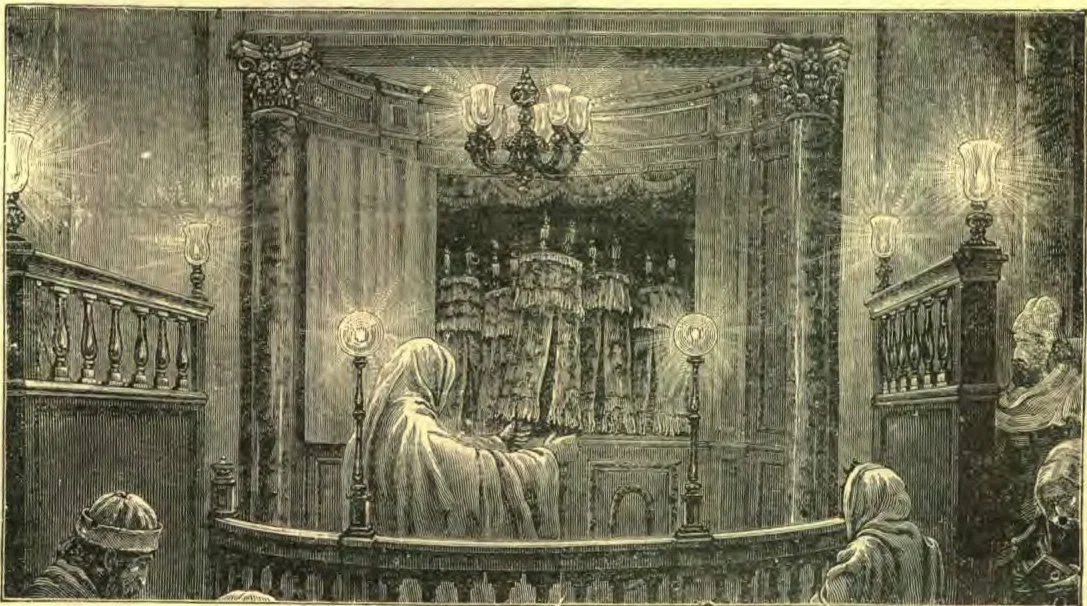
In the illustration on the first page there is a view of the eastern portion of a Hebrew synagogue. All Jewish synagogues face the east so that the worshipers can pray looking toward Jerusalem. See Dan. 6:10; 1 Kings 8:44, 48; Jonah 2:4. This is a general law among the Jewish rabbis. The dark background seen under and back of the chandelier is called “The Holy Ark.” It is an open receptacle, made of wood. In this ark we notice the five rolls of the law, or rather the beautiful cases which inclose the five books of Moses: Genesis, Exodus, Leviticus, Numbers, and Deuteronomy. The lamps are always lit in a Jewish synagogue during worship. The person in front, whose dress resembles that of a woman, is the reader of the synagogue, called the chazan. He is in the act of taking out one of the sacred rolls, or books. The man at the right is the “president,” or Jewish minister. The two persons before the chancel are at prayer, with their faces turned to the east toward Jerusalem. As you notice, all have their heads covered, as it is a law among the Jews, that all heads shall be covered in their places of worship.
In the small illustration is represented the sacred ark, with the covering cherubs, and in front is the golden table with the twelve loaves of shew bread; this last signifying our continual need of that heavenly Bread which gives life to all mankind. John 6:35. G. W. A.

TREASURES

Have hope! Though clouds environ round, And gladness hides her face in scorn. Put thou the shadow from thy brow; No night but hath its morn!
Have faith! Where'er thy bark is driven, The calm's disport, the tempest's mirth. Know this: God rules the hosts of heaven, The inhabitants of earth.
Have love! Not love alone for one, But man, as man, thy brother call, And scatter, like the circling sun, Thy charities on all.
Thus grave these lessons on thy soul,— Hope, faith, and love,—and thou shalt find Strength when life's surges fiercest roll, Light when thou else wert blind. —Schiller.

THE STRONG GATE.

I know a lad who lives in a beautiful castle with high windows; he has servants to guard him and do his bidding, to grind his corn and prepare his food, and to make sweet music for his entertainment. He can ride abroad to see his neighbors, and have his friends with him at his castle; it would seem as if he must have a very happy and prosperous life.
And yet he has a great deal of trouble; but I will tell you how this happens. The lad has a strong, watchful enemy who hates him, and has sworn his destruction. When he received the castle from his father, that father said to him: “Now, Filius, there is only one road by which our enemy can reach you, and I have provided strong bars for that path, which he can neither break down nor pass. But you must see to them yourself, and at least twice a day, night and morning, fasten them securely in place. If you do this, you will have nothing to fear from the enemy.”
This seemed a very simple remedy against evil, and Filius was sure that he would never neglect his gate of strong bars. But, would you believe it? he frequently fails to attend to this defense. Sometimes he will forget all about the gate; sometimes he will be hurried, and put off doing it; and sometimes he grows careless and lazy, and says to himself, “Never mind; my enemy will not come to-day.”
But his enemy always comes. Never once was that gate left down but the cunning foe found it out, and came swiftly along the path, and entered the castle.
What a silly boy to let his gate be down!
But be careful how you scorn Filius for his folly. Your mind dwells in the castle of your body, and your hands and feet, your eyes and ears, in fact all your members and senses, wait upon and attend it.
But your great enemy, the devil, is ever watching you. If you allow him access to your thoughts, he will destroy your peace, your purity, your salvation.
What then is the strong gate you may build against him? It is prayer. “Lead us not into temptation, but deliver us from evil.” If you utter the petition earnestly from the heart, as a soldier would pray for safety on a battle-field, this is a bar the devil dare not cross.
You know what path he takes to reach you. We all may know, if we will, what road of the heart lies open to the tempter. Up with the gate! Lift up the strong, imploring cry, “Lead us not into temptation, but deliver us from evil.”—Elizabeth P. Allan.

HOW PRAYER HELPED THE BABY.

In the city of New Orleans there are thousands of poverty stricken people. Many of my little readers, with their pleasant homes and comfortable beds, can have no idea of the woe and suffering in such a city as this.
A lady missionary, a friend of the writer, spends her time among the prisons and destitute parts of the city. Once she gave me a bit of her experience that will no doubt be interesting to the readers of the INSTRUCTOR. In a little damp room in one of the dark, wicked corners of the city, lived a very destitute family. The mother took in plain sewing. The father also learned to use the needle, and thus helped the brave mother and little girls; but, sad to say, he more than offset his help by spending some of the scanty earnings for drink. Is not Intemperance a hard master, when once he has control?
Along with other burdens, came one day another little burden,—a poor, delicate babe. All seemed to say, “What did you come for? there are more mouths here now than can be filled.” But baby was in no way sensitive, and showed every indication of having come to stay. As our missionary friend saw the poor little thing, so destitute, and so pinched by cruel poverty, her heart was drawn out towards it. She sought her room for prayer, believing if God would even notice the sparrow’s fall, he would also hear concerning baby, who was worth more than a whole field of such tiny birds. She earnestly prayed for God to take care of baby, to give it clothes and food, and that some friend might be found for baby’s mamma. Now see, children, how quickly God hears prayer.
Soon a letter came from a strange lady away in the far North, stating that she had a Sunday-school class of little boys who wished to support some destitute baby with their contributions. Baby’s case was then made known to them, and they accepted her. Soon came two little dresses, and some cash for mamma; shortly after more dresses and more cash. The little boys sent down an extra donation for baby’s picture. Don’t you think they were happy when they saw baby’s pretty picture, and heard their teacher read, from the missionary’s letter, how their contribution brought sunshine to the humble home? I think they must have remembered the words, “It is more blessed to give than to receive.”
Children, God is good, and is so anxious to work for us if we will only trust him.
“God moves in a mysterious way His wonders to perform.”
T. H. Gibbs.

HITTING THE NAIL.

At a recent Sunday-school concert in an Eastern city, an anecdote was related to the children, which is worth remembering.
One of the corporations of the city being in want of a boy in their mill, a piece of paper was tacked on one of the posts, in a prominent place, so that the boys could see it as they passed. The paper read: “Boy wanted—call at the office to-morrow morning.”
At the time indicated, a host of boys were at the gate. All were admitted, but the overseer was a little perplexed as to the best way of choosing one from so many, and said he:—
“Boys, I only want one, and here are a great many; how shall I choose?”
After thinking a moment, he invited them all into the yard, and driving a nail into one of the large trees, and taking a short stick, told them that the boy who could hit the nail with a stick, standing a little distance from the tree, should have the place. The boys all tried hard, and after three trials each, signally failed to hit the nail. The boys were told to come again next morning; and this time, when the gate was opened, there was but one boy, who, after being admitted, picked up the stick, and throwing it at the nail, hit it every time.
“How is this?” asked the overseer. “What have you been doing?”
And the boy, looking up, said: “You see, sir, I have a poor, old mother, and I am a poor boy; I have no father, sir, and I thought I should like to get the place, and so help her all I can; and after going home yesterday, I drove a nail into the barn, and have been trying to hit it ever since, and I have come down this morning to try again.”—Selected.

Remember the Cross: Verse on Faithfulness Under Scorn

If scorn be thy portion, if hatred and loss, If stripes or a prison, remember the Cross! God watches above thee, and he will requite; Stand firm and be faithful, desert not the right. —Norman M'Leod.

SINGING SCHOOL FOR BIRDS.

THERE is such a school as this, and very good scholars it makes. They cannot read or write, but they can sing. They sing a few simple notes, like the small linnets you may hear in the fields; but after they are taught, they will whistle regular tunes.
Last summer I was at a friend's house at Nahant. I rose early in the morning, and went down stairs to walk on the piazza. While there, I heard, as I thought, some person whistling a tune in a very sweet style. I looked around, but could see no one. Where could the sound come from? I looked up, and saw a little bird in a cage. The cage was hung in the midst of flowers and twining plants. “Can it be,” thought I, “that such a little bird as that has been taught to sing a regular tune so sweetly?” I did not know what to make of it. When my friend came down stairs, she told me that it was indeed the little bird who had whistled the sweet tune. Then my friend cried out to the bird, “Come, Bully, Bully, sweet little Bullfinch, give us just one more tune.” And then this dear little bird hopped about the cage, looked at its mistress, and whistled another sweet tune. It was so strange to hear a bird whistle a regular tune! “Now, Bully, said my friend, “you must give us ‘Yankee Doodle.’ Come, come, you shall have some nice fresh seed if you will whistle ‘Yankee Doodle.’” And the little thing did whistle it, much to my surprise.
My friend then told me that she had brought the bird from the little town of Fulda, in Germany, where there are little schools for teaching these birds to sing. When a bullfinch has learned to sing two or three tunes, he is worth from forty to sixty dollars; for he will bring that price in France or England. Great skill and patience are needed to teach these birds. Few teachers can have the time to give to the children under their charge so much care as these bird teachers give to their bird pupils. The birds are put into classes of about six each, and kept for a time in a dark room. Here, when their food is given to them, they are made to hear music, so that when they have eaten their food, or when they want more food, they will sing, and try to imitate the tune they have just heard. This tune they probably connect with the act of feeding. As soon as they begin to imitate a few notes, the light is let into the room, and this cheers them still more, and makes them feel as if they would like to sing. In some of these schools, the birds are not allowed either light or food till they begin to sing. These are the schools where the teachers are most strict.
After being thus taught in classes, each bullfinch is put under the care of a boy, who plays his organ from morning till night, while the master or mistress of the bird school goes round to see how the pupils are getting on. The bullfinches seem to know at once when they are scolded, and when they are praised by their master or mistress; and they like to be petted when they have done well. The training goes on for nine months; and then the birds have got their education, and are sent to England or France, and sometimes to America, to be sold.—The Nursery.

Livingstone on Sacrifice and Privilege

PEOPLE talk of the sacrifices I made in spending so large a portion of my life in Africa. Can you call that a sacrifice which is only a small payment on that great debt to God which can never be fully discharged? Say, rather, that it is a privilege. I have never made a sacrifice.—David Livingstone.
WORLDLY prosperity is not the safest ambition.

WHERE TO PLACE THE MAIN EMPHASIS.

In the use of language the proper effect is largely dependent upon the right use of emphasis. A wrong stress may not only obscure, but may positively pervert, the meaning of the sentence as a whole. How largely does the tone express the temper and spirit of our speech! The subtlest falsehoods lurk in emphasis, for the subtlest falsehoods are those which are perversions of truth while still wearing its form,—falsehoods which create wrong impressions without openly telling a lie. Language is, indeed, a subtle instrument of thought, and, as has been shrewdly said, is quite as able to conceal as to reveal thought. Emphasis is a subtle spirit which presides over language, and is able to turn it to any desired account. It can make our words true or false, sweet or bitter.
It will be plain, then, that the force and appropriateness of our language will depend greatly upon where we place the main emphasis. The minister who made the analysis of his sermon on the text: “Saul, Saul, why persecutest thou me?” by laying the main stress successively upon “why,” “persecutest,” “thou,” and “me,” did make the passage yield a fourfold meaning, but some of these emphases must have been perversions of its natural force. Imagine an orator exclaiming: “Friends, Romans, countrymen, lend me your ears,” as if he preferred to borrow these rather than anything else; or thus: “Friends, Romans, countrymen, lend me your ears,” as if he had none of his own.
Nor is it language alone which is dependent upon emphasis. Teaching takes its character from the main emphasis. It would be well for every Sabbath-school teacher to ask himself: Upon what do I lay the main stress? What ideas are central and determining in all my efforts with my class? All the teachers of a school may go over the same lesson, call attention to the same points, rehearse the same facts, and find the same moral, and yet make widely different impressions because of difference of emphasis. It is a great lesson to learn in teaching to emphasize in proportion to importance. In every biblical lesson there are many things that are important, but there are some things which are always of prime importance. The framework in which the narrative is set, the connection with the preceding and following events, the geography, history, and figures of speech, are important, but chiefly so as setting us into relation with the moral truths and spiritual principles contained in the passage. The great thing is to draw out and enforce the ideas and truths which bear upon Christian duty and life. Here should be placed the main emphasis in study, thought, and teaching.
He is likely to be the successful teacher in any branch of knowledge who has a keen and correct sense of the relative importance of things. The student who does not acquire this power will toil to little purpose. The world of books has grown too vast for us. We must be content to know and teach a little, but let it be something which is important; something which is useful, stimulating, helpful to mind and heart; something from which we learn more of God and of ourselves. We may well be content to know comparatively little, and to teach comparatively few things, provided these be of sufficient importance. It is no disgrace to be a man of one idea, if the idea is large enough. Paul was a man of this sort. He determined not to know anything save Jesus Christ and him crucified. But his “one idea” was the grandest and broadest ever entertained by the human mind. To know Christ, the manifested God, in his atoning love and in the manifold meanings and relations of his teaching and work in the world; to know in one's own experience the power of his life, and in the world's history the work of his transforming spirit,—might well satisfy the most aspiring soul.
But the most comprehensive question for us to consider is: Where are we putting the main emphasis of our life in its total influence on the world? Whether consciously or not, every person is putting the main stress of ambition, energy, and aspiration upon some particular purpose or end in life. Whatever that purpose is, determines chiefly the quality and range of our influence and usefulness among our fellows. While we build for ourselves, we build for others. Where we make ourselves strong in character-building, we shall be strong for influence and service. We cannot build one kind of character in ourselves and another kind in other men. Where we lay the main stress upon our own lives, we shall lay the main stress of our influence upon other lives. These two things —a man's formation of himself, and his part in the formation of other men—go together, and we can no more separate them than we can untangle the closely woven web of human society.
There are many things which are important, but there are a few things which are transcendently important. The formation of a Christian character, built firmly upon the truths of sympathy, usefulness, and sacrifice which Jesus taught and lived, and the exertion of an elevating and helpful influence which can spring only from such a character, is an aim so high and a purpose so comprehensive that we should lay upon it the main stress of thought, prayer, and energy. A celebrated sculptor, when approaching the end of his life, said to his friends: “What I was as a sculptor has seemed of great importance to me all my life. What I am as a follower of Jesus Christ is the only thing of importance to me now.” Many things are important; one thing is supremely needful.—S. S. Times.

THE GREAT OBJECT DEFEATED.

The great object of Sabbath-school teaching should be to affect the heart and life of those who are taught. This is generally best accomplished through the lesson itself, rather than outside of it. Every lesson should be written with a view to this fact, no matter what its subject may be. But the best-written lesson may fail of its object through unwise management on the part of the teacher. So far as possible, a lesson should be written with a view to climax; that is, the thoughts should be so built up, as the lesson advances, that the interest will naturally increase, and the strongest impression be made at the close. Thus it is easily seen that the last part of the lesson is very likely to be the most important part, the first part being more or less preliminary. To miss the last part of the lesson, then, is very nearly as bad as losing the lesson altogether. Again, since the culminating point of each lesson is near the close, to neglect that part would be to lose sight of the main points,—the links that make up the chain of leading ideas necessary to a good understanding of the subject which the series of lessons is meant to bring out.
But how many teachers there are who seldom get through a lesson during the time given for recitation. This is especially true in the senior classes. “Many a time and oft,” the teacher does not even get to the middle of the lesson. Then the classes join in general exercise, and there, since less time can be had than for the ordinary recitation, the last half of the lesson seldom receives much attention. Other teachers and superintendents make it a point to go through the lesson at all events, or rather to go over it; but the last part is often treated of in such a hurried manner as to lose all its force, and thus to leave the emphasis where it does not belong. Such a course confuses the mind.
But what is to be done when the lesson is too long? Well, a lesson that is not too long to be learned is not too long to be recited. A comparatively short time is needed to recite a lesson that has been thoroughly learned. But if the lesson is too long to be wholly mastered, it is far better to learn the most essential parts thoroughly, and pass over the other parts lightly. And this brings up another point. The pupils will soon come to give the most of their study to that part of the lesson which is most likely to be made prominent in the recitation. How often I have heard the remark: “Well, it is no matter if I do not study the last part of the lesson; for I have now studied farther than we shall get in the recitation.”
It is painfully true, however, that the shortest and easiest lessons are left unfinished as well as longer ones. I have been through a large division where not a teacher finished a lesson that could easily have been recited in ten or twelve minutes. What were the causes? They were the same that prevail, or are liable to prevail, almost everywhere.
In the first place, the teacher may be constantly interrupted by questions from the members of his class,—questions not asked for the purpose of gaining information, but to introduce some favorite hobby,—some trivial fact that the questioner imagines may be new to somebody, or some difficulty that will be likely to puzzle the teacher and perhaps the whole class. Not unfrequently the object seems to be to show that somebody’s commentary has been consulted, and vast wisdom obtained therefrom. In short, whatever the immediate object may be, the motive at the bottom of it all is to appear wise, or wonderfully discerning. Does it not indicate smartness to be able to discover difficulties that others have not seen? to ask questions that nobody can answer? to tell something that no one else may have read?
Such questioners do not seem to consider whether these interruptions will help or hinder in bringing out the main issue of the lesson. In fact, they seem never to have thought any such bearing could be possible. In many instances there appears to be a total lack of judgment in the matter. These trivial and often irrelevant things look larger to them than the great truth which the lesson aims to enforce.
In many instances the teachers set the example themselves, and do it innocently enough too. They fear that unless they bring in something new, they will not secure the interest of the class. So in a little while the main effort of the whole class is directed, like that of the ancient Athenians, toward “nothing but either to tell or to hear some new thing.” They forget that there is a greater and higher good to be had from studying and considering the lesson itself.
When the pernicious habit of straining after foreign matter is once formed, it is almost impossible to get the mind to settle down to any consistent or profitable study of the lesson.
Sometimes a morbid craving for discussion takes possession of a class like an evil demon; and truly it may be said of it that “This kind goeth not out but by prayer and fasting.” The unhappy school that is afflicted with this evil, is in a dangerous condition, and claims the pity of all lovers of truth.
Many become so intent on improving and supplementing the lesson, that they scarcely find time to study it enough to know what is in it. Others keep up such a running fire of improper questions and petty discussion that we strongly suspect them of trying to use up the time in such a way that their almost total neglect of studying the lesson will not be discovered.
Preliminaries are often necessary, but they should be brief; what may be termed side-lights are sometimes useful in bringing out the points of a lesson with greater force; supplementary questions and comments have their place; but they should all be made subordinate to the lesson itself. The stress of teaching, and the main portion of the time, should be put upon the chief features of the lesson, and especially upon its culminating point.
The teacher who cannot restrain a propensity to make lengthy comments on almost every passage in the lesson, should be admonished. The teacher who cannot control the minds in his class sufficiently to take them through a reasonable lesson in the allotted time, should learn to, or else resign his place. A teacher who cannot discover the important points in a well-written lesson, should be exchanged for one who can.
The evil treated of in this article is a great one, and very wide-spread. These few poorly-written paragraphs do not fully expose it, but may set some one to thinking. It is enough to make one’s heart ache to see hundreds of people passing over lesson after lesson, without gaining any perceptible moral or spiritual power from them.
The great question with us should be, What can we find in each lesson that will help us to become better men and women? All the critical Bible knowledge the world contains cannot make one Christian, nor take a single soul into the kingdom of God. Let us by all means take the lesson home to the heart first, and when it has done its work there, give it as much critical study as its nature demands, or as we have time to spare. G. H. B.

NEEDLESS INTERRUPTIONS.

A PRIME requisite to the teacher’s best success is freedom from interruption during the recitation hour. This is an idea that seems never to have entered the minds of some school officials. There is the conscientious superintendent, fearful lest some one shall think him shirking his duty or not showing sufficient cordiality. Full too often has he been seen to pause beside a teacher who had just succeeded, after half an hour’s patient effort, in gaining the undivided attention of each wayward mind, and proceed to pass comments on the number present, inquire regarding the cause of any absence, the interest the class is taking in the lessons, etc., etc., wholly oblivious to the fact that he had by this mistaken kindness neutralized the teacher’s best efforts for that day. And there is the pompous secretary, anxious to magnify the duties of his office, who interrupts with suggestions in regard to the record, donations, lesson papers, or what not, that falls in his line of work. Now there is no teacher who would not welcome questions of friendly inquiry or suggestions regarding the better performance of his work. “But to everything,” says the wise man, “there is a season, and a time to every purpose under the heaven; . . . a time to keep silence, and a time to speak;” and doubtless there is a time for the secretary to make criticisms and the superintendent to make inquiries, but we very much doubt if it is during the recitation hour. That time the superintendent should spend in quietly visiting from class to class, noting, either mentally or on a tablet, the excellencies of each teacher, or the points on which each needs help. Of these facts he can at some opportune moment make such use as the good of the school seems to demand. Now it must not be understood that the superintendent should never speak to a teacher during the recitation hour; but the occasions where he will need to do so are rare, and a considerate manager will seek to make them as few as possible.
W. E. L.

HOW MANY IN A CLASS.

There are a number of things to be taken into the account in deciding how many pupils ought to be put into a class. Of course, the first thing to consider is the number of teachers that can be had. If there are not more than five or seven persons in the school, that are available as teachers, then the school of necessity must be divided into not more than five or seven classes. But it does not follow that the classes should be equal in size. Some teachers may be able to hold the attention of eight pupils better than others can of five. If there must be any large classes, it is better that they should be made up of the older pupils. We quite often see the opposite course pursued, just because the younger ones take up less seat room. Indeed, some superintendents appear to make up their classes rather by weight than by number. Such should remember that it is harder to hold the attention of children than that of the same number of grown people.
There is one point, however, that is generally overlooked. A teacher who can conduct a recitation creditably with a good-sized class, may not be able to look after them properly during the week. There may be a lack of time, or a lack of disposition; or it may be a lack of both. Some teachers with very moderate skill in teaching may have better success than others who are remarkably efficient in the pedagogic art; and all just because they look after their pupils the whole week through. Napoleon Bonaparte made great conquests with but few battles. When asked how he accomplished this, he said, “By knowing how to follow up a victory.” Some teachers have not yet learned that art. In making up a class, then, the question should not be merely how many pupils the teacher can govern and teach, but how many he will look after. Of course this applies chiefly to classes of children; but people at any age like to be visited by their Sabbath-school teacher. How many happy hours have been enjoyed in this way,—hours of prayer and Christian intercourse that will bear fruit for the kingdom of God! G. H. B.
Continue reading: INDIANA S. S. ASSOCIATION