The Youth’s Instructor, Vol. 59, No. 6.

AFTERMATH

The Youth’s Instructor

Feb 7, 1911

Review and Herald Publishing Assn. · Takoma Park Station, Washington, D. C. · Feb 7, 1911

AFTERMATH
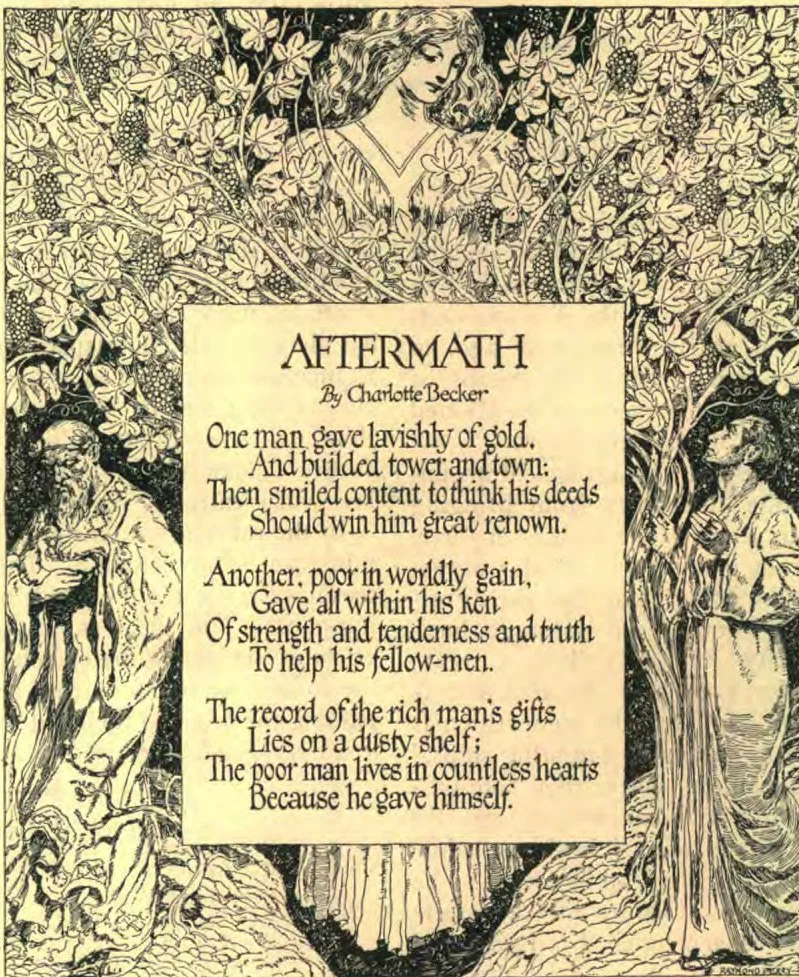
By Charlotte Becker
One man gave lavishly of gold. And builded tower and town; Then smiled content to think his deeds Should win him great renown.
Another, poor in worldly gain, Gave all within his ken, Of strength and tenderness and truth To help his fellow-men.
The record of the rich man's gifts Lies on a dusty shelf; The poor man lives in countless hearts Because he gave himself.
From the Delineator.

An Atlantic Steamship Combination

IN New York, on January 4, the government brought suit against nearly all of the transatlantic steamship companies, under the Sherman Anti-Trust law, alleging that they are parties to an unlawful combination, having conspired by an agreement known as the Atlantic Conference, made in London nearly three years ago, to control the steerage passenger business by means of an allotment of traffic, by fines for excess of the allotted percentage, and by attacks upon competitors.
The court is asked to declare the agreement an unlawful one, to enjoin the companies from bringing ships into any American port so long as it is in force, and to enjoin them from making any similar agreement. It is alleged by the government that the agreement affects ninety per cent of the steerage business, amounting to fifty million dollars a year; that the fine imposed for exceeding the allotment is twenty dollars per passenger; that the competition is attacked and suppressed by means of “fighting ships,” sent to the ports of competitors, where they take passengers at very low rates; and that in this way one Russian company was driven out of business, while another was forced to enter the combination. The manager of a company now resisting attack asserts that four companies have been compelled to retire, and that the agreeing companies are assisted by the railroads, which give them rebates or commissions. At the agreeing companies’ foreign offices it is said that the suit was welcomed or even instigated by the defendants, who desired that the law should be tested, believing that the courts would say it was not applicable to their business. But the government does not admit that the suit is a friendly one. In the House, at Washington, Mr. Humphrey has introduced a bill forbidding the thirteen companies to enter or clear a ship in any of our ports, under penalty of a fine of two hundred dollars for each passenger, and a forfeiture of all merchandise carried. This bill also directs the Postmaster-General to cancel all contracts with these companies for carrying the mails.— The Independent.

To Keep Parsley All Winter

PARSLEY may be kept green and fresh all winter. Put it in a strong boiling-hot brine of salt and water. Leave in a half-hour and then hang up in a dry room with the blossom downward. Kept in this way it is as nice for flavoring soups, dressings, etc., as when it is freshly grown and gathered.— C. R.

First Postage-Stamps in China

CHINA had a well-organized postal service at least two centuries before Christ. It remained, however, for a foreigner to introduce postage-stamps into the Celestial empire, and to remodel the system, patterning it after Western ideas.
It was Sir Robert Hart who did the work, remodeling the imperial post and making it a subdivision of the imperial customs service, at first only as a convenience to the customs in transmitting their despatches from port to port.
When the slow-moving Chinese saw the wonderful advantages the new system had over the old one, they very quickly took it up, and it grew amazingly, so that now a letter may be sent to any part of China by ship, rail, or foot courier.
Sir Robert Hart still lives in Tientsin, China.— Selected.

Swift Kindness Is Best

“Swift kindnesses are best; A long delay in kindness Takes the kindness all away.”

The Greeley Centenary

In many schools, colleges, and clubs, fitting exercises commemorating the centenary of the birth of Horace Greeley were held Feb. 3, 1911. Mr. Greeley has the honor of being called “the man who made Lincoln president.” It was his effort, at least, that brought about Mr. Lincoln’s nomination; and it was his words, “Go West, young man,” that became the inspiration of much of the early Western migration. Mr. Greeley was one of the heroic figures in the combat against slavery; and his pen was ever wielded in behalf of the oppressed in bondage.

Paper Cups by Law

A NEW law has gone into effect in Massachusetts which prohibits, under penalty of a fine of twenty-five dollars, the use of common drinking-cups in any public park, street, or way, in any building or premises used as a public institution, hotel, theater, public hall, public school, or in any railroad station, railroad car, steam- or ferry-boat.
By the adoption and carrying into effect of this law the individual paraffine cup has sprung into popular favor; and already the manufacturers of this specialty are so overrun with orders that they have been obliged to add to their equipments in order to meet the demand for these cups. One manufacturer, whose product has exceeded more than one hundred thousand cups daily, has already added floor space and mechanical equipment to increase his output to at least five hundred thousand cups a day; and he states that it is very doubtful if this immense output will be sufficient to meet the future demands which the enforcement of this new law will create.
In the railroad stations and public park bubble fountains are being installed. The public-school committees have requested the pupils to bring their own drinking-cups. The theaters, anticipating the going into effect of the law, at the opening of their season adopted the individual paraffine cup, and ever since have been passing them out to their patrons at each performance. — Paper Trade Review.

The Publishing Work

An Agent of the Gospel

E. R. PALMER
The printing-press is one of God's great universal agencies for carrying the gospel of the kingdom to all nations. It may be called a universal agency from two points of view.
First, because it is an efficient agent in all nations; and second, because it is so varied that all, both old and young, and those who have many talents or few, can engage successfully in the work.
The printing-press is doubtless one of the greatest of the latter-day inventions which were foreshadowed in the prophecy, “Many shall run to and fro, and knowledge shall be increased.”

A Powerful Factor in the Reformation

It was given to the world near the close of the fifteenth century, at the very time it was needed to make the Reformation of the sixteenth century possible.
The leaders of the Reformation recognized in the printing-press an agent which all the power of the Papacy could not overthrow. During the first ten years of that mighty movement, upward of four hundred fifty publications, in the form of books, pamphlets, and tracts were issued from the Reformation presses, as compared with only thirty publications which at that time had been published by the Papacy.
Printers were engaged, tract societies were established, agents were trained, and large bodies of students from the universities upon which the Reformation had laid hold, were sent out two and two. Luther, Melanchthon, Zwingle, and others among the brightest stars of the Reformation were organizers and leaders in the work.
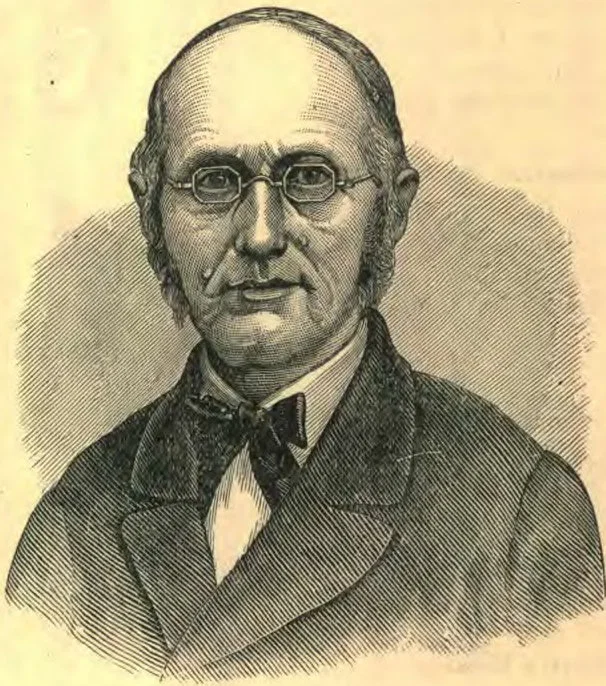
JOSEPH BATES
JOSEPH BATES
This literature found its way, not only to the nobility and the common people in Germany, but to England, the Netherlands, across the Alps to Italy, and to Rome itself, and even into the home of the Inquisition in Spain. Some of the writings of Luther were sold on the streets in Jerusalem six weeks after the date of their publication.
It was this movement, with the literature of the Reformation, which was symbolized in that wonderful dream of the elector of Saxony. In his dream he saw a monk writing “on the door of the church of the castle of Wittenberg,” in characters so large that they could be read at the elector's castle, and with a pen so long that it “reached as far as Rome, where it pierced the ears of a lion that was crouching there, and caused the triple crown upon the head of the Pope to shake.”
Literature has also been the foundation of the great, permanent foreign missions of the past century. One of the most striking illustrations of this fact is found in the work of Robert Morrison, who gave the Bible and a dictionary to China, as the fruit of twenty-five years of earnest labor. William Carey is called the “father of missions” in India, because of his great work in translating the Bible, or portions of it, into twenty-four of the languages and dialects of India. Judson, also, in Burma, and John Williams, the great missionary to the islands of the Pacific, made their work permanent by the translation of the Scriptures and other gospel writings, into the native tongues.

The First Seventh-day Adventist Literature

The first leaflet which might be considered definitely as Seventh-day Adventist literature, was published April 6, 1846, by Mrs. E. G. White, before her marriage, and was signed, Ellen G. Harmon. It was her first vision, and as far as we know, the first production which appeared from her pen. It was printed on the whole of one side and on one half of the opposite side of a sheet of foolscap paper. A foot-note invited the reader to write out his impressions on the half-page of blank space, and return the same to the author. Two hundred fifty copies were printed, and the expense was paid by Brother H. S. Gurney and a young man by the name of James White, the latter name appearing on the leaflet, as publisher.
About one month later, May 8, 1846, Elder Joseph Bates published a tract entitled “The Opening Heavens.” In August of the same year Elder Bates also published a forty-eight-page tract entitled “The Seventh-day Sabbath a Perpetual Sign.” This was doubtless the first tract published by Seventh-day Adventists on the Sabbath question.
The year 1849 was a most interesting one in the history of our publishing work. Three important publications were issued; namely, the first testimony, the first number of the Review and Herald, then called Present Truth, and the first collection of hymns.
The first testimony was addressed “To Those Who Are Receiving the Seal of the Living God,” and was signed, E. G. White.
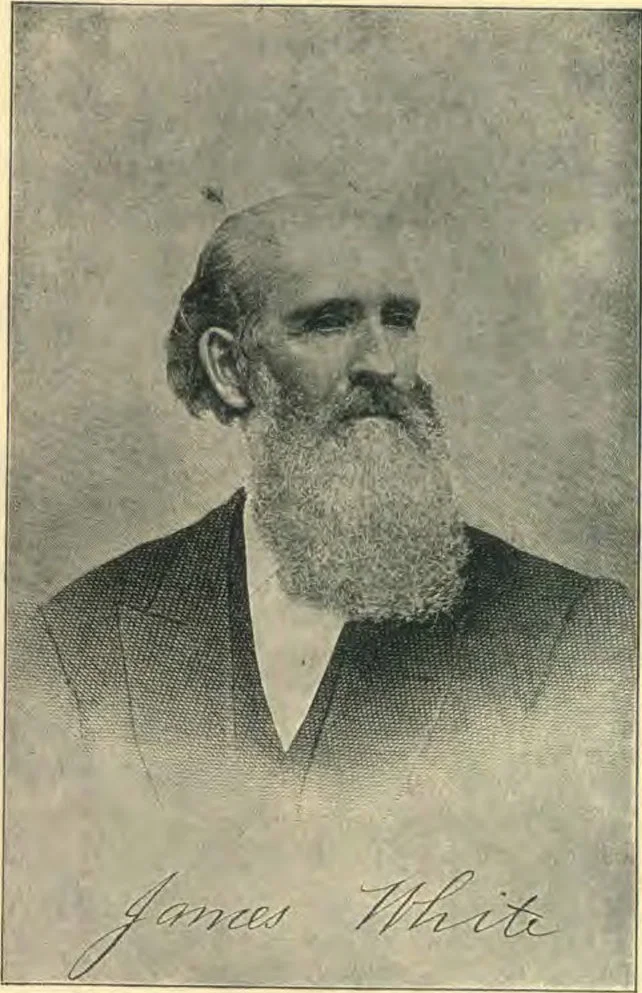
The first number of the REVIEW was published in July, by Elder James White, at Middletown, Connecticut, the money for the enterprise having been earned by cutting grass with a hand scythe; and the first edition was carried by Elder White eight miles from Middletown to Rocky Hill and back again, in a carpet-bag.
The first hymn-book was also published by Elder James White. The little book was 3⅜ x 5 inches, and contained forty-eight pages with fifty-three hymns. Hymn No. 3 begins with the stanza:—
“We speak of the joys of the blest— Of that country so bright and so fair; And oft are its glories confest; But what must it be to be there? We speak of its pathway of gold; Of its walls deck'd with jewels so rare; Of its wonders and pleasures untold— But what must it be to be there?”
At this time all our literature was given away, people who became interested being asked to contribute what they were able toward the publication of another edition.

The First Literature Sold

The first effort to sell our literature was in the year 1854, when Elder J. N. Loughborough, while holding a short series of tent-meetings in Rochester, Michigan, conceived the idea that our publications could be sold. The total value of one copy each of all the tracts and pamphlets published at that time was thirty-five cents. These were made up into parcels and offered for sale at the close of the meeting, by Elder Loughborough, at thirty-five cents a package. The literature sold in this way on three successive Sunday evenings amounted to fifty dollars.

An Interesting Comparison

It may be of interest to compare the parcel of literature at that time with what the volume and cost would be of one copy each of our tracts, pamphlets, books, and periodicals at the present time. The figures are as follows:—
NUMBER PAGES VALUE
Books 333 103,261 $377.03
Pamphlets 287 21,086 35.87
Tracts 1096 15,174 15.97
Periodicals 118 28,855 59.13
Totals 1834 168,376 $488.00
NOTE.—If convenient, these figures may be placed upon the blackboard or upon a large sheet of paper, where they can be more easily explained by the reader, and appreciated by the congregation.

A Pioneer of the Third Angel's Message

Since those early days of small beginnings, when God by his providence was planting the mighty seeds which were destined to spring up and bear fruit in all the world, the publishing work has kept in the van in the progress of the gospel to all nations, and has been the active pioneer to make a way for the living preacher.
Recently, Elder O. A. Olsen made the statement in a missionary talk that, so far as he has observed, our literature has really pioneered the way into every country which the third angel's message has entered.

Sixty-Five Years of Growth

We now have twenty-seven publishing-houses publishing our literature in sixty-seven different languages. The following figures show the value of literature sold from the beginning of our work until the close of 1909, the totals being given by decades during the first sixty years, or until 1904; and then the totals for each year are given during the first five years of the seventh decade:—
PERIOD VALUE
1845–1854 $2,500.00
1855–1864 17,500.00
1865–1874 73,000.00
1875–1884 371,000.00
1885–1894 3,969,000.00
1895–1904 3,144,000.00
Total for sixty years $7,577,000.00
1905 548,000.00
1906 824,000.00
1907 1,035,000.00
1908 1,290,000.00
1909 1,402,000.00
Total for five years 5,099,000.00
Grand total $12,676,000.00
NOTE.—These figures, also, should be placed upon the blackboard, where they can easily be seen and studied.
It will be observed that the total sales of literature during the past five years have been nearly two million dollars above the sales during the preceding ten years, and equals two thirds as much as the total sales for the previous sixty years. If the work continues to grow, as we trust it will, the sale of literature during the seventh decade in which we are now living, will be far above all the sales of the previous sixty years.

The Better Proofs of Progress

It seems almost a cause for regret that we are largely limited to figures expressing dollars and cents, in our effort to show the advance of a department of work, which includes the life, the prayers, the earnest labors, and the very heart-beats of a people who are carrying the last gospel message to all nations. Yet, from time to time we are uplifted and cheered by other evidences of progress. The Lord gives to his workers some visible fruit of their labor in the salvation of souls.
One of the members of our first tract and missionary society testified, near the close of her life, that she knew definitely of one hundred persons who accepted present truth through reading the Signs of the Times she had sent to them by post, and had followed up by correspondence.
A missionary worker sent the Signs for a long time to an address, without any response. These papers were used by the family, who were poor, to paper the walls of their kitchen. Finally, they moved out, and the family who next rented the house, read the papers on the walls, and accepted the truth. A few months ago, when the writer was narrating this incident before a congregation at one of our conferences, a gentleman stood up in the rear of the room, and asked to give his testimony. He said that a few months before, he had accepted the truth through reading the Signs which he found pasted on the walls of the milk-room in the house last rented.
Some years ago a sea-captain threw a roll of papers in a pouring rain upon the wharf in Port of Spain, Trinidad. A passer-by picked them up and read them. The result was a little company of Sabbath-keepers, and a call for missionary workers. Some of these same papers were sent to Barbados to friends, who accepted the truth, and also sent for a missionary.
In one of our largest conferences it was ascertained through personal inquiry from all the members, that over one third, numbering more than one thousand members, had accepted the truth through reading our literature.
When one of the conferences in Australasia was organized, it was ascertained that sixty per cent of the churches in the conference had sprung up as the result of the sale of subscription books.
A lady in a large city purchased a copy of “Bible Readings for the Home Circle.” She hid it away for fear of her husband, for two years, reading it only when he was away. Finally the husband became interested in the truth through reading one of our papers in the public library. He mentioned his interest to his wife, who informed him that she had a book which taught those same doctrines. The book was brought out. The family accepted the message, and, in turn, published it to their neighbors, fifteen of whom decided to obey God's commandments. In the same city a gentleman purchased a copy of “Great Controversy.” He was greatly offended with its teaching, and lent the book to his son, that the son might share his disgust; but he accepted the truth, and became the elder of this little church of fifteen members.
By such small but powerful means the truth of God is winning its way. The seed sown is watered by the tears of the sower and by the Spirit of God, and is warmed by the love and the prayers of the worker until the seed springs up and bears a bountiful harvest.
It is a beautiful truth, which should be both an encouragement and an admonition to us, that the cause of God still prospers as in the past, through the earnest labors of the children of God, under faithful leadership. “The Lord gave the word: great was the company of those that published it.” This is the testimony of the psalmist. And after the victory over their enemies, Deborah and Barak sang: “For that the leaders took the lead in Israel, for that the people offered themselves willingly, bless ye Jehovah.”

In Other Lands

THE prophecy of Revelation 14 that outlines this advent movement from its rise to its close, definitely marks it for “every nation, and kindred, and tongue, and people.” And it is following the path divinely set.
Just thirty years from 1844, when the hour of God’s judgment began, our first missionary to cross the sea, Elder J. N. Andrews, entered Europe. But even before this, the truth had gained a foothold there, and French-Swiss believers were calling for help. This is illustrative of the manner in which we have again and again been led forward. The truth leaps on ahead, by the providence of God, and we are called to follow.
In 1874, when that first missionary set sail, we numbered seven thousand believers, all in America. To-day our brethren number over twenty-one thousand in Europe. Not only in Catholic countries and provinces, but in some Lutheran states as well, the workers have had the old apostolic experiences of imprisonments and exile. In Austria it is only by organizing, under legal provisions, a “More Light” Study and Lecture Society that public services are maintained. Only a few weeks ago a young laborer in one of the Lutheran provinces of Germany was expelled from the kingdom because of the interest aroused by public meetings. But at the rate of over two thousand a year, for several years, the European membership has been increasing. The Russian Union Conference expected at the close of 1910 to have reached a membership of four thousand, and their report will likely show it.
The first point in Asia touched by our work was doubtless Hongkong, a British city on the China coast. Here good old Brother La Rue settled in 1887. The next point touched was directly across the great continent, in Turkey, where, in 1890, Elder Z. G. Baharian learned of the message through a Greek Seventh-day Adventist shoemaker, Brother Anthony, who had moved to Constantinople from California, the year before. Now, our Asiatic missions are working in more than a score of languages, in China, Japan, Korea, Straits Settlements, Burma, India, Turkey, and in Siberia and Turkestan; while two young men, Brethren F. F. Oster and H. Dirksen, are now in Baku, near the Persian border, preparing to pioneer our way into ancient Elam.
Our first mission station for heathen peoples was opened in 1894, in Matabeleland, then a wild country, so unsubdued that our missionaries had to flee from the station in the native rising of 1896. Now several thousand youth, all told, are in our mission schools in Africa, south, east, west, and central. In German East Africa, among the Chassus, and by the Victoria Nyanza, among the Kavirondas, our young men have reduced languages to writing, and the Word of God is speaking in those tongues for the first time.
Just over twenty years ago the first jets of light, representing this message in lands southward, were springing up in British Guiana and the West Indies. Now but one country of South America is off our list, Colombia,—and even this we may count by the foothold we have in St. Andrews Island,—and in most of the West Indies we are at work. Central America has a representation in every country except San Salvador.
It was the stirring signal from Pitcairn’s lone isle, home of the famous mutineers of the “Bounty,” that led us into Polynesia. In 1886 Brother John I. Tay was allowed to land from a British war-ship. Soon the diarist of the island entered the record: “Oct. 30, 1886, the church on Pitcairn Island unanimously kept the seventh-day Sabbath of the Lord our God.” Many well remember the rousing interest of our people, young and old, in building the missionary ship “Pitcairn” by the Sabbath-school offerings, so that workers might be set down in the island groups of the South Sea.
  • (Concluded on page fourteen) *
  • (Concluded from page five) *
And just the year before the signal from Pitcairn—so closely do the missionary providences fit together—the first laborers were sent to Australia to begin in a work which has now grown into a strong Australasian Union Conference, able to take the burden of carrying the message of the Lord’s soon coming to the islands of the South Pacific, and to the East Indies—a parish of over fifty million souls.
So round the world the message speeds. But the work thus far done only opens up field upon field still waiting. The hundreds of languages still silent in the message, and the tribes and peoples altogether untouched, are a daily challenge to our people.
W. A. SPICER.

“Lest We Forget”

M. E. OLSEN
When Moses gave those noble farewell addresses, which are recorded in Deuteronomy, he repeatedly expressed his concern lest the children of Israel, having settled themselves at ease in the promised land, should forget the God who had led them out from Egypt, had watched over them during their wanderings in the wilderness, and had given them for a peculiar possession the land flowing with milk and honey. Joshua, at the close of his strenuous life, addressed a similar warning to the people; but it was not heeded by future generations. How pathetic is the record! “Israel served God all the days of Joshua, and all the days of the elders that overlived Joshua, and which had known all the works of the Lord, that he had done for Israel.” With a new generation apostasy comes in. The people forget Moses and Joshua, and they forget God.
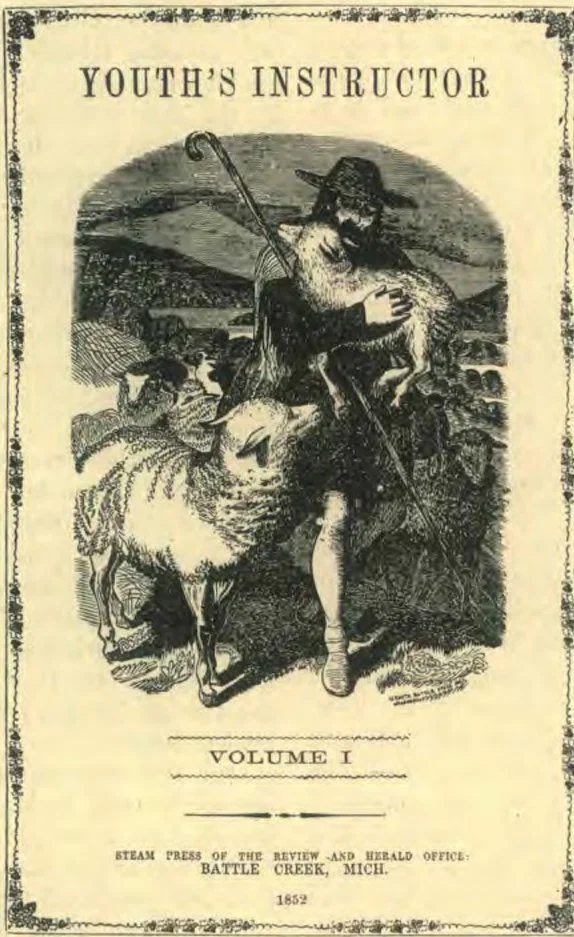
FACSIMILE OF COVER PAGE OF FIRST NUMBER OF THE INSTRUCTOR
Sometimes I think that the young people now growing up are in danger of losing sight, not only of the many divine providences in connection with the early history of this people, but also of the zeal, self-denial, and devotion to duty which characterized the pioneers. Those were heroic times, and they bred heroic men and women. It does us good to associate with them by reading their writings, and trying to put ourselves in their places. Wherever we look we shall see hardships borne with the utmost cheerfulness, and incredible difficulties overcome by earnest prayer and persevering labor. We may see Elder Joseph Bates, with want staring him in the face, sitting down with perfect composure to write his tract on the Sabbath, and later follow him in his fruitful work in many places, dependent upon God’s opening providence, and cheerfully doing the thing that needed to be done whether it was preaching a sermon, or, in those days when cook-books were scarce, going into the kitchen to explain the mysteries of hygienic cookery to some housewife eager to learn.
We may see Elder James White in the intervals of those strenuous labors which were so successful in gathering the scattered believers together and forming the nucleus of a work which was to embrace the world, — we may see him at such intervals, in order not to be chargeable to the work of God, earning money by hauling stone, or chopping cord-wood at fifty cents a day, or cutting hay, and that, too, while suffering from severe bodily weakness, so much so that his nights were often sleepless from pain. We may see him in the face of apparently insuperable obstacles forging steadily ahead, alert, watchful, vigilant, doing the work of a true minister of the gospel, and at the same time with rare foresight laying firm foundations for our publishing work, and for our system of schools and sanitariums. We see him doing all this for the love of the Master, buoyed up by the blessed hope, and looking forward to the crown which shall be given to all the faithful workers in that day.
There is something more than sentiment involved in a remembrance of these earlier men and earlier times. We need to study the lives of the pioneers in order, not only to understand the men, but to understand the message itself. We must study the men in such a way as to enter into the spirit of their work. It is not what is told us of the truth that will save us, but that which we are able to weave into our lives. We never fully possess a truth until we have had a spiritual experience growing out of it. We never really know anything until we have obtained a heart knowledge of it,—till it has cost us something.
Especially do the young people who have, as we say, been born into the truth need to study the soul experiences of these early pioneers, and emulate their example. While it is a blessing thus to grow up in the truth, there are also some drawbacks connected with it. The young man or young woman who has always kept the Sabbath, at least outwardly, has missed that deeper experience which comes to those who give up friends and associates, perhaps even father and mother, and all that the world holds dear, in order to obey the truth. To miss the trial, is to miss the purification of all the affections which it involves, and to miss the consequent strengthening of character.
Fortunately, there are still experiences that may be bought. If the pioneer work has been done in this country, it remains to be done in the regions beyond. The young men and women who have grown up in the truth may fix their eyes on China, India, Africa, and other great and needy fields, where millions of precious souls are waiting to hear the gospel. There, in pioneer missionary work, they may, in some degree, live over again the strenuous times experienced by the noble, disinterested men whom God called to lay the foundations of this work. And we who remain behind by practising self-denial in little things and in large things, may be able to contribute liberally of our means toward their support. Thus we may all emulate the example of the pioneers.
Continue reading: History of Our Educational Work