The Youth’s Instructor, Vol. 37, No. 8.

THE TWO SACKS

The Youth’s Instructor

Feb 20, 1889

S. D. A. Publishing Association · Battle Creek, Mich. · Feb 20, 1889

THE TWO SACKS.

A MAN, upon a distant journey bound, In troublous times sought everywhere around Where he could leave the produce of a field Which had at harvest brought him plenteous yield. At length he thought that he of friends had twain With whom he could intrust the precious grain. Since honest men they were, true friends indeed, Who would not rob him of a single seed. Betwixt the two divided he his grain In stout sacks, as I need not to explain. Long was the journey; many a month flew past. Before he saw his home again at last. On his return he chose an early day To fetch his two sacks home without delay. To one friend went the traveler, and said, “Where, Friend, is the sack I left beneath thy care?” No answer gave his friend, but, “Come and see; Out through the house and garden, come with me.” He went with him, but great was his surprise; No sack of grain there stood before his eyes. His friend had brought him to a piece of land, Where, ripe, and waiting for the reaper’s hand, A crop of wheat he saw that shone like gold. His grain, when sown, had borne a hundredfold.
“There,” said his friend, “I thought when thou cam’st back. This crop would please thee better than a sack; I sowed thy grain, and good has been the yield, To-morrow send thy reapers to my field.”
O’erjoyed and grateful, home the traveler came. And said: “My other friend has done the same, No doubt. The two crops will a good price bring, With some seed left to sow before the spring.”
* * * * *
Then of his second friend he sought the door, And said, “I pray thee, kindly friend, restore The sack I ’neath thy keeping left, the day When first to foreign climes I took my way.” He said: “I in a cellar safe have kept Thy sack, lest thieves should take it while I slept.” But oh, the disappointment! Rats and mice No doubt had found the grain extremely nice; Half they had eaten; what they had not ta’en Was marred. Quite useless had become the grain. The seed, which, planted, might have brought much gold, Was spoilt by rats and by the cellar’s mold.
* * * * *
My younger friends, I most sincerely trust You will not leave the powers God gave, to rust. Unused, they’ll spoil—used, bear an hundredfold. As Jesus in his parables hath told.
—Selected.

THE DISOBEDIENT PROPHET.

The Bible does not tell us his name. He is simply called “the man of God.” He lived in Judah. We do not know how old he was, nor when he was born, nor who his parents were. If it were not for one event in his life, we would probably never have known about him; but this one event contains such a suggestive lesson that we cannot afford to miss it.
There were troublous times in Israel when this “man of God” lived. The greater part of the kingdom had revolted, and chosen a new king. In the organizing of this new kingdom, when many difficult questions had to be settled, the king changed some customs that he certainly ought to have left untouched. He was so jealous of the rival king in Judah that he would not allow his subjects to go to Jerusalem to worship, and thus he led them into the wicked idolatries practiced by their heathen neighbors. He made priests of the lowest and most worthless of the people, while he himself acted as high-priest.
One day when the king was standing at the altar offering incense, this man of God came to him, and uttered a bitter prophecy against the new religion Jeroboam had introduced. The king was very angry that any one should dare to say such things, especially in the hearing of so many people as had come to worship. And he stretched out his hand, crying, “Lay hold on him!” But God protected his faithful prophet by causing the king’s hand to wither.
Afterward, in answer to entreaties from the man of God, the Lord restored the withered hand whole as the other. In a burst of gratitude, the king entreated the prophet to go home with him and refresh himself. But the prophet refused, saying, “If thou wilt give me half thine house, I will not go in with thee, neither will I eat bread or drink water in this place; for so was it charged me by the word of the Lord, saying, Eat no bread, nor drink water, nor turn again by the same way that thou camest.” So the man of God did as the Lord told him.
Now there lived in Bethel an old man who had once been a true prophet; and when he heard through his two sons who were near the place of worship, of all the things that had been done that day in Bethel, he saddled an ass and went after the man of God.
He overtook him sitting under an oak to rest, and the old prophet entreated him to return with him. But the man of God made the same reply that he had given to the king, “I may not return with thee; neither will I eat bread nor drink water in this place.”
Then the old prophet lied to the man of God, and said, “An angel spake unto me by the word of the Lord, saying, Bring him back with thee into thine house, that he may eat bread and drink water.”
And the man of God believed what the old prophet said, although he was a stranger to him, and he had no way of proving that he spoke the truth.
I imagine that the man of God had not gone far out of Bethel when he stopped under the oak to rest. Perhaps he was even then thinking what a hard errand the Lord had sent him on, when he told him that he might not take even so much as a drink of water after he had finished the first part of the journey and reached Bethel. I suppose he was faint and thirsty and very weary when he sat down to rest. And so he was the more willing to credit the old prophet’s words, and grasp at any plausible excuse that would let him go back.
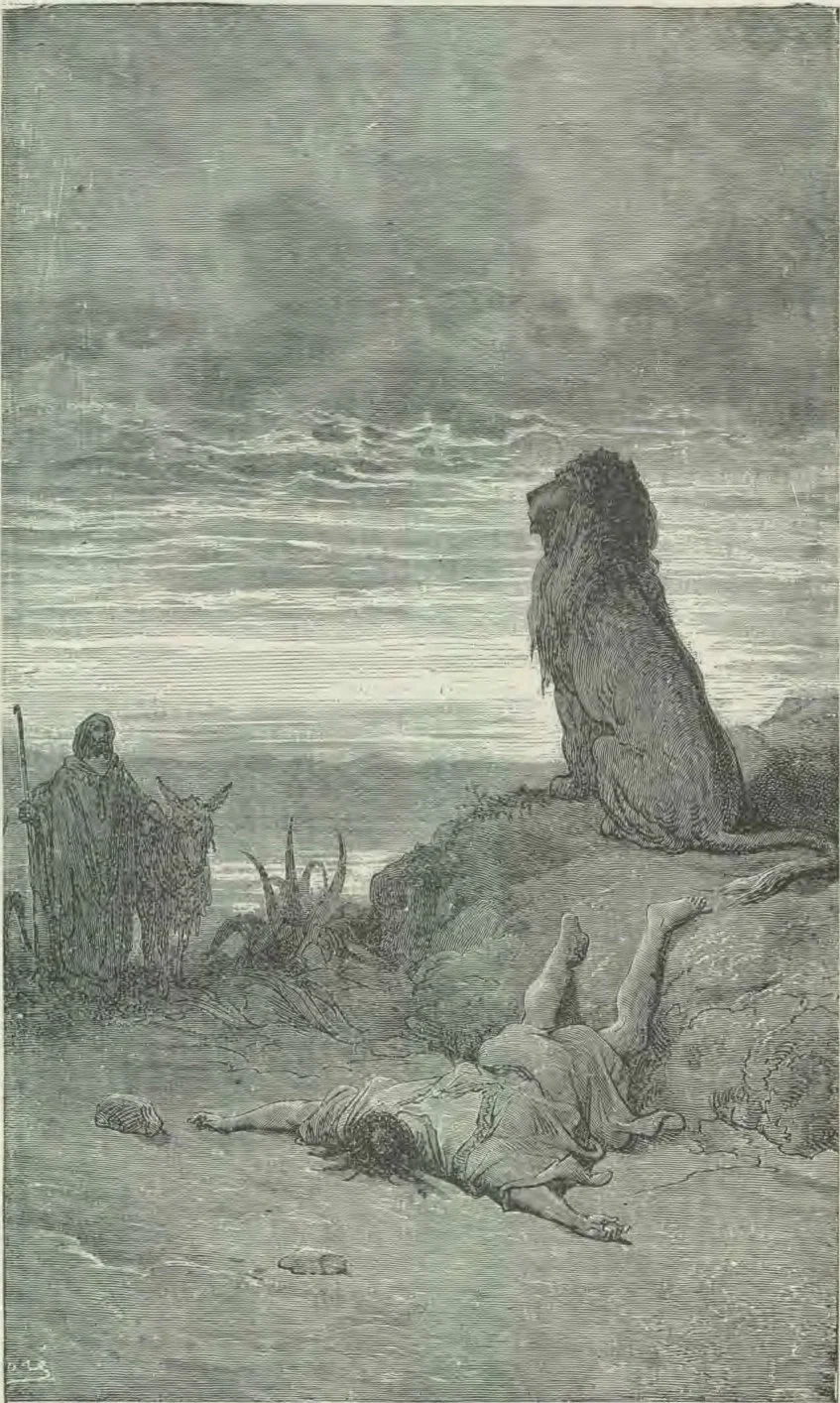
But while he was dining with the old seer in Bethel, the Lord sent a sad message to this man who had disobeyed him, saying, “Because thou hast disobeyed the mouth of the Lord, . . . thy carcass shall not come unto the sepulcher of thy fathers.” And these words were made true the same day; for when the man of God turned to go again toward Judah, a lion met him in the way, and slew him. When the old prophet heard from the passers-by that the man of God was dead, he went after him and brought him back to Bethel, burying him in his own sepulcher.
I sometimes think that if the man of God had never stopped to rest under the oak, but had kept straight on his journey home, the old prophet would not have overtaken him.
The Lord loves prompt obedience now as much as he did three thousand years ago when the man of God lived; for he says, “I am the Lord, I change not.” And, indeed, the only way we can show that we are truly grateful for his love to us and care for us is to do cheerfully the things he requires of us. That good apostle, John, who knew so well how true were the words of Jesus, which he recorded, wrote, “And Jesus said, If a man love me, he will keep my words; and my Father will love him.” W. E. L.

THE SECRET OF THE OCEAN.

“So, lad, thou wouldst be a sailor, then? Well, thou’rt in the right of it. Why should a brisk lad like thee waste his life combing wool in these hot streets, where a man can’t even draw his breath freely, when the brave, open sea lies yonder waiting for thee?”
So spoke, with an emphatic flourish of his broad brown hand toward the smooth sunlit waters below him, a battered old Italian sailor of the fifteenth century, whose dark, weather-beaten visage, half buried in a bushy gray beard, looked very grim indeed beside the fresh round cheeks of the handsome boy of fourteen, with whom he was talking.
“My father is a wool-comber himself,” answered the lad, “and therefore he would fain have me one, too. But I am well assured that if he knew I was fitter to be a sailor, and saw that I had set my heart upon it, he would not say me nay—he is far too kind for that.”
“Say’st thou so?” cried old Jacopo. “Nay, then, I must have a talk with him about thee. Let me alone to persuade him, when I tell him of the brave lands that men have found away to the southward, on the coast of Africa, where you may pick up gold as we pick grapes here in Italy!”
“Gold?” echoed the boy, staring.
“Ay, good red gold, and diamonds too,” said Jacopo, who fully believed what he was saying. “And then the Fortunate Islands, which lie far off to the westward—ah, lad, if thou couldst see what I have seen there! Fruits finer than any that my Lord Andrea Doria eats in his palace up yonder, lying strewn on the ground for want of hands to gather them; fish so thick in the water that you had only to throw in a net, and pull out as many as you could lift with both hands; houses ready made from the great leaves of the banana, that folded into each other overhead like the tiles of a roof; and the air so warm and soft that a man might go for twelve months without a shirt to his back, and never catch cold.”
“And is it true,” asked the young listener, who was drinking in every word with parted lips and sparkling eyes, “that there’s a place where the sea is boiling hot, and all the fish that come into it die at once?”
“Some of my comrades used to tell of such a place,” replied the old seaman, “but I don’t remember to have ever seen it myself, although methinks it were no ill chance at sea to pull up a pan of fish ready cooked. But in the isle of Flores (beyond which, to the westward lieth the unknown sea) I saw a greater wonder still, even a piece of wood curiously carved, which had floated thither from the west; and learned men who had seen it said that it was not carved with any steel, but with a sharp flint. Likewise I saw great canoes which the sea had cast up, the like whereof are not known in any Christian land, for their bigness was such that were they scooped hollow, they would have held water like pipes. Moreover, they of the island told me how that not long before that time, they had found on their western beach the bodies of two men, such as they had never seen before, exceeding broad-faced, and in no wise like the men of Christendom.”
“Can there be other lands to the westward, then, which no sailor has ever reached?” asked the boy, in an awe-stricken whisper.
“In truth, lad, thou must ask that question of some wiser man than I am,” said Jacopo, shaking his gray head. “None living knows what may lie hidden behind the great Atlantic sea; and for my part I would not willingly venture thither to find out its secret.”
“Are the western seas so perilous, then?”
“Perilous? Why, seest thou not that the earth being round like my cap here, and flat like this bench whereon we sit, if a ship should venture too close to the edge of the world, she might be blown over it into empty space, and keep on tumbling and tumbling forever? A Venetian captain told me once how he was driven so nigh to the brink by a storm, that had not the wind changed by heaven’s mercy, so that he could put his vessel about, over it he must have gone, he and his ship and all his crew!”
“I would venture it, though, for all that,” said the boy, flushing up with excitement. “It must be a noble thing to go where no man has ever gone, and see what no man has ever seen. With God’s help I will sail the unknown sea yet before I die, and learn some of its secrets.”
Forty-two years later, that boy returned in triumph from his voyage across the “unknown sea,” bringing with him the discovery of a new world. On the spot where he talked with old Jacopo, his statue now looks down on the crowded harbor of Genoa, while on the Isthmus of Panama another statue of him stands gazing seaward, over the great waste of waters that once tried in vain to hide America from the eye of Christopher Columbus.—Harper’s Young People.

A TRUE HERO.

“Be kindly affectioned one to another, with brotherly love, in honor preferring one another.”
This was the golden text for the day, and Mabel wanted to memorize it while her mother prepared breakfast.
“Mother, dear, what does it mean when it says, ‘in honor preferring one another’?”
“We will have breakfast, and then there will be time, before the school bell rings, to tell you a true story, that will give you a very clear idea of what Paul has expressed so beautifully.”
So, after breakfast, Mabel helped her mother clear the table, and then, with the other children, who knew well how interesting mother’s stories always were, crowded around her easy-chair, and she began:—
“You have all heard of the great telegraph cables, by which messages are sent under the seas from one country to another; and all of you are familiar with the telegraph system used on the land. The invention of the telegraph has always been ascribed to Prof. Samuel S. F. Morse, an artist of considerable ability, and Professor of the Arts of Design in the University of New York. He was always very much interested in chemistry, but more particularly electrical and galvanic experiments, and on a voyage from Havre, France, to New York, he conceived the idea of a magnetic telegraph. Five years later he exhibited the invention to Congress, and applied for a patent. In 1843, Congress granted him $30,000, with which to build a line of telegraph, as an experiment, between Washington and Baltimore. From that beginning has sprung the marvelous system of inland and submarine telegraphy that girdles the globe. Honors of all kinds were fairly rained upon Prof. Morse, and he became a wealthy man. He died in New York in 1872, and in the Central Park of that city stands a beautiful statue of the Professor, erected as a tribute of respect by the Western Union Telegraph Company; the body of the famous man lies entombed in costly marble, in Greenwood Cemetery, near the city.
“Not far from this prominent mausoleum is the grave of Alfred Vail, the real hero of my story. At the time Prof. Morse conceived the idea of an electric telegraph, he had nothing more than an idea, and had not the ability to give it a material form, having no mechanical genius. He was also very poor, having only his salary as a professor of the University, and this was not more than sufficient to support him. His relatives looked upon him as a visionary dreamer, who did not deserve encouragement; hence even if he had any thing practical to offer, he could have gained no financial aid.
“Attending the college at the time was a young man by the name of Alfred Vail, whose father was a wealthy manufacturer, Judge Stephen Vail, residing at Morristown, New Jersey, and proprietor of the Speedwell Iron Works at that place. Alfred told the Judge about Prof. Morse, and his idea, and kept at it so persistently that finally the curiosity of the Judge was aroused, and he invited the Professor to dinner. The result of this visit was a mutual liking for each other and a life-long friendship.
“The Judge gave his son the use of a small building back of the great factory, and here Alfred and the Professor went to work. For a year they experimented, at the Judge’s expense, and at last three miles of copper wire was purchased, a real telegraph line arranged, that number of miles long, both ends terminating in the building, and an actual message was sent and received. The Judge wrote the message, ‘A patient waiter is no loser,’ Alfred sending and the Professor receiving it.
“Soon afterwards, Congress, through the influence of Judge Vail, granted the money to build the line between Washington and Baltimore, and Professor Morse became at once the most famous of all living men. But the name of Alfred Vail, the man to whom all the honor was due, the real inventor, the one who originated the alphabet and the instrument that bears Prof. Morse’s name, and who arranged and planned and executed all the details connected with the practical working of the telegraph,—that man’s name never appeared in print, or was known, outside of the circle of his friends, as having been in any way connected with the great invention. All he did was done in love for his friend, the Professor; and having seen that friend exalted and honored, his heart was content, and he turned quietly again to his books, never looking for, or dreaming of, reward. Was he not a true hero? And do you now understand what Paul means when he says, ‘With brotherly love, in honor preferring one another?’” W. S. C.

THE WARMTH OF A WORD.

'Twas a day in the dead of winter, And echo of hurried feet Struck sharp from the icy pavement Of the pitiless city street.
Each passer was loath to linger, Though wrapped in a fur-clad fold; For the air was a-tingle with frost-flakes, And the sky was benumbed with cold.
The cimeter wind in its fury, Bore down like a sweeping foe; The tempest was waiting the onset, And abroad were its scouts of snow.
Yet, 'midst it all, with his tatters A-flap in the whirling blast, A child who seemed born of the winter— A creature of penury—passed.
So tremulous were his accents, As he shivered and crouched and sung, That the names of the numbed papers Seemed frozen upon his tongue.
He paused for a bitter moment, As a wondrously genial face Arrested his voice, and held him With a pity that warmed the place.
“Have a paper?” The kind eye glistened As the stranger took the sheet, And glanced at the stiffened fingers, And thought of the icy feet.
Then dropped in his hand the value Of his fifty papers sold; “Ah, poor little friend!” he faltered, “Don't you shiver and ache with cold?”
The boy, with a gulp of gladness, Sobbed out, as he raised his eye To the warmth of the face above him, “I did, sir,—till you passed by!”
—Christian Union.

NOTHING IN PARTICULAR.

“What is your trade? What can you do?”
“Oh, nothing in particular. I am willing to take hold of anything you may set me about.”
This is the question and answer between countless employers and their applicants for work.
The country is full of people who have learned to do nothing in particular. They have grown up in the community as purposeless as weeds, fitted for nothing, and working at nothing, only as the demands of necessity require.
It is the men who have learned to do nothing in particular who form the great class of the discontented. They must always receive the lowest wages, wear the coarsest clothes, eat the plainest food, and, withal, do the hardest and most disagreeable work.
So it is self-evident that every boy and girl should learn to do at least some one thing, and learn to do it well. About the only thing a man can do without learning, is to dig in the ground. So if a young man does not wish all his life to be employed in the sewers, or in digging trenches, or working on the streets, he should show his fitness for something better by specially preparing himself for some specific work. A full-grown man should be ashamed to answer to his employer’s question, “What can you do?” “Oh, nothing in particular.”—Stenograph.

GLORIFYING CHRIST.

One spring my mother bought some flower-seeds—little, ugly black things—and planted them. They grew and blossomed beautifully.
One day a neighbor, coming in and seeing these flowers, said: “Oh, how beautiful! I must have some, too. Won’t you please give me some seed?”
Now, if this neighbor had seen simply the flower-seeds, she would not have called for them; it was only when she saw how beautiful was the blossom, that she wanted the seed.
And so with Christianity. When we speak to our friends of the truths of the Bible, they seem to them hard and uninteresting, and they say, “We don’t care to hear about these things; they are not as interesting as our own stories.” But when they see these same truths blossoming out in our lives into kindly words and good acts, then they say: “How beautiful these lives! What makes them different from other lives?” When they hear that it is the teaching of Jesus, then they say, “We must have it too!” And thus, by our lives, more than by our tongues, we can preach Christ to our unbelieving friends.—Selected.

WHAT CAN WE DO?

Oh, what can little children do to make the great world glad? For pain and sin are everywhere, and many a life is sad. Our hearts must bloom with charity wherever sorrow lowers, For how could summer days be sweet without the little flowers?
Oh, what can little children do to make the dark world bright? For many a soul in shadow sits, and longs to see the light. Oh, we must lift our lamps of love, and let them gleam afar. For how could night be beautiful without each little star?
Oh, what can little children do to bring home comfort sweet For weary roads where men must climb with toiling, wayworn feet? Our lives must ripple clear and fresh, that thirsty souls may sing: Could robin pipe so merrily without the little spring?
All this may little children do the saddened world to bless; For God sends forth all loving souls to deeds of tenderness, That this poor earth may bloom and sing, like his dear home above; But all the work would fail and cease without the children's love. —Well-Spring.

INDIAN CHILDREN AND THEIR PETS.

Many people suppose that the Indian children have no dolls or pets. This is a mistake. The Indian baby, or pappoose, is provided by its squaw mother with a sort of doll from its earliest infancy.
The baby itself is tied to a board which is covered with buckskins and fanciful bindings, or with bright-colored cloth ornamented with bead-work and tinsel. This baby-board, which is carriage and cradle in one, looks like the toe of a large slipper, and has a piece of wood bent across the head to protect its little copper-colored occupant from being struck by anything. Just as her convenience may prompt, the squaw hangs her pappoose, thus cradled, on her back while walking, or in a tree when working about the tent, or on the saddle pommel. From the protecting head-board hangs suspended the doll, made of feathers, beads, and red cloth, perhaps representing an Indian warrior. The little pappoose looks at this dangling image all day long, and this monotonous endeavor often causes a horrible squint from which the Indian never recovers.
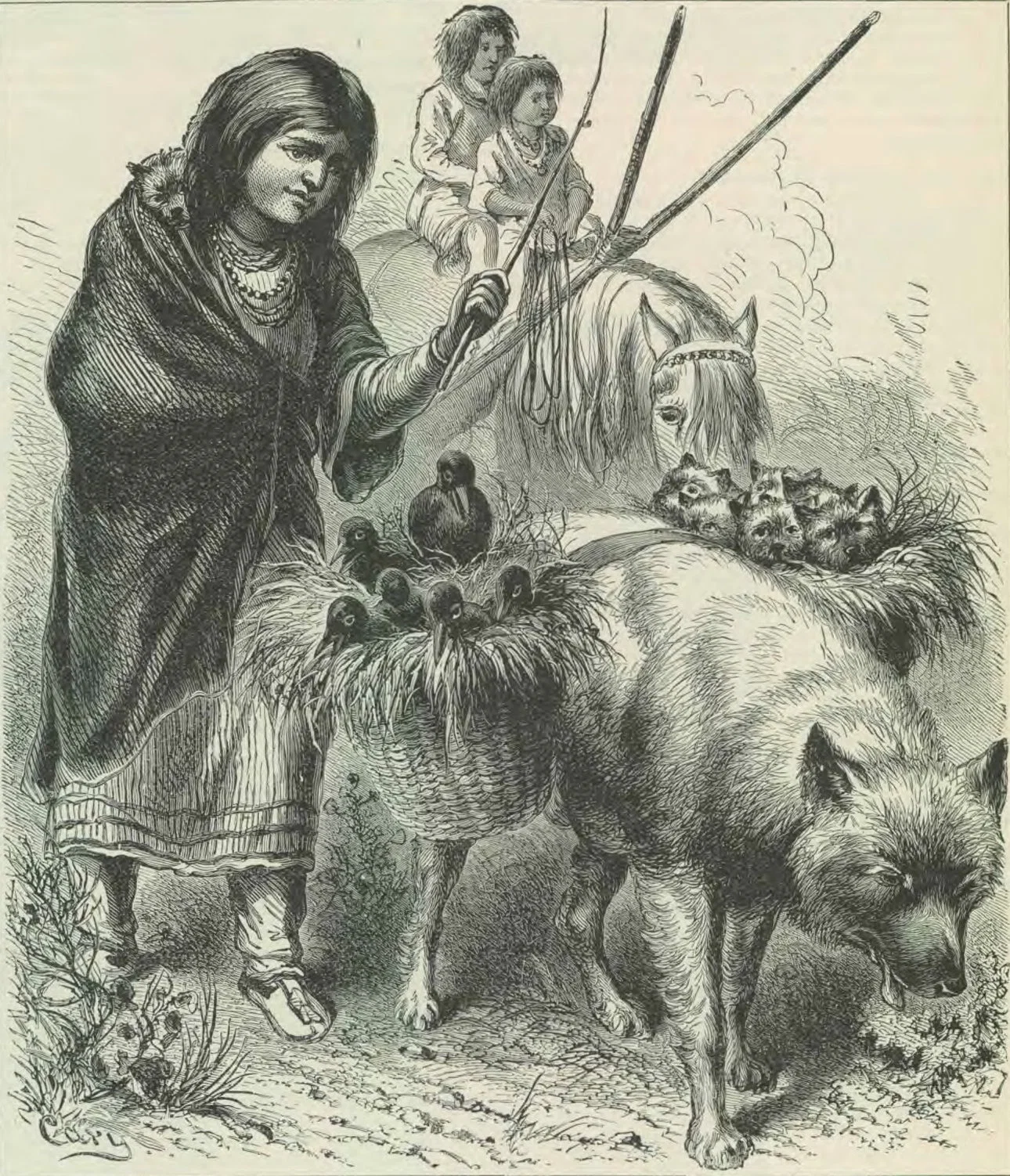
The squaw mothers sometimes make tiny pappooses, bound to cradle-boards in fancy covering, like their own, for the older children to play with; but it is a still commoner sight to see the girls carrying a puppy in a little blanket over their shoulders. It seems strange that they should make of their pets what is considered the greatest delicacy, puppy-stew, which is the chief dish of a feast given when a child reaches a certain age.
The little Indians also make pets of crows. A little girl will often daily carry about with her a wicker basket filled with crows just as they are taken from the nest by her brother. Beside her an old dog will often be wiled along, dragging her puppies in a similar net or basket, stretched across transverse poles.
The Indian boys have pet colts to ride; and they make pets of young eagles, which they put on a sort of stand with a string attached to one leg to prevent the birds from flying away.
The boys also learn to use the bow and arrows, and are often occupied in driving blackbirds and cowbirds from the growing maize.
Corn is the only vegetable cultivated by the Indian; and the Chippewas, who are semi-civilized, grind their corn into a sort of coarse samp by pounding it in a mortar with a wooden pestle. They also roast the ears and dry them for winter use.
Great groups of children will sit with a squaw (perhaps mending moccasins), who helps them at their work and preserves order. They sit on high platforms the whole day, overlooking the corn-fields, so as to drive away birds as they alight in flocks.
The older boys amuse themselves by different games while tending the horses. First they spread upon the ground a buffalo hide on which they kneel facing each other. Then one takes a little stick and passes it from one hand to the other, first behind and then before, while the other boy guesses which hand it is in. He is entitled to three guesses. The first, if right, counts him three; the second, two; and the third, one. If he misses altogether, he loses according to the number put up for stake. The one guessing makes his guess known by hitting his right or left shoulder, according to the hand he thinks his opponent holds it in.
This, like all other Indian games, is made interesting by the stakes, which generally consist of some ornament, or some service to be rendered.—From Wonder Stories of Travel.

THE POOR BOXES.

“Don’t forget to dust the poor-boxes this morning, Nettie,” said Mrs. Williams to her little girl, while I was calling at the house one morning.
“The poor boxes!” thought I. “What can Mrs. Williams mean? I wish I knew what they were.” But, of course, it was not polite for me to ask any questions about them, and I should have come away none the wiser, had not Nettie come back into the parlor with one of them in her hand, and said to her mother:
“Mamma, this box is empty.”
It was a small, square, wooden box, painted red, and on the front of it were these words: “For the lame poor.”
“It’s Clifford’s box,” the lady said, taking it in her hand, and passing it to me that I might see it. “Clifford seems to find a great number of subjects for his generosity. He told me the other day that it is really surprising how many lame poor people there are in the city.”
“May I ask what you mean by the lame poor box?” I asked; and added that I was deeply interested.
“It was Clifford’s invention,” the mother said. “A year ago he fell from an apple-tree when he was at his grandfather’s in the country, and almost broke his left leg. He suffered a great deal for some time with it, and one night he said to me: ‘Mamma, when I get about again, I’m going to make a memorial-box in remembrance of my lame leg’s getting well. It would have been so hard if I’d had to go on crutches, or have my leg all done up in splints.’”
“So when Clifford came home, he brought this box to me, and told me if any poor lame person came to the house, to give them something out of it. He has found so many outside in his daily rounds, and he has become so interested, that I am sure nearly all his pocket money goes in here. You can readily imagine that such a new way of doing good found favor with the whole family. Mary has a blind poor-box, and Nettie a sick poor-box, and the father and mother have one larger than the rest—we call it the ‘opportunity-box’—one that we always take out of when we ‘do good as we have opportunity.’”
“A beautiful way of helping others,” I said. “I must tell my children about it.”
“Mary, you know,” said Mrs. Williams, “had trouble with her eyes two years ago, and had to be shut up in a dark room for weeks, so she can realize somewhat the blessing of light; and Nettie has been ill so much in her young life, that she can sympathize with those who have not the comforts necessary to the sick-room. We do not give without finding out all about the person who receives our thank-offerings. That leads to a wider field of usefulness; and these poor-boxes have brought us in contact with some lovely characters among the Lord’s poor.”
“How much the little boxes must teach of self-denial and generosity!” I said.
“Oh, I cannot begin to tell you,” the mother replied, “what beautiful traits of character these savings for the suffering poor have brought out in my children. And you would be surprised to know how much good can be done by a few pennies saved here and there. It is a strict rule, that any piece of money dropped into these boxes can never be taken out for any purpose, only the one lettered upon the box.”
I was astonished when I heard how many persons little Mary had found by diligent inquiries and persistent efforts. I could not help thinking of the matter for days after I came home; and I thought what a beautiful thing it would be for us all to remember God’s special mercies and gifts to us in this way!—Young Reaper.

LAYING UP TREASURE.

Fred and Nellie lived in a lovely woody place all the happy summer days. It would take a long time to tell even the names of all the pleasant acquaintances they made—not boys and girls only, but birds and bees and butterflies and squirrels, and many other dwellers in the woods and fields.
But none of these charming little people were more entertaining than a chipmunk, a bright-eyed little fellow who lived just at the back door. He was very shy at first. Fred and Nellie were careful not to frighten him, but fed him nuts, coaxing him every day to come a little nearer, until he lost all fear, and would run into the house and sit down on the sofa, and wait until he saw some one from whom he could hope to get a nut.
It was very funny to see how greedy he could be. He would take a nut out of Fred’s mouth, and put it into the little pocket on one side of his own mouth; then Nellie would give him another, and he would drop that into the other pocket. Then he would sit up on his hind legs, and cross his little paws in front, and look so bewitching that some one would give him still another, which he would carry away in his paws, walking carefully on his hind feet lest he should drop the treasure. How droll he did look with both cheeks puffed out, as though he had the worst kind of a swelled face!
What did Chippie do with these nuts? Why, he carried them to his storehouse, and put them away for winter use; for well he knew that the day was coming when nuts would be few, and his little appetite would be very sharp indeed.
“Sensible chap!” said Fred one day. “Laying up treasure, isn’t he?”
“Yes,” replied thoughtful Nell; “and we would better learn a lesson from him.”—Sel.

DAN'S “GOLD-DUST.”

“THAT boy knows how to take care of his gold-dust,” said Dan's uncle often to himself.
Dan went to college, and every account they heard of him, he was going ahead, laying a solid foundation for the future.
“Certainly,” said his uncle, “certainly that boy, I tell you, knows how to take care of his gold-dust.”
“Gold-dust!” Where did Dan get gold-dust? He was a poor boy. He had not been to California. He never was a miner. When did he get gold-dust? Ah! he has seconds and minutes, and those are the gold-dust of time—specks and particles of time, which many boys and girls and grown-up people often waste. Dan knew their value.
His father, our minister, had taught him that every speck and particle of time was worth its weight in gold, and his son took care of them as if they were. Take care of your gold-dust.—Sel.

THE WHALE'S FOE.

I heard a boy say once that whales could beat any other fish, they were so large and strong.
I wish I could see that boy, and tell him about a dreadful enemy the whale has. He is called just what he truly is, “a whale-thrasher.”
These are his fighting tools: a very round trunk, nearly five feet long, and a tail, twelve feet in length, very flat, but having a very sharp edge. Sometimes these whale-thrashers swim alongside one poor whale. The big creature might as well give up first as last, for when these tails, with sharp edges, strike a whale, he is dreadfully cut, just as if knives had been used.
These cruel foes never give up. They get nearer and nearer their prey, watching every motion and turn of his body. When they strike, it is the end of the poor whale.—Our Little Ones.

OLD TESTAMENT HISTORY.

LESSON 10.—WATER FROM THE ROCK.

INTRODUCTION.—Continuing the narrative of the experience of the Israelites in the wilderness, we are brought in this lesson to two more instances of God's power exercised in behalf of his people, the circumstances attending which, and the lessons to be learned therefrom, it is the purpose of this lesson to consider.

QUESTIONS WITH NOTES AND COMMENTS.

1. RELATE the instances already learned, in which God miraculously interposed to deliver his people.
2. After all these deliverances, how should they have felt?
3. Into what straits were they brought in their next encampment, after the giving of the manna? Ex. 17: 1.
4. What did they do? Verse 2.
5. With what did they again charge Moses? Verse 3.
6. What were they about to do to him? Verse 4.
7. Against whom were they really murmuring? Verse 2, last part.
8. What doubt was indicated by their murmuring? Verse 7.
9. What did they thereby virtually say about the wonderful miracles that they had witnessed?
10. How did the Lord provide for them on this occasion? Ex. 17: 5, 6.
11. What graphic description does the psalmist give of this? Ps. 78: 15, 16.
12. Of what was their drinking water from the rock an emblem? 1 Cor. 10: 4.
While it is evident that Paul refers here to the occasion of Moses's smiting the rock at Horeb, the “spiritual drink,” must have been given them throughout the entire length of their journey, as much one time as at another. The text designs to show by reference to some particular and striking instances of divine power in their behalf, as in the falling manna, and the water supplied from the rock, that the Israelites had the same spiritual blessings then which were enjoyed by the church in Paul's day, and that they were from the same source, Christ. On the act of smiting the rock with Moses's rod, Mr. Ainsworth says: “This rock signified Christ, and is therefore called a spiritual rock. 1 Cor. 10: 4. He being smitten with Moses's rod, and bearing the curse of the law for our sins, and by the preaching of the gospel crucified among his people (Gal. 3: 1), from him floweth the spiritual drink wherewith all believing hearts are refreshed.”
13. What kind of water does Christ give? John 4: 10.
14. What will it do for the one who drinks it? Verse 14.
15. While the Jews were at Rephidim, what other trouble did they have? Ex. 17: 8.
16. Relate what followed. Verses 9–13.
The act of Moses, reaching up his hands towards God, was to teach Israel that while they made God their trust, and laid hold upon his strength, and exalted his throne, he would fight for them and subdue their enemies. But when they should let go their hold upon his strength, and should trust to their own power, they would be even weaker than their enemies, who had not the knowledge of God, and their enemies would prevail over them.—Great Controversy, vol. 1, chap. 19.
17. What was shown by this circumstance? Ans.—That they were delivered, not by their own strength, but by the direct interposition of God.
18. What does the prophet Isaiah say of God's tender care for them? Isa. 63: 9.
19. What beautiful illustration is given to show how the Lord carried them? Deut. 32: 11, 12.
20. Of what may the people of God always be assured? Deut. 33: 25–27.

A Teacher's Honest Admission of Ignorance

The next best thing to a teacher's knowledge is his readiness to admit that he does not know. One of the most conspicuously frequent phrases in the address of an eminent American naturalist before a recent scientific meeting was, “I do not know,” or, “I think this may be so, but I really do not know.” Had he been any less a scientist, and any less a teacher, he would never have thought about what he did not know, or he would shyly have avoided allusions to his ignorance. No teacher can know all that might be known about every, or indeed, any lesson. Every scholar knows that, as well as every teacher. But if, on the one hand, there is an incidental appearance of general ignorance that betrays a teacher's lack of capacity or neglect of study, there is also, on the other hand, an open confession of ignorance at certain points, that gives the scholars a feeling of trust in the teacher's knowledge at other points. It is a good thing to know all that you can know; but do not forget that your scholars know that there must be some things that you do not know.—Sunday-School Times.
Continue reading: Letter Budget