Signs in the Heavens to Precede Christ's Coming—A Remarkable Darkening of the Sun—Science Can Not Account for It—The Time of Its Occurrence, as Well as the Event, Foretold
By EUGENE W. FARNSWORTH
"IMMEDIATELY after the tribulation of those days shall the sun be darkened, and the moon shall not give her light, and the stars shall fall from heaven, and the powers of the heavens shall be shaken." Matt. 24: 29. We now have before us the question of special import in this twenty-fourth chapter of Matthew, "What shall be the sign of Thy coming, and of the end of the world?" Luke says, "There shall be signs in the sun, and in the moon, and in the stars; and upon the earth distress of nations, with perplexity; the sea and the waves roaring." Luke 21: 25.
Note this carefully. The disciples asked, "What shall be the sign of Thy coming?" Matt. 24: 3. The Saviour replied, "There shall be signs in the sun, and in the moon, and in the stars." He stated further that there should be "upon the earth distress of nations, with perplexity."
THE TIME FORETOLD
When was the sun to be darkened?—"Immediately after the tribulation of those days." The Reformation and other influences caused the general persecution of God's people to end about 1750. It grew less and less until, about 1760 or 1765, we find no persecution. The Saviour said, "Immediately after the tribulation of those days shall the sun be darkened."
He not only tells what the sign will be, but He tells us when it will occur. It is "immediately after the tribulation of those days,"—after the persecution that was inflicted on the people of God during the Dark Ages had ceased.
THERE WAS SUCH A DARK DAY
It is a fact that a little while after the tribulation ended, there was a notable dark day for which science is unable to give any satisfactory reason. The sun has been darkened, as the Saviour declared it should be. Eminent men have borne testimony to the truth of this statement. For lack of space, but two or three can be quoted.152
In Webster's Unabridged Dictionary, edition of 1869, in "Explaining and Pronouncing Vocabulary," article "Dark Day," we read: "Dark day, May 19, 1780, so called on account of a remarkable darkness on that day, extending over all New England. In some places persons could not see to read common print in the open air for several hours together. . . . The true cause of this remarkable phenomenon is not known."
In "Our First Century," page 88, is found this testimony: "Almost, if not altogether, alone, as the most mysterious and as yet unexplained phenomenon of its kind in nature's diversified range of events during the last century, stands the dark day of May 19, 1780, a most unaccountable darkening of the whole visible heavens and atmosphere in New England, which brought intense alarm and distress to multitudes of minds, as well as dismay to the brute creation, the fowls fleeing bewildered to their roosts, and the birds to their nests, and the cattle returning to their stalls. Indeed, thousands of the good people of that day became convinced that the end of all things terrestrial had come; many gave up for the time their secular pursuits, and betook themselves to religious devotions."
IT WAS NOT AN ECLIPSE
This darkening of the sun was not an eclipse. It is a well-known fact that astronomers can tell when there is to be an eclipse. Five, twenty, a hundred, or a thousand years ahead, they can tell just as accurately as they can for next year. Astronomers declare that at that time there could not have been an eclipse, on account of the relative position of the sun and the moon to the earth.
Josiah Litch, in his exposition of prophecy, referring to the dark day, says: "I refer to the dark day of A.D. 1780, May 19. That was a day of supernatural darkness. It was not an eclipse of the sun, for the moon was nearly at the full. It was not owing to a thickness of the atmosphere, for the stars were seen. The darkness began about nine o'clock A.M., and continued through the day. Such was the darkness that work was suspended in the field and shop, beasts and fowls retired to their rest, and the houses were illuminated at dinner time. . . . The sun was supernaturally darkened."
Such statements as these quoted are remarkable; and other writers bear the same testimony,—that at midday, when the sun was overhead, the stars were distinctly seen, hence the darkness could not have been caused by clouds or anything of that kind. There is abundant reason for believing that God brought about the fulfilment of His own prediction.
HERSCHEL THE ASTRONOMER COULD NOT EXPLAIN IT
Sir John Herschel wrote on this subject as follows: "The dark day in Northern America was one of those wonderful phenomena of nature which will always be read with interest, but which philosophy is at a loss to explain."
The poet Whittier thus makes reference to this dark day:
" 'Twas on a May day of the far old year
Seventeen hundred eighty, that there fell
Over the bloom and sweet life of the spring,
Over the fresh earth and the heaven of noon,
A horror of great darkness, like the night
In day of which the Norland sagas tell—
The twilight of the gods.
"Birds ceased to sing, and all the barnyard fowls
Roosted; and cattle at the pasture bars
Lowed, and looked homeward; bats on leathern wings
Flitted abroad; the sounds of labor died;
Men prayed, and women wept; all ears grew sharp
To hear the doom-blast of the trumpet shatter
The black sky."
No one denies that the sun was darkened as these writers describe it. And all agree that science is at an entire loss to account for this remarkable phenomenon.
A SIGNAL HUNG IN THE HEAVENS
This was the first great signal that God Himself hung out in the heavens to teach His people that the Lord's coming was near at hand. "What shall be the sign of Thy coming?" Answer: "There shall be signs in the sun." "The sun shall be darkened," is the testimony of another. And when that event takes place at the time He declared it should, why should we not believe that it is the very event He said should occur?
CHRIST HIMSELF COULD NOT REMOVE THEIR DOUBTS
Some may say, "Indeed, I thought that when the sun was darkened, it would be in such a way that no one could possibly doubt it." Anybody can doubt any evidence God gives them if they wish. When the Pharisees saw the miracles of Christ, what effect did these have on them? They said, If You are the Son of God, show us a sign from heaven. No evidence He could give to verify His divine mission, had any weight with them. They hardened their hearts in unbelief, and rejected the evidence sent them, until they were ready to drive the nails that fastened Him to the cross. The lesson taught by their experience is for all time.
The Indwelling Christ
By Le Roy E. Froom
THE tendency is to fix the mind upon the historic Christ so that we fail to realize the indwelling Christ. No theory of the atonement can take the place of the living Saviour.
As a result of not experiencing the personal presence of Christ, many do not have that peace and joy which rightfully belong to the child of God. The story of His life is inspiring; faith in His teachings is necessary; but this can never take the place of the Christ Himself. We may learn about Him, but religion is a failure unless Christ is formed within.
No system of education or training can accomplish this. Socialism can never do it, for Socialism is based on self-preservation. Humanity must have a change of heart.
Neither can culture evolve the higher life. We can no more culture ourselves into the spiritual kingdom than we can culture a vegetable into an animal. "That which is born of the flesh is flesh; and that which is born of the Spirit is spirit." The nature must be changed.
All attempts to imitate the Christ end in failure. The artificial can always be detected. His life must be substituted for our life. We must be "born again" before we can grow spiritually. It is called the new birth,153because it is the beginning of a new life—a life absolutely different from the old—with Christ in the heart.
We go to Him with the old thoughts and desires, out of harmony with His will. Then comes that marvelous change, a "right about face," and we begin a new life, with heart and purpose in tune with the Infinite.
In the spiritual life, victory comes through surrender, not to the enemy, but to Christ. As clay yields to the touch of the potter, so must we yield to the divine touch of the Master. He can then mold and shape our lives, and bring about that wonderful transformation which human effort can never accomplish.
Our part is the surrender of the heart. His part is the infilling and indwelling of the Christ. And if we do our part, we may rest assured that the King of love will do His part. LE ROY E. FROOM.
Constellation of Taurus
By Augusta Wolcott Heald
A Fine Object Now in the Evening Sky
—The Infinite Display of Power—Truest
Comfort in Knowing that Not One Fails
By AUGUSTA WOLCOTT HEALD
“LIFT up your eyes on high, and behold who hath created these things, that bringeth out their host by number: He calleth them all by names by the greatness of His might, for that He is strong in power; not one faileth.” Isa. 40: 26.
IN contemplating the starry worlds with whatever capabilities have been given us, we are permitted to follow, to the extent of our finite powers, the thoughts of the infinite Creator, who “calleth them all by names.” This exercise of our higher faculties imparts an inspiration and a spiritual uplift, and is moreover a source of keenest enjoyment.
The great constellation Taurus is now very near the meridian at eight o’clock, in this latitude. The Pleiades, or “seven stars,” shine forth with their gentle light in the shoulder of Taurus. They are also sometimes called the “Virgins of Spring,” because the sun enters this cluster in May, the season of buds and blossoms. God alludes to this fact when He challenges Job, “Canst thou bind the sweet influences of Pleiades?” Job 38: 31.
Below the Pleiades are the beautiful Hyades, in the face of Taurus. This cluster is readily distinguished by five stars so placed as to form the letter V, often called the harrow. The principal one of these stars, the brilliant Aldebaran, is very red, rivaling even the planet Mars, and is supposed to mark the eye of the infuriated animal of Egyptian or Chaldaic mythology. The Hyades present many fine doubles which are readily seen through a field-glass, and make this cluster surpassingly lovely.
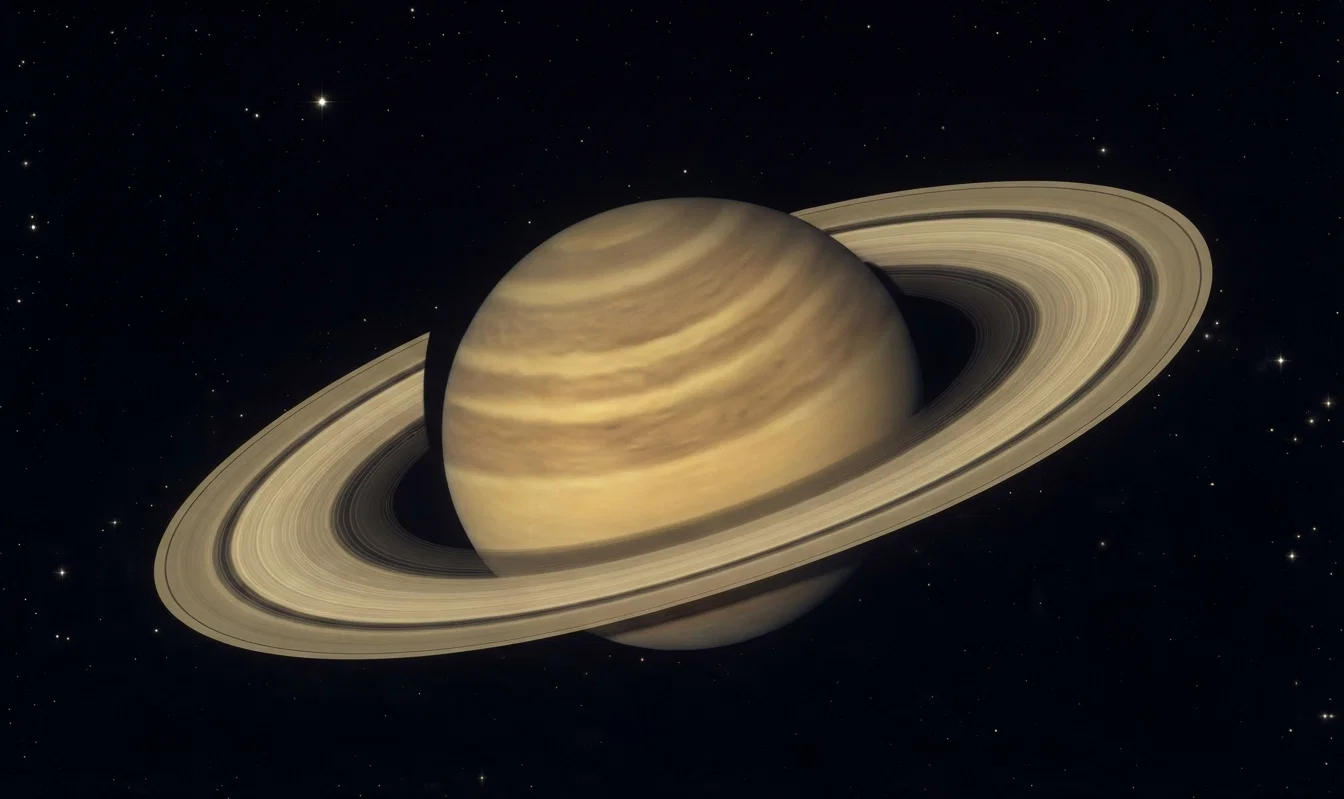
The beauties of Taurus are at the present time greatly enhanced by the presence of great Saturn, that far-distant world, the most wonderful object as yet observed by man in the solar system. This planet is visible to the unaided eye, as a bright star, somewhat pale in color. A moderate-sized telescope shows him away in the depths of space, surrounded by his rings, which seem to form a flat, luminous framework, or setting, a most beautiful and awe-inspiring object. A powerful instrument would show also the varied belts, five in number, and at least seven attending satellites.
Saturn is about nine hundred millions of miles distant from the sun. His diameter is about eighty thousand miles. Twenty-nine and one half years are required to accomplish his circuit around the sun. In the words of another: “There is no planet in the solar system whose firmament presents such a variety of splendid and magnificent objects as that of Saturn. The various aspects of the seven moons, one rising above the horizon, while another is setting, and a third approaching the meridian; one entering into an eclipse, and another emerging from one; one appearing as a crescent, and another with a gibbous phase; and sometimes the whole of them shining in the same hemisphere, in one bright assemblage; the majestic motions of the rings, at one time illuminating the sky with their splendor, and eclipsing the stars; at another, casting a deep shade over certain regions of the planet, and unveiling to view the wonders of the starry firmament;”—all these scenes bespeak the majesty and omnipotence of the divine Architect.
He who has created the starry worlds is “strong; not one faileth.” There is truest comfort in knowing that the infinite God, who holds celestial spheres in space, is also pledged to protect His children. Every trusting, believing soul who turns to Him becomes His especial care. Not one shall fail. “He shall never suffer the righteous to be moved.” Ps. 55: 22.
Harsh Words to a Wife
“THE man who speaks harshly to his wife is sending an arrow into the heart of his best friend.”
A WORD TO OUR READERS
By Editor
We send no papers from this office to individuals without pay in advance. When persons receive copies without ordering them, they are sent by other parties, and we can give no information in regard to them. Persons thus receiving copies of the SIGNS are not indebted to the office, and will not be called upon to pay for them. Please read the papers you may receive, and hand them to your friends to read.
DATE OF EXPIRATION
The SIGNS wrapper bears date of last issue due on your subscription. Unless renewed in advance, paper stops with expiration date.
If herewith is an order-blank, you will know you have overlooked sending renewal. You will not wish to miss a single issue. Back numbers often can not be furnished.
SCRIPTURE QUOTATIONS
Our authority for the doctrines we teach is the Bible. Quotations are usually from the King James Version or the American Standard Revised.
LAWS INTRODUCED BEFORE THE FALL OF MAN
By R. C. P.
They Were All Moral—Two Conspicuous Examples Considered
ALL LAWS instituted before the fall of man were moral laws. Ceremonial laws were not instituted until after the fall. The laws introduced before the fall had to do only with man's moral relations to God and his fellow man. The relations required by the moral law of God's government were therefore designed to inaugurate perfect relations between man and God and between man and his fellow man, and these relations were designed to be perpetual. If sin had not entered, all of the laws introduced before the fall would have continued as laws of God's moral government eternally. Unless they continue since the fall, that which was originally immoral has ceased to be immoral, or God has weakened in demanding as the standard for His kingdom a moral government.
THE MARRIAGE LAW
The marriage law as given in the second chapter of Genesis is, therefore, a moral law, and it is of perpetual obligation. In stating the principle upon which the marriage institution rests, the Lord places the marriage relation upon an unalterable moral basis. "And the Lord God said, It is not good that the man should be alone; I will make him an help meet for him. . . . And the Lord God caused a deep sleep to fall upon Adam, and he slept: and He took one of his ribs, and closed up the flesh instead thereof; and the rib, which the Lord God had taken from man, made He a woman, and brought her unto the man. And Adam said, This is now bone of my bones, and flesh of my flesh: she shall be called Woman, because she was taken out of Man. Therefore shall a man leave his father and his mother, and shall cleave unto his wife: and they shall be one flesh." Gen. 2:18, 21-24.
It must ever remain a fact, therefore, that the marriage of one woman to one man, both, by that relation, being so completely blended in their lives that they become one flesh, is for the highest good of the race of mankind. Plural marriages, introduced as the result of apostasy, have always been a source of trouble. They were disapproved of God in the days of Abraham. Gen. 21:9-14.
THE PHARISEES CHALLENGED CHRIST
Christ was challenged by the Pharisees of His time on the question of His teaching the perpetuity of this moral precept. Their question, and His most lucid exposition of the perpetuity of the morality of the marriage law as originally given, are recorded in Matt. 19:3-9: "The Pharisees also came unto Him, tempting Him, and saying unto Him, Is it lawful for a man to put away his wife for every cause? And He answered and said unto them, Have ye not read, that He which made them at the beginning made them male and female, and said, For this cause shall a man leave father and mother, and shall cleave to his wife: and they twain shall be one flesh? Wherefore they are no more twain, but one flesh. What therefore God hath joined together, let not man put asunder. They say unto Him, Why did Moses then command to give a writing of divorcement, and to put her away? He saith unto them, Moses because of the hardness of your hearts suffered you to put away your wives: but from the beginning it was not so. And I say unto you, Whosoever shall put away his wife, except it be for fornication, and shall marry another, committeth adultery: and whoso marrieth her which is put away doth commit adultery."
Christ's declaration is that the marriage law unites two and no more than two in the marriage relation until death or immoral conduct dissolves the marriage bond. There is therefore no room for misunderstanding the moral character of the marriage law.
THE SABBATH A MORAL INSTITUTION
The Sabbath was instituted in Eden before the fall. It was made for man before sin entered. Its institution was based upon the fact that God rested upon the first seventh day, and blessed and hallowed it. Gen. 2:1-3. The basis of the Sabbatic rest is therefore an unalterable and eternal fact of the moral obligation of the creature to remember his Creator. Had sin never entered, the Sabbath would have been kept eternally. Either the original creation Sabbath must still be kept eternally, or Satan, through the fall, has defeated God's purpose to perpetuate this moral institution.
That the Lord still required the continual observance of this moral precept after the fall, as a perpetual covenant for the purpose of remembering God as Creator, is most clearly stated in Ex. 31:15-17: "Six days may work be done; but in the seventh is the Sabbath of rest, holy to the Lord: whosoever doeth any work in the Sabbath day, he shall surely be put to death. Wherefore the children of Israel shall keep the Sabbath, to observe the Sabbath throughout their generations, for a perpetual covenant. It is a sign between Me and the children of Israel forever: for in six days the Lord made heaven and earth, and on the seventh day He rested, and was refreshed."
THE FALL COULD NOT RELEASE
Since the fall can never release the binding obligation of any moral precept, and all institutions and laws introduced before the fall are moral obligations, designed to endure eternally, the Sabbath institution founded as a weekly memorial of the Creator's rest at the close of creation week is a moral institution, and unchanged must endure eternally.
This is further shown in that after the restoration of all things to their original Edenic conditions, the original creation Sabbath is perpetuated in Eden restored. "For as the new heavens and the new earth, which I will make, shall remain before Me, saith the Lord, so shall your seed and your name remain. And it shall come to pass, that from one new moon to another, and from one Sabbath to another, shall all flesh come to worship before Me, saith the Lord." Isa. 66:22, 23.
CAN NOT DISPENSE WITH EVEN ONE
What moral precept can be dispensed with, and subjects of a moral government remain perfect? Can they have other gods, make and worship images, profane the name of God, or disregard the Sabbath, and be blameless? Can they dishonor parents, kill, commit adultery, bear false witness, or covet, and remain morally pure?
No one who is pure in heart will wish to be released from the obligation to observe every precept of God's perfect code of morals. One who would wish a single precept of His law abrogated, is defective in moral character, and is unfitted to dwell in a perfect Paradise, as were Adam and Eve in Eden after they had committed one act of transgression. Perfect conformity to God's perfect moral law is therefore required of all subjects of God's moral government.
Ministering to Sin-Sick Souls
"Nigh and afar off are souls weighed down by a sense of guilt. It is not hardship, toil, or poverty that degrades humanity. It is guilt, wrong-doing. This brings unrest and dissatisfaction. Christ would have His servants minister to sin-sick souls."
THE SOUL'S SIN-OFFERING AND SACRIFICE
By J. O. C.
Did the Son of God Himself Really Die?—Is the Sacrifice Divine, or Merely Human?—He Tasted Death for Every Man
HOW superficially is considered, at times, the cost of man's salvation! How disposed are many to weigh this matter by natural standards! How apparently easy to think of the divine Sacrifice in the light of a common death! This is so, evidently, because of the established custom of measuring deeds by comparison of human environments. By such customary appraisements, many take for granted that the death of Christ was simply the snuffing out of His physical life, which affected only the human form of flesh in which was enshrouded the Son of God.
MORE THAN MERE PHYSICAL DEATH
But there surely must have been something more than the taste of physical death in the attendant scenes of Calvary. No common obituary record can relate the story of that "death of death" suffered on the "hill of crucifixion." Of ordinary malefactors, with all their belated sorrow for a wrong course, not one was ever known to sweat blood drops from face and trunk in anguish of soul for the final act. There must, then, have been an inner meaning to the words of the Redeemer's passion, when He declared that His soul was exceeding sorrowful, even unto death. Matt. 26:38.
The excessive agony of that Gethsemane event was not, however, the symptom of personal guilt clinging to the divine Sufferer. No, indeed! But the deep wounds which caused such superabundant, cheerless grief, were the resultant burden of a world's multiform transgressions. Those shocking bruises were the effect of stripes laid on the Guiltless One, made inconceivably grievous by the infinitely expanded iniquities of creation's millions.
CARRYING THE GRIEFS AND SORROWS OF OTHERS
The Sorrowing One of Gethsemane and Calvary, in all His sufferings, was but bearing the griefs and carrying the sorrows that belonged to a world of sinners against Himself. Afflicted though He was, beyond human comprehension, without offering complaint, yet He was unappreciated. Because He was seen to be so given to grief, He was said to be thus humiliated by having been smitten of God as for leprosy, that hated disease of the Jewish nation. The very ones He came to suffer for and save, were so anxious to rid the world of Him, that justice was denied Him, and He was "cut off" without a legal trial.
Whatever guilty humans deserved as a penalty for multiplied transgressions, was tasted in that awful experience. An unchangeable decree had made death the wages of sin. Rom. 6:23. This was not simply physical dissolution; for if that were all, it would soon be over. It must have been more than this, else the sufferings of Christ were a supererogation, and an excessive requirement from Him. But love's demand is not thus unreasonable. Christ simply tasted death for man—that is, in man's behalf—no more, no less.
THE "DEAD BRANCH" AND THE DEATH CHRIST TASTED
At his creation, man was endowed with capacity for real happiness. This power of discernment was no less than a "living soul" bestowed on the senseless clay by the inbreathing of God's own life. But disobedience was made the sure cause of the man's alienation from this all-sufficient support, which would leave him to wander in the "vanity," or uselessness, of his degraded mind. Gen. 2:17; Eph. 4:17-19. To remain thus cut off from the life of God, no union with the Eternal could be hoped for, no heavenly pleasure could be known, and only the darkness of despair could be depended upon. In this way man became a "dead branch," only fit to be cast into the fire and be burned. John 15:6.
It must have been this death, this alienation from God's life, that Christ tasted—yes, tasted—for every man (Heb. 2:9) whose soul was tainted with sin. Christ's very soul was therefore made an offering for sin, that the souls of men might again thrill with the inbreathing of God's life, and thus promote the pleasure of a loving Father. Isa. 53:10; Rev. 4:11. He must, then, have had a depressing soul sense of man's forsaken condition, as an alien from God's sustaining life, which grieved Him "even unto death"—that is, made Him conscious of the temporary withdrawal of the life of the Godhead. This was intensified to the limit when the agony of the cross drew from the cognizant Sufferer those appalling words which broke His own heart: "My God, My God, why hast Thou forsaken Me?" Matt. 27:46.
Just how great was the God-man sacrifice, none may ever know until the full God-power of discernment has been restored to the156redeemed in the future life, when men shall be counted sons of God after the model of their elder Brother, when He was raised from the dead. Rom. 1:4. This much, however, is now familiar to all — the sense of sin has become so generally admitted as to cover the world with altars, churches, and temples. In all grades of humanity, religious rites betray this consciousness so strongly that many are readily found who will sacrifice earthly holdings to satisfy sin-stricken moral faculties. Nay, more; to ward off death, which is the aftermath of sin, everything dearly held, as accumulated possessions, is gladly offered, though in vain. But even this can not measure the sufferings which brought relief to every sin-sick soul who will receive it in the way prescribed.
In view of what the divine sacrifice meant, it is not so strange that in the agonizing prayer of His garden passion, He who had never sinned, but had ever been one with the eternal Father, should fear that His offering would not suffice to meet the awful debt of accumulated sin. But we may well thank the loving Father that the suffering Saviour was heard in the thing that He feared, and so was perfected to become the Author of eternal salvation to all who accept Him as their offering for sin. Heb. 5:7-9. J. O. C.
COMFORTING JOYS OF THE BLESSED HOPE
By E. E. A.
All Sorrow, Pain, and Death to Vanish—He Has Promised to Come in Person—The Glory to Be Revealed in Us
SICKNESS, sorrow, pain, and death are all consequences of sin. They had no place in God's original plan for man. They are abnormal conditions, brought about because of man's transgression of God's holy law. Created in the image of God, and crowned with glory and honor, man was an entire stranger to suffering, and would have remained so for eternity had he not sinned.
In violating God's law, Adam planted the seeds of death in his person; and sickness, pain, and suffering—with death as the ultimate end—have marked the course of sin through the millenniums that have followed. "Sin hath reigned unto death;" but, thank God, a plan has been devised whereby "grace" is now to "reign through righteousness unto eternal life by Jesus Christ our Lord." Rom. 5:21.
"The Son of man is come to save that which was lost." Matt. 18:11. All that was lost in the fall is to be restored in the plan of salvation. "For this purpose the Son of God was manifested, that He might destroy the works of the devil." 1 John 3:8. "The last enemy that shall be destroyed is death." 1 Cor. 15:26. When "death is swallowed up in victory," the saints of God will shout, "O death, where is thy sting? O grave, where is thy victory?" 1 Cor. 15:54, 55.
The prophet Isaiah, in speaking of the future glory of the righteous, says: "Thine eyes shall see the King in His beauty; they shall behold the land of far distances. . . . And the inhabitant shall not say, I am sick: the people that dwell therein shall be forgiven their iniquity." Isa. 33:17, 24, margin.
But this is not all of the blessed story. "And God shall wipe away all tears from their eyes; and there shall be no more death, neither sorrow, nor crying, neither shall there be any more pain: for the former things are passed away." Rev. 21:4. It is therefore clear that all sorrow and crying, all pain and sickness, and death itself, are among the things that are to pass away when the work of redemption is completed.
For sixty centuries death has apparently prevailed against the church, while many millions of the righteous have gone down into the dark portals of the tomb; but the promise and oath of God still stand. From the heavenly portals comes the word, "I am He that liveth, and was dead; and, behold, I am alive forevermore, Amen; and have the keys of hell and of death." Rev. 1:18.
Speaking of Christ, the prophet Isaiah said, "The key of the house of David will I lay upon His shoulder; so He shall open, and none shall shut; and He shall shut, and none shall open." Isa. 22:22. The One who holds the keys of death is soon to return to earth in power and great glory, attended by all the heavenly host. "For the Lord Himself shall descend from heaven with a shout, with the voice of the Archangel, and with the trump of God: and the dead in Christ shall rise first: then we which are alive and remain shall be caught up together with them in the clouds, to meet the Lord in the air: and so shall we ever be with the Lord." 1 Thess. 4:16, 17.
The righteous hear the call of the Lifegiver, and are changed from mortality to immortality. 1 Cor. 15:51-54. Then this body of our humiliation will be fashioned like the body of His glory. Phil. 3:20, 21, R.V. "Then the eyes of the blind shall be opened, and the ears of the deaf shall be unstopped. Then shall the lame man leap as an hart, and the tongue of the dumb sing." Isa. 35:5, 6.
"I reckon that the sufferings of this present time are not worthy to be compared with the glory which shall be revealed in us. For the earnest expectation of the creature waiteth for the manifestation of the sons of God. For the creature was made subject to vanity, not willingly, but by reason of Him who hath subjected the same in hope, because the creature itself also shall be delivered from the bondage of corruption into the glorious liberty of the children of God. For we know that the whole creation groaneth and travaileth in pain together until now. And not only they, but ourselves also, which have the first-fruits of the Spirit, even we ourselves groan within ourselves, waiting for the adoption, to wit, the redemption of our body." Rom. 8:18-23.
Though our bodies may be racked with pain, or our hearts breaking with sorrow, we may "look up, and lift up our heads," knowing that our redemption draws nigh. When in the quiet hour we listen to the voice of our blessed Lord, we hear Him say, "Surely I come quickly." And with unutterable longing our burdened hearts respond, "Amen. Even so, come, Lord Jesus." Rev. 22:20.