The Youth’s Instructor, Vol. 29, No. 12.

TRIUMPHAL ARCHES

The Youth’s Instructor

Mar 23, 1881

S. D. A. Publishing Association · Battle Creek, Mich. · Mar 23, 1881

TRIUMPHAL ARCHES.
A TRIUMPHAL arch is a monumental structure erected in honor of some celebrated person or his deeds, or to commemorate some great event. It is supposed that they originated among the Romans. Since the building of the first in the year 196 B. C., there have arisen, in the city of Rome alone, twenty-one of these monuments. The popes have been pleased to call Rome the “Eternal City”; but this title does not hold true concerning these arches. Each succeeding century has left a smaller number than it found, and, at the present day, but few remain. But the custom of raising these arches did not perish in the city of its origin. Cities of other countries soon followed suit; and not until a late period, was this custom superseded by that of raising monuments. Paris excels all modern cities in the number and beauty of its arches. The most magnificent is the arc d’Etoile, which was built to commemorate the victories of Napoleon. Its height and breadth are each 150 feet. It has three arches, the central one 95 feet, and those on either side 52 feet in height. There are but two in England, one of which was erected at Hyde Park corner. It is surmounted by the equestrian statue of the Duke of Wellington, in whose honor it was raised.
In China there are said to be over 1000 of these arches, 200 of which are very beautiful. They are situated not only in cities, but on eminences along the highways leading through the empire. Some few of the less beautiful are in honor of distinguished women.
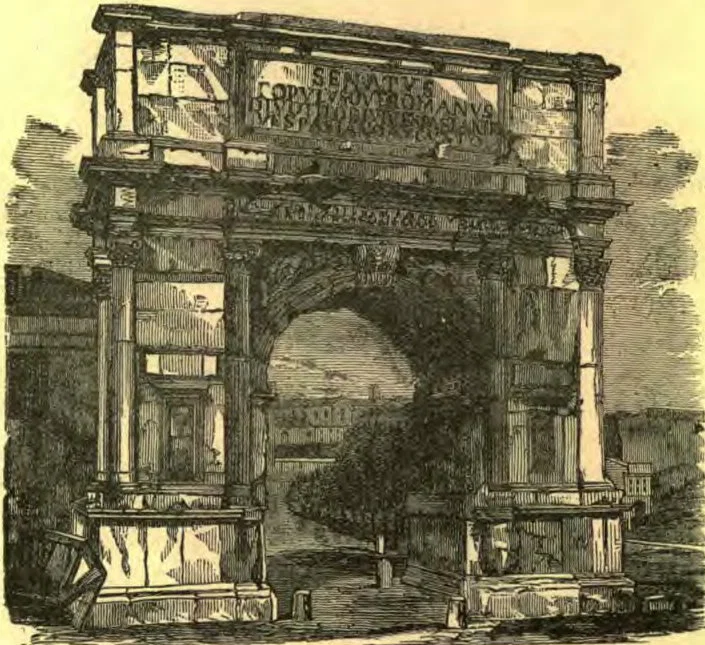
One of the finest of Roman arches is presented in the accompanying engraving. The Latin inscription on the frieze is thus translated: “The Senate and people of Rome to the divine Titus, son of the divine Vespasian the Great.” Vespasian commenced the conquest of Judea; but on being called to Rome to be crowned emperor, he left the completion of the undertaking to his son, Titus. The latter terminated the war by the taking of Jerusalem, A. D. 70, about forty years after our Lord forewarned his disciples of this event. Returning to Rome, laden with rich spoils, Titus, together with his father, enjoyed great honors at the hands of his countrymen; and this arch was erected to commemorate their success. In history it is mentioned as the arch of Titus. At first sight it does not appear to possess much architectural beauty; but a more careful study of its plan shows that, at the time of its erection, it was a noble structure. History gives a description of some parts that are not seen in the picture. On one of the inner sides of the arch is an imposing scene, sculptured in bass-relief. It represents the emperor in his car, drawn by four horses and attended by lictors. Victory is following, bearing in her left hand a branch of palm, and with her right, placing a laurel wreath upon the conqueror’s brow. The horses are led by a figure, clothed in armor, symbolizing Rome, which is followed by magistrates. Turning to the opposite side of the arch, another bass-relief meets our view. There are represented the tables of show-bread, the golden candlestick of seven branches, the tables of the law, the ark of the covenant, and other spoils taken at Jerusalem.
This monument is surpassed by only two in Italy, of which the largest and most beautiful bears the name of Constantine. This was also built at Rome.
The erection of a Roman triumphal arch was always preceded by a pompous ceremony, called a “triumph,” performed in honor of the victorious general. He was allowed to enter the city, crowned with a wreath of laurel, bearing a scepter in one hand, and a branch of laurel in the other, and riding in a chariot drawn by four horses. He was preceded by the Senate and magistrates, musicians, the captives in fetters, and the spoils. The procession advanced in this manner to the Capitoline hill, where sacrifices were offered, and the commander entertained with a public feast. The design sculptured on the arch of Titus undoubtedly represents a scene in his triumph.
How must the hearts of those mighty chieftains have throbbed with pride, while thus receiving the homage of the applauding multitude! Yet as we read the record of their lives on the pages of history, we are reminded that “the triumphing of the wicked is short, . . . because he hath oppressed, and hath forsaken the poor; because he hath violently taken away a house which he builded not. . . . The heaven shall reveal his iniquity, and the earth shall rise up against him.”
Each victorious Christian soldier will enjoy a triumph with which the grandest of this earth cannot be compared. Led by his divine Commander he will enter the truly “Eternal City,” whose “every several gate was of one pearl; and the street of the city was of pure gold.” His name will there be recorded, not on perishable monuments of stone, but in living characters, on the Lamb’s book of life. With such a hope before us, we are led to exclaim with the psalmist, “Save us, O Lord, our God, and gather us from among the heathen, to give thanks unto thy holy name, and to triumph in thy praise.”
CHAS. H. GILES.

THE THREE HARDEST WORDS.

A VERY learned man once said, “The three hardest words in the English language are, ‘I was mistaken!’”
Frederick the Great once wrote to the Senate: “I have lost a great battle, and it was entirely my own fault.”
Goldsmith says, “This confession displayed more greatness than all his victories.”
Do not be afraid to acknowledge your mistakes, else you will never correct them; and you are really showing how much wiser you are than when you went astray.

A SERMON IN RHYME.

If you have a friend worth loving, Love him. Yes, and let him know That you love him, ere life's evening Tinge his brow with sunset glow. Why should good words ne'er be said Of a friend—till he is dead?
If you hear a song that thrills you, Sung by any child of song, Praise it. Do not let the singer Wait deserved praises long. Why should one who thrills your heart Lack the joy you may impart?
If you hear a prayer that moves you By its humble, pleading tone, Join it. Do not let the seeker Bow before his God alone. Why should not your brother share The strength of “two or three” in prayer?
If you see the hot tears falling From a loving brother’s eyes, Share them, and, by sharing, Own your kinship with the skies. Why should any one be glad, When his brother’s heart is sad?
If a silver laugh goes rippling Through the sunshine on his face, Share it. ’Tis the wise man’s saying, For both grief and joy a place. There’s health and goodness in the mirth In which an honest laugh has birth.
If your work is made more easy By a friendly, helping hand, Say so. Speak out brave and truly, Ere the darkness veil the land. Should a brother workman dear Falter for a word of cheer?
Scatter thus your seeds of kindness, All enriching as you go— Leave them, trust the Harvest-giver; He will make each seed to grow. So, until its happy end, Your life shall never lack a friend.
—Amherst Record.

THE LITTLE GIRL AND HER COPY.

A little girl went to writing-school. When she saw her copy, with every line so perfect, she said, “I can never write like that.”
She looked steadfastly at the straight round lines so slim and graceful. Then she took up her pen, and timidly put it on the paper. Her hand trembled; she stopped, studied the copy, and began again. “I can but try,” said the little girl; “I will do as well as I can.”
She wrote half a page. The letters were crooked. What more could we expect from a first effort? The next scholar stretched across her desk and said, “What scraggy things you make!” Tears filled the little girl’s eyes. She dreaded to have the teacher see her book. “He will be angry with me and scold,” she said to herself.
But when the teacher came and looked, he smiled. “I see you are trying, my little girl,” he said kindly, “and that is enough for me.”
She took courage. Again and again she studied the beautiful copy. She wanted to know how every line went, how every letter was rounded and made. Then she took up her pen, and began to write. She wrote carefully, with the copy always before her. But oh, what slow work it was! Her letters straggled here, they crowded there, and some of them looked every way.
The little girl trembled at the step of the teacher. “I am afraid you will find fault with me,” she said; “my letters are not fit to be on the same page with the copy.”
“I do not find fault with you,” said the teacher, “because I do not look so much at what you do. By really trying, you make a little improvement every day; and a little improvement every day will enable you to reach excellence by-and-by.”
“Thank you, sir,” said the little girl; and thus encouraged, she took up her pen with a greater spirit of application than before.
And so it is with the dear children who are trying to become like his dear Son in a minute, or a day, or a year; but what pleases him is that you should love him, and try every day to follow his example. It is that disposition which helps you to grow day by day, little by little, into his likeness, which God desires to see. God loves you for trying, and will help you.—Sel.

I WISH I HAD KNOWN IT BEFORE.

A BEAUTIFUL woman lay on a bed of sickness in an elegant residence on one of the finest and most fashionable of Boston’s broad avenues. She was surrounded with every luxury and attended by kind friends, anxious to anticipate every wish, and to relieve the monotony of her weary, painful days in every possible manner.
One afternoon she opened her eyes and said, in a low, weak voice: “Read to me, please. Oh dear, how I wish there was something new in matter and manner in the literary world. I am so tired of everything.”
Her sister went into the next room for a book of poems; and while she was gone, the professional nurse who sat beside the bed, took from the pocket of her plain drab wrapper a small Bible, and opening it, began reading in a subdued voice:— “And seeing the multitude, He went up into a mountain, and when he was set, his disciples came unto him, and he opened his mouth and taught them, saying—”
The sick woman listened attentively until the nurse paused with the words, “And the people were astonished at his doctrines, for he taught as one having authority, and not as the scribes;” then she said,—
“That is beautiful! That will create a sensation! Who wrote it? Where did you get it?”
“Why,” said the nurse in astonishment, looking with surprise at her patient, and thinking at first she was wandering in her mind, “it is in the Bible; Christ’s Sermon on the Mount, you know.”
“That in the Bible? Anything so beautiful and so good as that in the Bible?”
“What did you suppose was in the Bible if not something good?” asked the nurse seriously, yet smiling, in spite of herself, at her patient’s tone of surprise and incredulity.
“Oh, I don’t know. I never thought much about it. I never opened a Bible in my life. It was a matter of pride with my father to never have a Bible in the house. How did this one come here? Oh, it’s yours, your pocket Bible. It is strange you should have surprised me into listening to a chapter, and that I should have been so charmed and not know to what I was listening.”
“You have certainly heard the Bible read in church?” asked the nurse in surprise.
“Not I. I never have been to church. We have always made a holiday of Sunday. Papa got into that way in Paris. We have been to all popular places of amusement, of course, but never to church. I never have thought about the Bible. I did not suppose it had literary merit. I had no idea it was written in the simple, beautiful style of the portion you have just read. I wish I had known it before.”
A few hours later her disease took a fatal turn. The physician came and told her that her time on earth was very short. She would never see another sun rise.
“It cannot be possible,” she said; “I never realized that death could come to me. What was that prayer you read, nurse? ‘Our Father which art in Heaven.’ Say it with me, husband,”—and he did. “I wish I had known it before,” she said, over and over, until she fell into a sleep from which she passed into eternity, and that wail of regret was the last word upon her dying lips.
The nurse said it was one of the saddest experiences of her life to see that beautiful, cultivated, gifted young woman, with kind friends, a loving husband, and a beautiful home,—she who had all her life taken pride in ignoring the Bible;—turn, when death came, from everything she had prized to the little despised book, and die with the cry upon her lips, “I wish I had known it before.”
—American Messenger.

IMPERFECTUS

I wonder if ever a song was sung But the singer's heart sang sweeter! I wonder if ever a rhyme was rung But the thought surpassed the meter! I wonder if ever a sculptor wrought Till the cold stone echoed his ardent thought! Or if ever a painter, with light and shade, The dream of his inmost heart portrayed!
I wonder if ever a rose was found, And there might not be a fairer! Or if ever a glittering gem was ground, And we dreamed not of a rarer! Ah! never on earth shall we find the best, But it waits for us in the Land of Rest; And a perfect thing we shall never behold Till we pass the portal of shining gold. —Independent.

THE TONGUE.

The tongue is an unruly member, and but few govern it properly. Children should study to make a wise use of the tongue. Some use it too much.
Two icicles of nearly the same size were hanging from the eaves of the house. The warm sun was shining without and a warmer fire blazing within, consequently the icicles began to melt. One of them dropped fast, drop, drop, drop, drop; while the other dropped only at long intervals. It was noticed that the drops which fell fast were quite small, while the drops of the other were large. A dish was placed under each of these icicles, and after two hours it was found, by actual measurement, that more water had fallen from the one that dropped so slowly than from the other.
Here is a lesson. It is not always those who talk the most, who say the most. Take two persons for instance. One will talk all day long—just clatter, clatter, as you have before now heard a loose clapboard on the windy side of the house. The other will talk only when he really has something to say. Now, if at night you will carefully weigh what each has said (mind, I say weigh, not measure), you will find that he who has talked the most has said the least.
Then there are deceitful tongues, tattling tongues, swearing tongues, lying tongues, saucy tongues, scolding tongues, and oh! so many kinds. And what hateful things these are to carry about!
But children like short sermons, and so do I. I will give you a text: Prov. 15:4; and now see who will write the best sermon. H. A. St. John.

Sowing, Reaping, and God's Harvest of Grace

ONE sows, another reaps the ground, God garners in the sheaves; He knows the heart where grace abounds, Accepts the fruit, not leaves.

REBUKE

THE world is old and the world is cold, And never a day is fair, I said. Out of the heavens the sunlight rolled, The green leaves rustled above my head, And the sea was a sea of gold.
The world is cruel, I said again; Her voice is harsh to my shrinking ear, And the nights are dreary and full of pain. Out of the darkness, sweet and clear, There rippled a tender strain,—
Rippled the song of a bird asleep, That sang in a dream of the budding wood; Of shining fields where the reapers reap, Of a wee brown mate and a nestling brood, And the grass where the berries peep.
The world is false, though the world be fair, And never a heart is pure, I said. But lo! the clinging of white arms bare, The innocent gold of a baby's head, And the lisp of a childish prayer.
—Overland Monthly.

BE KIND TO YOUR PARENTS.

Boys, be kind to your parents. When your father is tired with working, say to him, “Father, I will put away your tools.” When he comes home from business or from church, go to meet him and offer to attend to his horse. You do not know how much your father will appreciate such services, and how proud he will feel of such a son. Do not be ashamed to help your mother, too; and drop a kind word for them both whenever you can.
Girls, watch your tired mothers. Help them whenever you can. Even if you are quite small, you can bring her a basket of chips or a bucket of water, which will help her a great deal; and when you grow older, you can help her in many ways. Go to her often and say, “Mother, I will help you.” Sometimes, when she is almost worn out, ask her to sit down while you finish her work. From your mother’s heart will flow a river of thankfulness; and when she kneels in her closet, she will remember you to the God of love, who will reward you in time and in eternity.
Be kind to your parents. God will bless you for it, and the world will respect you for it. Besides, it is a duty you owe them for having tenderly watched over and cared for you during your helpless childhood years; and the consciousness of having faithfully performed this duty will bring you a peace and joy in after years that no other acts of your life can.—
Well-Spring.

HOW TO READ.

READ systematically. Do not take up and read any books because they merely chance to fall in your way, and after wasting a few hours over some of their pages, tumble over the remainder of the leaves. This method of acquiring knowledge dissipates the mind, destroys habits of accurate thinking, and unfits you for any intellectual progress. Make an effort to penetrate the full meaning of your author, and think patiently of every difficult passage until you understand it, or, if it baffles your unassisted efforts, have it explained. Examine carefully the title-page and preface of every book you read, that you may learn who wrote it, where it was written, and what it was written for.

SCENES IN THE LIFE OF CHRIST.

LESSON 9.—JOHN THE BAPTIST.

The Bible tells us of two very noted men by the name of John, who lived in the time of Christ. One was called “the beloved disciple,” because his disposition was so gentle and yet so noble that Jesus had a special love for him; the other was called “the Baptist,” because he baptized so many people.
John the Baptist was born in what was called the Hill Country of Judea. This country lies south and southwest of Jerusalem, and, although hilly and quite broken, it was, in many parts at least, beautiful and productive. The plains were rich with grain, and the hillsides were terraced, watered, and planted with vines, figs, olives, and pomegranates.
Somewhere in this country, lived Zachariah, and his wife Elizabeth. Zachariah was one of the priests, whose duty it was to serve a part of the time in the temple. The priests were divided into sets, called courses, and when one course had served a few days, another set took their place, and so on throughout the year.
At one time, when Zachariah was ministering in the temple, the angel Gabriel appeared to him, and told him that he should have a son. Now Zachariah and Elizabeth were old people, and had never had any children; so, although Zachariah probably desired a son more than anything else, he could not believe that what the angel promised would come to pass. Then the angel “answering said unto him, I am Gabriel, that stand in the presence of God, and am sent to speak unto thee, and to show thee these glad tidings; and behold thou shalt be dumb, and not able to speak until the day that these things shall be performed, because thou believest not my words.”
Now what the angel had to say was not called glad tidings just because Zachariah and Elizabeth would be glad to have a son, but because that son was to do a special work for the Lord. He was to proclaim that the coming of Jesus as the Redeemer of the world was nigh at hand, and, by teaching the people, to prepare them to receive Jesus as their Saviour when he should come.
Gabriel told Zachariah all these things. He said, “Thou shalt call his name John, and thou shalt have joy and gladness; . . . for he shall be great in the sight of the Lord, . . . and he shall be filled with the Holy Ghost.”
“And the people waited for Zachariah, and marveled that he tarried so long in the temple. And when he came out, he could not speak unto them; and they perceived that he had seen a vision in the temple; for he beckoned unto them, and remained speechless.”
The angel’s words all proved true; and when John grew to be a man, he went out to preach. As we go east and southeast from Jerusalem, we soon come to a barren, rocky region that extends all the way to the Dead Sea. There is hardly a tree to be seen, and scarcely any bushes, except on the steep, rugged sides of the wild ravines, which are frightfully deep, and afford a passage for torrents and small streams. During the rainy season these streams are turbulent, and as we stand on the rocks above, we can look down, down, hundreds of feet, into the chasm below, and see the water roaring and dashing among the rugged rocks at the bottom. But these streams are not generally fed by springs, and when the dry season comes on, they grow smaller and smaller until most of them entirely disappear, leaving nothing but a gravelly torrent-bed where they once rushed on so furiously.
On the sides of these ravines, and from the crevices of the rocks, grow bushes and many wild flowers. From the flowers, bees make honey, and since they can find no better place, they lay it up on the sides of the rock.
This wild region is called the Wilderness of Judea, and here John went to preach. There were no houses, villages, or cities; but the people left the towns, and went out to hear him. At night he slept on the ground. He was dressed in a garment woven from camel’s hair, and his food was wild honey, and such fruits as could be found growing along the ravines.

QUESTIONS.

  1. What name was given to each of two noted men who lived in the time of Christ?
  2. In talking of them how do we show which one is meant?
  3. Why is one called “the beloved disciple”?
  4. Why is the other called “the Baptist”?
  5. Where was John the Baptist born? Luke 1: 39, 40.
  6. Which way from Jerusalem does this country lie?
  7. What may be said of its general appearance and nature?
  8. Describe its plains and hillsides.
  9. Who were the parents of John the Baptist? Luke 1.
  10. To what class of people did Zachariah belong?
  11. What was it the priests’ duty to do?
  12. Were the priests all needed in the temple at the same time?
  13. What arrangement was made in regard to their services?
  14. When Zachariah was at one time serving in the temple, who appeared to him?
  15. What did Gabriel tell him?
  16. Could Zachariah believe that such a thing would really come to pass?
  17. What did the angel then say about his name, and his rank in Heaven? Verse 19.
  18. What did he say about his errand?
  19. What did he say should happen to Zachariah?
  20. Why was what the angel said called “glad tidings”?
  21. What great work was John to do?
  22. How was Zachariah made acquainted with this?
  23. What did he say the child’s name should be? Verse 13.
  24. What was to be his character?
  25. What caused the people to marvel who were waiting outside of the temple? Verse 21.
  26. When Zachariah came out, how did the people perceive that he had had a vision?
  27. How were the angel’s words fulfilled? Verses 57–66.
  28. What did John do when he grew to be a man? Matt. 3: 1–6.
  29. As we go east and southeast from Jerusalem, to what kind of country do we soon come?
  30. How far does this desolate region extend?
  31. What grows in this dreary place?
  32. Describe the ravines.
  33. Describe the streams that flow through them.
  34. Why do most of them disappear in the dry season?
  35. What grow from the crevices of the rocks along the sides of these ravines?
  36. What is produced from the flowers?
  37. Where is it laid up?
  38. What is this wild region called?
  39. What happened here to make the place interesting?
  40. Was this region inhabited?
  41. How, then, did John have hearers?
  42. Where did John lodge at night?
  43. How was he dressed?
  44. What was his food?

LESSONS ON NEW-TESTAMENT HISTORY.

LESSON 22.—INSTRUCTION AT THE SECOND PASSOVER.

In our last lesson we left our Lord at the passover,—the second one after his baptism. He had just performed a noted miracle at the pool of Bethesda. This awakened the jealousy of the Pharisees, who raised an outcry against him, and “sought to slay him,” accusing him of breaking the Sabbath, and of making himself equal with God. Jesus then discoursed to them, defending his own conduct, condemning them for their envy and unbelief, and giving encouraging promises to those who should believe and obey.
He thus continues:—
“Verily, verily, I say unto you, The hour is coming, and now is, when the dead shall hear the voice of the Son of God; and they that hear shall live. For as the Father hath life in himself, so hath he given to the Son to have life in himself; and hath given him authority to execute judgment also, because he is the Son of man. Marvel not at this; for the hour is coming, in the which all that are in the graves shall hear his voice, and shall come forth; they that have done good, unto the resurrection of life; and they that have done evil, unto the resurrection of damnation. I can of mine own self do nothing; as I hear, I judge; and my judgment is just; because I seek not mine own will, but the will of the Father which hath sent me. If I bear witness of myself, my witness is not true.
“There is another that beareth witness of me, and I know that the witness which he witnesseth of me is true. Ye sent unto John, and he bare witness unto the truth. But I receive not testimony from man; but these things I say, that ye might be saved. He was a burning and a shining light; and ye were willing for a season to rejoice in his light. But I have greater witness than that of John; for the works which the Father hath given me to finish, the same works that I do, bear witness of me, that the Father hath sent me. And the Father himself, which hath sent me, hath borne witness of me. Ye have neither heard his voice at any time, nor seen his shape. And ye have not his word abiding in you: for whom he hath sent, him ye believe not.
“Search the Scriptures; for in them ye think ye have eternal life; and they are they which testify of me. And ye will not come to me, that ye might have life. I receive not honor from men, but I know you, that ye have not the love of God in you. I am come in my Father’s name, and ye receive me not: if another shall come in his own name, him ye will receive. How can ye believe, which receive honor one of another, and seek not the honor that cometh from God only? Do not think that I will accuse you to the Father: there is one that accuseth you, even Moses, in whom ye trust. For had ye believed Moses, ye would have believed me; for he wrote of me. But if ye believe not his writings, how shall ye believe my words?”

QUESTIONS.

1. What did Jesus say was about to happen? Repeat John 5:25.
2. What gift has the Father bestowed upon the Son? Verse 26.
3. What has he given him authority to do? Verse 27.
4. What reference does our Lord make to the final resurrection? Verses 28, 29.
5. What is meant by the resurrection of life?—The resurrection that will take place when our Lord comes again in the clouds of Heaven, and all the holy angels with him.
6. Why is it called the resurrection of life? Luke 20:36; Rev. 20:6.
7. What is meant by the resurrection of damnation?—The resurrection of the wicked at the end of the thousand years. Rev. 20:5, 7–9.
8. By what argument did Jesus prove that all his judgments are just? John 5:30.
9. Of what does this give further proof?—That God makes the decisions of the Judgment, and commissions Christ to execute them.
10. Who had borne witness of Christ? Verses 31–33.
11. What remark did Jesus make concerning John? Verse 35.
12. What greater witness had Jesus? Verse 36.
13. What evidence did the Pharisees give that the word of God was not abiding in them? Verse 38.
14. What does Jesus admonish them to do? Verse 39.
15. What further condemnation does he bring upon them? Verses 40, 42, 43.
16. From whom does Christ receive honor? Verse 41.
17. By what question did Jesus show how they had wandered from God? Verse 44.
18. Who did he say should accuse them? Verse 45.
19. How did he make it appear that in rejecting him they rejected Moses? Verses 46, 47.

THE SKEPTIC AT SABBATH-SCHOOL.

A GENTLEMAN strongly inclined to skepticism visited the infant class of a Sabbath-school, and listened with fixed attention to the lesson. At the close of the exercises, he turned to the teacher with an incredulous look on his face, saying: “Is not this time thrown away, trying to teach babies about a Christ? Or, supposing you may impress them with some kind of knowledge, of what use will it all be, seeing they will not be able to remember anything of the character you are now telling them about?”
“Pardon me, sir,” returned the teacher, “but may I ask if your mother is living?”
“Ah! no; she died when I was a mere infant,” said the visitor, a cloud of sadness passing over his face. “But,” he continued, “I was told all about her as soon as I could learn anything. I was told how loving, patient, and self-sacrificing she was; and so clearly and well was my mother represented to me, that I love and revere her memory.”
“Then, sir,” broke in the teacher, with a warm smile upon her lips, “if you at that early age could be so taught about the mother whom you have not seen, may I not be sure that Jesus can be made as plain to the mind and as lasting to the memory of these little ones?”
The gentleman’s cheek flushed, but he made no reply, and shortly after took his leave.
The good teacher supposed she had given offense, but knew that her motive had been pure, and so simply lifted her heart in prayer that good might come of the words she had spoken.
To her great surprise, the next Sabbath the gentleman again presented himself, this time holding by the hand a lovely little girl about four years of age. Leading the child to the teacher, he said simply: “I have brought you my child; she is motherless, as her father is; but I cannot endure the thought that she should be Christless.”—S. S. Times.

“I INTENDED TO.”

“I INTENDED to learn my lesson this week.” Yes, no doubt you had intentions, but how strong were they? It seems that they were not strong enough to make you learn the lesson. You intended to eat your breakfast this morning, and you succeeded. You intended the same thing yesterday and the day before, and each time were successful. Your intentions can be carried out in the case of breakfast, but fail when it comes to the lesson.
But perhaps we are more interested in our breakfast than in our lesson. Ah! there is the real trouble. It is not a want of intention, but a lack of interest and determination.
Some one has said, If religion could be judged according to men's intentions there would scarcely be any idolatry in the world. The remark could apply to every act of our lives. Let the intentions be ever so good, but if the determination be lacking, then good-by to success. C.

LETTER BUDGET.

Leonard and Gertrude Crain write from Newstead, N. Y. They both go to Sabbath-school and study Lessons for Little Ones. He is twelve and she ten years old.
George Adams and his brother write from Sherman, Texas. George is ten and his brother twelve. They take the INSTRUCTOR, and attend Sabbath-school regularly. They are trying to be good boys.
Ortegal D’Arland writes from Hyde’s Mills, Wis.: “I like my INSTRUCTOR well. I got one yesterday. I go to school every day. I am eleven years old. I never wrote to the paper before. I never went to Sunday-school but once or twice. My mother died when I was little, and my father is gone out to Dakota. I live with my grandparents. I have no brothers or sisters. It is a very pleasant place where we live. I can’t think of any more this time.”
Jessie C. Sloan writes from Humbrid, Wisconsin: “I began to keep the Sabbath with my mother last summer. I am nine years old. I take the INSTRUCTOR, and go to Sabbath-school. I am trying to keep all of God’s commandments, so that I may meet Jesus when he comes. I send love to the editor and all the INSTRUCTOR family.”

GRACIE AND THE BLUEBIRDS.

“Why didn’t God tell them, mamma!” Said Gracie, in sad surprise, As she stood by the window and saw the snow On the earth, in the air and the skies.
“Tell whom, my little girl Gracie? Who was it you wanted told?” “Why, the poor little bluebirds, don’t you know? I’m afraid they have died in the cold.”
“’T was only yesterday morning I heard them singing so gay; I suppose they were sure that the spring had come, And winter had gone away.”
“They looked so pretty and happy, All flying and hopping around; I think they were going to build their nests, And were picking up straws from the ground.”
“Why didn’t God tell them, mamma, That the snow was coming again? And teach them to wait in a warmer place, Till he sent the April rain?”
“God knows what is best for birdies, As well as for you and me; And, Gracie, I think they are hidden-away All safe, where we cannot see.”
“The spring is as sure as ever, Though we did not expect the snow; And we and the bluebirds can wait for God, For he loves us well, you know.”
“By-and-by when the storm is over, You may scatter some crumbs about And if any hungry bluebird is near, I think he will find them out.”
“And soon, when the snow is melted, They will all come back again; And grass will grow, and birdies will know They have not waited in vain.”
“God doesn’t tell birds nor people What storms are coming some day; He wants them to wait and trust in him, For he knows the very best way.”
Little Gracie thought and listened, And the trouble went out her eyes; But she kept her watch at the window all day Till the storm had gone out of the skies.
And just at the cold, gray sunset A “Peep! peep! peep!” was heard, And down on the window, for Gracie’s crumbs, Flew one little lonely bird.
“You’ve come for your supper,” said Gracie: “God sent you, I guess; he knows; And, birdie, you needn’t be afraid, No matter how much it snows.
“Just shut your eyes and wait, birdie, Till God says, ‘Ready!’ then fly And see how the grass will be growing green All under the warm blue sky.”
—New York Observer.
Continue reading: THE APPLE IN THE BOTTLE