Your ShelfYour Projects

Review and Herald, Vol. 75, No. 3.

MRS. E. G. WHITE

Review and Herald

Jan 18, 1898

Seventh-day Adventist Publishing Association · Battle Creek, Mich. · Jan 18, 1898

MRS. E. G. WHITE

OUR WORDS.—NO. 1.

MRS. E. G. WHITE

“A good man out of the good treasure of the heart bringeth forth good things: and an evil man out of the evil treasure bringeth forth evil things. But I say unto you, That every idle word that men shall speak, they shall give account thereof in the day of judgment. For by thy words thou shalt be justified, and by thy words thou shalt be condemned.”
The Jewish priests and rulers, to whom these words were addressed, held positions of great responsibility. They were not ignorant men; they were looked upon by the people as wise teachers, whom they must obey. But they were unworthy of their holy office. Christ said of them: “Whereunto shall I liken this generation? It is like unto children sitting in the markets, and calling unto their fellows, and saying, We have piped unto you, and ye have not danced; we have mourned unto you, and ye have not lamented. For John came neither eating nor drinking, and they say, He hath a devil. The Son of man came eating and drinking, and they say, Behold a man gluttonous, and a winebibber, a friend of publicans and sinners. But wisdom is justified of her children.”
Here is shown the improper use made of the gift of speech. John was the greatest prophet born of women. “Verily I say unto you,” Christ declared, “among them that are born of women there hath not arisen a greater than John the Baptist.” “This is he, of whom it is written, Behold, I send my messenger before thy face, which shall prepare thy way before thee.” He was sent by God to prepare the way for his only begotten Son; but bitter, unkind words were spoken of him, and those who spoke these words pronounced judgment on themselves in so doing. “They say, He hath a devil,” Christ said. Did that make it so?—No; these words were spoken because he rebuked sin, and called men to repentance.
Many to-day feel at liberty to use the talent of speech recklessly, without thinking of the influence their words will have upon others. The Lord sends his messages by whom he will, and those who make disparaging remarks of the messengers and the message need to remember that they would speak in the same way of Christ if he should come to them as he came to the Jews, with a message that did not suit their unrenewed hearts. Those who use their speech to mimic the one who is speaking the words of God are charged with having done this to Christ; for it is done to him in the person of his saints.
The pious rulers would not receive John, and neither would they receive Christ who declared to them, “I am not come to call the righteous, but sinners to repentance.” Christ clothed his divinity with humanity, to meet humanity where it was, but not to speak the words of humanity. He sat at the table with publicans and sinners, he went among the most needy to speak words of life, and to sow the seeds of truth; for there he found more hopeful subjects than among the jealous, prejudiced scribes and Pharisees, who thought themselves exalted to heaven by their position.
Christ carried on his work among the needy and suffering. These judged him by his works. “Then was brought unto him one possessed with a devil, blind, and dumb: and he healed him, insomuch that the blind and dumb both spake and saw.” When this man was healed, the people were amazed, and they expressed their conviction when they said, “Is not this the Son of David?” meaning, Is not this the Messiah? The gracious works they had witnessed were to them a convincing evidence that he who performed them had the power of God, and they had no thought of attributing them to any other agency. Hence the inquiry, “Is not this the Son of David?”
But when the Pharisees heard it, they said, contemptuously, “This fellow doth not cast out devils, but by Beelzebub, the prince of the devils.” These words were inspired by Satan. The enmity and prejudice of the rulers were stirred into a fury of madness; and priests and rulers, Pharisees and Sadducees, united in pouring forth their hatred. From the treasure-house of their hard, stubborn hearts came the words, “This fellow doth not cast out devils but by Beelzebub, the prince of the devils.” They could not ignore Christ’s wonderful works, or attribute them to natural causes, so they said, They are the works of the devil. In unbelief they spoke of the Son of God as a human being. The works of healing done before them, works which no man had ever done or could do, were a manifestation of the power of God. But they charged Christ with being in league with hell. Their talent of speech was used to abuse the world’s Redeemer and the recording angel wrote their words in the books of heaven. They attributed to satanic agencies the holy power of God, manifested in the works of Christ. Thus the Pharisees sinned against the Holy Ghost. Stubborn, sullen, iron-hearted, they determined to close their eyes to all evidence, and thus they committed the unpardonable sin.
“If I had not come and spoken unto them, they had not had sin,” Christ said, “but now they have no cloak for their sin. . . . But this cometh to pass, that the word might be fulfilled that is written in their law, They hated me without a cause.” Christ’s works of mercy contrasted too sharply with their pride, selfishness, and evil actions. They could not bear to have his goodness and tender sympathy acted out, even to those whom they despised.
“Jesus knew their thoughts, and said unto them, Every kingdom divided against itself is brought to desolation; and every city or house divided against itself shall not stand: and if Satan cast out Satan, he is divided against himself; how shall then his kingdom stand? And if I by Beelzebub cast out devils, by whom do your children cast them out? therefore they shall be your judges. But if I cast out devils by the Spirit of God, then the kingdom of God is come unto you. Or else how can one enter into a strong man’s house, and spoil his goods, except he first bind the strong man? and then he will spoil his house. He that is not with me is against me; and he that gathereth not with me scattereth abroad. Wherefore I say unto you, All manner of sin and blasphemy shall be forgiven unto men: but the blasphemy against the Holy Ghost shall not be forgiven unto men. And whosoever speaketh a word against the Son of man, it shall be forgiven him: but whosoever speaketh against the Holy Ghost, it shall not be forgiven him, neither in this world, neither in the world to come. Either make the tree good, and his fruit good; or else make the tree corrupt, and his fruit corrupt: for the tree is known by his fruit.” In Christ’s works the Pharisees were given sufficient evidence of his mission, but they rejected this evidence.
“O generation of vipers, how can ye, being evil, speak good things? for out of the abundance of the heart the mouth speaketh.” By their words the Pharisees and Sadducees were exerting a deadly influence upon the people, who looked upon them as wise and good men. They were false teachers, poisoning the religious principles of the people by their deception, and teaching for doctrine the commandments of men. The Pharisees especially were stirred by a power from beneath, and they strove earnestly to exalt their manufactured precepts, their traditions and man-made commandments, above the law of God.
As for you, Christ said, your words reveal the malignity of your hearts. “A good man out of the good treasure of the heart bringeth forth good things: and an evil man out of the evil treasure bringeth forth evil things. But I say unto you, That every idle word that men shall speak, they shall give account thereof in the day of judgment. For by thy words thou shalt be justified, and by thy words thou shalt be condemned.” Your words are an index of your character, and they will testify against you.
Here we see the importance of carefulness in the employment of speech. This talent is a great power for good when it is used aright, but it is just as great a power for evil when the words spoken are poisonous. If this talent is abused, out of the heart proceed evil things. The words are either a savor of life unto life or of death unto death.
It is the privilege of all to fill the chambers of the soul with pure and holy treasures by making themselves thoroughly familiar with the precious words of Christ, spoken for our instruction. “The entrance of thy words giveth light; it giveth understanding unto the simple.” The word “simple” does not here mean those who lack reason and intellect. It means that class specified in Isa. 57:15: “Thus saith the high and lofty One that inhabiteth eternity, whose name is holy; I dwell in the high and holy place, with him also that is of a contrite and humble spirit, to revive the spirit of the humble, and to revive the heart of the contrite ones.” By heeding the reproof and encouragement given in God’s word, we may “walk worthy of the Lord unto all pleasing, being fruitful in every good work, and increasing in the knowledge of God; strengthened with all might, according to his glorious power, unto all patience and long-suffering with joyfulness.” Those who are thus strengthened will not walk with head bowed down like a bulrush. Cheap, nonsensical remarks, spoken to create levity, will not fall from their lips.
“Giving thanks unto the Father, which hath made us meet to be partakers of the inheritance of the saints in light: who hath delivered us from the power of darkness, and hath translated us into the kingdom of his dear Son: in whom we have redemption through his blood, even the forgiveness of sins.” Then shall we not all, old and young, learn to converse in the language that is spoken by those who are translated into God’s kingdom? Shall not our words be such as will be heard with pleasure by our Heavenly Father?
As those who claim to be Christians, we are under solemn obligations to reveal the truth of our profession by our words. The tongue is a little member; but what an amount of good it can do if the heart is pure! If the heart is stored with good things, if it is stored with Christlike tenderness, sympathy, and politeness, this will be shown by the words spoken and the actions performed. The light shining from the word of God is our guide. Nothing so weakens a church as a wrong use of the talent of speech. We dishonor our Leader when our words are not such as should come from the lips of a Christian.
“Work out your own salvation with fear and trembling. For it is God which worketh in you both to will and to do of his good pleasure.” The quality of our works is shown by our words. When our words and works harmonize in Christ, we show that we are consecrated to God, perfecting holiness in his fear. As we give ourselves, soul, body, and spirit, to him, he works in us, both to will and to do of his good pleasure.
The love of Christ in the heart is revealed by the expression of praise. Those who are consecrated to God will show this by their sanctified conversation. If their hearts are pure, their words will be pure, showing an elevated principle working in a sanctified direction. The mind will be absorbed in holy contemplation, and there will be a sense of the presence of God.

GOD’S WILL.

LET nothing make thee sad or fretful, Or too regretful; Be still! What God hath ordered must be right; Then find in it thine own delight, My will.
Why shouldst thou fill to-day with sorrow About to-morrow, My heart? One watches all, with care most true; Doubt not that he will give thee, too, Thy part.
Only be steadfast; never waver, Nor seek earth’s favor, But rest; Thou knowest that God’s will must be For all his creatures — so for thee — The best.
— Selected.

ABRAHAM'S CHILDREN.

PHILIP GIDDINGS.
(British Guiana.)
THE promise made to Abraham was not restricted to the literal Jews, merely and only as such. The promise was made, first, to Abraham himself, because he was faithful; second, through him, to all others who, like him, should be faithful. The promise was for Abraham’s children. But as we will notice, the faithful alone are Abraham’s children. “Know ye therefore that they which are of faith, the same are the children of Abraham (Gal. 3:7), but no other, so far as the promise is concerned. A natural Jew—one in the flesh only—is not, for that reason, Abraham’s child, is not God’s child, in the sense of this promise. “For they are not all Israel, which are of Israel: neither, because they are the seed of Abraham, are they all children: but, In Isaac shall thy seed be called. That is, They which are the children of the flesh, these are not the children of God: but the children of the promise are counted for the seed.” Rom. 9:6–8.
Now Abraham was not to be the father of one nation, but of many nations. That is what his name implies. “Thy name shall be Abraham; for a father of many nations have I made thee.” Gen. 17:5. The blessing through Abraham was not exclusively to the Jews; for the promise reads, “In thee shall all families of the earth be blessed.” Gen. 12:3. The only advantage the Jews had was that “unto them were committed the oracles of God,” to teach to others. Their position was intended to be like that of an elder son whom a father might have made distributor of paternal gifts to the other children. “And the scripture, foreseeing that God would justify the heathen through faith, preached before the gospel unto Abraham, saying, In thee shall all nations be blessed. So then they which be of faith are blessed with faithful Abraham.” Gal. 3:8, 9.
Gentile as I am, by birth, I could never think that the Lord is more partial to a Jew than he is to me. If I lose the blessing and the promise, it will not be because I am a Gentile, but because I am faithless. If a Jew gains the blessing and the promise, it will not be because he is a Jew, but because he is faithful. We stand or fall on the same conditions. Rom. 11:20, 23. However, the promise was made to Jews, but there are Jews and Jews. There were some people in our Saviour’s time who claimed to be Abraham’s children, but the Lord told them if they were, they would do the works of Abraham. John 8:39, 44. There are also some mentioned in Rev. 2:9, “which say they are Jews, and are not, but are the synagogue of Satan.”
A thorn-bush is not a grape-vine because it grows in Palestine, nor is a grape-vine a thorn-bush because it grows elsewhere. The place does not signify the fruit. A grape is a grape, a thorn is a thorn, irrespective of where each may grow. A man, therefore, may come up from Judean soil, and yet be no Jew; while another from Guiana may be a Jew indeed. “By their fruits ye shall know them.” Not where we grow, but what we grow, must decide whether or not we are Jews. “For he is not a Jew, which is one outwardly; . . . but he is a Jew, which is one inwardly.” In fact, the Abrahamic promise was intended for, and will be fulfilled only to, Christians everywhere. “Now to Abraham and his seed were the promises made. He saith not, And to seeds, as of many; but as of one, And to thy seed, which is Christ.” “And if ye be Christ’s, then are ye Abraham’s seed, and heirs according to the promise.” Gal. 3:29.
And this with no partiality between Jews and Gentiles any more than between male and female; for all are one. Verse 28; Rom. 10:11, 12. But will not all Israel be saved?—Yes, and no. If by “Israel” is meant the literal seed, the children of the flesh, we say No. See Rom. 9:6–8. “Esaias also crieth concerning Israel, Though the number of the children of Israel be as the sand of the sea, a remnant shall be saved.” Rom. 9:27. But will not all Israel be saved?—Yes, because it is written, “And so all Israel shall be saved.” Rom. 11:26. Is there any contradiction?—Not at all. We have noticed the scripture that says that only a remnant shall be saved, and another that declares, “They are not all Israel, which are of Israel.”
Let us now consider the meaning of Israel. Was it to denote nationality or character?—Rather, character. “And Jacob was left alone; and there wrestled a man with him until the breaking of the day. . . . And he said, Let me go, for the day breaketh. And he said, I will not let thee go, except thou bless me. And he said unto him, What is thy name? And he said, Jacob. And he said, Thy name shall be called no more Jacob, but Israel: for as a prince hast thou power with God and with men, and hast prevailed.” Gen. 32:24–28. Israel, then, properly speaking, means “prevailer,” “overcomer.” So, then, all Israel shall be saved; for all saved will be prevailers, overcomers, Israel. “He that overcometh shall inherit all things: and I will be his God, and he shall be my son.” Rev. 21:7. That the term “Israel” was applied to all faithful Jews, as well as to those who were faithless, is admitted; but, as already observed, these faithless ones were discounted, being no Israel in fact.
When we say “British subjects,” we mean no one particular people, but different people found anywhere who are loyal to that power. And so the Israel of God will be composed of every nation, kindred, tribe, and people; but they will all be Israel and only Israel—Israel because they are overcomers, Abraham’s children because they are of faith. “And this is the victory that overcometh the world, even our faith.” I John 5:4. “Know ye therefore that they which are of faith, the same are the children of Abraham.” Gal. 3:7.

THE WAITING-TIME.

The King and the kingdom are coming, Though long has the waiting-time seemed; And oft, to the eye of the watcher, A light in the distance has gleamed, But only to go out in darkness, And leave the heart sad as before: Be patient a little while longer; The waiting-time soon will be o’er.
The crown is a thing of the future, The glory will yet be revealed; The royal gift has not gone by thee, Nor Jesus his promise repealed. Be faithful a little while longer: The night must give place to the day; The King and the kingdom are coming, And for their arrival we pray.
Our prayer is the prayer of the ages, Which Jesus himself taught to men; And thus he is pledged to performance, Without telling all about when. So, praying, and hoping, and working, In faith to each other we cry: “The King and the kingdom are coming! Keep heart; for the Lord draweth nigh.” — Charles H. Gabriel.

Solitude: Its Effects on Great and Small Spirits

Much has been said regarding the advantages and the disadvantages of solitude, yet it is doubtful if any one else has made a better statement of the true philosophy regarding this subject than did Dr. Samuel Smiles when he said: “While in a large-natured man, solitude will make the pure heart purer, in the small-natured man it will only serve to make the hard heart still harder; for though solitude may be the nurse of great spirits, it is the torment of small ones.”

Be Filled with the Spirit

“Be ‘filled with the Spirit.’ Pray daily for God to pour out his Spirit upon all flesh.”

THE LAST GREAT BATTLE.

“AND the nations were angry.” Rev. 11:18.
Hark! what means this martial music? Neigh of horse and shout of men? All earth’s dreams of peace and safety Vanish in the horrid din.
’T is the war-cry of the nations Falls upon the startled ear, Turning faces pale and ashen With a dark, foreboding fear.
Hear the bugles loudly blaring Through the trembling, livelong day! See them mustering all their forces, Arming for the deadly fray!
Silken banners proudly waving, Sabers flashing bright and keen, Countless camp-fires brightly burning,— What may all this pageant mean?
Listen! hear the hissing rockets; Can you, in their quivering light, Read a message flashing skyward At the dead of solemn night?
Why are war drums wildly beating Over many a peaceful land? Are their scheming kings all dreaming Of a triumph near at hand?
Millions upon millions training— How their legions stretch away! Can it be that they are mustering For earth’s last great battle-day?
Yes; the closing conflict cometh; All its signs, we know them well; And how soon its threatening fury Will burst o’er us, who can tell?
To the Bible, earnest student! There the prophecy is clear That proud Armageddon’s battle, Dark with vengeance, draweth near.
Blow, then blow, the trumpet loudly, Give it no uncertain sound; May the message that you herald Circle all the earth around.
May it bring sweet peace to every Heart that holds the Saviour dear, With the glad news, “Lo! he cometh! Christ, our King, will soon appear!” — C. Edwin Johnson.

“AND THE NATIONS WERE ANGRY.”

A. O. TAIT.
  • (Oakland, Cal.) *
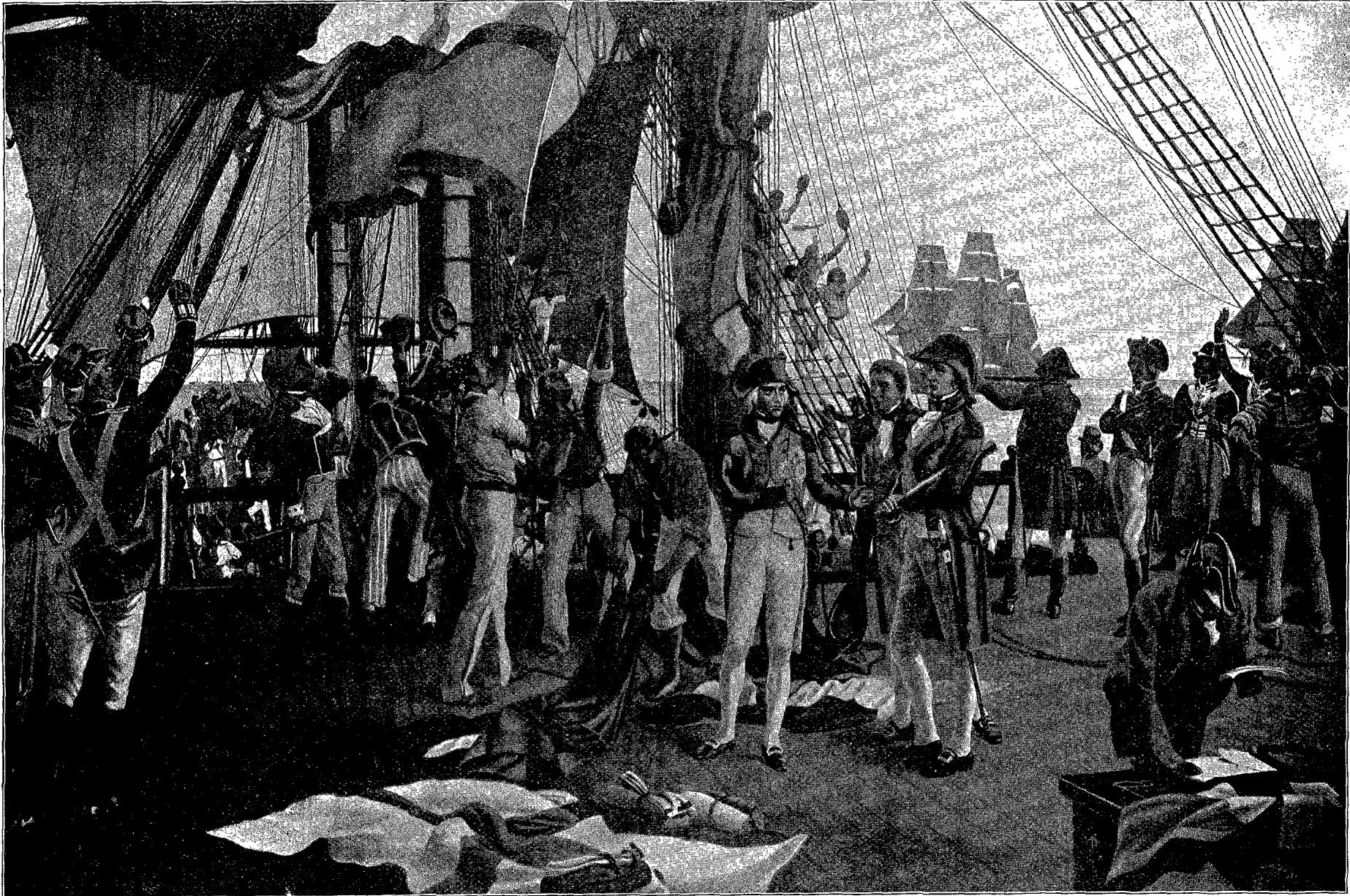
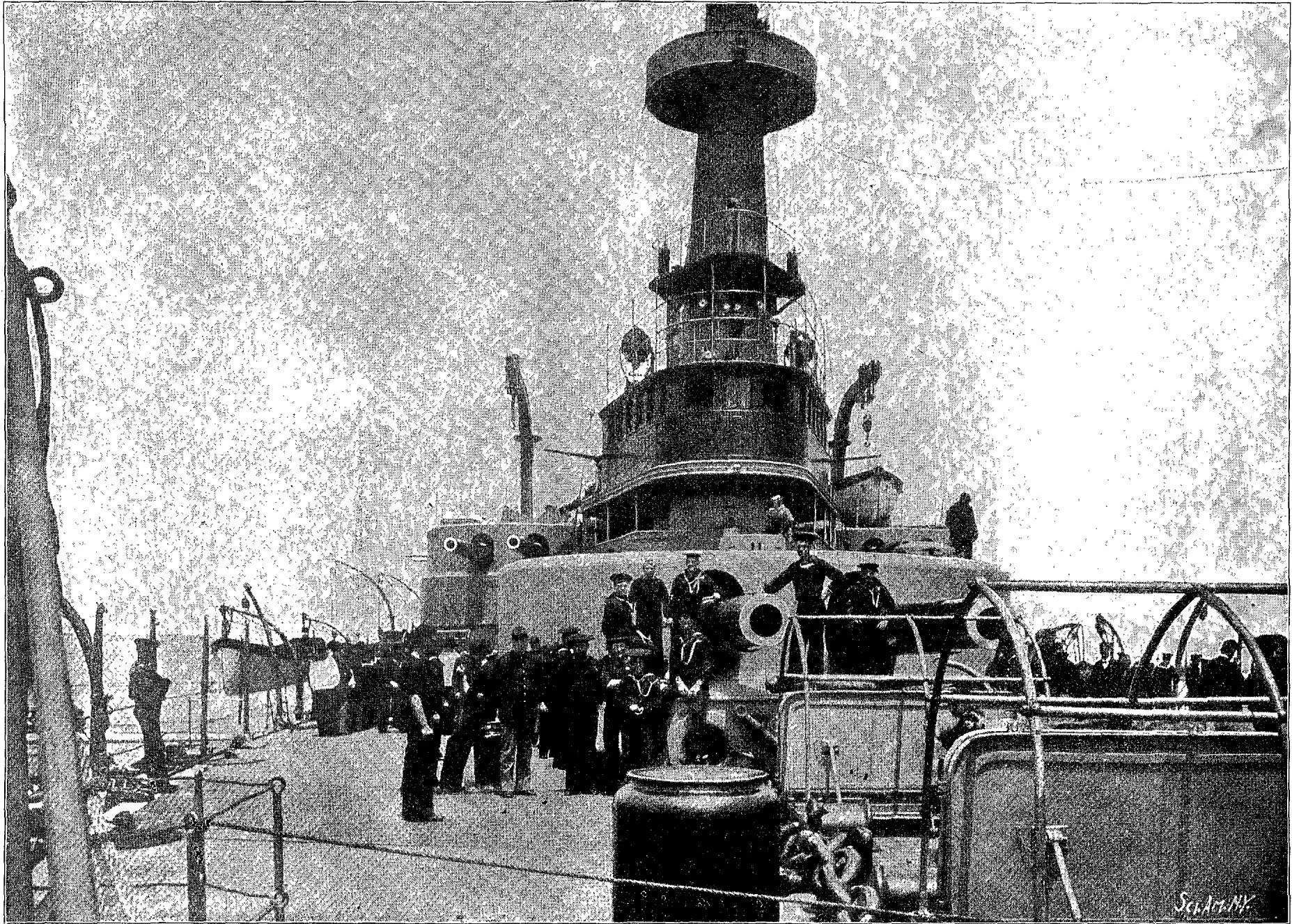
England alone has a line of battle-ships thirty miles long. Previous to 1860 any country in possession of a single gunboat like the great “Indiana” could have swept from the seas all the navies of the world. Compare our two pictures of two mighty war-ships—the one at the beginning, the other at the end, of this century. Shaking from her steel-armored sides, almost as so many drops of water, the comparatively small and forceless cannon-balls of those times, and turning her ponderous cannon and “rapid-fire” guns upon the best men-of-war in those days, it would have been mere child’s play for the “Indiana” to break them in pieces, and send them to the bottom of the ocean.
Trafalgar—1805. Nelson's flag-ship, "The Victory," entering battle, at the moment of running up the signal "England expects every man to do his duty."
But what will be the direful results when England, with her armies and thirty miles of these terrible war-ships, together with all the armies and navies of the nations of the world, is plunged by the rage of demons into the final war! For while England is considered the greatest naval power to-day, other nations are making all possible haste to float navies that can humble the British Lion on the high seas. Even Japan, which has been considered among the “benighted heathen,” encouraged by the results of her recent naval victories over China, is equipping a navy that bids fair soon to challenge the world.
A person who does not see fit to give his name has an article in the December Cosmopolitan entitled, “Our Late War with Spain.” The matter is written upon the supposition that the quarrel between the United States and Spain over Cuban questions had actually resulted in war. From this he proceeds to draw, from the present war facilities, a description of what would occur if the fleets of Spain and America should begin a fight. The picture he presents is a vivid one, yet all that he says is entirely in keeping with the fearful possibilities of a naval engagement. In describing the supposed fight, this gentleman says:—
Five—six—seven explosions take place on the American vessels. It is the enemy’s shells. One has struck the steel top of an observation tower, and carried it away, leaving the headless body of the young officer at the glass to sink to the floor. The body is hastily removed, and a new man appears standing, telescope in hand, in the now unguarded opening, sweeping the horizon as calmly as if nothing had occurred.
The signal “Full speed ahead” has been reserved for this moment. Almost before the heavy guns of the enemy have been recharged, the vessels have crossed the two-mile limit, and the signal to begin firing is hoisted on Admiral Bunce’s flag-ship. Not only do words fail to describe the terrific forces brought into action in the modern sea battle, but the imagination itself can present but a feeble counterpart. Officers who were in the fight off Havana say that from the moment the action was fairly opened, they worked amid horrors. “We seemed to be in the crater of an active volcano,” one said, describing the scene. “The ears were split with sound. Comrades disappeared in fragments before our eyes. Fury appeared to take possession of the living. There would be an explosion, and when the smoke had partly cleared, it would be found that a whole section had been shot away.”
Under cover of the dense smoke which quickly enveloped the waters, a new engine of war was brought for the first time into play. Well in the rear of the line as it departed from Havana, was the American liner “St. Louis.” A thousand mechanics had hastily cut port-holes through her thin iron sides, and mounted three hundred six-pound rapid-fire guns. Along the center upper deck had been erected a slight iron platform, on which one hundred and fifty Gatling and Maxim guns were in place, with twenty more on platforms built around the masts. Each of the six-pound guns had a capacity of ten shots a minute, or a total rain of three thousand shells, each capable of piercing light armor, or causing death and destruction if it entered a turret port-hole. When the subject had been discussed prior to the breaking out of the war, the idea of thus equipping a fast merchant steamer had been pooh-poohed, the claim being set up that the big guns of the battle-ships would leave nothing of the merchantman before she could come within the limited range at which her six-pounders would be effective. With her great speed in reserve, the “St. Louis” hung on the rear and out of reach until the action had well begun. As the pall of smoke began to descend, her officers recognized their opportunity, and came on without attention from the enemy until almost alongside the “El Pelayo,” one of the Spanish battle-ships. Then there was let loose a broadside of one hundred and fifty three-inch guns and the entire one hundred and seventy Maxim and Gatling guns.
It was believed by the officers on board the “St. Louis” that the guns of the Spanish ship were never fired after the receipt of that first minute’s iron and leaden hail. It was found afterward that numberless bullets from the repeating guns and many shells from the rapid-fire guns had penetrated every port-hole and opening. A single three-inch shell had killed every man in one turret. Before the discovery was made that the ship had ceased fighting, nearly eight thousand three-inch shells and more than fifty thousand bullets had been rained upon her—the greater part rattling harmlessly from her armored sides. Nevertheless a small percentage penetrating the openings was sufficient to leave nothing alive above the water-line. And it was all so quickly done! In four minutes the “St. Louis,” comparatively little injured, was able to cease firing, and turn her prow in pursuit of another adversary.
Under the cover of the smoke, three Spanish cruisers managed to get away, and, rounding Cuba, reach a neutral port well to the south. One battleship and two cruisers were sunk during the engagement, going down suddenly, with all on board. The remainder cannot be said to have surrendered. They simply ceased firing; and when taken possession of, were a mass of ruins above the water-line— everywhere encumbered with the dead and the dying. The water was full of sailors who, in the craze of the awful din, had jumped overboard, preferring death by water to the seemingly certain death on board ship.
A curious thing had happened to the second-class battle-ship “Texas.” In her construction the naval engineers had arranged a torpedo compartment in the after part of the ship, covered with three-quarter-inch armor. A small shell from a Spanish rapid-fire gun penetrated this iron, and struck one of two Whitehead torpedoes which were being handled preparatory to use. The explosion which followed seemed to blow the upper part of the ship to atoms, and to penetrate to the magazines; for a second explosion immediately followed, hoisting one of the great turrets bodily into the air. Captain Wise, who was on the bridge at the time, was blown into the water, and escaped by clinging to some wreckage.
It was a victory, but gained at what a cost in lives!—a victory which left not a single vessel belonging to the victors in condition to renew the fight.
If a simple knowledge of the frightful possibilities of a modern naval battle would cause a man to write such a description of an imaginary fight as the foregoing, what will the awful realities be when all the armies and navies of the world are gathered by the “spirits of devils” to “the battle of that great day”? If God had seen fit to give no other line of evidence than that presented in the wonderfully warlike attitude of the nations to-day, it would be sufficient to show clearly that “the end of all things is at hand.” But this is only a small part of the evidence piling up all about us to-day. Truly there can be no mistaking it. “The coming King is at the door.” Yet how many of the world’s inhabitants are unacquainted with this great truth!
By permission of the “Scientific American.” United States battle-ship “Indiana,”—the heaviest armed ship of the United States Navy.
Are we doing all we can, individually, to tell the discouraged and unhappy sinners of this world what a wonderful and complete Saviour we have found? Are you earnestly telling all around you that “this gospel of the kingdom shall be preached in all the world for a witness unto all nations; and then shall the end come;” “and that, knowing the time, that now it is high time to awake out of sleep; for now is our salvation nearer than when we believed”?

Known by Being Born of the Spirit

“SOME individuals are known because of their wealth, others by reason of their position; but the child of God is known by his having been ‘born of the Spirit.’”

Pride, Learning, and the Humble Heirs of God's Kingdom

“THERE are those who live in pride and arrogance; and others who boast of an extensive education; but those whose passions have been subdued by the Spirit of God may be living in obscurity and in the most humble manner, and yet be heirs of an everlasting kingdom.”

The Engineer and the Unseen Helm

Away down in the darkness, in the heart of the great steamer, the engineer stands. He never sees how the vessel moves. He does not know where she is going. It is not his duty to know. It is his only to answer every signal, to start his engine, to quicken or slow its motion, to reverse it, just as he is directed by the one whose part it is to see. He has nothing whatever to do with the vessel’s course: he sees not an inch of the sea.
It is not our part to guide our life in this world, amid its tangible affairs. It is ours just to do our duty, our Master’s bidding. Christ’s hand is on the helm. He sees all the future. He pilots us. Let us learn to thank God that we cannot know the future,—that we need not know it. Christ knows it, and it is better to go on in the dark with him, letting him lead, than to go alone in the light and choose our own path.—Selected.

EVANGELISTIC TEMPERANCE.

MRS. S. M. L. HENRY.
(Sanitarium.)
TEMPERANCE means the legitimate use of all things helpful, and total abstinence from all things harmful, and is reckoned as one of the fruits of the Spirit. Only the Spirit of God can hold a man to that steady equipoise that will make temperance possible. But since the Spirit of God is freely given for that very purpose, if any of us who know him fall short of that attainment, it is our own fault, not his.
While people are intemperate in eating or drinking; that is, while they eat and drink too much, or at unseasonable times, of those things that are suitable and right, or while they eat or drink anything that is not perfectly suitable for the use of the body; and while they indulge in impure habits of any sort, neglecting the cultivation of those habits that make for personal cleanliness, they cannot practically apply enough of the gospel to be saved.
Now, in this present time, we must come as near the Edenic ideal of life as our best knowledge of Christ and the power of his Spirit can make possible, before we shall be ready to meet him in the air, or to go down into the grave to wait for him. Excuses will be allowed according to the measure of our inability or lack of opportunity to learn and practise right living, and no further.
All that is taught in God’s word, and, among us, all that can be cleared up of obscure truth through the wonderful instrument which has been placed in our hand in the Testimonies, will be required of us. It is just as impossible for a man who indulges “fondness for the table” or domestic concupiscence, to have the mind that is in Christ, as for the drunkard or the harlot; yet where are the ministers of the gospel who teach this truth from the pulpit? and where are the congregations that will endure this teaching?
This teaching must be given, as a rule, by a different corps of instructors,—by W. C. T. U. evangelists and medical missionaries. It is a very significant fact that these two organizations began their work in this field at almost the same time, and have been keeping well-nigh abreast, although so far separated that the one has been almost totally ignorant of the other all through these years since the “crusade,” which began in December, 1873. There is work for an organization of women alone to do, that could not be done by a mixed company; so each has its peculiar field in taking the whole gospel to the whole man.
In 1886 I was in the purity campaign in Pennsylvania. The W. C. T. U. was making an effort to secure legislation for the better protection of girls against the assaults of brutal men. In the interest of this movement I spoke in twenty-one different churches in Philadelphia, as well as nearly all over the State, and so had opportunity to find out how ministers and churches regarded this special line of temperance work.
One Presbyterian minister in Philadelphia said to me, after my address: “I am more than glad for the plain truths which you have given us this morning. My people need to be aroused along these lines. I have felt it, but it would be impossible for me to say the things which you have said.”
“Why so?” I asked.
“Why?—Because they would not receive them from me. I would be asked to resign before the week was out. No church that I know of would stand the discussion of these subjects by its pastor. Understand that this is not because the subject is indelicate in the least,—they would not charge that on anything that you have said,—but because it comes home, it fits too tightly; they would not tolerate the sight, very often, of the one who had made them feel as they have felt under your preaching this morning, unless they had made up their minds to repent. This I hope they will do; but I doubt it, I doubt it.”
“Then,” I said, “I see, as never before, why God called us to this work.”
“Well you may,—yes, indeed; the world is dying for truth that cannot be administered through ordinary church channels. You can do this work, and I hope there will be opened wide doors for the W. C. T. U. in doing it.”
This minister is but one of hundreds who have said practically the same things to us; and if it is true of the W. C. T. U., how much more of the medical missionary, who goes out equipped with the whole truth, and with such training, with such skill, and with such power to give the most practical demonstration of gospel principles as no W. C. T. U. evangelist ever had?
Our people should know and appreciate that they are the most highly favored people on the face of the earth, with this right hand of power—the Medical Missionary Association—at their service, and make haste to place themselves in line with it for the mission of rescue which especially distinguishes this last message of mercy.
The whole gospel must include a practical cleansing from every taint of sin which is found in body, soul, or spirit; in house or field; in barn-yard or garden; or in closet, pantry, or wardrobe.
The heavenly sanctuary is interested in your bedchamber, kitchen, and parlor; and its cleansing mercifully waits upon those who are laggards in bringing in all their sin-offerings. A man who is partly saved may be a very good church-member, a very useful citizen,—God may even turn him to account in forwarding his work in the world,—but at the point where his salvation was suspended by his failure fully to surrender to God, there is going on that sort of decay which will unfit him for eternal uses. He may be good and sweet in spots, like an apple which has ripened with a worm at the core; but he will not keep, and must, sooner or later, fall back to the earth from which he came, and share the fate of everything which, not having life in itself, must utterly decay. Only the whole gospel, taken into the whole man, can prevent the decay of the entire nature.
Continue reading: THAT TROUBLESOME AXIOM