The Youth’s Instructor, Vol. 38, No. 3.

A DINNER IN JAPAN

The Youth’s Instructor

Jan 15, 1890

S. D. A. Publishing Association · Battle Creek, Mich. · Jan 15, 1890
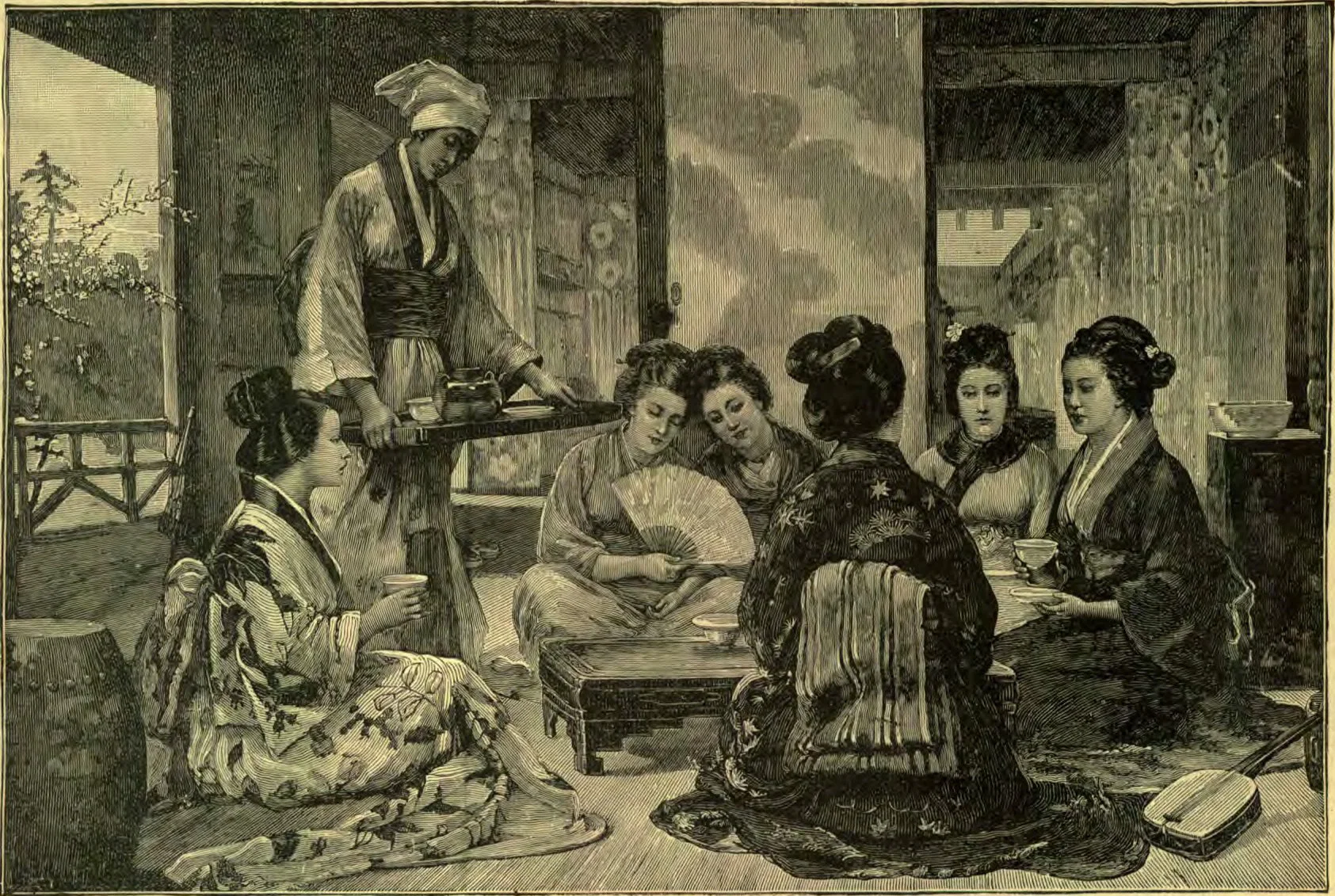
A DINNER IN JAPAN.

In the exterior a Japanese house is a dreary, barn-like looking structure; inside it is a paper-doll house on a large scale. The hall, in a private dwelling, is simply a raised platform about two feet from the ground. Here the visitor removes the covering of his feet,—boots, shoes, or sandals, as the case may be;—and enters the interior through a sliding door. That he has been in the house before is no sign that he can recognize the rooms on another visit, because the partition walls, which are all made of paper, and are simply movable panels, are changed repeatedly, as occasion and necessity require. The visitor may, therefore, pass directly to the parlor, the dining-room, the study, or the nursery, as the convenience of the family may have arranged the screens during his absence. There is no privacy in a Japanese house. Conversation can be heard with ease in any part, and the eavesdropper has simply to wet his finger, and touch the paper, in order to obtain a convenient “key-hole” through which to ascertain what is taking place within.
The floors are of a peculiar kind of matting made of stuffed wicker, and are an inch thick, let into the floor. They are kept scrupulously clean. There are no tables or chairs. The Japanese sit down on their heels, wherever they may choose, and their meals are brought to them. At first a stranger takes little pleasure in eating, because of the painful attitude he is forced to assume, in order to follow the custom of the country.
At any time, when tired, the visitor is not obliged to go to bed. All that is necessary is to throw one’s self down on the matting wherever suited, and take one’s ease. At night, all that is required to obtain a bed-room is simply to draw the walls around the selected spot, and rest comfortably and peacefully in company with hundreds of rats, which, never molested, are harmless and very friendly. In the morning it is customary to take a bath; and if an honored guest, the host and hostess with their family will approach the bath while the visitor is thus engaged, and congratulate him upon his good health. On returning to the place of the bed-room of the night before, all will have disappeared, and the entire house, perhaps, have been rearranged. Sometimes a bed is improvised by laying a few of the paper walls first upon the matting, or a futon, or thick quilt, is first laid down, and a rug or blanket furnished to roll the body in.
The bath differs from our American idea of such a contrivance. It is an oval tub, holding about fifty gallons of water. Through the center runs a funnel, or pipe. This is filled with charcoal coals, and soon heats the water nearly to the boiling point. Into this the Japanese boldly enters, sits down, and perspires freely. It requires some courage for foreigners to imitate him, while the members of the entire household stand around, amused at the grimaces of pain and the antics of their guest. It is not intended to wash in these baths, but simply to open the pores of the skin. In proper time attendants present themselves, and, if a stranger, soap the bather, or if a member of the family, administer a rubbing, after which comes a cold douche.
The Japanese are outwardly the most polite people in the world, and at dinner this characteristic is fully exhibited. A party congregate at some chosen spot, and sit down on the floor for a formal repast, ordinary family meals being consumed at such points as individuals elect. As soon as congregated, various objects of interest are handed to the guests, with which they may amuse themselves during the waiting period. It is proper to affect the greatest interest in all these, no matter how familiar the object, any lack of interest being considered a grave breach of etiquette.
The first course of soup and fish is then served on a lacquer tray. After drinking the soup from the bowl, the fish is eaten with chop-sticks, a much easier feat than is commonly supposed, a very little practice, with the force of example, making one tolerably expert. Next comes, generally, a beautiful little dish with four kinds of food upon it,—a preparation of chestnuts, a portion of a nicely-cooked small bird or wild fowl, and two little tempting piles of boiled lily root and stewed sea-weed. One is required to eat these, a portion from each alternating, with the chop-sticks. Then comes the native wine, sake. It resembles sherry, and is served hot. The guests do not help themselves. Servants, usually girls, sit on their heels in an outer circle, before the diners, and place a bowl of water and a tiny cup before each. It is their duty to see that the cups are kept constantly filled. If a Japanese desires to drink a glass of wine with a guest or another diner, no words are spoken. He dips his cup in the bowl of water, and moving in front of the selected party, touches the cup to his forehead, and then placing it upright on the palm of his hand, offers it to the one he desires to toast. It is received with profuse demonstrations of appreciation, and then immediately filled by the servant. A few minutes afterward the toast is returned.
The toasting ended, the servants present very small wire gridirons, upon which are laid tiny pieces of horrible-tasting raw fish, with a palatable sauce, and delicious salads. After this course come the inevitable cakes in endless variety, and tea. The tobacco bon, a receptacle for a small brazier, or coal box, pipe, and a place used as a spittoon and depository for ashes, is now brought in, or even previous to the toasts, as the diners wish. When one wishes to retire, it is customary to call for rice, which closes the repast.
During the entire dinner the geisha, or girl musicians, dance to the samisen, the biwa, and the ni-gen-king. They are generally small, beautiful girls, most exquisitely dressed, with marvelously framed headdresses and coiffures. The dinner ends the day in Japan, and the guests depart with as much ceremony as at their arrival.
W. S. C.

"AS STARS FOREVER."

NIGHT hath many a star That shines with a feeble light; But none of them shineth in vain— Not one in the good God's sight.
For the star that glimmers so faint In the heavens above us, may Be lighting some far-off world With the light of its bright, glad day.
Your life is a star of God; It may seem but faint and dim, But it shineth never in vain, If it ever shines for Him.
And, perhaps, in eternity's years, When the hour of time is done, You may find, if you nobly live, That your light was the light of a sun.
—Selected.

THE ATLAS AND THE DICTIONARY.

The habit of consulting these two books is invaluable, and the earlier it is formed in childhood the better. The atlases used in the grammar schools are sufficient for ordinary reference. To some children geography is a difficult study, but we think if at the beginning of the study and all the way along the atlas is made continual use of as a reference book, and the child taught to find on the map every place it knows anything about, all difficulty would vanish.
As one grows older, the necessity for a continual use of the atlas becomes more and more imperative. We are reading every day of happenings here and there, at home and abroad, and unless we can materialize the points named and give them “a local habitation,” much of what we read will fail to profit us. With a good book of travels and an atlas, one may, without moving from his own fireside, see a great deal of foreign life, and escape all the discomfort of travelers. It is quite usual now to find in books of travel accurate and minute maps of the routes gone over, and this is as it should be.
The dictionary is another book we need to have near at hand all the time. New words are being added to our vocabulary, and old words are used with new shades of meaning. If we are reading after a writer who understands the definition and force of the words he uses, we shall often be compelled to turn to the dictionary in order to get the full value of the thoughts expressed. If we are reading a scientific work, we need to refresh our memories; for scientific and technical terms slip easily from the memory, and though we may understand in a general way what the author says, we lose much if we do not understand him thoroughly and exactly. The person who can locate in his mind on the map all the places he reads about, and readily define accurately all the words and terms he finds in his reading, or hears in sermons, speeches, and conversations, has made a good beginning toward an accumulation of accurate and valuable knowledge.—Sel.

ROUND THE WORLD.—3.

LONDON TO GRAN CANARIA.

“Haul up the gang plank! let go your moorings!” were the orders of Captain Winchester as the steamship Warwick Castle swung round in the great East Indian dock at Blackwall on the morning of August 7th. There is a gentle pulsation, then a few great throbs, which announce to the experienced mariner that the propeller is in motion, and soon the noble vessel has dropped through the lock, and, just as the sun is rising in the east, turns her head toward the open sea. The river Thames is filled with shipping; there are crafts of almost every description, from the three-decked excursion steamer, with her white paddle-boxes glistening in the sunlight, to the dark-hulled man-of-war, with guns bristling from every port.
The banks of the Thames are covered with objects of interest. Conspicuous among them is the great Woolwich arsenal, where almost all the arms of England are manufactured. Then there are many fortifications, some of which have figured prominently in “ye olden time,” but which now look as if one good shell would demolish them. Their martial appearance is fast vanishing away, as over their walls the green ivy twines, and chattering swallows build their tiny nests between the crevices of the stone. They are monuments of bygone days, and in this age of naval and military science are picturesque rather than protective. Chief among them is Tilbury, concerning which there is many a famous legend dating from the reign of “Good Queen Bess” and the cavaliers.
At Gravesend we were boarded by the Government officials, who examined the ship fore and aft and from deck to keel. No ocean-bound steamer can put to sea without undergoing this inspection. The crew are piped to the quarter-deck, so that the officers can see that there are a sufficient number of able-bodied seamen to man the ship in a storm. The cannon is loaded, run out, and fired to prove that it is in good order, and can be used for signaling in distress; then the engines, sails, stores, in fact everything, undergo a strict inspection, so that all may be well found for the trip. This finished, the dignified officials are lowered over the side into a boat ready to receive them.
In a short time we hear the order, “Weigh the anchor!” the captain takes his stand on the bridge, and in a moment more three sharp rings are heard. There is a general inquiry among the passengers as to what they mean. They come from the “tale teller,” which is a rather large dial placed on a pedestal on the bridge. On this dial are the different orders, “Full speed ahead,” “Astern,” “Port,” etc. By moving an indicator, the instrument records the order in the engine-room and also in the wheel-house, and the different rings enable the officers at any part of the ship to tell what order has been given.
Running at the rate of fourteen knots an hour, we passed out into the estuary of the river, and ere long the shores of old England grew dim, and we were in the open channel, headed for Flushing, on the Holland coast. On awakening next morning, the good ship was in harbor, and when towed to her berth, the passengers were permitted a four-hour run ashore, while cargo was taken aboard.
The country is very low and flat, and is in many places protected by huge dykes from the inundations of the sea. There is a luxuriant growth of grass and many pretty shade trees. The roads are narrow, paved with large coping stones, and flanked on either side with high hedges. There are no great sights in the town itself. The only event of note that ever occurred there was a great naval battle between the Dutch and the English, in which the latter were signally defeated. There are many fruit venders in the market square; they are mostly women, and wear a very peculiar head-dress, composed of a white linen hood fitting closely to the head, drawn tightly over the temples, and fastened to the hair with a large gold spiral spring. Unlike most cities in Europe, there are no hordes of beggars, curio sellers, and guides at Flushing; the tourist is allowed to view the place in peace, and then return to the ship.
At noon we set sail once more, and were soon in the channel, and running toward the open ocean. During the evening and night we ran close to the English coast, passed Bournemouth and Dartmouth, and then into the Strait of Dover. Here the pilot left us, and the twenty-four days’ journey on the open sea really commenced.
Ships nearly always salute each other on the ocean; they have a flag or light for every letter of the alphabet, and others meaning whole words and sentences, and it is interesting at times to watch the conversations that take place. The Trojan was passed early in the voyage; she ran up, “Wish you a pleasant voyage,” to which our captain replied, “Thanks.”
One meets all kinds of characters at sea. There is the typical Englishman, with his university education, who has not been able to find anything to do at home, and is now on his way to the diamond or gold diggings in the Transvaal; missionaries who are returning after a visit home, and have spent their lives in Madagascar or the wilds of Central Africa; Americans on a trip round the earth; British soldiers on the way to India,—in fact, there seem to be people gathered from every corner of the globe, and hardly two on the same quest.
Life at sea is very monotonous. An easy chair and an interesting book beneath the awning pass away a few hours during the morning, then a walk up and down the quarter deck, or a chat with the engineers in the stables (engine room) occupies the time till dinner; after the repast, many seem to take pleasure in a siesta in some retired corner, till called by the supper bell. There is no way of taking exercise, except such as may be offered by a game of quoits or swinging Indian clubs, and every one longs for night, when sleep will wrap him in oblivion. The state-rooms are always hot, and many prefer to sleep on deck; but to the great discomfiture of such, at three o’clock they are liable to be awakened by a cold shower from the hose; for the sailors are swabbing down and holystoning the decks.
And so the days pass on, and we are nearing the Canary Isles. On the morning of the fifth day the mountains are seen in the distance, the water gradually becomes more calm, and once more the order resounds adown the deck, “Let go the anchor!”
P. T. M.

Hail to the Opening Year

Hail to the opening year! We greet its natal morn With promises and hopes And high resolves unborn; Lord, we would spend this year to thee, In works of love and purity.
God of the opening year, God of each passing day, Oh, hear our youthful prayer, And grant us grace alway To shun the paths of vice and sin, And heaven's blest life on earth begin! —Selected.

A CHEERFUL GIVER.

“Not a giver of alms, entirely, but a cheerful giver of every good gift. The most difficult of all, perhaps, is giving up one's own will for that of another. You gave the obedience due from a boy to his mother, to be sure, when she asked you to put away your book and do an errand for her; but every one in the room knew, by the way you slammed the door, that you did not give it cheerfully. You stopped and washed Emma's face, at mamma's request, while Nellie was waiting for you to go down town; but although you gave your time, Emma's screams at your unsisterly scrubbing testified it was not cheerfully given. How many times have we seen acts of charity performed in such a sullen or ostentatious manner that the deed, really good in itself, was spoiled in the giving, and a source of mortification and pain to the one who was intended to receive the benefit. In church or Sunday-school you may give your attention, but in such a careless, indifferent manner that you receive no benefit yourself, and are a stumbling-block to others. In our devotions, in our work or play, a half-hearted, lukewarm manner kills all enthusiasm, and renders every one discontented and dissatisfied. If you do not wish to do a thing, decline courteously but firmly; and if you consent, do it with your whole heart, “not grudgingly; . . . for God loveth a cheerful giver.”

AN ACCURATE BOY.

Do well what you have to do. Never “do a thing by halves.” The thorough and accurate, who put their whole heart into the business at hand, and do their best, are the ones to succeed.
There was a young man once in the office of a railway superintendent. He was in a situation that four hundred boys in that city would have wished to get. It was honorable, and “it paid well,” besides being in the line of promotion. How did he get it? Not by having a rich father, for he was the son of a laborer. The secret was his accuracy. He began as an errand boy, and did his work accurately. His leisure time he used in improving his writing and arithmetic. After awhile he learned to telegraph. At each step his employer praised his accuracy, and relied on what he did because he had always found him right. And it is thus in every occupation. The accurate boy is the favored boy. If a carpenter must stand at his journeyman’s elbow to be sure that his work is right, or if a cashier must run over his book-keeper’s column, he might as well do the work himself as employ another to do it in that way; and it is very certain that the employer will get rid of such an inaccurate workman as soon as he can.—Sel.

PUN-CHEE

PUN-CHEE was the name of the queerest little girl most of our readers have ever seen. She was young,—only eight, and not very large for her age. Her hair was black and straight,—“straight as a string,” the boys used to say; and I am sure I have seen strings that came nearer to curling than did Pun-chee’s hair.
Sometimes the teacher at the mission braided Pun-chee’s hair; and at such times we were all pleased, for braids were far more becoming to her than loose hair. Pun-chee’s face was very dark, even copper-colored, and her cheek-bones were high and ugly; for Pun-chee was an Indian girl. But beneath the cheek-bones were two little red spots; and when she laughed, showing two rows of white teeth and a dimple,—yes, a real dimple!—one felt she looked very much like other children.
Pun-chee had not always lived at the mission, nor in a house of any kind. Not long since, she had lived with her father and mother in a tent on the banks of the Canadian River. Then it was that Pun-chee was an Indian indeed!
Her smooth black braids, that now hung to the bottom of her chubby waist, had never been combed. Once, so long ago Pun-chee could hardly remember, her mother had smoothed out her hair with her fingers, and rolled it in a round, hard roll, and covered it over with a strip of beaded cloth; and that was the way it stayed until the mission teacher found her.
Her clothing consisted, at that time, of a bright-figured cotton skirt, made very long and very narrow. This same skirt had been Pun-chee’s especial pride. Her father had bought it of some white men, who traveled about in a covered wagon.
The waist to Pun-chee’s dress was still odder than the skirt. It was verily a “shirt” waist. Green ribbon was stitched around the bottom, and up the sides, and fastened in little rosettes at the corners.
Pun-chee had been very fond of these rosettes, and had spent a great deal of time playing with them.
Pun-chee also had a bright, new red blanket with a black border. It was a very small blanket,—just big enough for Pun-chee. When she rolled herself into a little brown roll, with the blanket tucked in tightly about her and over her head, she looked funny indeed.
This was the way Pun-chee was sitting beside her father’s camp-fire, when the missionary people found her.
As useless as a little daughter appears in the eyes of a heathen father, Pun-chee’s father was not willing to part with her. Many were the inducements offered by the missionaries, but to no purpose, until, at last, to the surprise of the missionary as well as her father, Pun-chee wanted to go, when the matter was settled.
And so it came about that Pun-chee went to live at the mission, with sixty other little people, some older, and a few younger, than herself.
Pun-chee was very much bewildered when she first entered the mission. She had never been in a house before; for settlers were scarce in the Indian Territory at that time.
She looked at the board floor in a comical way, and at first refused to walk on it. She did not like to be surrounded by walls, either, but rather preferred the sunlight and the open air.
Sometimes, when uncommonly frightened, Pun-chee would hide under the table, or behind the doors; and the missionary would have a difficult task to coax her out.
But that was some time ago; and when Pun-chee had been at the mission six months, she could read and spell words of three letters, and help in a great many ways about the house.
Pun-chee had never heard about “right” and “wrong,” nor about loving one another. She had always done things because she wanted to, or because she was afraid to do any other way; but never because it might grieve, or create love.
When the teacher at the mission told Pun-chee of God, who made the world, the trees that bordered the stream where her father’s tent was pitched, the stream itself, and even the starry heavens above,—and that he loved little Pun-chee and every other little girl, whether black or white,—her amazement seemed boundless. She laughed and cried by turns; but, growing weary, she settled herself in the teacher’s lap, and was soon sound asleep.
The next morning Pun-chee was gone. Her little calico dress that the mission teacher had made her was hung up in its place, and the scant cotton one had been taken down in its stead.
In vain did the teacher and pupils search for Pun-chee. She was not in the barn nor straw-stack. She was not in the corral with the horses,—a favorite haunt for Pun-chee,—nor anywhere else about the mission-grounds.
Several days passed away, and still Pun-chee did not come. A week had gone by, when the missionary had cause to pass by Pun-chee’s former home, and found her.
She was seated on a log when the missionary approached, and before her were gathered father and mother, sisters and brothers.
The odd little red blanket was gathered about her in true Indian fashion, but her face wore an earnest expression which, as a savage, she had never known.
It would seem that Pun-chee was delivering an address; but her speech was so rapid that the missionary could not understand. What Pun-chee said we may never know, but the effect of her words will last forever.
Pun-chee was willing, even anxious, to return with her teacher, but one feeling kept her back. It took some time for the missionary to understand what Pun-chee wished to tell her, but at last it was made plain: Pun-chee wanted her father and mother to go too.
And so it was that Big Thunder and Weeping Willow—for these were the names of Pun-chee’s parents—went to live at the mission, and with them their three other children.
Weeping Willow soon learned to cook, and Big Thunder cared for the horses, and occasionally added a venison to the mission larder. Pun-chee’s brothers and sisters entered the school with herself, and received the same pure and loving instruction.
A few months since, I received an especial invitation to visit the mission. A little Indian boy brought the note, riding Pun-chee’s own pony to deliver it. There was no explanation as to why I was to come on this especial day; but I knew the missionary had a reason, and a good one, else I would not have been sent for.
When I reached the door of the mission, all was very quiet within; then they began singing, “Jesus, I my cross have taken.” All the voices joined in this, for it was a familiar hymn.
During the next quiet, I entered the room. Then it was that I knew why I had been sent for.
Before the altar stood Pun-chee. Her little black braids were plaited neatly, and tied with a white ribbon, and she wore a plain white dress. Behind her, yet very closely, stood Big Thunder and Weeping Willow, and beside them their three other children.
I had witnessed many baptisms, and heard many confessions, but this seemed more effective than they all.
A child, a heathen and a savage, who had thus early in life brought five souls to the Saviour, seemed truly wonderful.
I gazed into her little brown face, and thought her truly beautiful.
Just at this moment a friend, a child of her tribe and people, stepped forward, and placed in her hand a bouquet of the wild roses so abundant about the mission.
As the missionary repeated low and soft the words, “Rose, I now baptize thee,” I felt how many such roses there were that only needed a gentle hand to nourish them, and they would bloom into heavenly beauty.
Do any of our little people think there is nothing children can do for Jesus? Ask little Pun-chee, or Rose, of Riverbed Mission.—Sunday School Times.

A CUCKOO CLOCK.

In a country of Europe, called Switzerland, a great many people earn their living by wood-carving. They do not use a scroll-saw, as we do in this country; they carve the most beautiful things with only a jack-knife.
Among the many pretty things made by them, none are prettier than the cuckoo clocks. I have one in my sitting-room, which I will try to describe to you.
It does not stand on a shelf like an ordinary clock, nor on the floor, like a tall, old-fashioned clock; it hangs on a large nail. The case is of brown wood, and it is prettily carved so as to look like the porch of a church.
The dial is of lighter colored wood, the figures are of white wood, and the hands, long, slender, and beautifully carved, are of still another kind of wood of a whitish color.
If you have ever looked inside of a common clock, you have noticed two lumps of lead or iron, one at each side. These are the weights. But the weights of the Swiss clock are not inside of the case. They hang down below it, and that is the reason why the clock cannot rest on the shelf, but must be hung on the wall, seven or eight feet from the floor.
The weights are of cast-iron, made to look like large pine cones, and bronzed. They are hung on long gilt chains, and are very pretty. They are not wound from a reel, as the weights of the common clock are; they slip down and down until they touch the floor. Then they must be drawn up close to the bottom of the case and begin again.
But why is it called a cuckoo clock? you ask. I will tell you.
In the upper part of the pointed arch in front, just above the dial-plate, there is a small door. When the clock is ready to strike the hour, this door flies open, a little bird comes out, makes a bow, and calls “cuckoo!” It calls just as many times as the clock strikes.
If it is one o’clock, it calls “cuckoo!” once. If it is two o’clock, it calls twice “cuckoo! cuckoo!” and so on. When it has finished calling the hour, it draws back, and the door shuts at once.
A little girl who often comes to visit me, when she first heard the cuckoo call, thought it was a live bird, and that the clock was its cage, and she asked me what I gave it to eat. She could not imagine how it could come out and sing unless it were alive.
But it is only a wooden bird, carved by a Swiss peasant, and made to move and speak by the machinery that makes the clock go.
The real cuckoo lives in England as well as in Switzerland.
In April the little English children begin to watch for his coming, and are so eager to hear his call “cuckoo!” they can hardly wait. They watch and watch, and by and by, some fine morning, they hear it call “cuckoo! cuckoo!” They love it better than the skylark or nightingale.
A good many verses have been written about the cuckoo, and here is the very oldest one in the English tongue. It was written a great many years ago:—
“Summer is a-coming in, Loud sings cuckoo; Groweth seed and bloweth mead, And springeth the weed new.” —Our Little Men and Women.

DILLY DALLY.

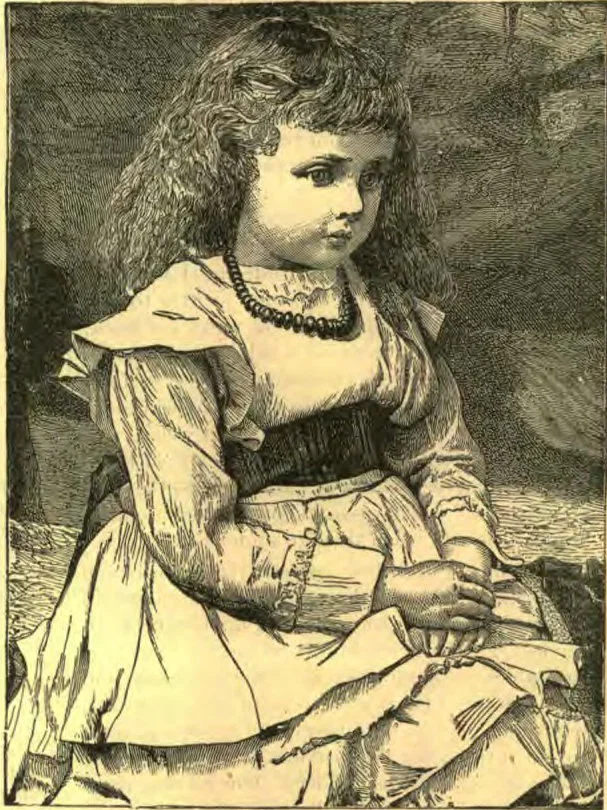
As sweet a child as one could find, If only she were prompt to mind; Her eyes are blue, her cheeks are pink, Her hair curls up with many a kink— She says her name is Allie; But, sad to say, Ofttimes a day We call her Dilly Dally.
If sent on errands grave or gay, She's sure to loiter by the way; No matter what her task may be, "I'll do it by and by," cries she; And so, instead of Allie, We, one and all, Have come to call This maiden Dilly Dally.
I think if she could only know How wrong it is to dally so, Her tasks undone she would not leave, Nor longer mother's kind heart grieve; And then, for Dilly Dally, We'd gladly say, Each well-spent day, "This is our own sweet Allie!"
—Our Little Ones.
“WE CALL HER DILLY DALLY.”

MORNING IN A GERMAN SCHOOL.

It is always morning somewhere in the world, and children are always starting for school. While you are still asleep in your beds, at three or four o’clock, the German children are trudging along, with books under their arms, to their daily tasks.
In Germany the schools begin at eight in the morning. During the short days, the sun does not rise until about eight, so that often it is quite dark in the room when school begins. But the scholars are always there, punctual and ready for a hard day’s work.
Let us see how it looks in one of the rooms of a girl’s school about this time in the morning.
The sun is just rising, and a sort of twilight is over all. Here and there are groups of neatly dressed girls from eight to fifteen years of age, the oldest being those who are nearly ready to leave school forever.
Presently, at one minute to eight, a bell rings. All instantly take their seats without a word more of conversation; for these girls are brought up from infancy to obey in the strictest meaning of the word.
What a stiff, precise, but perfectly orderly picture they make, sitting there in rows, each with her hands folded on her desk! They all wear clean, plain dresses with linen collars; and no matter how wealthy they may be, the wearing of jewelry in school is an unheard-of thing. It is only the Americans among them who do this.
As the teacher enters, all rise to greet her. Then she calls the roll, after which a hymn is sung, and the Lord’s Prayer is repeated. Now begins the real work.
The geography of Germany and Palestine is studied hard, and mastered; but of the other countries they know very little.
The Bible is one of the principal studies. Every one is taught to read French; and the literature of their own land they know thoroughly.—Selected.

DORA’S SOUR APPLE.

There were two apples—a big and a little one; each little sister wanted the big one. “I’ll put them behind my back, so,” said Dora. “Now, which hand will you take?”
“I’ll take the right,” said little Madge; and quick as a flash Dora changed the apples behind her back, and gave her sister the little one.
“Never mind,” said merry little Madge, “this one is sweet, anyhow.”
Was Dora’s sweet? Oh, you may be sure it was not; it tasted like bitter ashes in her mouth. More than that, the sunshine didn’t seem pleasant any longer, nor was there any more fun in their plays. Dora knew she had done wrong, and that little preacher, Conscience, kept saying over and over, “A lie! a lie! a mean lie!”
After dinner mamma gave them two more apples—big rosy fellows this time.
“O mamma!” said Dora, hiding her face in that kind mother-lap, “give them both to Madge; I must not have any.”
And then with tears of shame she told her mother what she had done in the morning. “I am sorry that my dear little daughter could do such a thing,” said mamma, “but I am glad and thankful that she knows how to repent of her sin and show her repentance by giving up her apple.”
But not a bite of Dora’s apple would Madge take, so they had to take it out to the fence and give it to a little boy on his way to school. “Now,” said Dora, “my next apple will taste sweet again.”—Sunbeam.

SAYING PRAYERS OR PRAYING.

Which do you do? “When you kneel down at mother's knees, and repeat, “Now I lay me” and “Our Father,” do you pray, or do you only say your prayers? Do you try to think that the dear Father in heaven is listening to you? and do you try to ask him in your heart to take care of you, and keep you from harm and from wrong-doing? It is not praying when we only repeat the words, and do not think of what they mean. Try always to pray when you kneel down before God.—Selected.

SOME BABY SEALS.

I MADE, the other day, a call on a unique household. My entertainers were seven young seals, recently captured. I believe they are to be trained, but at present they are in a purely natural state, and, to my mind, much more interesting than they will be after they have been taught to count, to shake hands, to play the banjo, etc.
They are kept in a pen in which the tide ebbs and flows. There is ample space to swim, and the pen encloses a portion of a rocky ledge, upon which, at low tide, the seals can come up and sleep.
We climbed over the barriers of the pen, and sat upon these rocks a long time, watching them at play. One only declined to gambol. He lay motionless on the surface of the water, sending out an occasional mournful little cry. He was homesick, said their keeper, for his mother, and he thought that he might let him out, and I begged that he would; for these seals were none of them more than two months old—mere babies, not yet weaned. Indeed, if they had not been so young, they would not have been caught in the net set for them.
The keeper said the old seals were wary, kept away themselves from the nets, and prevented their young from going near, so far as they could. He said he had known a mother-seal to tear a net in tatters in order to release her baby. They also follow their young to the pen, and call them from the outside, while the baby seals reply with plaintive cries. This they do day after day, but finally retire discouraged. With the exception of the homesick one, the small seals seemed happy and played and tumbled about, throwing their flippers around each other like children. I watched one of them a long time, as he swam swiftly to and fro. He came toward us, swimming upon his back, and under water, turning as he reached the ledge, in a graceful upward curve, and rising to the surface. As he swam off, he would look coyly over his shoulder at us, as much as to say, Didn't I do that well?
Their eyes are really beautiful, gentle, full of intelligence. They have “whiskers” like a cat—they are called “sealions,” I believe—and round black nostrils that shut up tightly when they go under water.
“They will bite,” said their keeper. Had it not been for his warning, I should have met the advances of one soft-eyed creature, who crawled up the rock to my very feet, gazing beseechingly at me.
These babies are small, two feet long, perhaps, and roly-poly. Some of them sat up straight in the water, on their tails. To casual observers they would seem to have three tails, but two are fins, or flippers, which serve as paddles, if not as rudders. One among them stood persistently on his head, upon the rock under water, rubbing his head as though he were scratching it. But the drollest sight was to see one little fellow sit up in the water and scratch his ear, or the side of his head, with his flippers.
I think he was the same who swam so persistently, and seemed bent on entertaining us. The flipper, when not spread, looks precisely like a small hand, and the motion, as he scratched, was very nearly like that made in combing out one's hair. Some one suggested that it was this action on the part of some big seal that first gave rise to the notion of the mermaid combing out her long locks.
While we sat there, some children came out in bathing suits, and began to swim and splash about in the water just outside the seal-pen. The seals at once left their play, attracted by the noise, and crowded up to that side, and looked inquisitively out between the slats. Perhaps they took the children for a larger and gayer species of seal. Having satisfied their curiosity, they went back to their own play.—Wide Awake.
Continue reading: MINUTE SCREWS