The American Sentinel, Vol. 11, No. 50.

Christian Nation Versus Christian Government in the United States
Earlier text: Christian Nation Versus Christian Government in the United States

THE IOWA SABBATH-RESCUE STATE CONVENTION.

In accordance with a call issued by representatives of the Iowa Sabbath Association, Iowa Sunday School Association, the Des Moines Ministerial Association, the Iowa Christian Endeavor Association, the Y. M. C. A., and the two branches of the W. C. T. U. in the State, there was held at Des Moines, Iowa, December 1–3, the “Sabbath-Rescue State Convention,” the object of which was to “consider and decide upon the best methods by which to arrest the prevalent and alarming tendency to disregard the Lord’s day and turn the holy day into a holiday.”
Invitation was extended to “each synod, association, conference, convention, league, union, church, Sabbath school, and Young People’s Society, in sympathy with the purposes of the convention,” to send accredited delegates. It was hoped that the gathering would enable the Sabbath Association to be placed on a broader and better understood basis, by making it representative of all the religious bodies of the State in sympathy with the movement, and thus become the servant and central agency of this interdenominational constituency, sustaining much the same relation to it that a central committee does to a political party in a campaign.
The papers and addresses all gave evidence of being prepared with unusual care, and the positions taken were, as a rule, much more conservative than at like conventions in the past. There were few if any new ideas advanced. The predominant idea of the convention seemed to be that the future welfare of our nation depends solely upon the preservation of Sunday as a day of rest; that on account of the cosmopolitan nature of our population, moral suasion was ineffectual, and therefore the only remedy left was compulsion by legal enactment. At the same time nearly every speaker emphasized the thought that it was the civil and not the religious aspect of the question that was under consideration; that there was no disposition whatever to legislate people into a religious observance of the day, but simply to make it possible for all who would, to have the privilege of resting one day in seven, and that those engaged in business should not be obliged to sustain a financial loss at the hands of their competitors who for any reason did not see fit to close the doors of their business on that day.
Mayor McVicar in his address of welcome said, among other things:—
It is not alone from a moral standpoint that we value the day of rest. The benefits of the Christian sabbath from a political point of view are universally conceded, for where the sabbath is best observed, there you find the highest order of civilization.
Rev. Dr. Marshall said:—
I am glad to welcome this convention to our city, because its purpose is to lay emphasis upon the preservation of our holy rest day. By whatever name it is known, it means much. Whether we have the old, old name of Sabbath or rest day, whether it be the last good name given—Lord’s day—or whether it be that other name, Sunday—which I like to spell Sunday instead of Sunday, because it is the day specially given to sanctify to us Christ’s resurrection—it means more than many suppose. I welcome you here because you have come to devise ways to make the observance of the Lord’s day a popular thing. Now, in these Sunday laws no one has thought to do another injury. They have all been planned on the part of man, as the moral law is on the part of God, for the good of mankind. They are to be helpful, not hurtful; it is not to take away the rights of anyone, but to give those rights to the people that they do not now enjoy. I hope we may here learn to better speak of this sabbath, so that those who have not seen it from the standpoint of religious instruction may see in it as a civil institution a great blessing that ought to be preserved, and that we may be able to gain their earnest, conscientious helpful support in preserving the day as a holy one to the American people.

The Only Basis of Union.

Rev. E. L. Eaton, pastor of the First Methodist Church of Des Moines, and until recently actively connected with the “Sabbath Rescue” work in Wisconsin, was perhaps the most pronounced in his views as to what is desired, and what the religious element proposes to do when it gets the power. Even a synopsis of his discourse would cover too much space to incorporate in this report. Suffice it to say, he declared that we are past the day when moral suasion can be effectually used in raising the standard of Sunday observance; that if the day is to be preserved as a rest day, it must be done from the civil standpoint. He would stop the busy wheels of commerce and industry and have quiet and rest in all the homes of the land.
He said that the battle now on is the same old one that Nehemiah fought 2400 years ago—it was not that the fish venders of that time should be compelled to become Jews, worship the same God that they did, and conform to their religious requirements; but it was that the Sabbath day should not be used by them for gain; and that, he declared, was the pivotal point for which Sabbath reformers to-day contend—that Sunday, which is regarded by the American people as the Sabbath, shall not be devoted to making money. He said that everywhere the sentiment is growing that in order to preserve the day as a holy one, it must be protected by law; indeed, he did not believe there was another point on which all denominations could unite except this one of enforced Sunday rest. On it “Catholics, Lutherans and all other Protestants could as brothers work together in a great cause that is worthy of their effort.” Then to conclude his address he said:—
We want to touch legislation; we want to go over yonder into that Capitol building and sit there among the law makers with as much serenity and with as much right as do the lobbyists of the great corporations. We want to put our finger on the moral pulse of the legislature until they feel the power of our influence to the extent that they dare not refuse our demands.
Another paper of interest was prepared by Mrs. E. H. Slocum, entitled, “A Progression that Needs to be Recognized and Resisted.” In it she laid at the doors of church-going people the blame of a large share of Sunday desecration. In a most graphic and castigating manner, she paid her respects to the Christian Endeavorers for patronizing the Sunday trains when they attended the national convention at Boston; and declared that they could never hope for the day to be observed as it should be by the people at large, when those who were supposed to be its conservators were such open and flagrant violators of it.
Rev. J. C. Jacoby spoke on the subject, “The Sabbath in Relation to Our Civil Government.” The central thought was to the effect that while the sabbath was established under a theocratic form of government, later forms of government became equally responsible for its observance. The fact that the State and Church are now separated does not change their relation to the Creator. Both the State and the individual should observe the sabbath; corporations, too, should keep the sabbath. There should be more laws, and a better enforcement of them against sabbath desecration. He believed that organized capital is largely responsible for the demoralization of sabbath observance.

Didn’t Know What They Were Talking About.

He was followed by C. A. Dudley, Esq., a prominent attorney of the city, who took him to task for the narrowness of his views. He told him that he was talking about that which he did not understand; that the corporations of the city were far better sabbath observers than many of their most prominent church people; the banks and loan and trust companies close their offices, and the railroads would do likewise, but because of the demand for their services—in most instances from the church-going people. And more, were it not for the demand of the professedly Christian people of the land, the Sunday mails would not be delivered. The trouble with them was that they wanted the earth on their side; but were unwilling to grant a single concession to the others. This was downright selfishness. He said he had no sympathy with those who were decrying this generation as wholly given over to the world, the flesh and the devil—if they didn’t believe him let them go and read up D’Aubigne’s History of the Reformation.
What the people needed to-day was not legislation to compel the observance of the day, but backbone to follow out their convictions. Sunday laws at most could only protect the day as a civil institution, and with the religious phase of the question it had nothing whatever to do. Just as soon as it did, then look out for the rack and thumbscrew. The majority of those in favor of Sunday laws did not understand the matter, and it was time for them to post up if they ever expected to place their work on a basis that would command the respect and coöperation of thinking, liberty-loving people.

The Puritan and the Continental Sunday.

“The European or American Sabbath, Which?” was the title of a flowery paper, by Rev. T. P. Robb. As a preface to it, he stated that he felt a moral certainty in the fact that the Holy Spirit had impressed him to write what he had, over a month before the convention; and therefore felt perfectly clear in presenting it, although the subject matter had been given by others before him. Then he drew the picture of an ideal, Puritanical sabbath, which, according to him, was known only in America, and then contrasted with it a Sunday in Paris where none of the sabbath restraints were known, and where it existed only as a holiday.
The harvest of offenders in the police courts of Paris on each Monday as the result of the carousals of the previous day, had its counterpart only in the 5th of July in America. The day is given over to revelling by the rich, while the poor were compelled to toil in abject slavery—and is such a day as we will have here in America in a very short time unless a check is made on the encroachments of the “Continental Sunday.” “Already,” he said, “the sabbath in our land has been literally stolen from the poor man, and its desecration is sapping the life-blood from our national life as nothing else is, and therefore, I say, we cannot keep quiet. Friends of the sabbath cause, awake!”
Immediately following this, Hon. O. O. Roe took the floor, and said that he had prepared a paper to be read; but would leave it for another time, and simply talk a little. Then in a quaint and quiet manner he described Sunday as it was observed in his father’s home when he was a boy, and strangely enough it corresponded in almost every particular with the ideal sabbath of the previous speaker. “But this,” said Mr. Roe, “was not in America, but in Continental Europe—in a country of 2,000,000 inhabitants in which there were fewer murders committed in a year than in some counties in Iowa in a month.”
He resented the idea that the question was America against Europe, the American sabbath against the Continental Sunday. It was not that, but it was the spirit of Christ against the spirit of the world. The contest was in every country on the globe, and he didn’t want the audience to get the impression from the previous speaker’s remarks that only in America was Sunday observed as it should be; for there was just as good sabbath-keeping in Europe as anywhere. He thought the people should not forget pious Europe, for it was from there that the good old fathers and mothers came who laid the foundation of our Government.
He said he had looked in vain for a truly American sabbath, such as had been portrayed—a day observed in the spirit in which the Almighty designed it should be; but he was sorry to say that even in this the most glorious land the sun ever shone upon, it was not to be found, and from the present outlook he was afraid it never would be found. He reminded his hearers that Americans did not need to leave their native shores to find all the inherent meanness of humanity, for right here among us were evils that Continental Europe knew nothing of, and if America would but look to herself, the denunciation of the prophet of long ago would apply—“America, thou art the transgressor.” Here everything in the way of luxury, gratification and wantonness is demanded by those who can afford it, while at the same time these very ones were among those who are seeking by legislation to curtail the liberties and privileges of those who produced the wealth that these rich and greedy men enjoy.
Then in an inimitable manner he drew a picture of a foreigner with his wife and children, who, because of his limited compensation, is obliged to take quarters in some rickety tenement row above the stench of a teeming city. No minister ever visits him, and he never attends church, because he would not be welcome if he did. So on Sunday morning of a pleasant day with his family he boards a cable car and starts for the park. A rich man who has just made sure that his clerks are busy at work adding up long columns of figures and seeing that no orders are missed or mistakes made, passes him while on his way to church. In class-meeting this pious fraud gets up and thanks God that he is not like that poor Dutchman he had just seen, and immediately declares that there ought to be something done to arrest the encroachments of the Continental Sunday which these foreigners have brought to our shores.
Then in an impassioned manner he appealed to the Association to go about the work in hand as did the Master of old—mingle with the people, share their sorrows and griefs, and in tenderness lift up the fallen and downcast, not coerce them—and if this were done then the twentieth century would witness a wonderful sight, not merely an American sabbath but a Christian Sabbath, dedicated as it should be to the service of God and the uplifting of humanity.
Of course the effect of such counter speeches can be easily imagined, and the feeling was plainly manifest.
“Phases of the Work That Need Emphasizing,” was the title of an address by Rev. A. L. Frisbie, pastor of the First Congregational Church of Des Moines, and who, by the way, has been a reader of the AMERICAN SENTINEL for some time past. He showed very clearly that he had correct ideas of religious liberty, and what compulsory Sabbath laws are liable to lead to. Like Mr. Dudley he believed that the only phase of the question that could be considered from a legal standpoint was the civil one, and yet after all, a man could not have goodness legislated into him; and never would Sunday be observed as it should be unless men did it because they felt that it was a duty they owed to God, for any other than heart worship was hypocrisy; that while there were phases of the work that could possibly be better effected by legislative measures than otherwise, yet it was the duty of the Church to win the people to a religious observance of the day rather than coerce them.
There were numerous other papers and addresses on various phases of the question, but they partook so much of the nature of what the readers of the SENTINEL are familiar with that it would hardly be profitable to give them. Resolutions were adopted deprecating the desecration of the day; protesting against Sunday trains, moving of United States mails, Sunday newspapers, etc.; asking for the closing of all places of business and the discouragement of all social and recreative diversions on Sunday; exalting the first day of the week as a holy day in the hearts of the people as set apart by God for divine worship; and demanding that one day in seven should be secured to all the people as a day of rest under the protection of the civil law.

Noticeable Features of the Convention.

One noticeable feature of the convention was their lack of unanimity of thought. One man, “led by the Spirit,” would make certain statements concerning the sabbath and its preservation as a holy day, and he would be followed by another speaker who would squarely contradict him on many points. It reminded one of the accusers of Christ, of whom it is said, “Their witnesses agreed not together.”
Another interesting feature was the stress laid upon the distinction between the civil and religious phases of the Sabbath question. One of the speakers was asked privately if the logical result of Sunday laws was not persecution, no matter if only the civil sabbath was sought to be protected. He replied “No.” When asked how he explained the fact that the same Sabbath laws in substance that were on the Iowa statute books existed in many of the Southern States, and yet under the latter, honest, conscientious men were sent to jail and made to work in chain-gangs because they refused to rest on Sunday after having observed the previous day as the Sabbath, replied: “The people down there are not yet out the woods; they need educating; we would never do that in the North.” And it might be remarked that right here a fatal error, lies so close to a vital truth, that only those who understand what constitutes true religious liberty can detect it.
Still another noticeable feature was the apparent consciousness of the inability of the plan they propose, ever really to succeed in bringing about the desired result. One speaker said that after all, the place to begin the rescue of the Sabbath was in the homes and with the children—that unless they were taught to reverence the day as God’s day, and regard it as unto the Lord, and not unto man, they could not be made to observe it as they should in later years.
At no previous convention attended by the writer was there so little said as to why the first day was observed instead of the Sabbath. Sunday was the recognized Sabbath of the nation, and that was enough. Yet whenever appeal was made to the Bible as authority for the observance of Sunday, no Sabbatarian could ask for stronger arguments for his position—to a certain point at least. One speaker said, “The fourth commandment is as eternal as God himself; the very nature of the Sabbath indicates that it can never be abrogated; and unless the young people of to-day are early taught that the observance of Sunday rests upon this Sabbath commandment, there is no hope for the future.”

THANKSGIVING POLITICS.

BY M. E. KELLOGG.
The elections are over, but the political fever has not yet abated; it continues to show itself, and in curious ways. The most ridiculous piece of political folly to be seen since the election is the way certain persons to whom is given the prerogative of issuing Thanksgiving day proclamations have taken advantage of their position to inject their politics into their proclamations. This was begun by no less exalted a personage than the President of the United States, who, in his Thanksgiving proclamation, expressed himself in a way that left no doubt that he thought that the success of a certain party in the elections had saved the nation from “dire disaster.”
Of course if the President could make his annual Thanksgiving proclamation a means to get even with his party which had repudiated him, others to whom is given the authority to issue such proclamations could also take the same means to express their political sentiments. Hence several governors of States have issued proclamations in a similar vein. On the one hand, it is suggested in pious and covert phrases that God should be thanked because of the result of the election; and, on the other hand, that he should be thanked in spite of it!
The right of the President, and of the governors of States, to issue Thanksgiving day proclamations is a very questionable right, to say the least; and when we see it so prostituted that it becomes only a means of issuing a political and partisan manifesto, it deepens the impression that it is about time that it be dispensed with. This is not saying that we should not give thanks. But why confine it to one day, or wait for a President or governors to express their political views under cover of the Thanksgiving proclamation? God’s blessings are new every morning and fresh every evening. Then let every day of mercies be to us a day of true thanksgiving unto the Giver of every good and perfect gift.

NEWS AND NOTES.

The “American Sabbath Union” is conducting meetings in various towns and cities in the United States, at which the subject discussed is, “The American Sabbath: Its Relation to Good Citizenship and Christian Progress.” Addresses, limited to ten minutes each, are made by representatives of the various young people’s societies, as the Epworth League, Christian Endeavor Society, etc. Thus the subject of “Sabbath reform” by law is being kept before the minds of the Christian young people of the country.
Recently in the course of his revival effort in New York City, Mr. Moody, the well-known Evangelist, devoted an afternoon meeting to the subject of Sabbath observance. Mr. Moody’s meetings have been almost sensational in their apparent results thus far, but the weak spot in his work appeared when he came in touch with the very practical question of keeping the Sabbath. He did not tell his audience which day is the Sabbath, although he must have known that very many of them were unsettled in their minds upon this important point. The Author of the Sabbath is perfectly specific in his statements concerning which day is the one to be observed. He says, “The seventh day is the Sabbath of the Lord thy God; in it thou shalt not do any work.” Is the Creator too definite upon this point? Is his way of presenting the subject inferior to that discovered by Mr. Moody? Or was Mr. Moody silent on this point because he knew that he was addressing those who observe the first day instead of the seventh, without any scriptural warrant for so doing?
The Tulare (Cal.) Daily Register, of November 27, reports that a regularly issued order to the California national guard requires them to attend church on Sunday evenings, the men being left free to select the church of their preference. The Register suggests that “this is probably an atonement for sending the men out to camp in the frost without tents, overcoats or blankets.”
If the men can rightfully be obliged to prefer some church, why not oblige them to prefer some one church, and thus secure uniformity and avoid confusion, as should be done in military matters? The same principle would be followed in the latter course as in the former.
The Alabama Legislature passed a bill December 5, “To prohibit the sale, giving away, or otherwise disposing of spirituous liquors within five miles of the Saginaw M. E. Church, Shelby County.” Why should the Legislature of Alabama single out this church for such special “protection”? Have the members of this church more confidence in the civil law to purify the community in which they live than in the power of Christianity which Christ’s followers are to possess? Or are they conscious that that power is absent from their own lives?
Christianity rejoices in entering the darkest spots of earth to illumine them with the light of life. She comes to the most sinful and degraded of human beings just as they are, and does not ask some other power to make them presentable to stand in her presence.
As mentioned in our last issue, the organ of the “Christian nation” party recently announced a remarkable discovery in connection with the President’s “Christian” Thanksgiving proclamation. It was that the “settlement of the Venezuelan controversy” announced in the papers a few days later, came as a direct testimonial of divine approval of the President’s course. Looking upon this happy occurrence it was moved to exclaim, “Was there ever a more complete or fuller illustration of that golden promise of God’s word: ‘Them that honor me I will honor’!”
Probably, from the “Christian nation” standpoint, there never was! But behold! it now transpires that the Venezuelan controversy is not settled after all. Venezuela is not represented on the commission of arbitration, the country has risen in indignant protest, negotiations are stopped, and the controversy is seemingly as far from an end as ever! We advise the aforesaid exponent of “National Reform” to wait next time until it can be sure that its discoveries will have the support of facts.
A “reform” which is based on tradition in place of the Word of God, is always a reform backwards. Such is the reform which now seeks to enforce the observance of Sunday.

Teachers' Bible with Pronunciation Aids and Helps
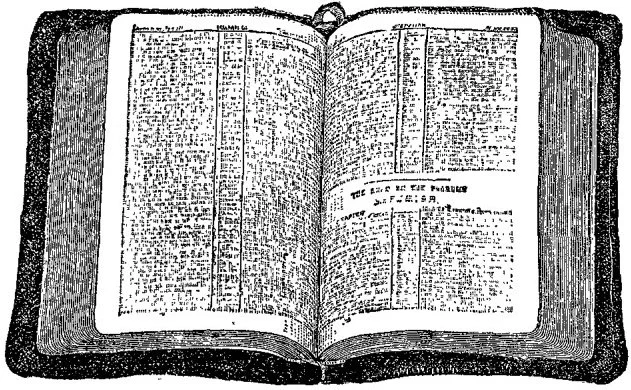
OUR PREMIUM BIBLE OPEN.
With this book reading is made easy. No more stumbling over the hard words. All proper names are divided into syllables, and the accent and diacritical marks render their accurate pronunciation a simple matter. With a little study of the Key to Pronunciation to be found in every copy of this Bible, the reader loses all fear of the long, hard names of Scripture, and pronounces them with ease.
As is indicated by the name, this is a teachers’ Bible. It contains fifteen maps and 64 pages of illustrations and diagrams, copious helps of the latest revision, Bible index, concordance, dictionary of Scripture proper names with their pronunciation and meaning, and many other excellent features.
OUR PREMIUM BIBLE CLOSED.

Covenant Sealed by Nehemiah and the Leaders

gavest before them, neither turned they from their wicked works.
36 Behold, we are servants this day, and for the land that thou gavest unto our fathers to eat the fruit thereof and the good thereof, behold, we are servants in it:
37 And it yieldeth much increase unto the kings whom thou hast set over us because of our sins: also they have dominion over our bodies, and over our cattle, at their pleasure, and we are in great distress.
38 And because of all this we make a sure covenant, and write it; and our princes, Levites, and priests, seal unto it.

CHAPTER X.

1 The names of them that sealed the covenant. 29 The points of the covenant.
1 Now those that sealed were, Nehemiah, the Tir'sha-thā, the son of Hach-a-li'ah, and
25 Re'hum, Hā-shab'nah, Mā-a-sē'-jah, 26 And A-hī'jah, Hā'nan, Ā'nan, 27 Māl'luch, Hā'rim, Bā'a-nah.
28 ¶ And the rest of the people, the priests, the Levites, the porters, the singers, the Neth'i-nims, and all they that had separated themselves from the people of the lands unto the law of God, their wives, their sons, and their daughters, every one having knowledge, and having understanding;
29 They clave to their brethren, their nobles, and entered into a curse, and into an oath, to walk in God's law, which was given by Moses the servant of God, and to observe and do all the commandments of the LORD our LORD, and his judgments and his statutes;
30 And that we would not give our daughters unto the people of the

WHAT THEY SAY OF IT.

AMERICAN SENTINEL: I received my Bible over two weeks ago, and am very much pleased with it. I hope others will avail themselves of this excellent opportunity to secure a nice Bible cheap. Yours truly, MRS. L. A. ROSS, Butte, Mont.
AMERICAN SENTINEL: I am delighted with the Bible. I don't know how you sell it so cheap. Yours truly, THOMAS RACE, 349 E. 13th St., St. Paul, Minn.
“Dear Sirs:—
“I received the Bible all right and am very much pleased with it. It is all that it is claimed to be, a first class Bible.”
A lady 75 years old bears this testimony:—
“Dear Brethren:—
“I sent to the express office and received the Bible in good condition and judge of my surprise on seeing the name so nicely put on. Many thanks for the same. I am well pleased with the Bible.”

A FIRST-CLASS HIGH-GRADE BIBLE

$7.00 WORTH FOR $3.50.

We propose to make it possible for each and everyone to be the possessor of

A FIRST-CLASS HIGH-GRADE BIBLE.

The book we offer has large clear type (see specimen page) and is what is known as the AMERICAN OXFORD SELF-PRONOUNCING REFERENCE TEACHERS' BIBLE, Bourgois Type, Bound in Imperial Seal Leather, Divinity Circuit, Extra Linen Lined to Edge, Round Corners, Red Under Gold Edges, Silk Headband, Silk Marker, Binding of the Best Quality,

Unprecedented Offer: Bible With American Sentinel Subscription

It is only by special arrangement with the publishers of this Bible that we are able to make this

UNPRECEDENTED OFFER.

REMEMBER, the price of this Bible is $6.00. ANYONE, OLD OR NEW SUBSCRIBER, SENDING US $3.50 WILL RECEIVE THIS BIBLE POSTPAID, AND THE SENTINEL ONE YEAR.
Or WE WILL GIVE ONE OF THESE SUPERB BIBLES for seven new names at the regular subscription price, $7.00.
For 25 cents extra we will mark on the Bible in gold letters any name desired.
Address all orders to AMERICAN SENTINEL, 39 Bond Street, New York City.

Opposing Religious Politics: Wooley's Church-Government Vision

IN his efforts in behalf of temperance and also prohibition nobody can bid John G. Wooley more hearty God-speed than we do. But to his effort and hope to have the Church dominate and “run” the Government, nobody can be more opposed than are we. These views of religion are as political as those of the veriest National Reformer that has yet appeared. In Our Day, for November, 1896, he declares that—
This country will never be saved but by the enthronement of Jesus in the politics of the republic, and his coronation by the Christian voters as the “King of kings and Lord of lords,” and Platform of platforms.
Whether the country is ever saved or not, this thing will never be. There will never be any enthronement of Jesus in the politics of the republic; nor will he ever be crowned by the Christian voters as King of kings, nor as anything else. There were some folks once before who proposed “the enthronement of Jesus in the politics of the country,” but he departed from them. In that day he said, “I receive not honor from men.” And he says it yet.

Election Day as a Testimony to Jesus Christ

John G. Woolley says that “it seems as clear as a demonstration that the rallying cry and fighting slogan of our Christian Citizenship in the present civic revolution ought to be, Election day for a testimony to Jesus Christ.”

Ministerial Association and the Ideal Newspaper

THE Ministerial Association, composed of many good clergymen, has undertaken to wrestle with the “ideal newspaper.” Softly, dear brethren. The ideal newspaper will come in time with the ideal sermon. In the meantime why not render unto Cæsar the things that are Cæsar’s, and unto God the things that are God’s?—New York Herald.

Correction: Napoleon Cut Printed by Permission of McClure's

THROUGH a misunderstanding we missed stating at the proper time that the excellent first-page cut of Napoleon, which appeared in our issue of December 3, was printed by permission of McClure’s Magazine. This enterprising magazine reproduced it from an unpublished water color in the collection of Monsieur Christophle, ex-minister of Public Works, France.

Church Trusts and Sunday-School Superintendents Criticized

PROFESSOR GOULD, of Philadelphia, in an address before a church congress at Norfolk, Va., a short time ago, said that “One of the most gigantic trusts, whose fraudulent operations astonished and shocked the country, has on its board of directors two Sunday-school superintendents and other men high in the councils of the Church.” There is no comment needed on this.

Clergy Quarrel With the Sunday Newspaper

PROBABLY the chief, if not the only quarrel the clergy have with the Sunday newspaper is that it makes people forget that “it was time to go to church half an hour ago” on Sunday morning. The remedy is evidently not to suppress the Sunday newspaper, which is a vain hope, but to make the Sunday sermon so attractive that church time will be looked forward to with eagerness.—New York Journal.

Reform Bureau Petition Tactics Criticized

The old directions to petitioners to Congress for religious legislation are still being repeated. The Reform Bureau says: “While individual signatures are good, especially if occupation and address are given, indorsements of churches, societies and public meetings, by vote are better.” In this way not only can the same petitions be repeated indefinitely, but thousands of people who are opposed to it can be counted for it. Yes, for their purposes a vote is better than individual petitions; and a crooked vote better than a straight petition.

“WHAT AN IMPROVEMENT!”

SURELY this is what the readers of the AMERICAN SENTINEL will say when they shall see the first issue of the new year. Beginning with 1897, the SENTINEL will wear an entirely new dress, and will have sixteen pages. The pages will be of different form and somewhat reduced in size; but altogether the SENTINEL will be larger than it is now. Look out for it.

Puritan Blue Laws and the Sabbath Kissing Question

THE apologists of the New England Puritans think they have a mighty weapon in defense of their heroes when they have demonstrated that there was no specific statute prohibiting kissing on Sunday. Upon this they declare that Sam. Peter’s account of the Blue Laws is all a made-up story, out of enmity to the innocent Puritans. The truth of the matter is that the Bible was the code, and the Bible forbids “finding thine own pleasure” on the Sabbath day. And though this applies to the seventh day and not to Sunday at all, the Puritans decided that Sunday is the Sabbath, and then made this Scripture apply to Sunday observance. Then, by this piece of hocus pocus, Sunday being the Sabbath, and the Bible being the code, as the code forbade people finding their own pleasure on the Sabbath, and as assuredly it is a pleasure for a man to kiss his wife, it followed plainly enough that it was unlawful for a man to kiss his wife on Sunday. And now the vast National Reform Christian Endeavor combination are determined to have the Bible the code of the whole nation with themselves as final interpreters, as in that other Blue Law system.

Defending the Puritans: A Warning About Historical Honesty

On Thanksgiving day last month, at Lincoln, Neb., Presiding Elder D. W. C. Huntington preached a sermon which was hardly anything else than a long, blind, unreasoning defense of the Puritans and all their enormities. This, however, is neither new or unusual. It is probable that the same thing was done at other places in the United States the same day. We notice it here only to call attention to it as one of the things, among many others of to-day, that needs to be watched and thought about. For, as has been well remarked, “if we are to be profited by the past, it is essential that we should study our history honestly and impartially. We cannot be true to ourselves if we begin by being false to our predecessors. If we credit them with motives they did not feel and could not have understood; if we claim for them things which they never accomplished; if we defend their indefensible acts; if we seek to prove them in the right when they were in the wrong, in their behavior toward others—it will follow that we will deal likewise in our own case, and prove dishonest and tricky as a nation and in our personal transactions.” Any one who will defend or excuse to-day the barbarisms and enormities of the Puritans, will just as readily defend or excuse the like things if they should be committed under like circumstances to-day.

Breckenridge's Political Return Criticized by Sunday Law Advocates

THE following appeared in the November issue of Our Day, from the pen of Rev. W. F. Crafts:—
Another ill omen is the resurrection of Breckenridge, of Kentucky, by the gold Democrats, as a speaker at their national convention, where his welcome was not unmixed with wholesome hisses, and his renewed candidacy for Congress under the auspices of that party, endorsed by Republicans of the district also.
Mr. Crafts and those for whom he speaks evidently do not consider the debt of gratitude they owe Mr. Breckenridge as their congressional ally in the effort made in 1890 to get Congress to pass a Sunday law for the District of Columbia. It must be hard for Mr. Breckenridge to be thus disowned by the party whom he led only six years ago in the crusade for “moral reform” by congressional enactment.

You have reached the end of this edition.

The American Sentinel · Dec 17, 1896