Pacific Press Publishing Company · New York · Jun 27, 1895
THE MODEL SABBATH-KEEPER.
Robert R. Whaley, a Seventh-day Adventist, is now in jail at Centerville, Md.
He was placed there on complaint of a Methodist neighbor.
The complaint of the Methodist was that his seventh-day neighbor set out plants in his garden on Sunday.
If Christ, the Lord of the Sabbath, should come to Maryland, would he enter the pew of this Methodist as he worships on Sunday, while his seventh-day, Christian neighbor, on his complaint, is locked in a cell,—would he enter that pew and say to the Methodist, “Well done, thou good and faithful servant”? Would he?
Or would he go to the prisoner in his cell and say, “Be thou faithful unto death, and I will give thee a crown of life;” and then visit Mr. Whaley’s home and speak words of comfort to the weary wife, and bless the prisoner’s little children?
Twelve honest, upright citizens of Rhea County, Tenn., are to be tried at Dayton, the county seat, July 1, on the charge of “violating the Sabbath.” These twelve men are Seventh-day Adventists, and their offense is that after resting the “Sabbath day according to the commandment,” they (without disturbing either the public or private worship of their neighbors) followed their usual vocations on Sunday.
On Which Side Would He Be Found?
If Christ, the Lord of the Sabbath, should come to the court-room, at Dayton, next Monday, would he side with the professed Christians who are persecuting their seventh-day, Christian neighbors, or would he espouse the cause of the twelve men charged with “violating the Sabbath”? Would he be found at the prosecutors’ table aiding the first-day observers to convict their seventh-day neighbors, or would he be found in the prisoners’ dock, saying, “Blessed are they which are persecuted for righteousness’ sake: for theirs is the kingdom of heaven”?
These questions can be answered with positive certainty by referring to the record of the attitude of Christ toward the Sabbath and toward self-constituted guardians of other men’s Sabbath-keeping, when he visited our world about nineteen hundred years ago. He is “the same yesterday, to-day, and forever.” And what he did then he would do now.
What did he do then? To better understand the conflict between Christ and the Pharisees of his day over the Sabbath question , it is necessary to briefly note the history of Sabbath-keeping among the Jews. The Lord, through the prophet Jeremiah, made the following promise to Israel:—
If ye diligently hearken unto me, saith the Lord, to bring in no burden through the gates of this city on the Sabbath day, but hallow the Sabbath day, to do no work therein; then shall there enter into the gates of this city kings and princes sitting upon the throne of David, riding in chariots and on horses, they, and their princes, the men of Judah, and the inhabitants of Jerusalem; and this city shall remain forever. Jer. 17:24, 25.
On the other hand, should the people disobey202they were threatened with the following judgments:—
But if ye will not hearken unto me to hallow the Sabbath day, and not to bear a burden, even entering in at the gates of Jerusalem on the Sabbath day; then will I kindle a fire in the gates thereof, and it shall devour the palaces of Jerusalem, and it shall not be quenched. Verse 27.
The Result of Disobedience.
They refused to obey, and the threatened judgments overtook them, as recorded in 2 Chron. 36:18–21: “They burnt the house of God, and brake down the wall of Jerusalem, and burnt all the palaces thereof with fire, and destroyed all the goodly vessels thereof.” And this was done “to fulfill the word of the Lord by the mouth of Jeremiah.”
Those of the people who survived the siege were taken to Babylon, where they remained for seventy years; after which their descendants were permitted to return and rebuild Jerusalem.
Remembering that their city and temple had been destroyed, and their fathers taken into captivity because of a failure to hallow the Sabbath, one of the first resolutions they made after returning, was as follows:—
They clave to their brethren, their nobles, and entered into a curse, and into an oath, to walk in God’s law, which was given by Moses the servant of God, and to observe and do all the commandments of the Lord our Lord, and his judgments and his statutes; and if the people of the land bring ware or any victuals on the Sabbath day to sell, that we would not buy it of them on the Sabbath. Neh. 10:29–31.
But a few years later the people disregarded their oath and again violated the Sabbath in the most flagrant manner, as recorded in Neh. 13:15, 16:—
In those days saw I in Judah some treading wine-presses on the Sabbath, and bringing in sheaves, and lading asses; as also wine, grapes, and figs, and all manner of burdens, which they brought into Jerusalem on the Sabbath day; and I testified against them in the day wherein they sold victuals. There dwelt men of Tyre also therein, which brought fish, and all manner of ware, and sold on the Sabbath unto the children of Judah, and in Jerusalem.
Nehemiah’s Warning.
Remembering that both their city and nation had been destroyed because of Sabbath-breaking, Nehemiah warns the people thus:—
Then I contended with the nobles of Judah, and said unto them, What evil thing is this that ye do, and profane the Sabbath day? Did not your fathers thus, and did not our God bring all this evil upon us, and upon this city? yet ye bring more wrath upon Israel by profaning the Sabbath. Verses 17, 18.
From the days of Nehemiah to the coming of Christ, this threatened destruction of the Jewish nation was kept before the people by the priests, as a reason for the strict observance of the Sabbath. An almost endless number of hair-splitting rules for the observance of the Sabbath was enacted until the true Sabbath, and true Sabbath observance was lost sight of and a counterfeit, man-made sabbath, hedged about with traditional exactions, took its place.
The Sabbath of the Lord and the sabbath of the Jews were just as different and just as conflicting as were the Lord of the Sabbath and the Jewish leaders. Although these two Sabbaths occupied the same twenty-four hours, they could have been no more unlike in character if the sabbath of the Jews had been observed on Sunday.
True Sabbath observance is the hallowing of the hallowed day. The seventh day is the Sabbath, whether men recognize it or not. It is impossible to hallow the Sabbath on any other day than the one hallowed by the Lord. But it is possible to observe man’s erroneous ideas of Sabbath-keeping on the seventh day as did the Jews, without hallowing the Sabbath of the Lord. True Sabbath-keeping is a hallowing of the God-hallowed day in the God-appointed way.
The Sabbath of the Lord “was made for man,” not against him; it was a merciful institution. The sabbath of the Pharisees was unmerciful in that it enslaved men. It included in its prohibited work the rubbing out in the hands of a little grain with which to satisfy hunger. Mark 2:22–28. It prohibited the healing of the most pain-racked sufferer. Proof that healing the sick was included among the “work” prohibited by the sabbath of the Pharisees is found in Luke 13:11–14:—
False Sabbath-Keeping.
And, behold, there was a woman which had a spirit of infirmity eighteen years, and was bowed together, and could in no wise lift up herself. And when Jesus saw her, he called her to him, and said unto her, Woman, thou art loosed from thine infirmity. And he laid his hands on her; and immediately she was made straight, and glorified God. And the ruler of the synagogue answered with indignation, because that Jesus had healed on the Sabbath day, and said unto the people, There are six days in which men ought to work: in them therefore come and be healed, and not on the Sabbath day.
Thus it is seen that when Christ came to Israel he found a traditional, priest-made Sabbath, and he found the Jewish rulers watching sharply for violators of it, lest its violation should result in again bringing upon them the judgments of God, whereby they would lose their place and nation and be again taken into captivity.
What should the Lord of the Sabbath do? Should he rescue the Sabbath from beneath the traditional sabbath of the Pharisees, or should he leave it buried forever beneath that tyrannical institution? To rescue it he must violate the laws enacted to enforce the man-made sabbath, and consequently, rest under the charge of being a Sabbath-breaker, and of making the people Sabbath-breakers, and thereby inviting the judgments of God upon the nation. This he must do, and suffer all the consequences; for it was prophesied of him that “He will magnify the law, and make it honorable” (Isa. 42:21); and no part of the law was more dishonored by traditional enactments than was the Sabbath.
What He Did.
What the Lord of the Sabbath did under these circumstances he would do to-day, and what he did his followers ought to do to-day. It is recorded in Mark 3, that—
He entered again into the synagogue; and there was a man there which had a withered hand. And they watched him, whether he would heal him on the Sabbath day; that they might accuse him.
Here we have the Lord face to face with the issue. To refuse to heal the afflicted man would be to surrender the true Sabbath to the claims of the false sabbath. To heal the withered hand would be to subject himself to the charge of Sabbath-breaking, and endanger his life.
And he said unto the man which had the withered hand, Stand forth. And he said unto them, Is it lawful to do good on the Sabbath days, or to do evil? to save life, or to kill? But they hold their peace. And when he had looked round about on them with anger, being grieved for the hardness of their hearts, he said unto the man, Stretch forth thine hand. And he stretched it out: and his hand was restored whole as the other.
This tells what the Lord of the Sabbath did; and the next verse tells what the defenders of the sabbath of tradition did:—
And the Pharisees went forth, and straightway took counsel with the Herodians against him, how they might destroy him.
Repeated Attempts To Kill Him.
The first account given by Mark of an attempt to “destroy” the Saviour is the one just quoted.
The first recorded attempt to “destroy him,” as given by Matthew, is on this same occasion, and for the same offense,—violating the traditional sabbath by healing contrary to law, and keeping the true Sabbath by healing the afflicted, and doing good on that day.
The first attempt to kill him, as recorded in Luke, is at this same time and for the same reason,—healing the withered hand on the Sabbath day.
The first attempt to “slay him,” recorded by John, was occasioned by his violating the traditional sabbath of the Pharisees. It is found in the fifth chapter of John, and reads thus:—
And a certain man was there, which had an infirmity thirty and eight years. When Jesus saw him lie, and knew that he had been now a long time in that case, he saith unto him, Wilt thou be made whole? The impotent man answered him, Sir, I have no man, when the water is troubled, to put me into the pool; but while I am coming, another steppeth down before me. Jesus saith unto him, Arise, take up thy bed, and walk. And immediately the man was made whole, and took up his bed, and walked: and on the same day was the Sabbath. . . . And therefore did the Jews persecute Jesus, and sought to slay him, because he had done these things on the Sabbath day. Verses 5–9, 16.
The first sending of officers to arrest him to put him to death was occasioned by another healing on the Sabbath, another honoring of the true Sabbath, and a disregarding of the false, traditional, unmerciful sabbath of the Pharisees; and is recorded in the seventh chapter of John, as follows:—
Did not Moses give you the law, and yet none of you keepeth the law? Why go ye about to kill me? . . . If a man on the Sabbath day receive circumcision, that the law of Moses should not be broken; are ye angry at me, because I have made a man every whit whole on the Sabbath day? . . . Then they sought to take him: but no man laid hands on him, because his hour was not yet come. And many of the people believed on him, and said, When Christ cometh, will he do more miracles than these which this man hath done? The Pharisees heard that the people murmured such things concerning him; and the Pharisees and the chief priests sent officers to take him. Verses 19, 23, 30–32.
Again, in the ninth chapter it is recorded that when Jesus healed the blind man on the Sabbath day, the Jewish leaders declared in their rage, “This man is not of God, because he keepeth not the Sabbath day.” Verse 16.
His Faithfulness.
Thus over and over again the Jewish leaders attempted to kill the Lord of the Sabbath because he violated their sabbath regulations and did honor to the true Sabbath. But notwithstanding he knew that they were watching him, and that every time he violated their sabbath laws he was endangering his life; still he persisted in doing that which was lawful on the Sabbath of the Lord, and that which was not lawful according to the sabbath laws of the Pharisees.
From these repeated attempts to kill the model Sabbath-keeper as a Sabbath-breaker, it is plain that when they do kill him, whatever may be the professed reasons, an important reason, if not the chief one, will be that he violated what they declared was true Sabbath-keeping; but which, in fact, was Sabbath-breaking,—a sabbath observance which they themselves had originated, and upon the keeping of which they rested the existence of their city and nation.
In the eleventh chapter of John, it is recorded that the Pharisees called a council and opened it thus:—
What do we? for this man doeth many miracles. If we let him thus alone, all men will believe on203him; and the Romans shall come and take away both our place and nation.
It is very true, as the Lord had said, and as Nehemiah had reiterated, their place and nation did depend on the observance of the Sabbath; but they were now making it depend upon the observing of their false ideas of Sabbath-keeping. The council closed with these words from the lips of the high priest, Caiaphas:—
It is expedient for us, that one man should die for the people, and that the whole nation perish not.
The Real and the False Reason.
Thus the Sabbath-breakers deliberately decided to kill the model Sabbath-keeper in order to save the nation from the judgments of God. And they killed him (but not openly) on the charge of Sabbath-breaking. To have charged him publicly with Sabbath-breaking would have necessitated a public acknowledgment that he had healed on the Sabbath day, and this would have necessitated a public confession that he had power to work miracles, a fact which they were most desirous of concealing. Hence, they accused him before Pilate of being a civil offender,—“We found this fellow perverting the nation, and forbidding to give tribute to Cæsar, saying that he himself is Christ a king.”
This basely untrue and cruelly dishonest, civil charge availed, and the model Sabbath-keeper was murdered, by the Sabbath-breakers ostensibly as a civil offender; but in truth, as a religious offender.
The model Sabbath-keeper submitted to be nailed to the cross, and to perish as a malefactor, but he persistently and faithfully refused to submit to the laws enforcing a false Sabbath, and thereby rescued the Sabbath of the Lord from beneath the traditions of men.
The Parallels.
Christ observed the Sabbath of the fourth commandment; so do Seventh-day Adventists.
There is absolutely no scriptural authority for the traditional sabbath observance of the persecutors of Christ; neither is there any scriptural authority for the Sunday-sabbath of the persecutors of Seventh-day Adventists.
The Sabbath observance of the Pharisees was man-made, and yet the salvation of the individual and the nation was made dependent upon it; it was therefore the sign of their salvation, and that a salvation by human works. The Sunday-sabbath of to-day is a man-made institution, and yet the salvation of the individual and the nation is made dependent upon its observance; it is therefore the sign of salvation by human works.
Christ broke the laws enforcing the observance of a sabbath made by man, in order that he might faithfully keep the Sabbath made for man; so do Seventh-day Adventists.
Christ could not submit to the laws enacted to do honor to a rival sabbath without dishonoring the true Sabbath; neither can Seventh-day Adventists.
Christ, because of his faithfulness to the Sabbath, was called a Sabbath-breaker and accused of “perverting the nation.” For their faithfulness to the same Sabbath, Seventh-day Adventists are called Sabbath-breakers, and accused of “corrupting public morals.”
Christ was crucified to save the nation from the judgments of God; Seventh-day Adventists are persecuted for the same reason.
Christ was persecuted before a civil court, ostensibly as a civil offender, when in truth his offense lay in his religion. Seventh-day Adventists are persecuted before the courts ostensibly as civil offenders, when in reality their offense lies in their religious beliefs and practices.
Christ was faithful in his Sabbath-keeping, even unto death; so have Seventh-day Adventists been, and the Lord of the Sabbath being their helper, so will they be.
Again we ask, If Christ should come to Maryland or Tennessee, would he espouse the cause of the persecuting Sunday-keepers or the cause of the persecuted Sabbath-keepers?
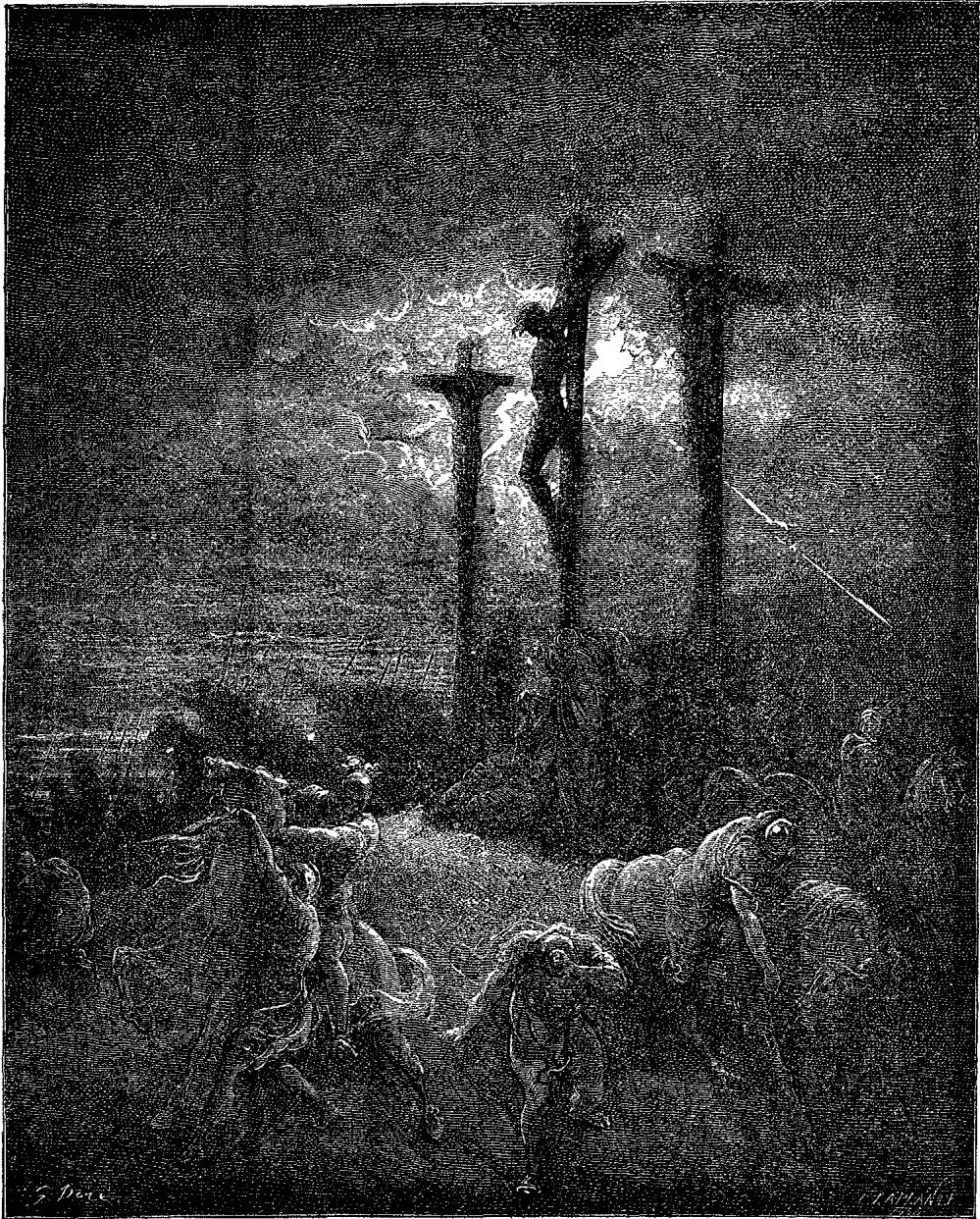
CRUCIFYING THE MODEL SABBATH-KEEPER.
“Therefore did the Jews persecute Jesus, and sought to slay him, because he had done these things on the Sabbath day.” John 5:16.
PERSECUTION GONE MAD.
By W. H. McKee
BY W. H. MCKEE.
The Imprimerie Polyglotte, the publishing house of the Seventh-day Adventists in Basel, Switzerland, has been closed because of the persistent prosecution, for its Sunday labor, met with from the authorities of Basel. The work of the house, in the publication of the literature of the denomination, will be divided and carried on outside the regulation of the factory law. To make this complete revolution in the carrying on of the business will cause considerable expense, much trouble, and some loss from the quantity of valuable machinery and material left idle. However, there is every certainty that this will result in a far wider distribution of the denominational work and literature than before, and an increased production at cheaper rates. The handsomely situated and commodious building, formerly occupied by the publishing business, will be remodeled within and used as a nurses’ training school, and for the introduction and development here of the rapidly increasing medical mission work of the denomination.
Such an outcome as this was, of course, unlooked for by those who brought the persecuting prosecutions. Yet it has been invariably and everywhere the result and will be no less so here than elsewhere. At the trial of the last case, brought on the 31st of May, the very day on which it had been previously decided to discontinue the business of the Imprimerie Polyglotte, the prosecuting attorney said in his summing up, “It is a satisfactory thing that, at last, the Seventh-day Adventists in Basel are broken up.” Yet he had already acknowledged that they were a quiet, peaceable, respectable, honorable people. It was clear that he had nothing to bring against them except the fact that they believed that they ought to obey God rather than men, and practiced their belief. On the occasion in which Peter and the other apostles were called before the council and made that reply, “We ought to obey God rather than men,” some very wise advice was given by a doctor of the law, which, though apparently forgotten, is still applicable,—“If this work be of men, it will come to nought; but if it be of God, ye cannot overthrow it;” therefore he counselled that they leave them alone, “lest haply ye be found even to fight against God.”
The proceedings against the Basel publishing house, for its Sunday work, present as strange a legal medley as can probably be found upon the records of any modern court. According to the factory law, under which it was necessary to bring the prosecution, the manager of the establishment, alone, is responsible. Therefore, the manager, Mr. Holser, was fined and his household goods taken and sold to satisfy the fine. Again, he was fined two hundred francs, and imprisoned three weeks. The fine was not paid, and no goods were found to levy upon, all his personal effects having been taken to satisfy previous fines. When the authorities found that the fine could not be collected, they would have imprisoned Mr. Holser forty days more, in lieu of the fine, but, in the meantime he had gone to America to attend the biennial conference of Seventh-day Adventists of the world, to which he had been called as a delegate. He was then advertised as a bankrupt, according to legal form. Upon his return to Europe, Mr. Holser did not come into the jurisdiction of the Basel court, but went to attend denominational meetings in northern Europe, to which he had been assigned. Apparently the limit of legal procedure in this line had been reached, and still the employés of the Imprimerie Polyglotte continued to work peacefully and quietly six days in the week and rest upon the seventh.
Also, in the meanwhile, the police had maintained a careful and systematic supervision over the house, on Sundays, and all its outgoing and incoming. During the last week in May a summons was received at the office of the Imprimerie Polyglotte, which was then preparing to go out of business on the 31st of May. On reading the summons, it was found that the “congregation of Seventh-day Adventists” was summoned before the court. As the congregation has no legal personality, and no one was summoned personally, the law firm which has previously attended to the legal business of the Imprimerie Polyglotte was asked to appear in answer to the summons and so represent, and request a dismissal of the case on the ground that it had not been brought against any person or corporation having a legal individuality to be proceeded against in law. This was done and the fact made very clear to the court that the Seventh-day Adventist Church in Basel was not a corporate business body, and owned no property, and did no business,—that it paid rent for the assembly room which it used in the building formerly occupied by the Imprimerie Polyglotte in its publishing business. But instead of dismissing the case, the court did about as strange a thing as can be found in the legal annals of our time. It fined “The Central European Conference of Seventh-day Adventists” five hundred francs, the limit of the law,—and threatened a similar fine for every Sunday upon which labor should be continued in the publishing house. This fine was decreed against this other religious body, as the court said, in “contumaciam,” which, of course, means for refusal or failure to appear before the court in answer to a summons. Note the remarkable inconsistency,—a religious body, not a definite person, was summoned, nevertheless an accredited lawyer appeared, and there were present in court the pastor of the church and several members,—the court then fined another religious organization, not mentioned in the summons, five hundred francs for not appearing. Neither the Seventh-day Adventist Church in Basel, nor the Central European Conference owns any property in Basel, or transacts any secular business anywhere, and yet the court fined “The Central European Conference,” which it had not summoned, and which is a religious organization anyway, five hundred francs, and threatened to continue the multiplication of the same fine weekly until work was stopped in the Imprimerie Polyglotte, the buildings and business of which is owned and managed by an incorporated business association having its headquarters in Battle Creek, Michigan. It scarcely seems possible that futility and inconsistency could have gone any farther.
This ends all possible proceedings against the Seventh-day Adventist publishing house at Basel. The next step will be to prosecute the members of the church individually, under the cantonal law, whenever they are complained of as laboring on Sunday. This law is very strict, and yet admits of an interpretation which is a sufficient protection to the ordinary citizen from its severity. It remains to be seen how long it will be before it is put in operation against Seventh-day Adventists.
Basel, Switzerland.
WAS IT A “SLIP”?
By Editor
The Truth Seeker, of the 15th inst., thus takes us to task for a supposed “bad slip,” which however was not a slip at all:—
The AMERICAN SENTINEL made a bad slip in its issue of May 30. During the trial of J. Q. Allison of Douglasville, Ga., for the violation of the Sunday law, the judge said, answering the plea of the defense that the Sunday statute interfered with the religious liberty of the citizen:—
“I would not interfere with you in any way in the enjoyment of your religion; this is simply a law of the State, and we are bound thereby. The State could say that you should keep Wednesday or Thursday, or every other Thursday, that it would be a crime to work on every other Wednesday or every other Thursday, and we would be bound to obey the law.”
To this the editor of the Adventist paper replies: “This statement by the judge would be true if the law were indeed a merely civil regulation based upon civil reasons.”
The italics are his. He then goes on to show conclusively that the Sabbath law is not based on merely civil reasons and thus effectually disposes of the judge’s defense of the prosecution. But we are not here concerned with this aspect of the matter; what we would call attention to is the astounding admission of the SENTINEL that the State has a right to make honest labor a crime on any day for any reason. This is unconditional surrender.
The SENTINEL has made no such surrender. Our freethought critic has overlooked the if in what we said. The SENTINEL has many times proved that there is, and can be, no civil reason for enforced weekly rest. This was the thought we had in mind when we italicized the phrase “based upon civil reasons.” It would have been better, we confess, to have said plainly in the very next sentence that there could be no such reason; but we did say in the same paragraph: “The prohibition of secular labor and business on Sunday has absolutely no other basis except the supposed sacred character of the day. No other reason could possibly exist for forbidding a man to plow in his own field on Sunday.”
It follows that there can be no civil reason for prohibiting honest labor upon any day, for if there could that reason could apply to Sunday as well as to any other day. The fact that after years of diligent search no such reason has been found proves that it does not exist. The SENTINEL has made no surrender either unconditional or otherwise, for the SENTINEL supposes no unsupposable case. The position of the SENTINEL is and always has been that a weekly day of rest can exist only on a religious basis and for religious reasons, that therefore the State could, of right, have nothing whatever to do with the question; and that all so-called civil reasons are mere figments invented for the purpose of evading constitutional guarantees of freedom of conscience.
However, we are glad that the Truth Seeker is so clear-sighted as to detect even this supposed heresy, and we hope our contemporary will continue to seek the truth and point out the errors connected with this subject, even to the extent of correcting a supposed error in the AMERICAN SENTINEL.
DECISIONS DECLARING VOID THE SUNDAY STATUTES OF KENTUCKY.
As stated in these columns last week, Judge William L. Jackson, of the Circuit Court, and Judge Charles G. Ritchie, of the County Court, both filed opinions at Louisville, on the 1st inst., declaring void Sections 1,303, 1,321 and 1,322 of the Statutes of Kentucky. The following is the opinion of Judge Jackson in full, as reported in the Louisville papers of the 2nd inst:—
Judge Jackson’s Opinion.
On the 19th day of February, 1895, a warrant issued from the Police Court of Louisville against the defendant, Louis Seelbach, charging him with the offense of keeping open on Sunday a bar-room and place for the sale of spirituous, vinous, and malt liquors, and alleging that he did sell spirituous, vinous and malt liquors on Sunday. On March 9, 1895, a demurrer to said warrant was overruled by said Police Court, and the defendant was fined $20, and from the judgment assessing said fine he has prosecuted an appeal to this court, and the case coming on for trial de novo here, the defendant has again interposed a demurrer to the warrant.
This, a test case, and numerous cases await its decision. The warrant is drawn under Section 1,303, of the Kentucky Statutes, which section is as follows:—
Any person who shall on Sunday keep open a bar-room or other place for the sale of spirituous, vinous, or malt liquors, or any of them, on Sunday, shall be fined not less than $10 nor more than $50 for each offense.
As very many of the cases pending in the Police Court arise under Section 1,321, of the Kentucky Statutes, by agreement that section has also been fully argued and briefed, and it is to be considered as if case were pending under it.
Section 1,321 reads as follows:—
No work or business shall be done on the Sabbath day except the ordinary household offices or other work of necessity or charity, and work required in the maintenance or operation of a ferry, skiff or steamboat, or steam or street railway. If any person on the Sabbath day shall himself be found at his own or other trade or calling, or shall employ his apprentice or other person in labor or other business, whether the same be for profit or amusement, unless such as is permitted above, he shall be fined not less than $2 nor more than $50 for each offense. Every person or apprentice so employed shall be deemed a separate offense. Persons who are members of a religious society who observe as a Sabbath any other day of the week than Sunday shall not be liable to the penalty prescribed in this section if they observe as a Sabbath one day in each seven, as herein provided.
It is contended that these sections especially offend against Section 59 of the new constitution. The material parts of said section are here given:—
“The General Assembly shall not pass local or special acts concerning any of the following subjects, or for any of the following purposes, namely.” After enumerating various subjects, that section provides: “29th—In all other cases where a general law can be made applicable, no special law can be enacted.”
In discussing Section 1,303 of the Kentucky Statutes, it becomes necessary to settle the question, What is the generic subject of legislation under said section? On the one side it is claimed that the generic subject is Sunday observance: on the other, that it is regulation of the liquor traffic. A brief historical view of said section answers this question. Section 1,303, somewhat enlarged in its scope, it is true, is a reenactment, substantially of the Act of April 13, 1880. That act was an amendment of Section 10, Article 17, of the General Statutes, which was the general law for Sunday observance. From its history and its wording it seems clear to me that the paramount thought and central idea of said section is Sunday observance. Section 1,303, being a law for the observance of Sunday, questions raised upon the two sections now become cognate, and the lines of argument no longer diverge. Whatever may have been the reasoning in former opinions, it is now the accepted and approved doctrine of law writers and modern decisions that “Laws which prohibit ordinary employments on Sunday are to be defended as establishing sanitary regulations based upon the demonstration of experience that one day’s rest in seven is needful to recuperate the exhausted energies of body and mind.”
This being the beneficent purpose and object of Sunday laws, by reason of the points here raised, the twenty-ninth subdivisions of Section 59 of the constitution becomes material. That provides, “In all other cases where a general law can be made applicable, no special law shall be enacted.” Can a general law for the observance of Sunday be made applicable? Is it not apparent that such a law can be made as “broad and general as the casing air?” Section 1,321, stripped of its exceptions, fully solves the problem.
If then it is true that a general law for the observance of Sunday as a day of rest can be made applicable, by what law and with what logic can it be contended that if one person keeps open a bar-room or other place for the sale of spirituous, vinous, or malt liquors, or who shall sell or otherwise dispose of such liquors, that he shall be punished more severely than another person who keeps open another place of business, or who sells any other article or commodity? Learned counsel attempt to answer this question by invoking the police power and claiming that under that power a greater punishment can be inflicted upon a party keeping open a bar-room or other place for the sale of spirituous, vinous, and malt liquors, and selling the same, or otherwise disposing of same, than can be inflicted for keeping open any other place or selling any other article or commodity. Would not this be placing the police power higher than the constitution? I now state the settled rule in regard to said power: “It is very broad and comprehensive. Its limit cannot be accurately defined, and the courts have not been willing definitely to circumscribe it, but this power, however broad and extensive, is not above the constitution, which is the supreme law, and so far as it imposes restraints, the police power must be exercised in205subordination to it.” Again, stated in a very recent opinion, “It is very broad and far-reaching, but is not without its limitations. Legislative acts passed in pursuance of it must not be in conflict with the constitution.”
In the face of Subdivision 29 of Section 59 of the constitution, by what law and with what logic can it be claimed that if one person on the Sabbath shall himself be found at his own or any other trade or calling, or shall employ his apprentices or other person in labor or other business, whether the same be for profit or amusement, that he shall be punished, while persons engaged in the maintenance or operation of a ferry, skiff, or steamboat, or steam or street railroad in the limits of this State, or who belong to a religious society who observe as a Sabbath any other day in the week than Sunday, and shall observe as a Sabbath one day in each seven, that they shall go free and unpunished?
In answer to this question it is ingeniously insisted that the exceptions enumerated in Section 1,321 are a legislative declaration of what are works of charity and necessity, and that accused cannot complain of these exceptions. To hold that these exceptions were meant by the legislature as a legislative declaration as to what are works of charity and necessity, would be to hold that the legislative department was invading powers expressly given to the judicial department by Section 27, greatly amplified by Section 28 of the constitution. To deny the accused the right to complain of this section by reason of the exceptions would be to hold that the exceptions were passed for his benefit, and that by them he was not discriminated against, neither of which is true. At first blush it appeared to my mind that if these exceptions did not make Section 1,321 obnoxious to the provisions of the constitution aforesaid, these exceptions should be held void, but I find this position is not tenable. The rule, as stated by Mr. Cooley, is as follows:—
“But if its purpose, that is, the purpose of the law, is to accomplish a single object only, and some of its provisions are void, the whole must fall unless sufficient remains to effect the object without the aid of the invalid portion, and if they are so mutually connected with and dependent on each other as conditions, considerations or compensations for each other as to warrant the belief that the legislature intended them as a whole, and if all could not be carried into effect, the legislature would not pass the residue independently, then if some of the parts are unconstitutional, all the provisions which are thus dependent, conditional or connected, must fall with them.”
There is but one other question which I find it necessary to pass upon, and that is that if Section 1,303 and Section 1,321 are invalid, then Section 1,304 which reads, “Any person who shall, without license so to do, sell or otherwise dispose of any spirituous, vinous, or malt liquors, shall for each offense be fined not less than $20, nor more than $100,” applies to this case, because defendant’s license, if he had any, did not give defendant the right to keep open his bar-room on Sunday, or to sell or otherwise dispose of liquors on said day. It seems to me that the warrant is insufficient to raise this question, and that it would be a complete defense to Section 1,304 if any one produced a license, whether he had sold on Sunday or any other day.
For the reason given the demurrer to the warrant is sustained.