The Youth’s Instructor, Vol. 33, No. 3.

WILLIAM THE SILENT

The Youth’s Instructor

Feb 4, 1885

S. D. A. Publishing Association · Battle Creek, Mich. · Feb 4, 1885

WILLIAM THE SILENT.
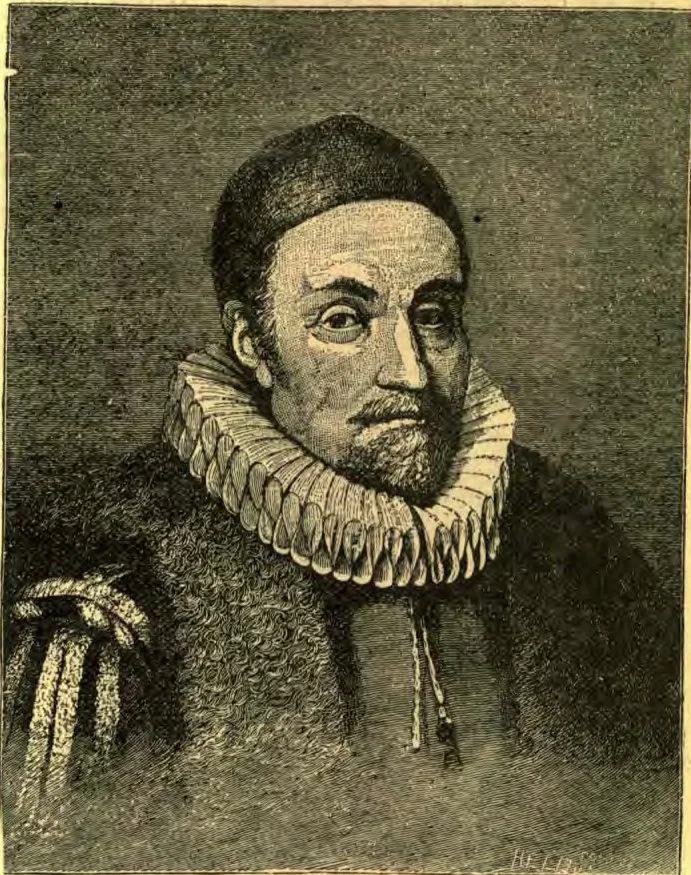
In the heart of Germany lies an undulating and fertile province, a little larger than the State of Rhode Island. It is called the duchy of Nassau. This little realm is ruled over by a count, who divides the land up into farms, tilled by the peasantry.
In this province, in a battlemented and turreted old castle at Dillenburg, was born, April 25, 1533, a boy named William. His father was count of Nassau, and William, as the eldest son of the family, was heir of all these fair lands. He seems to have had no childhood, but took a long step from the cradle to manhood. He was taught the various languages necessary for one in his position to understand. He was drilled in the forms of court etiquette, and was skilled in all military and athletic exercises. He was an apt scholar, and early exhibited the sound judgment and foresight that so distinguished him in after life.
When William was only eleven years old, his cousin, the Prince of Orange, died childless, leaving his title and his rich estates to the young count, who was the next heir. As Prince of Orange, he became one of the most powerful and wealthy of the French nobles. This was wonderful fortune for such a young boy, but it does not appear that he was injured by it.
Charles V., who was king of Spain, prided himself on his ability to read character. He heard of this young noble, and thought it wise to make friends with one who would by and by be such a power in the kingdom. So he invited him to come to Brussels to the imperial palace. King Charles treated him as he would his own son. He told him all the secret plans of his administration, frequently following out the suggestions that the young prince gave him. No matter what business was to be discussed, he always wanted William present. He showed his confidence in his favorite by placing him, when only twenty years old, in command of the imperial army on the French frontier. This was a position that the most able generals in the Spanish army would have felt honored to hold.
Charles V. was now a feeble old man, threatened with insanity. He deemed it unsafe longer to bear the burdens of the empire, and resigned in favor of his son, who was known as Philip II.
Philip was jealous of the Prince; he envied his superior talents and his popularity, but he took good care not to let this be known.
The new king was a bigoted Catholic, and meant to rid his realm of all the hated Protestants. To better accomplish this object, he made peace with Henry II., king of France. William of Orange and an illustrious French noble were sent to the French court to draw up the treaty. As they set out on their journey, the king said, “The greatest service you can render me in this world is to make peace. I desire to have it at any price whatever.”
The king of France was one with the king of Spain in his hatred toward the Reformers, and he supposed that William of Orange shared these feelings in common with them. Although the Prince was a Catholic, he cherished no such bitterness toward them as rankled in the bosom of his king.
While at the French court, he one day went with the king on a hunting excursion. In the excitement of the chase, they became separated from the rest of the company, and found themselves, with wearied horses, alone in the dark forest. Riding slowly along, the king told William a secret plot between himself and the king of Spain to kill all the Protestants in France, Spain, and the Netherlands. He described minutely the whole plan of the midnight assassination. The Spanish troops were to murder the Netherlanders.
The Prince was horrified at this revelation; yet he listened in silence to all that the king said, never, by the least expression of his countenance, showing the indignation he felt. Had the king suspected his feelings, it would have proved the death of the Prince.
From this circumstance he earned the title of “William the Silent.” On returning to the palace, he joined in the court festivities as if nothing had happened. Shortly afterward he obtained permission to go to the Netherlands, where he exerted all his influence to have the Spanish troops withdrawn.
A few days after this, Henry II. died, and thus the massacre in France was indefinitely postponed. Philip II., angry because the Netherlanders petitioned for the removal of the troops, transferred his capital from Brussels to Spain. Here he persecuted the Spanish Protestants with such vigor that in a few months every trace of the Reformed religion was obliterated.
The king, who was not absolute monarch of the Netherlands, had no more right to interfere with the laws of the provinces than the President of our own country has to make laws for the State of Michigan. Yet he continually ignored their ancient laws, and trampled on their rights. All efforts of the Prince and the Catholic nobles to obtain justice and to prevent the horrible Inquisition from gaining a foothold in the Netherlands proved unavailing, and at last he was obliged to go to Germany to save his life. With his departure, hope seemed to leave the people; for they looked to him for guidance in these troublesome times.
But there is not space in one brief article to tell of all the oppression brought to bear upon these Netherlandsers. It is estimated that up to the year 1566, fifty thousand Reformers had been put to death in the Netherlands alone, and that thirty thousand had fled to England. Nor are these all who suffered the tortures of the Inquisition.
In Germany, Prince William embraced the Reformed religion. He went from court to court, among the Protestant emperors, eloquently pleading for help for the distressed Netherlandsers. He spent all his vast income, and got deeply in debt, in raising an army to drive out the Spanish troops.
You will have to read in some history of the terrible struggle that followed, and how the people at last accomplished their object only by cutting the dikes, letting the seething ocean in, and drowning their fair meadow-lands. You will also learn that as soon as the Spanish troops had fled from the on-coming flood, a strong east wind blew, and drove the sea back to its bed.
When the people found themselves free, they wanted the Prince to rule over them; but he would not do it. So they chose the Duke of Anjou, brother of the king of France, for their sovereign. He proved traitor, and fled to France, where, after a short time, he died.
Before any steps could be taken to appoint a successor, Prince William also died. He was assassinated in his own house at Delft, July 10, 1584. The whole nation mourned for him as they would for a father. “He went through life,” says his biographer, “bearing the load of a people’s sorrows upon his shoulders, with a smiling face. Their name was the last upon his lips, save the simple affirmative, with which the soldier who had been battling for right all his lifetime, commended his soul in dying ‘to his great captain, Christ.’ . . . As long as he lived, he was the guiding star of a whole brave nation; and when he died, the little children cried in the streets.”
W. E. L.

The New Year.

The year in silence dies away, And softly o’er the snow Another comes with outstretched hands, Whose face we do not know; Yet must we rise and walk with him Wherever he may go.
Perhaps through waters deep and dark, Perhaps by sunny rills, O’er rough and thorny mountain sides, Or pleasant sloping hills, The stranger closely grasps our hands, And leads us where he wills.
But high above the passing years We know the Lord is King, And every day of all the months Some gift from him shall bring; We trust him, and are not afraid The while his love we sing.
He never has forgotten us! The story of the years Is full of his great goodness Through all our hopes and fears; And he will bless us every day, And wipe away our tears.
After the darkness comes the dawn, And though the past was sad, The sunshine will break forth again, And all the world be glad; Where death has been, the flowers shall bloom, In summer beauty clad.
And so we lift our eyes to Thee, O Thou who changest not; Thou keepest us within Thy heart— We shall not be forgot; And light from Thee shall bless the way, Whate’er our earthly lot.
We thank Thee for thy tenderness; We praise Thee for Thy grace; We fear not anything that comes Before we see Thy face. Lead Thou us yet another year Nearer Thy fair home place.
—Selected.

KITTY AND THE EYE.

Kitty was left at home one Sabbath, because she was not quite well, and the weather was bad. She had her hymn to learn, and a pretty book to read.
She had learned one verse of the hymn perfectly, when an idle thought entered her head, and she followed it to the baby-house. That house was shut up on the Sabbath, and rarely visited; for in Kitty’s home the Sabbath was a holy day, loved and prized by all in the family. It was not a stiff, disagreeable day, but a day when father was at home from his work, with leisure to speak to his little ones. Kitty often thought how good it was in God to make a rest-day for her papa; else how could she see him enough?
Well, the idle thought carried Kitty to the play-room—only to look; but she saw a doll’s dress left unfinished the afternoon before. She took it up, pulled the needle through, sewed a good many stitches, and then tried it on her dolly. The little girl had some misgivings; but said to herself, “Aunt Mary can’t scold me for what she doesn’t know, and there’s nobody to see.” Nobody to see! It seemed now as if there were an eye looking right through the wall, watching her; not an angry eye, not a fiery eye, but a great sorry eye.
Kitty put her work down. She trembled. Oh, how she seemed to remember in a minute all she ever knew about the Sabbath-day! How God, when he made the world, put by his work; how he wrote it in his ten commandments himself; how the people in Jerusalem displeased him because they broke it. Did God set so much by his Sabbath, and she not mind it? She had no excuse to make; she did not try to excuse herself. She only felt that she had grieved and offended the Lord, and she was sorely troubled. Kitty stayed not a moment longer in the play-house.
That evening, when her father took her in his lap, and heard her hymn, she leaned on his shoulder, and a tear stole down her cheek. “Papa,” she said, with a choking voice, “I have been grieving God to-day;” and she then told her papa everything. “If I’d only gone to church, it wouldn’t have happened,” she said.
“You have had a more faithful teacher than the minister to-day, my child,” replied her father. “You have had the Holy Spirit, who shows us our sins, and makes us feel what a grievous thing it is to break God’s blessed law,” and he looked down on the little girl’s face, and saw a tear on her cheek, more precious in his eyes than silver or gold.
There are many kinds of tears—complaining tears, teasing tears, tears of disappointment, tears of joy—but this was a tear of penitence; and a tear of penitence is precious, because it softens, sobers, and humbles the heart.
That night Kitty prayed: “O God, forgive a sinful child, for Christ’s sake!”—a prayer dear to the heart of God from every infant lip.—Selected.

A QUAINT BOY.

Once upon a time two lads in the north of England heard a bellman announce a teetotal meeting. This was a new thing. “Let us go and hear all about it,” said the lads; so they went off to the meeting.
The speaker was a plain, homely, but persuasive man. The lads were convinced under his words, and signed the pledge. One of them went home, and told his mother what he had done; she called him “stupid.” When he went to his work, he told the men what he had done; and they said, in return, that he would soon be dead. Men could not live without beer, that was certain; and the sooner he took his beer, the better.
But he kept his pledge, and thought. Remembering that the paupers in the work-house had no beer, he started off, saw the master, and solemnly asked him whether the paupers died when they got no beer? The master laughed, and told him that people came there through drinking beer, and did not die, so far as he knew, when they could not get it.
“Ah,” said the men, “it’s no use talking; you’ll die if you don’t take beer.”
The inquiring youth was not going to be beaten. Off he started to the jail one day, and craved permission to see the governor. When he did so, he quietly asked him how many prisoners died through not having beer. The governor was much interested in the lad, inquired his reason for asking such a curious question, and ended by taking the boy over the prison, relating to him the dreadful histories of some of the prisoners, and advised him to keep his pledge. He also gave the lad a good dinner, and sent him away with a glad heart. That was forty years ago, and the lad is to this day a staunch teetotaler.—Selected.

Reading That Yields Something Worth Learning

READ nothing from which you cannot learn something.

EDITOR'S CORNER.

FEARING the excitement of the holidays would leave a careless, indifferent spirit with you, to counteract the influence of your good, New-Year resolutions, we have felt for some days that we would like to bring again to your notice the fact that upon the first day of January, 1885, you each began a new “year book,” and that you have been adding a new page to it every day since. As the year opened, no doubt the most of you sincerely purposed that if you lived to complete this work, it should be an improvement upon any record book you had ever made.
Book-making is particular business, always. The making of an ordinary book requires a great deal of time, care, and hard work,—yes, and of anxiety, too, lest, after all it has cost, it may fail in some particular to meet the claims necessary to its acceptance.
But to make a book to satisfy the mind of the great God himself, who can read every thought of the heart even before it is expressed; will require more than common effort; for it is only the stainless pages that will be approved by him. So we think it a matter of great importance ever to know of what sort our work is.
Let us take a little time right here, dear young friends, to examine the first leaves of our new record. Of the long list of readers, how many find the first page spotless? how many the second? Do you find any stains of selfishness? any marks of disobedience? Are any of the leaves defaced with tale-bearing, Sabbath-breaking, or any of the other sins that we sometimes yield to? Perhaps some of you discern faults in the making up of nearly every page.
Supposing the examination has brought to light an imperfect record,—what then? You cannot possibly think of giving up? Oh, no! we suppose you will begin over again. Why not?
Because you failed yesterday, is not evidence that you will fail to-day. If, as we said at the beginning of the year, you would learn to live by the day,—one day at a time, you would find it ever so much easier to make a clean record. It is easier to watch, and pray, and do right, when you think it is just for a little time; for when you think it is for any great length of time, you become fearful, and then discouraged, and then weary, and so become careless, and cease trying. Is not this so?
Form the habit of doing present duty all right, just as though that was the last work you had to do. Try it for one day, to prove that it is the better way. Begin early in the day, and strive with all your might, asking Jesus to help you. Reach often for his hand when you come to the hard places, and you will feel a sweet peace of mind that God's blessing always gives.
We love the dear readers of the INSTRUCTOR, and want to guide their feet in the narrow way. Don't be discouraged. If you fail, begin over again. Shall we not all begin over again every day, making each new day's record best of all?
“Over and over again The brook through the meadow flows; And over and over again The ponderous mill-wheel goes. Once doing will not suffice, Though doing be not in vain; And a blessing failing us once or twice, May come if we try again.”
M. J. C.

BEFORE MEN.

It was Saturday evening, and Edith Strong was making out a list of pretty things which she would buy on Monday. For six months past, since her thirteenth birthday, her father had given her a monthly allowance of ten dollars to dress herself. It was not large, but it was all he could afford, and it taught her the value of money.
“Just enough,” she said to herself, as she added up the cost of every needed article. “Oh,” she cried suddenly, “I forgot the collection to-morrow. I hav’n’t a cent for that, and Maggie Burns, who sits right across the aisle, will know if I put nothing on the plate; she always gives. Dear me! What shall I do? I cannot spare a cent, but I’ll have to. There are five Sundays in this month: church twice on Sunday. I’ve got to save ten cents on something. I’ll buy half a yard less of ribbon for my hat. It will look skimped, but what else can I do? Of course it would never do for me to let the plate pass; every one around our pew would see it. I’ll slip the penny under a bill, so no one will know what I give.”
Ten pennies were counted, and put in one corner of the bureau drawer. So Edith gave, not cheerfully, but grudgingly and of necessity and to be seen of men, one hundredth of her allowance to the Lord. She did not lay by as the Lord had prospered her, but the least amount she could do without.
Maggie Burns had an allowance too; but as her father was not at all rich, it was only five dollars a month.
“I wonder,” Edith mused in church the next morning, as the plates came toward her, “how she manages with that pittance to have anything to put on the plate. If I had no more, I wouldn’t try.”
Maggie, to all appearances, did not “try” this morning. She sat with folded hands and let them pass her. She did not look up to see Edith cast in her gift. Edith’s first emotions were a superiority—a whole penny’s worth—then a momentary regret that she wasted the cent. But an old gentleman in the pew behind Maggie seemed to be watching them both, and Edith was sure he was mentally comparing them, and how much to her advantage!
Maggie was not at church in the evening, neither was the old gentleman, and Edith felt as if the penny was quite thrown away. By strange coincidence the text was, “Be not deceived; God is not mocked: for whatsoever a man soweth, that shall he also reap.”
Edith was thinking so much of the trimming on the hat ahead of her, and whether she could trim hers that way without the extra half yard, that she did not hear one word of the discourse. But “Be not deceived; God is not mocked,” rang in her ears as she walked home with her father. She forgot it playing with the baby, and her mind was so filled with her purchases she did not give it a thought the next morning. She went from school to the store, and returned with arms laden. She was very busy trying to make the new hat look “respectable” without the extra half-yard, when her mother came into her room.
“I wish, Edith,” she said, “you would go right to Mrs. McMull’s, and see why she did not come and wash to-day.”
“Pretty soon, mamma,” she responded, no more willing to give any of her time to her mother than her money to the Lord. “There is no hurry.”
“Yes, there is; for if she cannot come to-morrow, you must hunt some one else.”
“But I am busy,” she protested.
“Go immediately,” commanded Mrs. Strong.
When she spoke in that way, Edith obeyed; but she put by the hat reluctantly and went, not cheerfully, but grudgingly and of necessity, and yet she knew the Lord loves a cheerful giver of time as well as money. She hated to go in the part of the village where Mrs. McMull lived, for pigs, goats, and drunken people abounded there. So it was not a very pleasant face that presented itself at Mrs. McMull’s very poor abode a little later.
“Shure, an’ I axes the leddy’s pardin,” was the woman’s response to her inquiry, “an’ it’s mesilf as ’ll come to-morrer. Me Biddy’s been thet sick I could n’t leave her at all, at all, to go till yer mither, and I had n’t so mich as a goat to sind wurred by. Cum in, miss. Shure, an’ she’ll be after lokin’ to say ye.”
“Thank you, I can’t,” she replied stiffly. She caught a glimpse through the half-open door of an untidy, poverty-stricken room, and she recoiled from entering it. “You will surely come to-morrow, then?”
“I will, shure. The young leddy, Miss Burns—ye mist know her—sid she’d stay wid Biddy to-morrer. A perfect little leddy she is too. Shure, I don’t know wat we’d done widout her last night. She stayed wid us the whole noight long. She’s a dilicut young leddy, too, an she was that worried out this mornin’ she could n’t sit up, or she’d a stayed wid her to-day.”
Edith turned shortly away, walking rapidly up the dirty street to get out of the neighborhood as quickly as possible. It surely could not be, she thought, that Maggie Burns would of her own free will spend a night in that shanty watching with a sick child. She was not at church last night, nor at school that day.
“I don’t believe it was,” Edith decided to her own satisfaction.
But the next day Mrs. McMull, always talkative over the washtub, and always sounding the praises of those who helped her in her struggle to live, told Mrs. Strong all about it. It was Maggie Burns; nor was that night and this day all she gave: she bought medicine the little child needed, and delicacies for her to eat. She must have spent all her five dollars, Edith concluded; for she did not buy a much-needed hat or gloves for a month, neither did she put a cent on the plate at church, where she would be seen of men. But God, who is not mocked, and who loves a cheerful giver, knew she gave her “all” that month to him. He knew, too, that it was a trial in more ways than one to her to let that plate pass by without putting anything in it. When this, or most of it, came to Edith’s ears, it showed her her own sin. Slowly she learned the great lesson that God is not mocked, that she had been mocking, even insulting him, by the begrudged pennies given of necessity before men.—The Child’s Paper.

THE EMPEROR AND THE RABBI.

The great difficulty to the mind of the Emperor Trajan was that God should be everywhere, and yet not be seen by mortal eye.
“You teach me,” said the Emperor to his Rabbi Joshua, “that your God is everywhere, and you boast that he lives with you and your nation; I should like to see him.”
“God’s presence is indeed everywhere,” said the Rabbi, “but he cannot be seen. No mortal eye can behold his glory.”
Trajan remained unsatisfied.
“Well, then,” said the Rabbi, “let us go and look first at one of his ambassadors.”
They went out into the noonday, into the open air; the sun was blazing in its splendor. “Look up, there he is,” said the Rabbi.
“I cannot see, the light dazzles me,” said the Emperor.
“What! thou art unable to bear the light of one of his creatures! how, then, couldst thou look upon God himself and live? Be content and believe.”

IMPORTANT BIBLE SUBJECTS.

LESSON 30.—PUNISHMENT OF THE WICKED.

CONTINUED.
[NOTE TO THE STUDENT.—Do not consider the lesson learned until you can give at least the substance of every text, with the correct reference for each. The references in black letters indicate those texts that should be committed to memory. A little diligent application each day will enable you to do this.]
  1. With what does Paul say that the wicked shall be punished? 2 Thess. 1: 7–9.
  2. When will this punishment take place?
  3. From whom does this destruction come?
  4. What does the prophet Joel say of the day of the Lord? Joel 1: 15.
  5. What is the agent of this destruction that comes from the presence of the Lord? 2 Thess. 2: 8; Rev. 20: 9.
  6. What does the inspired writer say of the suffering of those who are thus devoured? Rev. 20: 10.
  7. Repeat another testimony on this point. Rev. 14: 9–11.
  8. What, in ancient times, was the law concerning Hebrew servants? Ex. 21: 2.
  9. If in the seventh year the servant refused to leave his master, what was done? Verses 5, 6.
  10. After the ceremony of boring the servant’s ear had been performed, how long was he to serve his master? Ib.
  11. Can this by any possibility mean that in such a case the servant was never to die?
  12. What must we understand by the expression, “he shall serve him forever”? (See note.)
  13. Then what may we understand by similar expressions concerning the torment of the wicked?
  14. What positive proof can you give that those sufferings will eventually be terminated by cessation of existence? Mal. 4: 1, 3.
  15. How many other texts do you remember that prove the same thing?

NOTES.

“If thou buy an Hebrew servant, six years he shall serve; and in the seventh he shall go out free for nothing.” “And if the servant shall plainly say, I love my master, my wife, and my children; I will not go out free; then his master shall bring him unto the judges; he shall also bring him unto the door, or unto the door post; and his master shall bore his ear through with an awl; and he shall serve him forever.” Ex. 21: 2, 5, 6. “It is appointed unto men once to die,” and no one is foolish enough to imagine that the ceremony here indicated would prolong for a single day the life of either servant or master. The expression, “he shall serve him forever,” is in contrast to the idea that at the end of a certain period the servant should go free. It means that after the servant had declared his intention to stay with his master, and the law had been complied with, then he was bound to serve his master continuously, as long, of course, as he should live. There was after that ceremony to be no intermission in his service. But if in this case the term “forever” does not mean “without end,” it need not necessarily, when applied to the torments of the wicked, imply that there is no end to them; and in this case we know that the wicked will not be tormented to all eternity, because of the oft-repeated assertion that they shall be devoured, destroyed, burned up, become ashes, etc. Rev. 14: 10, 11; 20: 10 teach that there will be no intermission in the terrible torments of the wicked until they are ended by eternal death.

FOLLOW UP YOUR WORK.

I often think that Christian work is like much of our secular work in its laws and methods. If you send a woodman into the forest to fell trees, you do not expect him to strike his ax into one trunk, and then into another, till he has gone through the whole wood, delivering but one stroke upon a tree. That would do if he were “blazing a trail” through the forest; but if his work be to fell trees, it doesn’t do at all. He may chop until he is gray, and never produce a log for the mill. He must take his stand by one trunk, and smite away, and make the chips fly, and walk around it, still swinging his ax and working toward the heart, till it comes crashing to the ground. That is the type of successful Christian work.—Rev. A. L. Stone, D. D.

FROM THE SUNNY SOUTH.

I WANT to have a little talk with the dear Instructor family, and tell them how pleasant it is down here in Dixie. We had our first freeze on the night of the 18th of December. During the night, ice formed nearly an inch thick in open tubs and buckets. The change was very sudden; for it was quite warm only a few hours before. We had more ice water than we wanted at the time; but in two days it had all gone, and the water became so warm that we are now glad to go to the well for cool water. There had been some light frosts previous to this, but none severe enough to kill the four o'clocks, morning glories, or the delicate lilies.
We have raised a pair of gray squirrels, which are very gentle and cunning. They love to turn the wheel of their cage, but they spend most of their time in a large good's box, where they have plenty of room to play. A girl kissed one, and in so doing held it so tight that it returned the compliment, causing her lip to bleed a little.
Pretty little brown wrens build their nests in the eaves of our house, and rear their birdies every year. They often come in and about the house, singing their cheery songs.
I suppose some of you will come to the world's fair in New Orleans? I intend to go. There will be many things of interest to see, no doubt. There are many grand sights in this world; but many still grander will transpire in the near future, when the Saviour shall come on the great white cloud to gather his people, and crown them with immortality. May we be of that number.
Your friend, PETER H. CLARK.

THE LITTLE CLOAK.

I sing no splendid deed of fame: My theme, two children nine years old, Crossing the Melton Moor one day, When winter winds were keen and cold, When all below was white and still, And all above was dull and gray, And anxious robins could not sing, And streams were frozen on their way.
Brother and sister; on they went; Their childish hearts of kindness full, Yet scantily clothed, and scantily fed, They, like the birds and streams, were dull. And yet the little shivering lad Tried hard his own sore need to hide; Tried hard to give the smile and word That cheered the sister at his side.
She had a little woolen wrap, And suddenly with tears she spoke: “Why! it is big enough for both; Come closer, dear, and share my cloak.” “It will not shield us both, Marie;” “Come closer to me, do not fear; And if it is not big enough, We’ll stretch it, just a little, dear.”
They crept together, hand in hand, They found that comfort shared is best; They laughed, and ran, and were as warm As croodling birds within a nest. And oh, how beautiful those souls, That always find it wise and fit To stretch their blessings and their love Beyond themselves a little bit!
—Lillian E. Barr.

THE BRAIN STONE.

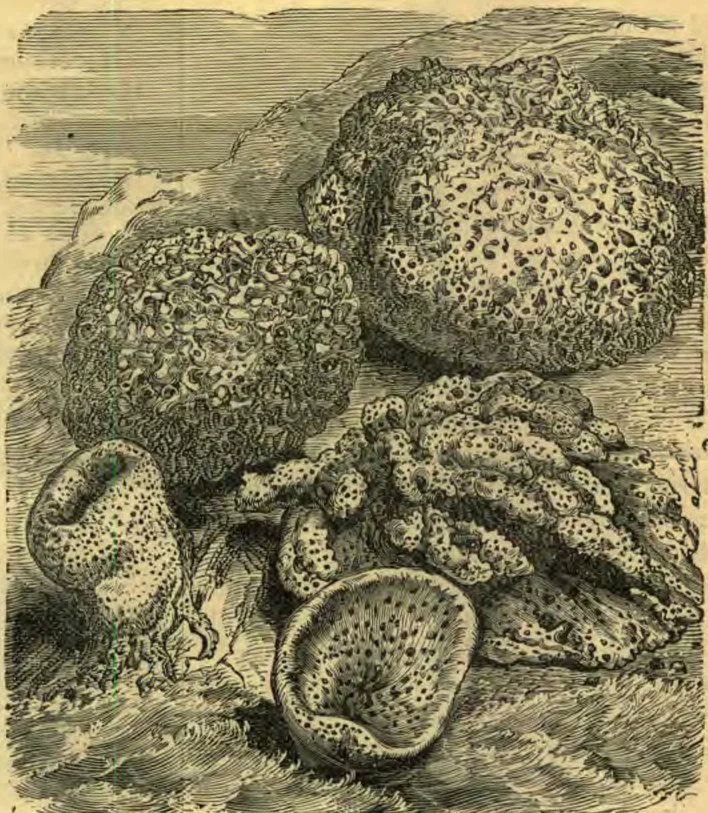
Sometimes a ship, as she sails among the islands of the Tropics, meets with a terrible danger; the little workers in the sea have been doing mischief. They have been making a great stem, or trunk, like a tree. On the top of the stem are a number of lumpy knobs, like those you see in the picture, and they are called brain stone. The brain stones are covered with a thick, flesh-like jelly, in which the polyps live.
The polyps are called madrepore polyps, and are only met with in the hot seas of the Tropics. They work so fast, and their stony houses are so strong, that it is not at all pleasant to meet with them.
They fill up many a space that had better be left open—I mean a space over which a ship is going to sail. On comes the ship, and before the captain is aware, it drives upon the rock. The rock has quite lately been built up by madrepore polyps.
Do you see how curiously the brain stone is marked? It has twisted lines, or ridges, all over its surface. The polyps have their cells between these lines, and live in them as in so many villages.
They throw out the lines, that make their cells, in thin plates like sheets of paper. These plates, or layers, are arranged in a ray-like form around the middle of the cells, so that the madrepore head has a very curious effect. But it can only be seen when the structure has been raised to the surface of the water, and the polyps and the flesh-like jelly are gone. Then the chalky, ray-like heads are clearly visible.
While the polyps are alive and at work, the madrepore rock or tree is gay with little rose-colored heads, that keep moving about, like flowers in the breeze of summer.
I must tell you that the madrepore polyps build all kinds of fantastic shapes in these warm tropical seas. Besides walls, and rocks, and trees, the structure will resemble a sheaf of corn, or a leaf, or a flower. There is no end to the strange devices of the little architects. The traveler on board a ship will often gaze at these queer forms in wonder and admiration, as they glow, in all their beauty, beneath the waters.
In the coral reef, the lumps of brain stone lie at the bottom of the reef, and help to resist the action of the waves.—The Sea and Its Wonders.

Industry and the Blessing of Labor

NEVER be idle; as a rule, idle hands are mischievous. Work with a will, and your labor will be blessed.

NEW BOOKS!

AMONG the new books offered as prizes to our boys and girls, is

“DR. KANE, THE ARCTIC HERO,”

by M. Jones, author of “Stories from European History,” etc. It is a most entertaining narrative of the adventures and explorations of Dr. Kane in the Arctic regions, preceded by an interesting memoir of his life.
Dr. Kane, of the United States Navy, was commander of the most remarkable expedition sent out in search of Sir John Franklin, who went out in 1845 to look for what was called the “north-west passage,” and was lost in the polar regions.
This very attractive story of Arctic life and travels is made from Dr. Kane’s work entitled, “Arctic Explorations,” a book so fascinating as to tempt others to undertake the same perilous adventures.
In size, the book is seven inches long by about five inches wide, and more than half an inch thick. It contains 168 pages, and 35 illustrations; is printed in large type, upon heavy paper; and is handsomely bound in cloth. Price 80 cts. It will be furnished free, postpaid, to any one sending ten new subscriber’s to YOUTH’S INSTRUCTOR, Battle Creek, Mich.
M. J. C.
Continue reading: Letter Budget