S. D. A. Publishing Association · Battle Creek, Mich. · Oct 8, 1890
HOW TO HAVE CONSTANT GOOD COMPANY.
THE most charming companion I ever met was a plain little woman whose life for years had been entirely given up to the care of an invalid, demented father, an old man who demanded her constant presence in his darkened room during his waking hours, in the few spare moments she had while going through the usual round of household duties.
Poor, living in the backwoods, where she never saw any society, she gained a depth of mind and a power of expression far superior to any of her old schoolmates who had shown greater promise, and had possessed every advantage. Indeed, she was neither “smart” nor particularly studious at school, but excessively fond of fun, excitement, and company.
One day I asked her the secret of the change.
She laughed: “I have been enjoying constant pleasant company for the last few years.”
I stared mystified. She drew from her pocket a little quotation book, and pointed to two quotations, “My own thoughts are my companions,” and, “They are never alone that are accompanied with noble thoughts.” There were several other quotations written on the margin, and the pages were well thumbed.
She said earnestly: “Looking back over my girlhood, I know that there is a fatal defect in the training of our girls; our words, our actions, receive attention; we are given advice and instruction in every point but in our thinking. I did not have even a conception of entertaining myself by my own thoughts; I wanted all the time to be amused by something or somebody outside of myself. Then came that plunge into poverty, sadness, and loneliness; at first I believed I should become insane, then God must have directed me to this little book, too worthless to be sold when our library went. One other quotation chained my mind. “Our thoughts are heard in heaven,” and I began recalling my thoughts. How disgusted I was with them! Round and round, in a weary rut of repining they had traveled, or even if not repining, how stupid, how unelevating they had been! From that hour I determined my thoughts should be inspiring companions; when sewing up a seam, they should not be, ‘So long and tiresome, wonder how long before I get done,’ and so on, and so on, over and over again. Why! I would take a little trip while sewing that seam.
When washing the dishes, I discuss with myself different national questions; when sweeping the room, I review the last book I read, or perhaps a book read years ago; every duty not requiring concentration is enlivened in this way.
“Not more than an hour can I ever read a day. Our books scarcely number a dozen, but since I began to think, one verse of the Bible will unfold and unfold, until it blossoms into a wonderful revelation, and I hope bears fruit. Before, I did not take time to wait for the unfolding and the fruit-bearing.”
“But I can’t control my thoughts,” I objected. “They will dwell on any trouble or worry I have.”
“Paul tells us that in our warfare our weapons are ‘mighty to cast down our imaginations,’ ‘bringing into captivity every thought;’ that promise is a great help when I feel despairing over my wrong thoughts. To keep down the disagreeable ones, to shake myself free from the servitude of the daily fretting tasks, I drill myself into meditating on pleasant subjects, just as I would drill my tongue, if in company, to make pleasant speeches.
“Tell the girls you teach and write to, how true it is that ‘The pleasantest things in the world are pleasant thoughts, and the great art in life is to have as many of them as possible,’ also that this art cannot be learned when the feebleness of age has weakened the control of the mind.”
When she had left me, I remembered she was the only person who had not made inane remarks about the weather, nor said, “Wasn’t that Johnstown calamity awful?” Do you suppose it was because thoughts had occupied her mind, not empty turning of the mental wheels?
If the mill grinds not grist, it will grind itself; if the mind feeds not on thought, it preys upon itself, and is its own destroyer.—The Christian at Work.
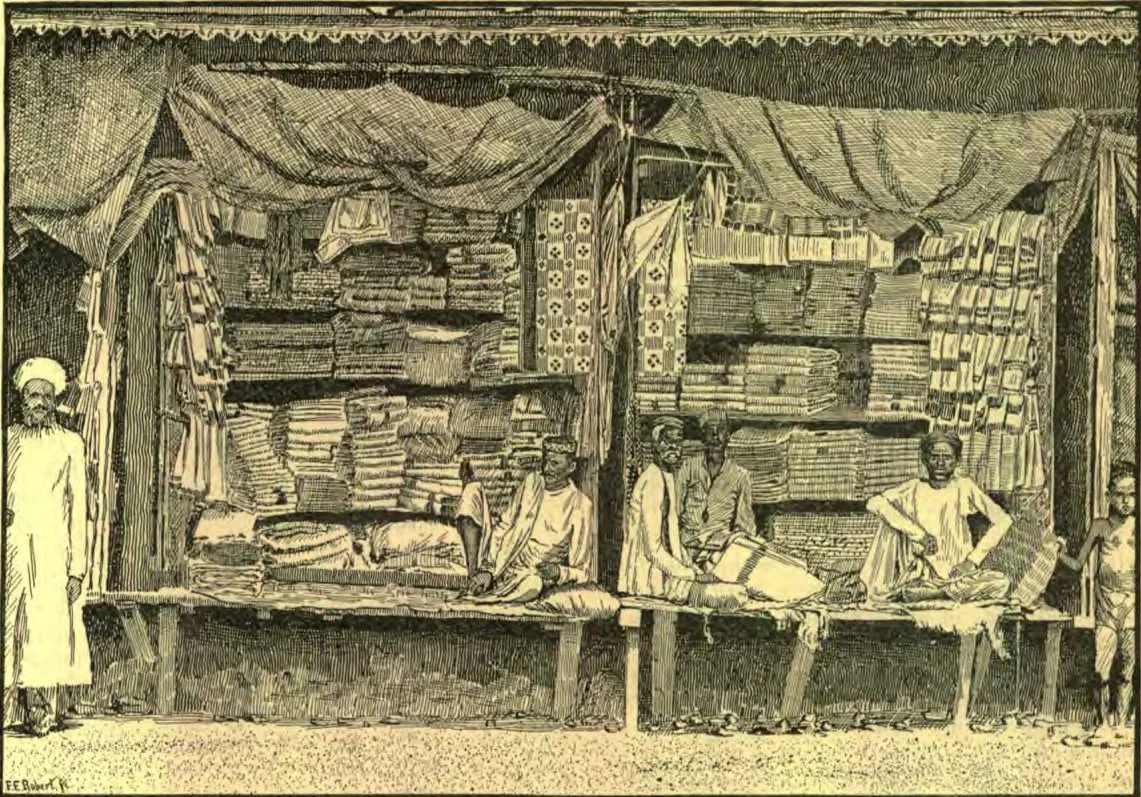
A DELHI STORE.
ROUND THE WORLD.—30.
By P. T. M.
DELHI.
WHEN we reached Delhi, we had journeyed 955 miles from Calcutta, and had still 880 to make before reaching Bombay.
Within a range of twenty miles south and west around Delhi are many ancient ruins, which testify to the various sites that the city has had in days of yore. This has been occasioned sometimes by Mogul invaders, who destroyed the old town with its forts and palaces, and reared up another; or sometimes by the caprice of emperors, who wished to erect more royal dwellings for themselves than those of their predecessors. Wherever the sovereign held his court, there parasites and nobles clustered around; and merchants, having no longer the protection of the king’s troops in the old town, took their wares to the vicinity of the new palace, to save themselves from exposure to hordes of bandits, who, in early days, roamed over the Indian plains, and they also wished to command the patronage of the Rajahs associated with the affairs of State.
The principal street in Delhi is the Chandi Chowk, one mile long and 122 feet broad. It is fairly clean, and adorned with a handsome row of trees on either side. The queen’s gardens are very elaborate, with many winding walks beneath the shade of varied foliage. There is a handsome clock-tower, and a museum containing many relics of antiquity. Another large street intersects the city from north to south; it commences at the famous Kashmir gate, which was stormed and taken by the British in the mutiny of 1857. After carrying the gate, the English soldiers engaged in a hand-to-hand conflict with the mutineers for six days in the streets of the city, and finally won back the town. An immense number of natives were slain, and the entire place was plundered.
Delhi was then, and is now, noted for its wealth. The most beautiful gold embroideries, shawls of silk and cashmere, ornaments of ivory, and sweet-scented sandal-wood fill every nook and corner of the bazaars. It is a pretty sight to see the venders, in spotless white garments, seated on the floor showing their handiwork. In little stores, six and eight feet square, are crowded thousands and thousands of dollars’ worth of goods, of texture and design that would almost breed covetousness in the heart of a saint.
The citizens of Delhi pride themselves on the purity of the Hindustani they speak, and upon their politeness and affability. They will express their grief if you tell them “jow,” meaning “go,” in the rough tones in which it is customary to salute a Bengalee. They will inform you with the blandest of smiles that they are not lying, that such vices they do not cultivate; but162after taking their oath by all the Hindoo gods that they cannot sell a shawl or a sandal-wood box a rupee cheaper than they have asked, you need not be surprised if they come down seventy-five per cent; take it as a matter of course, and then bid them half that amount.
There is a fort at Delhi, much the same as the one at Agra. It, too, has a palace, which contains a hall of audience famous in the annals of Indian history. It is a square marble pavilion, resting on massive pillars and moresque arches. The marble is highly polished, but there is little decoration, a few graceful flowers in mosaics being the only ornament. One side of the hall of audience opens on a court, a second side looks on the palace gardens, a third side commands a fine view of the river Jumna, and the fourth rests on the walls of the zenana. Between each pair of the outside rows of pillars is a very beautiful balustrade of marble, chastely carved in several designs of perforated work. The roof has at each corner a marble kiosk with a gilt dome. The shape of the building is oblong, but in size it cannot nearly equal the one at Agra. The ceiling was once entirely composed of gold and silver filigree work, for which the goldsmiths of Delhi are still noted.
In the center stood the famous peacock throne, so called because its back was formed by jeweled representations of peacock’s tails. The throne was six feet long and four feet broad, composed of solid gold inlaid with precious gems. It was surmounted by a gold canopy, supported on twelve pillars of the same material. Around the canopy hung a fringe of pearls, and on each side of the throne stood two chattahs, or umbrellas, the symbol of royalty; they were made of crimson velvet, richly embroidered with gold thread and pearls, and had handles eight feet long of solid gold studded with diamonds. This unparalleled achievement of the jeweler’s art was constructed by Austin de Bordeaux, by command of the Emperor Shah Jehan, who founded the present city of Delhi. The value of the throne was estimated to be $30,000,000. The peacock throne was taken away by the Persian Nadir Shah, and the silver filigree ceiling formed part of the spoil of the Mahrattas, in 1759, by whom it was melted down.
After leaving the palace, we drove to the Jami Musjid, one of the largest and most beautiful mosques in the East. It is situated on a high, rocky eminence, and the main entrance is reached by climbing a long flight of well-worn red sandstone steps, which, under the burning rays of an Indian sun, we found no pleasant task. The court is 450 feet square, is paved with red stone, and in the center is a marble reservoir for water. The interior of the mosque proper is paved with slabs of white marble, three feet long by one and one half broad, each decorated with a black border, which gives it an extremely beautiful appearance. Near the nibla, or that part which indicates the city of Mecca, is a handsome taq, or niche, adorned with a profusion of rich frieze work, and though joined in several places, appears to have been cut out of a solid block of white marble, four feet high and six feet in length.
In the northwest angle is a little chamber partitioned off by a beautiful white marble screen, in which are deposited some spurious relics of the prophet Mahomet. An old priest opened the door, and while he was fumbling about with keys and locks innumerable to undo the heavy locks which were attached to the precious caskets, I took the liberty of resting my foot, which was very weary, on the threshold of the doorway. I shall never forget the look of horror that came over his wizened old face, and had I been alone, he might have attempted to take my life for thus profaning the holy place. I judge that such a daring piece of sacrilege had not been committed for some time. The relics consisted of some hair that was said to be from Mahomet’s beard, but which more likely was extracted from the tail of a Yak cow years after Mahomet had departed this life. Then there were the crumbled remains of his shoes, which, too, in all probability, he never wore, but were more likely purchased in the bazaar for two rupees; and part of the Koran, hand traced, said to be the work of Mahomet’s grandson, but if the truth were known, was also the handiwork of some wallah in the Delhi bazaar. But the crowning lie is told about an impression that is shown. It is a foot-mark in solid stone, and was supposed to have been made because Mahomet stood there to pray so often. He must have had powerful understandings.
P. T. M.
AUTUMN
WHISPERING winds kiss the hills of October,
Thistledown phantoms drift over the lawn,
Red glows the ivy, like ghost-lighted ember,
Shrouded in mist breaks the slow-coming dawn;
Sunlighted vistas the woodland discloses,
Sleeping in shadow the still lake reposes,
Gone is the summer, its sweets and its roses—
Harvest is past, and summer is gone.
Plaintively sighing, the brown leaves are falling,
Sadly the wood-dove mourns all the day long;
In the dim starlight the katydids calling
Hush into slumber the brook and its song.
Gone are the sowers and ended their weeping,
Gone are the gleaners and finished their reaping,
Blossom and bee with the song-bird are sleeping—
Harvest is ended, and summer is gone.
—Selected.
BELINDA'S BEGINNING.
“Of course I mean to be a Christian; father and mother are, so are grandfather and grandmother, and most of my other relatives; so is Ellen, in the kitchen, and James, who cares for the horse. Of course I mean to be a Christian. Haven’t I said my prayers every morning and night for years? and haven’t I read my Bible, too, every day since my last birthday? And more too, haven’t I read a chapter in Miss Havergal’s ‘Morning Bells’ each day for almost a year? Of course all this is not being a Christian; but it shows I mean to be one some day, and so I do. I wonder what I must do to be a Christian.”
These were the thoughts that kept running through Belinda’s mind on her way home from prayer-meeting one evening.
There was beginning to be an “interest” in the village church which she attended, and although not considered old enough to be a regular evening attendant, she had gone this evening; her parents hoping, without telling her so, that some word or prayer might touch her heart, and set her thinking.
And thinking she was, as hard as ever she thought in her life, walking a little ahead of her parents, whom she thought unusually quiet. For Mr. Blair, the minister, had asked those who wished to be Christians to stand, and poor little Belinda knew not what to do. For the first time in her life she had a question to decide for herself, and she turned red and pale by turns all those awful moments while Mr. Blair was waiting, and some were rising about her. For the first time she realized that each soul stands alone before God; and her heart beat so hard with the struggle going on within her that she feared others might hear it. Stand up, she could not. Yet she did mean to be a Christian sometime. At length, when all were again seated, Mr. Blair said: “There may be some here who have given no sign of their desire; but their hearts are known to God. He is as near us at home as in his house, and as willing to bless us there as here.” That was a word of comfort to Belinda, and, hurrying home, she resolved to become a Christian that very night.
So, when alone in her own room, she began to pray, but it had never been so hard before. She had always gone to God with her troubles and perplexities as naturally as to her mother, but now he seemed miles and miles away, and her heart so heavy and dull she knew not how to pray.
“Become a Christian that night?” She did not even know what to do to become one, and how could any one be a child of God with such a hard, wicked heart? And so the day ended, and other days began and ended, and poor Belinda was no farther along. Weeks passed by, and she saw one and another of her young friends coming forward to confess Christ, while she stood apart, not daring even to call herself an inquirer, and yet longing and praying to know what to do to become a Christian.
And for the first time in her life something had come to her of which she could not speak to her parents. She shrank from being alone with them for a moment, for fear they might question her.
At length, one morning, reading in her pale face something of the struggle going on within her, her father laid his hand gently on her arm, and said, “My daughter, are you going to let these golden days slip by without seeking the Lord for yourself?”
Rushing from the room without answering him, but with a desperate determination to find help somewhere, she snatched her bonnet, and fairly flew along the walk till she reached Mr. Blair’s door.
“Father is not in, nor mother either,” said his daughter Mary, answering the bell; “but come in a moment. You look tired.”
She drew the child into a quiet corner, and let her rest a little, wondering what her trouble was, and longing to help her. A few questions soon drew the little girl to her side, and her story was soon told with sobs and tears. “And I pray and pray, and my heart doesn’t get any softer; and I read pages in the Bible, and try so hard to become a Christian, but it does no good. O Miss Mary! tell me what to do to become God’s child!”
“Dear child,” said her friend, drawing her very close, “you are God’s child now. You have been his child from the first moment of your existence. But you have never acknowledged yourself to be such. You have taken all his love and benefits, and returned him half-hearted thanks and such obedience as was convenient. Is it not so? Now go home to your own room. Take your Bible and kneel by your bed, and give yourself to God, to be his child forever and ever; promise him that you will make his book your guide, and do his will as far as you know it. That is all you can do; the rest is his, and trust him to do the rest.”
And so Belinda made her beginning in the new life. Just as she was, and with sins full in her mind, and her dull, heavy heart pulling her back, she gave herself to God, and made a solemn promise to be his forever and ever.
“And did the light from heaven seem to fill the room in which she knelt?” Not at all. “Surely, then, her heart was full of joy?” No, not so; it felt very little lighter than before. “At least she felt her sins were forgiven?” No, she did not feel they were forgiven; but she had given herself to God, and trusted him to do the rest. That was all of which she felt sure. And it was enough; fully enough. Little by little the light came; little by little the way was made plain; little by little the strength to walk in it was given; God did all the rest.
And he will do it for you and for me, and for all.—The Scholar’s Magazine.
Religion and the Bridled Tongue
RELIGION affects a man's tongue. Holiness and an unbridled tongue do not go together. “If any man among you seem to be religious, and bridleth not his tongue, . . . this man's religion is vain.”
'Tis Better to Laugh Than to Cry
By Helen L. Towne
'Tis better to laugh than to cry, dear—
A proverb you'll grant me is true;
'Tis best to forget to be sad, dear—
The heart's-ease is better than rue.
'Tis better to be glad for what is, dear,
Than to sigh for the things that are not;
'Tis braver to reckon the joys, dear,
Than the troubles that fall to your lot.
'Tis more to be good than be great, dear;
To be happy is better than wise.
You'll find if you smile at the world, dear,
The world will smile back in your eyes.
—Helen L. Towne.
KINDNESS IN A STREET-CAR.
ONE warm spring morning a poor woman entered a heavily laden down-town cable car, in one of our large Western cities. Besides her large market basket, she had two small children, hardly more than babies. A glance at her careworn face and the shabby, although clean, attire of herself and the children told at a glance of many a struggle with poverty.
She was evidently on her way to market, and having no one to leave the babies with at home, had been forced to take them with her. Perhaps this had been the case before; for with a glance at the “rules and regulations,”—all fares five cents cash, and only infants in arms free,—she put her basket on the floor in front of her, and took both the children in her arms for the long, weary ride.
Shortly afterward there entered the car two daintily dressed school-girls, as fresh as the June morning itself. Their merry faces sent a thrill of pleasure to the hearts of the other passengers, so much of youth’s buoyancy and happiness did they seem to bring with them.
They found seats next to the poor woman, and after a minute or two, the one nearest said to her, “Let me hold the little boy for you,” at the same time transferring the warm little bundle of humanity from the overcrowded mother’s lap to her own.
The words were spoken so gently, and accompanied by a smile so winning, that the little fellow made no objection, but was happy and contented all the ride, especially when a rosy-cheeked apple from the pretty lunch-basket found its way to his tiny hands.
The woman’s grateful “Thank you!” as she left the car, showed that not only were the weary arms rested, but the heart cheered, by the little act of thoughtfulness.
“What made you do that, Ruth?” asked her companion. “See how he has mussed your nice clean dress. It would have been so much easier to have paid his fare, and let him have a seat.”
“Yes,” said Ruth, “it would have been easier, but I don’t think it would have been so kind.”
“God bless her!” exclaimed an old gentleman with white hair and gold-rimmed spectacles, as the corner was reached where the girls got off to go to school, “God bless her, and may she long live to make the world brighter and better by her kind acts.”—Sel.
Self-Absorption and the Secret of Staying Young
It is self-absorption that carves wrinkles in the face, and streaks the hair with gray. Kindly thought and labor for others, dependent and beloved—the living out of and not in the petty round of personal and individual interests—keep heart and energies fresh.
“I have been too busy to count the years. I suppose some have slipped by unnoticed, and so I have made a miscalculation by a dozen or so,” was the explanation given by a grandmother when asked “how she kept herself so remarkably young.”
Forget the years, or register them by blessings, and they will forget you.—Home-Maker.
THE TIME FLOYD DIDN'T MIND.
By W. L. K.
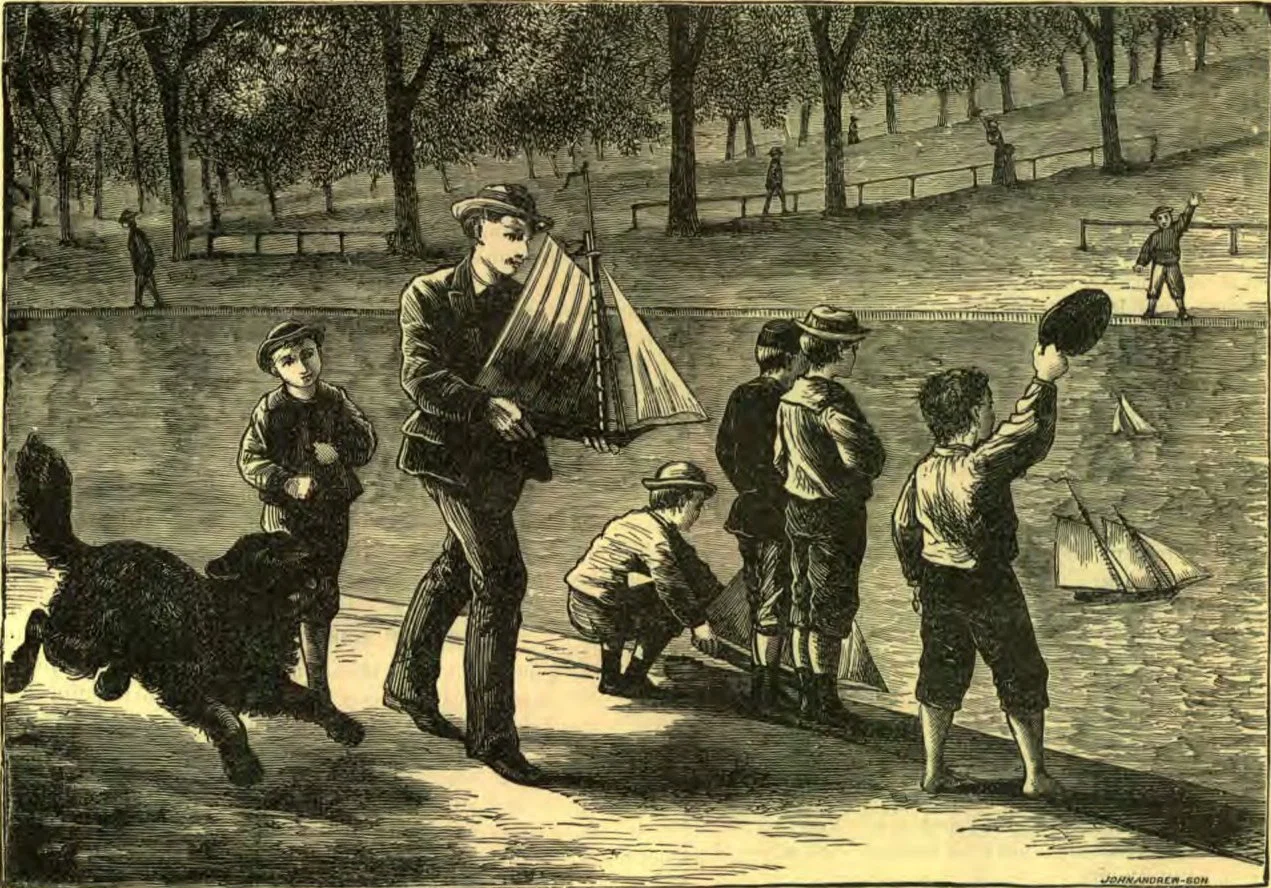
FLOYD ALLEN had two presents on his seventh birthday that he thought a great deal of. One was his first suit of clothes with jacket, pants, and real suspenders; the other was a toy ship from his Uncle Ralph. The ship was a large one and a beauty. Floyd hardly knew which to be the most delighted with. But he could wear the clothes, and carry the ship around; so it really made no difference.
By the pump stood a large trough full of water. Floyd spent hour after hour in watching his ship sail this make-believe sea. To be sure, the voyage was extremely short, but Floyd seemed satisfied. At night he slept with his ship in the chair by his pillow.
In the yard next to Floyd’s home stood a house that had been for a long time empty. One day he noticed an unusual noise over there. A large dray had driven to the door, and two men were unloading things. Floyd took his station on the fence-post to watch the moving. With the last load came the family, and among them a boy. The boy was twice as large as Floyd. He went at once into the house. Then Floyd’s mother called him to supper, and he, too, went in.
A little way back of the house was a large plat of ground. It had been meant for a park. Beautiful walks had been laid out. The trees were old and tall. An artificial pond had been made, and a river, both of which got their water from a small river near by. The old man who was building the park had suddenly died, and everything had remained just as he left it. Floyd had been to this place with his mother many times, but she had forbidden him to go alone; for rough boys played there, whose ways she did not want him to learn.
One day, about a week after the new family moved in, Floyd was busy sailing his boat in the trough. Suddenly he felt as if some one was watching him, and glancing up, he saw the new boy perched on top of the fence.
“Hello!” said the new boy, whose name was John, “that is a fine ship you have there.”
“Yes,” said Floyd, glowing with pride over his treasure; “my Uncle Ralph gave it to me on my birthday.”
The new boy then got down from the fence, and came nearer to inspect it.
“She would go like the wind, if she had half a chance,” he commented, looking at it closely.
Floyd’s bosom swelled with pride. “My Uncle Ralph always gives me nice presents,” he replied.
“My!” said John, still handling the boat, “that would beat any other one at the park. Why don’t you take it there, instead of sailing it in this old horse-trough?”
“My mother won’t let me go,” said Floyd.
The big boy put the ship down, and with a laugh, jumped over the fence. He came back, however, the next day, to watch the new boat. In fact, he came a good many days. Sometimes he gave Floyd some nuts or a piece of candy. John was not a good boy. He meant, as soon as he got well enough acquainted with Floyd, to get the boat, and take it to the pond.
Floyd liked John very much. He thought he had never seen so clever and pleasant a boy before.
One day Mr. and Mrs. Allen went away from home, leaving Floyd with his grandmother. John saw them go, and knew they would not be back till night. So after dinner he hurried over to Floyd’s.
“Come on,” called John, “let’s take the boat down to the pond.”
“I can’t,” said Floyd; “I never go there without mother.”
“Fudge!” returned John, “you’re not a baby; and all she meant, any way, was to have you go with somebody that was older than you. I am fourteen, and it’ll be all right if you go with me.”
Floyd was not at all sure it would be all right; his mother had expressly forbidden his going off with the boys. “But she meant little boys,” he reasoned, “and John is very old.”
Meanwhile John had taken the coveted ship in his arms, and was sauntering slowly down toward the back fence, in the direction of the park. Floyd followed on. It was such a temptation to try the sailing powers of the new craft on a pond large enough for it! How the boys would stare! They wouldn’t call him “sis” and “girl” any more when they saw his new suit and his new boat. Surely if mother were there, she would let him go. By the time he reached the back fence, he had persuaded himself that it was all right, and just what his mother would have been pleased to have him do. Of course she wanted him to be a man.
It was short work to climb the fence, and reach the water. There were rougher boys at the pond that day than usual. Only one of them knew Floyd and John. They crowded round the two boys, pretending to watch the launch with interest. But no sooner had the trim craft filled its sails than stones began to fly at her from all quarters, and cries of, “There she goes!” “Hit her again!” “Capsize her!” rang out.
In a trice the mast was broken and the sails torn. John ran ahead to catch her as the wind drove her into a cove, and then the boys turned on Floyd.
“See mother’s darling!” cried one, as he spied the new suit.
“Take that for beauty,” cried another, hitting him with a clod of fresh dirt.
“Trip him up!” called out a third.
How Floyd ran! Just as his persecutors turned to leave him, he stubbed his toe on a loose stone, and fell into a puddle of muddy water.
He picked himself up as best he might, and hurried off toward home. John was ashamed to come round, and had left the ship down by the back fence. Floyd did not go straight to the house. He got an old sponge at the barn, and tried to clean the mud off his suit at the trough. The more he scrubbed, the worse it seemed to make it look. Before he was half through, he heard a crunching on the gravel outside the gate. Mamma had come home. What did make her come so early!
Floyd ran down to a sunny place in the garden. May be his suit would dry before he had to go into the house. But it seemed hardly ten minutes before the tea bell rang, and his mother called, “Floyd! Floyd!”
Floyd was not accustomed to disobey or deceive, so he walked slowly into the house. His mother first noticed his dirty face and then his muddy clothes. She looked very grave. She felt of his clothes, and found them still wet. She took Floyd into the bathroom, and gave him a good scrubbing with a coarse towel. Then she got some clean clothes. She never said a word except to tell Floyd they would talk about the matter after supper.
Papa was merry at supper, and laughed and joked, but Floyd could not join in. The hands of the clock crept round, and at last the dishes were put away. How Floyd’s heart beat! Mamma always asked such lots of questions. Floyd could not think of any way to cover up his wrong. Little by little mamma learned the whole story. Then she and Floyd talked a long time about yielding to temptation, and about the best way to resist it.
Of course Floyd had to be punished, to help him remember, his mamma said. It was six long weeks before he could have his loved ship to play with, and through all that time he had to wear the hated kilt skirt and blouse waist, and hear the neighbor boys call him “girl.” But he remembered that “the way of transgressors is hard,” and that it is best not to yield to the first suggestion of the tempter.
W. L. K.
THE TIME TO BE PLEASANT.
By Young Reaper
“Mother’s cross,” said Maggie, coming out into the kitchen with a pout on her lips.
Her aunt was busy ironing, and she looked up and answered Maggie: “Then is the very time for you to be pleasant and helpful. Mother was awake a good deal of the night with the baby.”
Maggie made no reply. She put on her hat, and walked off into the garden. But a new idea went with her,—“the very time to be pleasant is when other people are cross.”
“True enough,” thought she, “that would do the most good. I remember when I was ill last year; was so nervous that if any one spoke to me, I could hardly help being cross, and mother never got cross or out of patience, but was quite pleasant with me. I ought to pay it back now, and I will.”
And she jumped up from the grass on which she had thrown herself, and turned a face full of cheerful resolution toward the room where her mother sat soothing a fretful, teething baby.
“Couldn’t I take him out in his carriage, mother? It is such a sunny morning,” she asked.
The hat and coat were brought, and the baby was soon ready for his ride.
“I’ll keep him as long as he’s good,” said Maggie, “and you must lie on the sofa and take a nap while I am gone. You are looking dreadful tired.”
The kind words and the kiss that accompanied them were almost too much for the mother, and her voice trembled as she answered, “Thank you, dear;164it will do me a world of good. My head aches badly this morning.”
What a happy heart Maggie’s was as she turned the carriage up and down the walk! She resolved to remember and act on her aunt’s good words: “The very time to be helpful and pleasant is when everybody is tired and cross.”—Young Reaper.
THE EMPTY NEST.
By Emily Huntington Miller
WE found it under the apple-tree,
Torn from the bough where it used to swing,
Softly rocking its babies three,
Nestled under the mother's wing.
This is a leaf, all shriveled and dry,
That once was a canopy overhead:
Doesn't it almost make you cry
To look at the poor, little, empty bed?
All the birds have flown away:
Birds must fly, or they wouldn't have wings;
Don't you hope they'll come back some day?—
Nests without birds are lonesome things.
Deep in the mother's listening heart
Drops the prattle with sudden sting;
For lips may quiver, and tears may start,
But birds must fly, or they wouldn't have wings.
—Emily Huntington Miller.