The Youth’s Instructor, Vol. 31, No. 33.

Written for the INSTRUCTOR

The Youth’s Instructor

Aug 15, 1883

S. D. A. Publishing Association · Battle Creek, Mich. · Aug 15, 1883

Written for the INSTRUCTOR

LOCH LOMOND.
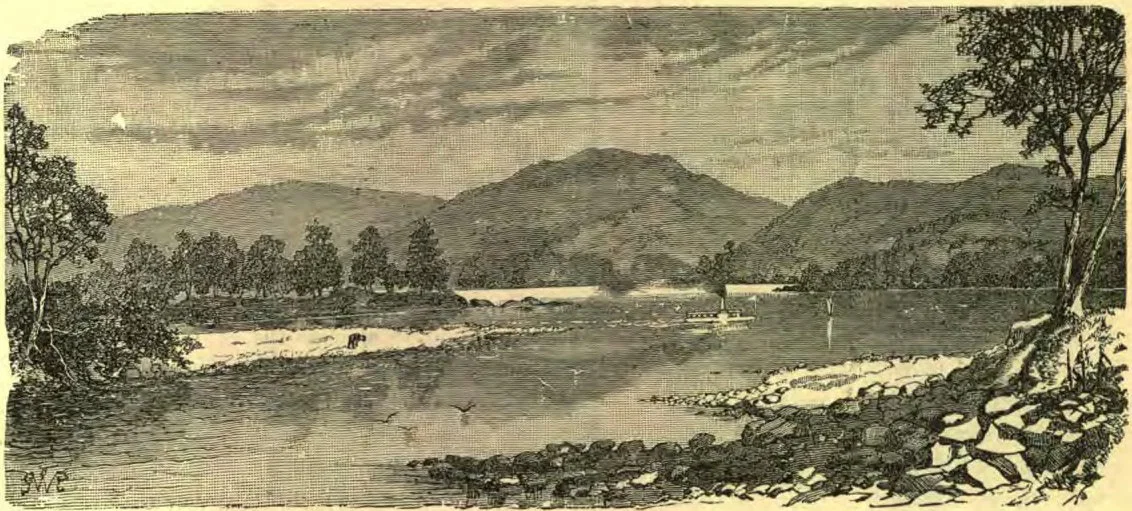
THROUGH the center of Scotland runs from east to west the chain known as the Grampian Mountains, which divides the country into two sections. The northern division is the more mountainous and elevated, and is called the Highlands; while the southern part is known as the Lowlands. The Highlands abound in lakes and grand and picturesque scenery. Many thrilling tales are related of the feuds among the clans anciently inhabiting this wild, rocky region. The Lowlands, though less mountainous, possess much beautiful scenery, and are of great historic interest on account of the many battles that have been fought on their green plains by the hardy mountaineers who tried for so long to preserve the independence of their country against the inroads of British invaders.
Near the northern border of the Lowlands, and about twenty miles northwest of Glasgow, is situated the largest lake in Scotland, a view of which is given in the accompanying picture. Loch Lomond, which is the Scotch for Lake Lomond, is about twenty-five miles in length. It is shaped something like a long wedge, the sharp end lying to the north, and about a mile in width, while the southern end is about seven miles wide. The lake contains thirty islands, among which a small steamer plies, giving travelers an opportunity of enjoying the varied scenery without the labor of rowing. Every year brings scores of sight-seers to the borders of Loch Lomond, to gaze on the wild and picturesque masses of mountains bounding the lake on the north; the high table-lands to the south, dotted with villas; to wander among the ancient ruins on the shores; and to catch the fine trout with which the lake abounds.
But not alone for its beautiful scenery is this lake and its vicinity famous, nor is this the chief attraction that calls to its shores nearly every one making a tour of the Old World. Scotland's bard, Sir Walter Scott, in his songs of the early struggles of his countrymen for freedom, has pictured every hill and lake and glen in all the region round, from Stirling's towers to the farthest rill that feeds Loch Lomond's waters. So vividly has he done this, that he who visits these places involuntarily looks around, almost expecting to see the very warriors and women, horses and hounds, with which the songs of the poet have peopled this region. He thinks he hears the pibroch of grim Roderick and his fierce followers,—
“The Saxon scourge, Clan-Alpine's pride, The terror of Loch Lomond's side.”
Quite likely one of the hills seen in the picture is Ben Lomond, the Scotch for Mt. Lomond. When it is known that this hill is nearly 3,200 feet above the sea, the force of the allusion to it in the following lines will be seen:—
“Of stature tall, and slender frame, But firmly knit, was Malcom Graeme.
Each pass by mountain, lake, and heath, He knew, through Lenox and Monteith.
Right up Ben Lomond could he press, And not a sigh his toil confess.”
But of wilder scene and more tender memory is Loch Katrine. This beautiful sheet of water lies but a short distance from Loch Lomond. Around it rise Benvenue, Ben-an, and Ben-ledi. A beautiful picture of this lake is presented in the following lines:—
“And thus an airy point he won, Where, gleaming with the setting sun, One burnished sheet of living gold, Loch Katrine lay beneath him roll'd, In all her length far winding lay, With promontory, creek, and bay, And islands that, empurpled bright, Floated amid the livelier light, And mountains, that like giants stand To sentinel enchanted land. High on the south, huge Benvenue Down on the lake in masses threw Crags, knolls, and mounds confusedly hurled, The fragments of an earlier world. A wildering forest feathered o'er His ruin'd sides and summit hoar, While on the north, through middle air, Ben-an up-heaved his forehead bare.” C. H. G.

Sin Advances Unless We Retreat From It

SIN is never at a stay; if we do not retreat from it, we shall advance in it; and the further we go, the more we have to come back.

The Flower Clocks.

’Twas midsummer morn, the night had died, When Lois threw open her lattice wide, And cried to herself with joyous pride, “There’s nobody up in the world beside!” But the morning-glories were wide awake, And bowed their beautiful heads, and spake: “Our goddess, the Dawn, is an hour up; On disk and bell, on chalice and cup, On stately spikes, and tendrils curly, She lavishly hangs her jewels pearly, And decks like a bride the morning early.” Then Lois laughed, and said, “Ah, me! The morning time is fair to see!”
But the hours went on, and by and by The lordly sun rode high in the sky; Then the loyal sun flower raised its head, And fervently called to the child, and said, “Come, bask in the full, high noontide heat, The Earth is asleep at her Master’s feet; The wind itself is too warm to stir; But the blue-flies buzz, and the locusts whirr: I follow my King from east to west, And his beams forever enchant my breast; But his noontide look I love the best.” Then Lois laughed like a silver chime, “The glowing noon is the goodliest time!”
But the hours flew on as the swallow flies, The sun was far in the western skies; Then the four-o-clocks opened their indolent eyes, And looked at the maiden in slow surprise. “Is there anything half so fair,” said they, “As this golden hour of a golden day? The dawn’s gone by with her dripping feet, And the scorching noon with its burden and heat, And now the shadows are slant and sweet; The hay comes home on the swaying wain; The cows are lowing along the lane.” Then Lois laughed with girlish glee, “This golden hour’s the hour for me!”
But the hours sped on, and the sun went down, The tree-tops lost their golden crown; And the primrose spread in the twilight mellow Her petals of faint and far-off yellow. “Come hither,” she breathed, “sweet child, and see The tint of the evening skies in me. The wind is sighing in dreamy whispers, The thrush is singing his solemn vespers, The air is heavy with honey-dew, The stars in heaven are peeping through, And the angel of sleep is waiting for you.” Then Lois laughed, “Good-night, fair flower, The cool, pure eve is the sweetest hour.” —Olive A. Wadsworth.

THE MOUNTAIN SHEEP.

I ONCE knew a hunter living near a mining town in Montana, who made a business of selling wild game that he brought in from the surrounding mountains. In his excursions, he would often happen upon the young of various wild animals, and bring them to his cabin as pets for his children. In fact, he had made considerable money by rearing some of these young animals, and afterward sending them to the Eastern States to be sold to menageries. He captured young grizzlies, mountain lions, panthers, and lynxes, and many a baby buffalo has he brought home to his children. These, when they grew large, were either sold or turned in with the cattle, of which he owned a large herd.
One day I was riding by his cabin, and noticed that he had built around it an inclosure of common rough planks, put close together, and sawed off at an even height, making a board fence such as you have often seen in towns or villages. While looking at this fence, my attention was attracted by a curious little animal running along the top of the fence. At a little distance it looked like a kid or lamb; yet no one ever saw a lamb run along the top of a board fence, skipping and dancing as freely as when on the ground. It would suddenly stop and stand on its hind legs, and shake its head as if at some enemy on the other side of the inclosure, or fence.
My curiosity being aroused, I drove up to see what this curious creature was. It did not appear to be afraid of me, and came close up to where I stood, now and then shaking its head ominously, however, as if to say, “I should like to try a fight with you, too.” At that moment I heard a sudden bark, and a small Newfoundland dog dashed around the fence. Away went the strange creature, leaping down the fence and dashing across the yard, the dog after it, but both in play, as I could see. Their jumps and gambols would have astonished you. But always, when hard pressed, the queer animal would wheel, and with one spring land on the very top of the board fence again. Its powers of leaping and balancing were truly marvelous.
I shouted to the hunter, whom I now discovered unsaddling his horse at the door of his stable nearby, saying, “What do you call this lively thing?”
“That is a kind of a Chinese puzzle on legs,” said he, in reply. “Did you ever see any circus clown beat him at jumping?”
I replied by asking, “Well, what do you call the creature when cooked?”
This question he did not evade, but answered promptly: “We call it mutton or lamb. That, sir, is a young mountain sheep. These animals resemble our sheep in many ways, but not in their straight, coarse, yellowish-brown hair. But beneath this rough coat they have a fine, short wool covering their bodies. They used to be called goats; but the wise men of the country have decided that they are really sheep.”
I had seen these strange sheep at a distance, in little bands, but never any so young as the one now playing about my friend’s fence.
The older sheep have a dark brown streak down the back of the hind legs, and also the same kind of a mark down the front of the fore leg. Their eyes are very large, resembling those of a deer or antelope.
They feed on the bunch grass, lichens, and moss that grow on the rocks, on sage, and on the bark of trees. They are very difficult to approach in their wild state, yet, when captured young, are easily tamed.
Hunters have very laborious sport when hunting these animals, as they seek the most elevated peaks of the mountains, and very seldom descend to the valleys. It is the object of the hunter to get above his game, if possible, when in pursuit of the mountain sheep; for they are so quick of eye, ear, and foot that, if he meets them on the same level with himself, he stands but little chance of bagging his game. So he strives to get above them. Then a stone thrown down among them will suffice to frighten them, and they will immediately begin ascending the mountain; and as they cannot scent the hunter who lies in wait above them, they will then fall an easy prey to quick and true shots from his rifle.—St. Nicholas.

MAGGIE DARNLEY'S EXPERIMENTS.

“THERE!” said little Margaret Darnley, in despair, as she stood, broom in hand, at the north door. The dust, and bits of paper, and string, and clippings of cloth, which she had been collecting from all over the room with her broom, kept drifting back persistently when she tried to sweep them out at the door; and worse than all were the feathers from the pillow of Myra’s doll, which were scattered in every direction. Myra did sew dreadfully, and a pillow was the last thing she ever ought to have made. And everybody knows what hard things to sweep up feathers are. Margaret leaned against the wall, tired out.
“Why don’t you try the other door, Maggie?” asked her brother Jack, who sat by the window.
“That is just the queer part of it,” said Margaret. “I tried the other door first, and it is just as bad there. The wind can’t blow in exactly opposite directions at once, can it?”
“May be it shifted while you were sweeping the dirt across the room,” said Jack.
“Well, that would be funny,” said Margaret; “but I’ll try it again. It will be a sort of nixperiment, I guess.”
“A sort of what?” asked Jack.
“A nixperiment,” said Margaret. “I listened to your philosophy teacher the other day, and Mr. Baird said that everything in science had to be—something by nixperiments.”
“Verified by experiments,” said Jack, laughing. “Yes, that’s so, and now we’ll see if there’s any philosophy about this dirt.”
So Margaret swept the dirt carefully across the room again, while Jack looked on.
“There!” exclaimed Margaret, “look at that.”
Jack did look, and had to confess that it was too much for his philosophy. “Stop,” said he, “I’ll see which way the wind is really blowing.” Margaret shut the door, and sat down to wait. The poor little arms were quite tired by this time; for Margaret was only ten years old, and was but just learning to sweep.
“It’s the stillest day we’ve had this season,” cried Jack, bursting in. “The weather-cock turns tail to the south, so whatever wind there is comes from the north. Let’s try the south door again.”
To the surprise of both Jack and Margaret, the dirt, which had been so perverse and contrary, went out this time without making much trouble.
“That’s it—the wind shifted, don’t you see, Maggie?” said Jack, with a wise look. “That’s the way with science. Science believes nothing till it has thoroughly proved it. That’s what experiments are for, and that’s the beauty of science.”
“Open the draft, Jack, and put in some more wood. What makes this room so cold?” called their father from a small adjoining room, which he used as a study. “What’s that you were saying about science?” he added, with a quizzical look on his face.
Jack, with a very grave and scientific look, explained their experiment in natural philosophy.
“Ah!” said his father, “the wind shifted, did it? How many times?”
“Why, four times, father,” said Margaret. “Just as quick as lightning—almost,” she added, seeing her father raise his eyebrows. “I swept the dust from one door to the other just as quick as I could; but by the time I got there, the wind got there too, and blew the dirt back every time.”
“Suppose we try the experiment again,” said Mr. Darnley.
“Oh, I’ve swept all the dirt out now,” said Margaret, “for after we had tried and tried, it finally went out quietly.”
“Well, here are a few feathers which gave you the slip, little Pearlie,” said her father. “We can try the experiment with them. Put in some more wood, and make the room pretty hot.”
“What for, father?” asked Jack, who was not very fond of carrying wood.
“It is necessary to our experiment,” said his father.
Jack put in the wood. This was mysterious and interesting.
“Now, Maggie,” said her father, when the room was uncomfortably warm, “get your broom and sweep out these feathers.”
“Which door, father?” asked Margaret.
“It makes no difference,” said her father, “either door will do.”
“Better let me look at the weather-vane again,” said Jack.
“It is not necessary,” said his father, smiling.
Margaret tried again, but the feathers all blew back, some entirely across the room.
“There they are, Maggie, close to the south door,” said Mr. Darnley. “I’ll shut this door, and you may sweep them out at that one.”
But Margaret had no better success than before.
“Isn’t it curious!” said Jack. “There must be witches standing in the door, blowing the feathers back.”
“That is what ignorant and superstitious people would have said years ago, Jack,” said his father, “but science shall teach us better than that.”
“Now,” continued Mr. Darnley, “let us make two piles of the feathers—one near the south and the other near the north door. Jack, get another broom for this pile. Now, both sweep in opposite directions at the same time. That will show us whether it is caused by the shifting of the wind.”
Jack and Maggie tried faithfully, but the feathers went every way but out of the doors, some of them even rising toward the ceiling.
“It’s the cold day,” said Jack; “they don’t like to go out.”
“Father, what is the reason, please?” asked Margaret, earnestly.
“Hot air always rises,” replied Mr. Darnley.
“Why?” asked Margaret.
“Because,” answered her father, “hot air is lighter than cold. When it rises, of course cold air rushes in to fill its place. When you open the door, currents of cold air rush in at the bottom, while the hot air is escaping at the top. Open the door, Jack, and try to drive out a feather above your head, while Maggie tries one at the floor.”
The children did so, and found that, while the feather at the bottom blew in, the one at the top floated out.
“But, father,” said Maggie, “we did sweep the dirt out at last. Why was that?”
“Because you had let the room grow cold while you were trying your experiments,” said her father, “and as the temperature became more like that outside, the currents were less strong. That is the way your ‘wind shifted.’”
Jack looked foolish.
“Science is a fine thing, my son,” continued his father, “and great beauty and interest, as well as importance, attach to its discoveries. But the life and soul of science lie in its exactness and thoroughness. A scientific experiment, to be worth anything, must be thorough. You tried an experiment half-way, and then jumped to a conclusion.”
“Mother,” said Margaret, “how do you sweep the dirt out?”
“I take it up on the dust-pan, Maggie, dear,” said her mother, smiling.
Jack and Maggie had both learned something that morning.—Jane Eggleston Zimmerman.

WHAT OF THE PAST DAY?

THE day is drawing to its close, And what good deeds since first it rose Have I presented, Lord, to thee? What wrongs repressed; what fruits maintained; What struggles passed; what victories gained; What good attempted and attained, As offerings of my ministry? —Longfellow.

NEW-TESTAMENT HISTORY.

LESSON 148.—THE QUESTION OF CIRCUMCISION.

Paul and Barnabas remained in Antioch a long time. While they were there, certain men of Judea came down to Antioch, and troubled the brethren who had been converted from among the Greeks, telling them that unless they were circumcised, they could not be saved. Paul and Barnabas tried to convince these men of their error, but to no avail; so it was determined that Paul and Barnabas, with others, should go up to Jerusalem, and lay the matter before the apostles and elders there. The church at Antioch kindly forwarded these messengers on their way, taking them through Phoenicia and Samaria. As they passed along, Paul and Barnabas rejoiced the hearts of all the brethren whom they saw by telling them how the Lord had wrought for the conversion of the Gentiles.
On arriving at Jerusalem, they declared to the apostles and elders and all the church there what things God had done through them for the people of those Gentile countries which they had visited. But some of the brethren who had been converted from the Pharisees thought it necessary that these Gentile converts should be circumcised, and keep the law of Moses. So a meeting of the apostles and elders was called, and after there had been much disputing on the question, Peter rose up and said, “Men and brethren, ye know how that a good while ago God made choice among us, that the Gentiles by my mouth should hear the word of the gospel, and believe. And God, which knoweth the hearts, bare them witness, giving them the Holy Ghost, even as he did unto us; and put no difference between us and them, purifying their hearts by faith. Now, therefore, why tempt ye God, to put a yoke upon the neck of the disciples, which neither our fathers nor we were able to bear? But we believe that through the grace of the Lord Jesus Christ we shall be saved, even as they.”
Then all the multitude listened attentively while Paul and Barnabas declared what miracles and wonders God had wrought among the Gentiles by them.
It would appear from the narrative that James presided over this important meeting; for he summed up the evidence and gave his decision in the following words: “Men and brethren, hearken unto me: Simeon hath declared how God at the first did visit the Gentiles, to take out of them a people for his name. And to this agree the words of the prophets; as it is written,—
After these things I will return, And build again the tabernacle of David, which is fallen; And I will build again the ruins thereof, And I will set it up: That the residue of men may seek after the Lord, And all the Gentiles, upon whom my name is called, Saith the Lord, who maketh these things known from the beginning of the world.
Wherefore my sentence is, that we trouble not them, which from among the Gentiles are turned to God; but that we write unto them, that they abstain from pollutions of idols, and from fornication, and from things strangled, and from blood. For Moses of old time hath in every city them that preach him, being read in the synagogues every Sabbath day.”
This decision seems to have been accepted; for Silas, and Judas surnamed Barsabas, were chosen, not only by the apostles, but also by consent of the whole church, to go to Antioch with Paul and Barnabas, that the report of the decision might not rest alone on the testimony of those who had been sent to Jerusalem. Letters were also written to the Gentile believers in Antioch, Syria, and Cilicia, in which the whole matter was kindly and clearly set forth. The closing words of this most comforting message were as follows:
“For it seemed good to the Holy Ghost, and to us, to lay upon you no greater burden than these necessary things: that ye abstain from meats offered unto idols, and from blood, and from things strangled, and from fornication; from which if ye keep yourselves, ye shall do well. Fare ye well.”
When this epistle was read to the church at Antioch, they rejoiced at the consolation and peace which it afforded them. Judas and Silas remained for some time, exhorting and comforting the brethren with wholesome instruction and admonition.

QUESTIONS.

1. By what teaching were the brethren at Antioch troubled? Acts 15:1.
2. How did Paul and Barnabas succeed in their endeavors to convince these false teachers that they were not following the counsel of God?
3. What was it finally thought best to do? Verse 2.
4. How did the church at Antioch manifest a tender care for Paul and Barnabas?
5. Through what countries did these messengers pass, on their way to Jerusalem?
6. How did they rejoice the hearts of the brethren whom they saw on their journey?
7. What did they do on arriving at Jerusalem?
8. Who claimed that the Gentile converts ought to be circumcised, and keep the law of Moses?
9. What opportunity was given for discussing the question?
10. Who first addressed the meeting?
11. To what fact did he call their attention? Verses 7–9.
12. By what startling question did he appeal to their sense of consistency? Verse 10.
13. By what remark did he seem to show that being circumcised did cut men off from being saved through faith in Jesus Christ? Verse 11.
14. What respect was shown to Paul and Barnabas, after Peter had completed his remarks? Verse 12.
15. What seems apparent from the narrative, as given in the Scriptures?
16. What circumstance seems to confirm this supposition?
17. In this summing up, to what did he first call their attention? Verses 13, 14.
18. To what scripture did he refer as a confirmation of Peter’s testimony?
19. What sentence did James then pronounce? Verses 19, 20.
20. How may we know that this decision was accepted by the brethren who had met in council? Verse 22.
21. What seems to have been the object of sending Judas and Silas with Paul and Barnabas to Antioch?
22. To whom were letters sent?
23. In this message how did the apostles disclaim all part in the teaching which had so troubled the Gentile believers? Verse 24.
24. How did they commend Paul and Barnabas? Verse 26.
25. How did they kindly speak of the requirements that it was deemed proper to lay upon their Gentile brethren?
26. How was this epistle received by the church at Antioch?
27. How was the church benefited by the visit of Judas and Silas? Verse 32.

NOTES.

Acts 15: 13. James.—The speaker is the James spoken of in Acts 12: 17. He was the pastor of the church at Jerusalem, and perhaps president of the council.—Hackett.
Ver. 14. Simeon.—This is a Hebrew name. The Greek mode of writing it commonly was Simon. It was one of the names of Peter. Matt. 4: 18.—Barnes.
Ver. 17. The residue of men.—This phrase is evidently understood by James, as referring to others than Jews, to the Gentiles. The rest of the world—implying that many of them would be admitted to the friendship and favor of God.—Ibid.
Ver. 19. My sentence.—That is, I give my opinion. It is the usual language in which a judge delivers his opinion; but it does not imply here that James assumed authority to settle the case, but merely that he gave his opinion, or counsel.—Ibid.
Ver. 20. Pollutions of idols.—The word rendered pollutions means any kind of defilement. But here it is evidently used to denote the flesh of those animals that were offered in sacrifices to idols. See ver. 29. That flesh, after being offered in sacrifice, was often exposed for sale in the markets, or was served up at feasts. 1 Cor. 10: 25–29. It became a very important question whether it was right for Christians to partake of it. The Jews would contend that it was, in fact, partaking of idolatry. The Gentile converts would allege that they did not eat it as a sacrifice to idols, or lend their countenance in any way to the idolatrous worship where it had been offered. To partake of that food might not be morally wrong (1 Cor. 8: 4), but it would give occasion for scandal and offense; and, therefore, as a matter of expediency, it was advised that they should abstain from it.—Ibid.
Ver. 21. For Moses, etc.—The meaning of this verse is, that the law of Moses, prohibiting these things, was read in the synagogue constantly.—Ibid.
Ver. 22. Silas.—The same as Sylvanus, well known in after years as the fellow-missionary and friend of Paul.—Rev. Com.
Ver. 23. And Syria.—Antioch was the capital of Syria, and it is probable that the dispute was not confined to the capital. And Cilicia.—Cilicia was adjacent to Syria. Paul and Barnabas had traveled through it; and it is probable that the same difficulty would exist there which had disturbed the churches in Syria.—Barnes.

“SHINE IN USE.”

WILL not all the children, both large and small, who read these words, take them down into their hearts, and try to live them out in their lives?
It would take too long to enumerate the many ways in which all can be useful. The smallest child knows how he can be useful, and help in his little way, and there is only too much work waiting to be done by older hands, if they are only “ready and willing.”
We all would like to shine in some way, but we think that means to do something large, that will be known and praised by many, and we often think that if we were in some other one's place, it would be so much easier to do his work. We forget that God meant us to be just where he has placed us, and if each day brings us only little things to do, it was meant for us to do just these little things. And we can each be useful and help others much in doing these little duties cheerfully, which some one must do if we don't; and little things done well take time as well as larger things.
So we can all “shine in use” every day of our lives, and the more we try, the more we shall accomplish, and we shall be the happier, and we shall really shine. And others will see and feel the shining; and better than all, God will see it, and he never forgets the smallest thing that is done for his sake.—Child's World.

Life's Great Moments Are Ordinary Moments

THE great moments of life are but moments like others. Your doom is spoken in a word or two. A single look from the eyes, a mere pressure of the hand, may decide it, or of the lips, though they cannot speak.
Continue reading: TEDDY'S BOOK