The Youth’s Instructor, Vol. 31, No. 16.

THE SEED

The Youth’s Instructor

Apr 18, 1883

S. D. A. Publishing Association · Battle Creek, Mich. · Apr 18, 1883

THE SEED.

The farmer planted a seed— A little, dry, black seed; And off he went to other work— For the farmer was never known to shirk; And cared for what he had need.
The night came with its dew— The cool and silent dew; The dawn came, and the day, And the farmer worked away At labors not a few.
Home from his work one day— One growing summer day— His children showed him a perfect flower; It had burst in bloom that very hour; How, I cannot say.
But I know if the smallest seed In the soul of love he cast, Both day and night will do their part; And the sower who works with a trusting heart Will find the flower at last.

AT THE WELL.

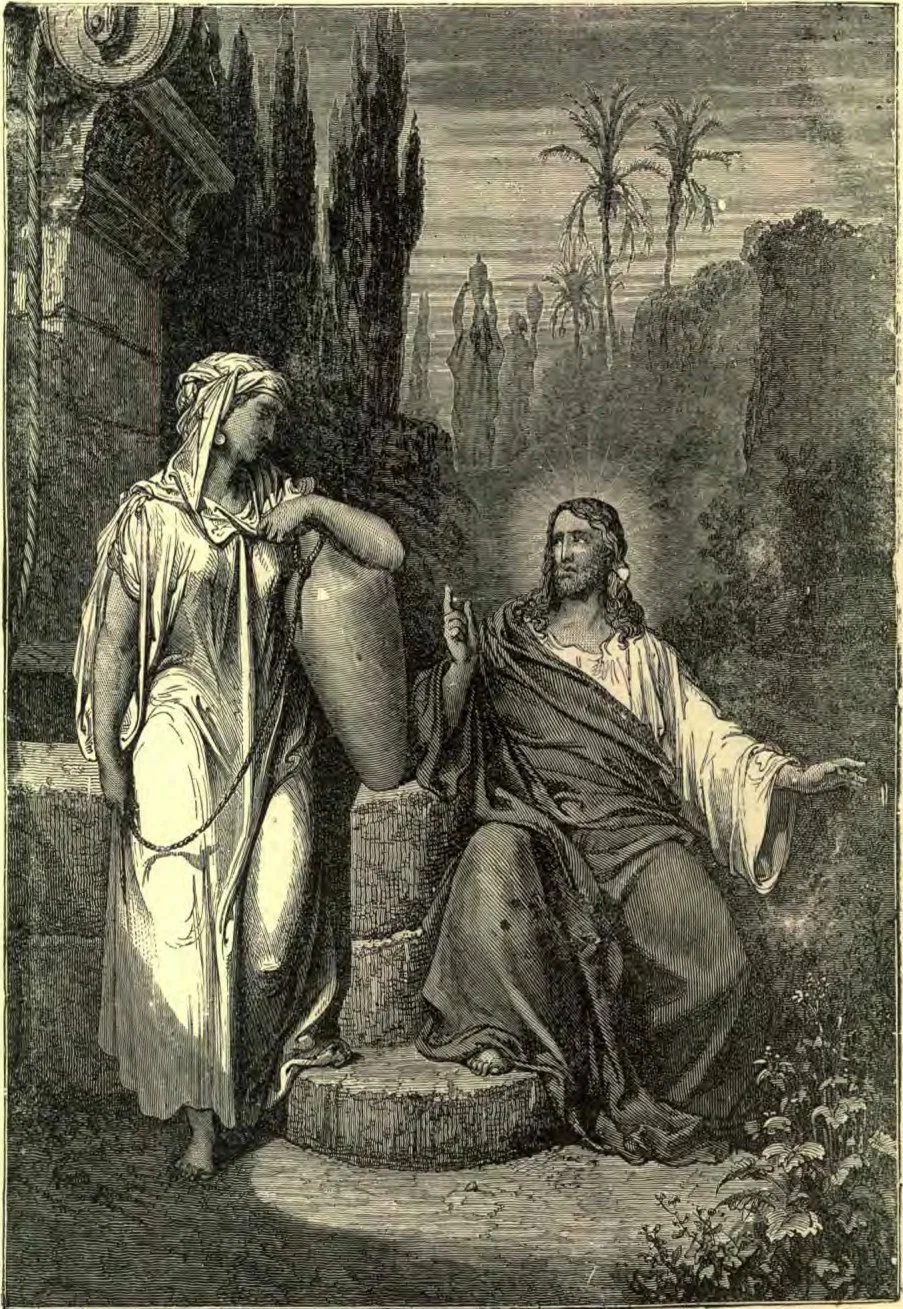
It was nearing the noon of a bright day in June, and the sun of that Eastern clime shone with all its wonted strength, when a company of men might have been seen wending their way on foot along a dusty and well-traveled road. One among their number they appear to regard as a kind of leader, and all seem to listen eagerly to his every word. As, one after another of them has occasion to ask him some question, he is addressed as “Master.”
Their road at first leads through a hilly country, and valleys and hillsides are decked with a profusion of wild flowers of the brightest colors; while dashing little brooks hurry down the declivities. In the fields the husbandmen are toiling; some of the hill-sides are terraced and planted to grapes, while on others, more rough and stony, sheep and goats are pastured. As they journey, numerous small villages look down upon them from their perches on the hill-sides.
At last, after leaving the hilly country and traveling for a few miles over a pretty little plain, their road makes a turn to the left, and enters a narrow valley, which passes between two mountains, Ebal and Gerizim, the same which Moses, the great law-giver, saw from Mount Pisgah’s height, and pointed out as the place where the blessings and curses should be pronounced.
When the patriarch Jacob returned from Padanaram, with wives, children, and herds, he made his first tarrying-place in this valley of Shechem; and though it abounds in flowing fountains, he there dug the well which still bears his name, at the foot of Mount Gerizim, just where the road turns. When our travelers come to this well, they stop to drink of the clear, cool water; and being “wearied with his journey,” the “Master” rests here on the curb of the well, while his followers go to a town nearly a mile farther down the valley to buy some food for their dinner.
It was now about noon, at which time the women of the city were accustomed to come to the well to draw water, for they thought there was no water so good as that from the well their father Jacob had dug. And there came a Samaritan woman to the well, with her pitcher in her hand; and the weary traveler asked her to give him a drink. This led to a conversation between them, during which he told her so many things about her past life that she said to him, “Sir, I perceive that thou art a prophet.” He told her also of the water of life, of which if a man drank, he should never thirst again. She seemed much perplexed to know what he really meant; and finally, as if to quiet her own doubts, said, “I know that Messias cometh, which is called Christ; when he is come, he will tell us all things.” And to her great surprise the traveler said, “I that speak unto thee am he.”
Just then the disciples returned with food, and wondered that their Master talked with the woman; but they said nothing. And the woman ran into the city and told her friends to come with her, and see a man who had told her all things that ever she did. She soon returned to the well, followed by a company of Samaritans, who besought Jesus so earnestly that he returned with them to their city, Sychar, where he tarried two days, and taught them. The result was that many of the people of the city believed in Christ as the Saviour of the world. So it came to pass that the Samaritan woman, coming to the well to draw water, found for herself and the people of her town the water of everlasting life.
At the return of the Jews from captivity in Babylon, there arose a feud between them and the Samaritans because the latter were not allowed to help in rebuilding the temple. This had grown more and more bitter from age to age, until in the time of Christ “the Jews had no dealings with the Samaritans.” It was usual for the Jews in traveling from Judea to Galilee, to cross the Jordan and go through Perea, the land east of the river, in order to avoid the hated Samaritans, who had often attacked and even killed the Galilean Jews who ventured to pass through the country on their way to the Passover. But Jesus had good reason at this time for passing through Samaria. He had a message for some of these very people. There were chosen ones of God in Sychar who were to be led by him to a knowledge of eternal life. It was here, too, that he taught to all mankind that grand lesson of human equality, and spoke those sublime words which can never grow old: “God is a Spirit, and they that worship him must worship him in spirit and in truth.”
“By the well-side, O my Father, Let me drink and drink again, Of the water Jesus gives me, From the never-failing spring.”
E. B. G.

THE SAFEST WAY.

“You never signed the pledge, did you, Uncle John?”
Uncle John was Harry’s ideal of a great and noble man. And it was not a mistaken ideal. Uncle John’s hair was white with the passing of over eighty winters, but his eye was bright, his step firm, and his voice earnest and kindly as ever. His life had been one of uprightness as well as one of what the world calls success.
“I never signed a pledge on my own account; but I have signed several as an example or aid to others,” replied Uncle John.
“Casper Firmstone is all the time teasing me to sign,” said Harry; “but I know I can drink a gill of cider and not want any more, or let it alone if I do want it. And I can take one sip of the best wine Mr. Fraser has, and not take the second. So I don’t see any use in hampering a fellow with a piece of paper.”
“Don’t be too sure about what you can do, Harry. I’ve seen a good many ‘sure’ people in my life, as well as a good many ‘cautious’ people, and I’ve always noticed in a long run that the cautious people were the safest. I’ll tell you where I first learned that lesson, if you’d like to know.”
“I should,” said Harry, always ready at the first hint of a story.
“When I was a boy, a good deal smaller than you, I lived in a small town in Vermont. There was a large creek by the village, and at a place called ‘The Mills’ there was a beautiful fall of water, of ten or twelve feet, pitching off from an even-edged, flat rock. Reaching quite across the creek, a distance of twenty feet, over this fall of water, was a bridge spanning the stream.
“The sides of this bridge were boarded up some four feet high. These side-pieces were capped by a flat railing of boards from four to six inches wide. Some of the more daring school-children used to walk on this narrow capping-board when crossing the bridge, and more than one fall and serious injury happened there.
“There was one thing that saved me from getting hurt or killed by the dangerous crossing. You would like to know what it was? The easiest thing in the world. It happened from the small circumstance that I never had either the courage or the disposition to walk there at all! In other words, I wasn’t ‘sure’ of my head, and I was sure on the broad, open bridge.
“I can think of a great many places that boys and men try to pass safely which are quite as dangerous, and where multitudes fall and ruin themselves, and perhaps perish, both soul and body, forever. The safest way is never to take the first step on a dangerous path.”—Youth’s Temperance Banner.

THOROUGHLY

Whatever is to be done at all, should, if attempted, be well done. One may once in a while get a fit of thoroughness, but the wise worker in any place is one who has a way of doing everything thoroughly—large things, small things, sacred things, secular things.
The vivacity and love of change in young people lead them to great carelessness. The carelessness is thoughtlessness; the thoughtlessness is generally owing to forgetfulness; the forgetfulness is because of outside diversions and attractions.
Take the matter of answering letters. Every letter should be answered. It should be answered carefully. Rapid writing is a discourtesy. Slovenliness with the pen is as offensive and improper as slovenliness in dress or manner. Letters should be answered punctually. It may not be necessary to sit down on the day that a letter is received to give it reply; but, if anything in the letter demands an immediate answer, the thing to do is to sit down at once, pen in hand, and reply to the question or suggestion of your correspondent.
When you come to answer a letter, read it over to make sure about the date, the facts reported, the subjects discussed, the questions asked. If you have received a kindness, if it be merely in expression by words, acknowledge it. But you must not forget the contents of the letter, and to guard you against forgetting, read it over two or three times before finally signing and sealing your answer.
Take the matter of making presents. You feel that a certain classmate, relative, or friend is entitled to some small souvenir. You think it over. You make up your mind to do it. Having done this, do not forget it. Do not put it off. If, for a good reason, you defer it until a birthday or a holiday, make a memorandum of your intention, make ample provision, and send or give the present as originally intended.
In cleaning or adjusting your room, follow the same law of thoroughness. Sweep, dust, arrange furniture, put your table to rights, and do all this in as perfect a manner as possible.
Life is made a ragged sort of thing by lack of system and care.—S. S. Classmate.

MISS MEEKE’S LESSON.

For three days and nights the snow fell, covering all the ground very deep.
“We shall be all snowed up, and there’s an end to our New Year’s sleighing party to Oldfield,” said Winnie, as she stood at the window on the third day of the snow-fall, looking drearily out over the white earth and powdery sky.
“It can’t snow forever,” exclaimed Ella.
“I believe it will snow forever. It looks like it. Just look out and see! The Scotch firs are so loaded down with snow I should think the limbs would snap right off! And still, it is snowing as steadily as ever,” said Winnie.
“Never mind; I’m sure it will clear off to-morrow,” hopefully suggested Ella.
“I wouldn’t mind it, were it not for the sleigh-ride. We were all going in one sleigh, with four horses to draw us. How nice it would be! But no, it is going to keep on this way forever and ever,” growled Winnie.
Next day, being New Year’s, it came off clear and sunny. Happy were the faces of the children as they peered out to see how promising was the day for their ride. The roads would soon be trodden so that sleighing would be all the better for the snow.
Little Ella bade the sun a hearty good morning, and said, “We are so glad to see you!”
“Yes, after your uncommonly bad behavior in sulking and hiding yourself for the last three days,” added Winnie.
“You wrong the beautiful and benignant sun, Winnie, dear,” said Miss Meekes, coming up behind them. “The sun is always shining for us. The earth turns from the sun, and it is night; it turns toward him, and it is day. The earth wanders far away from the sun, and it is winter; it comes toward him again, and it is summer. But the sun shines all the time, wherever the earth may be. Fogs and mists arise from land and water, condense into clouds, and obscure his glorious face, but they come down in rain or snow, clearing the atmosphere, and we say the sun shines again, when, in truth, he has been shining all the time.
“And as it is with the sun and the earth, dear children, so it is with our Father in heaven and ourselves. We turn away from him, and our souls grow dark; we turn to him again, and we receive his light. We wander from him into selfishness and worldliness, and we suffer a spiritual coldness and blindness; we come back to him, and we are warmed and enlightened by his love and wisdom. Sometimes doubts and fears and hates—the opposites of faith and hope and love—arise from our lower nature, and hide us from the face of our Father in heaven; but he has not changed. He is always ready to bless us when we turn again to him—turn in truth and love, not in terror and self-seeking. So, dear ones, when clouds and storms darken the atmosphere, think of the sun that is shining above them; and when doubts and fears and sorrows and temptations come, think of the love and wisdom and power of our heavenly Father, and turn to him for light and strength and guidance.”—Selected.

Muddy Stream and Clear Water: Youth and Company

A MUDDY stream, flowing into one clear and sparkling, for a time rolls along by itself. A little further down they unite, and the whole is impure. So youth, untouched by sin, may for a short time keep its purity in foul company; but a little later, and they mingle.

A FABLE OF CLOUD-LAND.

Two clouds in the early morning Came sailing up the sky— ’T was summer, and the meadow-lands Were brown and baked and dry.
And the higher cloud was large and black, And of a scornful mind, And he sailed as though he turned his back On the smaller one behind.
At length, in a voice of thunder, He said to his mate so small, “If I wasn’t a bigger cloud than you, I wouldn’t be one at all!”
And the little cloud that held her place So low along the sky, Grew red, then purple, in the face, And then she began to cry!
And the great cloud thundered out again As loud as loud could be, “Lag lowly still, and cry if you will, I’m going to go to sea!”
“The land don’t give me back a smile, I will leave it to the sun, And will show you something worth your while Before the day is done!”
So off he ran without a stop, Upon his sea voyage bent, And he never shed a single drop On the dry land as he went.
And directly came a rumble Along the air so dim; And then a crash, and then a dash, And the sea had swallowed him!
“I do n’t make any stir at all,” Said the little cloud with a sigh, And her tears began like rain to fall On the meadows parched and dry.
And over the rye and the barley They fell and fell all day, And soft and sweet on the fields of wheat, Till she wept her heart away.
And the bean-flowers and the buckwheat, They scented all the air, And in the time of the harvest There was bread enough and to spare.
—Alice Cary.

NEW-TESTAMENT HISTORY.

LESSON 131.—PETER AND JOHN BEFORE THE SANHEDRIM.

On the next day after Peter’s sermon, the rulers, and elders, and scribes came together in Jerusalem, with Annas the high priest, Caiaphas, and John, and Alexander, and all the kindred of the high priest. And when they had brought in the apostles, they said, “By what power, or by what name, have ye done this?” Then Peter, filled with the Holy Ghost, said unto them, “Ye rulers of the people, and elders of Israel, if we this day be examined of the good deed done to the impotent man, by what means he is made whole; be it known unto you all, and to all the people of Israel, that by the name of Jesus Christ of Nazareth, whom ye crucified, whom God raised from the dead, even by him doth this man stand here before you whole. This is the stone which was set at naught of you builders, which is become the head of the corner. Neither is there salvation in any other; for there is none other name under heaven given among men, whereby we must be saved.” Now when the chief priests, and those that were assembled with them, saw the boldness of Peter and John, and perceived that they were unlearned men, they were astonished, and knew at once that they must have been with Jesus, and obtained wisdom from him. They also saw the man which had been healed, standing by them, and could say nothing against it. So when they had commanded the apostles to go aside out of the council, they conferred among themselves, and said, “What shall we do to these men? for that indeed a notable miracle hath been done by them is manifest to all them that dwell in Jerusalem; and we cannot deny it. But that it spread no further among the people, let us straitly threaten them, that they speak henceforth to no man in this name.” So they called in the disciples, and charged them not to speak at all nor teach in the name of Jesus. But Peter and John answered and said, “Whether it be right in the sight of God to hearken unto you more than unto God, judge ye. For we cannot but speak the things which we have seen and heard.” Now all the people were disposed to glorify God on account of the great miracle which had been done; and the priests and elders, fearing the people, dared not punish the apostles. So after threatening them still more, they were obliged to let them go. As soon as Peter and John were let go, they went to their own company, where they told all that had been said to them by the chief priests and elders. When the other disciples heard what Peter and John said, they lifted up their voices to God with one accord, saying, “Lord, thou art God, who hast made heaven, and earth, and the sea, and all that in them is; who by the mouth of thy servant David didst say, Why did the Gentiles rage and the peoples imagine vain things? The kings of the earth set themselves in array, and the rulers were gathered together, against the Lord, and against his anointed.” “For of a truth against thy holy child Jesus, whom thou hast anointed, both Herod, and Pontius Pilate, with the Gentiles, and the people of Israel, were gathered together, for to do whatsoever thy hand and thy counsel determined before to be done. And now, Lord, behold their threatenings; and grant unto thy servants, that with all boldness they may speak thy word, by stretching forth thine hand to heal; and that signs and wonders may be done by the name of thy holy child Jesus.” Then they all bowed in prayer, and the place where they were was miraculously shaken, and they were all filled with the Holy Ghost, and spoke the word of God with boldness. And all the multitude of believers were so united that it is said of them that they were of one heart and one soul: no one of them claimed anything of his own; but all things were enjoyed by them in common. No one was allowed to want for anything; for those who owned lands or houses sold them, and brought the money to the apostles, in order that those who were needy might have their wants supplied. In the meantime, the apostles, by their words and miracles, gave witness of the resurrection of the Lord Jesus; and a great measure of the blessing and grace of God rested upon them all.

QUESTIONS.

1. Who came together in Jerusalem on the next day after Peter’s sermon? Acts 4: 5, 6.
2. When they had sent for the apostles and brought them before the council, what question did they ask?
3. Who spoke in reply?
4. How did he address them? Verse 8.
5. How was he enabled to speak with confidence and authority?
6. How did he speak of the charge brought against them? Verse 9.
7. How did he briefly answer their question? Repeat verse 10.
8. How did he bring condemnation upon those before whom he was called to be examined? Verse 11.
9. How did he speak of salvation through Christ? Repeat verse 12.
10. Why were the chief priests astonished at the wisdom and power with which Peter and John spoke?
11. How did they account for the eloquence of these unlearned men?
12. Why were they unable to say anything against what Peter had declared?
13. What did they do after sending the apostles out?
14. What question did they ask one another?
15. What were they obliged to acknowledge?
16. What did they decide to do?
17. How was the decision carried out? Verse 18.
18. What reply did the apostles make? Verses 19, 20.
19. What were the priests and rulers compelled to do?
20. Why did they not dare to punish the apostles?
21. What made the miracle the more convincing to the people? Verse 22.
22. As soon as Peter and John were dismissed, what did they do? Verse 23.
23. How were the disciples affected by what they heard?
24. How did they give honor to God?
25. What words did they quote from the writings of David? Verses 25, 26. New Version.
26. How did they now recognize the hand of God in what he had allowed Jesus to suffer? Verses 27, 28.
27. What did they ask God to consider? Verse 29.
28. For what did they most earnestly pray? Verses 29, 30.
29. By what miracle did God show that their prayer was heard?
30. What special blessing did he pour out upon them?
31. What fruit followed this outpouring of the Holy Spirit?
32. How were the wants of the needy supplied?
33. How did the apostles witness to the resurrection of their Lord?
34. By what abiding favor were the whole multitude of the disciples encouraged?

NOTES

Ver. 5. Their rulers. A general designation of the Sanhedrists. The Sanhedrim consisted of three orders,—Elders, heads of families who had a seat in the great council; Scribes, the recognized teachers and interpreters of the divine law; and the High Priest. In other passages this third order is termed “the chief priests.” These chief priests included the reigning high priest, with others of his house who had borne the title, and possibly also the heads of the twenty-four courses of priests. The Sanhedrim seems to have consisted of seventy-one members. The place of assembly was a chamber in the temple, situated between the court of the Israelites and the court of the priests, and was called Gazith. Some forty years before the fall of the city, it removed to a building without the temple precincts. The Sanhedrim was the supreme court in the Jewish nation. Its decrees apparently were respected beyond Palestine, for we read how Saul was provided with credentials from the Sanhedrim to the Jewish synagogues of Damascus, when he went to search out the Syrian followers of Jesus of Nazareth. Its powers embraced all matters, civil as well as religious. It tried accused persons, and its decisions admitted of no appeal. In the New Testament, the trials before the Sanhedrim of Jesus, Peter, John, Stephen, and Paul are related.—Rev. Com.
Ver. 6. And Annas the high priest. The actual high priest was Caiaphas (John 11 : 49); but Annas, his father-in-law, had once held this dignity (7-15 A. D.) and still kept the title. The high priest under Jewish law held his office for life, but the Herods and the Roman governors frequently deposed the high priests to serve political purposes. At his trial our Lord was taken before Annas first (John 18 : 13). He was perhaps the most influential person among the Jews at this time. Five of his sons were advanced to this high office during his lifetime.—Ibid.
Ver. 9. Impotent,—powerless in one or more of the bodily functions, in this case unable to walk.
Ver. 11. He is the stone, etc. The accusation of dishonoring what God had so honored, Peter repeats by boldly applying to them the well-known words of Ps. 118: 22. The rulers of the Jews as the builders to whom the charge of the house of God was given, should have been the first to acknowledge the long-looked-for Messiah. They had rejected him; but God, by raising him from the dead, had shown that he was the cornerstone on which the spiritual temple on earth should rest. Christ had in presence of the disciples used these words (Matt. 21 : 42).—Rev. Com.
Ver. 13. Unlearned and ignorant. Their language and arguments proved that they were untaught in the rabbinical learning of the Jewish schools. They were the fishermen of Galilee, but had been instructed by Christ and emboldened by the Spirit.—Ibid. Ignorant is more probably common people, in contrast with public and recognized teachers.—Abbott.
Ver. 14. Standing with them. No longer sitting as a cripple at the Beautiful gate.
Ver. 17. Straitly charge,—strictly charge.
Ver. 23. They came to their own company. This has been understood by some to signify their brother apostles, but the term comprehends a large number of the believers then in the city. These no doubt had come together on the threatening aspect of the affairs of the little community, as the arrest of the two leaders by the order of the Sanhedrim was of course known throughout Jerusalem.—Rev. Com.
Ver. 30. By stretching forth thine hand. The apostles not only desired boldness to speak, but they asked that God would continue to work miracles, and thus furnish to them, and to the people, evidence of the truth of what they delivered.—Barnes.
For additional Notes, see Review for April 17.

Honoring the Lord's Work in Every Task

Says the biographer of an eminent Sunday-school worker: “He was the stronger for his own work through not neglecting the Lord’s work. In truth, all that he did he looked on as the Lord’s work; and, because he honored the Lord in its doing, the Lord honored him in its results; and ‘the Lord made all that he did to prosper in his hand.’”

HOW TO REMEMBER.

We often remember best by not trying to remember at all. Just give the mind wholly to the appreciation and enjoyment of the subject under consideration, without any anxiety about remembering it. In this way the deepest impressions are made. As soon as you think, “I must be sure to remember,” your mind is, by that very anxiety, diverted from the thoughts you wish to retain. Let your whole being be absorbed in your subject, and if it is a worthy one, it will certainly come back to you.
If the theme is historical, descriptive, or narrative, place yourself right on the scene of action. In this way, the scene will be enacted before you. You will see, and hear, and feel, as though you were really a participant in the occurrences related. They will become like a part of your own experience, and you will recall them as though they had been a part of your own life. Time after time you will live these events over till they will become too familiar ever to be lost.
If the subject be philosophical or meditative, allow your mind to assimilate the thought without being disturbed or frightened in its work, by having the cudgel of admonition continually flourished over it. This is the true secret of acquiring real knowledge.
G. H. B.

THE WATER HEN.

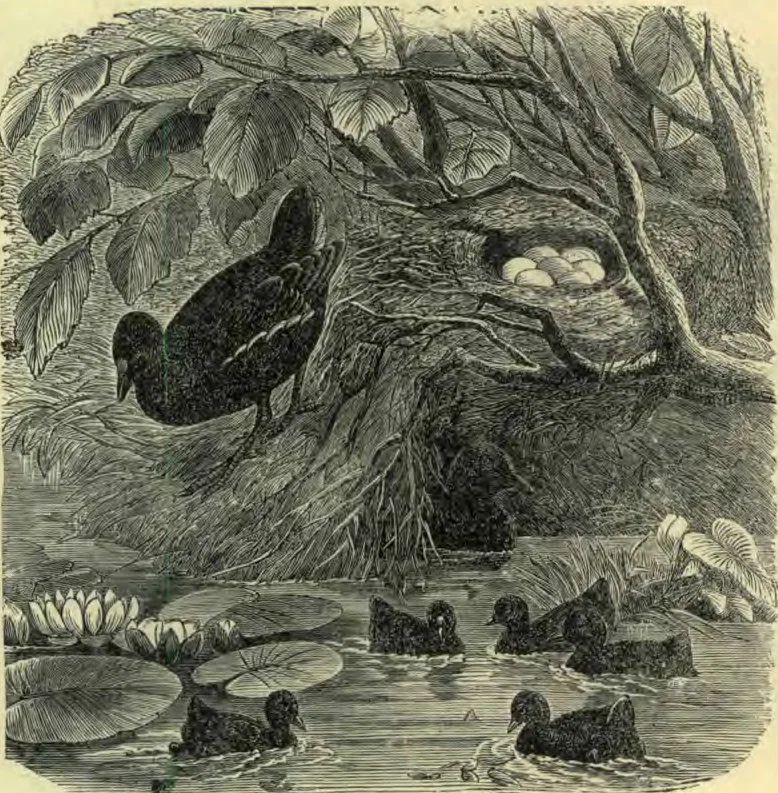
What is this picture about? Let us look at it closely, and see if we can tell. This bird looks very much like a duck, doesn’t it, but it is not a duck; it is a water hen. You will see it has very long toes and curved claws, but its feet are not webbed. Its bill is bright red, tipped with yellow. The head is blackish gray, the back olive green, and the breast blueish gray, with a few white feathers at the base of the wings and at the tail; while its legs are yellowish green.
Down in the water are the hen’s little chickens. They are downy black, and do not have pretty colored feathers until they are older. They go swimming in the water almost as soon as they are hatched. Until they get a little larger, they paddle close by the old hen’s side among the pond lilies and rushes; for if they do not keep a sharp lookout, a large fish called a pike comes floating under the water, and seizing the little hens, carries them off for a meal.
These birds always choose for a building-spot some open place among the tall weeds and rushes near the edge of a pond or deep, quiet stream; and if they like the place, they will come back to their old home season after season. The nest is made of sticks, leaves, and dead grass. There are usually from seven to ten eggs; and when the mother bird goes away from the nest, she scratches leaves and grass over it to hid her eggs from the crows and jays, or other birds that like to eat eggs. Sometimes the stream rises, and comes up as high as the nest. Then the birds go to work patiently putting sticks and twigs under the nest until it is out of the water. One bird goes off to find the sticks, and the other stays by and fixes their home.
These birds can run on the ground as easily as any hen, picking up worms, insects, and grain, though they like the water best. They live in England and in the warm States of America from Florida to Texas, in the summer coming north as far as Carolina. They also live in South America. If you will get your geographies, you can see on the maps just where these places are.
These birds are not afraid of any loud noise, and will float on the water with a train of cars thundering along right beside them. But if they see a man with a gun or a dog coming, they are out of sight in an instant, so that it is very hard to catch them. When shot, the bird dives suddenly, and swims along under the water, till it comes to a good hiding-place among the weeds, and then it sticks out its nostrils, and waits until the danger is over, so that if the hunter has not a good dog with him, he cannot get the bird. Sometimes it makes believe that it has been shot, and drops over among the rushes as if it were dead; then while the hunter is loading his gun, the bird floats off to some safe place out of sight.
Water hens have been brought up with other fowls in the barn-yard, and were as tame as any hens. They are, however, very mischievous; and one man who had a good many with his other hens, had his garden nearly destroyed by them. They ate up his peas, strawberries, currants, and gooseberries while they were green, besides entirely stripping his cabbages and greens of their leaves. W. E. L.

STORY OF A LITTLE GIRL WHO BUILT A CHURCH.

THERE was a new church needed in a certain place; so a good man who loved to work for the Lord went about among the people, asking them to give money with which to buy the materials and pay the workmen. But one man said, “No!” Another said, “I cannot!” Another said, “I am too poor.” Somehow or other every one found some excuse for himself, and not a cent was raised. At last he applied to a member of the church who was poor of purse, but large of heart. Possibly he might help them.
“No!” said the church member; “I have my wife and children to support, and this year I can do no more.”
“But,” urged the good man, “if you put down your name, others may perhaps follow your example; if you refuse me, I must give up discouraged.”
“Father,” said a little voice by his side, and the bright eyes of his little daughter looked up into his face. “Father, if you will only put down your name, I will earn the money by picking berries and selling them. Honest and true, I will. Please don’t say no, father.”
The bright eyes were very earnest. The father could not resist his little girl’s pleading, so he promised to pay a certain sum.
The discouraged worker again took heart, and went once more among the people, telling them of the love and zeal of this little girl. Many were touched by the story, and one after another put his name on the paper, till there was an abundance of money.
Then the bricklayers came, and the carpenters, and the masons, and after a time a beautiful new church was built; and the people always said that it was all owing to one little girl.—Selected.

Letter Budget.

HERE we have a letter written by some little colored children away off in Africa, to a lady in California. It is written by some older person, and signed by six children's names. It reads as follows: “Although we are perfect strangers to you, yet by your unexpected favors, and through the kindness of our master, Mr. Rose, we are emboldened to write this to thank your children and the Sabbath-school class for the beautiful cards they sent us and the package of INSTRUCTORS. We prize them highly, for we are poor colored children, the offspring of liberated Africans; and such gifts, coming to us over the mighty Atlantic, are very precious. We find the papers very interesting and instructive. Although the merry days [holidays] will pass before this reaches you, we venture to beg for a few Christmas and New Year cards, with a few papers. May the Lord continue to bless you for your kindness in our behalf, is the prayer of your ever grateful servants and children.”
Perhaps you would like to know the names signed to the letter. They are: “Silvanus Moses, Emanuel Cole, Nathaniel Jones, Cassandra Macaulay, Mary Doherty, Esther Davis; and the letter is dated at McDonald Town, Africa.”
HERE is a letter from MAGGIE RILEY, of Council Grove, Morris Co., Kansas. She says: “I am a little girl five years old. I keep the Sabbath with papa and mamma. I get a lesson every week in ‘Bible Lessons for Little Ones.’ I want to be a good girl, so I can play on the new earth. I want you to send me the paper all the time. I have been a good many days writing this; it makes my hand tired.”
Maggie has spelled every word right, and has printed her letter so neatly that it is as easy to read as a book. She has set a good example, and it would be well if those who are older would take as much pains to make their letter plain and neat as she has.

MUSIC BOOKS.

Pearly Portals for the Sabbath-school. By D. S. Hakes. The music in this work is new. The words from the best authors. 160 pp. Boards, 35 cents per copy. Cloth, .50
Song Anchor for the Sabbath-school, praise-service and fireside. 164 pp. Boards, 35 cents. Cloth, .50
Temperance and Gospel Songs. For the use of Temperance Clubs and Gospel Temperance Meetings. Price, .30
Better than Pearls. A new collection of the best Gospel Songs, Hymns, and Tunes for use in Tent and Camp-Meetings, as well as in Revivals, Social and Praise Service. Cloth, 40 cents. Board, .30
Songs for Class and School. For Singing-School, Day-School, Convention and Fireside. 160 pp. $.35
Hymn Book. “Hymns and Tunes for those who keep the Commandments of God and the Faith of Jesus.” It has 537 hymns, and 147 tunes, 416 pages. Muslin Bound, $1.00. Morocco, gilt edges, $1.50
All of the above works will be sent by mail, post-paid, on receipt of prices named. Address,
REVIEW & HERALD, Battle Creek, Mich.

THE ROAD TO SCHOOL.

In winter, when it freezes, In winter, when it snows, The road to school seems long and drear, O’er which the school-boy goes.
But when the pleasant summer comes, With birds and fruit and flowers, The road to school, how short it is! And short the sunny hours!
But to the boy who loves to learn, And wisdom strives to gain, The road to school is always short, In sunshine, snow, or rain. —From the German.

You have reached the end of this edition.

The Youth’s Instructor · Apr 18, 1883