The Youth’s Instructor, Vol. LIII, No. 5

Visiting the Vale of Wonders

The Youth’s Instructor

January 31, 1905

Review and Herald Publishing Assn. · Washington, D. C. · January 31, 1905

Visiting the Vale of Wonders

  • (Continued)*
Our next trip in the valley was to what is called the Happy Isles. They are farther up the valley on the right-hand side, being a chain of little islands in the rushing of the waters of the Merced River, when it is still foaming and agitated from its terrifying leaps over Vernal and Nevada Falls. We spent a happy day there in our hammocks under the shady trees, listening to the songs of the river.
By this time we were in good trim for the long, hard trip that leads by the Happy Isles, Vernal Falls, Nevada Falls, to the foot of Little Yosemite Valley, around to Glacier Peak, Sentinel Rock, and down the trail to the Sentinel Hotel and home to camp. The guide-book calls it twenty miles, I believe, and I think it is all of that. My wife walked, but the other ladies of the party went on horseback until the descent began down the Glacier Peak trail.
The Merced River comes into the valley over the two falls named, and then for several miles rushes down the canyon at terrifying speed, a mad race of dashing white waters. The roar of the falls and the cascades can be heard for miles. The sides of the canyon are close and precipitous, and the concentrated roar is like the roar of a dozen express-trains rushing past at full speed. The very mountains seem to tremble under the impact of the angry waters. The volume of water coming over these falls and down this canyon is much greater than that which comes over Yosemite Falls. There are two ways to get to the top of Vernal Falls, one by a circuitous trail, which takes fully an hour, and the other straight along the sides of the canyon, where a misstep may send one into the foaming water. This leads first near to the foot of the fall, and then straight up the face of the cliff by zigzag stairs cut out of the solid rock. These stairs have taken the place of the old wooden stairs which tourists used to climb. My wife and I and Henry took this trail, but the others of the party were obliged to go by the more circuitous rout because of the horses.
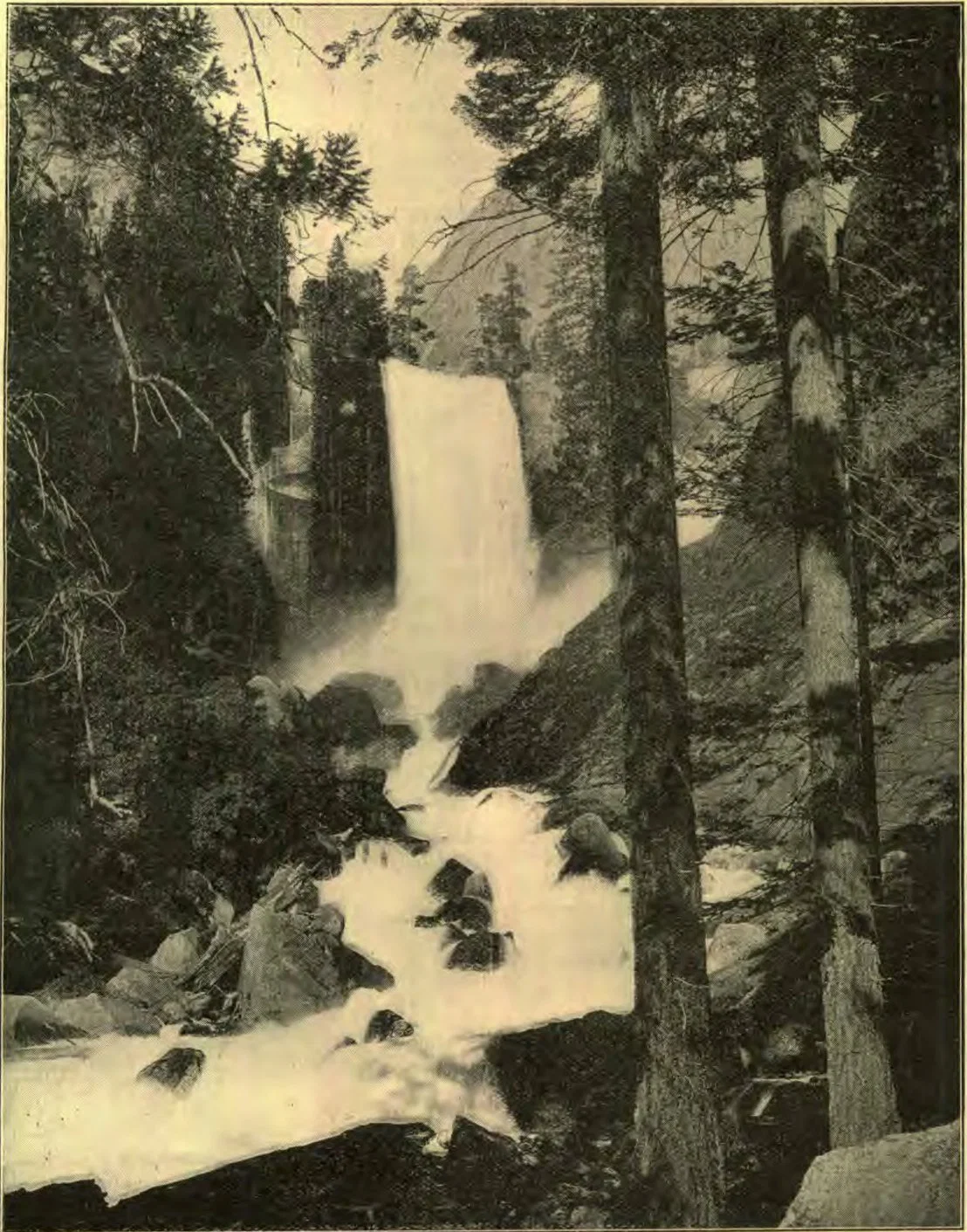
As we threaded our way by the foot of the falls, our clothing was drenched by the constant cloud of spray; but it was worth the exertion and the wetting; for there was the continual rainbow—not a half circle as we see it in the sky, but the complete circle, the lower edge of which seemed right under our chins. For a long time we stood watching a scene which we never expect to be able to describe. Vernal Falls is not so high as any of the others, but much broader. An excellent view is had of it from Lady Franklin Rock, as also from the bridge below, and from both these points Carrie and Iva “kodaked” it. But the grander and more entrancing view is had from a position near the very foot of the falls. The cloud of spray from the falls and from the cascades below drenched our clothing, but we cared nothing for that in the enjoyment of what we were privileged there to look upon.
VERNAL FALLS
VERNAL FALLS
Whatever position we took to view the falls, the sun was painting its halo over the scene, and the thunderous roar of the falling water spoke to us of the power of Him whose hand was doing this, and whose power was keeping us. The beautiful, broad sheet of water came over the wall of rock like billows of the most fragile fabric, and slowly and majestically its great fleecy folds floated down to join the raging pool below. It did not plunge, it floated down, and seemed to gather no momentum on the way. The last foot of its drop was as majestic and self-possessed as the first, although we knew that it was striking with the weight of hundreds of tons every moment. It is three hundred fifty feet from the point where this fall bends over the rock to the place where it strikes the surface of the pool. The wind does not toy with it as with the other waterfalls; the weight of the stream is too great and the fall too short, though it is more than twice as high as Niagara. Nevertheless, it is impossible for one to imagine the fall as high as it is. We tried with the eye to measure off each hundred feet; but the spaces seemed altogether too small. Yet in comparing the height of the fall with large trees growing near by, we could see that the fall must be as high as the guide-book specified.
For a long time we stood admiring the wonderful scene, and then, fearing lest our party would reach the trail above, and think we had gone on, we began the ascent of the stone steps cut in the face of the solid rock leading up to the top of the fall. I had twice ascended the stone stairway of Bunkerhill Monument; but this was a much higher climb and more dizzy, with the tremendous roar of the falls in our ears, as the waters seem now literally to plunge down by us and rush away in a mad race for the floor of the valley, with the bits in their teeth, and covered with foam.
We were ready to rest when we reached the top, and leaning over the natural rock balustrade, could look straight down into the foamy depths below. Our capacity for wonder and admiration seemed totally inadequate to the subject. We could see nothing of the rest of our party, and so followed the brink of the river to the next place of interest, Emerald Pool, only a short distance above. It is only about two hundred feet long, and though so close to the mighty fall, it is as placid as a day in June. The whole pool is of a pretty green hue, and very restful to look upon.
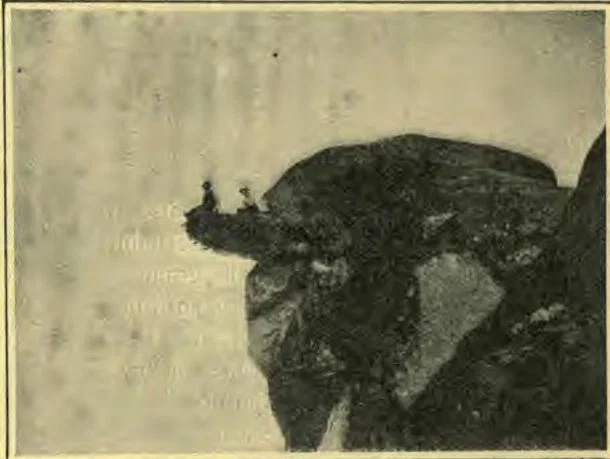
GLACIER PEAK. THIRTY-SEVEN HUNDRED FEET ABOVE VALLEY FLOOR
Just above Emerald Pool is Silver Apron. Here the entire width of the river runs over a bed of silvery granite in playful ripples. The ripples, instead of going straight across the stream, seem to be held back at both sides, and in this respect resemble the flounces on a skirt. From this characteristic it has derived its name. I wish to say right here that all the names of objects in this wonder garden are very appropriate and pleasing. So many times God’s wonderful works are connected with God’s enemy in the names that are thoughtlessly bestowed upon them. It is not so here.
After some hardy climbing up to the trail, and another waiting period, the rest of our party came in sight. When they had taken their view, we went on to a deserted house known as Snow’s Hotel (since burned down), and there took our midday meal. So strenuous a climb in such a wholesome atmosphere arouses hungry nature’s demands to be fed.
After a generous rest at Snow’s Hotel, we began the ascent of the trail leading up to and over Nevada Fall. The sun was shooting his warmest shafts into the canyon, and shade of any kind was very scarce. At last we reached the foot of the fall, and gazed up in wonder at its eight hundred feet of yeasty cataract. This is the most tumultuous of any of the falls in the valley. The water falls perpendicularly about two thirds of the distance, and then strikes a steep chute, and rages and tosses like a great mad, untamable monster. The ferocity of its plunge is accentuated by the fear-inspiring volume of its voice.
When we had admired this as long as we dared, considering the great length of the remainder of the trail, we began the zigzag ascent up the side of the mountain to reach the top of the fall, where we were to cross on a bridge in continuing the journey around to Glacier Peak. It seemed an interminable climb in the hot sun. The way is very steep, and much of the trail is built of loose rocks along the sheer mountain-side, but laid up in such a way that there is little danger unless one’s horse should miss his footing. We had surer footing than that of the horse, and so did not fear. When the climb was finished, we all felt that we had earned a rest, and took it. Here we could walk right out to the edge of the fall and look over, and some of the party amused themselves by throwing large rocks and pieces of wood over the precipice, counting the seconds in their descent, and so figuring out the height of the fall. One of our party lay down to rest upon the soft, pine-needle-covered earth, and did not notice until too late that she was using as a pillow the nest of a colony of busy ants. When this was discovered, there was work for all of us for a few minutes, disentangling angry ants from a head of hair.
At the top of these falls there is a trail leading away to Clouds’ Rest, and another leading into Little Yosemite. We did not have time to visit either of these places on this trip. From the top of Nevada Fall one gets an entirely different view of the valley. He can see Liberty Cap, Half Dome, Yosemite Point, Yosemite Fall, Eagle Peak, and Glacier Peak; but he can not see El Capitan, Cathedral Spires, Bridal Veil, or the Two Sisters, as they are cut off from his view by the Glacier Peak promontory. The air in this region is very clear, and distant points stand out in every detail. This is one of the things that add to the pleasure of a visit to this valley, and another is the ever-changing view as one visits the different points of interest.
C. M. Snow.
  • (To be concluded)*

The Presidency

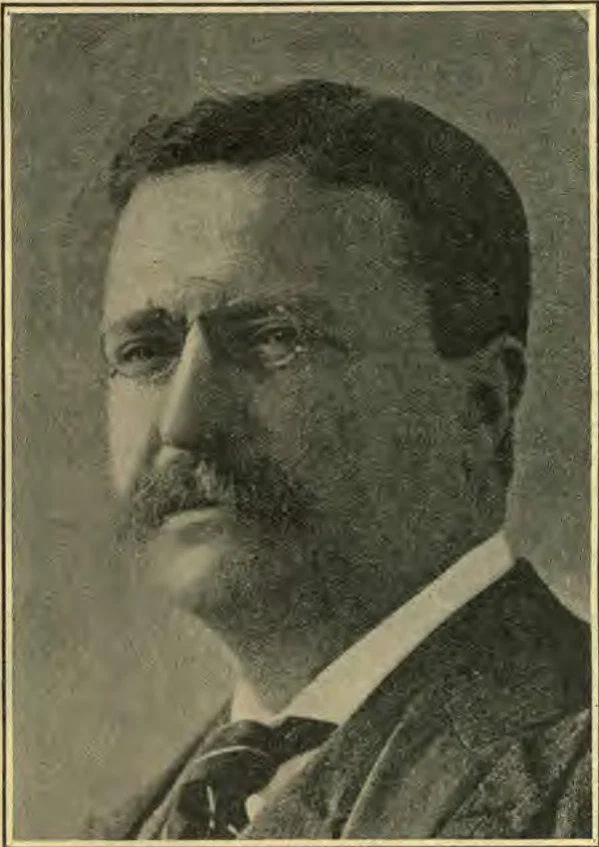
THE president of the United States occupies a position of peculiar importance. In the whole world there is no other ruler under free institutions whose power compares with his. Of course a despotic king has even more, but no constitutional monarch has as much. In France and Switzerland the president is not a very important officer compared with the president of the United States. In England the sovereign has much less control in shaping the policy of the nation, the prime minister occupying a position more nearly analogous to that of our president. The prime minister, however, can at any time be thrown out of office by an adverse vote, while the president can only be removed before his term is out for some extraordinary crime or misdemeanor against the nation.
It is customary to speak of the framers of our Constitution as having separated the judicial, the legislative, and the executive functions of the government. The separation is not sharply defined. The president has most important legislative functions, and the upper branch of the national legislature shares with the president one of the most important of his executive functions; that is, the president can either sign or veto the bills passed by Congress, while, on the other hand, the Senate confirms or rejects his nominations. The president can not initiate legislation, although he can recommend it. But unless two thirds of Congress in both branches are hostile to him, he can stop any measure from becoming a law.
The immense federal service, including all the postal employees, all the customs employees, all the Indian agents, marshals, district attorneys, navy-yard employees, etc., is under the president. But he does not appoint these by himself. His is only the nominating power. It rests with the Senate to confirm or reject the nominations.
The secretaries who form the cabinet are in the strictest sense the president’s own ministerial appointees,—the men, chosen out of all the nation, to whom he thinks he can best depute the most important and laborious of his executive duties. They all advise him on matters of general policy when he so desires it, and in practise each cabinet officer has a very free hand in managing his own department, and must have it if he is to do good work. But all this advice and consultation is at the will of the president.
The president and Congress are mutually necessary to each other in matters of legislation, and the president and the Senate are mutually necessary in matters of appointment. The Senate has no right to dictate to the president who shall be appointed, but it has an entire right to say who shall not be appointed; for under the Constitution this is its duty. Although many men must share with the president the responsibility for different individual actions, and although Congress must also very largely condition his usefulness, yet the fact remains that in his hands is infinitely more power than in the hands of any other man in our country during the time that he holds the office; that there is upon him always a heavy burden of responsibility; and that in certain crises this burden may become so great as to bear down any but the strongest and bravest man.
We have had presidents who have acted very weakly or unwisely in particular crises. We have had presidents the sum of whose work has not been to the advantage of the republic. But we have never had one concerning whose personal integrity there was so much as a shadow of a suspicion, or who has not been animated by an earnest desire to do the best possible work that he could for the people at large. Of course infirmity of purpose or wrong-headedness may mar this integrity and sincerity of intention; but the integrity and the good intentions have always existed. We have never had in the presidential chair any man who did not sincerely desire to benefit the people, and whose own personal ambitions were not entirely honorable.
Corruption, in the gross sense in which the word is used in ordinary conversation, has been absolutely unknown among our presidents, and it has been exceedingly rare in our presidents’ cabinets. Inefficiency, whether due to lack of will-power, deficiency in wisdom, or yielding either to the pressure of politicians or to other pressure which is often found even in a free democracy, has been far less uncommon; of deliberate moral obliquity there has been but very little indeed.
In the easiest, quietest, most peaceful times the president is sure to have great tasks before him. The simple question of revenue and expenditure is as important to the nation as it is to the average household, and the president is the man to whom the nation looks, and whom it holds accountable in the matter both of expenditure and of revenue.
The representatives in the long run are sure to try to do what the people effectively want. The trouble is that although each group has, and all the groups taken together still more strongly have, an interest in keeping the expenditures down, each group has also a direct interest in keeping some particular expenditure up. This expenditure is usually entirely proper and desirable, save only that the aggregate of all such expenditures may be so great as to make it impossible for the nation to go into them. But the president has to balance the demands on the treasury with the capacities of the treasury.
Inasmuch as particular questions have to be met every year in connection with every session of Congress and with the work of every department, it may readily be seen that even the president’s every-day responsibilities are of no light order. So it is with his appointments. Entirely apart from the fact that there is a great pressure for place, it is also the fact that in all the higher and more important appointments there are usually conflicting interests which must somehow be reconciled to the best of the president’s capacity.
An immense addition to the president’s burden is caused by the entirely well-meaning people who ask him to do what he can not possibly do. For the first few weeks after the inauguration a new president may receive, on an average, fifteen hundred letters a day. His mail is so enormous that often he can not read one letter in a hundred, and rarely one letter in ten. Often there are letters which the president would really be glad to see, but which are swamped in the great mass of demands for office, demands for pensions, notes of warning or advice, demands for charity, and requests of every conceivable character.
One rather sad feature of the life of a president is the difficulty of making friends, because almost inevitably after a while the friend thinks there is some office he would like, applies for it, and when the president is obliged to refuse, feels that he has been injured. It is hardly necessary to allude to the well-known fact that no president can gratify a hundredth part of the requests and demands made upon him for office, often by men who have rendered him real services, and who are fit to fill the position they seek.
Perhaps the two most striking things in the presidency are the immense power of the president, and the fact that as soon as he has ceased being president, he goes right back into the body of the people, and becomes just like any other American citizen. While he is in office, he is one of the half-dozen persons throughout the whole world who have most power to affect the destinies of the world. He can do more than any save one or two absolute sovereigns to affect the domestic welfare and happiness of scores of millions of people; then when he goes out of office, he takes up his regular duties like any other citizen.
All together, there are few harder tasks than that of filling well and ably the office of president of the United States. The labor is immense, the ceaseless worry and harassing anxiety are beyond description. But if the man at the close of his term is able to feel that he has done his duty well, that he has solved after the best fashion of which they were capable the great problems with which he was confronted, and has kept clean and in good running order the governmental machinery of the mighty republic, he has the satisfaction of feeling that he has performed one of the great world tasks, and that the mere performance is in itself the greatest of all possible rewards.—Theodore Roosevelt, in Youth’s Companion.

Gleanings from the Life of Luther

  • (Concluded)*
At about this time it was decided that he should be heard, not at Rome, as summoned, but at Augsburg. To many this journey seemed a death march; but to such, Luther said: “Even in Augsburg Jesus Christ reigns; let Christ live; let Martin die.”
At the hearing in Augsburg three demands were made of him in the name of the pope: “First, a recantation of errors; secondly, a promise to refrain from them in the future; and, thirdly, the avoidance of all other acts that might disturb the peace of the church.” Luther inquired what the errors were that he was required to recant. The one specified has since been known as the formal principle of Protestantism; namely, “the sole authority of Holy Scriptures in matters of faith.” The mere suggestion that he should surrender a doctrine that entered so deeply into his Christian experience occasioned Luther the deepest pain, and he answered that on this point he could not recant, since this alleged error was the clear teaching of Holy Scripture.
Before leaving Augsburg, he wrote out a defense, which was later sent to Rome. He closed this defense with these words: “Only compel me to do nothing against my conscience.”
The closing scene of this Augsburg Conference was one of excitement. Not a single passage of Scripture was produced against Luther’s statements, but, instead, the one word that he heard was, “Recant! Recant!”
He was finally dismissed with the words so like those of Pharaoh of old to Moses: “Recant, or do not come again before my eyes.”
On reaching home on the anniversary of the nailing up of the theses, he wrote: “I am full of peace and joy, so that I am surprised that this trial of mine seems anything important to many and great men.”
Early in October the pope’s bull condemning the errors said to be found in Luther’s writings, also ordering the public burning of Luther’s books, was sent to Wittenberg. But its arrival, instead of striking terror wherever read, only excited contempt and indignation. Still Luther realized that the breach with the church was now really made; and writings now poured from his pen thick and fast. “The blows upon the papacy are not only sharp and heavy, but they are incessant.” At two cities the demand for the burning of Luther’s books had been complied with.
Aiming at creating a moral effect, Luther resolved upon a bold retaliation; and posted on the bulletin-board at the university the following notice: “All friends of evangelical truth are invited to assemble at about nine o’clock at the church of the Holy Cross beyond the city wall. There, according to apostolical usage, the godless books of the papal constitutions will be burned; inasmuch as the presumption of the enemies of the gospel have cast the godly, evangelical books of Luther into the fire. Let all earnest students appear at the spectacle; for it is now the time when Antichrist must be exposed.”
When the signal was given, all lectures were abandoned, and the multitude thronged to the appointed place. The spot, most aptly chosen, was near a pest-house, where infected clothing was wont to be burned. On the pyre there built, Luther placed the books which had become particularly obnoxious to him, since support was constantly sought from them for the claims of the papacy in contradiction of the Scripture passages he had cited against them. As the flames from this mounted up, Luther hurled into it the bull, with these words: “Because thou dost trouble the Holy One of the Lord may eternal fire consume thee.”
Before the books were all consumed, he withdrew, with greater joy than over any previous deed of his life.
At this time he was almost momentarily expecting to be summoned before the emperor to answer for his course.
His heart was much saddened about this time by knowing that several who had been his stanch friends thus far in the Reformation, through fear of threats by the enemy were now drawing back. To one of these Luther closed an earnest appeal with these words: “Whosoever . . . shall confess me before men, him will I confess also before my Father which is in heaven. But whosoever shall deny me before men, him will I also deny before my Father which is in heaven.”
Luther’s enemies were exceedingly anxious that the bull ordering the burning of Luther’s books be universally carried out at once; but the emperor would not permit it until Luther be given a hearing. He accordingly ordered Frederick, elector of Saxony, a friend of Luther, to bring him to the diet to be held at Worms. The enemies of Luther protested vigorously against the hearing of a man condemned by the pope, before he recanted, and the summons to the diet was recalled; but it produced such a storm of protest from the knights and common people that a second summons was issued, this time direct to Luther. “The summons in itself was a triumph. Never had heretic condemned by the pope been addressed in such respectful terms by a Catholic sovereign.”
On April 2, 1520, accompanied by a few friends, Luther set out for Worms. All along he was greeted most cordially by the people. But meanwhile affairs at Worms had taken a different turn. The papal ambassadors had at last succeeded in procuring an imperial edict for the burning of Luther’s books. “This was practically a condemnation in advance, and seemed to render Luther’s presence unnecessary.” The emperor, however, did not really withdraw his summons, but pacified the papists by saying he was summoning Luther simply to cause him to recant.
At this time he wrote to a friend: “Christ lives, and we shall enter Worms though all the gates of hell and powers of the air be unwilling.”
As they drew near Worms, and a band of friendly knights came to meet him, and to prevent, if possible, their beloved friend’s venturing farther, Luther spoke these memorable words: “Though there be as many devils in Worms as tiles on the roof, I will enter.”
As he entered the city, to the great indignation of the papists, he was received with joyful demonstrations. The hearing was not until next day at four o’clock in the afternoon.
He slept little that night, spending most of his time in prayer and gently touching his lute. Next day found thousands within and thousands without the Episcopal Palace where the diet was in session, prominent among which, in places of honor, were the emperor, princes, electors, and cardinals.
A speaker, who represented the emperor, called upon Luther to answer two questions; namely, “Martin, the emperor has summoned you hither to answer, first, whether you have written these books and others published under your name, and, secondly, whether you will recant or abide by them.” As the titles to the various books were read, he answered that he had written them. But to the second question he replied by requesting them to give him more time for his decision. His request was reluctantly granted, and he was given till next day to decide. Still, the possibility of recanting never occurred to him. That night he boldly wrote: “I shall not recant one iota if Christ be gracious to me.”
He had simply asked for time that he might frame his confession of faith in a manner to honor the great principles for which he was taking his stand before emperor, princes, and potentates.
As we would expect, next day Luther only reiterated his former statement, closing with his ever-memorable words: “Here I stand. I can not do otherwise. God, help me! Amen.”
On his return trip from Worms, fearing for his safety, a party of knights, his friends, took him prisoner, and lodged him in Wartburg Castle at Eisenach. During his nine months’ imprisonment here, he translated the Bible into German. His watchword was: “Make the people acquainted with the Word of God.”
Knowing, however, that the Bible was of little use to the people so long as they could not read, Luther set himself sturdily to the task of improving the schools, which were in a most deplorable condition. He urged upon both parents and the state the importance of educating their children, and really established the public school system of Germany.
As this earnest, unwearying life drew toward its close, much physical suffering fell to its lot. We know our dauntless hero would not wish us to linger there; but we will glance at his triumphant death scene for a moment.
The following is a prayer on that occasion: “Heavenly Father! Eternal, merciful God! Thou hast revealed unto me thy dear Son. Him I have taught, him I have confessed. Him I love as my Saviour and Redeemer, whom the wicked persecute, dishonor, and reprove. Take my poor soul up to thee.”
A friend standing near asked, “Do you die in the doctrines you have constantly preached?” He answered by a joyful, “Yes.” And saying, “Father, into thy hands I commit my spirit,” he died peacefully, Feb. 18, 1546.
The wooden doors upon which the immortal theses had been nailed on the church at Wittenberg, have been replaced by bronze ones upon which the theses were cast. This church is the Westminster Abbey of the Lutheran Church. Within, lie the Elector Frederick, Luther’s loyal defender, also Luther, Melanchthon, and many professors and teachers of note.
We are prone to linger in the presence of this marvelous life; for surely, though dead, he yet speaketh.
“There is a power mightier than armies. It is that power on which Luther placed his reliance in all the conflicts through which he passed,—the simple power of the living Word.”
“Four potentates ruled the mind of Europe in the Reformation: the emperor, Erasmus, the pope, and Luther. The pope wanes, Erasmus is little, the emperor is nothing; but Luther abides as a power for all time. His image casts itself upon the current of ages, as the mountain mirrors itself in the river that winds at its foot—the mighty fixing itself immutably upon the changing.”
“Hast thou chosen, O my people, on whose party thou shalt stand, Ere the Doom from its worn sandals shakes the dust against our land? Though the cause of Evil prosper, yet ’tis Truth alone is strong, And, albeit she wander outcast now, I see around her throng Troops of beautiful, tall angels, to enshield her from all wrong.”
CARRIE E. ROBIE.

FEBRUARY FIELD STUDY

(February 11)

Opening Exercises:—

Singing.
Scripture Reading. Romans 12.
Prayer. (Let a number take part.)

Field Study:—

(a) Malaysia.
(b) The situation in Korea.
(c) Progress in eastern Polynesia.
(d) From Rarotonga to Singapore.
(e) Beginning in Portugal.
(f) Peru unentered.

Map Exercise, with questions:—

1. Where is Nukualofa, Tonga? 2. What worker is located there? 3. What special line of work does he report? 4. Locate our mission in British East Africa. 5. Who is laboring there? 6. How many baptized native believers at this station? 7. How many attend the Sabbath-school? 8. The day-school? 9. What subjects are taught in the day-school? 10. What was grown on the farm last year? 11. How many copies of our Icelandic paper are published? 12. Who is our laborer in Iceland? 13. Where located? 14. How many are reported as having recently accepted the truth in Argentina?

Closing Exercises:—

Prayer for the workers in the fields.
Singing.
Benediction.

Note

The material for this study will all be found in the REVIEWS of Dec. 22 and 29, 1904, and Jan. 5 and 12, 1905. The map exercise can be made interesting if some one points out the different places on the map as the questions are announced. The answers to all the questions will be found in the above-mentioned REVIEWS. Every one should look over the questions, so that the exercise may be a general review in which all may participate.
E. H.

Our Young People's Work

SINCE the first of November I have visited ten places in the northwestern part of Iowa, in the interests of the young people’s work. At Spencer I found a number of consecrated young people who were anxious to be banded together for service. As soon as we had organized, they sent for seventy-five sets of the special Signs, with which to begin work. The Society numbers fifteen, and we expect to see much accomplished as a result of the efforts put forth at that place.
We also organized a Society at Ruthven. There we have about twenty bright, active young persons who can and will do much in helping to carry forward the message in this generation if they are properly directed and encouraged.
At Hartley, the little company of ten is doing excellent work. The members ordered one hundred thirty-five sets of the Signs, and in a few days disposed of them. It was encouraging to see the real missionary spirit that was manifested by all.
As I visited the various Societies in this part of the State, and saw the earnest enthusiasm which our young people are manifesting at this time in working for others, it brought to my mind the statement made in “Education,” that “with such an army as our youth, rightly trained, might furnish, how soon the message of a crucified, risen, and soon-coming Saviour might be given to all the world.” As we consecrate ourselves to the Lord, we shall be anxious to carry the good news of salvation to every man’s door. One who is truly converted will never be idle.
More than fifty have signed the pledge to read their Bibles through during this year. Are there not many others who will do the same? “None but those who have trained the intellect to grasp the truths of the Bible will stand in the last great conflict.” Some very interesting letters have been received from work that is being done, and it fills our hearts with courage to see the work moving forward. The Society at Lisbon just sent in five dollars for the fund for France.
FANNIE BLACK, Secretary.

Heavenly Father Gives Something Better

“OUR Heavenly Father never takes any earthly thing from his children except he means to give them something better instead.”

Good Word from Lowell

WE have been wondering whether it would not be of help, or at least of interest to others in the Master's work, to read how the children here are working for Jesus. About a month or six weeks ago we formed a Society for the children of our Sabbath-school, to interest and instruct them in distributing literature, also in selling some of our papers. We began by giving each one who was willing to take one, a copy of Life and Health to sell, and nearly all of them brought the five cents the following Sabbath, having sold their papers. This money, after our papers are paid for, goes to buy more papers, and also tracts. The next Sabbath we again gave the children copies of Life and Health, and in addition a few pages of tracts to be given away. This plan we follow every week, and the children have already sold forty copies of Life and Health and two sets of the special Signs of the Times, and given away seven hundred fifty pages of tracts, and have eighty cents in the treasury. They have also secured two yearly subscriptions for Life and Health, and what is best of all, we have a little band of workers who are willing to continue this work. The children's ages range from four to thirteen years.
Our plan is, after selling a paper to a person or giving him a tract, to call on him the following month, with the next issue of the paper or with another tract, and in this way the children are getting acquainted with the people, and the people are also learning that when they buy from these children, they get good reading. In this way we expect to interest many in the work of the third angel's message.
Of course the children often have the door shut in their faces, or are told to “get out of the way;” but as we aim to encourage them from week to week, and help them to feel glad to bear this, and even worse rebuffs, for Jesus, some are still eager to continue in the work. We are also grateful for the parents' help in this, by encouraging their children to continue to be faithful. Last week we gave each child a copy of the Review and Herald and a copy of the Bible Training School, and the tract “What Do These Things Mean?” all neatly rolled together and tied, to be given to some family.
We believe that our little ones can in this and many other ways do a great work for Jesus, and we are seeking the Lord to guide us in helping them in it. MRS. E. MITCHELL.

There Is Ever a Song Somewhere

There is ever a song somewhere, my dear; There is ever a something sings alway; There's the song of the lark when the skies are clear, And the song of the thrush when the skies are gray. — James Whitcomb Riley.

The Coming of Christ

1. What promise have we that Christ will come again?
“Behold, two men stood by them in white apparel, which also said, Ye men of Galilee, why stand ye gazing up into heaven? this same Jesus, which is taken up from you into heaven, shall so come in like manner as ye have seen him go into heaven.” Acts 1:10, 11.
2. For what will he come?
“And if I go and prepare a place for you, I will come again, and receive you unto myself; that where I am, there ye may be also.” John 14:3.
3. What will he bring with him?
“And, behold, I come quickly; and my reward is with me, to give every man according as his work shall be.” Rev. 22:12.
4. What will attend him as he comes?
“For whosoever shall be ashamed of me and of my words, of him shall the Son of man be ashamed, when he shall come in his own glory, and in his Father’s, and of the holy angels.” Luke 9:26.
5. What will be the manner of his coming?
“For as the lightning cometh out of the east, and shineth even unto the west; so shall also the coming of the Son of man be.” Matt. 24:27.
6. How many will see him come?
“Behold, he cometh with clouds; and every eye shall see him, and they also which pierced him: and all kindreds of the earth shall wail because of him. Even so, Amen.” Rev. 1:7.
EMMA S. NEWCOMER.
These texts are all so good that I can hardly decide which to ask you to memorize. I wonder if there are not some who will learn every one of them.—Ed.
Continue reading: Jamie's Serenade