WHEREVER in the world I am,
In whatso'er estate,
I have a fellowship with hearts
To keep and cultivate.
I would not have the restless will,
That hurries to and fro,
Seeking for some great thing to do,
Or secret thing to know.
I ask but for a thankful love,
Through constant watching wise,
To greet the glad with joyful smiles,
To wipe the weeping eyes;
A heart at leisure from itself,
To soothe and sympathize.
— Anne L. Waring.
Conversation in the Home
THERE is reason to believe that many men are “silent at home.” This is not because they have no opportunity to “get in a word,” but because when they get home, they are “tired.” Yet if a personal friend “drops in,” they talk with the greatest ease, and no harm comes to their nervous system. Others are “silent” because they literally have nothing to say. Their wives and children have the newspapers, and the husbands think there is nothing for them to tell. Some, as soon as the evening meal is over, start for the halls of the fraternal order to which they belong.
Where there are children, the father should always be alert to see or hear things to tell them, mingling the instructive with the interesting. It is one of the best methods of securing and retaining their affection. It will be a strange day in any business, and in going to it and returning, when there is not something to tell the little folks as well as the older members of the flock. It is well for all husbands and fathers to consider their duty and interest in this matter in the light of “How would you like it yourself?”—a popular unconscious rendition of the golden rule.
Little children stumble on wise sayings, and often on foolish ones. No one can correct them better than the father, if he has a heart and a mind for their guidance. Also when the mother finds her teachings indorsed by her husband, she perceives that everything possible is done for their welfare. It is a true saying that “the whole future man is in the heart of the child.” And so is it with the whole future woman.
Many subjects are of common interest to husbands and wives; and these afford material for conversation harmonious in nature. And though each reads the same journals, one may be more impressed by one incident or idea than the other, and this state of feeling will furnish a stimulus to an exchange of ideas.
Should the husband, silent at home, think of the condition of his wife as he leaves home,—without his company, busy all day in the house and with the care of the children if there are any, and lonely if there are none,—and watch for incidents or listen to communications with the thought of selecting those most likely to interest her, he might find the sunshine brighter than it had been since the early days of their married life. Nor would it be long before his wife would reciprocate, and find something to please him when he comes home. Moreover, if she loves him, and has been doing most of the talking, she would be more than willing to hear what he has to say.
Home certainly should be the abode of free speech. Though it is not wise to discuss all things before children, many things may be prudently and profitably said to and of them in their presence—provided the father and mother have come to an understanding about the method for their training.
Sharp discussion between husbands and wives concerning the treatment of their children, in their presence, is a foe to reverence in the minds of the children, and injurious to parental peace and love. And when the children retire, the parents have the long hours of the evening for exchanging their ideas on any and every subject which interests either one or both.
Home should be the happiest place on earth for those who compose it. This it never can be without conversation. A silent home is never a happy one, unless it is composed of deaf-mutes. And they are the greatest conversers in the world. Their eyes are always speaking, and their fingers ever moving.—Christian Advocate.
Manual Training
Some of us look at the question of manual training in a narrow way. We grudge the time taken from books, and argue that its place is not in the school, not realizing that the greater part of the value of study is mental training, and that, in many cases, this can be better accomplished by other means than books. We have to take into consideration that we forget nine tenths of what we learn from books, that only one tenth goes into our culture fund. What we have from the nine tenths is only the effect of the process of learning it on our minds. For this purpose manual training often serves equally well. The value of manual training as an aid to mental growth is now universally admitted by those who have studied the subject. Many children’s minds can be reached in this way when they are entirely closed to book learning. . . . The child almost never gets exact knowledge from his studies; but if he makes a box, he must make its edges exactly true. . . .
The whole school system should be changed, making it possible for a child to take the pace his deficiencies or superiorities demand. The lock-step now required of all is a hideous injustice. The stupid or physically unfit child is overtaxed and the clever child’s powers are stunted.
The writer once taught a small boy of five for ten months, one hour and a half, or less, four or five days in the week. He knew only the alphabet to begin with. At the end of that time he was reading easily in the third reader, and was beginning fractions,—work that takes several years in school. He was not an especially clever child, and was much more interested in life than in books. His brain was not in the slightest way overtaxed. Thus was brought home the terrible waste of a child’s strength and interest in the monotony and confinement of school.—Selected.
An Improvised Bed for Baby
WHILE a guest in a large sanitarium, the writer was much interested in the construction of a little bed for a wee stranger who arrived when there was no crib at hand for his reception.
Since then I have more than once found it convenient to provide such a bed, and have been glad that I took the time to look into the wherewith and the manner of making.
The wherewith is always at hand,—two chairs with seats of equal height, (dining-room chairs do nicely), a full-sized sheet, and some safety-pins.
Place the chairs together facing each other. Tying the front legs together in pairs will prevent the chairs separating, and make the bed easy to move. Next take the unfolded sheet, and wrap it around the outside of the chairs, having one edge escape the floor evenly all around. Pin the overlapping edges snugly, using about four safety-pins from bottom of lapping to the height of chair backs.
Now let the top of the sheet drop down inside the chair backs; arrange the inside smoothly, and pin the edges together securely where they rest on the chair seats. Failure to do this in the construction of the first-named bed resulted in the little man who occupied it rolling out on the hardwood floor when he was but four days old, much to the humiliation of the nurse. Fortunately no harm came of it to either child or mother; but—well—pin the sheet!
Now place one large pillow lengthwise, or, better, two pillows crosswise; cover with an oilcloth or rubber protector, a mattress pad, and a little sheet, and you have a safe, snug, and wholesome little bed, constructed in ten minutes, or less, from materials at hand in any home.—American Motherhood.
Selfishness Unlike Christ, Self-Sacrifice Brings Us Near Him
WE are most unlike the Saviour when we are selfish. Selfishness is the antipodes of Christlikeness. On the other hand, every time we give up our will for the sake of others, and for the sake of our Lord, every time we bear an undeserved burden, and every time we do a deed of self-sacrificing helpfulness, we are drawing near to the image of him who “pleased not himself.”
The Chang-Sha (China) Riot
By P. J. Laird
P. J. LAIRD
FOR two years before the recent riot it had been felt that we were living on the edge of a political volcano; but April 13-17, events took an unexpected and alarming turn. On the evening of April 13, we had been to see the Wolfe family off on board a Japanese steamer. We returned home with heavy hearts at the thought of resuming again our labors at this difficult center without the counsel, companionship, and practical sympathy of coworkers. As we reached the first cross-street, we met a large crowd composed of all classes of people, with a sprinkling of well-dressed men. A police shelter-box was lying on the street, apparently smashed. A sullen silence seemed to possess this large concourse of people, suggesting that trouble was brewing. Questioning our evangelist, Brother Huang, as to its probable nature, he urged us to quicken our steps, and get through the crowd. This we did, reaching home after dark.
About two o’clock we were suddenly awakened by a tremendous pounding and yelling in the street outside our house. Our evangelist came up-stairs half-dressed, and evidently much distressed, to tell us that an enormous crowd was blocking the street, and angrily demanding rice of the store opposite. He said they were shouting something about thousands of men coming from the south gate, but with what object was not clear. Remembering what we had seen the previous evening, we surmised that the long-pent-up feelings of the populace had been aroused, and knowing not how far the movement might be antiforeign, we saw how imminently dangerous our situation was, and how helpless we were should they decide to attack us. Escape by the front door was to run the gauntlet, as the mob had congregated there, and our house possessed no rear exit. Praise God for the comfort of his presence in the hour of trial! We rested our helpless souls on Jesus, telling him we were ready to die if that must be; yet the very situation before us appealed to us as proof that our work was hardly begun in warning Hunan’s millions of the judgment going forward in the heavenly sanctuary. Our prayers brought us such sweet peace! Hastily dressing, we went down-stairs to encourage the brethren and sisters, and to see how God would work for our deliverance. In a few hours the mob melted away considerably, and we all breathed more freely. My wife and I again retired, and slept until breakfast time. Meanwhile some had ventured out to investigate, and returned telling us that the mob had begun to burn the missions, and that reports were alarming in the extreme. Running up-stairs and out onto our roof platform, we could look across the city, and see the smoke arising from the burning buildings of the China Inland Mission and of the Norwegian Mission.
We at once decided that escape was necessary; but while we thought we had the confidence of the people on our street, as well as of large numbers in various parts of the city, to meet a mob while crossing the city was a hazardous undertaking. Looking toward the city wall, we saw that a large company of people with sticks had assembled. Their object may have been to watch the incendiarism going on, yet we could form no opinion whether they might be friendly disposed or hostile toward us, should we attempt to pass them in order to get onto the city wall, or to pass through the gate to go into the country. Yet at any moment the maddened crowd might come to fire our house, for all we knew to the contrary. It was easy to see that God must work in our behalf, and we believed he would.
After dinner a petty military official, who had attended our meetings, came to the house, accompanied by four unarmed soldiers, to escort us to a place of safety. It was deemed advisable to allay suspicion by leaving the house without taking anything but our umbrellas, just as if we were going on the wall for our daily walk. So we had a short farewell meeting with the Chinese brethren, urging one another to be faithful to the message at all costs. Then, having given them instruction in case they had to flee, and handing them all the spare money we had except a dollar and a few small coins, we left the house. The brethren accompanied us to the inner gate, leading to the city wall, where we said “good-by.” Tears filled their eyes and ours as we parted, not knowing whether we should meet again on earth.
As we were walking on the wall, we saw the governor’s residence fired in several places. After we had gone about three miles, our guide took us into his own room in the barracks, while he went down on the street to hire sedan-chairs. After we had entered these, the blinds were drawn as closely as possible, and we were conveyed through the north gate, and out to the British consulate at the river front. Finding no one, we went on board the British steamer. There we ascertained that the rest of the refugees had gone aboard the other British steamer, which was lying up-stream. We were the last family but one to leave the city.
Later, the other steamer anchored alongside ours, and at the suggestion of the British consul, the majority of those on board, including my wife, who was slightly indisposed, left that evening for Hankow. Our steamer remained close to the city that night, keeping a double watch in case of an emergency. When the rabble fired the Romanist mission, which was about a quarter of a mile away, the excitement became intense. It was certainly no pleasant sight to see the flames in various parts of the city leaping into the sky, and illuminating surrounding objects. Rumors reached us that the people were preparing fire-boats to float down-stream with the object of setting fire to our steamer. This, however, was not done. Nevertheless, the steamer dropped down-stream, out of sight of the city, to await the arrival of British and Chinese gunboats, which arrived April 16. We followed in their wake back to the city.
The next morning absolute protection was granted all who wished to go ashore9to visit their homes, and I availed myself of the privilege. While it was distressing to find one’s home so badly wrecked, and the débris lying all around, I remembered that God’s commandings are his enablings, and that we are exhorted to take joyfully the spoiling of our goods. Our books were injured but little. But what shall we say of the faithful Chinese, who lived in the house, and lost practically all they had in trying to save our things. May the Lord reward them!
Learning where the brethren were sheltered, I gave them a pleasant surprise by calling on them. Brother Huang, the evangelist, had gone down to Hankow, thinking that our steamer had done likewise when we dropped down-stream out of the danger zone.
The Christians would have me take my meals with them, which was a great treat for me. Having cleared away some of the unsightly débris, I was glad to retire, and slept soundly despite the fact that I was one of only two foreigners who slept in the city through that night. Having gotten together the few things saved from the wreckage, I went out to call at the other missions, and learn the extent of their losses as well as to offer sympathy. I was surprised to find them all gone, and going down to the river front, noticed they were all on the steamer I had left the previous day. Out of curiosity I called a boat, and went on board, where I learned that they were very anxious to know what had become of me. It appears that numerous placards were posted through the city after we had landed, calling upon the citizens to massacre all foreigners. A messenger had been sent to warn me of the danger, but did not come to our house. As no foreigners were allowed ashore to stay, and being without means to stay on a house-boat with others for an indefinite period, I thought it best to go to Hankow to rest, and to counsel with the brethren.
The Coming of the Lord
By L. D. Santee
L. D. SANTEE
UP to the solemn arch my eyes are turning,
And slow I see the white-winged clouds go by.
For His dear presence how my soul is yearning,
Who sometime will appear in yonder sky.
Still pass the days, and evening’s starry banner
Follows hard after day’s retiring king;
And yet I list in vain for the hosanna
That all the white-robed, blood-washed throng will sing.
The morning comes, and on the earth’s broad bosom
Soft see I there the wavering shadows lie;
But still in vain I look to see the glory
Which Christ will throw upon the arching sky.
Soon will the earth behold his chariot nearing:
God to fulfil his promise is not slack.
Sinners will stand aghast, with woe and fearing,
When he appears upon his flaming track.
The saints will dwell at peace with Christ forever,
Their feet will rest upon the jasper sea,
And all the fond earth-ties that death could sever,
Forevermore will reunited be.
How good the rest beside life’s flowing river,
The pleasures that will span the eternal years!
Blest shall we be with Christ, the gracious Giver,
In joys eternal, free from pain and tears.
Up to the solemn arch my eyes are turning,
And slow I see the white-winged clouds go by.
My faith is strong, and still my heart is yearning
For Him I shall see coming by and by.
Moline, Ill.
J. N. HERBOLTZHEIMER
By J. N. Herboltzheimer
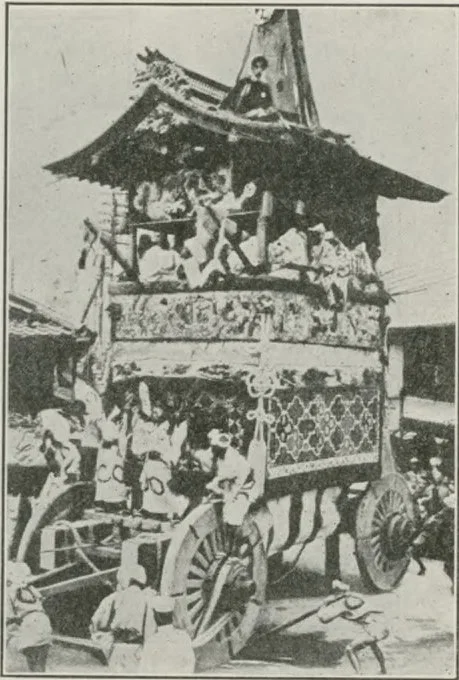
A FESTAL CAR — JAPAN
Japan
J. N. HERBOLTZHEIMER
THE work in Japan is very encouraging. Elder F. W. Field stopped here a few days ago on his way from Hiroshima to Tokyo. He reports a good interest in Hiroshima. The laborers there are doing faithful work, and winning souls to the message.
Some canvassers went to Shikoru to canvass for the special number of our paper; and since their return, word has been received that two have begun to keep the Sabbath, and are calling for help to lead them in the paths of righteousness.
Brother W. L. Foster reports a good interest in Nagasaki. He and Brother Tsukamoto have a large number of interested inquirers in their Bible classes.
Dr. Noma and the workers at the sanitarium are very busy now, and they are all of good courage. They have made many friends by their faithful work. One patient has rented a piece of ground, about an acre in extent, and donated the use of it for five years to the sanitarium. Another man is paying for an advertisement for the sanitarium for one year in the best paper in Japan, and the one having the largest circulation. These people have also become interested in the truth. The principles so faithfully carried out by the workers here have found an entrance into the hearts and homes of the people.
Several doctors have become interested in our work. One has sent a nurse to the sanitarium to receive a thorough training in hydrotherapy, massage, and dietetics. I received a letter from another doctor yesterday, inquiring about hygienic cooking and the vegetarian diet. My wife gives cooking lessons each week.
Another physician is so interested in our methods that he comes very often from a neighboring city twenty miles away for instruction. After his first visit I sent him our little paper, and he returned the next day to inquire concerning our belief. We studied several hours together. He now has a desire to go to one of our institutions in America for a course of study.
God is blessing the medical work in Japan, and we are thankful that we have this part in his great work to help carry forward the third angel's message in this dark land.
Kobe.
Out-Schools of the Malamulo Mission
By R. C. Porter
R. C. PORTER
It was interesting to visit among the out-schools of this mission, and see the people in their native condition. It was more interesting to see them eagerly studying the Word of God. The simple faith of these heathen people was a new revelation to me. The “Higher Critics” would surely be put to shame if their unbelief were placed in contrast with the simple faith of these natives when the Word of God is brought to them.
Besides the main station, which has an attendance of over two hundred, there are twelve out-schools, ranging from three to sixty miles from the main station. Seven of these out-schools are within walking distance of the main school, one is fifty miles distant, and four are sixty miles away. The total attendance in the twelve schools is over four hundred, or an average of thirty-three in each school.
The climate being always warm, the school buildings are usually built of bamboo poles placed close together perpendicularly. The roof is thatched with a long, coarse grass. The seats are made by driving forked sticks into the ground, and laying a pole across. The natives usually furnish the material, and assist in the erection of the building.
The attendance is good and quite regular, often including the head man of the village, and married men and women. The ages range from five to fifty years, but the majority of those who attend are of the usual school age.
The first work in an out-school is to teach reading and writing in the native language. The pupils are then taught mathematics, geography, Bible, and sometimes grammar. Those who are being trained for teachers are taught English. They manifest extraordinary ability in memorizing. This makes it difficult to get them to comprehend the practical side of the instruction given, but in time they learn to study, and apply principles. When they have reached this point, they are usually quite strict in their adherence to principle.
The Matandane Station
The Matandane station lies about one hundred miles distant from the Malamulo Mission. It is situated on a high elevation, nestling near the mountain, with an abundance of pure, life-giving air and plenty of water. Fruit and vegetables are easily grown, and the farm is sufficient to supply all the needs of the station, with abundant pasture for the cattle.
So far, this station has been conducted only as a day-school. The attendance has been about fifty. Several times students have been turned away who came from Portuguese territory across the near-by border, as they were too far away to attend the day-school. During our visit it was decided that a small boarding-school be started, to accommodate such students. One great problem in this field is how to reach the Portuguese. They are entirely under the control of the Catholic clergy, and this makes it next to impossible to establish Protestant missions in their territory. I know of but one Protestant station that has crossed the border, and it was established at the request of the Portuguese villagers. Even then it took a long, hard battle with the priests before it was permitted. Our hope now is that by providing for students from Portuguese10territory, the way may eventually open, through their influence, to establish mission work among their people.
The Matandane station is under the management of Brother and Sister S. M. Konigmacher, who have a good work started. Four natives were baptized during our visit, and a church of eleven members was organized, with Brother Konigmacher as elder, and Sister Konigmacher as clerk and treasurer. This station has four out-schools, from four to twenty miles distant, with an aggregate attendance of one hundred twenty-five. The prospect is good for establishing several more out-schools the coming year.
Thus the Malamulo Mission, with its six white workers and thirty-three native assistants, is carrying nearly a thousand students, with the prospect of quite an extension of the work.
I was much pleased with the prosperity of the work in British Central Africa, and the outlook for the future is encouraging. If you who read this report could have the privilege of seeing these natives, who, only a short time ago, were steeped in the deepest heathen superstition, eagerly studying the Word of God, singing his praise, and worshiping reverently before his throne, your hearts would be melted to tenderness, and you would say, with me, We must make greater efforts to bring the message to the millions in heathen darkness.
Claremont, South Africa.
Conference in East Bengal, India
By W. W. Miller
W. W. MILLER
[This report was written just before the death of Elder J. C. Little.—Ed.]
In company with Elder J. C. Little I arrived in Barisal, East Bengal, to attend an annual conference of our Bengali people. Arrangements had been made for a four days’ meeting. Through the influence and kindness of a Bengali gentleman, we were able to secure a tent that would seat between three and four hundred persons. As we were able to provide seats for only a portion of the tent, many who came had to sit on the ground.
Barisal being an educational center, many of the people were able to understand English, and requested that the evening meetings be conducted in that tongue. The first evening Brother L. G. Mookerjee spoke in English, the tent being well filled. The writer was to speak the next evening, and announced at the close that he would address the people in English, the subject to be, “Why Have We Come to Barisal?” But as I thought over the matter, and because some said they did not understand English, also for the reason spoken of in 1 Cor. 14: 8, 9, 19, I decided that I would speak through an interpreter.
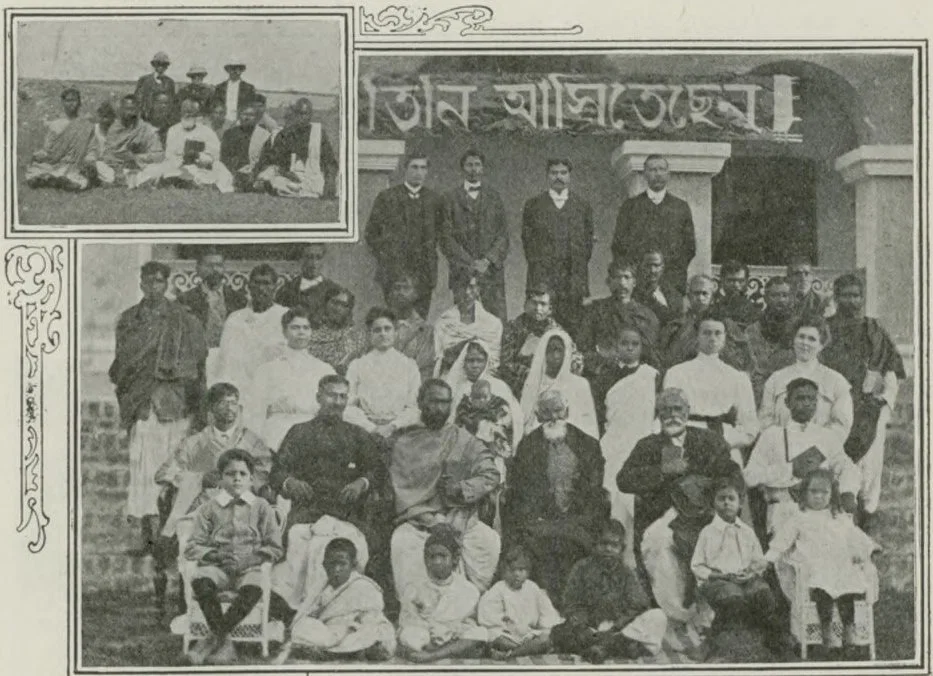
The small picture represents the Bengali (India) Conference of believers in 1909. The other their gathering in 1910. Standing at rear, left to right: J. C. Little, A. G. Watson, L. G. Mookerjee, W. W. Miller.
Barisal is one of the centers of the Swadeshi (India for the Indians) movement, and the government sent police to see that nothing was said or done that would be in the nature of sedition. For this reason I knew it was not only necessary to be most careful what I said, but also that I be not misunderstood. After stating my reasons for speaking through an interpreter, I told my hearers, in brief, that the Lord is sending a message to all the nations of the earth; that through this message he will gather out a people for his name; and that he desires the people of Barisal to be among the number. This was the reason we were among them, and why they were in the tent,—that they might hear the invitation, “Come, for all things are now ready.”
I never spoke to a more interested or orderly people. J. C. Little and A. G. Watson spoke to them on the prophecies, portraying with clearness the history of the world and the events that are now transpiring, showing that the end is near. From early morning until late at night the people came to inquire about our work and belief. We had a sign put up over the front door of the tent, which read, “Behold, He Cometh!” and many were the inquiries, “Who is he that is coming?” “When is he coming?” etc. The sign was printed in Bengali, and appears just above the heads of the company in the picture. The picture is of our own people only. Had we been able to take a picture of those attending the evening meetings, it would have shown between three and four hundred Bengalis.
The attendance at the evening meetings indicated that God is moving the people of India to listen to the last message; and why not? for really it is due to the whole world. The heavenly timepiece has struck the hour, “Go ye into all the world, and preach the gospel to every creature.” Where are the workers to-day who are saying, as they see the needs of this field, “Here am I; send me”? Where are those who are standing idle in the market-place at this eleventh hour, saying, “No man hath hired us,” but who are willing to go and work and be content with their wages?
Near the close of the meeting we baptized twenty Bengalis, and organized a church of twenty-six members. At the baptism a Hindu embraced one of the men when he came out of the water, saying, with tears in his eyes, “May God bless you,” showing that his heart was touched by the scene.
We celebrated the ordinances on the Sabbath, and I must say that I never attended an ordinance meeting where my heart was so touched as at this time. To see our poor old leper brother, whom the Lord healed in answer to prayer, washing Brother Little’s feet, with his fingers almost gone, and Brother Little washing his feet, which were off up to the instep, was enough to melt the hardest heart. In the case of this leper it can be truly said that he returned to give God the glory. [The healed leper spoken of sits in the front row, the fourth from the left, with his crippled hands under his cloak.]
As these native brethren sang, “We will bear the cross of Jesus,” it filled our souls with joy unspeakable, and at the same time made a lasting impression upon our minds that these people understand and appreciate the love of Christ for them. The leper brother was healed by prayer many years ago; and when he learned that Jesus kept the Sabbath, he decided at once to keep it, saying that he would gladly follow in the footsteps of him who had healed him.
Since our meeting ten more Bengalis in East Bengal have accepted the truth, and many more are interested. Brethren Little and Watson are constantly receiving calls to present the truth in the villages. The work in East Bengal is going forward more rapidly than ever before, and we hope to see a large company of believers gathered out of this part of India.
Lucknow.
Proud of American Liberty
By C. M. S.
CARDINAL VINCENZO VANNUTELLI, the papal legate to the Eucharistic Congress at Montreal, made a tour through Canada and the United States after the close of the congress. One feature of his journey, which seems peculiar in this land of education and enlightenment, was the kneeling of immense crowds of American citizens wherever he appeared in public, beseeching his blessing as if he were a veritable God, and kissing his ring, the symbol of his authority. In Montreal, in Winnipeg, in Minneapolis, in St. Paul, in Washington City, in Philadelphia, and in Baltimore this strange spectacle, this recrudescence of medievalism, was strikingly in evidence.
The inappropriateness of such demonstrations in a free government ought to be apparent to every thoughtful American. He who kneels to another and kisses the symbol of that other's authority, by so doing, declares his complete subjection to that individual in all that he represents. Cardinal Vannutelli represents the Pope of Rome, and all the claims of the church at the head of which he stands. That church and its head stand for the complete control of the whole world in all things, spiritual and temporal. He who kneels before the papal legate and kisses his ring, acquiesces in all the claims of the Papacy, whose he is, and whom he is here to represent. Can American citizens, having declared allegiance to the government of the United States, kneel before the representative of a foreign power, and kiss the symbol of his authority, thereby recognizing his claim to the rulership of this nation,—can they do this, and still be loyal citizens of the United States?—It is impossible; there can not be two rulers at the same time over the same territory. “No man can serve two masters,” declares our Lord.
If the Pope's authority be recognized, and his claims are to be admitted, he is the real ruler of our country, and of every country that admits his claim. But that is wholly antagonistic to the principles of popular government. The Pope is not a president of a republic. He is a monarch, the head of a theocratic monarchy. Admit his pretensions, and there is no rule in the world but his. The whole purpose of the great eucharistic congresses, as expressed by the Pope and by his legate, is to bring the whole world into submission and obedience to the “supreme pastor,” the “vicar of Christ.” Eucharistic congresses are being used as “convert-makers” to that end. When that purpose shall have been accomplished, republics and constitutional monarchies will be no more; and the Pope will be sole monarch, with no constitution to hamper him in the accomplishment of his will, and kings will12be mere satraps, under appointment, or subject to dismissal, from the Vatican.
Such is the policy and the unyielding purpose of the Papacy, and no man can kneel to the papal legate, and kiss the symbol of his authority, without, in that act, granting all that the Papacy claims and demands. Are Americans ready to yield all they have striven for these one hundred thirty-four years, and admit the claims and the pretensions of a ruler beyond the sea, and submit again to “taxation without representation”? If “taxation without representation” was tyranny then, can it be liberty now?
It is beside the point to argue that the Pope's claim is a claim of fealty in spiritual things only. The Papacy admits no such distinction. That power whose representative was willing to drench Europe in blood, if thereby he might restore the temporal sovereignty of the Pope, makes the proud boast that her purpose never changes. The purpose to rule over the kings of the earth, to reign as a temporal sovereign, is rooted as deep in the heart of the Papacy to-day as at any point in the history of that organization; and it augurs ill for the future of the American continent and American independence when the representative of that power can make a triumphal procession through Canada and the United States, and see thousands on thousands in every city he enters falling on their knees before him, and kissing the symbol of his authority.
In the city of St. Louis, where such a demonstration was made, the cardinal legate, in addressing four hundred youths at the Christian Brothers' College, advised his hearers thus: “Be proud that in America you are free to practise your faith unmolested; and that this country is not like those lands in which they have proscribed the faith, and made limitations to the duties of conscience.”
As a matter of fact, there is no proscription of the Catholic faith in any land in all the world. But France, tired of church dominance and church dictation in matters civil as well as in matters religious, has broken off diplomatic relations with the Vatican, and left Catholicism practically where it is in this country. Spain, weary of the same conditions, is going in the same way. The Catholic religion has not been proscribed in either of those countries. In fact, in Spain, until the present year, the Catholic religion was the only one that had not been proscribed. With the field all to herself for centuries in France, Spain, and Portugal, her arrogant intolerance has become so unbearable that her own children, nurtured on her knees, have turned against her. This attitude on the part of those nations ought to be sufficient warning to the people of all North America to cause them to repudiate her claims, and look with dread on all her advances toward the peoples of this continent.
If Catholic Americans should “be proud” that in America they can practise their faith unmolested, they should also remember that they owe that privilege to the principles of liberty and equality engrafted in the Constitution of the nation. They ought to “be proud” also that every other citizen has the same privilege. That ought to be a greater and a broader cause of pride (if we can call it that) than the mere fact that they themselves have that privilege; for in France, Spain, and Portugal for hundreds of years the members of the Catholic Church have been free to exercise their faith, and no one else has. The result has been a condition which the church now deprecates.
The American principle is the true one—it is better even for Catholics; and yet the freedom of speech, of the press, and of religion which this nation guarantees to all its citizens, has been most strongly denounced by the “supreme pastor” of the Catholic Church. It was Pope Pius IX who, in 1864, in an encyclical issued December 8, reiterated the statement of Pope Gregory XVI, that the idea of religious liberty was insanity. Pius IX, in that encyclical, declared the idea of religious liberty to be “that erroneous opinion most pernicious to the Catholic Church and to the salvation of souls.” Yet the carrying out of the principles of the Papacy in that matter has made for the Catholic Church itself, in France, Spain, and Portugal, conditions which harass her very soul. If the papal legate finds in America conditions of which Catholic citizens ought to “be proud,” it would be worth his while to study the principles which have brought those conditions about. But he will not find those principles in the encyclical of Gregory XVI nor of Pius IX. They are not found indigenous anywhere in the soil of the Papacy. They are found in the Constitution of the United States, and we wish they might remain there to the end of time, so that even Catholics might say, to the end of the world, “Here we have liberty to worship God according to the dictates of our own consciences, untrammeled, unhindered, unmolested.”