The Youth’s Instructor, Vol. 28, No. 33.

SEED BY THE WAYSIDE

The Youth’s Instructor

Aug 11, 1880

S. D. A. Publishing Association · Battle Creek, Mich. · Aug 11, 1880

SEED BY THE WAYSIDE.

IN TWO CHAPTERS.

CHAP. II.—HOW THEY GREW.

If you have seen the mountain valleys in winter, looking so still and white and lonesome, you never would guess how lovely they can be in the spring, when the grass along the little brooks is a tender green, and every sheltered nook and sunny slope is sown thick with delicate blossoms, or later when all the hillsides are covered with the rosy snow of the laurels and the wild azaleas. That was the way they looked when Molly Longdon first saw the little brown hut where she was to live with her mother and her brother Joe. If I said it seemed like fairy-land to a child whose whole life had been passed in the garret of a miserable city tenement house, that would not half express it, for Molly had never heard of fairies, and had seen flowers only in shops and in rich men's gardens. It was hard for her to understand that she might go where she pleased and gather what she chose; but by-and-by she grew accustomed to her freedom, and while her mother sewed, and scrubbed, and made garden, and kept the little hut tidy, and Joe came home every night, black, and hungry, and good-natured, from his work with the charcoal-burners, Molly explored the valley, waded in the brook, gathered flowers and berries, and grew stout and rosy, if one could have seen the roses under such a covering of sunburn and freckles.
What do you think: do the good times make the bad times easier to bear? Or is it easier to get along with bad times when you have never known anything different? At least I know that when Molly, after six months of downright fun, fell out of a chestnut-tree and broke her leg, she thought that she was the most miserable child in all the State of Pennsylvania. There were no doctors in that region, but Joe brought down one of the charcoal-burners, a sort of horse-doctor who knew something about bones, and he bound up the broken leg after an awkward fashion, and then there was no more to be done but to wait.
“Be patient, sis,” Joe would say every morning; “bones don’t grow in a night.”
Oh, how Molly wished that they did, and how long and weary the days and nights seemed.
By-and-by she could sit at the window; and that was some comfort, though it was winter and nothing ever stirred in the valley except the jays that flew screaming about, the great hawks that sailed overhead, and now and then a rabbit that ventured into the garden to nibble a frost-bitten turnip or cabbage leaf. But Molly found a new pleasure in watching the daily trains that crept across the long trestle-work almost over her head. She never cared for them before, but now she watched eagerly, glad of a sight at the faces crowding the windows, the brakemen on the platforms, the firemen on the engines. Once a little boy’s cap fell from his head into the ravine. Joe brought it in, and it hung on the wall still;—a pretty blue velvet cap, too small for any of them, but Mrs. Longdon said she would make a fine cushion of it some day, or perhaps a bag for Molly. So one after another the days passed by, and Molly’s leg was mending slowly in spite of its clumsy setting, when a new misfortune came upon her. She fell asleep in her chair, and, starting up suddenly, displaced the bone, and there was all the work to be done over again.
Poor Molly felt as if it was too much to bear, and nobody could say a word to comfort her, so she sat in her chair pale and disconsolate, too unhappy to care for anything. She heard the train coming, and it made her almost angry. It was near Christmas, and there would be lots of happy people on it, going about and having good times, while she must stay there, and nobody in all the wide world cared anything about her. The train came nearer. Yes, it was just as she supposed, all the coaches were full of people.
There were two children at one window, and there at another was a girl, no bigger than she was, with such a pretty scarlet hood on! She was leaning out at the window; she had lost something,—or did she toss it out? It certainly looked as if she did it on purpose, and Molly saw just where it fell. She was so much excited she could hardly wait until her mother came in from feeding the cow.
“Right under that big bush, mother,” she said, eagerly, “I saw her throw it, and she dropped something red too, you can see it hanging.”
“It’s likely an old lunch-box; or a candy-box maybe,” said Mrs. Longdon. Molly thought it would be a pleasure to have even an empty candy-box, but her mother would not go out to see.
“You must wait till Joe comes home,” she said. “There’s no path broke, and my shoes are not fit for wading. It would go hard if I was laid up now with rheumatism.”
So Molly sat, scarcely taking her eyes from the spot lest she should lose it in the twilight, until Joe came home and tramped through the snow, guided by the little red signal. Sure enough, he brought something up from the snow, carefully detached the bright flag, and carried it daintily between his thumb and finger.
“A pretty silk handkerchief with a scarlet border,” he said, dropping it in Molly’s lap.
“Now for the parcel,” and he took out his big knife to cut the string, while Molly’s pale cheeks flushed and her eyes grew bright as stars with expectancy.
You and I know what was in the parcel, but we cannot quite guess what a delight it was to the lonely, crippled child, without a playmate or a book or a plaything in the world.
“Well, of all things!” said Mrs. Longdon, while Joe drew his sleeve across his eyes and said with a queer laugh,
“I reckon Santa Claus must have been on that train, sis.”
“It was n’t Santa Claus,” said Molly, “it was a dear, good little girl, and she did it a-purpose; I saw her.”
It was a little seed, and cost very little trouble to sow, but by God’s blessing it took root and grew. The puzzle pictures furnished delight for many a weary hour. The beautiful card, for which Joe made a frame of fir branches, preached a daily sermon in its assurance of divine care, and the papers with their simple stories and lessons from the Bible found a way into Mrs. Longdon’s heart.
“We’re no better than heathen,” she said to Joe, “and it’s a shame for me that was brought up to ’tend preachin’ and say the catechism of a Sabbath. Do you tell Minot to fetch us out a Bible when he goes down again with charcoal. We ain’t so poor but we’ve got souls to look out for.”
“I’ll do it,” said Joe, and so he did.
The next summer as Molly sat reading to her mother from the new Bible, she found this verse:—
“Casting all your care upon him, for he careth for you.”
“Oh, that’s what the card says,” she exclaimed; “do you suppose God sent it to tell us he cared for us?”
“Maybe so,” said her mother, “I’m sure it was good of him to care for us when we did n’t care anything about him.”
“And we ought to thank him,” said Molly.
“Yes, indeed, child.”
And Molly leaned her arms upon her book and looked up very reverently at the sky as she said,
“Thank you, God, for caring for us.”—EMILY HUNTINGTON MILLER, in Christian Union.

THE FOUR CALLS.

THE Spirit came in childhood, And pleaded, “Let me in;” But ah, the door was bolted And barred by childish sin. The child said, “I’m too little; There’s time enough to-day; I cannot open;” sadly The Spirit went his way.
Again he came and pleaded In youth’s bright, happy hour, He called, but heard no answer; For fettered in sin’s power, The youth lay dreaming idly, And crying, “Not to-day; For I must have some pleasure;” Again he turned away.
Again he came in mercy, In manhood’s vigorous prime; But still could find no welcome,— The merchant had “No time” To spare for true repentance, No time to praise and pray; And thus repulsed and saddened, The Spirit turned away.
Once more he called and waited, The man was old and sad; He scarcely heard the whisper, His heart was seared and bad. “Go, leave me. When I need thee I’ll call for thee,” he cried; Then, sinking on his pillow, Without a God he died!—Sel.

OUR OCEAN STEAMER.

In our last, we were just out of sight of land after leaving New York harbor. Nearly all the passengers remained on deck viewing the broad expanse of blue water, and watching the white and gray sea-gulls. These birds follow our ship till we leave the banks of New Foundland, picking up the refuse food that is thrown overboard from the table. It is very amusing to see two or three of them get hold of one piece of meat at once and try to fly off with it. When, in their flight, they become tired, they rest a few minutes on the waters and then fly on to overtake us.
As we get fully out to sea, a strong December breeze makes us all glad to leave the upper deck. This deck is also called the “promenade deck,” because that here is a place, when it is not rough weather, for all to walk about, get exercise, and view the sea. From this deck, we enter a saloon with windows all around it and furnished with settees so that we can look out upon the sea even in time of storm. In one end of this saloon are short stairways leading down to the lower deck, where is the dining-saloon of the ship. This saloon is sixty feet long and twenty feet wide. Extending through the center of this room is a long table.
Suspended from the ceiling, over the table, is a shelf. In this shelf are slits and sockets which hold the various colored wine-glasses, tumblers, and decanters. Everything is made to fit securely to the shelf, so that although the shelf swings with the motion of the ship, nothing is thrown from its place.
On either side of the table are cushioned seats with backs, which are so constructed that they may be made to face the table, or, after meals, one may sit with his back toward the table. These seats, as well as the table, are all securely fastened to the floor with bolts; if they were not, in time of rough seas, both table and seats would be dashed about the saloon in the wildest confusion.
Over the table there is a long sky-light so constructed as to admit an abundance of light from the upper deck. There are, also, many curiously constructed lamps about the room, which are left burning all night. These lamps are hung on double pivots, so that the ship may move in any direction, and yet the lamps keep right side up.
On each side of the dining-saloon are state-rooms with passage-ways leading to them from the dining-saloon. Between these passage-ways are large mirrors securely fastened to the sides of the room. These mirrors are about fourteen feet in length and four feet high. Above and below the mirrors is carved and gilded work, with beautiful paintings of flowers, landscapes, birds, animals, etc. The mirrors, presenting a reflection of all this, make the room appear three times as large as it really is. Around the edge of the room, near the floor, is a steam-pipe which warms the room with the exhaust steam of the ship’s engine. The stewards are very particular to keep everything in this room tidy and scrupulously clean.
How pleasant it is to have so nice and cheery a place in which to sit during the days of our voyage! When the storm-clouds gather without, one is apt to be gloomy, and this would be increased if obliged to sit in a doleful, dreary place; but to have a room so beautiful and home-like takes away much of this unpleasant feeling.
To help us to amuse ourselves, at the end of the room stands an open piano, inviting any of the passengers who understand music, to play. Besides the music of the piano, there are two other sounds that we hear that are not so musical. One of these is the noise of the engine and the wheel of the propeller, not a very unpleasant sound when we become accustomed to it, as it says that “we are still on our way.” The other is the striking of the bell every half-hour. This is done in the wheel-house of the ship by the helmsman, who steers the boat. Commencing at noon, the bell strikes once at half-past twelve; at one it strikes twice; at half-past one it strikes three times; and when it strikes eight times in succession it is four o’clock. At half-past four it begins again by striking one. Every four hours, that is, at four, eight, and twelve, it completes its eight strokes, and at these points changes are made in the officers of the ship.
But night is coming on, and, as the sailors say, “we must turn into our bunks.”
J. N. L.

The Habit of Whining in Children

Some little folks have a habit of whining. They get up in the morning in a bad humor, and they whimper, and whine, and make ugly faces, and put everybody in pain who hears or sees them. It is a habit which is easily formed; and once formed it is very hard to break off. The whining boy or girl is sure to make a scolding man or woman, unless a sweeter spirit comes to bless the life.

THE GIANT AND THE FAIRY.

In the past, so dim and distant, did the fairies weave their spell, And still in our homes, dear children, oft unseen by us they dwell. Of giant strong, and fairy, and the wonders they can do, If you'll leave your play and listen, I will tell a story true. At the giant's touch, the forest waves, a field of golden grain, And the city's domes and spires spring up from out the grassy plain. His strong hands have tunneled mountains, and the raging torrents spanned, Swiftly borne by fiery coursers, speeds he on from land to land. Yet whene'er alone he dwelleth, on his work there rests a gloom, And the palace home he buildeth hath a chill like the chill of the tomb. But the blithesome fairy's presence, it fills every place with light, The face of the grim old giant with a happy smile grows bright, The sunlight rests on the valleys sweet, birds warble in merry song, And the giant works greater wonders, for his heart is glad and strong. Make him your friend, and gladly, he each task will help you do, Oft life's uneven pathway, his strong hand will smooth for you. From the sweet-voiced fairy you may gain, to other hearts the key, She will touch your lives with brightness, your lips with melody.
And who are these mystic workers? do you ask, they are known to fame; The giant strong is Labor, and Love is the fairy's name. Oh, the hands that are strong to labor, the hearts that are all aglow With love to God and neighbor, life's richest blessings know! And the home that toil hath builded, that is bright with the light of love, Is on earth the best reflection of the home of the blest above. M. A.

LESSONS FOR CHILDREN.

LESSON LXXXV.—DANIEL.

We will now go back about eighteen years, and see what had been going on in Babylon since a part of the people of God had been carried to that country. We will first learn when and how the first company were taken captive.
In the first chapter of Daniel, we read: “In the third year of the reign of Jehoiakim, king of Judah, came Nebuchadnezzar, king of Babylon, unto Jerusalem, and besieged it. And the Lord gave Jehoiakim, king of Judah, into his hand, with part of the vessels of the house of God, which he carried into the land of Shinar to the house of his god, and he brought the vessels into the treasure house of his god.
“And the king spake unto Ashpenaz, the master of his eunuchs, that he should bring certain of the children of Israel, and of the king’s seed, and of the princes,—children in whom was no blemish, but well-favored, and skillful in all wisdom, and cunning in knowledge, and understanding science, and such as had ability in them to stand in the king’s palace, and whom they might teach the learning and the tongue of the Chaldeans. And the king appointed them a daily provision of the king’s meat, and of the wine which he drank; so nourishing them three years, that at the end thereof they might stand before the king. Now among these were of the children of Judah, Daniel, Hananiah, Mishael, and Azariah, unto whom the prince of the eunuchs gave names; for he gave unto Daniel the name of Belteshazzar; and to Hananiah, of Shadrach; and to Mishael, of Meshach; and to Azariah, of Abednego. But Daniel purposed in his heart that he would not defile himself with the portion of the king’s meat, nor with the wine which he drank; therefore he requested of the prince of the eunuchs that he might not defile himself.”
Now the king had upon his table food that the people of the Lord had been forbidden to eat, and, besides, it is probable that some of it had been offered to idols; so Daniel did not wish to eat of it. The prince of the eunuchs wanted to please Daniel, for he tenderly loved him, but he feared that if Daniel should eat only the plainest kind of food, he would become lean, and the king would inquire into the matter. Daniel then proposed that the prince should try them for ten days on pulse and water. “So he consented to them in this matter, and proved them ten days. And at the end of ten days their countenances appeared fairer and fatter in flesh than all the children which did eat the portion of the king’s meat. Thus Melzar took away the portion of their meat, and the wine that they should drink; and gave them pulse.
“As for these four children, God gave them knowledge and skill in all learning and wisdom; and Daniel had understanding in all visions and dreams. Now at the end of the days that the king had said he should bring them in, then the prince of the eunuchs brought them in before Nebuchadnezzar; and the king communed with them; and among them all was found none like Daniel, Hananiah, Mishael, and Azariah; therefore stood they before the king. And in all matters of wisdom and understanding, that the king inquired of them, he found them ten times better than all the magicians and astrologers that were in all his realm.”

QUESTIONS.

  1. How far back will we now go?
  2. For what purpose?
  3. What will we first learn?
  1. Where may we read about this?
  2. How long had Jehoiakim been reigning when Nebuchadnezzar came up from Babylon and besieged Jerusalem? Daniel 1:1.
  3. What did the Lord give into the hands of Nebuchadnezzar?
  4. What did the king of Babylon tell Ashpenaz, the master of his eunuchs, to do?
  5. What kind of persons was he to take? Dan. 1:4.
  6. What did the king appoint for these young men?
  7. Why did he want them cared for so generously?
  8. Who were among those whom Nebuchadnezzar meant to make officers and counselors at his court?
  9. What change was made in their names?
  10. What purpose did Daniel form? Verse 8.
  11. Why did he not wish to eat of the portion of food that was brought him from the king’s table?
  12. What favor did Daniel ask of the prince of the eunuchs?
  13. Why was the prince afraid to grant it?
  14. What experiment was agreed upon?
  15. How did it turn out? Verse 15.
  16. What course did Melzar then pursue in regard to their diet?
  17. How did the Lord favor these four children? Verse 17.
  18. How long were they trained in the learning and tongue of the Chaldeans before they were brought before the king to be examined? Verses 5, 18.
  19. How did they compare with others in the examination? Verse 19.
  20. How did they compare with the magicians and astrologers? Verse 20.
  21. How was Daniel distinguished above all others? Verse 17.

BIBLE LESSONS FOR YOUTH.

LESSON CXI.—REVIEW OF LESSONS CVIII-CX.

1. WITH what people did the Romans have three world-renowned wars?
2. When did the second of these wars close?
3. Give some of the circumstances of this war.
4. When did the third Carthaginian war terminate?
5. With what success to the one party, and with what reverses to the other?
6. What may be said of the next hundred years of Roman history?
7. What great powers did the Romans subjugate?
8. How was Rome imperiled about one hundred and six years before Christ?
9. By whose skill and courage was the danger averted?
10. What proved more disastrous than the invasion of foreign foes?
11. What noted characters appeared upon the stage of Roman history about this time?
12. How did Cicero first distinguish himself?
13. How did he afterward display his eloquence in guarding the interests of his country?
14. What high position did Julius Cæsar first hold?
15. Who were the other triumvirs?
16. Which one held dominion of Palestine?
17. Who had immediate control of Palestine after the death of Crassus?
18. What did Cæsar finally become?
19. What important events had taken place since Pompey took possession of Jerusalem?
20. What officers did Cæsar appoint in Palestine?
21. When and how did Julius Cæsar end his career?
22. How was the government of the Roman empire administered after the death of Cæsar?
23. Which one of the triumvirs ruled over Syria, including Palestine?
24. What circumstances favored Herod’s ambitious designs?
25. Who was Antigonus?
26. What resolute steps did he take?
27. How did Herod become king?
28. By what reverses was Antony overthrown?
29. With whom was he intimately associated?
30. What was her fate?
31. Who soon after became emperor of Rome?
32. What scripture incidentally shows that Rome now ruled the world?
33. Describe Herod’s course toward Aristobulus.
34. What treachery did he practice toward Hyrcanus?
35. Tell what you can of Mariamne.
36. Give other examples of the atrocious cruelty of Herod.
37. How did Herod try to overcome the hatred which his diabolical conduct aroused in the Jews?
38. What improvements did he make in different parts of the country?
39. How did he displease the Jews in trying to honor Augustus?
40. What work did he undertake in order to gain their good-will?
41. Give some description of the building of this temple.
42. How long was it in process of construction?
43. Give a brief synopsis of the history of the Jews from the time of Malachi to the birth of Christ.

TO TEACHERS.

One word to you, teachers! You who are so often absent from Sabbath-school. Have you a good excuse? Do you realize how much harm you are doing by staying away? Your class expect you there, and when you are not present they are disappointed. It is no encouragement for them to study the lesson, when the teacher whose place it is to instruct them, is so often missing.
The superintendent has to supply the class as best he can, and it too often happens that the one whom he selects to fill your place, not expecting to act as teacher, has hardly looked at the lesson. The class are dissatisfied, and it is no wonder that they soon begin to stay away, too; and thus the school grows smaller, the interest wanes, opportunities for doing good are lost, and whose fault is it? Teacher! think of these things, and resolve to be punctual, and do your whole duty to the class intrusted to your care.—Sel.

PERSEVERANCE VS. GENIUS.

THERE is no trait more valuable than a determination to persevere when the right thing is to be accomplished. We are inclined to give up too easily in trying or unpleasant situations, and the point I would establish with myself, if the choice was again within my grasp, would be never to relinquish my hold on a possible success if mortal strength or brains in my case were adequate to the occasion.
That was a capital lesson which a learned professor taught one of his students in the lecture-room after some chemical experiment. The lights had been put out in the hall, and by accident some small article dropped on the floor from the professor’s hand. The professor lingered, endeavoring to pick it up. “Never mind,” said the student, “it is of no consequence to-night, sir, whether we find it or no.” “That is true,” replied the professor, but it is of grave consequence to me as a principle, that I am not foiled in my determination to find it.” Perseverance can sometimes equal genius in its results. “There are only two creatures,” says the Eastern proverb, “that can surmount the pyramids,—the eagle and the snail!”

Teaching Children to Admire and Love Jesus

CHILDREN admire first and criticise afterward; men criticise first and admire rarely. Teachers of the youngest classes will often find it of great advantage to appeal to this faculty of admiration in presenting the character of Jesus and what he did out of love for sinners. From admiration, the child-mind may readily be led to love a person who would cheerfully do such wonderful and divine acts to save a race of sinners.

LETTER BUDGET.

ARBUCKLE, CAL.
DEAR EDITORS: We have a good Sabbath-school of forty-five members. I am ten years old. I keep the Sabbath with my mother and three brothers. My father is dead. We take the INSTRUCTOR, and like it very much. CHARLEY LYNCH.
NEILLSVILLE, WIS.
DEAR EDITORS: We are two sisters, aged eleven and thirteen. We are keeping the Sabbath with our parents. We were baptized by Eld. Decker, July 29, 1879. We have taken the INSTRUCTOR ever since we embraced the truth, and like it very much. LIZZIE and MARY SUFFICCOOL.

JAMIE AND THE FLY.

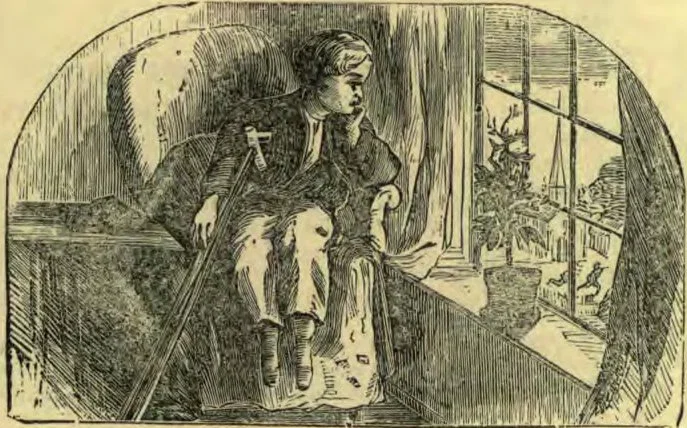
Jamie was sulky. Are you ever sulky? Here is a picture of him as he sat pouting, with his finger in his mouth. I think that if you who are sometimes sulky will look at this picture, it will cure you of the least desire to look as he did. I think that if his papa had held a looking-glass before him so that he could have seen himself, he would not have been satisfied with the pouting, cross-looking little figure which he would have seen reflected in the glass.
There was no reason why Jamie should not be a happy little boy. To be sure he was lame, but with the aid of his crutch he could walk quite well, and would soon be able to get along without it, although he would always be a little lame. He had a pleasant home, and everything that a reasonable little boy could ask for.
But now, as he sat there, feeling angry and ill-natured, he saw a fly light on the window-pane; and, as he began to watch the movements of the fly, he forgot himself and the cause of all his troubles. The little fly was taking his morning washing and brushing. He was making his toilet.
In the first place, Mr. Fly rubbed his head with his hands; over and over did this tidy little body scrub his face. Then he began to wash and trim his wings. He smoothed them along the edges, and polished them with so much care that I dare say that had Jamie had as many eyes as the fly, he might have seen that the tiniest speck of dust was removed. Next he rubbed his legs. He did not spare himself any amount of trouble; for he rubbed them together, and he rubbed them separately; he rubbed and scrubbed and polished; and he polished and scrubbed and rubbed. When he was perfectly clean, he stood still a moment, probably to rest himself after the exercise, and then he flew away.
By this time Jamie had forgotten how cross he felt; and he looked at his hands to see if they were clean. No, indeed, they were grimy with dirt, and he knew that his face needed washing; for it was because his mother wanted to give him his bath that he began to pout and to sulk. Now that he had gotten over his naughty feelings in watching the fly, he began to be ashamed of himself and to feel that he was not as wise as a poor little insect.
Nobody had told Mr. Fly that he ought to keep himself clean; nobody had said, “Come here, little fellow, and let me see if your face is dirty;” and yet, of his own accord, he had given himself a good washing. I think Jamie showed wisdom in being willing to learn a lesson even from a little fly.—Children’s Friend.

EUROPEAN CATHEDRALS.

ST. PETER'S.

St. Peter's, at Rome, is undoubtedly the grandest temple ever reared by human hands. The approach to the building is of the most magnificent character. On either hand semicircular porticoes, supported by four rows of columns, inclose space enough between the two inner rows for the passage of two carriages abreast.
The galleries and porticoes, together, are not unlike in form to sickles, of which the galleries make the handles. All these structures are of the most colossal size. The porticoes are sixty-four feet high, and the army of saints which crown the entablature—nearly two hundred in number—are eleven feet high. But so harmonious are the proportions, that, when seen from the center of the piazza, the whole effect is light, airy, and graceful. The galleries and porticoes seem like all-embracing arms of invitation extended by the church to the whole Christian world, summoning them to come and worship under the roof of this most majestic of temples. Standing in this grand court, with the great colonnades sweeping around, the fountains on either side sending up their showers of silver spray, the mighty Egyptian obelisk piercing the sky, and, beyond, the great font and dome of the cathedral, one must confess unmingled admiration.
The square ascends toward the church, and a magnificent flight of steps, the whole width of the façade, leads up to the doors. The façade itself is enormous in its proportions. It is three hundred and seventy-nine feet long, and one hundred and fifty-two feet high, surmounted by a balustrade and colossal statues of the Saviour and the apostles. The portico is two hundred and thirty-six feet long, forty-two feet wide, and sixty-eight feet high, magnificently decorated with stucco.
From the portico, we push aside the heavy leathern curtain, and stand in the great nave. Before us is a marble plain over six hundred feet long, and, under the cross, four hundred and seventeen feet wide! One hundred and fifty feet above, springs a glorious arch, dazzling with inlaid gold. In the center of the cross are four hundred feet of air between us and the top of the dome. The grand cupola alone, including the lantern and cross, is two hundred and eighty-five feet high, or sixty-five feet higher than the Bunker Hill Monument; and the four immense pillars on which it rests, are each one hundred and thirty-seven feet in circumference! Everything is in perfect order, as if just made. The whole surface taken in by the eye, shines with marble and gilding. But the first view gives no idea of the immense scale upon which everything is. The marble cherubs, in high relief on the columns, are six feet long. But even after walking about, and returning to it again and again, the dimensions remain a mystery. It covers nearly five acres of land.—Arthur's Home Magazine.

The Invention of the Steam Engine

THE steam-engine was invented in 1649.

HARRY'S OPINION OF GRANDMOTHERS.

GRANDMOTHERS are very nice folks; They beat all the aunts in creation, They let a chap do as he likes, And don't worry about education.
I'm sure I can't see at all, What a poor fellow ever could do For apples, and pennies, and cakes, Without a grandmother or two.
And if he is bad now and then, And makes a great racketing noise, They only look over their specs And say, “Ah, these boys will be boys. “Life is, oh, so short at the best; Let the children be happy to-day.” Then they look for a while at the sky, And the hills that are far, far away.
Quite often, as twilight comes on, Grandmothers sing hymns very low To themselves as they rock by the fire, About Heaven, the far-off home, you know.
And then, a boy stopping to think, Will find a hot tear in his eye, To know what will come at the last; For grandmothers all have to die.
I wish they could stay here and pray, For a boy needs their prayers every night; Some need more than others, I s'pose,— Such as I need a wonderful sight.
—Ethel Lynn.

You have reached the end of this edition.

The Youth’s Instructor · Aug 11, 1880