Your ShelfYour Projects

Review and Herald, Vol. 60, No. 15.

Special Mention

Review and Herald

Apr 10, 1883

Seventh-day Adventist Publishing Association · Battle Creek, Mich. · Apr 10, 1883

Special Mention.

—Joaquin Miller publishes in the Chicago Times of March 4, 1883, a racy letter, commenting upon the evils of the accumulation of millions of money by individuals, and upon the supercilious and insulting demeanor of the officials in some of the departments at Washington. After having spoken of Mr. Vanderbilt, he says in general:—
“And I say further that any immensely rich man is not only a bad and a bitter man at heart, but he and his millions are a standing menace to this republic. Briefly, when hard times come, as come they will, the people will rebel against these new kings; the kings will require soldiers to protect them and their property; a stronger government will be demanded—this will be the end of the republic and of the people’s government. There is a text for ten thousand sermons.”
—The Michigan Christian Herald of March 29, 1883, gives the following curious incident. In view of the fact that an idolatrous devotion to business on the part of many of the “sons of Abraham,” is so strong as to lead them to trample upon the claims of the Sabbath, it is not so strange that one of them should so far forget himself as to use the abbreviation A. D. in writing a date. But there is a good lesson in it for all religionists. The Herald says:—
“Jews and Christians are alike in this that they sometimes forget their religion in their business. A son of Abraham building a storehouse in this city had a corner stone prepared and set in the wall, bearing his name on one side, and ‘A. D. 1883’ on the other. This unintended concession of the lordship of Christ having been discovered, he set about obliterating the ‘A. D.’ If he had been shrewd enough to explain that the inscription meant ‘All Done in 1883,’ he might have saved the block from defacement; but adopting the more humiliating and costly method of amending his mistake, he set an example for all those who resort to artful explanations in order to avoid confession and reform.”
A NEW TORPEDO GUN.—In the REVIEW of March 27, 1883, we made mention of the great perfection which has been reached in the construction of the torpedo as a weapon of war. And now comes notice of the invention of a new gun which is able to destroy any torpedo. So the advantage seesaws between attack and defense, being sometimes on one side and then on the other. The Scientific American of March 31, 1883, describes a new invention called the “Nordenfelt Gun,” which is able to discharge 108 steel shots of 7½ oz. weight in thirty seconds. At a distance of 300 yards, a bullet from this gun passed through the steel plate covering of a torpedo boat, one-sixteenth inch in thickness, through four bulkheads, and then striking the boiler, buried itself one-half inch in the half-inch steel plate. In experiments that were made under motion, the target was a model torpedo boat, and at different degrees of speed the number of hits was 48, 65, and 103, per minute. No boat could stand such a pelting for any great length of time.

HOW IT WAS ANSWERED.

In February last, Elder J. Byington, of this city, addressed a letter to the N. Y. Independent which was given a place in that paper, and a courteous reply appended thereto. As our readers will be interested in both the letter and the reply, we herewith present them:—
“A preacher among the Seventh-day Adventists, whose venerable years, as well as his office, justify the designation of ‘Elder,’ writes us:—
“TO THE EDITOR OF THE INDEPENDENT:
“Dear Sir: I have been very much interested in reading the editorials and editorial notes of your paper for several years past, and have been pleased with the candor manifested therein. In a late issue you speak of its being a hardship for seventh-day people, who do not believe in the first day of the week as a day of rest and holy time, but do believe in Saturday for this purpose, to be compelled to keep Sunday as a day of rest, and you also say it is enough for the State to enforce rest on the first day of the week, as a matter of public policy, while letting the religious element of the Sabbath entirely alone. I also understand you to say that seventh-day people should submit to what is called these civil enactments or leave the community where they reside. This is a matter of great importance to me. For some thirty years I have observed the seventh day of the week as a day of rest, as God’s holy day. I have done it in obedience to his plain commandment, ‘the seventh day is the Sabbath of the Lord thy God,’ and also, in obedience to the same law, I have done my own work on the six working days, embracing the first day, extraordinaries excepted.
“Now, Mr. Editor, will you please inform me how this matter has nothing to do with religion. The great God of Heaven has revealed his will to man in all places and in all times, and says, ‘Obey my voice.’ Now, will it be pleasing in the sight of God for me to rest two days of the seven, one in obedience to God and one to please man, and by so doing disobey God? I might leave the community, and retire to some lonely place in the earth, but the command says, Let your light shine before men, that they may see your good works. Is it not a good work to obey the voice of God, and that before men? A very worthy preacher once said to me that he was passing a man who was tilling his corn-field on the first day of the week. On inquiry, he found him to be an honest man, and keeping the Bible Sabbath. Seeing this man labor was his first conviction on the subject, and led the preacher to examine his Bible, which resulted in his keeping the fourth commandment. Daniel did not retire to some secret place to pray when civil law was against him; but, with his window to his chamber open, he was heard to pray to his Father in Heaven. He received the penalty and went into the lion’s den, and it all turned for the advancement of truth. Now, if we have to receive the spoiling of our goods for laboring on the first day of the week in obedience to God, he can cause the wrath of man to praise him.
“Please give this a place in your worthy paper, if consistent.”
ELDER J. BYINGTON.
“Battle Creek, Mich.
“We can only repeat to Elder Byington that it is a great disadvantage to be in the minority. People there may be right; but they must suffer and submit. With the seventh-day people it is a matter of religion and conscience. They must rest Saturday, and may, generally should, work Sunday; but the State has no quarrel with their conscience and religion and no favor for the religion of the other citizens. All the State wants is that the citizens shall have one day in seven for rest; not for religion. Which day it shall be, the majority must decide; but the law should be very considerate of those whose conscience requires another day. They should be allowed to work Sunday if they do not disturb the rest of the majority. If they insist on so working as to interfere with the rest-day of the majority, they must either move or be moved away. We are sorry, but there is no help for it.”

THE DEMAND OF THE PRESENT.

Under this heading a quotation from Green's “Moses and the Prophets,” is given in the November (1882) number of the Hebrew Student. It is written with special reference to the carping criticisms to which the Scriptures are at the present time subjected, and the arrogant claims and demands made by modern skepticism. To this end it is admirable; but as our readers peruse it, they will find every one of its terse and stirring utterances applying itself most aptly to our own specific work. It should do us good, and make us more energetic in our efforts to prepare for the demands that will in the future be made upon us. The quotation reads as follows:—
“We are coming now, as it would seem, to the culmination of the struggle. The battle rages around the citadel. No drones or cowards are wanted now. It is not the incompetent and the unfaithful who can serve the church in such a crisis. She can well afford to spare the idlers and stragglers and faint-hearted from the ranks. The times emphatically demand those who shall be prepared to acquit themselves like men.
“He has a very low conception of the work of the ministry, of the solemn duties and the momentous responsibilities which it involves, who can suffer himself to be slack and negligent in his preparation for it, or inactive or half-hearted in his discharge of it. And he gives little evidence of being called of God to the office, and little prospect of usefulness and success in it, who does not engage, whether in his preparatory studies or in the actual labors of the ministry, with a holy enthusiasm, throwing himself into them with all the energy of his nature, resolved by the aids of divine grace to make the most of the powers and faculties which God has given him in the special line of this high calling; seizing with eagerness every opportunity within his reach, and training himself by all available methods to the highest measure of fitness he can secure to be entrusted with the care of souls, to be an embassador of God to men, to be a steward of the mysteries of the kingdom of Heaven. If a charge so weighty and so sacred as this will not stir the energies of a man to the utmost, the least that can be said is, that he shows that he has no appreciation of this high and holy office, and no fitness for it.
“But besides this general demand which is always laid upon all ministers and candidates for the ministry, to use the utmost zeal in the whole round of their professional and preparatory studies, there is a call to special diligence and thoroughness now in the circumstances which have already been recited. If supineness were ever admirable, there is a loud call for alertness at the present time. There is a demand now, as never before, for high Biblical scholarship, for well-trained exegetes and critics,—for men well versed in the critical and speculative attacks made upon the word of God, and who are well prepared to defend it.
“The present phases of critical and speculative assault upon the Scriptures need create no alarm, as though they were more formidable than their predecessors; but though these should be repulsed and prove short-lived, that will not end the strife. The assault will be renewed at some fresh point or in some other form. And now that the critical battle is brought to our own doors, it will not do to wait till defenders of the faith in other lands work out a solution for us. We must have an English and American scholarship that is fitted to grapple with these questions as they arise.
“We need in the ranks of the pastorate, men who can conduct Biblical researches, and who can prosecute learned critical inquiries; who can do, in their own chosen field of Scripture study, what German evangelical pastors have done, such as Baehr in his ‘Symbolism of the Mosaic Cultus,’ and Ranke in the critical defense of the genuineness of the Pentateuch, and Fuller in the interpretation of the prophet Daniel, and Keil, who published his learned defense of the books of Chronicles and Ezra when he was only a licentiate.”

FAITH

Though life hath many a darksome day, And many a grief whose heavy sway Blots out all hope of brightening ray, And bends to dust; Yet cometh surely morning bright,— A day which will not end in night, When joy will every grief requite To them that trust.
And faith is but His blessed gift, Sent down the heavy heart to lift, And make through darkening clouds a rift; For so he saith. If every path were smooth and bright, Nor danger frowned nor joy took flight, How should we learn to trust his might? Oh, blessed faith!
—Selected.

Conditional Immortality.

The Interior comes near witnessing a good confession in its answer to the following question which appeared in its issue of March 29, 1883. It is something for it to admit that the doctrine of conditional immortality is the next to the best view of the subject. One more advance, admitting that it is the best, and it will be all right.
“Editor of the Interior: Is the view popularly known as conditional immortality, within the limits of confessional liberty? May one who believes that ‘sin when it is finished bringeth forth death,’ in the literal sense of the word, and that the punishment which God inflicts upon the sinning soul at last results in its absolute destruction, still continue as a minister or elder in the Presbyterian church? Or is it necessary for one who sincerely receives and adopts the Confession of Faith as containing the system of doctrine taught in the Holy Scriptures, to believe in the everlasting conscious suffering of the lost? S.
“There is nothing said about ‘everlasting conscious suffering’ in the Standards—probably for the reason that unconscious suffering is impossible. The argument for conditional immortality, and the extinction of the wicked, it is admitted by orthodox theologians, is the strongest argument, based on Scripture, that can be made, next to the argument for eternal punishment. But it is held by our church to be excluded by the plain language of Scripture fairly construed, and it is therefore in like manner excluded by the plain language of the Confession. It is not confessional eschatology.”

Lesson for the Third Sabbath in April.

(See Instructor for April 11, 1883.)

Notes on the Text.

Chap. 3, Ver. 4. Peter, fastening his eyes upon him.—The word fastening is a strong one, and implies a searching gaze, as if to discover the sincerity of the man’s character and the nature of his need. The same word is used of Paul when he fixed his eyes upon Elymas the sorcerer (Acts 13:9), but with a different result; and when he healed the cripple at Lystra. Acts 14:9.—Schaff.
Ver. 5. Expecting to receive.—Because it was a constant custom for all who entered the temple to carry money with them to give to the treasury or to the poor, or both.—Dr. Clarke.
Ver. 8. He entered with them into the temple.—His first thought seems to have been to return thanks for his great deliverance, as the next verse shows.
Ver. 12. Our own power or holiness.—The Jews believed that very high attainments in holiness were rewarded by miraculous power.—Cook. The apostle disowns both any peculiar prerogative of working miracles, and any peculiar privileges of access to God, any efficacy of prayer above that of a faith which may be exercised by any disciple.—Abbott.
Ver. 16. And his name.—The name of Jesus is here put for Jesus himself; and it is the same as saying, “and he,” etc. In this way the word name is often used by the Hebrews, especially when speaking of God. Acts 1:15; 4:12; Eph. 1:21; Rev. 3:4. It does not mean there was any efficacy in the mere name of Jesus that should heal the man, but it was done by his authority and power.—Barnes. Through faith in his name.—It seems to me clear that he speaks both of the faith of the apostles who wrought the cure, and of the faith of the man cured, who could not have been healed if he had not exercised sufficient faith to attempt obedience to the apostolic direction, “Rise up and walk.”—Abbott.
Ver. 19. That your sins may be blotted out.—(The first effect of repentance.) Instead of remission, we have here the stronger figure of obliteration. The Greek verb is applied by Xenophon to the erasure of a name from a catalogue or roll. It may here denote the canceling of the charges against any one, and this amounts to the same thing as remission. 2:38.—Alexander. This figurative expression was much more forcible with the ancient mode of obliteration. The ancients wrote on tablets with wax, and when they wished to blot out what they had written, they used the flat end of the iron pen, and thus obliterated every trace of it. So the repenting sinner who turns to this risen Saviour has the promise of an utter expunging of his sins—rubbing out every trace of them—from God’s book of account.—Jacobus. The blotting out of the sins of the righteous is the closing work of Christ as our Great High Priest in the heavenly sanctuary. It cannot be accomplished before, as this is the atonement and that is the closing act of the ministration of the priest. This work we understand commenced at the close of the great prophetic period of 2,300 days in 1844. It is occupied at first with the cases of the past generations of the dead, and closes with the cases of the living. In connection with this latter portion of the work, the outpouring of the Spirit, the “refreshing,” is conferred.
Ver. 21. Which (the times of the restoration of all things) God hath spoken by all his holy prophets.—This glorious restoration to holiness and happiness is the theme of all prophecy in every age in the Old Testament. It was the expectation of this “restitution,” so deeply rooted in the hearts of all Jews, which was the principal cause of their summary rejection of a suffering Messiah. They read their glorious sacred books in the strong false light of their own jealous hopes and burning desires; and so they passed over the plain intimations of some of their noblest prophecies, which told them how the glory they longed after could only be reached through a long, weary training of pain and sorrow, and the triumph of Messiah only through his suffering and death.—Schaff. Whom the Heavens must receive.—The meaning of this expression is that it was fit or proper that Christ should ascend to Heaven. He had there a work to do, an important part of which was to exercise his office as High Priest in interceding for his people. Rom. 8:34; Heb. 7:25; 8:1; 9:24. Another reason of that expediency Christ himself gives in John 16:7.
Ver. 24. They also told of these days.—This, as Alford and others maintain, may refer to the present time, as taking in the whole of the period known as “the last days;” but the reference more clearly points to the days immediately in the speaker’s mind, the second advent and the times of restitution of all things.—Meyer and De Wette.
Chap. 4, Ver. 1. The priests.—The particular course on duty at the temple during that week. David’s original division of the priests into twenty-four orders or courses (1 Chron. 24:1–19), each of which had charge of the temple services for a week at a time, had probably been revived after the captivity; the particular duties from day to day were assigned by lot. Luke 1:9. The Sadducees.—This is the first mention in the Acts of the bitterest enemies of the church of the first days. This sect rejected all that mass of oral tradition which entered so largely into the teaching of the Pharisees, but accepted the written word (not merely the books of Moses) as the rule of faith. They denied a future life and the existence of angels and spirit. Acts 23:8. Their power at the time was out of proportion to their real numbers, but they included in their ranks many of the most influential of the nation. The high priest’s family appears to have consisted mainly of Sadducees. Acts 5:17. During his earthly ministry, Jesus came into collision most constantly with the Pharisees and their formalism; but when once the fact of the resurrection was taught by his disciples, and believed by ever-increasing thousands, the Sadducees, alarmed at the ready reception, endeavored with all their power to stamp out the teaching of the apostles. On the other hand, hints seem to be given us (Acts 5:34, 35; 15:5), that the Pharisees, after the resurrection, relaxed their hostility partly influenced by their hostility to the Sadducee party (Acts 23:7), partly persuaded by a teaching which in many points agreed with their own doctrine. Came upon them.—The captain of the temple, incited by the priests, probably arrested the disciples on the pretext that the running of the people together (chap. 3:11) was disorderly; and the Sadducees helped on the tumult against them because they testified to the resurrection of the dead.
Ver. 2. And preached through Jesus the resurrection from the dead.—Here we have the real ground of the hostility of the Sadducees, who well knew that if this single instance of one being raised from the dead were substantiated, their creed would be at once discredited.—Rev. Com.
Ver. 4. Number . . . was (Rev. Ver., came to be) about five thousand.—It is uncertain whether this means the whole number of those that believed, or only those converted that day. It is by many commentators, however, understood to include the one hundred and twenty mentioned in chap. 1:15, and the three thousand converted on the day of Pentecost, thus making the whole number of believers five thousand.

THE TEMPLE.

“We would form an erroneous notion of the temple if we conceived it similar to any of our cathedrals. Perhaps the most magnificent part was not the temple proper, but its cloisters and courts. We must conceive a series of terraces, rising one above another, on the highest of which the temple was placed. The entire space occupied was a square a furlong on each side, so that its circumference would be about one-half a mile. The outer court, commonly called the Court of the Gentiles, was the most magnificent of all. It was enclosed with a lofty wall, and surrounded the temple. On each side were porches or cloisters, with Corinthian pillars of white marble, and roofs of cedar. ‘The pillars were each of them of one entire stone, and that stone was white marble.’ On three sides were two rows of pillars; on the south side, called the Royal Porch, there were four rows. A flight of fourteen steps led up from this court to the first terrace, the Court of the Women, which was surrounded by cloisters with one row of handsome pillars. Five (some say fifteen) steps led to the second terrace, the Court of the Israelites, and from this, twelve steps led to the temple, itself a comparatively small building one hundred and fifty feet long, built of blocks of white marble, and its front covered with plates of gold, so that the temple appeared to strangers, when they were at a distance, like a mountain covered with snow, for those parts of it which were not covered with gold were exceedingly white.”
The Court of the Gentiles was open alike to Jews and Gentiles, for Israelites themselves were obliged to pass through it in going into the temple proper. But it was the limit to which Gentiles might advance in visiting the structure, for inside of it were stationed notices warning them not to go farther on pain of death. The next inner court, that of the women, was not devoted exclusively to the use of women, for it was the only access for the men to the Court of Israel, and it is thought that it was the common place of worship for both sexes. It obtained its name from the fact that women were not permitted to go farther except for sacrificial purposes. The gate Beautiful is thought by many to have been the one between the Court of the Gentiles and the Court of the Women. On its steps the Jews had for many years placed the lame man, just as privileged beggars now lie at the entrance to continental cathedrals. Upon being healed, the man probably entered the Court of the Women with Peter and John, and on their return from worshiping there, he followed them out into that portion of the Court of the Gentiles where was situated Solomon’s porch. Acts 3: 11. Here, no doubt, the Gentiles as well as Jews “ran together unto them,” and then they listened to Peter’s sermon, so fruitful in its spiritual results, until he was interrupted by the temple police.

FIRST NAMES OF MEN.

BY A. SMITH.
THE following paragraph, which I transcribe from an English work will doubtless be of interest to the readers of the Review.
“Adam, man; Seth, placed; Enos, miserable; Renan, possession; Mahalaleel, the prized good; Jared, descending; Enoch, teaching; Methuselah, his death produces; Noah, rest. On connecting the words, they teach this great truth: Man being placed in a miserable condition, the blessed God descending shall teach that his death produces to debased man rest.”

THE TWO COVENANTS.

BY ELD. J. O. CORLISS.
(Continued.)
Are the Gentiles then cast out forever? Just how the Gentiles from this low state can be brought to share in the blessings of the new covenant will be noticed further on, but for the present we will waive this part of the subject to consider the important point of when and how the new covenant was instituted.
In Matt. 26: 26–30 is an account of the institution of the Lord’s supper: “He took the cup, and gave thanks, and gave it to them saying, ‘Drink ye all of it; for this is my blood of the new testament, which is shed for many for the remission of sins.’” The blood of Christ is the blood of the new covenant, the word testament, as already noticed, being the same as covenant. The disciples present on this occasion were Jews, and there, as representatives of the whole Christian church, they entered into the new covenant with the Lord. God had now set forth Christ as the Saviour of the world, virtually proposing to all that if they would receive him and his offering, on the conditions which he, in his divine teaching for three years and a half, had set before them, they should receive the remission of their sins, as it was for this purpose that his blood was shed. And they, by partaking of those emblems, accepted the arrangement.
The following day the Author of the covenant dies; the blood of Christ is spilled, and he cries out, “It is finished.” The new covenant is there ratified and sealed, and from that moment is in full force. This is verified by the statement of Paul: “For a testament is of force after men are dead; otherwise it is of no strength at all while the testator liveth.” Heb. 9: 17.
But what effect did this change from the old to the new covenant have upon God’s law, the ten commandments? Did it abolish the law or supercede it by another? Hear the emphatic declaration of God by the mouth of the prophet: “I will put my law in their inward parts, and write it in their hearts.” As Paul quotes it, it reads, “I will put my laws into their mind, and write them in their hearts.” To what law does this prophecy refer?—To that which was the law of God in the days of Jeremiah, which no one will dispute was the ten commandments. If it does not mean this, then it should have read, I will put a new law into their minds, and write it in their hearts.
And if, as our opponents contend, the law of ten commandments was the old covenant to be abolished, the prophecy of the change should have read, This shall be the covenant that I will make with the house of Israel: I will abolish my law, and take it out of their way. Or if the law was not to be abolished, but only changed, that fact should have been noted in some such language as this: This shall be the covenant that I will make with the house of Israel: I will change my law, and adapt it to the genius of the gospel dispensation.
But it says nothing of this kind, as the reader has sufficiently noticed. It says, “I will put my law into their inward parts, and write it in their hearts.” I will incorporate it into their very being; I will take away the carnal mind, which is not subject to the law of God, so that it will be their delight to keep it in sincerity and truth.
And this is further indicated in the fact that when the Minister of the new covenant came to take away the first and establish the second, he said, “I delight to do thy will, O my God; yea, thy law is within my heart.” Ps. 40: 8; Heb. 10: 5–9. And as he was, in all holy affections and loyalty to God, so must all his followers be.
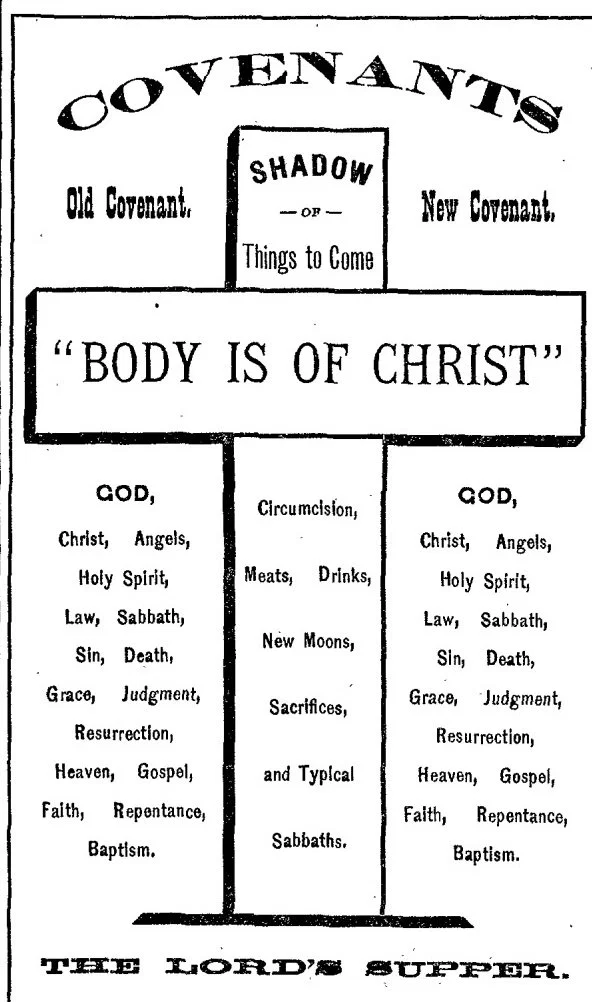
Then in what does the difference between the two covenants really consist? This can be readily shown by the use of the accompanying diagram:—
THE LORD'S SUPPER.
THE LORD'S SUPPER.
As previously shown, the death of Christ on the cross marked the close of the old covenant and the establishment of the new. So let the cross in the diagram represent the division between the two covenants, the space on the left side of the cross representing the old covenant, and that upon the right representing the new covenant. The question now under consideration is: What is embraced in the new covenant that was not in the old? or, to put it in another form, What did the old covenant contain that was abolished at the establishment of the new covenant?
We have arranged in parallel columns, one on each side of the cross, some of the more prominent points embraced in both covenants, which the reader can readily compare, and thus test the truthfulness of the positions designed to be maintained.
First in order, then, we ask, Does not the same being who has proclaimed himself unchangeable, and who was so prominent in all the arrangements of the old covenant, maintain his existence in the new covenant? And does not his hand still guide the destinies of the world? Certainly; no one would dispute this. Then, too, the name of Christ appears prominently in the new covenant. Did not the same Christ exert a controlling influence under the old covenant? In his letter to the Hebrews the apostle says that Moses esteemed the reproach of Christ greater riches than the treasures of Egypt. How could this be possible if Moses knew nothing of Christ? The facts are that Moses had a personal knowledge of Christ, and was furthermore guided by him in his movements with the people of Israel.
When God’s people started out on their journey from Egypt, God said to Moses, “Behold, I send an Angel before thee, to keep thee in the way, and to bring thee into the place which I have prepared. Beware of him, and obey his voice, provoke him not; for he will not pardon your transgressions; for my name is in him.” Ex. 23: 20–21. This being whom God sent to guide Israel, and to give instruction to Moses, had God’s name in him, or bore the name of God; hence the record of admonitions and directions of those forty years wandering says: “And the Lord said unto Moses.”
But who was this being so highly favored of God as to be intrusted with such weighty responsibilities? In his instruction to the church, Paul has spoken definitely on this point. He says: “Moreover, brethren, I would not that ye should be ignorant, how that all our fathers were under the cloud, and all passed through the sea; and were all baptized unto Moses in the cloud and in the sea; and did all eat the same spiritual meat; and did all drink the same spiritual drink; for they drank of that spiritual Rock that followed them [margin, went with them]; and that Rock was Christ.” 1 Cor. 10: 1–4.
The fact, then, is plainly established that Christ was the leader of the chosen Israel in the old covenant, and that they were so intimately connected with him as to receive a constant supply of “spiritual meat,” notwithstanding the oft-repeated assertion that the old covenant had no spiritual blessings. Who can deny that the people under the old covenant had Christ with them, without denying some of the plainest statements of Scripture?
Angels had a work to perform in connection with God’s people of old. This was so well understood by them that David, in describing God’s care for his people, boldly advocates the ministration of the angels. Thus he says: “The angel of the Lord encampeth round about them that fear him, and delivereth them.” Ps. 34: 7. But do angels maintain the same relation to the human family under the new covenant arrangement? We think so; for we read in Heb. 1: 14 that the angels are “all ministering spirits, sent forth to minister for them who shall be heirs of salvation.”
In the gospel dispensation so-called, the Holy Spirit takes a prominent part in the conviction of the sinner. Everywhere in the New Testament its operations and office-work are extolled, and we are warned against grieving it from us. But were its operations known, and was its influence sought as something desirable by the men of the Old Testament? Hear David plead, when he thought he had lost favor with God because of his terrible sin: “Cast me not away from thy presence, and take not thy Holy Spirit from me.” Ps. 51: 11. Evidently David felt that the loss of the Holy Spirit was equivalent to becoming a castaway, and as such, forever beyond the power of God’s mercy.
Again, Isaiah records the presence of the Holy Spirit with the people of God, and how they vexed that Spirit by their rebellion until God turned to be their enemy. Certainly all must acknowledge the operations of the Holy Spirit in the old covenant.
(To be continued.)

PERILOUS TIMES.

BY ELD. R. F. COTTRELL.
THE solemn warning which is laid down in prophecy as the last message of the gospel, accompanied by so fearful a threatening of wrath without mixture, implies great danger to the people living at the time of its fulfillment. It is given at a time when iniquity abounds, and the love of many waxes cold,—in perilous times, when those who have a form of godliness are self-lovers, money-lovers, and lovers of pleasures more than lovers of God. The commandments of God and the faith of Jesus are preached as a final test, to prepare a people for translation at the coming of the Lord. Rev. 14: 9-12. The danger is that the people professing godliness will be found breaking the commandments of God, and not walking according to the faith of Christ. If there was not great danger, so fearful a warning would not be given; but the warning must surely be given, for it is promised in the sure word of prophecy; therefore it is certain that the danger will be great.
The warning is now being sounded abroad in the world; but few will yield obedience to the commandments of God. Through the influence of the great apostasy predicted by the apostles, it is extremely unpopular to keep these statutes, as given by God himself. Ex. 20. On the contrary, many will follow the papacy, and accept the mark, or token, of its power to change the times and laws of God. Dan. 7: 25. And few will forsake the influence of a sinful world, and follow Him who “gave himself for us,” who “pleased not himself,” but “though he was rich, yet for our sakes he became poor, that we through his poverty might be rich;” but the many will be borne by the tide of worldliness downward to perdition.
The times are perilous. We are surrounded by dangers. Let no one presume, because he professes to believe and obey the message, that he is secure. “Let him who thinketh that he standeth, take heed lest he fall.” Having the light of present truth, our responsibility is increased. Never since the world began was there a more urgent call for labor in the cause of God. Souls are perishing for lack of knowledge. Those who have the light should hold it up, and let it shine to others. They who hold the solemn truths which we hold, should show by word and deed that they are not of this world. Covetousness, conformity to the world, pride and vain show should be put away. It should be seen that the cause of God has the highest place in our affections, that the eternal salvation of men is esteemed of the first importance, that we are dead to the world and alive to God.
Unless this is the case with us, how vain our profession! Worldlings may hail us as true fellows in fashionable folly, while inwardly they laugh at our profession and despise our transparent hypocrisy. We must get nearer to God, be sanctified through the truth which we hold, and have our hearts baptized into the work of the Lord. Then it will be seen that we are not of the world, but are chosen out of the world. Then shall we bring forth fruit to God. Sinners will be converted, the sealing message shall take effect, turning men from the traditions of apostasy to the commandments of God and the faith of Jesus.
Who would not have a part in the closing work of the gospel? What higher honor would we covet, than to bear a part in the present work of the Lord. What is more truly glorious! Men may reject and despise us; but what is it to receive honor of men, compared with being greatly beloved in Heaven? We may have our names written in the Lamb’s book of life. What is it to have them written with the proud and vain-glorious of perishing earth? Give me a part with the children of God!
Continue reading: BEFORE CONSTANTINE, A. D. 321