ZINC, which at the beginning of the European war was an unwelcome by-product of the more remunerative lead, copper, and silver mines, will have considerable credit for the good showing that our mines have made this year. It is hard to separate from the other metals, and before the war, had never brought more than seven and one-half cents a pound. The manager of the zinc mine in Nine-Mile Cañon reported to the stockholders in June, 1914, a loss of $91,000. But zinc is now in much greater favor, having risen for a time to the value of twenty-seven cents a pound.
With the demand for zinc incident upon the gigantic orders for war munitions from Europe, the zinc companies began work anew. “They worked the mines until the hoist cables shrieked; they sank new shafts, blasted new stopes, built new mills and new smelters, reopened old mines, searched the dumps and tailings for zinc ore discarded in the days of peace and poverty. From 343,418 tons in 1914, the country’s record production, the zinc output rose to 458,135 tons in 1915. And the value of the output soared from $36,000,000 to $121,000,000. Zinc producers contracted writer’s cramp indorsing checks.
“A single New Jersey zinc company paid out $11,500,000 in dividends the first five months in 1916, and a million of these profits went to a single stockholder. In Missouri, Wisconsin, Oklahoma, and Kansas the blood temperature of the zinc districts remained constant at 105. Every Far Western State shared in the windfall. California, for instance, in 1914 found zinc ores so unprofitable that only 400,000 pounds of the metal were produced. In 1915 the Golden State produced 13,000,000 pounds of zinc. The Duluth stockholders of the Idaho zinc mine, which lost $99,000 in the year preceding the war have received almost $4,000,000 — twice their total investment — in dividends since the beginning of 1915.
“The Butte and Superior was an old and respected copper mine in 1908, in which year Montana produced exactly 820 tons of zinc. But the owners of the Butte and Superior were uneasy. The copper ore was beginning to show an increasing percentage of zinc, and zinc was an unprofitable nuisance. They were afraid that the copper ore might give out and the mine turn into a zinc producer. With this fear gnawing at their hearts, they welcomed the chance to sell control of the property cheap.
“Their worst fears were realized. This year the Butte and Superior is producing no copper at all. Its entire output is zinc, almost 100,000 tons of it, only 5,000 tons less than the total amount of zinc smelted from all Missouri ores in 1914, and Missouri leads the zinc-producing States. Montana is now in second place, thanks to the output of a mine which earned four hundred and sixty per cent on its capital stock in 1915.
“At this writing, in July, zinc is selling for ten cents a pound, double the average of the past forty years, and production is still increasing. Prosperity is still dancing to the rhythmic rumble and clatter of the zinc mills, yet the wise producers are putting their houses in order. They know that zinc ores are fairly common on all continents, and that after the war American zinc will once more be restricted to the American market.”
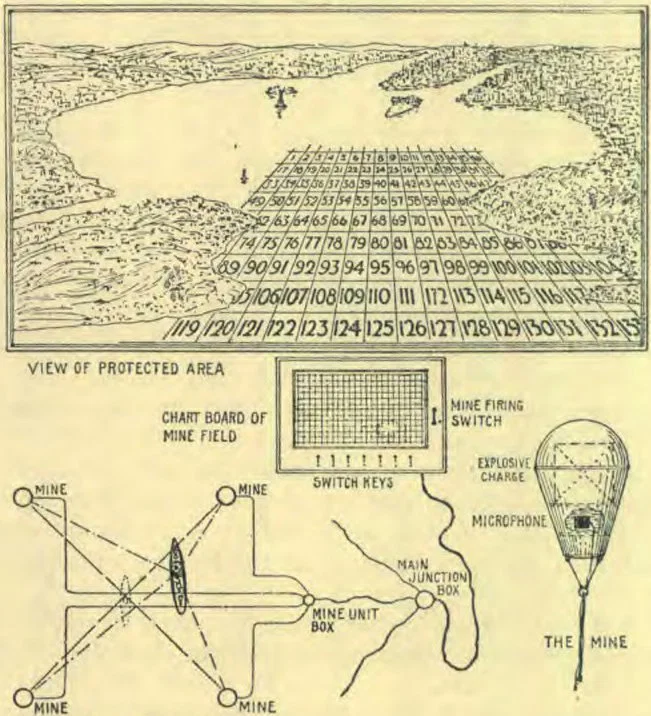
DIAGRAM OF MINE FIELD UNIT
— Unidentified
Questions
CAN you put the spider’s web back in its place
That once has been swept away?
Can you put the apple again on the bough
Which fell at your feet today?
Can you put the lily cup back on the stem
And cause it to live and grow?
Can you mend the butterfly’s broken wing
That was crushed by a hasty blow?
Can you put the bloom again on the grape,
And the grape again on the vine?
Can you put the dewdrops back on the flowers,
And make them sparkle and shine?
Can you put the petals back on the rose?
If you could, would it smell as sweet?
Can you put the flour on the husk,
And show me the ripened wheat?
Can you put the kernel back in the nut,
Or the broken egg in the shell?
Can you put the honey back in the comb,
And cover with wax each cell?
You may think my questions are trifling, dear;
Let me ask another one:
Can a hasty word ever be unsaid,
Or a deed unkind undone?
— Unidentified
The Ancient Condemnation
By Dr. Stough
The Tragedy of the Theater — No. 1
[The following article is from a chapter in Dr. Stough’s book, “Across the Dead Line of Amusements.” A notice of this inspiring and instructive book is given on page sixteen in this issue.]
The theater was intended, in its inception, to be the exponent of the drama, to further it in its work of education and culture, as one of the fine arts. But, because of the great revenues derived therefrom, the theater was soon organized as a commercial business, and as such was steadily developed until, within the past few years, so great has been the profit that it is now largely conducted as a consolidated trust, with an investment of millions of dollars in properties and in contracts with hundreds of actors and actresses.
Today every city in the country is being exploited, each has its various playhouses on what are called dramatic circuits. Companies, owned and operated by these trusts, are booked throughout the entire season. Into the coffers of these theaters pours a stream of millions of dollars spent each year by the pleasure-seeking public.
The theater has become a vital factor in American life, being one of the greatest teachers of the people, next in power to the press and the pulpit. As such it calls for the closest scrutiny and most searching inquiry upon the part of moral people. . . .
It may almost seem Don Quixotian for one to protest against the theater when some of the most moral and refined people, even of the churches and clergy, attend it, indorse it, and recommend it to their children and parishioners. How much good the presentation of the following arguments may do, I do not even venture to hope. If, however, they are in any way suggestive to inquiring minds and hearts, I shall feel amply repaid.
The Ancient Condemnation
Dramatic acting has existed from time immemorial, but even the ancient writers of moral truth, both Greek and Roman, frowned upon the theater and almost universally condemned it. Plutarch, Zenophon, Plato, Socrates, Solon, Seneca, Tacitus, Ovid, and many others have raised one common voice against it as hostile to morals. “An English writer in the time of Charles the First,” says Dr. Thomas Brainerd, “made a catalogue of authorities against the stage, which contains almost every name of eminence in the heathen and Christian world.” Plato once said, “Plays raise the passions and pervert the use of them, and of a consequence are dangerous to morality.” Aristotle said, “The seeing of plays and comedies should be forbidden to young people until age and discipline have made them proof against debauchery.” Tacitus said, “The German women were guarded against danger and preserved their purity by having no playhouses among them.”
Uhlhorn, writing of the theater in the Roman Empire, said, “The adventures of deceived husbands, adulteries, and amorous intrigues formed the staple of the plots. Virtue was made a mock of, the gods were scoffed at, and everything worthy of veneration was dragged in the mire.”
Philip Schaff, the historian, said, “The Roman theater became more and more the nursery of vice, and deserved to be abhorred by all men of decent feeling and refined taste.” Dramatic art took its rise at Athens, we are told, amid the orgies of Bacchus. “It was an exhalation from the frantic revels of a periodical national abandonment to intoxication and debauchery.”
All this was said about theaters where women never appeared, when their parts were acted by men and boys, as is the case at the present time in the Chinese theaters.
It is said no woman ever appeared on the stage until the time of the Restoration. The first time a woman ever acted was in Shakespeare’s “Othello,” in the part of Desdemona. It was regarded at first, Dr. Brand says, as shocking and monstrous.
Woman’s presence did not purify the stage, for Macaulay declares that from “the time the theaters (in England) were opened they became seminaries of vice. Nothing charmed the depraved audience so much as to hear lines grossly indecent repeated by a beautiful girl supposed not yet to have lost her innocence.”
The Church and the Theater
The church has tried both methods, to condemn and to condone. Dr. W. P. Breed said, “There was a theater in Jerusalem in the days of Jesus. Think you he ever attended it? Did the early disciples? So far from it that neither Jesus nor the apostles ever thought of forbidding their attendance upon stage plays.” When Herod introduced this theater, Josephus (not a Christian) denounced it as corrupting the morals of the Jewish people.
The church very early introduced into her conditions for membership an express prohibition against the theater. Dr. Tayler Lewis says, “At baptism the candidate was called upon to say ‘Vanis mundi pompus renuntio’—‘The vain pomp of the world I renounce.’ It can be clearly shown that this word ‘pompae’ was employed with special reference to theatrical shows.” Theophilus, Tertullian, St. Cyprian, St. Augustine, all denounced it.
The mystery and miracle plays were introduced during the Middle Ages and were acted very widely. The art of printing being not yet known, it was thought the people could be taught spiritual truths from the stage. However, the results were never satisfactory, and finally were deteriorating. Lecky says that after the thirteenth century they became one of the most powerful agents in bringing the church, and, indeed, religion, into disrepute. Reformers then tried to correct abuses. “Two hundred clergymen,” says Mrs. Mowatt, the actress, “wrote for the stage, but all in vain!”
Dr. Brainerd says that fifty-four ancient and modern general, national, and provincial synods, both of the Eastern and Western churches, have pronounced against the theater, and that the condemnatory sentence of seventy-one ancient fathers, and one hundred and fifty modern Catholic and Protestant writers, are on record. Conferences, assemblies, synods, associations, have all with one voice registered their protest. All these could not have been without worthy reasons, and it is to set forth these reasons that I am writing these words.
Patient Trying: Verse on Perseverance
“If you’ve tried and have not won,
Never stop for crying;
All that’s great and good is done
Just by patient trying.”
Why I am a Christian
By Florence Whaley
“KINDLY tell me why you are a Christian.” As I looked into the anxious, troubled face of the speaker, and read there the need of the Christ life, my gratitude to God for the blessings that have been mine thus far in the Christian way seemed almost overwhelming. A stronger, deeper love for God took possession of my heart, and I replied with fervor, “I am a Christian because I love my Lord.” “Yes,” came the response, “I believe you do; but why?”
My questioner’s voice and manner betrayed an earnestness she fain would have concealed had she been aware of it. This very attitude touched a responsive chord in my heart, instilling there a desire to give just the message she needed most. Without opening my Bible, I repeated slowly and very softly those words fraught with untold value to every believer in Christ, “God so loved the world, that he gave his only begotten Son, that whosoever believeth in him should not perish, but have everlasting life.” I told her I believed God. I dwelt upon the sacrifice of the Father, the agony it must have been to him who is all love and compassion to offer his only Son for our redemption. I spoke of the willingness of that Son to die for man. Then simply and freely I recited the story of the Saviour’s birth into this world of misery and sin, of his lowly life, of his ministry, of his crucifixion, and of his present work of intercession.
Evidently convicted, but not yet willing to fall upon the Rock to be broken, she rose suddenly, and with the words, “Yours is indeed a beautiful faith,” left me to myself. As I sat there alone with my thoughts and God, I meditated long upon the conversation that had ensued, and as I recall it today, I can truly say that I am a Christian because I love the Lord. And why should I not love him, when he lived, died, rose, and now pleads for me? His is the wonderful love, so wonderful that finite minds cannot comprehend it. So I do not attempt to fathom it, but accept it in simple faith, and endeavor to show my appreciation by a life of consecration to the Giver.
Then, too, the work committed to the Christian appeals to me. And this ministry for Christ is not confined to a few, but it includes you, me, all who name the name of Jesus, and in its accomplishment a foretaste of heaven is given to Christ’s followers. One who has experienced the blessedness of this service for the Master, can testify to the peace and satisfaction it brings. No worldly pleasure or gain can compare with the joy that fills the heart of him who is enabled not only to relieve physical suffering, but to point the afflicted one to the divine Healer of both soul and body. The fellowship with Christ that constitutes us his channels of blessing to others, would alone compensate the Christian.
Again, I might say I am a Christian because I need to be; I need such a loving, loyal friend as Christ has proved himself to be; I need the counsel, the comfort, that come to me through his Word; I need the consolation, the inspiration to a higher and holier life, that come through communion with him. And why not treasure as a priceless gift the friendship of One whose fellowship proves a power in the life, helping us to rise above the trials, disappointments, and discouragements that continually confront us? Christ is Lord of all, yet he takes notice of even the sparrow, and he assures us in his Word that we are of more value than many sparrows, and that even the hairs of our head are numbered. Could earthly love and guardianship be compared with such watchcare? Surely we ought to count it a privilege to be called the friend of Jesus.
Lastly, I am a Christian because I desire a home in the kingdom of God, a kingdom that will have no end, a place where sickness, sorrow, parting, and death will not be known, but where we shall live on and on to enjoy that which through the mercy and goodness of God has become our possession. I like to think of dwelling forever in a place where the mark of sin and degradation will never be seen, but where the love of God will fill every heart and be the ruling power in every life. This home in the new earth is very real to me. I think of it as a place that will not be darkened by the shades of night, as a place where we can roam through the fields and woods without fear of beast or reptile or any such thing; for you remember that there the lamb shall lie down with the lion, and that even a little child shall have no fear. And as I read the last two chapters of Revelation, I try to form a picture of the city of God, its streets, walls, and mansions prepared for the faithful. I picture myself and other redeemed ones there enjoying its riches and glories; and brightest and best of all is the thought that some day I shall see my Saviour face to face. I have read of him, I have studied picture representations of him, but what will be my feelings when I come into his living presence, behold the head that was crowned with those cruel thorns, see the prints of the nails in his hands, and hear from his own lips the story of creation, man’s fall, and the price of his salvation!
FLORENCE WHALEY.
What One Book Did
Recently Mr. E. R. Button went from Takoma Park, D. C., to Riversdale, Jamaica, to take charge of the printing work in that field. He relates the following interesting incident showing the good our temperance literature is doing. He says:—
“Before Brother Haines severed his connection with the Watchman Press and went back to the States, he sold a copy of ‘The Shadow of the Bottle’ to Conductor L. E. Johnson, of Spanish Town, Jamaica. For the past seventeen years Mr. Johnson has been an employee of the Jamaica government railroad, and has performed his duties faithfully. So far as known, he has had but one enemy, and that enemy was rum. After reading ‘The Shadow of the Bottle’ and carefully weighing the evidence, he decided to forever part company with this enemy. He did so. He is now so attracted by the idea of a clean life, that he is reading ‘The Other Side of Death,’ which the writer delivered to him one day on the train. He is anxious to read all books published by this denomination.”
For the Finding-Out Club
Name these two animals, and write a description of each.
The Morning Hymn
By F. E. Weatherly
Now the night is over,
Now the dark is past,
Angels sweet uncover
All the world at last.
Ere the sun is higher
With his golden rays,
Let us sing together
Hymns of thanks and praise,—
Thanks to God who kept us
Safely through the night,
Bade his angels wake us
At the morning light;
Thanks to him who gives us
All the daylight hours,
Wood and hill and meadow,
Birds and trees and flowers.
And as he has kept us
Through night's shadows gray,
He will also keep us
Safely through the day,—
Safe from tears and sorrow,
Pure from doing wrong,—
And accept our praises
And our morning song.
—F. E. Weatherly.
Little Five’s Image
By C. P. Lillie
RECENTLY I spent the Sabbath at a village in the northeastern part of Shantung, China. The season was dry, the crops were suffering severely, and the people were complaining bitterly. “We have been praying for rain daily,” they said, “but it does not come, and our crops are drying up. Why does not Tien has ye (Lord of heaven) send rain?”
The occasion brought to my mind a simple little story told by my language teacher. He says the tale is true, and the incident happened near his home.
About fifteen years ago, in a little country village in Shantung, lived a family by the name of Djang. In fact, most every one that lived there was named Djang, so the place was called Djang Village.
This particular Mr. Djang and his family kept a little shop where paper houses, horses, cows, and servants were made to be burned at funerals. These wonderful creations of paper and bamboo take long weary hours to make, but “go up in smoke” in a very short time. The Chinese think that by this means, the paper houses and animals are wafted into the spirit world, there to minister to the comfort of the departed.
No village of any size in China would be complete without its shop where these paper things are made. Sometimes the proprietor of the shop sells coffins also. I met a Chinese a few weeks ago, who was both doctor and undertaker and dealer in funeral trappings at the same time. Rather a suspicious combination of affairs, it seemed to me.
To return to the subject: Mr. Djang had five sons. I do not know how many daughters, because I did not ask especially, and in China when you ask for the number of children in the family, girls are not included in the answer unless your inquiry is quite specific.
One of Mr. Djang’s sons is the hero of this story. He was called Little Five, after the way boys are mentioned in this country, according to the order of their coming. I suppose his father and mother called him Little Dog or something like that, for he was only a small boy and had not received a real name yet.
One day Little Five was out in search of some way to amuse himself, and came to the almost dried-up bed of a pond. He saw great possibilities in the moist clay that was there, and an idea occurred to him. He would make an image out of the clay, and call it the Lung Wang, or dragon king.
So he set to work to fashion the image. Being a clever boy, he did his work well. After the image had stood in the hot sun for some time and become quite hard, he pasted yellow paper on its forehead and cheeks in imitation of the gilded faces of the idols in the temples. The Lung Wang was complete.
The Lung Wang, or dragon king of the Chinese, is the god of rain. In most every village in dry Shantung, there is a temple dedicated to this rain god. If the season is dry, the people always appeal to Lung Wang to help them.
Sometimes in case of extreme drought, they form a procession to escort the image through the villages. As the escorting party, heralded by the beating of drums and the clanging of cymbals, enters a village street, all the people uncover their heads. And as the image passes by each house, some of the inmates rush out with water and dash it upon the image or more frequently on the men who bear it. Other ceremonies are connected with the occasion.
Little Five had observed such a demonstration some previous year. He knew the crops were suffering. He himself had made a rain god, and would take in hand the matter of making special appeal for rain. He gathered his comrades together, and they escorted the little clay image through the village streets as nearly as they could after the fashion of their elders. It was fun.
The village people paid little attention to the childish prank. They were probably too busy moaning about their parched fields. No one honored the image that Little Five had made, by throwing water upon it. I think Little Five took care that his comrades didn’t throw water, for his image was made of clay and not of wood, like the regular rain god of the village.
That night it rained. It was a fine rain, and came just in time to save the crops. In the midst of the general rejoicing it occurred to some one that Little Five’s image which had been borne through the streets was the cause of the rainfall. The idea once broached immediately found favor. One and all declared that Little Five’s image was possessed with special favor. It was reverently placed in a shed prepared for it, and a thanksgiving service was held in its presence. It was worshiped.
Following this occasion, the people began to make up a subscription fund, and after the crops were harvested it was expended in a theatrical performance expressive of their gratitude to the dragon king.
In the meantime how about Little Five’s image?12Why, he had long ago come and demanded it, and had taken it home with him to play with. No one hindered him, for it was his. They had already honored the little idol, and what more did it matter? Did they not already have a rain god in the village shrine? and was not one rain god enough? If the fields needed rain again they could go to him, as they had done so many times before.
Here the story closes, unless this narrative, as I trust it will, may excite pity and love in some heart for these poor people who are living in such dense darkness, and whose grasp on divine things is so frail.
C. P. LILLIE.
Youthful Workers
By M. E.
(Texts for October 1 to 7)
MORE than two thousand years ago, according to the story that has come down to us, Diogenes, with a lantern in his hand, went up and down the streets of Athens looking for a man. Greece was seeking for men and women who would work loyally for the welfare of the nation, and endeavor to idealize the homes of her people. Every country is looking for such young men and women. Every church is wishing, praying, and searching for them.
There always has been a demand for young men and women who were as true to principle as the needle is to the pole; for young people who have been altruistic enough to get out of the dark, narrow rut of self-living, and cast their lives into the furrow of the world's great need. There have been such young men and women in the past; there are such young people today. You find them in legislatures, in colleges, in pulpits, on battle fields, in heathen lands—yes, everywhere.
The world always makes room for the young person who tries to fill his place with unselfish service. Some one has said that every great enterprise has a young person at its heart or at its head. History shows how young men have put their shoulders to the wheel of national, political, esthetic, and missionary progress. Let us notice a few cases: Alexander the Great, when a youth of about twenty, crossed the Hellespont and saved Greece from Asiatic rule. At the same age, La Fayette was a major general in the United States Army. At twenty-eight, Napoleon had changed the map of Europe. Washington was a major at nineteen. Think of Hamilton, a lad of seventeen, stirring his country in behalf of the cause of liberty! See Wilberforce and Gladstone step into Parliament when only twenty-two.
Look into the realm of science: George Stephenson, when a boy of only nineteen, had in his mind a very good plan for a steam engine. Alexander Graham Bell was a young man when he sent through the crude telephone he had invented the first spoken message ever carried over wires. Newton had completed many of his great discoveries before he was twenty-five. Maria Mitchell became a famous astronomer during her twenties.
Through the arteries of music, literature, and art, the blood of youth courses freely. Beethoven was a prominent musician at twenty-one, Bach at nineteen, Mozart at seventeen. Milton wrote “Comus” before he was twenty-six. Bryant was only nineteen when he wrote “Thanatopsis.” Michael Angelo was a very promising artist at seventeen. At thirty, Reynolds was the greatest portrait painter in England.
Coming to the work of the church,—the greatest of all world work,—we find young men and women in the forefront of its “far-flung battle line.” Charles Spurgeon became the pastor of a church when he was only eighteen. At twenty-five Huss had fought mighty battles for the truth. Roger Williams at about thirty-one was banished because of the religious liberty principles13he advocated. David Brainerd, at twenty-nine, had finished a career among the North American Indians that has given hundreds a desire to enter the Master's service. Luther was only twenty-nine when he nailed his theses to the door of the Wittenberg church. Wesley and Whitefield began the great revival of the eighteenth century while students at Oxford. Melanchthon was a teacher of Greek when only twenty-one. Calvin had published his “Institutes” when he was twenty-six.
To this list of noble young workers, could be added many names from our own church. Many of our leaders, Elders Daniells, Evans, and Spicer and others, entered the ministry when they were mere boys, about twenty-one years of age.
Sacred song has a large place in church work, and it is interesting to know that many of the heaven-sent messages have come to us through the pens of youthful writers. Take for instance, “Jesus, Lover of My Soul,” which one writer has called “the greatest hymn ever written.” That song has brought peace and comfort to aching hearts in all lands, is among the first sacred songs to be lisped by childhood and the last to linger on the lips of the dying sufferer. Henry Ward Beecher once said of it: “I would rather be the author of that hymn than to have the wealth of the richest millionaire in New York. He will die and pass out of men's thoughts. He will have done nothing to stop trouble or encourage hope! . . . But that hymn will go on singing until the trump brings forth the angel band.” And this hymn, which has done and is doing so much good in the world, was written by Charles Wesley when he was only about thirty years of age.
Such Bible characters as David, Daniel, Paul, and a score of others challenge young people to become efficient workers for God. So, also, do the brave young men and women who blazed the foreign missionary trail. When the century of modern missions dawned, we see William Carey, at thirty-three, pressing into India; Robert Moffat, at twenty, starting for Africa; John Williams, at the same age, sailing for the South Sea islands. David Livingstone, when twenty-seven, went to Africa. Robert Morrison, when twenty-five, entered China. When about twenty-four, Adoniram Judson began work in Burma. Allen Gardiner was a comparatively young man when he landed on the shores of South America. And with most of these young men, were equally brave young women. Should we turn our telescope upon the mission fields today, we should find that by far the majority of workers who are entering upon service there are young men and women, no older than those who blazed the trail in heathen lands one hundred years ago.
One thing is noticeable: When God wants a worker, he calls a worker. He does not search for the idle young man or woman. He calls the busy one. Moses, David, and Amos were all busy with their flocks when God called them; Elisha was busy plowing with twelve yoke of oxen; Nehemiah was busy bearing the king's cup; Peter, Andrew, James, and John were busy fishing and mending their nets; Matthew was busy collecting taxes. The same is true today. God can use only the young people who are busy improving their present opportunities.
Much of the comfort and hope we enjoy today, comes to us through the faithfulness of young men and women of the past. To all of them we owe much; but we are in a special way indebted to those who served in God's great army of soul-winners. Their poverty and self-sacrifice have made us rich. What have they bequeathed to us? They have left records of their noble lives which should inspire us to live for others, records of their experiences to guide us in service, and rich harvest fields for us to reap—harvests grown from seeds sown by their faithful hands, watered with their anxious tears, and blessed by their earnest prayers.
“They climbed the steep ascents of heaven
Through peril, toil, and pain.
O God, to us may grace be given
To follow in their train.”
My dear young friend, the world's greatest need today is of young men and women who will “follow in their train.” That is the need of the world! of the church! of our church! You are not too young to follow. Samuel was a very small child when his mother lent him to the Lord. Our Saviour when only twelve years old asked, “Wist ye not that I must be about my Father's business?” In the early advent movement children helped preach the message of our Saviour's return, and the Spirit of prophecy tells us that children will do a similar work before the close of time. Let us thank God for the host of young people who are trying to live “to bless others” just as their Master did; and let us thank God that it is our privilege to do the same.
“'Tis ours to make earth's desert glad,
In its Eden greenness clad;
Ours to work as well as pray,
Cleaning thorny wrongs away;
Plucking up the weeds of sin,
Letting heaven's warm sunshine in;
Standing on the hills of faith
Till upon earth's grateful sod,
Rests the city of our God.”
MEDITATION.—As I study the texts this week, I feel especially grateful that God can use young people in his work. I am reminded that the Spirit of prophecy says, “The Lord has appointed the youth to be his helping hand.” May God help all our young people to appreciate the great privilege of being God's “helping hand.” How shall I learn to appreciate this privilege more fully? How can I help others to see that it is their highest calling in life? A Christian worker once said: “If God has called you to be a missionary, don't dwindle into a king or a millionaire.” I am thinking of a man near here who recently purchased fifty sections of land in another State. But it is a greater privilege to be a soul-winner than to be the owner of that fine sheep ranch of 32,000 acres. Yes, and greater than the privilege of holding the scepter of any country in the world is the privilege of being “His helping hand” to save others. I am so glad he has chosen our young people. And I pray that no flattering temptation will cause them to dwindle.
SPECIAL PRAYER.—This week let us pray for pureness of speech. Let us notice carefully the words that slip from our tongue. Are any of them bitter? unkind? untrue? cutting? sarcastic? caustic? Does any slang escape? any fault-finding? murmuring? criticism? Are any of them liable to wound others? He whom we serve is able to bring into captivity every thought. Let us ask him to do this, that the words of our mouths may “be acceptable” unto him.
M. E.
A New Year's Gift
By H. A. Niergarth
ONE New Year's Day four employees of a German merchant in Paris, came to give him New Year's greeting. “I am glad that you have come,” said he to them, “I have remembered you, and have laid aside for each a sum of three dollars or a Bible. You may have your choice. But I would advise you to choose the Word of God.” The oldest of them answered: “I would willingly take the Bible; but you see, my lord, I cannot read; if it seems all right to you, I should like to—” “You would prefer the three dollars?” said the merchant. “I gave you the free choice, here is the money.” The second and third likewise gave forcible reasons, in spite of the kindly appeals and recommendations of the merchant, why they desired the money. But the last, a young man, replied: “I prefer the Bible, of which you speak. It is good and necessary.” “You are right, my friend,” said the merchant. “Take this Bible and read it diligently.” As the young man took the book and opened it, there rolled toward him a ten-dollar gold piece. He looked at his master astonished and inquiringly. The merchant said: “Take the gold, it is yours; the others would have found the same in their Bibles; I am sorry that they valued the money more than the Bible.”—German Youth's Friend. Translated by H. A. Niergarth.
Initial Characteristics
I TRIED this parlor game, and it afforded much amusement. It is called “Initial Characteristics.” The players form a cozy circle. Three judges are appointed. Start with any player, called the initialee, who gives his name and initials. Then each of the players, except the initialee, takes a turn at nicknaming the given initials, remembering to consider closely the habits, eccentricities, etc., of the initialee. When all have suggested a nickname for the first initialee, the player at the left gives his name and initials, and so on around the circle. The winner is the player who in the opinion of the judges gives the most appropriate or funniest nicknames.
Some of the best were: —
C. E. Platte Physician Charge Enough Platte
B. F. Cherry Coal and Wood Burn Fine Cherry
M. L. Hurdy R. R. Engineer Maine Line Hurdy
J. D. Lynch Attorney Justice Don’t Lynch
— Selected.
E. C. JAEGER
By E. C. Jaeger
We admire most
Who to duty's post
Will bravely stick
Through thin and thick;
Who with courage strong
Will meet the wrong,
And thus defeat
The foes they meet.
E. C. JAEGER
Abiding
By Max Hill
Thou, Lord, the foundations of earth hast laid; The heavens above by thy hands were made; Thy wisdom doth ever their course ordain; Forever and ever thou dost remain.
They all as a garment wax thin and old, And thou as a vesture the earth dost fold; They all shall be changed, though thou dost stand, For all things are possible in thy hand.
We therefore would give the more earnest heed, And daily abide by our first love’s creed, Lest haply, by word of a careless lip Or action unguarded, we let it slip.