“REMEMBER the Sabbath day, to keep it holy. Six days shalt thou labor, and do all thy work; but the seventh day is the Sabbath of the Lord thy God: in it thou shalt not do any work, thou, nor thy son, nor thy daughter, thy manservant, nor thy maidservant, nor thy cattle, nor thy stranger that is within thy gates: for in six days the Lord made heaven and earth, the sea, and all that in them is, and rested the seventh day: wherefore the Lord blessed the Sabbath day, and hallowed it.” Ex. 20:8-11.
Thus reads the fourth commandment. In thousands of churches it is read every Sunday, and all the congregation unite in saying at its close, “Lord . . . incline our hearts to keep this law.” And yet it is not kept, because the day which the commandment says must be observed is the seventh day, while people in general keep the first day of the week, a day not mentioned in the commandment, except as included in the “six days” in which work may be done.
It is a fact that the seventh day of the week is the day commonly called Saturday.
It is a fact that the people who heard the words of the law spoken directly to them from Mount Sinai, did observe the seventh day of the week in obedience to that commandment, and to this day still hold that it is the Sabbath, whether they keep it or not.
It is a fact that the Jews in the wilderness, and for centuries thereafter, were under the direct leadership of the Lord himself, the Lord manifesting himself to them, and talking with them and their leaders as he has never done with any other people.
It is also a fact that when they were the most closely connected with the Lord, and his presence among them the most marked, they were the most faithful in their observance of the seventh day.
The fact that the Jews kept the seventh day of the week while the Lord who spoke the fourth commandment was personally conducting them, shows that God meant just what he said, and that the fourth commandment does require the observance of the seventh day of the week, which alone is the true Sabbath of the Lord.
Further, it is a fact that the commandment cannot mean two different things. The words, “The seventh day is the Sabbath of the Lord thy God; in it thou shalt not do any work,” cannot mean both the seventh day and the first. Neither can they refer to either one of them indifferently. Neither can they mean anything different now from what they did when first spoken and written. If they apply to the first day of the week now, then they must always have meant the same day, and in that case the ancient Jews must have been wrong in their practice, and the Lord must have encouraged them in that wrong.
But such a supposition is impossible. The fact that God specified by daily miracles for forty years, just which day they should observe, shows, as before stated, that the seventh day of the week—Saturday—and that only, is the day which the commandment enjoins.
This being the case, those who hear the commandment read every Sunday should either cease responding, “Lord . . . incline our hearts to keep this law,” or else should begin to keep it; for it is certain that the fourth commandment can no more be obeyed by resting on Sunday, than the first commandment can be kept by worshiping Jupiter.
But some one will ask, “Has not the commandment been changed?” We do not find in the Bible any record of a change. If the commandment has been changed, so as to warrant Sunday observance, why is it that the revised law is not read in any of the churches? If people really thought that the commandment had been changed, it would be very strange for them to keep on for years reading the old commandment, which enjoins another day from that which they keep. No; the commandment has not been changed, and nobody really thinks that it has been.
“But surely the day has been changed.” Nothing can show the weakness of this position any better than the statements of those who hold to it. Read what the Vicar of Burgh, Lincolnshire, in a tract intended to show the necessity of Sunday observance, says about the matter:—
When Christ’s life on earth was ended, and he had ascended to heaven, a change was made as to the day which was to be kept holy. . . . Before Christ’s coming, the seventh day was kept holy in remembrance of the finished work of creation. After his ascension, the first day was sanctified in remembrance of the completed work of redemption. This change was made by the apostles in obedience to the will of Christ. We are not told of any words of his in which he gave this direction.
Just think of it. It is said that the apostles made the change in obedience to the will of Christ, and yet we nowhere find the words in which he gave the direction, nor even any words of the apostles, in which they intimate that such a direction ever was given! How then do men know that it was given? They do not, and never can know that it was. For no one can know that a thing is so when it is not so; and the fact that there is no record of any such change, is evidence that no such change was ever made. Christ ascended to heaven without saying anything about a change in the day. The apostles all died without ever saying anything about it, or even intimating that Christ ever said a word about it. But some men say that the change was made by the disciples in obedience to the will of the Lord. Let them produce the inspired record before they try to make people believe it.
No; the day remains the same, and will remain unchanged throughout eternity. But the people have changed. The great apostasy began, and the people insensibly drifted away from the standard of Christ and his apostles, under the influence of surrounding paganism. Then the apostasy culminated in the papacy, which thought to change the times and the349laws, so that the customs of the people were taken as the standard of right, instead of the Bible. And that is how people now keep Sunday instead of the Sabbath.
But custom cannot make a thing any different from what God has established it. “The customs of the people are vain.” Jer. 10:3. The traditions of men are the transgression of the commandments of God. This matter of custom against the word of the Lord is strikingly set forth in the following from John Bunyan’s famous “dream.” Christian was on his journey, when—
He espied two men come tumbling over the wall on the left hand of the narrow way; and they made up apace to him. The name of one was Formalist, and the name of the other was Hypocrisy. So, as I said, they drew up to him, who thus entered with them into discourse.
Chris. Gentlemen, whence came you, and whither go you?
Form. and Hyp. We were born in the land of Vain-glory, and we are going for praise to Mount Zion.
Chris. Why came you not in at the gate which standeth at the beginning of the way? Know ye not that it is written, “He that cometh not in by the door, but climbeth up some other way, the same is a thief and a robber”?
F. and H. They said that to go to the gate for entrance was, by all their countrymen, counted too far about; and that therefore their usual way was to make a short cut of it, and to climb over the wall as they had done.
Chris. But will it not be counted a trespass against the Lord of the city whither we are bound, thus to violate his revealed will?
F. and H. They told him that as for that he need not trouble his head thereabout; for what they did they had custom for, and could produce, if need were, testimony that could witness it for more than a thousand years.
Chris. “But,” said Christian, “will it stand a trial at law?”
F. and H. They told that custom, it being of so long standing as above a thousand years, would doubtless now be admitted as a thing legal by an impartial judge. “And besides,” said they, “if we get into the way, what matter is it which way we may get in? If we are in, we are in: thou art but in the way, who, as we perceive, came in at the gate; and we are also in the way, that came tumbling over the wall; wherein now is thy condition better than ours?”
Chris. I walk by the rule of my Master; you walk by the rude working of your own fancies. You are counted thieves already by the Lord of the way. You came in by yourselves without his directions, and shall go out by yourselves without his mercy.
To those who plead “custom” as a sufficient reason for keeping Sunday instead of the Sabbath, let me ask, “Will it stand a trial at law?”
OUR UNWRITTEN CONSTITUTION.
By Addison Blakely
[By Addison Blakely, Ph. D., Lecturer in Political Science and History, University of Chicago.]
THE written constitution is a political growth. For centuries of early political history constitutional law was merely a matter of tradition and memory; but repeated struggles for freedom emphasized the value of the pen and ink sketch of what the law was. So we have in history the Magna Charta, the Bill of Rights, the Petition of Right, the Declaration of Independence—all foreshadowing the Federal and State Constitutions of to-day. These fundamental principles of government are what constituted the unwritten constitution of the past, and in accordance with the modern idea of supremacy of fundamental law these old constitutional principles were declared to be of paramount authority.
Magna Charta had scarce been given to the English nation when it was redeclared and the provision added that any decree contrary to the rights therein secured, was void and of no effect. This appears to have been the first great statutory declaration of the nullity of any legal act contrary to fundamental law; it was, however, merely the statutory recognition of an already established constitutional doctrine.
This unwritten constitution was known as the common law,—as distinguished from custom law and statute law,—of the English peoples. It was called common law because it concerned and was common to the whole people. This common law was brought over from England with the colonists and forms the basis of the constitutional rights and liberties of the American people.
“The common law of England,” says Judge Cooley, in his “Constitutional Limitations,” “consisted of those maxims of freedom, order, enterprise and thrift which had prevailed in the conduct of public affairs, the management of private business, the regulation of the domestic institutions, and the acquisition, control and transfer of property from time immemorial. It was the outgrowth of the habits of thought and action of the people, and was modified gradually and insensibly, from time to time, as those habits became modified, and as civilization advanced, and new inventions introduced new wants and conveniences and new modes of business. Springing from the very nature of the people themselves, and developed in their own experience, it was obviously the body of laws best adapted to their needs, and as they took with them their nature, so also they would take with them these laws wherever they should transfer their domiciles from one country to another.”
“To eulogise the common law is no part of our present purpose,” continues the jurist. “But, on the whole, the system was the best foundation on which to erect an enduring structure of civil liberty which the world has ever known. It was the peculiar excellence of the common law of England that it recognized the worth, and sought especially to protect the rights and privileges of the individual man. Its maxims were those of a sturdy and independent race, accustomed, in an unusual degree, to freedom of thought and action and to a share in the administration of public affairs; and arbitrary power and uncontrolled authority were not recognized in its principles. Awe surrounded and majesty clothed the king, but the humblest subject might shut the door of his cottage against him, and defend, from intrusion, that privacy which was as sacred as the kingly prerogatives. The system was the opposite of servile; its features implied boldness and independent self-reliance on the part of the people.”
American law is full of praise for this great body of law on which our own Constitution is based. “No one who is familiar with the common law of England,” declares Justice Miller, of the United States Supreme Court, in his lectures on the Constitution, “can read the Constitution of the United States without observing the great desire of the convention which framed that instrument to make it conform, as far as possible with that law.”
And from this ancient source it was that we get the barrier that forever seals with disapproval and illegality any law interfering with religious freedom. The great Justice Mansfield, in stating this principle of law, declared: “Persecution for a sincere, though erroneous conscience, is not to be deduced from reason or the fitness of things [the test of what constitutes the common law].”
Early in the reign of George III., this constitutional principle was asserted in a judicial decision of the House of Lords, as follows: “There is nothing certainly more unreasonable, more inconsistent with the rights of human nature, more contrary to the spirit and precepts of the Christian religion, more iniquitous and unjust, more impolitic, than persecution. It is against natural religion, revealed religion, and sound policy.”
It was already a maxim of the common law five hundred years ago when Europe was deluged with the blood of martyrs. And it is this same constitution now, written and unwritten, that will be the sole protection of the statute-persecuted Christians of Tennessee and elsewhere. When legislatures, public sentiment and officers have no longer any sympathy for the persecuted, the followers of Jesus of Nazareth will have only what protection the Constitution can give. To the Charters of Justice alone can they cling, for all else fails when friends have failed.
RELIGIOUS LIBERTY—CHURCH AND STATE.
By Chas. Foley
[Chas. Foley, in Patriot Phalanx.]
THE word “religion” has such a worldwide meaning, and is used by people to express so great a variety of sentiment and things, that to understand its use in a given instance by any one, it is indispensably necessary to look and enquire outside of the word itself, and to study the person using it, and the circumstances under which used. I doubt whether there is another word in our language in as common use, that requires so much care to get at the meaning of the person using it. When the word religion is used to express a man’s highest and noblest conceptions of duty and obligation, then I think we will all agree that all men should carry such religion with them into the shop, the field, into politics, in short, with them wherever they go, and in all they do, whether as private citizens or public servants.
A man’s religion, whatever it is, whether exalted or low in conception, is purely an individual matter and can never be otherwise. A State can have no religion, any more than a bank or a railroad can. The maxim of the law books that “a corporation has no soul,” is true. A State cannot propagate religion, or oppose its propagation, but it can use its police and military power to propagate and oppose the views and opinions of individuals as to what constitutes religion, its origin, its use and the office it performs in this life, and any life hereafter. A man should not, no man has the right, to carry his religious views into a public office and use political power to advance the ends of his creed or church, or enforce his religious views on others. No one wants the State to assist in the dissemination of religious views with which he is not in harmony, or to oppose his own.
Many Christians claim that Christianity itself is repugnant to all attempts on the part of the State to propagate it, and earnestly oppose the exercise of such power. I have just read a production of Dr. E. T. Hiscox, author, with other works, of the “Baptist Church Directory,” a standard work among Baptists. He says:—
The “Baptist position” in respect to the relation of religious and secular affairs, is this: There should be no union of Church and State, but an entire separation between them in all matters pertaining to the administration of religious affairs. They represent two kingdoms, with distinct spheres and diverse functions, which cannot be united without injury to both. The State has no right of authority or of dictation in matters of faith or worship, which are questions of conscience and principle that lie between the individual soul and God. The State is bound to protect its citizens in the free exercise of their religious faith, without harm or hindrance, so long as they do not interfere with the rights of others. Christians should be good citizens, supporting the government which protects them, honoring the rulers and obeying350the laws under which they live, so long as such laws are not contrary to the Word of God. The Church should sustain no organic relation to the State, and receive no patronage or support from it, since to do that would imply the right of supervision and dictation by the State. The support of religion belongs to those who profess it, and to allow fellowship and accept patronage from the State never fails to secularize the spirit and to corrupt the purity of the Church. The civil authorities have no right to enforce or demand any form of faith, any manner of worship, nor yet to establish by law or compel the observance of a sabbath, or any religious institution. It has no right to force conformity, or to punish dissent. Baptists to-day are loyal to their traditions through all the past. What they have demanded, labored for, and suffered to secure, is not toleration, but liberty; liberty in all concerns of conscience and of faith. The enactment of civil laws for the control or the curtailment of religious liberty, or for the infliction of civil penalties for nonconformity and the exercise of religious liberty, is wrong, unjust, contrary to the spirit of the gospel and to the genius of Christianity.
Let it be remembered that history teaches that the religious system that is espoused by any State, is always the system of the strongest and most aggressive religious party in that State, without regard to whether it is right or wrong.
DANGER SIGNALS.
By Editor
[Midland (Mich.) Republican, April 19, 1895.]
A WRITER who has not sufficiently the courage of his convictions to call himself anything else but “M,” takes exception to the remarks of the Republican in regard to the danger of putting in the Constitution of the United States a clause naming “Christ as the nation’s Sovereign, Lord, and King,” and says: “We do not see the ‘great world’s council’ assembled to elect the representative of Christ.” This simply proves that “M” does not look into the past, nor open his eyes to the facts of to-day. It places him in the ranks of those who “having eyes see not.” Can he be oblivious to the fact that there is to-day, on earth, a representative—elected to his office—for whom it is claimed that he should be recognized by all nations as a supreme arbiter? But “M” says:—
Intolerance and persecution in the past had their stronghold, not in belief in Christ or acknowledgment of him, but in the ignorance of the masses. The spread of education renders such bloody scenes as the world has witnessed in the name of religion highly improbable if not quite impossible in this day.
It is because of the value of information and acquaintance with the warnings of history and the signs of the times, and because of the good that an enlightened press may do in sounding these warnings that we have hope. We trust that before the proposition referred to is put to a vote of the States, the intelligence of the people and the “campaign of education” will insure its defeat. Mind that we have not said a word against belief in Christ, nor against trust in God. The proposition does not touch these. These pertain to the individual; but when any man or set of men undertake to rule others in the name of Christ, and invoke the civil law to help them, there will be persecution.
Men are lying in jail to-day in this “land of the free,” simply for obeying the dictates of their own consciences in a matter of religious (Sabbath) observance. They are persecuted in the name and by the authority of the civil law. Referring to these things, no less a person than Dr. Lyman Abbot, in the Outlook, says:—
Let these abuses be ventilated. The sooner we understand whether this is actually a free country, the better it will be for all concerned.
The Examiner and National Baptist, of New York, says:—
In not a few of our States religious liberty is grossly, wickedly, infamously violated through the abuse of what are called the Sunday laws.
The Church Bulletin (Baptist), of Chicago, says:—
Let us be careful how we let in the camel’s nose of religious legislation.
The Louisville Courier Journal says:—
People are asking if we are returning to the days of Cotton Mather or the Spanish Inquisition.
But “M” says there is no danger. Let’s sleep on while the choir sings. Yet at the very moment a determined and persistent effort is being made to wipe out what constitutional guarantees there are against this dangerous tendency.
The New York World says: “It [the State] has no more right to proscribe the religious observance of sabbaths and holy days, than to order sacraments and ordain creeds.” Yet the convention referred to demanded that the “religious observance” mentioned be put in the Constitution, and further demanded the very thing that would lead to the ordaining of creeds,—in fact, demanded that a creed should be put in the Constitution itself!
DOES CONSCIENCE REQUIRE IT?
By F. D. Starr
BY F. D. STARR.
In its issue of Sept. 7, the Christian Statesman makes an editorial comment on the prosecution of Seventh-day Baptists and Seventh-day Adventists for violating the Sunday law. It says that the idea that there is any persecution about these arrests and imprisonments is an entire misapprehension of the facts in the case. Concerning labor on the first day of the week, the Statesman says: “No man’s conscience requires him to work on that day.” Upon this basis it argues that there can be no persecution whatever in a man’s being forced by law to refrain from labor on the first day of the week.
The Statesman has undertaken a very grave task in attempting to decide what other men’s consciences demand of them to do. It also states that “if anyone chooses to observe every day as a sabbath, the law will not interfere.” It is readily admitted by all that some people’s consciences require them to observe the seventh day of the week; but most people have consciences that take in other matters than the mere observance of any certain day in the week. Every Scripture requirement becomes to the true disciple of Christ a matter of conscience, and when he reads in 1 Tim. 5:8, “But if any provide not for his own, and especially for those of his own house, he hath denied the faith, and is worse than an infidel,” he feels in conscience bound to perform his duty. If he should neglect it, his conscience would condemn him, and properly, too.
We infer from the statement of the Statesman that no man’s conscience requires him to work on the first day of the week, that no man’s conscience requires him to work on any day of the week, and logically that a man’s conscience would not be violated if he should not work three days or even seven days in the week. But what sort of a Christian would he be who had such a conscience? Conscience requires a man to provide for himself and for his own family, as well as to observe a certain day of the week.
The same God who gave the commandment to observe the seventh day of the week as the Sabbath gave just as explicit a command for laboring six days, so as to provide for our temporal necessities. With the close times and increasing poverty among the laboring classes, it does not require any argument to show that a man actually needs the entire six days for laboring in which to support his family. If he takes off fifteen or twenty per cent. of his time, as he would have to do in observing an extra day, as a day of enforced idleness, we cannot conceive how his conscience could leave him at ease in the matter. It seems that the Statesman has not well considered this point, for its position that no man’s conscience requires him to work six days in the week would certainly indicate an extremely low idea of what a conscientious Christian must be. With a dependent family upon his hands to support, imagine, if you can, his conscience leaving him entirely unmolested on that day that he devotes to idleness, earning nothing whatever, but rather consuming the earnings of the other five days.
It seems remarkable that in an age of Christian enlightenment, any professed follower of the Master, who was ever diligent Himself, and who left ample instruction upon the point of diligence in business and frugal use of every moment of time, could advocate the absurd idea that a man can be a follower of Christ, and his conscience give him no trouble in so grave a matter as wasting quite a considerable portion of time every week, when he351needs that very time to support the family dependent upon him. Who can say that this is not a matter of conscience? No wonder the apostle has told us that he that is oblivious to this duty has denied the faith, and is worse than an infidel, no matter what his Christian profession may be.
Man’s first duty is to love God and thus keep the first four precepts of the Decalogue, but the command to love and care for fellow-beings is second only to this first command, and conscience requires it.
SECULARISTS BECOMING CONSISTENT.
By Editor
At the fourteenth annual congress of the American Secular Union in 1890, a resolution was adopted demanding the “repeal of all laws enforcing the observance of Sunday as a religious institution rather than an economic one, justified by physiological and other secular reasons.”
In commenting upon this demand of the American Secular Union, in the SENTINEL of Oct. 9, 1890, we said: “Sunday is, and always was, a religious institution. It was such in the old pagan world, and it is such now in the ‘Christian’ world, and we deny the right of the State to require its observance upon any grounds whatever. True, it is regarded as a holiday by many who have no religious regard for it, or indeed for anything else, and they have a perfect right to so use that or any other day, so far as their fellowmen are concerned; but we deny the right of one portion of the community or State to fasten upon the other portion, that is, upon the minority, no matter how small a minority it may be, the observance of Sunday or of any other day, for any reason either religious or otherwise. We do not deny the right of the State to make any day or any number of days legal holidays, leaving the individual citizen free to observe or not to observe such days just as he sees fit, as is now the case with the Fourth of July and other holidays; but to require the observance of such days, or to forbid upon one day, acts which are freely permitted upon other days, is an abuse of the power of the State. The American Secular Union should lay the ax to the root of the tree and demand that all laws ‘directly or indirectly enforcing the observance of Sunday’ upon any pretext, be repealed.”
This advice has been followed more than once by the body to which it was given; and its adoption of and adherence to correct principles in this matter gives us ground to hope that some at least of its numbers may yet be led to discriminate fully between the Christianity of Christ and the “Christianity” of the creeds. The SENTINEL labors not to destroy but to build. We would not take from any man the faith that he has without at the same time giving him ground for a better, a nobler, a truer faith.
BOOKS FOR THE CHILDREN.
We offer the following three books as the best of their kind we have been able to find. They are profusely illustrated, and the stories are told in a very simple yet highly entertaining manner. The books cannot fail to be exceedingly helpful to children in an educational way, and should be found in every home:—
LITTLE FOLKS’ BIBLE GALLERY
Has nearly 100 pages, and contains 43 Bible stories, each illustrated with a full-page picture. Size, 7x9 inches, bound in board lithograph covers. Price, by mail, post-paid, $1.00
BIBLE PICTURES AND STORIES
Has 45 full-page illustrations and an equal number of well-told Bible stories. Same style and size as “LITTLE FOLKS’ BIBLE GALLERY,” and is really a companion volume to it. Price, post-paid, $1.00
A mother, than whom none can be more careful and particular as to what her children have to read and study, speaking of these two little books, says: “Really it is a pity that any little child should not have the privilege of seeing these beautiful full-page pictures and hearing the well-told stories.”
Both “LITTLE FOLKS’ BIBLE GALLERY” and “BIBLE PICTURES AND STORIES” will be sent to one address, post-paid, for $1.75
STEPS TO CHRIST,
By Ellen G. White
By Mrs. E. G. White.
We take pleasure in announcing an important and exceedingly helpful work, under the title of Steps to Christ. The rare ability of the author in the presentation of Scripture truth has never been used to better advantage than in this little work. Steps to Christ is not alone suitable as a guide to the inquirer and young convert, but is rich in thought and suggestion for the most mature Christian. Some idea of its scope and practical character may be gathered from the following table of contents:—
The Sinner’s Need of Christ. Repentance.
Confession. Consecration. Faith and Acceptance.
The Test of Discipleship. Growing Up Into Christ.
The Work and the Life. Knowledge of God.
The Privilege of Prayer. What to do With Doubt.
Rejoicing in the Lord.
The book is issued in a rich, neat cloth binding, embossed in silver, at 75 cents per copy; in white vellum cloth, silver edges, $1.00. Sent by mail, post-paid, on receipt of price.
Address Pacific Press,
43 Bond Street, New York City.
or Oakland, Cal.
FATHERS OF THE CATHOLIC CHURCH.
By Ellet Joseph Waggoner
BY E. J. WAGGONER.
History repeats itself, because human nature is the same in all ages of the world. Hence, he who would know HOW TO AVOID ERROR IN THE FUTURE must know how errors have developed in the past. The “Fathers of the Catholic Church” shows the condition of the heathen world at the time of Christ, briefly states the principles of ancient heathen philosophy, and shows how the adoption of these principles by prominent men in the Church, and the incautious lowering of the standard of pure Christianity, developed the papacy, which was simply a new form of paganism. The chapter on
SUN-WORSHIP AND SUNDAY
is alone worth the price of the book.
Fine English Cloth, Substantially Bound,
CONTAINS ABOUT 400 PAGES,
Will be Sent Post-paid for $1.00
PACIFIC PRESS, 43 Bond Street,
New York City.
Oakland, Cal. Kansas City, Mo
The Grand Trunk Railway of Canada and the Chicago & Grand Trunk Railway
Form the GREAT THROUGH LINE to all Points in the West,
AND OFFER TO THE TRAVELING PUBLIC THE ADVANTAGE OF THROUGH TRAINS WITHOUT TRANSFER, AND A VIEW OF
THE ST. CLAIR TUNNEL,
“THE LINK THAT BINDS TWO GREAT NATIONS.”
It is the greatest submarine tunnel in the world, extending from Port Huron, Mich., under the St. Clair River to Sarnia, Ontario, and connecting the Grand Trunk Railway System of Canada with the Chicago & Grand Trunk Railway. It has just been completed at a cost of $2,700,000.
The tunnel proper is a continuous iron tube, nineteen feet and ten inches in diameter and 6025 feet, or more than a mile, long. The length of the approaches, in addition to the tunnel proper, is 5603 feet, making all told a little over two miles.
Trains of the Grand Trunk and Chicago & Grand Trunk Railways are hauled through this tunnel by engines specially constructed for the purpose. They are said to be the largest engines in the world. The entire weight of the engine and tender rests upon ten drive-wheels. The weight of one of these monster engines in actual service is found to be approximately one hundred tons.
N. J. POWER, G. P. A. Grand Trunk Ry., MONTREAL, CANADA. W. E. DAVIS, G. P. & T. A. C. & G. T. Ry., CHICAGO, ILL.
FRANK P. DWYER, Eastern Passenger Agent, G. T. Ry., 271 BROADWAY, NEW YORK CITY.
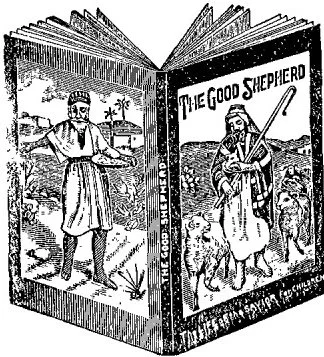
The Good Shepherd:
The Life of the Saviour for Children.
Beautifully Illuminated Covers!
Fifty-three Illustrations!
Interesting Reading!
Ninety-six pages,
Large print,
Good paper,
Strong binding.
This book, which is 8x10½ inches and ½ inch in thickness, tells the story of the life of Christ in a way that cannot fail to interest the little folks. It is exceptionally free from doctrinal errors, and should be in every family where there are children to be taught a Saviour’s love. The illustrations add very much to its educational value. Price, only 50 cents.
PACIFIC PRESS, 43 BOND STREET,
NEW YORK, CITY
BIBLES
A LARGE AND VARIED STOCK.
Send for Catalogue to
PACIFIC PRESS, 43 Bond Street,
Oakland, Cal. New York City.
Kansas City, Mo.
HAVE CHANGED THEIR MINDS.
The following from the Chicago Tribune, of October 28, illustrates some of the beauties of enforced Sunday rest:—
John Williams, No. 245 Sixty-third street, engaged a friend to move his household effects, and at 9 o’clock yesterday morning the work began. When the wagon was partly loaded an Englewood man going to church saw it and made complaint at the police station.
An officer was sent to the house with instructions to the family not to move. When the officer went away the work of loading the wagon continued, and again the police were requested to stop it. The man who owns the wagon said if they would not let him move the family because it was wrong to move on Sunday or do any work, he could not see his way towards unloading the wagon.
The police did not want the street obstructed all night, and the men who wanted to stop the moving did not want to be held responsible for any damage that might fall on the goods if they were left on Sixty-third street until Monday.
That was the status of the case when Police Sergeant Lillis told the man he might move, and at four o’clock in the afternoon, after wrangling all day, the teamster drove off with the goods.
The “law” of Illinois provides that the section prohibiting ordinary labor on Sunday, “shall not be construed to prevent . . . ferrymen from carrying over the water travelers and persons moving their families on the first day of the week.” It does not in so many words provide that persons shall be permitted to travel, or that it is lawful for families to move upon that day, but the presumption is that both things may be done, else why permit ferrymen to transport them over the water? It seems that this is the view that is taken of it by the police authorities of Chicago, for they only objected to the loading of the goods. It is simply another illustration of the absurdity of Sunday laws.
Purpose of Civil Government: Preserving Human Rights
The purpose of human government being to preserve human rights, it cannot go beyond that. And that this is the sole purpose for which God ordained civil government among men is evident from the fact that had he ordained it for any other purpose, he would thereby have abdicated the throne of moral sovereignty. Had God permitted men to define and enforce duty toward him, he would by that very act have committed to men not only the custody but the modeling of his law, and moral duty, would then have been whatever government declared it to be; and the varying moral codes adopted by men must in such a case have been not only the rule of human conduct, but the divine rule of the divine judgment.
The Sabbath as a Sacred Memorial of Creation
THE Sabbath is not merely one-seventh part of time devoted to rest because of man's physical necessities, but it is a specific portion of time set apart by the Lord himself to keep him in mind as the Creator of the heavens and the earth, and as a sanctifier of his people.