Forsyth's Gospel Sermon Wakes the Boston Congregational Council
A REMARKABLE scene in the late Congregational council at Boston illustrates the power of the plain old gospel truth, and shows how ready people are to recognize it and to welcome it. The crowds that had been in attendance daily and nightly, had been treated to eloquent sermons extolling evolution, displaying higher criticism, and magnifying science, when at last a genuine preacher of the gospel, Peter Taylor Forsyth, of Cambridge, England, stood up and preached the gospel,—just the plain, good, old, simple, saving gospel,—and the reporter declared that “if he had cried ‘fire,’ he could not have succeeded better in waking up the audience.”
“The multitude in the galleries stretched their necks. The audience frequently stopped him with a volley of applause, but he drew his breath, and then rushed on.” And the reporter proceeds: “What was this Peter Taylor Forsyth, who was capturing the audience, talking about?—He was talking about the cross, a very old theme, but a very attractive one to all Christians who are clothed in their right minds. He began with the assertion that the cross is the final seat of authority, and he was proving it. He talked about grace, and that is a joyful message to a sinful world; about forgiveness, and men and women need and want forgiveness; about an atonement that atones, and that too is what the world wants in spite of the floods of words with which theologians have tried to wash the meaning out of the atonement.”
“When he had come to a climax, he exclaimed: ‘Every man who breaks the law is under the curse of the law; but Jesus took the curse upon himself, bore it in his own body on the tree, and so set us free from the curse.’ It seems to me that I never heard that great gospel truth said with so much effect. My eye swept the galleries, and the people were leaning far forward, grasping every word, eager as dry grass catching the first rain-drops. One man could hold in no longer, and he shouted ‘A-m-en!’ No Methodist ever put more fervor into the word. When Dr. Forsyth stopped, the audience applauded, and kept on applauding, and would not stop applauding until he appeared again. Then Dr. Stimson arose and said: ‘There is only one thing that we can do now, and that is to sing one of the good old hymns.’ And so the mighty throng sang, ‘In the cross of Christ I glory,’ with a will and a fervor that made the great temple vibrate with joy.”
Thank the Lord for that! Thank the Lord that his voice of salvation could be heard amid the dismal din of the “sounding brass” and “tinkling cymbal” of worldly wisdom. Oh for preachers who will preach the gospel, who will preach “the power of God unto salvation,” to a hungering, thirsting, perishing world.
“THE TRUE NOTE OF THE GOSPEL.”
UNDER this heading, the Outlook of Sept. 16, 1899, presents the following excellent words, which have such a clear and true ring that they should be allowed to sound everywhere. Therefore we pass them on:—
The present time is plainly one of unprecedented opportunity and struggle for pecuniary profit, and of unexampled accumulations provoking to envy and to ambition. The master passion is cupidity for larger holdings, larger returns; and all ranks of society are equally pervaded by it. But not even in the church is the warning note of the Master adequately uttered: “Take heed, and beware of covetousness.” Covetousness is described by Paul as “idolatry.” Writing to the church at Colosse, he blacklists it together with the crime of fornication. It certainly is not so severely treated in the modern pulpit. In fact, it is now so disguised under such good names as economy, frugality, and thrift, that it sits incognito in the prayer-meeting and at the communion-table. It joins in the liturgical recital of the tenth commandment, but finds in the antique phraseology nothing that touches conscience with reproof.
What is now urgent is that Christian teaching shall do upon the tenth commandment that work of illumination that Jesus did upon the sixth and seventh, when he fixed the brand of murder upon the thought of hatred, and the stigma of adultery upon the lustful imagination. There is no lack of material in the New Testament for such a work. Particularly to be noted is the commonly unnoted significance of its common term for covetousness. The Greek word, pleonexia, literally denotes the desire for larger holdings. Jesus so interprets it in his parable of the poor soul whose chief desire was to build bigger barns. Acquisitiveness is the nearest English word for it. A prime concern of the Christian teacher is a plain and true definition of the real sin that the New Testament deals so severely with. It is to make getting the main desire and chief aim, or to be more intent on getting than on giving.
That this is not the sin of the rich more than of the poor is certain. It is seen in the wage-earner who cares more for full wages than for full hours or thorough workmanship, as well as in the capitalist who cares more for private dividends than for public services or his wage-earning partners, and in the office-seeker who is after a snug salary more than strenuous duty and public interest. Rich or poor, he is the covetous man, classed in the New Testament with the idolater; blacklisted there with the fornicator, whose thoughts are chiefly bent on getting for himself, intent on acquisition unbalanced by distribution of benefits and services.
If this surprises any, the explanation of so severe a judgment is not far to seek. The deadliness of covetousness consists in the insidious paralysis with which the passion of acquisitiveness affects the moral nature of its victim, while he flatters himself for respectable thriftiness. A soul thus stupefied ere it is aware, like a man inhaling carbonized air, may be nearer spiritual death, more incapable of resuscitation, than one who, overtaken by a sin of sudden passion, commits a crime.
It is needless for us here to set forth Jesus’ teaching concerning wealth, further than to say that he regarded it, whether in small or large amount, as a trust in the interest of the divine social order that he termed “the kingdom of God,” a good only when used as a social good, and pursued with an eye to social as well as individual interests. Our present concern is simply to call attention to a point that we are convinced does not receive in Christian teaching to-day the emphasis laid upon it in the teaching of Christ himself and his chief apostle, in times similar to our own, of great social tension and the sharpest contrast between extreme wealth and extreme want.
A fresh point must be put to the familiar demand for more of gospel preaching. No gospel preaching hews to the line closer than it is related to the need of the time for salvation from the sin of the time. The sin that is nearest the root of our social disorder and unrest to-day is the eminently respectable and deadly sin of covetousness, tainting the life of the family and the church, as well as of the state—the acquisitiveness whose sole concern is making money, and growing fat on what should be shared with others. Intemperance and licentiousness are more disgusting, but covetousness, which often promotes them for gain, dwarfs them both in the social detriment it works.
If the country is to be saved in the near future from what John Bright deprecated as “reformation by hurricane,” through some explosion of popular discontent with selfishly used wealth, “the peaceable fruit of righteousness” must be cultivated by the Christian pulpit. The pulpit that would dispense the gospel, and not dispense with it, must give full utterance and emphasis to the true note of the gospel concerning wealth and the use of it.
QUESTIONS ON THE SANCTUARY.
By Uriah Smith
A BROTHER asks further light on Rev. 15: 8, which reads as follows: “And the temple was filled with smoke from the glory of God, and from his power; and no man was able to enter into the temple, till the seven plagues of the seven angels were fulfilled.” Who, then, under the seventh plague, utters his voice from the temple, saying, “It is done”? To get perhaps a better idea of the situation, let us glance at the preceding steps, and the attending circumstances at the time when this scene takes place.
When Christ ascended from this earth to heaven, he entered into an apartment described in Rev. 4: 1-6: “After this I looked, and, behold, a door was opened in heaven.” An apartment in heaven was opened before the prophet, and the first object that met his gaze was a throne set in heaven, and One sitting thereon; and the awe-inspiring aspect of him that sat on the throne flashed forth in the combined radiance of the jasper and sapphire stones, while an emerald rainbow encircled the whole. Before the throne was a glassy sea, and round about the throne were four and twenty seats, on which sat four and twenty elders. The throne itself was the source of marvelous lightnings, thunderings, and voices; and round about the throne were also four many-featured living creatures, who stood and joyfully chanted, “Holy, holy, holy, Lord God Almighty, which was, and is, and is to come.”
John was looking into the first apartment, or holy place, of the heavenly sanctuary. This is positively proved, by the fact that before the throne blazed forth seven lamps of fire, which we recognize at once as the celestial antitype of the golden candlestick, with its seven lamps, in the earthly sanctuary, which candlestick always stood, by divine direction, at the left of the entrance door of the holy place. The antitype at which we are looking must occupy the same relative position in the sanctuary in heaven, and consequently be in the holy place there. But John’s vision is continued in the next chapter (Revelation 5), where Christ, the minister of the sanctuary, is introduced upon the scene, and the angels, Christ’s assistants in this great work, are also brought to view. By specific enumeration, one hundred million are mentioned as composing a part of the throng, and then innumerable millions more, which no figures can span. And all these, remember, were in that apartment into which John was looking, where was the antitype of the golden candlestick, the first apartment of the sanctuary in heaven.
When the time came for this sanctuary to be cleansed, at the end of the twenty-three hundred days, the scene was changed. The ministry was then to go forward in the most holy, instead of the holy, place. The whole company is therefore transferred to that apartment of the heavenly temple. The throne of God is moved there; and he, as the Ancient of Days, takes his position thereon, in a new office; namely, as a judge in a court of justice; for that is what the word “did sit” means in Dan. 7: 9, where the scene is described. Christ then goes in, as the sinner’s advocate, before his Father. To that place of glory and honor he is escorted by “clouds,” or multitudes, of angels. This thrilling scene is graphically delineated in Dan. 7: 9, 10: “I beheld till the thrones were cast down, and the Ancient of Days did sit, whose garment was white as snow, and the hair of his head like the pure wool: his throne was like the fiery flame, and his wheels as burning fire. A fiery stream issued and came forth from before him: thousand thousands ministered unto him, and ten thousand times ten thousand stood before him: the judgment was set, and the books were opened.” This describes the change of position of Jehovah, the Ancient of Days, into the most holy place, at the time the ministry was changed, to cleanse the sanctuary. Then verses 13, 14, describe the change of Christ, the Son of God, and his assistants, to the same place, to complete his part of the work: “I saw in the night visions, and, behold, one like the Son of man came with the clouds of heaven, and came to the Ancient of Days, and they brought him near before him. And there was given him dominion, and glory, and a kingdom, that all people, nations, and languages, should serve him: his dominion is an everlasting dominion, which shall not pass away, and his kingdom that which shall not be destroyed.”
Here Christ and his retinue of angels came into the most holy place; and when this was done, then the whole shining array of sanctuary ministers, and all the agents necessary to carry on the work, were there, in the most holy place, to carry out to its conclusion the great redemptive plan. There was the throne, the Ancient of Days, Christ, our great High Priest; and there were the four and twenty elders, and the four living creatures, who, with the innumerable company of angels, constituted the imposing array of his heavenly assistants. The court thus arranged was to continue in session till the destiny of all probationers should be forever decided. Then Christ receives his kingdom, the marriage of the Lamb comes; and those who are ready enter in with him to the marriage.
This is a most momentous hour; and here, it seems, Jesus makes one of those thrillingly solemn proclamations that mark some of these closing crises of a world’s destiny. Lifting up his hands, he exclaims, “IT IS DONE!” This we read in a statement in “Spiritual Gifts” (first edition), page 140: “I saw angels hurrying to and fro in heaven. An angel with a writer’s inkhorn by his side returned from the earth, and reported to Jesus that his work was done, and the saints were numbered and sealed. Then I saw Jesus, who had been ministering before the ark containing the ten commandments, throw down the censer. He raised his hands, and with a loud voice, said, ‘It is done!’ And all the angelic host laid off their crowns as Jesus made the solemn declaration, ‘He that is unjust, let him be unjust still: and he which is filthy, let him be filthy still: and he that is righteous, let him be righteous still: and he that is holy, let him be holy still.’”
Then the plagues begin to fall. We quote again: “It was impossible for the plagues to be poured out while Jesus officiated in the sanctuary. . . . In that fearful time, after the close of Jesus’ mediation, the saints were living in the sight of a holy God, without an intercessor. Every case was decided, every jewel numbered. Jesus tarried a moment in the outer apartment of the heavenly sanctuary, and the sins which had been confessed while he was in the most holy place were placed upon Satan, the originator of sin, who must suffer their punishment. Then I saw Jesus lay off his priestly attire, and clothe himself with his kingly robes. Upon his head were many crowns, a crown within a crown. Surrounded by the angelic host, he left heaven.”
The throne which Jesus takes at this time is his own throne. Previously to this time, he had been seated with the Father upon his throne. Rev. 3: 21; Zech. 6: 12, 13. At the period now under notice, the plagues are falling; and this brings us to the question of our correspondent, on Rev. 15: 8, which says that “no man was able to enter the temple, till the seven plagues of the seven angels were fulfilled.” We need not labor to show that the expression686“no man” has reference to any one who has ever been a human being; for, as we have seen, the original word is simply oudeis, no one, no being; that is, no one to act as mediator, no one to carry on the sanctuary service. This would not, and we learn from Rev. 16:17, does not, exclude God the Father from the sanctuary in heaven at that time; for as late as the beginning of the seventh, and last, plague, a great voice is heard “out of the temple of heaven, from the throne,” saying, “It is done.” This is doubtless the voice of God. So, though Christ, at the close of his mediative work, threw down the censer, and uttered the words, “It is done,” and with the angelic hosts left the temple, never more to return, it seems that the Father still lingers by his law, till the last judgment sent forth upon a disobedient world has been inflicted.
What movements occur in the temple after this, and how God removes his throne from the place (Rev. 21: 22), no instruction, that we are aware of, is furnished us. But later still the voice of God is again heard in the final crisis when God’s people are at last delivered. This is brought to view in “Great Controversy,” page 636, in these words: “In the midst of the angry heavens is one clear space of indescribable glory, whence comes the voice of God like the sound of many waters, saying, ‘It is done.’”
The seeming difficulty in the mind of our correspondent is apparently the question of adjusting and locating the different times when the voice, “It is done,” is heard, especially that of Rev. 16:17. For if there can be absolutely no being in the temple during the plagues, how could there be any one to speak from the throne under the seventh plague? But, as already noticed, the expression need not exclude the Father, any more than the expression “no man” in Lev. 16:17 excludes the high priest, who had some service to perform in the holy place, on the same day in which he ministered in the most holy.
We trust these remarks may be of some help to those who have felt any degree of perplexity over this question. U. S.
THAT POST-OFFICE.
Several of our readers are somewhat concerned over a sentence or two in Sister Henry’s answer to the letter of a sister, in the REVIEW of October 10, page 649. Yet we are quite sure that their difficulty is with what is not said, but what they suppose, rather than with what is really said.
It is certain that everybody who is acquainted with Sister Henry knows full well that she would never sanction the conducting of the business of a post-office, by Sabbath-keepers, on the Sabbath; and that she would not herself either go to a post-office or send for her mail on the Sabbath. It is therefore gratuitous to suppose that in the passage referred to she had any intention whatever of saying that the conducting of the business of a post-office on the Sabbath by Sabbath-keepers is necessary and legitimate business.
Now as an open and definite proposition, it is the truth that the keeping of a post-office is a legitimate and necessary business.
For a person who is not a Sabbath-keeper, the business of keeping a post-office is as legitimate as any other business.
The sister whose letter Sister Henry answered does not say that her husband keeps the Sabbath. She says, “My husband and I have charge of the post-office; . . . I [not we] feel as if I [not we] was in a great hole; . . . I wish to get out of this hole, but I can not get out unless I get out of this post-office, so I [not we] can keep the Sabbath just as I [not we] should.”
The only conclusion that the editor drew from this, and we think the true one, is that the husband is not a Sabbath-keeper. This being so, the business of keeping a post-office is for him as legitimate as any other business. Nor does this prevent his wife from keeping the Sabbath and being a Christian just where she is. We have personally known sisters whose husbands kept post-office even in their own houses, and yet these sisters kept the Sabbath and lived with their husbands, without any difficulty.
Even more than this, we have personally known husband and wife to be Sabbath-keepers together, and keepers of a post-office too: it was a Sabbath-keeping post-office—no business whatever was done on Sabbaths. But as evidently this is not the kind involved here, it is not necessary to say more about that.
So it seems apparent that the difficulty in the minds of the readers who have written on this is because of what they suppose, rather than what is really said.
We make this explanation now, so that inquirers can have response in reasonable time; as Sister Henry is now on the Pacific Coast. If anything more needs to be said, perhaps Sister Henry will say it herself.
WHAT MISSIONARY WORK CAN I DO?
By S. N. Haskell
“PUBLICATIONS . . . are to be scattered abroad like the leaves of autumn,” was the message given in 1874. As we see the leaves falling everywhere, we are reminded of the force of the figure used by the Lord. The leaves are carried everywhere; every nook and corner is filled with them. They fall noiselessly in the busiest thoroughfare, lodging in the carriages of the rich, as well as in the vehicles of the poor. We can not even keep them out of our houses. If our doors are open but for a minute, we find the leaves strewed over our floors. They are found in every place.
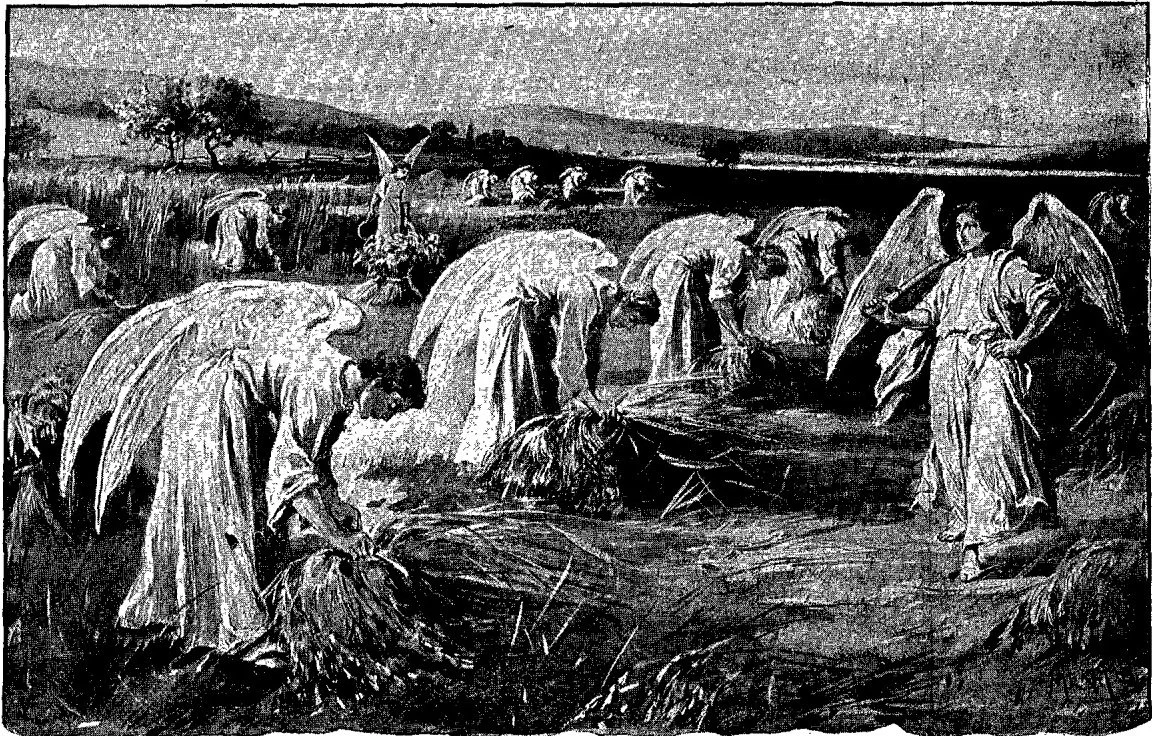
“THE HARVEST IS THE END OF THE WORLD, AND THE REAPERS ARE THE ANGELS.”
The distribution of small tracts, leaflets, and periodicals is best suited to answer the illustration. In the last few years there has been, from time to time, impulsive moves made in the distribution of our missionary paper, the Signs of the Times. Notwithstanding the fact that the greatest wisdom was not always used, yet the results show that the distribution of the paper has awakened a general interest in the truth in the localities where distributed. Many souls are rejoicing in the light to-day, who received the third angel’s message from the Signs of the Times. It can be sent by mail to thousands of families where it would be difficult for the living messenger to go. By a little effort every village and town could receive the paper.
The printing-office on the Pacific Coast was established, in the providence of God, for the purpose of publishing a missionary paper that could be used by all our people in America. The special editions have already proved a success. We now speak a word in behalf of the coming Harvest number. We urge our brethren everywhere to give it a general circulation. Attention has already been called to this number. I need only to refer to it.
The Present Truth has accomplished much in England, and the Bible Echo in Australia, in awakening an interest where the public laborers are few. In Australia and New Zealand some of our brethren and sisters make it their sole business to sell the Bible Echo from door to door. In some places the local Conferences pay them a small sum, which, together with the commission they receive on the sale of the papers, gives them a comfortable living. Why should not every Conference have many who devote their whole time to the work of carrying the Signs of the Times into the highways and byways, letting its light shine forth in the mansions of the rich as well as in the hovels of the poor? Arrangements should be made with the workers that they may be able to give papers to those too poor to purchase, that none need be passed by.
The publications are not to be rained down from heaven by the angels, but human beings will go everywhere with the printed pages, leaving them in the hands of all. What is better with which to gain an experience than the Harvest number of the Signs? What a wonderful work would be accomplished if our brethren in the cities, in the villages, and in the country throughout the whole land, should go forth selling the Signs to those who are able to buy, and giving to the poor. Now is the time to work for souls; for soon—yes, very soon—a state of things will arise that will make it difficult to work. For “the work which the church has failed to do in a time of peace and prosperity, she will have to do in a terrible crisis, under most discouraging, forbidding circumstances.” No one who bears the name of Seventh-day Adventist should be idle now. S. N. HASKELL.
THE following sketch of the Jew, by Mark Twain, is worth repeating:—
“If the statistics are right, the Jews constitute but one per cent. of the human race. It suggests a nebulous dim puff of star-dust lost in the blaze of the Milky Way. Properly the Jew ought hardly to be heard of; but he is heard of, has always been heard of. He is as prominent on the planet as any other person, and his commercial importance is extravagantly out of proportion to the smallness of his bulk. His contributions to the world’s list of great names in literature, science, art, music, finance, medicine, and abstruse learning are also away out of proportion to the weakness of his numbers. He has made a marvelous fight in this world, in all the ages; and has done it with his hands tied behind him. He could be vain of himself, and be excused for it. The Egyptian, the Babylonian, the Persian, rose, filled the planet with sound and splendor, then faded to dream-stuff, and passed away; the Greek and the Roman followed, and made a vast noise, and they are gone; other peoples have sprung up and held their torch high for a time, but it burned out, and they sit in twilight now, or have vanished. The Jew saw them all, beat them all, and is now what he always was, exhibiting no decadence, no infirmities of age, no weakening of his parts, no slowing of his energies, no dulling of his alert and aggressive mind. All things are mortal but the Jew; all other forces pass, but he remains. What is the secret of his immortality?”
MY VISIT TO AUSTRALIA.
By George A. Irwin
VERY early in the morning of June 28 I left Melbourne to return to Sydney. There was a hard white frost, from which the passengers suffered severely, as there are no arrangements or appliances for heating the coaches. This was the first cold weather I had experienced; and, in fact, the coldest during my entire stay; for only two or three times afterward did we have a repetition of it, and then much lighter. You can understand from this the mildness of an Australian winter; for the months that I was there—June, July, and August—correspond to December, January, and February in the States. Early on the morning of the 29th, I arrived in Sydney, and went directly to the sanitarium at Summer Hill, where I took breakfast, removing my luggage later to Elder A. G. Daniells’s home, where I remained during my stay. Most of the day was spent in looking over the city and harbor, in company with Elder G. B. Starr. We took a boat ride from Circular Keys, where the wharfs are, and where most of the vessels land, to Manley Beach, several miles down the harbor, and past the Heads. Such a ride gives one a fine view of the harbor, with its numerous inlets and estuaries.
Manley Beach is certainly a sight worth seeing, impressing one with the power and force of the mighty ocean, and also with the ease with which an omnipotent Hand can control its proud waves. It had been storming for two or three days, and the wind was still high, so that as many as six mammoth waves came rushing shoreward, one succeeding the other, with a roar that was frightful; yet there was a beauty and grandeur about the white foam and spray forming the crest of each billow, which, reflecting the rays of the sun, formed sudden flashes of the rainbow all along the line. As these mighty waves came rushing on, it seemed as if they would surely sweep over the beach whence we were viewing the scene; but all at once, as they reached the sandy beach, they would flatten out, obeying the divine command: “Hitherto shalt thou come, but no further; and here shall thy proud waves be stayed.”
On our return from the beach, we visited the principal park of the city, which is on a high point of land overlooking the harbor. The grounds of the park are well laid out and neatly kept; but I could not help noticing the lack of different varieties of trees that make the European and American parks so attractive.
Friday, June 30, was spent with Elder Daniells, Dr. Caro, and others, talking over the work in the city. The only sanitarium managed by our people in the continent is situated here, and is in charge of Dr. E. R. Caro. While the facilities and appliances are very meager, the building having formerly been a private dwelling, and hence poorly adapted to such a purpose, yet they have a good patronage, and have done successful work. One of the greatest needs at the present time, and, in fact, one of the greatest needs in the entire continent, is a small, plain, but well-equipped sanitarium in a quiet, restful place, surrounded by the beauties of nature. The fact that people come and stay at the present place, with such accommodations, is evidence that such an institution is needed, and would receive a liberal patronage. Dr. Caro is deserving of commendation for his persevering efforts to hold up the light, and teach the principles of health reform and correct living, under such adverse circumstances. I sincerely hope that our brethren in America will respond liberally to the appeals for help to start the various enterprises needed in this destitute field.
Sabbath, July 1, in company with Brother G. W. Morse, I visited the Ashfield church, and spoke to them for an hour, after which I assisted Brother Morse, who is elder of the church, in administering the ordinances. Ashfield church is the result of the first effort made in the city, by Elder J. O. Corliss, who brought out the company. The work thus begun was followed by Elder S. McCullagh, until an organization was effected, and the church where they now worship was built.
At three o’clock in the afternoon, in company with Elder Starr, I visited the Stanmore church, speaking to them for three fourths of an hour, and afterward taking part with Brother Starr in administering the ordinances. The Stanmore church building is a good-sized brick structure, with a seating capacity of six hundred, including the lean-to on one side. The present membership is largely the result of the labors of Elders Haskell and Starr, the church being organized in place of the disbanded organization once known as the Sydney church. The present building was erected through the efforts and under the direction of these brethren. There are two other churches in the city,—the Parramatta and the Prospect,—but I did not visit either of these.
Toward the close of the Sabbath, Elders E. H. Gates and E. Hilliard arrived from the islands. Elder Gates was appointed superintendent of the South Sea Island work, and sailed from San Francisco, Jan. 14, 1899, to visit the islands where our missionaries are situated. After visiting most of these places, he left the “Pitcairn” at Tonga, with instruction for it to return to the States, while he and Elder Hilliard took passage on a steamer for Australia, to attend the Conference. Sunday, July 2, was spent in talking with these brethren about the work in the islands, and in further counsel with Elder Daniells over the coming Conference. In the evening I spoke in the Stanmore church on the rise and progress of the message.
On Monday, July 3, I returned to Cooranbong. The next few days prior to the assembling of the Conference were taken up in writing, with occasional counsel meetings with Elders Daniells and White, and others. GEO. A. IRWIN.
WHAT DO SEVENTH-DAY ADVENTISTS BELIEVE?
By Editor
SEVENTH-DAY ADVENTISTS claim to be giving to the world, in discharge of a sacred responsibility, a message warning the people against the worship of the “beast” and his “image.”
They have long believed that, according to the prophecy in the thirteenth chapter of Revelation, there would be formed in this country an “image to the beast,” which all the people would be commanded to worship, under penalty of death if they refused.
It was in view of this, that several years ago they took alarm at the rise and progress of a movement which, as they plainly saw, aimed at the enforcement of that worship; and began actively to oppose it. They organized the National Religious Liberty Association, circulated a vast amount of literature, and in many ways manifested an active interest in keeping themselves informed regarding the situation, and in educating the people to see the nature of the issue that was involved. They would not have done all this if they had seen nothing beyond the events then taking place. But they were looking at the prophecy, and opposed the steps then being taken by the National Reform party, as being the beginning of a movement that would end in the complete fulfillment of all that the prophecy sets forth.
But now, after the lapse of years, the work in behalf of religious liberty languishes. The efforts that were once so actively put forth have nearly ceased. At all the gatherings of this people this subject is put into the background or ignored altogether; the organization that was thought to be needed years ago has but a feeble and failing support.
What is the matter? Have Seventh-day Adventists concluded that they were wrong in their understanding of the prophecy, and that the momentous events they had anticipated are not really going to take place after all? Have they concluded that the crisis in this movement has been reached and passed—that the work of the “beast,” the “false prophet,” and the “image,” has been accomplished? Or do they still believe that the climax has not been reached, and that we are surely and swiftly approaching it?
What kind of logic, what kind of consistency, has led Seventh-day Adventists at this date, years nearer the crisis than they were then, to slacken instead of increase their efforts? Ought we to exhort one another so much the less as we see the day approaching?
Can we explain the situation by looking at the movements of the enemy? Is he as active now as he was a few years ago? Let us see. At that time the forces pushing the movement for church and state union were, the National Reform party, the W. C. T. U., and the American Sabbath Union. To-day what do we see?—All these, and in addition, the Christian Endeavor Society, the Epworth League, the Christian Citizenship League, the League for Social Service, and the Sunday League of America, not to mention local organizations, such as the New England Sabbath Protective League. We see also the trade-unions falling into line with these for Sunday enforcement. And we see these leagues and societies flooding the country with their literature, covering large cities—as was done at Pittsburg—in a single day. Verily, then, we are on the wrong track here to obtain an explanation for our inactivity.
Since we are years nearer the thrilling climax of the great conflict than we were then, and since the forces of the enemy have vastly increased, and during this time our own efforts have almost ceased, is it not evident that somebody among Seventh-day Adventists has been sadly remiss in fulfilling this solemn duty to warn the world against the “beast” and his “image”? And who is “somebody”?
Great importance has of late been attached to other lines of work, and properly so; but does this make the religious liberty work less important? Do not Seventh-day Adventists see that this branch of the work is to be a safeguard to all the others? What would happen to these other lines of work, which are of such importance, if nothing were done to check the rising tide of religious persecution? What benefit has the work at large received from what has already been done in this line? Who can estimate it? Who is prepared to say that but for the work done by the Religious Liberty Association, many now laboring in these important lines of work might to-day be in prison instead of standing free before the people?
Do not be deceived by the idea—the writer has heard it expressed—that the purely benevolent lines of our denominational work are not going to draw persecution. Do not get the idea that some people engaged in this closing work are going to be so benevolent, so unselfish, so given to ministering to the poor and unfortunate, that the devil will pass them by in the final conflict. Jesus Christ did all these things constantly, and ere long found church and state united to put an end to his work by killing him. As with the Master, so will it be with the servant.
From the very fact, then, that other lines of work are important, the religious liberty work derives importance beyond that which it would otherwise have. It becomes of double importance. Here is a statement from “Testimony for the Church,” No. 33—not the only one either—that might be cited on the subject:—
“We are not doing the will of God if we sit in quietude, doing nothing to preserve liberty of conscience. Fervent, effectual prayer should be ascending to heaven that this calamity may be deferred until we can accomplish the work which has so long been neglected. Let there be most earnest prayer; and then let us work in harmony with our prayers.”—Page 242. Italics ours.
Then what shall we do? The Religious Liberty Association has been formed expressly to provide an answer to this question. It has been formed in order that this work may not be done haphazard and disjointedly, but efficiently, through organization. Address the headquarters of this association (Moon Building, Chicago, Room 750), and you will be told what to do. But before all else, become a member of the association, by sending in your name and the initiation fee of one dollar. Only in this way can the right answer be given to the question, What do Seventh-day Adventists believe?
L. A. SMITH, Editor of American Sentinel.
Duty to Warn the People of Present Dangers
“When God has given us light showing the dangers before us, how can we stand clear in his sight if we neglect to put forth every effort in our power to bring it before the people? Can we be content to leave them to meet this momentous issue unwarned?”