Pacific Press Publishing Company · New York · Aug 29, 1895
ROME AND THE BIBLE.
It is a boast of the Roman Catholic Church that “Rome never changes;” and yet few people realize how true it is that the Roman Catholic Church of to-day is the same in spirit, in purpose, and in policy as was the Roman Catholic Church in the sixteenth century.
September 5, 1893, Mgr. Satolli, speaking for the pope of Rome, bid the people of the United States to “go forward, in one hand bearing the book of Christian truth—the Bible—and in the other, the Constitution of the United States.” But let no one be deceived by this apparent change of front by the papacy. Rome’s attitude toward the Bible is just what it has always been, namely, one of hostility to the Word of God uninterpreted by “the church.”
Prior to the Reformation, the Bible was an unknown book, so far as the common people were concerned; but few even of the priests had ever seen the Book, and fewer still had ever read the sacred Volume. Luther never saw a Bible until he was twenty years of age; and until that time imagined that “those fragments of the gospels and epistles that the church had selected to be read to the people during public worship every Sunday throughout the year,” composed the whole Word of God.
It may be said that this was the fault of the times and not of the church; that all books were rare and expensive. But that Rome could have given the Scriptures to the people in the living languages of Europe, is proved by the fact that the Reformers did it in a single generation, in the face of the most bitter opposition by the papal church.
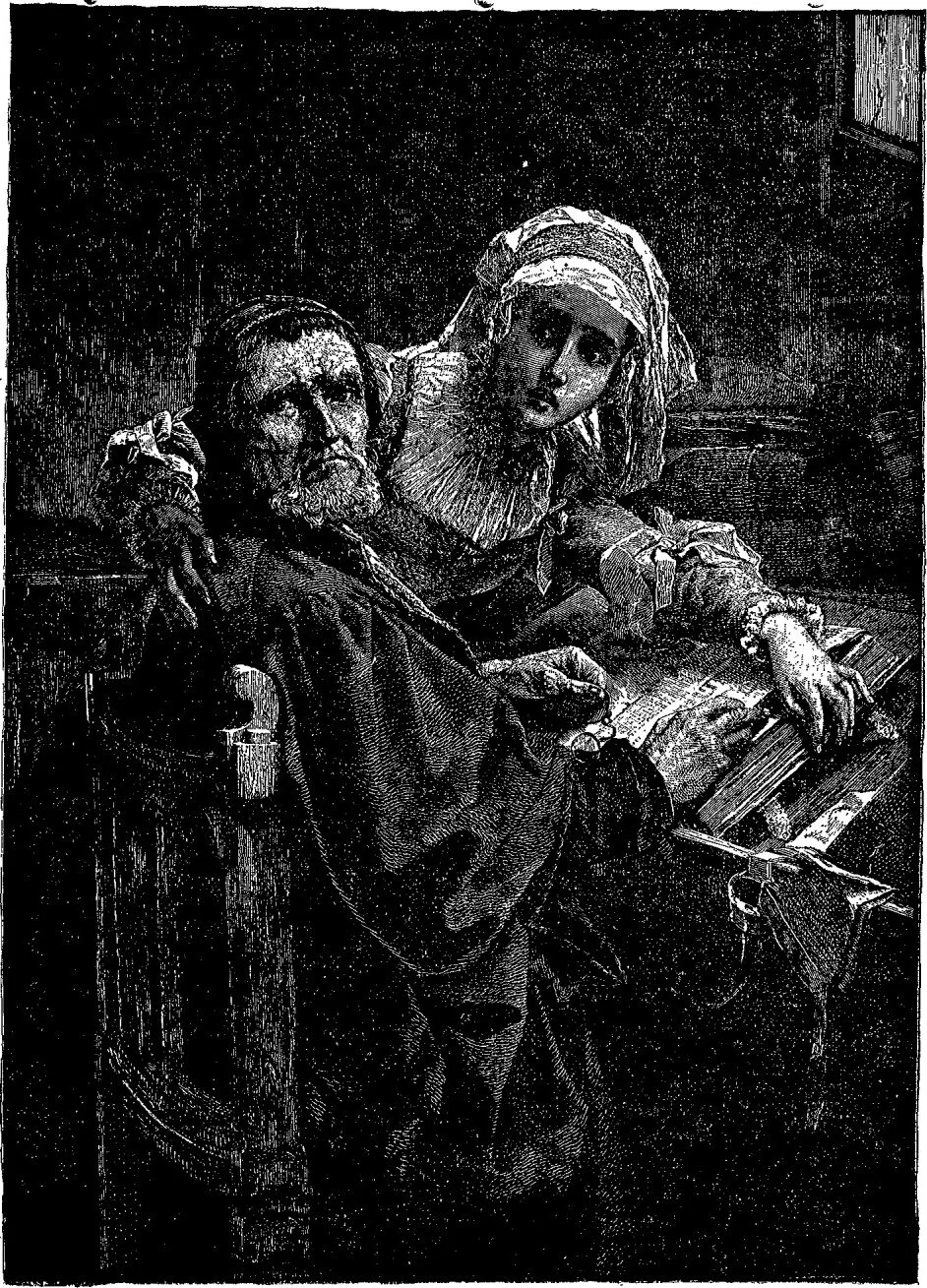
The fault was not with the times but with an apostate church, which not only kept the Word of God locked in dead languages, but forbade the reading of it under heavy penalties . Our illustration shows with what trepidation the people read the Scriptures in those days. It was against the law to read the Bible, and they watched as they read, as a house-breaker watches lest detection overtake him; and startled at the slightest noise, even as the hunted deer starts at the snapping of a twig or the rustle of a fallen leaf.
But the Reformation unsealed the precious Volume. “Tyndall and Luther,” says Dr. Wylie, “the one from his retreat at Vildorfe in the Low Countries, and the other from amid the deep shades of the Thuringian forest, sent forth the Bible to the nations in the vernacular tongues of England and Germany.”
The thirst thus awakened for the Scriptures, Rome did not think it wise to openly oppose. Civil penalties could no longer be invoked to punish those who read the Word of God. But papal policy was equal to the emergency. The Council of Trent enacted ten rules regarding the reading of prohibited books; and in the fourth rule the council prohibits anyone from reading the Bible without a license from his bishop or inquisitor—that license to be founded upon the certificate from his confessor, that he “is in no danger of receiving injury from so doing.” The council further said: “If anyone shall dare to keep in his possession that book [the Bible], without such a license, he shall not receive absolution until he has given it up to his ordinary.”
Such was the attitude of Rome toward the Bible at the era of the Reformation, and266such it is to-day. “No farther back than 1816,” says Wylie, “Pope Pius VII., in his bull, denounced the Bible Society, and expressed himself as ‘shocked’ by the circulation of the Scriptures, which he characterizes as a ‘most crafty device, by which the very foundations of religion are undermined;’ ‘a pestilence,’ which it behoves him ‘to remedy and abolish;’ ‘a defilement of the faith, eminently dangerous to souls.’ He congratulates the primate, to whom his letter is addressed, on the zeal he had shown ‘to detect and overthrow the impious machinations of these innovators;’ and represents it as an episcopal duty to expose ‘the wickedness of this nefarious scheme,’ and openly to publish ‘that the Bible printed by heretics is to be numbered among other prohibited books, conformably to the rules of the index; for it is evident from experience, that the holy Scriptures, when circulated in the vulgar tongue, have, through the temerity of men, produced more harm than benefit.’ Thus, in the solemn judgment of the Church of Rome, expressed through her chief organ, the Bible has done more evil than good, and is beyond comparison the worst book in the world.”
Reading the Forbidden Book.
In America, Satolli, the papal delegate, tells the people to “go forward bearing in one hand the book of Christian truth—the Bible;” but in Roman Catholic countries the Word of God is still a forbidden book; and as we shall see, the Bible, as the supreme authority in matters of faith, is still forbidden by Rome even in this country.
Some years ago, while Rome was yet under the rule of the pope, an English clergyman found it impossible to purchase in the city of Rome a single copy of the Scriptures of portable size in the language of the people; and when he inquired of each bookseller the reason of his not having so important a volume, the answer in every instance was, “E proibito,” or “Non è permesso;” that is, the volume was prohibited, or not permitted to be sold. It is a matter of general knowledge that at the present time Protestant colporters in the Roman Catholic countries of South America are not permitted to circulate freely copies of the Scriptures. They are hampered and hindered in a hundred ways, and are often arrested and thrown into prison upon the slightest pretext, evidently to prevent them from putting the Bible into the hands of the people.
But does not Rome permit the reading of the Bible by her people in the United States? Yes; but of the Catholic version only, and that is never printed without notes. The Roman Catholic Church claims to be the only authorized interpreter of the Scriptures, and she suffers her people to receive the Scriptures only as she interprets them; and when Rome says, “Go forward, bearing in one hand the book of Christian truth—the Bible,”—she means the Roman Catholic bible, and that interpreted by the church; for Rome has repeatedly refused to authorize the circulation among Catholics of the Douay version of the Scriptures, without note or comment.
The creed of Pope Pius IV., which every Catholic is taught to recite, and to which every priest is required to subscribe, thus defines the sense in which Rome admits even her own version of the Scriptures:—
I do also admit the Holy Scriptures, according to that sense which our holy mother, the church, has held and does hold, to which it belongs to judge of the true sense and interpretation of the Scriptures: neither will I ever take and interpret them otherwise than according to the unanimous consent of the fathers.
To the same intent, the present pope, Leo XIII., says:—
The professors [teachers] of Holy Scripture, therefore, amongst other recommendations, must be well acquainted with the whole circle of theology and deeply read in commentaries of the holy fathers and doctors and other interpreters of mark.
Thus Rome interposes insurmountable barriers between the people and the Bible, even while professing to freely give them the sacred Volume, bidding them go forward, bearing it in their right hand.
“The Protestant Bible,” says Rome, “is only a false skin, in which infidelity and revolution wrap themselves.” But Rome no longer fears the Bible in the United States as she once feared it, because the Bible is no longer regarded by the great mass of the people of this country as it was once regarded. The higher criticism and the thousand and one evasions of the plain Word of God, which have been adopted by so-called Protestants to support unbiblical doctrines, have so discredited the Bible and so instilled into the minds of the people the papal idea that the Bible must be interpreted, that Rome now feels safe in bidding the people thus educated to go forward, bearing in one hand the emasculated and discredited Bible, and in the other the perverted Constitution of the United States.
The very foundation principle of true Protestantism was thus set forth in the protest of the princes at Spires, April 12, 1529:—
“There is no sure doctrine but such as is conformable to the Word of God.” “The Lord forbids the teaching of any other doctrine.” “Each text of the Holy Scriptures ought to be explained by other and clearer texts.” “This Holy Book is in all things necessary for the Christian, easy of understanding, and calculated to scatter the darkness; we are resolved, with the grace of God, to maintain the pure and exclusive preaching of his only Word, such as is contained in the biblical books of the Old and New Testaments, without adding anything thereto that may be contrary to it. This Word is the only truth; it is the sure rule of all doctrine and of all life, and can never fail or deceive us. He who builds on this foundation shall stand against all the powers of hell, whilst all the human vanities that are set up against it shall fall before the face of God.”
It is before the Bible regarded in this light that Rome trembles. But Protestants are no longer taught to reverence the Word of God as did the German princes; they are no longer taught that a plain “Thus saith the Lord” is the end of controversy. They are, on the contrary, taught to accept what men have said about the Bible rather than the Bible; and as this is distinctively Roman Catholic doctrine, Rome can well afford now to appear as the champion of the Scriptures, for she well knows that, under the influence to which we have referred, the Bible has lost its power with the people; and she no longer fears it.
“Rome never changes,” but times change; and the changed attitude of Rome toward the Bible is not a change in principle but in policy. The same hostility to the Word of God exists as formerly; but as Protestants are no longer taught to look upon the Bible as of supreme authority, but regard it as something that must be interpreted, Rome no longer opposes the Bible but sets herself forth as the interpreter, expounder, and defender of that sacred Book. There is, in fact, an unconscious conspiracy between Rome and apostate Protestantism, and Rome’s so-called change of front is due to this conspiracy.
KEEPING THE FOURTH COMMANDMENT.
The commandments of God are given men to be kept every day in the week, and to this rule the fourth commandment is no exception.
That commandment says, “Remember the Sabbath day to keep it holy.” The Sabbath day is holy, for God made it so; and we are commanded to keep it holy. How are we to do this?
God made the Sabbath day holy by resting from his work upon it, blessing and sanctifying it. Gen. 2: 2, 3. This separated the Sabbath day from the other days of the week.267They are working days; it is the sacred rest day. Eze. 46: 1.
This distinction we are commanded to preserve. In the words of Deut. 5: 12, we are to “keep the Sabbath day to sanctify it.” To sanctify means to make separate, or distinct, from surrounding things. This definition is based upon Scripture.
When the Lord was about to come down in his majesty upon Mount Sinai and proclaim his law in the presence of the assembly of Israel, he gave directions to Moses concerning the mount, telling him, “Thou shalt set bounds unto the people round about, saying, Take heed to yourselves, that ye go not up into the mount, or touch the border of it: whosoever toucheth the mount shall be surely put to death.” And afterwards Moses, alluding to the same, said, “The people cannot come up to Mount Sinai, for Thou chargedst us, Set bounds about the mount, and sanctify it.” Ex. 19: 12, 23.
Another illustration is furnished in the narrative of God’s meeting with Moses at the burning bush. As Moses turned to behold the bush, God said to him, “Draw not nigh hither: put off thy shoes from off thy feet, for the place whereon thou standest is holy ground.” Ex. 3: 5.
Mount Sinai, while it was the abode of God, was sanctified,—set apart from the country about it, by the bounds placed around it, through which the people were not permitted to pass. The ground about the burning bush was likewise set apart from other ground, being made holy by the presence of God. By being thus separated or set apart, it was sanctified.
To sanctify the Sabbath, therefore, we must keep it separate, or distinct, from other days. It has been made so by the act of God, and this distinction we must preserve. Hence, while we are to regard the Sabbath as a sacred rest day, we must also regard the other days as working days. And this precludes us from regarding Sunday as a rest day.
Therefore it is utterly impossible to keep the Sabbath holy—to sanctify it—while making a weekly rest day of Sunday. To make Sunday a rest day, is to break in upon the distinction which pertains to the Sabbath. To keep the Sabbath commandment, we must regard the first six days as working days, as well as rest upon the seventh.
Let no one then assert that the law of the State commanding the observance of Sunday is not of a nature to interfere with the keeping of the seventh-day Sabbath. It is directly contrary to the fourth precept of God’s law, and forces upon every observer of that precept whom it reaches, the question whether he shall render obedience to God or to man?
THE FIRST DUTY OF CITIZENS.
THE first duty of every citizen of whatever country is to do right.
The duty of a citizen to the State which owns his citizenship is not determined in all things by the laws of that State. The authority of the State is not paramount. Only one authority is paramount, and that is the voice which is the quickener of conscience. Otherwise the office of conscience would be superfluous.
No individual can, in the same matter, as some people seem to think, owe one duty to God and another duty to the State. There can be but one duty for one time and one way for its accomplishment. And that way is the way of justice.
The first question to be considered is not, What says the State? but, What is right? And in doing what is right, the individual discharges his duty to the State.
The State can have no better citizens than those who conscientiously adhere to the right. And it can have no worse ones than those with whom conscience and right are secondary considerations.
The “first duty” of a citizen is his only duty, and this is the duty he owes to the State, to himself, and to God. If the law of the State commands him to do that which he knows not to be right, it is his duty to disregard that law and act according to his knowledge. And in so doing he will be serving the State, for it is not in the interests of the State that wrong should be put in the place of right, and falsehood in the place of truth. The peace, honor, and dignity of the State cannot be conserved through a bad law. That State has most honor and most peace which has most upright, conscientious citizens.
No individual can divorce himself from his duty to God, and he cannot be divorced therefrom by the State. And this duty covers the duty he owes to his fellow-men; for God has said, “Thou shalt love . . . thy neighbor as thyself.” By the highest considerations, those of love to his Creator and to his fellow-men, every individual is bound to do that which is just and right, according to the light God has given him. He is bound to bear witness by his life to the truth. This obligation is indestructible and unchangeable, and it is not for the State to set limits about it by law. The individual must determine its boundaries for himself, by the aid of the Word of God.
God’s word is the rule of right; and no word of man, even though expressed in law, can constitute such a rule. The fallible must give way to the infallible; the law of God must take precedence of the law of man. And in obedience to the law of God is found the highest expression of that law-abiding spirit which is so important a factor in good citizenship.
RIGHTEOUSNESS BY STATUTE.
The World, of the 16th inst., thus contrasts New York’s policy with that pursued in Chicago:—
If there is anything which the city of New York can do in the way of aiding the mayor of Chicago to make government easier and better in the western city, it ought to do it. We owe him a debt of gratitude for having expressed in just thirteen short words a doctrine that is at the present time of vital importance to New York. Mayor Swift says: “Out in Chicago we don’t think men can be made righteous by statute.” The opinion of New York is identical with that of Chicago. The difference between the two places is that in Chicago the authorities, recognizing the impossibility of making men “righteous by statute,” do not attempt the impossible, whereas in New York a young police commissioner, clothed with the novelty of power, acts on the theory that he can make men righteous by statute, although he would probably admit as a matter of fact that such an achievement was impossible even for a police commissioner.
But Chicago is not consistent in the stand it has taken, as is witnessed by the fact that while it cannot make men “righteous by statute,” to the extent of closing saloons on Sunday, the authorities of that city propose to make Seventh-day Adventists “righteous” by compelling them to cease work on that day. There is a vast deal of hypocrisy in both New York and Chicago.
ARE BAPTISTS DRIFTING?
By G. D. Ballou
BY G. D. BALLOU.
This staunch denomination that has so many years stood for the defense of liberty has just held its National Baptist Young People's Union Association here in the city of Baltimore. It began July 18th and closed the 21st. In their honor flags floated from thousands of windows, and banners of “Welcome to N. B. Y. P. U. A.” were conspicuous, and all the leading denominations flung wide their doors and their hearts to entertain the strangers from abroad, and nearly every pulpit in the city, except Roman Catholic, was filled on Sunday by a Baptist. Hundreds of dollars were spent in beautifying the grounds and the great pavilion about 200 by 325 feet.
State delegates were present from the Pacific Coast and every part of the country; in all 6,559 delegates were enrolled. Dr. Wharton, said to be the most eloquent and popular Baptist preacher in Maryland, delivered an address of welcome on behalf of the Baptist young people of Baltimore, which contains some things I wish to put alongside of the resolutions passed the next day that will, I think, make very interesting Baptist history. Here is the extract:—
The Baptists stand upon eternal principles. They believe in the Bible pure and simple from the first verse in Genesis to the last word in Revelation. They stand for liberty civil and religious, and the sacred institutions God-given and blessed. They honor the sabbath, they believe in the everlasting separation of Church and State; they do not believe in the red hat, but they do believe in the little red school-house. We welcome you as young people; it is the young people’s day. In all the avenues of trade, of business, of profession, the young men and women are at the front; in religion, in politics, and trade. We wave our hats and bid you welcome. We want your life in our churches. There has been too much stagnation. Westminster Abbey buries her people in the aisles of the church; we are content to have our dead sit in the pews. Life is what we want, and life more abundantly for which Jesus came into the world. Young men and women, go stand in the valley of dry bones and prophecy unto them while you beseech heaven to breathe upon the lifeless ones. Your energy, young people, is what is needed. When men go hunting and fishing they seek the game, and the youngest and most active are ordinarily most successful.
It is your mission to go out in the highways and hedges and compel them to come in, to stand in the stream and fish and hunt the game, start it afloat and pursue it until death; yes, until it is dead to this world and all things in it, and alive for evermore to Jesus Christ and his cause. A live man is better than a dead nation. The salt has lost its savor, the light has well nigh gone out. We look to you, God bless you, to seize the flag now falling from the nerveless grasp of the feeble, faltering church, and rush forth to conflict and to victory.
This animating and arousing address was cheered again and again; but what in the name of liberty does it all mean when interpreted in the light of the following resolutions, everyone of which was cheered to the echo and unanimously adopted the next day:—
We, the Baptist Young People’s Union of America, in convention assembled, recognize the first day of the week as the Lord’s day, and as the day set apart by the laws of the land as the day of weekly rest from secular toil.
We will, by example and influence, seek to promote a better observance of the day as the day of rest and worship.
And that to this end we will use all proper means to secure the enforcement of the Sunday laws.
To discourage the publication and circulation of the Sunday newspapers, the running of Sunday excursions, and the opening of places of public amusement, contrary to the law.
There was another resolution aimed against prize-fighting, and these were all the resolutions passed; and this reveals the object of this convention—to boom the Sunday law crusade.
Let us consider a few statements by Dr. Wharton, in comparison with the spirit of these resolutions.
“The Baptists stand on eternal principles; they believe in the Bible pure and simple;” and yet they adopt the corrupt principles and practices of the Middle Ages by proclaiming Sunday to be the Lord’s day, and pledging themselves to help enforce this dogma of their religion upon their fellow-men, under civil pains and penalties. And all this in face of the fact that Dr. Hiscock, of New York, the author of their church manual, only last winter showed them that there was no divine authority for Sunday—that it is not in the Bible.
“They stand for liberty civil and religious;” and yet pledge themselves to “use all proper means” to see that laws are enforced which will send to prison Christian Sabbath-keepers and others simply and solely because they differ from them about Sunday observance.
“They honor the sabbath.” How? By calling it “Jewish;” saying it is abolished, trampling it under foot and engaging to enforce the precept of a rival institution which a large number of their leading men know “was always only a human ordinance;” by helping to send men who keep the ancient Sabbath to prison or causing them to pay fines; in these ways they do dishonor the Sabbath that Jesus and every holy man of old sacredly observed, and thus do they cast contempt on the Lord of the Sabbath.
“They believe in the everlasting separation of Church and State” (i. e., the Roman Catholic Church and State; is not that right?). But they pledge themselves again to help the State enforce the Sunday sabbath upon all people, that the Baptist Church and her kindred sisters and their mother Rome may have their Sunday sabbath honored and their church work made more easy. Is this separation between Church and State, when the State makes a law enforcing religious dogma and the church pledges herself to help sustain the law?
Shades of consistency, are they gone mad? Jer. 51:7, furnishes the only consistent explanation.
“They do not believe in the red hat, but they do believe in the little red school-house.” They do not believe in the principle of Rome asserting her power to rule, but they do believe in Protestants making use of the civil arm to sustain what they call the truth, and thus keep their churches in the ascendancy. They forget that “they that take the sword shall perish with the sword,” and they cannot see that they are moved by the same principle and spirit that actuated Rome—“We must sustain our church and our religion by the civil arm.”
An appeal to civil power in matters of religion means the use of force in spiritual things, and this is not the religion of Jesus (see John 12:47, 48), nor of the Baptists of other days.
They talk about the life that is in Jesus, but their perverted appetites do not crave the water of life. It is the wine of Babylon that best suits their perverted religious taste, and268they thirst for civil power and seek it yet again. Prov. 23:35. Like the man who has tasted strong drink, so those who have drank of the wine—the false principles of Rome, her Sunday sabbath, her doctrine that the Church should control the State, that the Church may force the conscience—when they awake they say, We will seek it yet again.
God’s way is too tame and slow; we must compel men to obey. The recognized sign of Christian life and activity is a manifest desire to enter politics and make the Church a felt power in civil matters and control the counsels of the nation. And for what else does the B. Y. P. U. A. exist?
We asked at the head of this article, Is the Baptist Church drifting? We say No, manifestly No. She has got her prow turned, her rudder is set, her sails all trimmed, and with a full head of steam on, she is driving at full speed into the great vortex of ruin that will engulf Babylon and all her kin, and the mist of worldliness is so thick about her that only a few of her watchmen discern the grim shadows, or hear the dread soughing of the surf that lies athwart her course.
Why cannot Baptists see God’s Sabbath as well as baptism? How can they read Sunday into the fourth command and call it sabbath when they will not allow anyone to read sprinkling into the gospel commission and call it baptism? Why will they seek to the civil power to sustain their religion? Perhaps it is because they can sustain it in no other way.
Do they honestly think God’s Sabbath blessing has slipped from the seventh day over to the first day? And now, lest a few Sabbath-keepers shall succeed in slipping it back, will they spike the blessing onto Sunday with Sunday laws and then clinch the spikes with church resolutions? Truly they have drunken of Babylon’s wine and are mad.
The last day of this great convention, Sunday, July 21, was a gala one. Upon the grounds a half dozen lines of the best money-making business were in full operation. The street cars, in open violation of the statutes of Maryland, were reaping a rich harvest selling religious railroad tickets gotten up by the B. Y. P. U. A. especially for the occasion. On one side these religious tickets, sold at a reduced rate, read: “Believe on the Lord Jesus Christ,” “Culture for Service;” on the other, “Search the Scriptures,” “Loyalty to Christ.” Hackmen and bus drivers by the score solicited patronage at the gate, and throughout the city several lines of the best money-making business were almost unrestrained. It was a common remark of people who attended that it seemed more like a bazaar than a religious service. The cheering at times could be heard several blocks away. On this very day a poor, inoffensive Seventh-day Adventist quietly mended shoes in his private rooms in a secluded suburb of this same city far away from a chance to disturb any one; even his window blinds were closed, and the officer, to find out whether or not the man was at work, had to enter the room. For this awful conduct the brother was arrested and thrown in prison, and now must stand trial as a criminal with almost a certainty of a heavy fine or imprisonment.
Now, can the Baptists of America show cause why the National B. Y. P. U. A. convention, just closed, is not accessory in principles and purpose to this and all similar cowardly acts of persecution? They have pledged themselves to stand by Sunday laws and see that they are enforced; why are they not guilty in this case? They pledge themselves to sustain Sunday laws, but none of those in the Sunday-keeping ring are disturbed. If one only professes to keep Sunday he can do as he sees fit about keeping it. But let one turn aside from the beaten path, and he at once becomes a prey. What does this mean? Are they blind?—stone blind?
Reader, it is time to seek God for power to make the truth of God known to the people that they may heed the warning of Rev. 18:4: “Come out of her, my people, that ye be not partakers of her sins, and that ye receive not of her plagues.” Who will lift up the voice like a trumpet and show God’s professed people their transgressions and the house of Jacob their sins?
Baltimore, Md., July 24, 1895.
OUTRAGEOUS PERSECUTION.
[From the Christian Intelligencer, July 3.]
THE last case of outrageous persecution for religious opinion that has come to our knowledge occurred not in China, nor in Turkey, nor in any other half-civilized country, but in our own land beneath the stars and stripes. We learn from the Examiner that there is now in Georgia a man universally recognized as a good citizen who is shut up with incendiaries, thieves and murderers, and with them awaiting departure to a chain-gang; and the reason is that on Sunday he had worked quietly in his own back field, disturbing nobody, and acting in obedience to his conscience. This is lamentable intolerance. We have no sympathy with the mistaken views of this Judaizing Christian, but he has a perfect right to work on the first day of the week so long as he does not hinder his neighbors from the rightful use of the Lord’s day. To shut him up with gross criminals is nothing less than religious persecution.
THE GREAT CHRISTIAN ENDEAVOR MOVEMENT—WHAT OF ITS FUTURE?
By H. F. Phelps
BY H. F. PHELPS.
JUST at this time the great religious conventions are calling forth considerable comment. This is especially so of the Christian Endeavorers. Great hopes are entertained of this organization of the flower and pride of America, upon whom the hopes of the future depend. But are these great organizations to become political, and thus religio-political?
While hope is high with reference to the future, in the minds of many as to the responsibilities for good in religious and moral reforms that are centered in this body of young people, there are others who are accustomed to look beneath the surface, and who usually think deeply, who express fears regarding the outcome.
It must be conceded that, as to the greater part of these young people, they are unaccustomed to deep and earnest thought as to logical results in a given course and to wrestling with the great questions of the day; but, upon the whole, are actuated by the inspiration in the movement and are following their leaders. The logical conclusion is that if these leaders are actuated by right motives, if they are thoroughly acquainted with and recognize the underlying principle of all reforms—that of the equal rights of all men and the individuality of all men, the very principle for which Christ and his apostles and the Reformers contended—if they clearly recognize the fact that, as Herbert Spencer says, “Every man has the right to do whatsoever he wills, provided that, in the doing thereof, he infringes not the equal right of any other man;” then it may be that these leaders can lead these tens of thousands forward to the accomplishment of many a good work.
But if, on the contrary, they themselves are not standing upon solid ground, or are actuated by selfish motives—motives that are prompted by a blind adherence to some ’ism,—if they have reached the conclusion that their own methods and opinions are right and that all others are wrong, and that all these wrongs are to be righted according to their policy; if they forget that it is not possible for any moral reform to be carried forward successfully except by the power of the Holy Spirit, and that this power is only to be manifested in and through the preaching of the gospel of Jesus Christ; and that Christians are not authorized to seek the aid of any other power in their work except that of the Spirit of God, then it is that this nation and the world have cause to fear rather than to rejoice in the possible outcome of the movement.
It is evident that they intend to become a factor in politics—a possible political organization—and to make their influence felt at the ballot box. If then, as they now claim that their movement is in favor of religion, they are to become religio-political in their methods, what guarantee does the world have that they will not do as all other religious political organizations have done in the past? How do we know but that they may become the very image of the despotism of the past in the enforcement of religious enactments?
Mr. Charles A. Dana, the keen-sighted New York editor, sees danger ahead, and speaks concerning it. He says:—
The speakers at the convention of fifty thousand Christian Endeavor delegates at Boston have given great prominence to the subject of “good citizenship,” and their reference to the services which the societies throughout the Union should render toward the purification and elevation of politics, have excited much enthusiasm at all meetings. It is evident that a desire, if not a settled purpose, to make the organization a distinct political power has taken possession of many of its prominent members.
We regret to see it, and are heartily sorry; . . . for the moral and religious purposes of the organization are worthy of encouragement and praise; and if the disposition to use its machinery for their accomplishment by political means shall be continued, they will be defeated, and politics will be disturbed by bitter religious strife.
The Christian Endeavor enterprise as a moral enterprise is wholesome and beneficial; as a political movement it would be a curse to the country.—New York Sun, of July 15.
In the United States Senate Committee Report of 1829, Hon. R. M. Johnson, chairman, said: “Extensive religious combinations to effect a political object are, in the opinion of the committee, always dangerous. . . . All religious despotism commences by combination and influence; and when that influence begins to operate upon the political institutions of a country, the civil power soon bends under it; and the catastrophe of other nations furnishes an awful warning of the consequence.”
Dead-Letter Laws and the Tyranny of Strict Enforcement
“THE pretense that all law must be rigorously enforced because it is law is refuted,” says the World, “by a hundred dead-letter statutes, and condemned by the French philosopher in the saying that ‘of all sorts of tyranny the forcing of the letter of the law against the equity is the most insupportable.’”
The Limits of Civil Power
“THE powers that be are ordained of God,” but they are ordained to administer justice, not to decree injustice. There is, as every man knows, a limit to civil power.