Conducted by the Department of Education of the General Conference
H. R. SALISBURY - - - - Secretary
Emmanuel Missionary College
At the biennial meeting of the Lake Union Conference held in Battle Creek, Mich., early in May, the president of the college, Prof. O. J. Graf, gave his report, which showed that the blessing of God had been with the institution, and that prosperity was seen in every department. I earnestly hope that all our members in the Lake Union Conference will see in the prospering hand of the Lord in the college, a call for all the young men and women to leave the schools of the world, and crowd its halls to overflowing. I quote quite fully from the report, that all may know of the success of this school:—
"The past two years have been good years for Emmanuel Missionary College in many ways, for which we are indebted to a loving Heavenly Father, who has worked out his plans for us through a loyal and cooperative body of teachers and students. I think that I do not put it too strongly when I say that the working together of the board, faculty, and students in unity and harmony has, more than anything else, achieved the degree of success that we have experienced. The enrolment and attendance, as well as the per cent of advanced students and the number of graduates, are increasing, the attendance this year reaching 174.
Reincorporation
"In harmony with the action of the Lake Union Conference two years ago, the college has been incorporated under the College Act of Michigan, and bears the corporate name of 'Emmanuel Missionary College.' The school is now authorized to confer literary honors upon its graduates. At the close of this year, the college will have conferred the degree of Bachelor of Arts upon fourteen of our college students. Our degrees are honored and accepted at full value by the leading universities of this country.
The Normal Department
"At the time of the last Lake Union Conference, it was recommended that we accept the offer of the Berrien Springs church to turn its church-school and church-school building over to our normal department. This was done, and the following summer the building was moved onto the college grounds. The school has now been under the supervision of our normal department for nearly two years, with the most gratifying results to all concerned. This arrangement makes it possible for our normal graduates to do actual teaching under the direction and criticism of an experienced teacher. It combines theory and practise. We also plan to have it in operation during the coming summer school.
Equipment and Improvements
"During the past two years we have added quite freely to our musical, library, laboratory, and commercial equipment. Among these additions may be mentioned three pianos for the music department; three hundred books for the library; an adding machine and new typewriters for the commercial department; and a great deal of general equipment for the science department.
"Some of the improvements worthy of mention are the following: A one-hundred-loaf bake-oven for the kitchen. By means of this oven one of the students has been able to earn a large part of his school expenses, and at the same time provide the school with an excellent quality of bread at a lower price than it could be purchased from bakeries.
"The cow-barn has been provided with new cement and cork-brick floors, swinging stanchions, and a silo.
"The college grounds have been, are being, and will continue to be improved by grading, sodding, and the planting of trees and making of flower beds.
Industries
"We have four leading industrial departments, each under the supervision of a competent manager and instructor,—the printing, the farm, the fruit, and the carpentry departments.
"From two to twenty students are given employment in the printing department, a number of them earning nearly all their way through school. Practically all the typesetting, presswork, folding, stitching, trimming, and addressing of the Lake Union Herald is done by these students.
"The farm department has under cultivation about one hundred acres of land, the producing powers of which are being continually increased by means of fertilizing. The dairy consists of fifteen profitable milch cows. The sale of milk, cream, and butter now amounts to from $150 to $200 a month. Next year we hope to supply our kitchen with butter. This will be a great saving, for during the past winter we have paid out seventy dollars a month for butter alone.
"Seventy acres are devoted to the raising of fruit. The past season was a good one for this department, with the exception of a hail-storm which damaged our grapes to the extent of about $1,000. Notwithstanding this misfortune, we were able to market about five car-loads of grapes, between four and five car-loads of pears, and one or two car-loads of cherries and various kinds of berries. Aside from this, thousands of quarts of fruit were canned, both for our kitchen and for the market.
"The carpentry department has charge of all the repairs and construction work. In this department, as well as in the others, the work is done by students, under the guidance and instruction of an able workman. Last year the various industrial departments of the school gave to the students $8,012 worth of work.
Financial Condition
"Up to the time of the last session of the Lake Union Conference, the financial interests of the school were looked after by two departments,—the operating department meeting all running expenses, while the Central Educational Association made all improvements, paid insurance, and the interest on the debt. This arrangement relieved the school management of some very heavy burdens, which, however, had to be borne by an association that had no income, and hence found it necessary to borrow money to pay interest and make improvements. While this was embarrassing to the association, it was a great relief to the operating department, and we were16able to show good gains each year. But two years ago the debt, with its interest of about $1,900 a year, together with the other burdens formerly borne by the association, were passed over to the management of the school. We feared the result; but the Lord prospered us, and, with the aid of the two per cent fund, we were able last year to meet all expenses, including interest, and show a gain of $513. This year, the financial report for ten months shows a gain of $6,000. Of this gain only $659 was received from the two per cent fund, while all running expenses, and interest to the amount of $1,654 were paid, and improvements made to the amount of over $1,900. Our inventories have been increased over $2,000, and $1,383 of the college debt has been paid. This gives us courage to believe that we have been moving in the right direction, and we are hoping and earnestly praying that the Lord will in some way touch the hearts of his people in the Lake Union that they may now, in times of prosperity, roll away the reproach of debt, and free the school from its interest-bearing burden.
Spiritual and Missionary Interests
"But what should be of greatest interest to the conference is not the equipment, improvements, financial prosperity, or even the industrial or intellectual work of the school. All this and much more can be found in the schools of the world. That for which we are most thankful is that under the influence of the school, young men and women are giving their lives to God, and are preparing for service in giving the third angel's message to a lost world. During this school year, twelve have taken their stand for God for the first time. Each school year about sixty of our students actively enter some department of the denominational work.
"Various lines of missionary work have been carried on during the school year. Tracts, papers, and books have been sold, given away, and loaned. Three native missionaries—one in Japan, one in Korea, and one in China—are being supported by the Missionary Volunteer Society. Some of the young men who are looking forward to the ministry have held meetings in near-by halls and school-houses, and already some fruit of their labor has appeared.
"We have organized four missionary bands,—the canvassers' band, the foreign missionary band, the Missionary Volunteer band, and the evangelical band. These meet every Tuesday morning during the chapel hour to study the problems connected with these various lines of work. The evangelical band is for those who are planning to become ministers and Bible workers, and enrolled forty during the year. I think I can safely say that at least ninety per cent of our students are definitely preparing for service in the Lord's work."
British West Indies
By H. J. Farman
KINGSTON, JAMAICA.—On January 7, soon after the close of our conference, Elder D. E. Wellman, myself, and others began the work of enlarging our church-school building. It is now large enough to accommodate about one hundred pupils. It has two good rooms, is well-seated, lighted, and ventilated, and will be a great help to our Sabbath-school and young people's work, as well as to our day-school. We next began seating our church, putting in forty-three new pews, which have greatly added to the appearance and comfort of the building. We also built a conference storeroom and janitor's room, which were greatly needed.
The church has reduced its indebtedness about one half, having paid thirty pounds, and is making a determined effort to pay the remainder, to finish seating the building, and to paint it, hoping to have it ready to be dedicated at the next conference.
We have worked with all our might, and are glad to say that the Lord has helped us hitherto, and has blessed us with health and strength, for which we are very thankful. There are many difficulties to be encountered in this field. Especially is this true in the matter of financial support. The great mass of the people are very poor, and while there are noble examples of real self-sacrifice, some are indifferent to the needs of the cause.
One of our greatest needs is a higher type of spirituality and a greater love for the perishing. O that the Lord would breathe upon us all a real spirit of soul travail, which would lead to prayer and to work for the lost. Could we have this, our work here would move.
Since reporting last, I have baptized five persons, making, in all, twenty that have been added to the church by baptism in the last ten months. Some of these have been new converts, who have given good evidences of the work of the Holy Spirit in their lives. There are several others who have become interested through our district workers' meetings. These meetings are proving very helpful. Pray for the work here, and the workers that they may do efficient service for God. H. J. FARMAN.
The Publishing Work
By S. Joyce
Conducted by the Publishing Department of the General Conference
N. Z. Town - - - - - Secretary
Earning Scholarships in England During the Coal Crisis
Now that the disastrous coal strike is a thing of the past, our workers may begin to breathe more freely. In looking back over the past few weeks, it is highly gratifying and encouraging to notice some very remarkable figures in connection with our canvassing work. During the strike many of the leading industries were paralyzed, yet many of those who were engaged during that time in the sale of books containing the precious truths of the third angel's message have been greatly blessed and encouraged.
The most encouraging figures follow the name of Brother L. W. Barras, who is selling "Bible Readings" in territory where "Great Controversy" has been freely circulated. He worked 197 hours in five weeks, or almost full time,—40 hours weekly,—obtained 202 orders for "Bible Readings" and helps, amounting to $384.97, and delivered 175 copies of "Bible Readings," valued at $329.44. This is a fine record; and Brother Barras is faithful in ascribing praise and glory to God for what he has done for him. From February 28 to March 7 inclusive, Brother Barras canvassed seven days and secured 98 orders for books, amounting to $190.77. This is more than is required for a scholarship, and was earned in four days' less time than any previous scholarship; and these books were delivered while the coal strike was most severely felt.
Brother F. Bates, who is working in the same district with Brother Barras, made the second best record for March. In one month he had $240.07 worth of orders to report, and a delivery of $205.75 worth of "Bible Readings," or $18.73 more than is required for a scholarship.
Brother Pain comes next, with 71 orders for "Bible Readings," amounting to $146.46; and he is followed closely by Brother Brandt, with $146.22 worth of orders for "Great Controversy." Sister Maych also did well with our new edition of "Thoughts From the Mount of Blessing," and reported 211 orders with helps, amounting to $129.42; also a delivery of 167 books, valued at $101.64.
The last one I will mention is Brother Maych, who worked the same number of hours (197) as Brother Barras, and booked 166 orders for "Mount of Blessing," amounting to $109.82, and delivered 129 copies, valued at $78.52. These were sold just outside Manchester, where business was very quiet, owing to the strike.
These figures are highly encouraging, and demonstrate what can be done with our books even in the face of a great national crisis. Let us hold on to this good work until it triumphs gloriously.
S. JOYCE.
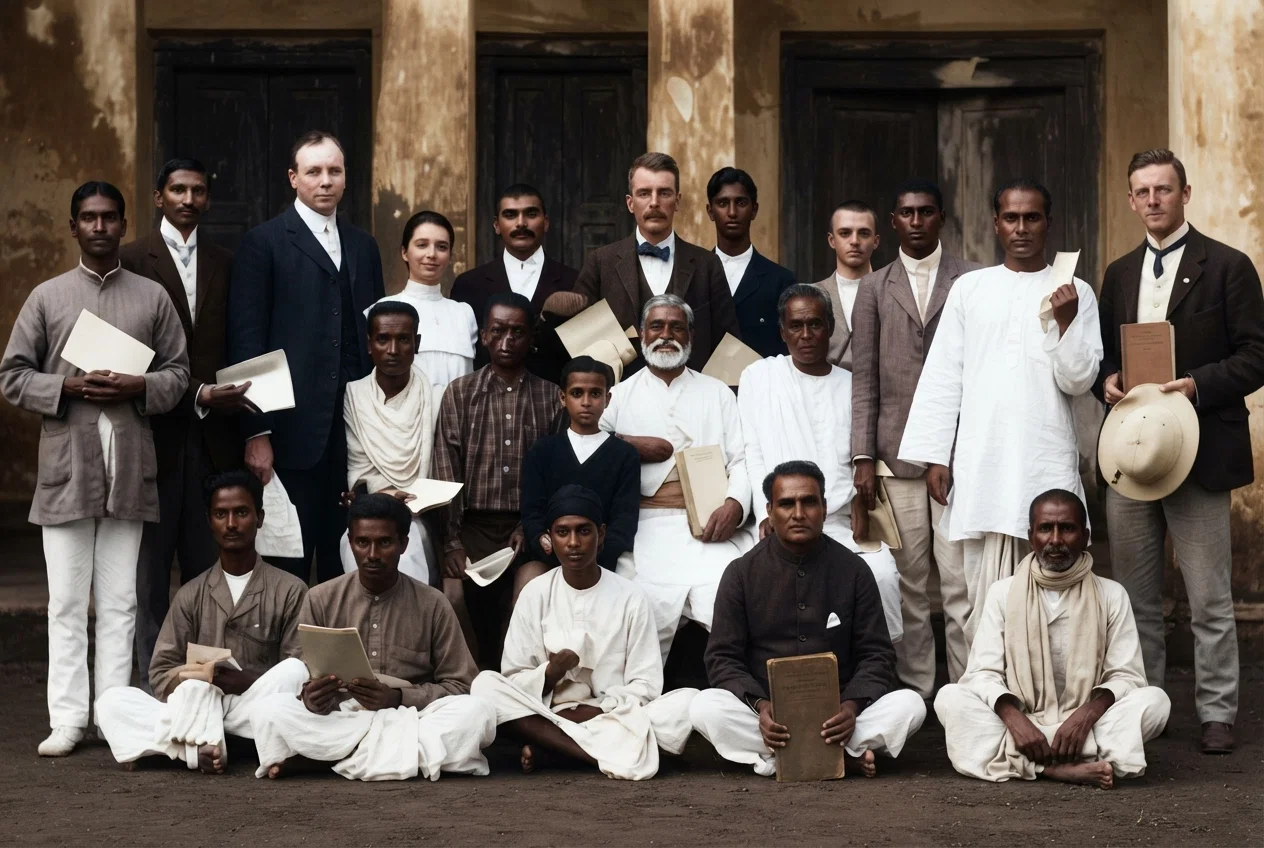
MEMBERS OF OUR FIRST CANVASSERS' INSTITUTE IN INDIA
Literature Work in India
Concerning the encouraging progress of the work in India, Brother C. E. Weeks writes:—
"The work is progressing in this field. The prospects are encouraging. Our native agents have never done so well before. The Burmese quarterly has been launched, and is now in the hands of the agents. The circulation of the Bengali paper was 1,500 at the time of our institute in December. This month we sent out 4,500. Two men have begun colporteur work in south India. One of them is already making sales almost equal to his salary. Brother Peter Rick continues to do well. His last report was the best yet, 146 rupees on papers alone.
"I am sending you a picture of those who attended our institute, which was held in connection with the Bengali conference. I believe this was the first canvassers' institute ever held in India. Ten of these native workers are giving their entire time to our periodical work. The native man at the far left is the most successful. He took over fifty yearly subscriptions last month, besides selling a large number of single copies. The sales of these men have doubled since our institute. Most of these workers are in the fever districts to the east of Bengal, where Brother Little died of cholera. The larger paper which these men are holding is the Bengali Signs of the Times. It sells for one-half cent a copy. The small pamphlet is the Sabbath-School17Quarterly. The English boy at the right is Brother Carratt, who was converted while in the British army in India. He bought his release, and is our most successful canvasser."
Obstacles on the Stairway of Life
By Wellspring
What is a stairway but a series of obstacles? Yet you rely on the stairs to help you mount to a higher place. If the life road had no obstacles to surmount, who would ever get up? No one can climb on thin air.
Thankfulness in Trouble
By Coleridge
IN the deepest night of trouble and sorrow God gives us so much to be thankful for that we need never cease our singing.
Christian Liberty
By S. B. Horton
Reports, Notes, and Comments Pertaining to the Current History of the Rights of Conscience
Conducted by the Religious Liberty Bureau
W. W. Prescott - - - - Secretary
S. B. Horton - - - Corresponding Secretary
Religious Liberty Convention
TOPIC No. 5, "The Education and Development of Religious Liberty Secretaries," was considered by A. G. Daniells and D. W. Reavis. Emphasis was laid upon the fact that the religious liberty secretary should be very fully informed upon current events, and should qualify for his work by careful and painstaking study. Among other things, Brother Reavis said:—
"The religious liberty secretary should develop into an organizer,—a general who can lead the people at his disposal in a strong, systematic effort. He must be a strong believer in the efficiency of our message-filled literature in changing public sentiment, and in leading the people back to true principles. He must know the value of ink, the power of the press, and be able to create and to use a strong constituency in promoting his work."
Topics Nos. 6, 10, "Campaign Work; Petitions, Protests, Mass-Meetings, etc.," and "Work With Legislative Bodies," were considered by K. C. Russell and S. B. Horton. In these topics the importance of the petition work, and its utility in bringing our message before the attention of leading officials as well as before the rank and file of the laity, were dwelt upon. The value of protests and how to plan for mass-meetings and publicity work, also received proper attention. Experiences in dealing with public men in Congress and in State legislatures and constitutional conventions were referred to. Religious liberty secretaries were urged to deal with public men in a wise manner.
N. Z. Town prepared a paper on "The Place of Literature in Our Campaign Work," in which he said, among other things:—
"In the rise and progress of the third angel's message our literature has been one of the most important factors in promulgating the truth. It enters largely into every department of our work, not only in pioneering in new fields, but also in establishing those who are brought into the truth. Elder H. P. Holser once said, 'This work of circulating the printed page will probably be one of the greatest in the closing message.'"
"As the great final struggle is to be especially over this particular phase of the message which relates to religious liberty, we believe that what Brother Holser said will be true concerning the literature of this department of our work."
A good paper was read by A. J. S. Bourdeau on "The Use of Our Magazines Liberty and the Protestant in Religious Liberty Campaigns," and we regret, as in the case of other papers, that we are compelled to follow brevity in referring to it:—
"Our chief effort in all campaigns should be to reach the great common people with our religious liberty principles; for, in the words of Lincoln, 'He who molds public sentiment, goes deeper than he who enacts statutes or pronounces decisions. He makes statutes and decisions possible and impossible to be executed.' Public sentiment is everything. With public sentiment, nothing can fail; without it, nothing can succeed."
"The sale of the magazines through agents is perhaps the best of all methods to be used in their distribution. It insures a most careful reading because of the financial investment on the part of the purchaser. It also provides a good living to the agent, as well as a particular education in the great university of life, and oftentimes he earns from one to three yearly scholarships in our own schools during a single vacation. . . ."
"The sale of these publications in connection with public lectures or tent efforts, is another excellent method. Hundreds of copies may be sold with ease at the conclusion of a religious liberty lecture."
Topic No. 8, "The Preparation and Publication of Articles in the Public Press," was considered by W. L. Burgan in a formal paper, and by S. B. Horton. In referring to the Press Bureau work since January 1, the paper said:—
"Many pages dealing with our denomination have been published in newspapers in different parts of the country. In fact, different phases of our truth have been published through the secular press from Maine to California and from Michigan to Texas. . . . In all the cities where the eight union conferences in the United States have been held this year, the newspapers have received the writers of the reports very courteously, and have also printed their articles. No estimate can be made of how many people have had an opportunity to read some phase of the last gospel message, and to learn the progress that is being made in carrying it to the ends of the earth. . . ."
Coming directly to the part that religious liberty secretaries can take in publishing our views to the world, there are many opportunities to bring the truth to the attention of the people. One of the most opportune times of having religious liberty principles published through the newspapers is during the session of the State legislature. . . . It would be best for our own workers to furnish the reports to the newspapers; there will then be no chance for a misrepresentation of our views, as might happen should any one not acquainted with our position on this question write the reports."
Attention was called to an instance in connection with press work. A synopsis of a sermon delivered in New Orleans was published in one of the local papers of that city, a copy of which found its way into the hands of a family living in Mississippi. Correspondence followed the reading of this synopsis, and as a consequence, three or four members of that family are now in the message.
Topic No. 9, "The Vital Topics for Short Institutes," was presented by W. A. Colcord in a very comprehensive paper.
Subjects selected for consideration at an institute should be such as will give those in attendance a clear conception of the forces, the issues, and the conditions which we have to meet. They should be such as will awaken a lively interest in the subject of religious liberty and inspire a desire to engage in religious liberty work, and should clearly outline both the work that needs to be done and how to do it. Such subjects as those planned for this short institute, or similar subjects, naturally suggest themselves for study and consideration in such a convention, and might be enumerated under the following topics:—
A Brief Study of the Fundamental Principles of Religion From a Bible Standpoint.
A Brief Study of the Papacy From the Standpoint of the Prophecies.
The Place and Importance of the Religious Liberty Work in Our Message.
The Rapid Strides Now Being Made by the Roman Power.
Protestant Organizations and Efforts to Unite Church and State.
The Sabbath; Its Origin, Nature, and Object, and How Its Blessings Can Be Secured.
Petition Work, Protests, Memorials, and Mass-Meetings.
The Circulation of Our Religious Liberty Literature.
The Preparation and Publication of Articles and Reports for the Public Press.
Work With Legislative Bodies—National, State, and Local.
Evils of a Union of Church and State From a Historical Standpoint.
A Brief Study of Our Religious Liberty Literature—the Leaflets, the magazines Protestant and Liberty, and "American State Papers."
What Can We Do to Help in This Work?
These are all vital and pertinent questions for us to consider at this time.
The closing topic of the convention, "Securing the Cooperation of Church-Members in the Department Work," was considered by J. L. McElhany and W. H. Heckman, who emphasized the importance of definite planning on the part of the churches. In18the Round Table Talk, the following books were recommended for religious liberty secretaries to secure: "The Story of Liberty," by Chas. C. Coffin (Harper and Brothers, 1876); "The Papacy and the Civil Power," by R. W. Thompson, ex-Secretary of the Navy; S. M. Cobb's "Rise of Religious Liberty in America;" D'Aubigne's "History of the Reformation;" J. A. Wylie's "History of Protestantism;" "Historical Studies," by Eugene Lawrence (Harper and Brothers); "Religious Liberty," by H. M. King (Preston and Rounds, publishers); "Church and State," A. Taylor Innes (Brentano); "Emancipation of Massachusetts;" and "American State Papers."
It was the sense of the convention that each union conference should place a man in the field who would give his entire time to the religious liberty work, and that local secretaries should be retained to assist as far as possible. The union conference presidents and committeemen who were present coincided with this recommendation. The Atlantic Union has already adopted this plan, and has a secretary devoting his entire time to religious liberty work. S. B. H.
Pacific Press Notes
By H. H. Hall
DURING the last two or three weeks our foreign orders have been particularly heavy. Here is a list of some of the countries to which shipments have been made:—
Australia has led, with a shipment of almost five tons of books in unbound form.
Spain followed with an order for "750 copies of 'Coming King,' Spanish, the same to be forwarded by mail." Cuba has ordered 400 copies of the same book, and Peru 750 copies.
Chile has ordered 300 copies of "Patriarchs and Prophets" and the same number of "Home and Health," both Spanish.
Even far-away Burma has had a shipment of a little over 300 copies of "Daniel and the Revelation." India has had a shipment of eight hundred pounds of assorted books.
The Philippines have had a shipment of 300 "Patriarchs and Prophets," in the Spanish, and have just placed an order for 430 copies more.
Orders from Mexico have been few of late on account of the revolution. The brethren are confined to the city of Mexico itself, where they are selling periodicals until the war-clouds lift.
H. H. HALL.
Gospel Workers' Department
By A. G. Daniells
Their divine calling, qualification, and preparation. Methods of labor, plans, etc.
Conducted by A. G. DANIELLS
Council of City Evangelists
The Scriptures; Their Value, Place, and Use in Preaching Our Gospel Message
ONE of the questions that received very careful consideration in the council of city evangelists was the value, the place, and the use of the Scriptures in gospel work. In placing the subject before the members of the council, the chairman called attention to the following points:—
"Let us consider this question from three viewpoints: First, the value of the Bible to the worker personally; second, personal, original study of the Bible in the preparation of subjects; third, the use of the Bible in the presentation of subjects.
"The whole tendency of human nature and of the age in which we live is away from the Bible. There is nothing in this world that leads toward God's Word. Everything, almost, in intellectual and commercial affairs, and also in the moral conditions around us, leads away from the Bible. How can we avoid this drift away from the Bible? How can we live without being affected by it personally, unless counter-influences work upon our minds and our hearts to lead us in the other direction?
"No doubt we all realize from personal experience that the current is powerful, and that it affects us. We find a tendency to be occupied with other things rather than with the Bible. It is easier at the beginning of the day to go at our work than to take up the Book of God. We naturally swing into the busy activities
ties of life rather than occupy ourselves with the Word. The pressure of the age and the strenuous conditions around us encourage this tendency. There is so much to do, so many activities of varied kinds that are pulling on us all the time, that we have to struggle to keep from drifting away from the daily, personal contact with the Scriptures.
"We must fight against these influences. Seventh-day Adventist ministers should be mighty men in the Scriptures. Their ministry must be attended by the power of the Word of God. But that will be true only to the extent that the minister comes in daily, personal contact with that Word. He can not live on past experience and study. Day by day he must obtain personal instruction, help, zeal, and enthusiasm from the Scriptures.
"How shall we study the Bible in the preparation of our sermons? Shall we study our subjects principally from the books that are written? or shall we use them as aids and helps as far as we can, making the Bible itself the main object of our earnest, deep study?
"Then in delivering our message, what direct use shall we make of the Scriptures? Shall we swing into the general custom of a very sparse use of the Scriptures in preaching? or shall we follow closely the methods adopted by the pioneers in our cause, who made much use of the Scriptures, being so familiar with them that people who heard them were deeply impressed that these men were giving them the Word of God?"
G. B. Starr: "I believe we must have the Word in our own hearts in order to preach it. We ought to make the impression upon the people that we have a message from that Book. This will give us power with the people. I believe in the old method of holding the Bible in our hands and reading from it. I believe it has a better influence if we turn with sacred reverence to the Word itself and read it just as it is written."
K. C. Russell: "'Man shall not live by bread alone, but by every word that proceedeth out of the mouth of God.' We teach this to people, exhorting them that, if they want spiritual vitality, strength, and power, they must partake of that Word daily. I believe that it applies infinitely more to the man who delivers this message to others, and that in our tent work we must constantly be getting light and truth from the Bible. We must study the Bible alone and together, feeding on it continually, and thus receive power and inspiration from it."
W. W. Prescott: "I would raise the question whether we study the Bible, or whether we study certain subjects upon which we think we must preach. When we have preached on all the subjects of a certain list, have we presented the subject, the real theme? The real subject is salvation through Jesus Christ; and when we do not teach that, no matter what we do teach, I think we get away from the real subject of the Bible. Whatever phase we may emphasize at any particular time, it seems to me that one subject we should aim to teach in every lesson is personal salvation, and how to obtain it."
K. C. Russell: "I have long been impressed that we should make personal salvation stand out prominently in our evangelical work. While we are criticized for protesting against many things, it is well to let the people know that we believe19in personal salvation, as most denominations profess to believe, and that we consider that the great object of the gospel is to reach the souls of men. Personal salvation is the objective point of every subject of Scripture."
C. H. Edwards: "Many of the doctrines we as a people hold, are antagonistic to the general belief of the Christian world. Many times we build up an argument for the purpose of convincing the mind and showing the distinction between truth and error, taking so much time to present arguments and build up a particular theory, that when we get to the real thing itself,—personal salvation,—the time has come to close the meeting."
A. J. Clark: "There are two great subjects in the Bible that we have to give to the people to-day,—the general truth of personal salvation, and the present truth of the coming of the Lord,—and both should be made prominent."
M. H. Serns: "I find that people will take an interest in the truth when they learn that we believe in personal salvation. Many who do not accept the truth are those who suppose we preach nothing but doctrine."
C. S. Wiest: "I have been much interested in studying the Bible in book form, noting the relation that each book sustains to the entire Bible. I believe that every book has a peculiar setting in the Bible, and I have been concerned to know the reason why certain books have been contained in the Scriptures, and what their bearing is upon the message for to-day."
C. Sorenson: "Failure in properly presenting a subject often results from failure to study the subject. Sometimes we are so anxious to have some argument and clearly cut presentation of doctrine that we fail to study the Bible as a whole. If we study the books, one by one, we shall find that each book is permeated with the idea of salvation through Christ. While we need to give definite texts, I believe we present our doctrines a little too much by piecemeal."
G. B. Thompson: "I find that I can always handle my subject to better effect if I turn to the texts and read them out of the Bible, even though I may be able to quote them correctly. A great many, at least of the common people, have respect for the Bible. It is better to read texts, centering the attention of the people on the Bible. It is the most interesting book in the world. We should study it, to find not some curious thing to interest people, but that which will help the people. The study of the Scriptures should be a personal benefit to us. We should feed on the Word of God ourselves, then we can make it a great blessing to others. We should not seek to impress people with the facility with which we can quote many texts, but should rather draw their attention to the Scriptures themselves."
S. B. Horton: "I shall never forget the first sermon I heard on present truth—'Man's Nature and Destiny.' The preacher presented the subject very thoroughly from the doctrinal standpoint, and then wove in practical statements, making the application, and then drawing lessons. He handled the subject in such a way that I made a covenant with the Lord that night that, if he would permit me to handle the Scriptures as that man did, I would work for him."
W. M. Campbell: "I find that it makes a better impression upon the minds of the people if, when they ask questions in regard to certain subjects, I turn to the Scriptures and read to them, rather than tell them the answer myself."
J. L. McElhany: "Special emphasis should be placed upon the point of reading the Word to the people and fixing their attention on what the Bible says. This appeals to me as I listen to other men preach. I believe that in our personal work, if we sit down with the people, and place the Bible in their hands and have them read the Word, it will carry great weight. Some people believe that we have a Bible of our own, different from others; and if we quote largely, they may think we are quoting from our own Bible."
A. G. Daniells: "The preacher is a man with a message. His message is in the Book. He must therefore be a man with the Book—the word of the living God. He must live with that Book. He must understand and know that Book, and he must give that Book to the people. In view of the discussion we have given this subject, would it not be well to express our views in some brief, definite form?"
A committee composed of G. B. Thompson, M. H. Serns, G. B. Starr, and L. T. Nicola was appointed to formulate a brief statement. They presented the following report, which was unanimously adopted:—
"We are deeply impressed through the instruction given during this convention, with the importance of the proper presentation of the great gospel message, which we are commissioned to carry to all the world. We believe that our threefold message is founded directly upon the Bible, and that it will be made most effectual in warning, converting, and saving the lost when the Scriptures are made the basis of authority and appeal; and we know that we can not effectually teach the gospel to others without having by diligent study, aided by the Holy Spirit, acquired a personal knowledge of the Scriptures themselves. We, therefore, express our deep convictions as follows:—
"1. That we, as laborers, should give ourselves 'continually to prayer, and to the ministry of the word.' Acts 6:4.
"2. That we should daily give prayerful study to the Scriptures for the deepening of our own personal experience, and the increasing of our knowledge of the things of God.
"3. That we may truly be workmen that need not to be ashamed, more fruitful in the work of winning souls, we solemnly urge the importance of making a thorough preparation for our ministry, by earnest, original study of the Bible as a whole, as well as the special truths of the message.
"4. That in the public presentation of the gospel, we follow the example of Jesus, who, when preaching in the synagogue, 'opened the Book,' and when he had 'found the place where it was written,' read the word to the people; and that we encourage a clear, reverential reading of proof-texts in support of the truths presented, instead of merely alluding to, or quoting from memory, the texts used, that the attention of the people may be closely, devoutly directed to the clear statements of the written Word."
A. G. DANIELLS, Chairman:
THADDEUS LEGG. Secretary.