Pacific Press Publishing Company · New York · Nov 29, 1894
The “Modern Inquisition.”
NOT a week passes but brings new evidence that the National Reform Association, the American Sabbath Union, and its auxiliary State organizations, such as the Pennsylvania Sabbath Association, etc., are modeled after the papacy of the 16th century, both in spirit and methods.
At a meeting held at Williamsport, Pa., October 30th and 31st, under the auspices of the Pennsylvania Sabbath Association, to celebrate the one hundredth anniversary of the Pennsylvania Sunday law of 1794, the secretary of the association distributed a circular, headed, “Suggestions to Sabbath Defense Committees.” These “Sabbath Defense Committees” are the “law and order league” arms of the Sabbath Association octopus.
And now, to show how closely these “Sabbath Defense Committees” or law and order leagues are constructed on the model of the papal Inquisition, we print, first, a cardinal-indorsed description of the origin, object and methods of that terrible tribunal. The quotation is from a Roman Catholic work, entitled, “Half Hours With the Servants of God, With a Complete History of the Catholic Church,” “Approved by His Eminence Cardinal Gibbons, and Their Eminences Cardinals Manning and Newman, the Most Reverend the Archbishops of New York, Philadelphia, Edinburgh, and Glasgow, and Many Bishops,” and published by Murphy & McCarthy, New York. On pages 58, 59, and 60, of this work, is found the following description of
THE INQUISITION:
For many ages after the conversion of Constantine it was easier for the church to repress heresy by invoking the secular arms than by organizing tribunals of her own for the purpose. Reference to ecclesiastical history and the codes of Justinian and Theodosius shows that the emperors generally held as decided views on the pestilent nature of heresy, and the necessity of extirpating it in the germ before it reached its hideous maturity, as the popes themselves. They were willing to repress it; they took from the church the definition of what it was; and they had old established tribunals armed with all the terrors of the law. The bishops, as a rule, had but to notify the appearance of heretics to the lay power, and the latter hastened to make inquiry, and, if necessary, to repress and punish. But in the thirteenth century a new race of temporal rulers arose to power. The Emperor Frederic II. perhaps had no Christian faith at all; John of England meditated, sooner than yield to the pope, openly to apostatize to Islam; and Philip Augustus was refractory towards the church in various ways. The church was as clear as ever upon the necessity of repressing heretics, but the weapon—secular sovereignty—which she had hitherto employed for the purpose, seemed to be breaking in her hands. The time was come when she was to forge a weapon of her own; to establish a tribunal the incorruptness and fidelity of which she could trust; which, in the task of detecting and punishing those who misled their brethren, should employ all the minor forms of penal repression, while still remitting to the secular arm the cases of obstinate and incorrigible offenders. Thus arose the Inquisition.
The duties and powers of inquisitors are minutely laid down in the canon law, it being always assumed that the civil power will favor, or can be compelled to favor, their proceedings. Thus it is laid down, that they “have power to constrain all magistrates, even secular magistrates, to cause the statutes against heretics to be observed,” and to require them to swear to do so; also that they can “compel all magistrates and judges to execute their sentences, and these must obey on pain of excommunication;” also that inquisitors in causes of heresy “can use the secular arm,” and that “all temporal rulers are bound to obey inquisitors in causes of faith.” No such state of things as that here assumed now exists in any part of Europe; nowhere does the State assist the church in putting down heresy; it is therefore superfluous to describe regulations controlling jurisdiction which has lost the medium in which it could work and live.
And, now, with this authentic description of the Inquisition of mediæval days before the reader, we submit an authentic description of an organization made in the image of the original,—the
“MODERN INQUISITION:”
Suggestions to Sabbath Defense Committees.
Civil government is a divine institution. Rom. 13: 1-7.
Therefore—
1st. Realize that your duties are a department of that work to which your Lord and Master has called you.
2nd. Undertake the work in His name and in the spirit of His gospel.
3rd. When an offense against the law is known to you, in the spirit of Matthew 18: 15-20 send one of your members, wisely selected, to talk with him (or her); whose duty it shall be to show the offender wherein he is violating the law and try to persuade him to desist, giving him reasonable time to consider the matter, if necessary. If reformation does not370follow this effort within a reasonable time send a committee of two of your members that they may make another and similar effort. Success will often crown the first or second effort, but if not, and you are convinced that other and more effective measures must be resorted to, make formal and definite complaint to the proper civil officer, requesting him to perform his duty as prescribed in the law and in his oath of office.
4th. If the said official refuse or fail to perform his duty, make complaint in writing to his superior in office.
5th. If all this results in disappointment and failure, one of two things remains, either secure the impeachment of the delinquent official and his consequent removal; or institute process in law against the violator, if he still continues the offense; remembering that information must be made within seventy-two hours after the offense is committed.
6th. Through the pastors of the churches secure the appointment of one Lord’s day annually, when a sermon on the question of the Sabbath shall be preached from every pulpit.
7th. See to it that a representative delegation attend every County or State Sabbath Convention.
PENNSYLVANIA SABBATH ASSOCIATION,
J. H. LEIPER, Field Secretary.
There are at least seven fundamental points of similarity between the two inquisitions.
1. The papal Inquisition claimed the right to decide who were heretics. This modern Inquisition claims the same right. They declare the church dogma, “the first day is the Sabbath,” to be orthodoxy, and the Bible doctrine, “the seventh day is the Sabbath of the Lord,” to be heresy. They declare that the old puritanic method of Sunday-keeping is orthodox, and that visiting parks, and excursions into the country, on Sunday are heterodox.
2. The mediæval Inquisition believed civil government to be a “divine institution” for the punishing of those whom the church pronounced heretics. This modern Inquisition makes the same claim.
3. The old inquisitors believed that heresy hunting was a department of that work to whom their Lord and Master had called them. These new inquisitors make the same declaration in their “Suggestions to Sabbath Defense Committees.”
4. The old inquisitors imprisoned, tortured, and burned heretics “in his name,” and in their interpretation of “the spirit of his gospel.” These “Sabbath Association” inquisitors are instructed to “undertake the work” of fining and imprisoning little hungry newsboys and old confectionery women who have been pronounced heretics because they follow their ordinary means of obtaining a livelihood on Sunday, “in his name” and in their interpretation of the spirit of his gospel. But this interpretation of the spirit of his gospel, is satanic, and is identical with the interpretation given to the gospel of Christ by James and John when they wanted to punish the heretical Samaritans with fire. Jesus said to the would-be inquisitors of his day, and to their successors, both mediæval and modern, “Ye know not what manner of spirit ye are of. For the Son of man is not come to destroy men’s lives, but to save them.”
5. The papal Inquisition was organized for the purpose of enforcing laws against heretics. This Protestant Inquisition was organized for the same purpose. That Sunday laws in general, and the Pennsylvania Sunday law in particular, are laws against heresy is admitted by these modern inquisitors. The following is an extract from a “Sabbath Association” history of the Pennsylvania Sunday law, copies of which were distributed at the Williamsport convention at the same time as the “Suggestions to Sabbath Defense Committees:”
When our ancestors [Presbyterians] came to Pennsylvania there was then in existence the statute of 29 Charles II., enacted in 1676, “forbidding worldly labor on the Lord’s day or any part thereof.” The provincial assembly of Pennsylvania, at different times, enacted laws to the same effect as that of Charles II. After the Revolution, acts were passed for the observance of the Lord’s day, commonly called Sunday, and the one now in force was passed the 22nd of April, 1794.
And now that the reader may see that the statute of 29 Charles II.—which the “Sabbath Association” admits is the grandfather of the Sunday law of 1794,—is a statute against heresy enacted at a time when Church and State were united and when heretics were compelled to attend church, we print the statute below:—
For the better observation and keeping holy the Lord’s day, commonly called Sunday; be it enacted by the king’s most excellent majesty, and by and with the advice and consent of the lords, spiritual and temporal, and of the commons in this present Parliament assembled, and by the authority of the same, that all the laws enacted and in force concerning the observation of the day, and repairing to the Church thereon, be carefully put in execution; and that all and every person and persons whatsoever shall upon every Lord’s day apply themselves to the observation of the same, by exercising themselves thereon in the duties of piety and true religion, publicly and privately; and that no tradesman, artificer, workman, laborer, or other person whatsoever, shall do or exercise any worldly labor or business or work of their ordinary callings upon the Lord’s day, or any part thereof (works of necessity and charity only excepted), and that every person being of the age of fourteen years or upwards offending in the premises shall, for every such offense, forfeit the sum of five shillings; and that no person or persons whatsoever shall publicly cry, show forth, or expose for sale any wares, merchandise, fruit, herbs, goods, or chattels whatsoever, upon the Lord’s day, or any part thereof, upon pain that every person so offending shall forfeit the same goods so cried or showed forth or exposed for sale.
Thus it is seen that the law of 1794, which is an admitted grandson of the law of Charles II., is a relic of the laws against heresy, enacted by a government in which Church and State were united and where heretics were forced by law to attend the services of the State Church. And these modern inquisitors, in attempting to enforce the Sunday law of 1794, are attempting to enforce a heresy-suppressing relic of the State Church period of more than two centuries ago.
6. The mediæval Inquisition was made necessary because the civil authorities were more Christian than the ecclesiastics and desired to repeal the laws against heretics or allow them by disuse to become a dead letter. This modern Inquisition is made necessary because the civil authorities are more humane than these inquisitors, and desire to repeal the Sunday law relics of State Church intolerance, or desire to permit them to remain a dead letter.
7. The Inquisition of the 16th century attempted to compel civil magistrates to enforce the laws against heresy, and inflicted the terrible penalty of “excommunication” in case of failure. The Inquisition of the 19th century attempts to compel civil officials to enforce the Sunday law against heretics, and when they refuse the inquisitors are instructed to inflict their penalty, the “impeachment of the delinquent official and his consequent removal.” And if this fails, when the offending official is again a candidate for office, an attempt is made to “knife him at the polls” by the organization of a political church boycott, as was done in the case of Senator Lyon, of Pennsylvania in the recent campaign which resulted in his election to the office of lieutenant-governor.
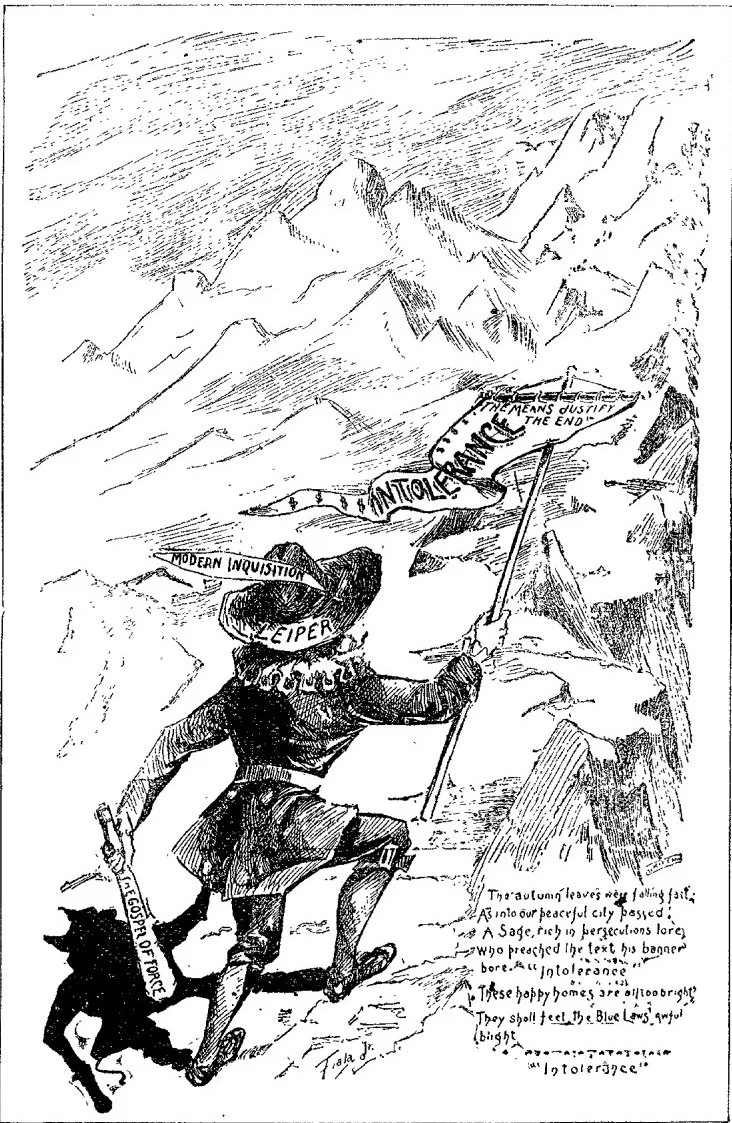
Other points of similarity between the papal Inquisition and this modern image of it might be mentioned, but they are not necessary. The one is so complete an image of the other that the Pennsylvania Grit, a paper of large circulation and influence, published at Williamsport, Pa., under liberal Roman Catholic management, contained, in its issue following the Sunday-law convention, the cartoon which appears on our first page. It would be expected that a well-read Roman Catholic would be able to discern in this “gospel of force” movement a counterpart of the Inquisition of mediæval days. This the editor does, and labels the movement, represented in the cartoon by its secretary, as the “modern Inquisition.” This is just what it is. It is an image of that engine of tyranny by which the papacy persecuted and put to death thousands of martyrs who refused to worship that beast of cruelty by obeying its laws against heresy, and who chose to obey God rather than man.
And now that this modern Inquisition, made in the image of that cruel power, attempts to compel all men to worship it and its prototype the papacy, by compelling obedience to its laws enforcing the observance of Sunday, the mark of papal power, let all men refuse to submit to its intolerant decrees. Let no man think that in thus refusing he is fighting against either God or good government. For that God who says the “seventh day is the Sabbath,” says also, “If any man worship the beast and his image, and receive his mark in his forehead, or in his hand, the same shall drink of the wine of the wrath of God;” and of those who refuse to submit and wear the badge of Rome, and who choose to keep the Sabbath of the Lord and suffer as the martyrs of old, he says in the same connection: “Here are they that keep the commandments of God and the faith of Jesus.” Choose ye this day whom ye will serve.
The Puritan Sabbath For “Physical Rest.”
In the agitation in behalf of Sunday laws that its advocates are carrying on all over the land, they seek to cover up the religious character of Sunday and of the legislation by the plea that “one-seventh part of time [that is, one whole day in seven, which must be Sunday] is necessary for physical rest” in order that men may “recuperate their wasted energies”371and be better prepared successfully to prosecute the vocations of life. This is the ground also upon which courts attempt to sustain the rightfulness of Sunday laws. It is well to examine this plea, and see what is its basis, and what its origin, that we may know what it is worth.
The theory of “one-seventh part of time” for rest originated in the controversy between the Puritans and the Episcopalians in the latter part of the sixteenth century, and the authority for the theory was the Rev. Nicolas Bownde, or Bound, D. D., “of Norton, in the county of Suffolk,” England. Dr. Bownde was a Puritan, and promulgated this theory for the first time in a book which he published in 1594, entitled, “The Doctrine of the Sabbath.”
The way it came about was this: It was in the height of the controversy between the Church of England and the Puritans about “habits and ceremonies, and church discipline,” that the Church of England maintained,—
That though the Holy Scriptures are a perfect standard of doctrine, they are not a rule of discipline and government: nor is the practice of the apostles an invariable rule or law to the church in succeeding ages; because they acted according to the circumstances of the church in its infant and persecuted state; neither are the Scriptures a rule of human actions, so far as that whatsoever we do in matters of religion without their express direction or warrant is sin, but many things are left indifferent. The church is a society like others, invested with powers to make what laws she apprehends reasonable, decent, or necessary for her well-being and government, provided they do not interfere with or contradict the laws and commandments of Holy Scripture: Where the Scripture is silent, human authority may interpose; we must then have recourse to the reason of things and the rights of society. It follows from thence that the church is at liberty to appoint ceremonies, and establish order within the limits abovementioned; and her authority ought to determine what is fit and convenient.—Neal’s History of the Puritans, Part I, chap. vii, par. 112.
All this the Puritans denied and asserted that the Scriptures are a rule of discipline and government as well as a perfect standard of doctrine. The position of the Church of England, summarily stated, was, that, whatever the Scriptures do not forbid, in matters of church discipline and church government, may be done without sin. While the Puritan position was, that, whatever is not commanded in the Scriptures, in these things, cannot be done without sin. The Puritans therefore dropped all church festivals and feast days, surplices, habits, and ceremonies, and charged the Episcopalians with “popish leaven and superstition, and subjection to the ordinances of men,” because they retained these. As proof which, they thought, ought to convince the Puritans that the church had liberty in such things as these, the Episcopalians produced the fact that the observance of Sunday is only an ordinance of the church, and rests only upon the authority of the church; and that the Puritans therefore contradicted themselves in observing Sunday while denouncing the authority of the church, the only authority upon which that observance rests.
This put the Puritans in a box; and they had to cast about for some way to get themselves out. They would not admit the authority of the church; because, if they did, that would involve the obligation to observe all the other festivals. Directions of Scripture to observe Sunday they found none; because the only authority for a day of weekly rest is the fourth commandment, which commands the observance of the seventh day, not the first day of the week. The Puritans therefore found themselves keeping a day for which there was no authority but church authority Church authority they would not recognize, and yet they would not give up Sunday observance. But to observe it without any authority while insisting, against the Episcopalians, that there must be a commandment of God for everything that was to be done, was to condemn themselves in the eyes of all.
There was great perplexity. What could be done? Then it was that the inventive genius of Dr. Bownde found play. He committed a deliberate fraud upon the commandment of God, and came to the rescue with the theory that it is not the definite seventh day, but “a seventh part of time” that is required by the fourth commandment to be kept for the Sabbath: that it is “not the seventh day from creation, but the day of Christ’s resurrection, and the seventh day from that:” that “the seventh day is genus” in the fourth commandment, so that “the seventh day from creation, and the day of Christ’s resurrection and the seventh from that” are “both of them at several times comprehended in the commandment, even as genus comprehendeth both his species.” Thus the fourth commandment was made to enforce the seventh day from creation until the resurrection of Christ and then the first day from that time onward!
This brought joy to the Puritans, for it relieved them from the dilemma into which the answer of the Episcopalians had cast them. “This book had a wonderful spread among the people.” “All the Puritans fell in with this doctrine, and distinguished themselves by spending that part of sacred time in public, family, and private acts of devotion.” Says Heylin:—
This doctrine, carrying such a fair show of piety, at least in the opinion of the common people, and such as did not examine the true grounds of it, induced many to embrace and defend it; and in a very little time it became the most bewitching error and the most popular infatuation that ever was embraced by the people of England.
But for what purpose was this “seventh part of time” appointed? For what was it to be used when it had been discovered?
“This year [1594] Dr. Bownde published his treatise on the Sabbath, wherein he maintains the morality of the seventh part of time for the worship of God.”—Neal, Id., par. 120.
Doctor Bownde’s own statement of the matter is this:—
Wherefore being bound by his calling (Gen. 2:15) to dress and keep the garden, and yet charged (verse 3) to keep holy the seventh day, meditating upon the wisdom and mercy of God appearing, as in all the creatures, so especially in himself, and thus (Rom. 1:20) beholding the invisible things of God in them, giving thanks to God for them, praying for the continuance of them, teaching them to his posterity, etc., it was needful that the seventh day should be unto him (and it was indeed) a Sabbath day, that is, a day of rest, resting from all his other necessary business that so he might with his whole heart and mind attend upon these, as the worship of God requireth.—Book I, under 4
There was not in it the remotest idea that this time was for physical rest. It was solely for worship and religious exercises. The suggestion of such a thought as that this time was intended or might be devoted to physical rest would have been spurned by the founder of the theory and by every other Puritan that ever lived in Puritan times, as only the suggestion of the arch enemy of righteousness. The theory therefore that a seventh part of time is necessary for physical rest is a positive fraud upon the original.
And that the original invention, that a seventh part of time is what is commanded and required by the fourth commandment is a positive fraud, is clearly proved not only by the circumstances of its invention but also by every test of Scripture and every rule of law.
But this theory of a seventh part of time for physical rest is not only a fraud upon the original Puritan theory of a seventh part of time for the worship of God, it is also a fraud upon the commandment of God which enjoins the day of rest. That commandment says: “Remember the Sabbath day to keep it holy. Six days shalt thou labor, and do all thy work; but the seventh day is the Sabbath of the Lord thy God; in it thou shalt not do any work, thou, nor thy son, nor thy daughter, thy man-servant, nor thy maid-servant, nor thy cattle, nor thy stranger that is within thy gates; for in six days the Lord made heaven and earth, the sea, and all that in them is, and rested the seventh day; wherefore the Lord blessed the Sabbath day, and hallowed it.”
Here are the reasons: First, he rested on the seventh day; second, he blessed it and made it holy. That one may become tired is not given as a reason for doing no work on the seventh day. God does not say that on the seventh day you shall do no work because if you should you would overdo or break down your physical system. Nothing of the kind. Man’s physical wants are not referred to in the commandment. It says, Work six days because the Lord worked six days; rest on the seventh because the Lord rested on the seventh day; keep that day holy, because the Lord blessed it and made it holy. It is the Lord who is to be held in view. It is the Lord who is to be exalted. Therefore the fourth commandment and its obligations have solely to do with man’s relationship to God. It is not man’s physical but his spiritual needs that are held in view in the Sabbath commandment.
This is further proved by referring again to the reason given in the commandment for the resting. It is to rest the seventh day because the Lord rested that day. Now, did the Lord rest because he was weary from what he had done on the six days? Did he rest because if he should work longer there was danger of overdoing or breaking down his physical system? Did he rest in order to “recuperate his wasted energies?”—Not at all. “Hast thou not known? hast thou not heard, that the everlasting God, the Lord, the Creator of the ends of the earth, fainteth not, neither is weary?” Isa. 40:28. This is what the Scripture says of it; and what one of the chief Sunday-law workers says of it is this:—
If he is never weary, how can we say of him that he rests? . . . God is a spirit, and the only rest which he can know is the supreme repose which only the Spirit can know—in the fulfillment of his purpose and the completeness as well as the completion of his work. Just as in the solemn pauses between the creative days, he pronounced his creatures “good,” so did he rejoice over the finishing of his work, resting in perfect satisfaction of an accomplished plan; not to restore his wasted energy.—Rev. Geo. Elliott, “Abiding Sabbath,” chap. 1.
The rest with which the Lord rested was spiritual rest, spiritual refreshing, and delight in the accomplished work of the creation. As the Lord’s Sabbath rest was spiritual, and as his so resting is the reason for man’s Sabbath rest, so man’s Sabbath372is likewise to be one of spiritual rest, spiritual refreshing, and delight in the works and ways of God. This is proved by that psalm for the Sabbath day, “Thou, Lord, hast made me glad through thy work; I will triumph in the works of thy hands.” Ps. 92:4. And by another scripture, “If thou turn away thy foot from the Sabbath, from doing thy pleasure on my holy day; and call the Sabbath a delight, the holy of the Lord, honorable; and shalt honor him, not doing thine own ways, nor finding thine own pleasure, nor speaking thine own words; then shalt thou delight thyself in the Lord.” Isa. 58:13, 14.
This is yet further shown by the fact that the Sabbath was instituted and given to man while he was yet in the garden of Eden; before he had sinned; before the word had been spoken, “In the sweat of thy face shalt thou eat bread;”—before toil had become a part of man’s lot; and while as yet there was no possible necessity or opportunity for any waste of energy and therefore no place for physical rest to recuperate wasted energy.
It is likewise shown in the additional fact that after men are redeemed, the earth made new, and Eden restored, the redeemed will keep the Sabbath. For it is written: “As the new heavens and the new earth which I will make, shall remain before me, saith the Lord, so shall your seed and your name remain. And it shall come to pass that, from one new moon to another, and from one Sabbath to another, shall all flesh come to worship before me, saith the Lord.” Isa. 66:12, 23.
A day of weekly rest is in itself an institution of God. Its basis is the rest of God, which was wholly spiritual. Its purpose is to cultivate the spiritual in man. Its authority is the commandment of God, which is spiritual and religious, and which must be spiritually and religiously observed to be observed at all. As says the seer of Patmos, “I was in the Spirit on the Lord’s day.” The whole subject, therefore, in all its bearings, is entirely beyond the jurisdiction and even the reach of the power of civil government or of man. It rests wholly in the power and jurisdiction of God, and remains solely between the individual and God.
Thus, we repeat, it is not man’s physical, but his spiritual needs that are to be held in view in the Sabbath commandment. The Sabbath is intended to be a day in which to worship God—a day of holy remembrance of him and of meditation upon his works. The day is to be kept holy, not civilly nor physically. If it is not kept holy, it is not kept at all in the purview of the commandment and the intention of the Author of the day of the weekly rest.
The evidences which we have here presented positively demonstrate, to the utter exclusion of every other theory, that the object of the Sabbath, the object of the weekly rest, is THE WORSHIP OF GOD.
The sum of this whole matter therefore is this:—
1. The Puritan theory of one seventh part of time for the Sabbath is, and in its inception was, a fraud upon the commandment of God.
2. The theory of one seventh part of time for physical rest is a fraud upon the original Puritan theory.
3. The seventh part of time for physical rest is therefore a fraud upon a fraud.
4. In addition to its being a fraud upon the Puritan theory, the seventh part of time for physical rest is also a fraud upon the commandment of God.
5. And the Puritan theory of a seventh part of time for the Sabbath is itself a fraud upon the commandment of God.
6. The two together, therefore—the Puritan Sabbath and the weekly physical rest day—interlocked as they are, form a HEAPED UP FRAUD.
That is just what the theory of one seventh part of time for physical rest is: and all the sophistry of all the preachers, and all the decisions of all the courts on earth, can never make it anything else.
Spiritualism.
THE ministration of holy angels, as presented in the Scriptures, is a truth most comforting and precious to every follower of Christ. But the Bible teaching upon this point has been obscured and perverted by the errors of popular theology. The doctrine of natural immortality, first borrowed from the pagan philosophy, and in the darkness of the great apostasy incorporated into the Christian faith, has supplanted the truth, so plainly taught in Scripture, that “the dead know not anything.” Multitudes have come to believe that it is the spirits of the dead who are the “ministering spirits sent forth to minister for them who shall be heirs of salvation.” And this notwithstanding the testimony of Scripture to the existence of heavenly angels, and their connection with the history of man, before the death of a human being.
The doctrine of man’s consciousness in death, especially the belief that the spirits of the dead return to minister to the living, has prepared the way for modern Spiritualism. If the dead are admitted to the presence of God and holy angels, and privileged with knowledge far exceeding what they before possessed, why should they not return to the earth to enlighten and instruct the living? If, as taught by popular theologians, the spirits of the dead are hovering about their friends on earth, why should they not be permitted to communicate with them, to warn them against evil, or to comfort them in sorrow? How can those who believe in man’s consciousness in death reject what comes to them as divine light communicated by glorified spirits? Here is a channel regarded as sacred, through which Satan works for the accomplishment of his purposes. The fallen angels who do his bidding appear as messengers from the spirit world. While professing to bring the living into communication with the dead, the prince of evil exercises his bewitching influence upon their minds.
He has power to bring before men the appearance of their departed friends. The counterfeit is perfect; the familiar look, the words, the tone are reproduced with marvelous distinctness. Many are comforted with the assurance that their loved ones are enjoying the bliss of heaven: and without suspicion of danger, they give ear to “seducing spirits, and doctrines of devils.”
When they have been led to believe that the dead actually return to communicate with them, Satan causes those to appear who went into the grave unprepared. They claim to be happy in heaven, and even to occupy exalted positions there; and thus the error is widely taught, that no difference is made between the righteous and the wicked. The pretended visitants from the world of spirits sometimes utter cautions and warnings which prove to be correct. Then, as confidence is gained, they present doctrines that directly undermine faith in the Scriptures. With an appearance of deep interest in the well-being of their friends on earth, they insinuate the most dangerous errors. The fact that they state some truths, and are able at times to foretell future events, gives to their statements an appearance of reliability; and their false teachings are accepted by the multitudes as readily, and believed as implicitly, as if they were the most sacred truths of the Bible. The law of God is set aside, the Spirit of grace despised, the blood of the covenant counted an unholy thing. The spirits deny the divinity of Christ, and place even the Creator on a level with themselves. Thus under a new disguise the great rebel still carries forward his warfare against God, begun in heaven, and for nearly six thousand years continued upon the earth.
Many endeavor to account for spiritual manifestations by attributing them wholly to fraud and sleight of hand on the part of the medium. But while it is true that the results of trickery have often been palmed off as genuine manifestations, there have been, also, marked exhibitions of supernatural power. The mysterious rapping with which modern Spiritualism began was not the result of human trickery or cunning, but was the direct work of evil angels, who thus introduced one of the most successful of soul-destroying delusions. Many will be ensnared through the belief that Spiritualism is a merely human imposture; when brought face to face with manifestations which they cannot but regard as supernatural, they will be deceived, and will be led to accept them as the great power of God.
These persons overlook the testimony of the Scriptures concerning the wonders wrought by Satan and his agents. It was by satanic aid that Pharaoh’s magicians were enabled to counterfeit the work of God. Paul testifies that before the second advent of Christ there will be similar manifestations of satanic power. The coming of the Lord is to be preceded by “the working of Satan with all power and signs and lying wonders, and with all deceivableness of unrighteousness.” And the Apostle John, describing the miracle-working power that will be manifested in the last days, declares: “He doeth great wonders, so that he maketh fire come down from heaven on the earth in the sight of men, and deceiveth them that dwell on the earth by the means of those miracles which he had power to do.” No mere impostures are here foretold. Men are deceived by the miracles which Satan’s agents have power to do, not which they pretend to do.
The prince of darkness, who has so long bent the powers of his master-mind to the work of deception, skillfully adapts his temptations to men of all classes and conditions. To persons of culture and refinement he presents Spiritualism in its more refined and intellectual aspects, and thus succeeds in drawing many into his snare. The wisdom which Spiritualism imparts is that described by the Apostle James, which “descendeth not from above, but is earthly, sensual, devilish.” This, however, the great deceiver conceals, when concealment will best suit his purpose.373
He who could appear clothed with the brightness of the heavenly seraphs before Christ in the wilderness of temptation, comes to men in the most attractive manner, as an angel of light. He appeals to the reason by the presentation of elevating themes, he delights the fancy with enrapturing scenes, and he enlists the affections by his eloquent portrayals of love and charity. He excites the imagination to lofty flights, leading men to take so great pride in their own wisdom that in their hearts they despise the Eternal One. That mighty being who could take the world’s Redeemer to an exceedingly high mountain, and bring before him all the kingdoms of the earth and the glory of them, will present his temptations to men in a manner to pervert the senses of all who are not shielded by divine power.—Great Controversy, pages 551-554.