The Youth’s Instructor, Vol. 37, No. 19.

A PEEP AT ETON

The Youth’s Instructor

May 8, 1889

S. D. A. Publishing Association · Battle Creek, Mich. · May 8, 1889

A PEEP AT ETON.
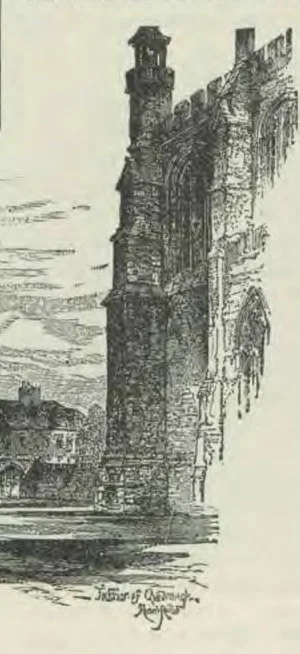
In one of the most beautiful places in England, on the banks of the Thames, stands Eton College. It was founded over four hundred years ago by King Henry the Sixth. Near the college, on the banks of the same river, is Windsor Castle, from whose windows the unhappy king no doubt often looked upon the stone masons and the carpenters, as they reared the buildings under his directions. King Henry loved nothing so much as quiet and books; so he founded two colleges in his lifetime,—this one at Eton, and another, King’s College, at Cambridge. But though he loved quiet and study, he could get very little of it himself; for all his life he was embroiled in those bitter quarrels that resulted in the wars of the Red and the White Roses,—quarrels so bitter, and troubles so annoying to him, that at last he went crazy.
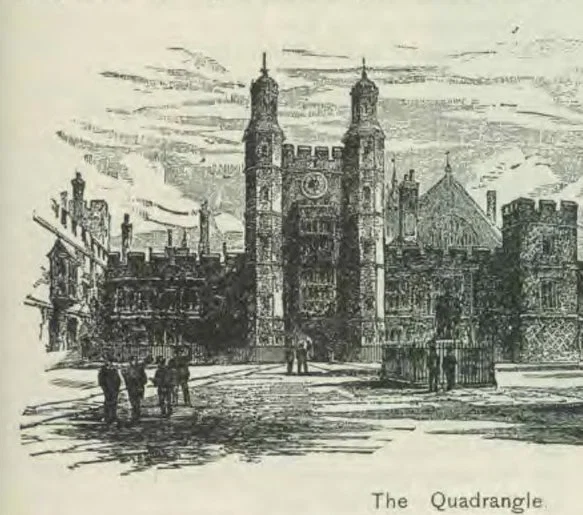
The Quadrangle.
The Quadrangle.
Whenever the king met any of those first Eton boys in his beautiful grounds around the castle, he generally gave them a little present of money and this wholesome advice: “Be good boys, meek and docile, and servants of the Lord.” He did not much like to have them come; for he knew, better than they, that kings were not happy.
The buildings of Eton are located, as was the fashion to build churches and schools then, around an open space, thus making an inclosed yard, or court, called the quadrangle. In this quadrangle stands a statue of the king, with a scepter in his hand. King Henry is held in great veneration by the boys.
When the college was first opened, the king appointed “a provost, a head master, a lower master, who was called the usher, ten fellows, ten chaplains, ten clerks, sixteen choristers, seventy scholars, and thirteen almsmen; for in those old times they used to have a place set apart for the poor in almost all institutions.” But this is much changed now. The almshouse was banished before King Henry died, and the ten fellows, who were priests allowed to spend their whole lives in study at the college, are also gone.
But the seventy scholars are there. These are poor boys who are allowed to go to school free of charge. At first they were appointed by the heads of Eton and Cambridge; but now they are admitted on competitive examination. The examination is a severe one, and it is considered a high honor among the boys to receive an appointment. There were few good schools in England when Eton was founded, and so pupils were sent here from all parts of the kingdom, to obtain an education. These boys were not permitted to live in the college building, but boarded out in the town at their own expense; hence they were called “oppidans,” which means “town-boys.” The “collegers” still board in college hall, while the “oppidans” room in the different masters’ houses around the town. “Every master has charge of thirty or forty boys, and every boy has a little room of his own. And very snug rooms they are, too, with the tables covered with books, and pretty things from home on the mantle-shelf, and the walls decorated with photographs and the pictures of hounds and horses. And the School Almanac is sure to be there, and the rules of the boat-clubs, and all sorts of hats and caps, and cricket-bats, and pewter cups won in the races.”
There is one custom prevalent among English schools which is not seen in America. The older boys have fags, that is, boys whom they select from the younger members of the school to do menial service for them. “Fagging,” says one, “is not easy work at Eton. Fags not only have to wait on their fag-masters at almost all hours, to bring them water, and to look out for their rooms, but they even have to cook for them. All the boys of a house take their dinner together; but excepting in two or three houses where a new rule has been made, every one has his breakfast and tea in his own room. And for these meals the poor fags are cooks and waiters. There is even a kitchen provided for their especial use, where they boil water, brew tea, and toast bread. Many heartaches have there been in those little kitchens! Fancy a youngster just out of the home nursery, you might say, being set to making toast, when he knows as little about it as he does about making Latin verses! And yet, if it is not all right, his fastidious master will take him to task with all the indignation of disappointed hunger, and then send him off to do his work over again.”
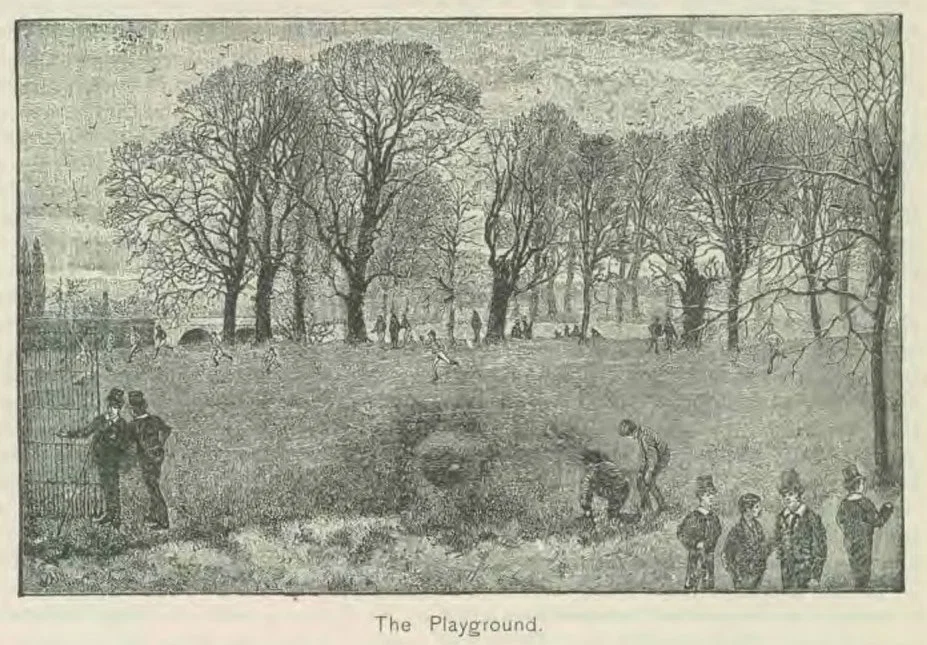
After school hours in the afternoon, the boys toss aside the tall silk hats and black coats and trousers, which custom obliges every Etonian to wear, exchanging them for caps and flannels, and hie away to the playground, which is soon alive with boys. Eton playgrounds are very beautiful. The shady elms of Poet’s Walk invite to delightful rambles, the green fields hold out inducements to the cricketers, and the Thames River, flowing close by, is specially tempting to all lovers of aquatic sports. “English boys are as serious at play as at study, and they will not spoil their chances of becoming either a really good cricketer or good oarsman, by trying to be both. It is considered an important moment when an Etonian decides whether he will be a ‘dry bob’ or a ‘wet bob.’”
No boy is allowed to join the boating-clubs who has not first learned to swim well. Every year boat and cricket matches are held between Eton and rival schools, and these seasons are very exciting to the boys.
And now I shall give you a description of the school from two travelers who have been there, and wrote out what they saw for the young readers of the St. Nicholas: “Across the yard, in front of us, beyond King Henry’s statue, is the Provost’s Lodge, filling that whole side of the square, and with the great clock-tower in the middle.
“On the right, as you stand in the gateway, is the great chapel, one of the most magnificent churches in all England, though not so magnificent as Henry meant it to be; and beyond that is the hall where the seventy collegers dine, with its fine stained-glass windows and big stone fire-places and portraits of famous Etonians. On the left is the Lower School, with the collegers’ rooms above it, where Long Chamber used to be; and over our heads, as we stand in the gateway, is the Upper School. The Upper School is a very long room. It is full of stools for the boys, and there are five desks for the masters, and great curtains which can be drawn to divide the long room up into small rooms. There are busts of kings and queens and statesmen all around; and the oaken panels of the walls are all cut up with the names of old Eton boys. In one very small space you can see the names of Chatham, Howe, Wellington, Canning, Gray, and Fox. At the end of the Upper School is the head-master’s room, a very handsome room, full of pictures of Athens and Rome. Here the sixth form is taught.
The Playground.
The Playground.
“But I think the old Lower School, with its rows of rough, worn-out desks and benches, is even more interesting than the Upper School. Here, too, the windows and the posts are all cut up with the names of those who, in the old days, obtained scholarships, and went up to King’s College at Cambridge.”
“The classes at Eton are much the same as at other English schools. The sixth is the highest form, and then follow the other forms and divisions. So long as they are in the Lower School, the boys do almost all their work in the pupil-room. At stated hours they study with their tutors, who then help them to prepare their verses, so that when they go to their masters, their work is really done.
“The day begins with ‘morning school,’ at seven in the summer and half-past seven in the winter, and this hour is the most miserable of the twenty-four. Then comes breakfast, plenty of time being allowed for the fags, after they have waited on their masters, and perhaps run for them to the ‘tuck’ shops for extra delicacies, to wait on themselves. Next comes a twenty minutes’ service in the chapel, to which all Etonians must go. At the end, they march out in regular order, first the collegers, in white surplices, then the oppidan sixth form, and finally the oppidans of the lower forms.
“After this, work begins in earnest with ten o’clock school, which lasts from quarter of to half-past ten, and is quickly followed by eleven o’clock school. For two hours there is a great quiet in Eton. When they are over, comes the ‘after twelve.’ Until two o’clock the elder boys do whatever they like; but the unfortunate little fellows in the Lower School must go on constructing and grinding out Latin verses in pupil-room. At two, however, when the dinner-bell rings, they are also at rest. They can at least eat their midday meal in peace; for they know that if the mutton is underdone, they will not have to roast it the second time, that if a glass of water is called for, they will not have to fetch it.
“The ‘after two’ is very short, afternoon school beginning again at three. The ‘after four,’ from a quarter to four to a quarter past during the winter term, is quite a favorite time for a walk on the High street. If you happen to be out just then, you will see boys in every shop in deep consultation with tailors and boot-makers, making appointments with photographers, looking over books, or more often in the confectioners’, eating pies and sweets. The fags, too, are on duty again, and are marketing for their fag-masters. As ‘lock-up’ in winter is at five o’clock, the boys have a long evening in the house. This they spend sometimes in studying, but, as a rule, in doing whatever best suits them. But you must not think on this account, these are always idle hours. There are many prizes outside the regular course, for which the boys compete; and then—another great reason for study—all who distinguish themselves in their school work are, like the great cricketers and oarsmen, looked up to as the ‘swells’ of the college. There are, besides, the house debating societies, and the great school debating society called ‘Pop,’—to which so many famous Englishmen belonged in their Eton days,—and literary societies and magazines; and altogether any Eton boy who chooses will find more to do than he has time for.” W. E. L.

THE BURMESE BIBLE.

THE Bible was translated into the Burmese language by Dr. Judson. It takes many years of study and labor to translate the whole of the Scriptures into any language, and it was twenty years after Mr. Judson reached Burmah before he finished this work. He by this time so well understood the hard Burmese tongue, so well knew all the shades of meaning, that I believe this Burmah Bible is one of the best and most faithful translations of God’s word that ever was made. Just before Mr. and Mrs. Judson went to live in “the golden city,” he had finished the New Testament. A part of it had been printed, but the larger part was only in writing.
On the 8th of June, 1824, early in the war between England and Burmah, Mr. Judson was taken from his home in Ava, and thrust into prison. Mrs. Judson then took this precious manuscript, and, with her silver and a few things of value, buried it in the earth under the house. But it could not long stay there, for it was the rainy season, and the dampness would soon cause it to mold.
It could not be returned to the house; for if found by the Burmans, it would be destroyed. When Mr. and Mrs. Judson, three days later, met at the door of his prison, and were permitted to speak a few words to each other, one of the first questions asked by Mr. Judson was, “Where is the New Testament manuscript?” When told, he said he would try to take care of it. So Mrs. Judson put the treasure inside of a roll of cotton, carefully sewed it up, then put on a cover, and Mr. Judson used it for a pillow. It looked so poor and hard that not even the keeper, who wanted almost everything, coveted it.
When the missionary had been a prisoner seven months, suddenly a change came. The little bamboo room, which Mrs. Judson had been allowed to have made for her husband in the prison-yard, was torn down, the pillow and mats scattered, and Mr. Judson, with the other white prisoners, hurried into the inner prison. Two more pairs of fetters were put upon their ankles,—they already had three pairs,—and there, fastened to a bamboo pole, more than a hundred men expected to be killed before the morning.
Mr. Judson afterwards said that, even during this terrible night, he thought of his pillow, and wondered if its precious contents would ever fall into the hands of his wife; and he even thought how he might have better translated some passages of the divine word.
The keeper, to whose share the pillow fell, gladly exchanged it for a good one brought by Mrs. Judson, with, perhaps, some wonder that the white man should prefer the poorer to the better one. Later in the season, when Mr. Judson was hurried away to Oung-pen-la, he, in common with the other prisoners, was robbed of nearly all his clothing, and allowed to take nothing with him. One of the jailors untied the mat which was used as a cover to the precious pillow, and threw into the yard what he thought was worthless cotton.
A few hours later, Moung Ing, one of the native Christians, in looking about, found the roll, and took it home with him as a relic of the prisoners. Months after, the manuscript was found within the cotton, and not at all hurt. Soon after the close of the war, the New Testament was printed, and given to the Burmans; and, in 1834, the whole of the Bible was in the language of the country. The day it was finished, Dr. Judson knelt down with the last leaf in his hand, and asked God to use it in “filling all Burmah with songs of praise to our great God and Saviour, Jesus Christ.”—Little Helpers.

A GOOD INVESTMENT.

Several winters ago a woman was coming out from a public building, where the heavy doors swung back, and made egress somewhat difficult. A little street urchin sprang to the rescue, and as he held open the door, she said, “Thank you,” and passed on.
“D’ye hear that?” said the boy to a companion standing near by him.
“No; what?”
“Why, that lady said ‘Thank ye’ to the likes o’ me.”
Amused at the conversation, the lady turned, and said to the boy,—
“It always pays to be polite, my boy; remember that.”
Years passed away, and last December, when doing her Christmas shopping, this same lady received exceptional courtesy from a clerk in Boston, which caused her to remark to a friend who was with her,—
“What a great comfort to be treated civilly once in a while—though I don’t know that I blame the store clerks for being rude during the holidays.”
The young man’s quick ear caught the words, and he said,—
“Pardon me, madam, but you gave me my first lesson in politeness a few years ago.”
The lady looked at him in amazement while he related the little forgotten incident, and told her that that simple “Thank you” awakened his ambition to be something in the world. He applied for a situation as office boy in the establishment where he was now an honored and trusted clerk.
Only two words, dropped into the treasury of a street conversation, but they yielded returns most satisfactory.—The Congregationalist.

The Wild Hogs of the Black Forest.

Near Würtemberg, Germany, there is an immense tract of timber land called the Black Forest. Roaming through this woodland are hundreds of savage wild hogs that spend the greater portion of their time hunting for and devouring the snakes that infest the region. These hogs are ugly and ferocious, and very dangerous to meet, yet extremely useful on account of their natural dexterity in capturing snakes.
Some time ago a very wealthy banker of New York City, Mr. Otto Plock, bought an elegant country seat in the Neversink Valley, near Port Jervis, New York, his parks extending to the Shawangunk Mountains. He had a large tract of the rough, wild portion near the base of the mountains fenced in with a high wire fence, and set it apart for deer, and pet animals and birds. But the holes, ledges, and thickets seemed to swarm with vermin and snakes, among the latter the deadly rattle-snake. After trying many plans for their extermination, he at last bethought him of the wild hogs of the Black Forest, and sent for nine of the most savage, and turned them loose in his park. It was not a great while before these ferocious creatures had almost exterminated the snakes; but a greater catastrophe has happened. In some way they succeeded in breaking open the wire fence, and have made their escape, becoming a terror to the country. These wild hogs, particularly the males, are of formidable aspect, with huge heads and shoulders, lank hind parts, and mammoth tusks, and long, erect bristles, and they are as quick and fleet as deer. During the daytime, they remain in the mountains, but at night descend into the valley, destroying the crops and everything else they come across, including the winter stores of roots and grain.
Recently, the superintendent of Mr. Plock’s grounds invited a large party of sportsmen from New York City to spend the day in the valley and mountains with guns and dogs, in an effort to capture and kill the herd; but only one old hog was found, and he was so ferocious that he put the men and dogs to flight, some of them who had been stationed on the runways taking to trees, until rescued by relief parties. It is probable that these savage animals will cause much trouble before all can be finally killed.
W. S. C.

SOME BIBLE STORIES, AND WHERE TO FIND THEM.

  1. The Flood, Gen. 7.
  2. Destruction of Sodom and Gomorrah, Gen. 19.
  3. Abraham Offering up Isaac, Gen. 22.
  4. Jacob and Esau, Gen. 27.
  5. Jacob and the Angel, Gen. 32.
  6. Story of Joseph, Gen. 37.
  7. Joseph's Temptation, Gen. 39.
  8. Moses in the Bulrushes, Ex. 2.
  9. Plagues of Egypt, Ex. 7–12.
  10. Crossing the Red Sea, Ex. 14.
  11. Quails and Manna Sent, Ex. 16.
  12. Ten Commandments Given, Ex. 20.
  13. Nadab and Abihu, Lev. 10.
  14. Miriam and Aaron, Num. 12.
  15. Korah, Dathan, and Abiram, Num. 16.
  16. Moses' Sin at waters of Meribah, Num. 20.
  17. Balaam, Num. 22–24.
  18. Rahab hiding the Spies, Josh. 2.
  19. City of Jericho Taken, Josh. 6.
  20. Achan in the Camp, Josh. 7.
  21. Sun and Moon Stand Still, Josh. 10.
  22. Deborah the Prophetess, Judges 4.
  23. The Fleece of Wool, Judges 6.
  24. Gideon's Army, Judges 7.
  25. Parable of the Trees, Judges 9.
  26. Jephthah's Vow, Judges 11.
  27. Shibboleth and Sibboleth, Judges 12.
  28. Samson's Riddle, Judges 14.
  29. The Foxes, Judges 15.
  30. Samson's great Strength, Judges 16.
  31. The story of Ruth, Ruth.
  32. The child Samuel, 1 Sam. 1, 2.
  33. Eli and his Sons, 1 Sam. 3.
  34. The Ark among the Philistines, 1 Sam. 5, 6.
  35. Jonathan and his Armorbearer, 1 Sam. 14.
  36. Saul's Disobedience, 1 Sam. 15.
  37. David and Goliath, 1 Sam. 17.
  38. David and Jonathan, 1 Sam. 18.
  39. Saul and the Witch of Endor, 1 Sam. 28.
  40. Uzzah Struck Dead, 2 Sam. 6.
  41. David's Great Sin, 2 Sam. 11, 12.
  42. Nathan's Parable, 2 Sam. 12.
  43. The Story of Absalom, 2 Sam. 15–18.
  44. Solomon Asks for Wisdom, 1 Kings 3.
  45. Rehoboam Follows Counsel of Young Men, 1 Kings 12.
  46. The Disobedient Prophet, 1 Kings 13.
  47. Elijah fed by Ravens, 1 Kings 17.
  48. Elijah and the Prophets of Baal, 1 Kings 18.
  49. Jezebel and Naboth, 1 Kings 21.
  50. Micaiah the true Prophet, 1 Kings 22.
  51. Elijah Translated, 2 Kings 2.
  52. Elisha Raises the Widows' Son, 2 Kings 4.
  53. Naaman Cured of the Leprosy, 2 Kings 5.
  54. Fifteen Years Added to Hezekiah's Life, 2 Kings 20.
  55. Huldah the Prophetess, 2 Kings 22.
  56. The Rebuilding of Jerusalem, Neh. 1–6.
  57. Esther, Esther.
  58. The Poor Wise Man, Eccl. 9:14, 15.
  59. The New Earth, Isa. 35.
  60. The three Hebrew Captives, Dan. 3.
  61. Daniel in the Lions' Den, Dan. 6.
ANNA L. COLCORD.

CHILDREN'S PRAYERS.

In the great battle of right against wrong, childhood's faith and earnestness, childhood's prayers and entreaties, have often led the way to victory. When the Reformation seemed almost defeated, and even Melancthon was cast down and disheartened, we read that, taking an evening walk, he heard the voices of children praying for the Reformation, and was cheered at once, and said to his friends: “Brethren, take courage; the children are praying for us.” That children's prayer-meeting changed seeming defeat into victory.

THE CHILD AND THE WORLD.

I see a nest in a green elm tree, With little brown sparrows,—one, two, three! The elm tree stretches its branches wide, And the nest is soft and warm inside. At morn the sun, so golden bright, Climbs up to fill the world with light; It opens the flowers, it wakens me, And wakens the birdies,—one, two, three; And leaning out of my window high, I look far up at the blue, blue sky, And then far out at the earth so green, And think it the loveliest ever seen,— The loveliest world that ever was seen!
But by and by when the sun is low, And birds and babies sleepy grow, I peep again from my window light, And look at the earth and air and sky. The night dew falls in silent showers, To cool the hearts of thirsty flowers; The moon comes out—the slender thing— A crescent yet, but soon a ring; And brings with her one yellow star,— How small it looks, away so far. But soon, in the heaven's shining blue, A thousand twinkle and blink at you, Like a thousand lamps in the sky so blue.
And hush!—a light breeze stirs the tree, And rocks the birdies,—one, two, three. What a beautiful cradle, that soft, warm nest; What a dear little coverlid—mamma bird's breast! She's hugging them close to her—tight, so tight, That each downy head is hid from sight; But out from under her sheltering wings Their bright eyes glisten—the cunning things! I lean far out from my window's height, And say, "Dear, lovely world, good night!"
"Good night, dear, pretty baby moon! Your cradle you'll outgrow quite soon, And then, perhaps, all night you'll shine, A grown-up lady moon!—so fine And bright that all the stars Will want to light their lamps from yours. Sleep sweetly, birdies, never fear, For God is always watching near! And you, dear, friendly world above, The same One holds us in His love,— Both you so great and I so small Are safe—He sees the sparrow's fall— The dear God watcheth over all!" —Kate Douglas Wiggin.

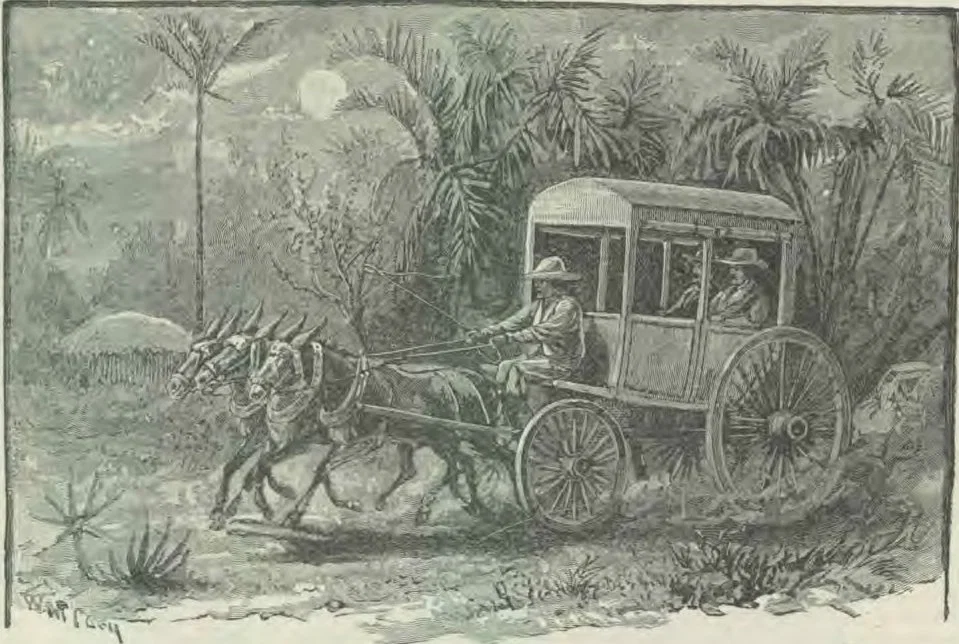
A THREE-MULE COACH.

THREE mules harnessed abreast to a coach! Where do they do it? In some countries of Europe they drive horses and mules in this way. The people of Mexico would laugh to see horses driven in pairs, or one ahead of another, because it is not their custom.
It was in a country called Yucatan that I traveled in this manner. Yucatan is far south of the United States, and is a portion of Mexico. The land is low and flat, like a great broad table of coral rock. It is very hot there.
Being so hot by day, people travel by night, when it is cool. The roads are dusty, but you don't mind the dust so much at night. I hired a driver and this coach with three mules to take me forty miles from the city I was living in, to a hacienda. This is a Spanish word meaning an estate, or farm.
As you may know already, a large part of America was once owned by Indians. The first people who visited them were the Spaniards. They were not willing the Indians should have so much good land, so they took it away from them. Then the Indians had nothing to do, and the Spaniards set them to work. They worked so hard that nearly all of them died.
Why did the Indians allow them to make slaves of them? Because the white men were stronger than they, and had guns, powder, armor, swords, and cannon. The poor Indians had nothing better than bows and arrows. Little by little the white men from Spain took the best part of America. But they have lost nearly all again; for they are not so strong as they were. They own only two islands now, in America. These are Cuba and Puerto Rico. But in the countries they once conquered, the people speak Spanish. Even the Indians, most of them, have forgotten their own language, and speak Spanish. This is the reason why we find large estates in Yucatan and Mexico called haciendas, and small farms called ranchos.
The estate I visited was very large. Its owner had forty square miles of land. This was planted with only one kind of plant. For miles and miles you could see nothing else. A great sea of green was spread out on every side.
What do you suppose was so profitable in Yucatan that they planted nothing else? It was not wheat, or barley, or oats, or even corn, though corn will grow there. It was the hemp plant. The soil is so poor that but few other things will grow there. But the hemp plant is at home here.
From hemp is taken a fiber from which twine and ropes can be made. This fiber is cleaned, and packed in bales, and sent by steamer to New York. There it is bought by the merchants, and sold by them to the rope-makers. Perhaps this very fiber, after having been twisted into ropes, may visit the land of its birth again. Thus the world is kept moving. We buy of other people what we need, and send them our products in payment.—Fred A. Ober.

AUNT HOPE'S SECRET.

There was a most dismal groaning sound in the kitchen. Aunt Hope, passing by the half-open door, looked anxiously in, fearing Kitty had cut her finger or bumped her head.
Neither. Kittie stood by the sink over a pan of potatoes which she had been set to wash; and if she did not expect to wash them in tear-drops, why did she send so many splashing down among the rough, brown-coated things?
“Why, Kittie Smith,” cried Aunt Hope, cheerily, “is the well dry that you must furnish water to wash the potatoes, or do they wash easier in salt water?”
Kittie's only answer was a fresh deluge of tears, half of which Aunt Hope kissed away, with a merry laugh.
“Now, dear child,” rolling up her own pretty dress sleeves, and plunging into the work as if she liked the fun, “let us do these potatoes as quickly and cleanly as we can, and I will give you a secret.”
Kittie always liked secrets, and the very idea of one dried up her tears. “I'll tell you one, auntie,” she said, “but it isn't any secret to you now; you've been here three days: I hate to work.”
“You do?” said Aunt Hope, in as surprised a tone as though she had never dreamed of such a thing. “Well, I just know how to pity you, for when I was your age, I did too.”
“Why, Aunt Hope,” and Kittie stared in astonishment. “Ned and I were talking about you last night, and we both thought we never saw so busy a body as you are, always doing something.”
“Yes, I love to work now, but I didn't then; I hated it.”
“There are some kinds of work I am sure I should like to do,” said Kittie. “If mother would only let me wash, or work the butter, or make pies, I know I should love to; but I hate to wash dishes and potatoes, and sweep down the stairs, and do all those things that I have to do every day.”
“And that is just why you hate to do them. Anything that you had to do every day you would soon tire of, and mothers don't give their little girls the hard and impossible things to do, but just the plain and easy ones. Well, my grandma gave me a grand secret to help me like work, and it worked like a charm. I have never forgotten it, and it helps me even now when I have anything to do that I really don't like.”
“What is it?” asked Kittie with deep interest.
“It is this: ‘The more you hate to do anything that must be done, the quicker go at it, and do it in the best possible way.’ Now, these potatoes,—the longer you stop to dread them, the worse they seem. Plunge into them at once, and rub and scrape with all your might, till they look clean and handsome.”
All the while Aunt Hope had been working as briskly as she talked, and Kittie had worked fast, too; so by the time the talk was ended, the potatoes were done.
—Sunday Afternoon.

RHOXY

The old speckled hen had laid an egg in a barrel that lay tipped over in the yard.
Mr. Dayton thought that wasn't a very good place for a Hen's nest, so at night he shut old Speck in the chicken-park.
Next day, though, she was out again, and laid another egg in the barrel. Then Mr. Dayton put some straw in there for a nest, and put the two eggs on it.
After that, for a long time, little Rhoxy Dayton would go several times a day and peep into the barrel, to see how many eggs there were; and every day she would find just one more.
After a while, though, she could not see how many there were; for the old hen was on the nest nearly all the time, and pecked and scolded when little Rhoxy tried to push her off with a corn-stalk.
For three whole weeks old Speck hid the eggs under her breast and wings; then, one day when Papa Dayton lifted her from the nest, and called Rhoxy to the barrel, can you guess what she saw?—Three weak little chickens, that could scarcely stand alone, and that had hardly any feathers; and there was another little chick just part way out of the egg-shell it had been living in; and Rhoxy could hear some inside of the other eggs, trying to pick holes in the shells, so as to get out.
Rhoxy thought it was the funniest thing that ever was, for an egg to turn into a chicken, and she wanted to look at them a long time; but her papa knew the little things would die if they got cold, so he had to put the old hen back to cover them up.
The next day, when Rhoxy looked into the barrel, some of the little chickens were toddling about inside; but when they saw her, they were afraid, and hurried to get under their mother's wings; but they put their little heads out to look at Rhoxy.
A day or two later, there was a great clucking and peeping heard back of the house; and when the folks went to see what was the matter, there was old Mrs. Hen and all her little children, out hunting for something to eat.
Each day, after that, Rhoxy would watch them running about in their comical way, trying to catch bugs or find worms; but as soon as it began to get dark, they would all go into the barrel and go to sleep.
Mamma Dayton said that was a good time for little folks to go to bed, too; for then they wouldn't be so likely to be cross, nor to get sick. So Rhoxy thought she would go to bed when the chickens did; and every night when it began to get dark, she would go and sit on the back steps, and wait for the chickens to go to bed.
They were getting bigger now, and the old hen went off to stay with the others in the chicken-park, and left her babies alone.
The barrel had been out so long, in the rain and the sunshine, that the upper staves had all fallen in, and only the hoops stood up over the nest; but the chickens still went there to sleep, because they had done so when they were smaller.
One evening when it was almost dark, Mrs. Dayton went to look for her little girl, and found her sitting on the kitchen steps, her little head tipped to one side, and her eyes almost shut.
She had played so hard that day, and it had been so warm, that she was very sleepy.
Her mamma asked if she didn't want to go into the house; but the chickens had not all gone into the old barrel yet, and Rhoxy thought she must wait for them. She said to her mamma, “Don't you think they's p'etty s'eepy? I is.”
Then Mrs. Dayton took the little girl upon her lap, and put her shawl over her, so that the dew, which falls down from the sky almost every warm night, would not fall on her; and before the last sleepy chick had stopped its peeping and quieted down for the night, little Rhoxy was fast asleep in her mamma's arms. —MRS. ADA D. WELLMAN.
Continue reading: LESSON 21.—THE BLINDNESS OF UNBELIEF