Your ShelfYour Projects

Signs of the Times, Vol. 36, No. 8.

Walking in the Same Footsteps.—History Repeats Itself

Signs of the Times

Feb 24, 1909

Pacific Press Publishing Association · Mountain View, Cal. · Feb 24, 1909

Walking in the Same Footsteps.—History Repeats Itself
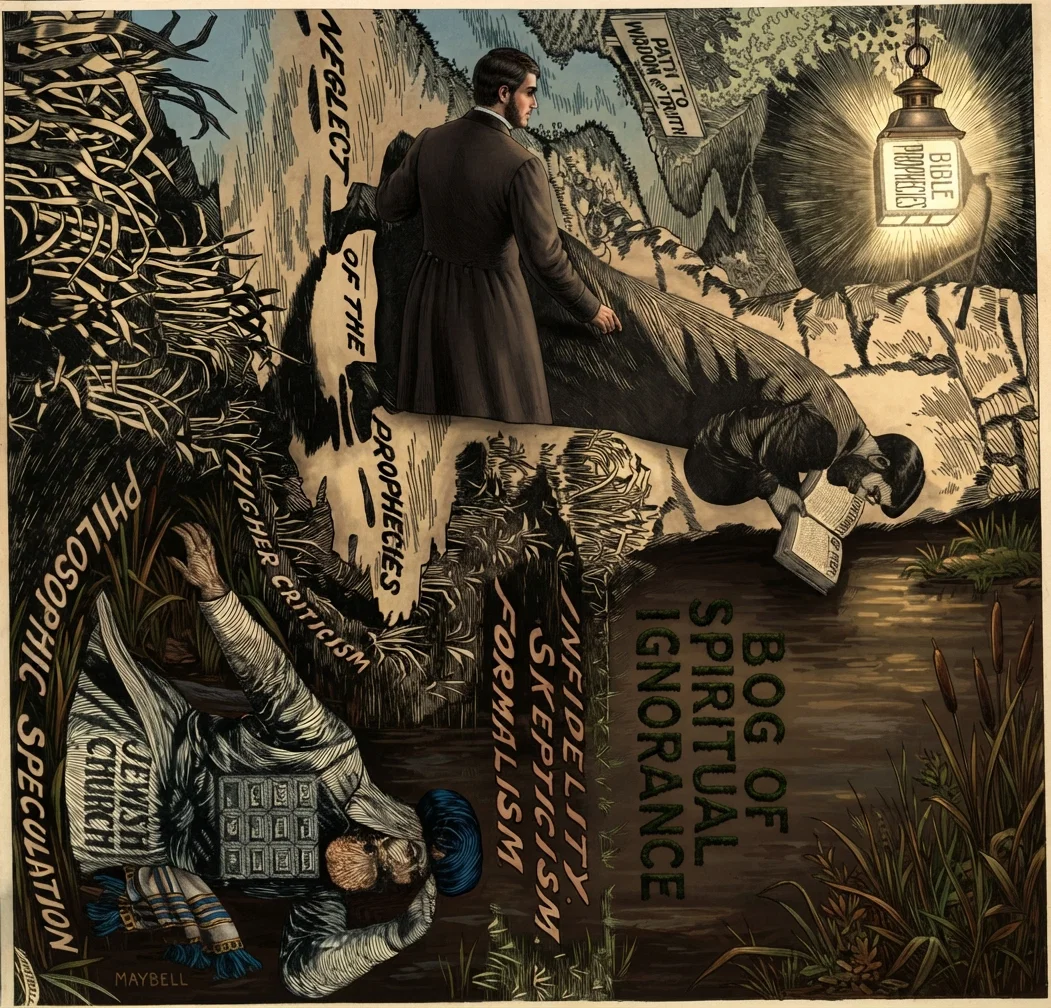
The artist has given us a striking lesson: Study it. The Jews neglected prophecy, and fell. Jesus said to them, "Had ye believed Moses, ye would have believed Me; for he wrote of Me." John 5:46. His word speaks to us: "We have also a more sure word of prophecy; whereunto ye do well that ye take heed, as unto a light that shineth in a dark place, until the day dawn." 2 Peter 1:19.
Walking in the Same Footsteps.—History Repeats Itself

Bible and History Questions

[All proper questions on Bible and history will be answered on this page as soon as possible after receiving them. This will sometimes mean a month or more. We can not promise to reply to the same question often. Let those who ask read other answers; they may find reply to their own. Always enclose stamp if answer is required. Those outside our Bible Band, please enclose ten cents. This does not begin to meet expenses oftentimes. "Foolish . . . . questions avoid."]

2743.— The Green and the Dry.

What does the "green and the dry tree" symbolize in Luke 23:31? C. K.
The general understanding of the text is that the green tree is symbolic of our Lord Himself, and the dry tree, of the impenitent wicked. If all these things can come to Him, the fruitful tree of God, upon whom rested the weight and burden of the sins of the whole world, what would be done with those who had filled up the cup of their iniquity to the full? Now, He, the green tree, was suffering for them, but when that time came that He was utterly rejected, then they would say to the mountains, "Fall on us," they would bring wrath upon them to the uttermost.

2746.— Sabbath and First Day. Matt. 28: 1.

A minister tells us that tho it is claimed that Saturday is the Sabbath it is not borne out by the Scriptures, and that where the Scriptures read that "Mary came to the sepulcher on the first day of the week," it should be "came to the sepulcher the first Sabbath," and that the original Greek should be so translated.
No one who understood the Greek, and who had a care for his reputation as a scholar, would ever make such a statement as this. The word "Sabbath" means not simply the day alone, but the week itself, and is always used as either referring to the day or to the week, the whole period of seven days of which the Sabbath was the crowning day. See No. 154, Bible Students' Library, "The Sabbath in the Greek," price, one cent. This explains all these various texts which have the first day of the week in, and gives the testimony not of seventh-day scholars, but of first-day scholars regarding it.
If any of our readers are troubled over such statements as are referred to in this query, let them send for that tract. It is an argument-setter on the question of the Greek word "sabbaton" or the Sabbath in the Greek.

2740.— Baptism of Fire.

Is it proper for Christians to pray for the baptism of fire? Matt. 3:11.
Read the context. Note the two classes which Jesus presents before us: The generation of vipers, those who call for repentance; the tree that brings forth good fruit, the tree that brings forth evil fruit. Note the illustration of the grain gatherer. He thoroly cleanses his thrashing-floor. The wheat he gathers into his garner, the chaff he burns with unquenchable fire. To these two classes Jesus was to come, John baptized in water unto repentance, but the Mighty One would fully baptize all, the one class in His Spirit, the other class in fire: "He shall baptize you in the Holy Spirit, and in fire." The "you" embraces both classes to whom John was talking. That baptism of fire will come when our Lord reveals Himself the second time; the burning glory of His presence, in which sin and those who have identified themselves with sin can not exist. "Our God is a consuming fire," we read in Heb. 12:29. That fire consumes only sin. In the light of these facts, and there are still other considerations of the same tenor, it would hardly seem as tho one should want to pray for the baptism of fire.

2741.— Who Is Addressed?

Will you please tell me to whom God is speaking in Isa. 28:2?
Isaiah 28 is a prophecy against the kingdom of Israel, and especially the capital city of the kingdom of Israel—Samaria. He calls that "the crown of pride of the drunkards of Ephraim, and the fading flower of his glorious beauty," because that kingdom was to fall. "The mighty and the strong one" evidently is the king of Assyria who was soon to sweep down upon the kingdom of Ephraim and destroy it. The fulfilment of that prophecy is found in 2 Kings 17, when Shalmaneser the mighty king of Assyria came up and completely overrun Ephraim and carried the Israelites captive.

2742.— Brothers and Sisters of Jesus.

Did Mary have other children besides Jesus? Mark 6:3 seems to indicate that she had. C. K.
Then why not believe the text? It clearly reads: "Is not this the carpenter, the Son of Mary, and brother of James, and Joses, and Judas, and Simon? and are not His sisters here with us?" And yet it is possible that these who are mentioned as brothers of Jesus were children of Joseph by a former wife. There are some who have contended that they were merely cousins, or close relatives, but one would hardly expect the language of Mark 6:3, Matt. 12:46, and Gal. 1:19 to refer to cousins. It would seem that the expression in Gal. 1:19 would mean one who was an actual brother. It would make no difference with our salvation in any way as to whether they were actual brothers of Christ, or brothers by law, because Joseph was His father by law. It is a great deal more important that we be truly His disciples so that Matt. 12:49 may be true in our case. "Behold My mother and My brethren."

2744.—A Different Body.

In 1 John 3:2, we read, "But we know that, when He shall appear, we shall be like Him; for we shall see Him as He is." Would not that indicate that He has a different body now from the body He appeared in to His disciples after He arose? Did He not appear to Saul of Tarsus as He is in His spiritual, glorious body?
No, His body will not be different from the body that He possessed when He went away, but when He comes that body will reveal His true glory. That glory has been veiled from mortal eyes hitherto because sinful man could not endure the sight; but when He comes, we shall be like Him, glorified, and shall be able to endure His glory, and consequently we shall see Him as He is.
Regarding the flesh spoken of in Isa. 66:23, and Job 19:26, there is no contradiction between that and 1 Cor. 15:50. What is meant by Isaiah is that all people, all who live upon the new earth, shall come up there and worship; and by Job, that he shall see Christ in His own literal personality. "Flesh and blood" in 1 Cor. 15:50, it seems to us, stands for corruptible flesh—mortal man. The life of the future man will be like that of the second Adam, a spiritual being.

2745.—Doth Not Commit Sin. 1 John 3: 9.

"Whosoever is born of God doth not commit sin: for His seed remaineth in him: and he can not sin, because he is born of God." Does John mean that if a person is born of God he can not sin, and if he does sin, is it a proof that he never was born of God? Is it always true that the one who is born again "keepeth himself, and that wicked one toucheth him not"? 1 John 5:18. J. S.
It is the purpose which God regards, the principle that actuates and moves the soul. He who is born of God has the one purpose; he may fall; he may sin, but just as long as he holds unswervingly to that purpose, God counts him His. "For the eyes of the Lord run to and fro throughout the whole earth to show Himself strong in the behalf of them whose heart is perfect toward Him." 2 Chron. 16:9. Understand "can not" in the sense of "will not," as in the oft quoted expression: "Look you, what I will not, that I can not do." Or as in Luke 14:20: "I have married a wife, and therefore I can not come;" not that it was a physical impossibility, but that there was no desire; and so he that is born of God doth not commit sin; that is not his purpose, his business. He can not, because he will not. The Syriac has it: "Doth not practise sin," that is not his business. There is always danger of poor mortals sinning, and yet the power of God is able to keep one from sin. "My little children, these things write I unto you that ye sin not [or that ye may not sin]. And if any man sin, we have an Advocate with the Father, Jesus Christ the righteous." 1 John 2:1.

2747.—In This We Groan. 2 Cor. 5:1-10.

Please explain 2 Cor. 5:1-10 and what is meant by "this tabernacle," "house not made with hands," "absent from the body," "present with the Lord," etc. Do these things refer to the soul and body?
If those interested will read carefully 2 Cor. 5:1-10 they will find three conditions set forth by the apostle. The first condition is expressed in such terms as "earthly house of this tabernacle," "in this we groan," "mortality," "at home in the body," "absent from the Lord." The second condition is expressed by such terms as "unclothed," and "naked." The third condition is "a house not made with hands," "eternal in the heavens," "clothed upon," "being clothed," "not found naked," "swallowed up of life," "present with the Lord." The apostle Paul recognized that he was mortal and in the flesh. This was his condition. He longed for another condition; not that of being unclothed, or found naked, or death, but to be "clothed upon," "that mortality might be swallowed up of life." Mortality will be swallowed up of life when the Lord Jesus Christ comes the second time. 1 Cor. 15:51-54. The same conditions are represented in Rom. 8:23 where the apostle declares that we ourselves groan within ourselves waiting for the same thing as expressed in Corinthians, but here he tells us what it is; "waiting for the adoption; to wit, the redemption of our body." But the redemption of our body will take place when the Lord Jesus Christ comes the second time. 1 Thess. 4:16, 17. Therefore the thing for which Paul longed and groaned was the second coming of the Lord Jesus Christ when he would be made immortal. It was not death, it was not to be found naked, it was not to be unclothed, not to lose life, but to be saved eternally. Note in this last reference Paul tells us that we shall be present with the Lord only when He comes the second time; and so that it is by His coming, by resurrection and translation, shall we be ever with the Lord.

2748.—The Whole Family in Heaven. Eph. 3:15.

From whom does the whole family in heaven and earth receive their name? From God the Father, or Christ the Son? And is it revealed in His word what that family name will be? N. A. B.
According to Eph. 3:14, 15 the family name is that of the Father. See the American Revised Version from later and better Greek texts: "For this cause I bow my knees unto the Father, from whom every family in heaven and on earth is named." What one of the great names of the Creator will be used as the family name, we know not. It may be "Jehovah," God's great covenant name.

2749.—Question of Tithe.

My income is one thousand dollars; the rent which I pay for the place from which I derive my income is $300. Am I to pay $100 tithe or $70.00 tithe? H. A.
If this is all that is involved, your tithe is $70, not $100. The $300 is not a part of your income; that belongs to the other person, and the one who receives that ought to pay tithe upon it.

2750.—The Fox Sisters and Spiritualism.—

F. S. B.—The first public manifestation of modern Spiritualism, or table rappings, was in connection with the Fox sisters, near Rochester, N. Y., in 1848; altho there are others who say that there had been more or less of private seances held for three or four years previous to that time, but it first became notorious through the Fox sisters.

Business Principles of the Christian

By Mrs. E. G. White
IN his business life the Christian is to stand as a representative of the principles of heaven. He is bound by sacred obligations to bear witness to truth in its virtue and holiness. Gentleness and kindness and strict truthfulness should mark his words and actions.
If he is consecrated to God, set apart to sacred service, he will always honor his religious faith. No thread of selfishness will be woven into the character. He will educate himself to reveal the Spirit of God in all his life work.
The Holy Spirit will never lead the steps of God's children astray. Through the power that the Spirit of God imparts, we may weed out from our lives every questionable thing. If we will come out of the darkness with which a lack of faith enshrouds the soul, and place ourselves where the clear shining of the light of God's word can fall fully upon us, we shall be led step by step in the path that leads to holiness. "We all with open face, beholding as in a glass the glory of the Lord, are changed into the same image from glory to glory, even as by the Spirit of the Lord."
The love and honor and perfection revealed in the Gospel are a revelation to man of the character of God.
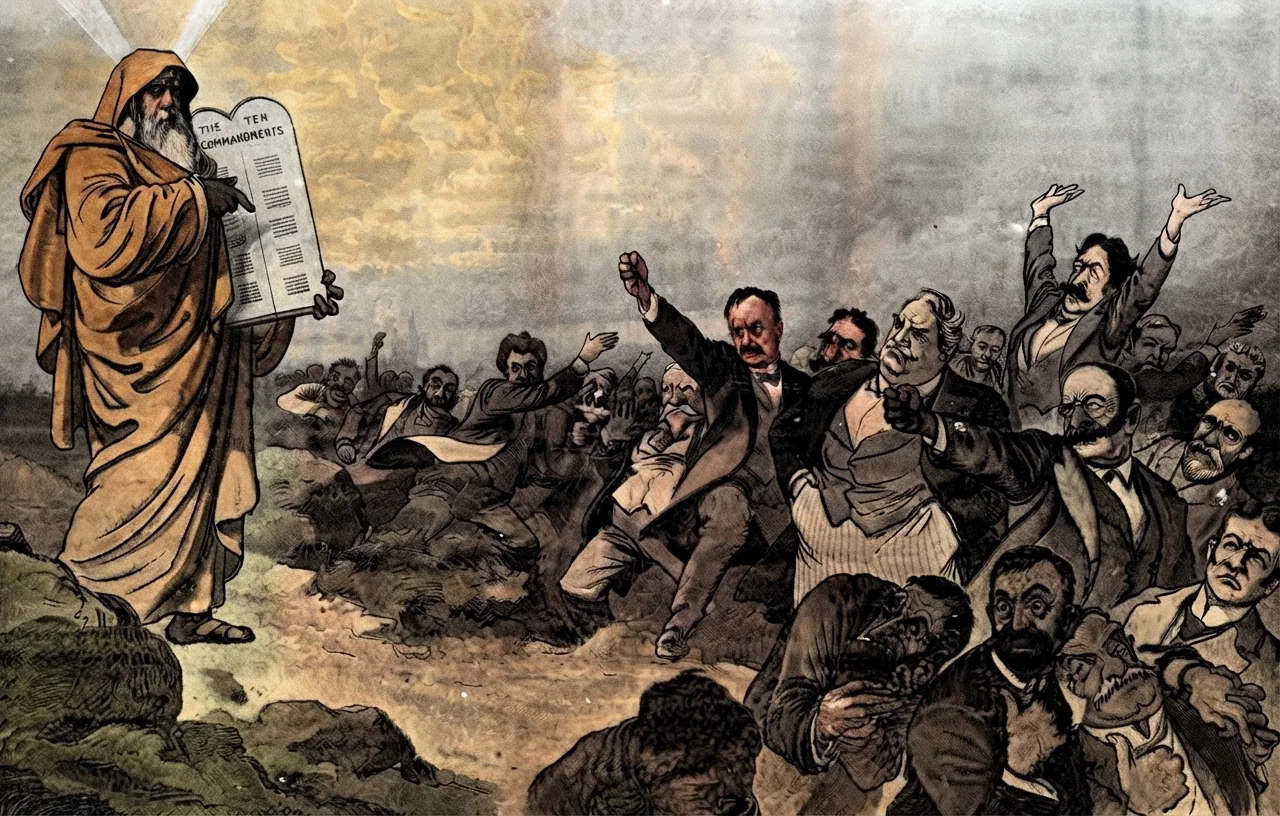
IF MOSES SHOULD COME DOWN TO-DAY. After Kepler in "Puck"
The justice and goodness and benevolence that were seen in the character of Christ are to be repeated in the lives of those who accept the privileges of the Gospel. By a study of the word, we are to see Him as He is, and, charmed with the view of His divine perfection, we are to grow into the same image. We need to understand that the Gospel fully reveals the glory of the Lord. It is the mirror that reveals the character of God to the converted soul. The likeness of God is revealed in the perfect character of His Son, that we may understand what it means to be made in the likeness of the image of God, and what we may become if by constantly beholding we allow ourselves to be changed from "glory to glory."
It is our privilege, by an earnest study of the word, to learn wherein we are not manifesting the principles of that word in our lives. And as the mirror reveals to us our defects, we are to seek by earnest prayer and faith to put them away. As we strive to meet the perfection that God requires, insensibly to us the human will become molded to the divine. Christ's nature will be revealed in human nature; the words will become gentle and courteous, the ways kind and helpful. Tho we may be largely unconscious of the change, yet the transformation is being surely wrought. Beholding day by day the glory of the Lord, we are molded into conformity to His Spirit and will.

Manifesting Right Principles.

God is very particular that all who profess to serve Him shall manifest the superiority of right principles. By the true follower of Christ every business transaction will be regarded as a part of his religion,just as prayer is a part of his religion. The study of the Scriptures will be considered a part of his religion; for by this he learns his orders. In the light of the Scriptures he regards himself as God's servant, employed to do His will. Sometimes he finds those orders different to that which he would choose were the decision left to him; but he does not find fault with his work because of this. And as he seeks to carry out the will of the Master, angels of God are with him, to be his defense against the wiles of Satan.
Satan is offering to every soul the kingdoms of this world in return for the carrying out of his will. This was the great inducement he presented to Christ in the wilderness of temptation. And so he says to many of Christ's followers, If you will follow my business methods, I will reward you with wealth. Every Christian is at some time brought to the test which will reveal his weak points of character. If the temptation is resisted, precious victories are gained. He must choose whether he will serve Christ or become a follower of the deceiver, and a worshiper of him.

A Worse than Earthly Loss.

Satan is the arch deceiver. The results to us of accepting his temptations are worse than any earthly loss that can be realized, yes, worse than death itself. Those who purchase success at the fearful cost of submission to the will and plans of Satan, will find that they have made a hard bargain. Everything in Satan's trade is secured at a high price. The advantages he presents are a mirage. The high hopes he holds out are secured at the loss of things that are good and holy and pure. Let Satan be always confounded by the word, "It is written." "Blessed is every one that feareth the Lord, that walketh in His ways. For thou shalt eat the labor of thine hands: happy shalt thou be, and it shall be well with thee."
He who stands prepared to do the works of righteousness will not be deceived by the allurements of the enemy. His actions will be guided by an exalted sense of right, and he will be enabled to distinguish between right and wrong, between truth, exalted truth, and error. Those who enter the kingdom of heaven will be those who have reached the highest standard of moral obligation, those who have not sought to hide the truth or to deceive, those by whom God has been exalted and His word defended, those in whom principle has not been misapplied to vindicate the wiles of Satan.
The path cast up for the ransomed of the Lord is far above all worldly schemes and practises. Those who walk in it are to show by their works the purity of their principles. They have a heaven to win, and by a well-ordered life and a godly conversation they are to show the genuineness of their profession. They are to work out their own salvation with fear and trembling, fearing lest they shall not perfect a Christian character, yet striving to follow on in the footsteps of Christ, keeping His life and His teachings ever before them. As they do this, God will work in them, to will and to do of His good pleasure.

The Great Day of the Lord

By Marvin Herrick Brown

Its Character.

THE word "day" in the Bible as generally used is applied to the period of twenty-four hours. This is its primary meaning and use. Sometimes, however, it refers to a long period of time. To illustrate: In 2 Cor. 6:2, reference is made to the "day of salvation," or the Gospel day, during which grace and pardon are ministered to the sons of men, it covers all probationary time, from the time of Adam's fall till the close of the Gospel day. It is man's day, his opportunity, during which he may seek and find the Lord. Hence we are exhorted to "seek ye the Lord while He may be found, call ye upon Him while He is near." Isa. 55:6. This is also proved by the fact that a time will come when mercy's call is no longer heard, and no offer of salvation is made (Amos 8:11, 12), and the destiny of all is decided (Rev. 22:11).
"The day of the Lord" is God's day of reckoning with mankind, the day of rewards and punishments, the day of retribution, "the day of the Lord's vengeance, and the year of recompenses for the controversy of Zion." Isa. 34:8. In other words, it is the day, or time, when God calls man to account for his conduct in this life, for his acceptance or rejection of the offers of mercy during the day of salvation, his day of privilege and opportunity. This clearly shows the character of "the great day of the Lord." To the righteous, those who accept the "great salvation," "that day" will be a day of deliverance, of gladness, and rejoicing. Isa. 25:8, 9; 26:1, 2; 2 Thess. 1:7, 10; 2 Tim. 4:7, 8. But to those who "neglect so great salvation" (Heb. 2:3), there will be no escape from the "righteous judgment" of God. 2 Thess. 1:5-10; Rom. 2:4-10. In view of the solemnity and momentous character of "that day," God says, "Blow ye the trumpet in Zion, and sound an alarm in My holy mountain: let all the inhabitants of the land tremble: for the day of the Lord cometh, for it is nigh at hand." Joel 2:1.
God warns the people to "flee from the wrath to come," to find in Christ a shelter from the storm, for "the day of the Lord is great and very terrible: and who can abide it?" Verse 11. It will not be a day of light, and spiritual blessing, and opportunity, to those who reject the last call of mercy. On the contrary, it will be "a day of darkness and gloominess, a day of clouds and of thick darkness." Verse 2. "All faces shall gather blackness." Verse 6.

A Day of Bitter Disappointment.

Some are looking forward to a brighter and better day for earth's toiling, unburdened, sorrowing millions, when the way of life will be made plainer and easier, when temptation's power will be broken, and the multitudes will accept the offer of salvation, and join in singing redemption's song. But the Saviour expressly warns us against being deceived by false prophets and false teachers. Matt. 24:3-5, 24-27; 7:15-21. He declares that the "many" travel the broad way which leads to destruction (verse 13), and "few" find the narrow way which leads to life (verse 14). The Scriptures nowhere bring to view a change during probationary time, when the narrow way becomes so broad that all, or nearly all, find it, and walk in it, and the broad way becomes so narrow that few, if any, walk in it. Jesus never intimated any such change. On the contrary He says, "Many will say to Me in that day, Lord, Lord, have we not prophesied in Thy name? and in Thy name have cast out devils? and in Thy name done many wonderful works? And then will I profess unto them, I never knew you: depart from Me, ye that work iniquity." Verses 22, 23.
The Lord addresses words of warning to those who entertain this false view of a future probation, and cherish a vain hope of a better opportunity and more favorable conditions than now obtain. He seeks to arouse them from their delusion, and warn them of the bitter disappointment which they will experience if they cling to such a hope. Thus He says:
"Wo unto you that desire the day of the Lord! to what end is it for you? The day of the Lord is darkness, and not light. As if a man did flee from a lion, and a bear met him; or went into the house, and leaned his hand on the wall, and a serpent bit him. Shall not the day of the Lord be darkness, and not light? even very dark, and no brightness in it?" Amos 5:18-20.

A Day of Destruction.

Instead of being a day of grace or salvation, the great day of the Lord will be a time of destruction. God's word says, "Alas for the day! for the day of the Lord is at hand, and as a destruction from the Almighty shall it come." Joel 1:15. In Zeph. 2:2, 3, it is called "the day of the Lord's anger." It is declared that "the mighty man shall cry there bitterly." Zeph. 1:14. "That day is a day of wrath, a day of trouble and distress, a day of wasteness and desolation, a day of darkness and gloominess, a day of clouds and thick darkness." Verse 15. "And I will bring distress upon men, that they shall walk like blind men, because they have sinned against the Lord. . . . Neither their silver nor their gold shall be able to deliver them in the day of the Lord's wrath." Verses 17, 18.
The experience of the wicked in "that day" is graphically described also in Isaiah 2:
"The lofty looks of man shall be humbled, and the haughtiness of men shall be bowed down, and the Lord alone shall be exalted in that day. For the day of the Lord of hosts shall be upon every one that is proud and lofty, and upon every one that is lifted up; and he shall be brought low." Verses 11, 12.
"And they shall go into the holes of the rocks, and into the caves of the earth, for fear of the Lord, and for the glory of His majesty,when He ariseth to shake terribly the earth." Verse 19.
This scene is also vividly portrayed in Rev. 6:15-17. "And the kings of the earth, and the great men, and the rich men, and the chief captains, and the mighty men, and every bondman, and every free man, hid themselves in the dens and in the rocks of the mountains; and said to the mountains and rocks, Fall on us, and hide us from the face of Him that sitteth on the throne, and from the wrath of the Lamb; for the great day of His wrath is come; and who shall be able to stand?" Only those will be able to stand in that "evil day," who heed the instruction given in Eph. 6:10-16, and thus become the loyal subjects of the coming King. May we be "wise unto salvation through faith which is in Christ Jesus."
[The next article in this series is upon an interesting and vital topic, "The Close of Probation."]

The Word of Prophecy

By B. G. Wilkinson, A.M., Ph.D.

The Horn, Little but Mighty.

(Concluded.)
TWO predictions of Daniel respecting this evil power have, as we see, met their fulfilment. There are others more signal and more convincing yet, which it behooves us to study particularly.

III. It Had a Mouth Speaking Great Things.

The tongue is, at any time, a difficult member to control. A man needs much grace of God to keep this unruly member from evil and to make it ever contribute toward righteousness. But when it is a question of the tongue of a power full of avariciousness, no matter how pious an exterior that power may affect, the tongue will betray its wickedness the moment the mouth begins to speak. What have been the utterances of the Papacy? Do they go toward locating it and it only as the little horn, or can the Papacy free itself from this accusation by pointing back to the purity of its utterances? And by these utterances we do not mean individual sentences expressed now and then, but we mean those declarations which are the official expression of the policy of the church.
Listen to the utterances of Pope Gregory VII:
“The pope is the universal bishop; he is unquestionably holy and never deceives himself.”
“To him alone it belongs to make new laws.”
“No one can weaken his decrees, and he can abolish the decrees of all.”
“No human creature has power to judge him.”
“He alone deposes and absolves the bishops, constitutes or abolishes churches, and presides over the councils.” (Senator Vallee, “French Senate Debates for 1905,” p. 149.)
Listen to the utterances of Innocent III:
“The pope is the vicar of Jesus Christ, under God, above man; smaller than God, greater than man.”—Idem.
And to Pius VI:
“I protest against liberty of conscience and against giving non-Catholics access to public employ.”
Could any other power answer this prophetic description more fully than the Papacy?

IV. It Made War upon the Saints.

“I beheld,” said Daniel, “and the same horn made war with the saints, and prevailed against them.” Verse 21. Again, verse 25: “And he shall speak great words against the Most High, and shall wear out the saints of the Most High.” Certainly the saints who felt the persecuting arm of this power, were not at a loss to point it out by name. Huss and Jerome, who were burned at the stake in the city of Constance, 1415 A.D., tho an express pledge had been given to the contrary, could certainly indicate the ruler which under a Christian garb persecuted the saints! The thousands of Albigensians, Waldensians, Huguenots, and others, who fell before the authoritative claims of the Papacy, would have no trouble in naming a power which was wearing out the saints of the Most High. “The Castilian,” says Prescott, speaking of the Catholic Spaniard, “too proud for hypocrisy, committed more cruelties in the name of religion than were ever practised by the pagan idolater or the fanatical Moslem. . . . It is a melancholy and mortifying consideration that the most uncompromising spirit of intolerance — the spirit of the Inquisition at home, and of the Crusades abroad — should have emanated from a religion which preached peace on earth and good will toward man.”—“Conquest of Peru,” Bk. II, chapter 1, p. 195."As regards Protestants," says the Hon. Paul Bert, so recently as 1787, "they had to petition for civil rights to be granted to their children." (Speech before French Chamber of Deputies, June 21, 1879.) So great have been the severities of the Papacy against those she considered as infidels and heretics, even tho in many cases they were believers in God, and were people free from scandalous lives, that some writers have computed at fifty millions those who have fallen before her persecutions. Upon this point the Holy See can not escape the convicting evidence which identifies her with the little horn.

V. It Continued a Certain Time as a Persecutor.
It had power to persecute the saints for three and one-half times, or 1,260 years. Even the length of duration allotted to this persecuting power was given to the prophet. Herein we may behold the love of God in declaring beforehand, that, tho the oppression of the church should be long, nevertheless it should have an end. The Most High would instruct His people not only about the nature of the events, but also about the hour in future time when these would terminate. “And he shall wear out the saints of the Most High,” declared the angel, “and they shall be given into his hand until a time and times and the dividing of time.” A time equals a year. “For the king of the north shall return, . . . and shall certainly come at the end of times, even years.” Dan. 11:13, margin. The little horn was therefore to be able for three and one-half years to suppress by persecution the religious liberty of dissenters. But these three and one-half years being found in prophecy, are prophetic years. Now, according to the Scriptures, a prophetic day equals a literal year; and a prophetic year consequently equals 360 literal years. See Num. 14:34; Eze. 4:6. Therefore a “time” equals one prophetic year or 360 literal years; “times” (two) equals 720 years; and “half a time,” 180 years; total, 1,260 years. This agrees with the prophetic statement of the apostle John found in Rev. 12:6 concerning the same events.
When did the 1,260 years begin? — Evidently they could not begin before the three horns which stood in the path of the little horn had been plucked up by the roots. As we previously stated, these were uprooted as follows: Heruli, 493; Vandals, 533; and Ostrogoths, 538. The uprooting of the Ostrogoths left the city of Rome free to the supremacy of the pope, and also to the execution of the decree of Emperor Justinian, issued in 533, by which the bishop of Rome was made “the head of the church and the corrector of heretics.” (See Justinian’s letter to Epiphanus, March 25, 533. Also “Nouvelles,” 9 and 31.)
Reckoning 1,260 years from the date 538, we are brought to the date 1798 as the point when the oppression of conscience by the little horn was to cease. Is there any event in 1798 which marks the end of that which was begun in 538? Yes, in the city of Rome itself, the last stronghold where the Papacy could restrict religious liberty, there was proclaimed, in 1798, religious equality by the armies of the French Revolution.
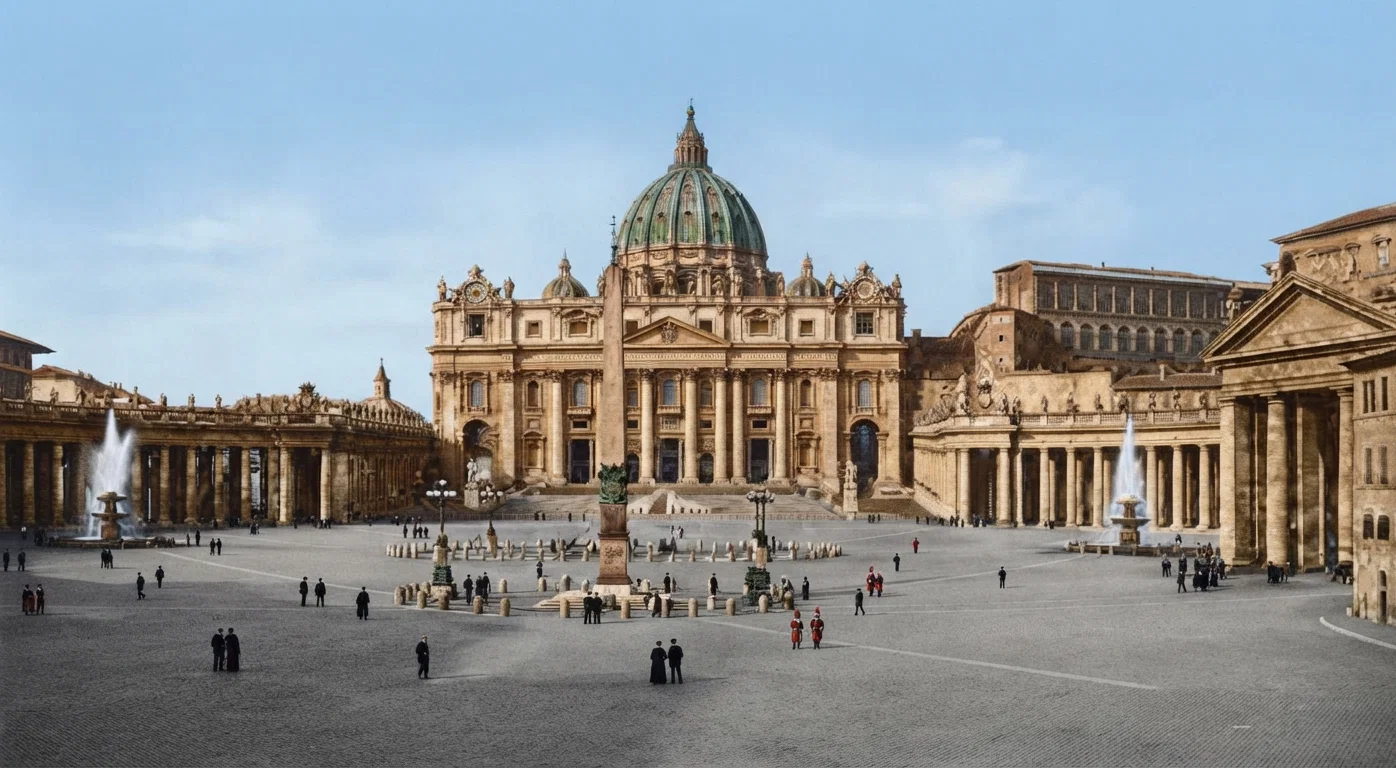
Basilica (Church) of St. Peter, Rome.
Listen to the testimony of the French Universal Dictionary by Larousse: “The assassination of General Duphot, a member of the French embassy to Rome, and killed by the papal troops, drew upon the city the dreaded phalanxes of the Great Republic. Berthier made his entry Feb. 15, 1798; the Papacy was destroyed, a revolutionary government set up, and the pope received his order to quit his estates. . . . Brought to Valence (France), July 14, 1799, he died, being a little over eighty years of age.”—(Article Pius VI.) Ranke in his history of the popes says that “it seemed as if the papal power was now forever at an end.”
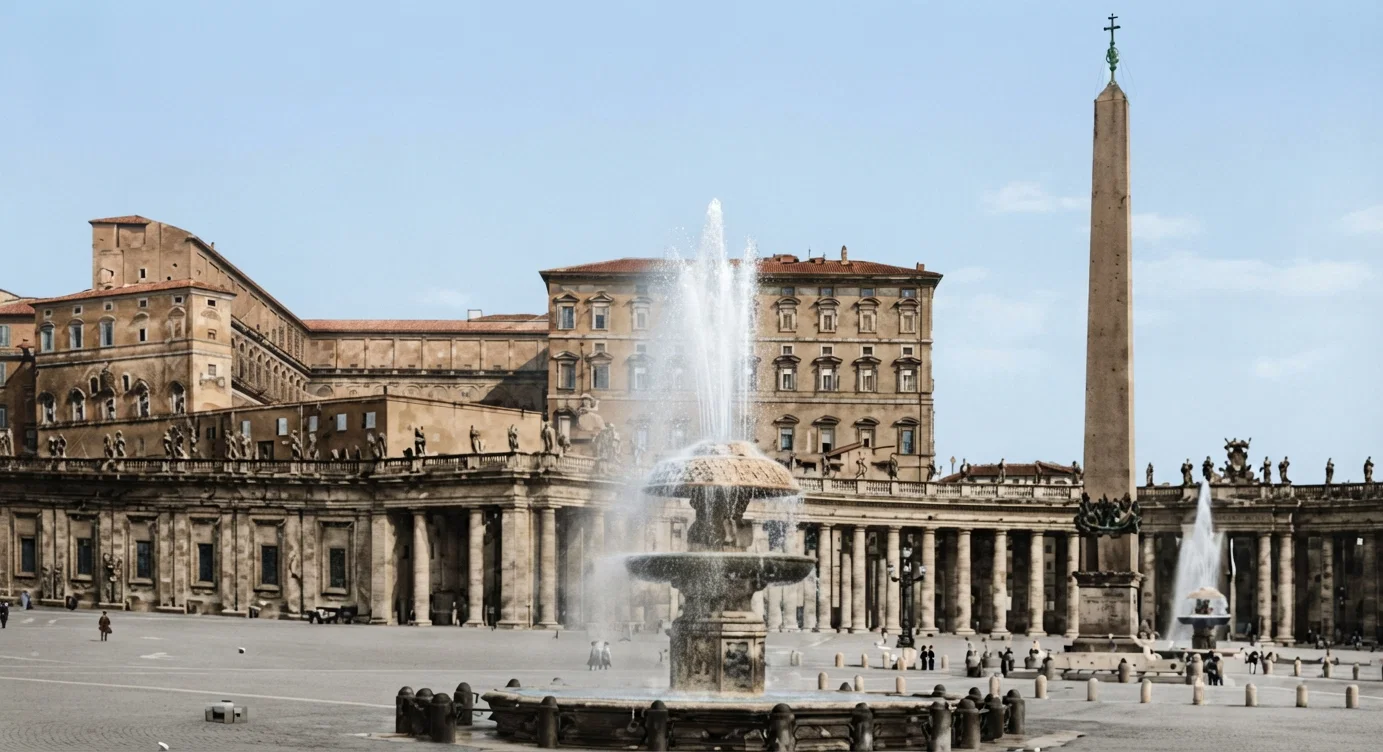
The Vatican, Rome, Headquarters of the Papacy.
How wonderfully have taken place the events just as Daniel foresaw them! The fulfilment of this portion of the prophecy, by bringing us to the year 1798, warns us that the time is near for the complete closing up of the vision. But there yet remains another definite specification in the prophecy concerning the work of the little horn:

VI. The Little Horn Was to Change God's Law.

That duty touches God's law. Daniel says of the little horn, “He shall . . . think to change times and laws.” Chapter 7:25. Evidently this presumptuous attack would be directed above all else at God's great moral law, the Ten Commandments, of which Spurgeon says: “The law of God must be perpetual.” The second commandment was changed from its original design when the Papacy received into the church and indorsed the worship of images. But the greatest change came on the fourth command, the Sabbath precept. In it God expressly says: “The seventh day is the Sabbath of the Lord thy God.” The Papacy, on the other hand, declares the first day of the week to be the Sabbath. Listen to the following from the highest authority, in the Catholic Church of the United States—Cardinal Gibbons:
“Cardinal’s Residence, 408 N. Charles St., “Baltimore, Md., Oct. 3, 1889. “Dear Mr. Franke: “At the request of his eminence, the cardinal, I write to assure you that you are correct in your assertion that Protestants, in observing the Sunday, are following not the BIBLE, which they take as their only rule of action, but the TRADITION of the church. . . . The Catholic Church changed the day of rest from the last to the first day of the week; because the most memorable of Christ's works were accomplished on Sunday. . . . “Yours very sincerely, “(Signed) W. A. Reardon.” (Taken from “The Bible Students’ Library.” “From Sabbath to Sunday,” page 7.)
This agrees with history. Many similar quotations might be given.
With this we must take leave of the subject. What has been given is enough to inform us of the solemn fact that the hours of earth's history are numbered. The great vision of Daniel 7 is drawing to its close; and its accomplishment means that, “the kingdom and dominion, and the greatness of the kingdom under the whole heaven, shall be given to the people of the saints of the Most High, whose kingdom is an everlasting kingdom.” Dan. 7:27. It will be the most glorious success a man can achieve to win a place in this kingdom. Shall we obey the little horn, or shall we serve the Most High? Shall we be counted as part of the world and its perishing glory, or shall we strive to enter that everlasting dominion whose servants are not of this world?
Continue reading: That Lie of Rahab’s