The Youth’s Instructor, Vol. 38, No. 11.

A KINDLY LAMP

The Youth’s Instructor

Mar 12, 1890

S. D. A. Publishing Association · Battle Creek, Mich. · Mar 12, 1890

A KINDLY LAMP.

FROM the cleft of a darkened mining shaft A little plant outgrew, And it held a snow-white flower aloft For a measure of light and dew, Like a kindly hand in a darkened night, That holds from the doorway a lamp of light.
The miners, grimy with toil and care, Passed from the pit beneath; Little they heeded its glory there, Or noted its fragrant breath; And yet, like the down of thistle blown, Its influence wafted most softly on.
It stood like a priest, with a censer swinging, Where no one thought of prayer; It stood like an angel softly singing Its anthems of praises rare; While men toiled to and fro from the mine, It whispered of rest, and of things divine.
And one day a miner, with tear-dimmed eyes, Saw the flower of light in his way; And it seemed like a star of peace from the skies;— He had buried his child that day;— And he loosened it out of its grimy sod, For it seemed like a light that reached forth unto God.
He bore it away to his garden plot; He planted its thought in his breast; And his life, with subtle fragrance fraught, Brought many another rest. So bloom, little flower, noble purity Thou knowest not what God may do with thee.
FANNIE BOLTON.

THE STABBUR.

If all the lands made beautiful by mountains and valleys, lakes and waterfalls, Norway is the most picturesque, surpassing even the land of the Alps. The whole country is broken and rugged, and every mile has its changing scenes of verdure and rock and bewitching cascades. Lakes lie high up on the table-lands, and their waters find vent only in narrow crevices of the mountains, through which they tumble uproariously down, striking the projecting shelves of rock and scattering in cloudy spray, then gathering up their fragments and rushing on, leaping, whirling, thundering down to the sea. Huge glaciers, too, are formed on these highlands, and are slowly but constantly pushing their way down to the valleys.
In such a land as this we might expect to find a people sturdy and independent, healthy and honest, with a wealth of love for home and country; and so they are. From valley to mountain-crest their dwellings are scattered, sometimes in such precarious places that it seems a miracle they are not blown off by the fierce winds that sweep around the craggy summits. But there they nestle, held close in the rocky niches, the contented farmers sowing and reaping their year's harvest in the short summer, and making merry by the bright fireside during the long, dark winter.
A Norwegian home usually consists of several separate buildings surrounding a little yard, and all painted red. There is the living-room, with its open fire-place or porcelain stove, a long bench or two to sit on, perhaps some chairs made by sawing off a tree trunk and leaving part of the bark for a back, and a bed or two. Then there are barns, hay-sheds, houses for sleighs, wagons, carts, blacksmithing, etc., sometimes as many as twenty different structures all belonging to the same farm.
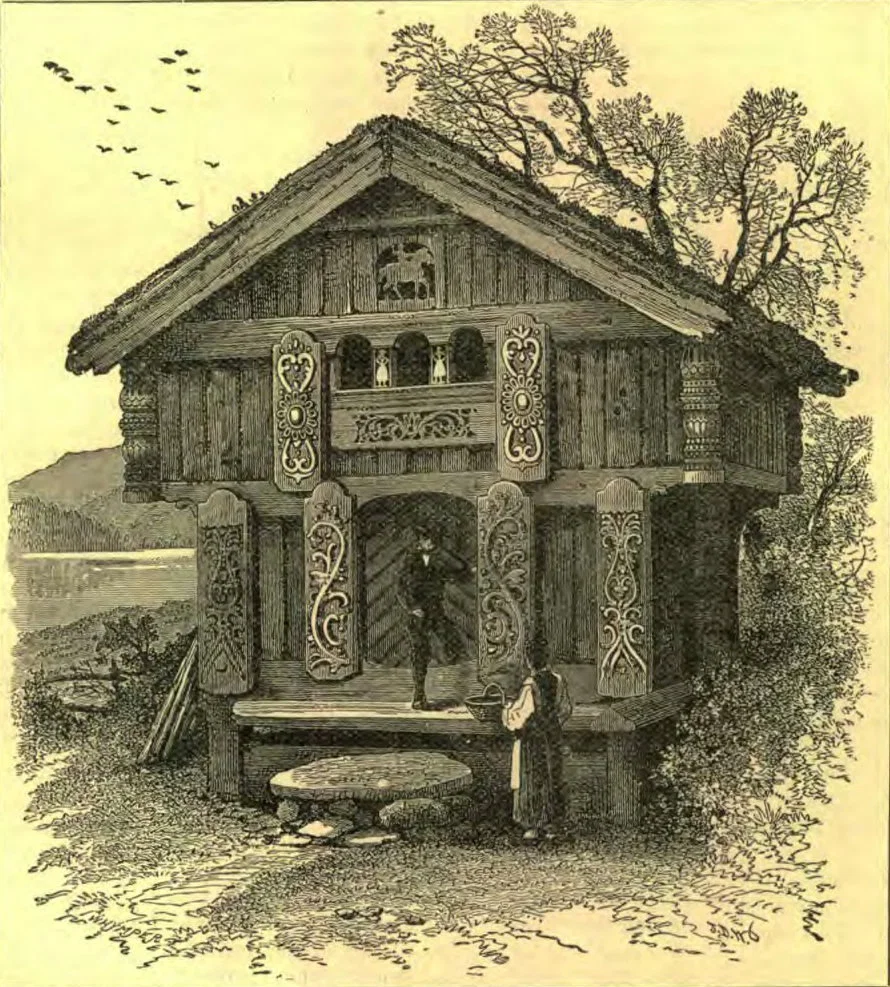
The most curious of these is perhaps the one shown in the engraving, called a stabbur. It is the family store-house, and has an almost sacred character to these mountain farmers. In the olden days, this was a room where all kinds of provisions and clothing were kept. After a time a second story was added, and the clothing was brought up here and hung high, so that it might be kept free from the dampness rising from the ground. There were windows in the ends, so the air could circulate freely. In those times, personal property was mostly in clothing, either in wearing apparel or for beds. So it was very important that it should be well taken care of. Originally built for a store-room, the upper story soon came to be used also, as it is to this day, as a sleeping-room for guests. Especially were noted guests taken here to rest on the softest of feather beds and pillows, and in the whitest and cleanest of linen sheets.
Great care was used in the construction of these buildings, provision always being made for a draught of air under the floors. Elaborate carvings often adorned the doors and windows. To prevent the entrance of rats and mice, the stabbur was sometimes built on posts, and this was what gave such buildings their name. The peculiar shape of these houses, especially those in Southern Norway, attracts the attention of strangers at once, and their dark, weather-beaten walls tell of their antiquity.
MARY STEWARD.

THE POTATO.

“SOME more potato, please!” called out Harry Jones, as he passed his plate over for the third time to be helped to this vegetable.
“Why, Harry! You have not eaten any bread yet, and this is your third potato,” said mamma.
“But I like potatoes. I do not think that I could do without them.”
“Yes,” said Mrs. Jones, “I know they taste good, but they do not contain near the amount of nourishment that is to be gotten from such fine graham bread as Mary has been giving us of late; besides, you could do without them, and be as strong and well as now; other people have.”
“I would like to know who ever went without potatoes,” said Harry, who was now eight years old and quite inquisitive.
“Well,” said mamma, “suppose we take the potato for our subject for this evening’s talk, and in the meantime you may all try to find out what you can about it.”
“I know something now; may I tell it?” said little Frankie, who had just passed his fifth birthday, and, having donned pants and jacket, thought he was almost a man.
“I hardly think you could, with your mouth so full,” replied Mary, a bright-faced girl of fifteen summers.
“Finish your dinner, now,” said Mrs. Jones, “for I must make all of those button-holes before dark. This evening each will have an opportunity to tell all he knows about the potato.”
Mrs. Jones was a widow who lived in the village of L—. Her husband had been dead for three years, leaving her four children, and nothing from which to obtain support save the small place where they lived. Diligence and close economy were practiced by all. The three older children attended the public school. Each evening Mrs. Jones assisted them with their lessons, and often subjects were chosen to talk upon that would be of interest and profit to all. Thus time passed pleasantly, and a strong bond of union was formed in that humble home, barring the door to the alluring devices of the tempter.
“Talk about the potato first, before I get sleepy,” said little Frankie, as they gathered around the table for their evening’s work.
“All right, Frankie,” said mamma, “you said that you knew something about the potato, so we shall hear from you first.”
“It isn’t so very much, but John Baker taught it to me the other day.”
“Let us hear quickly,” said impatient Harry.
“It is a sin to steal a pin, But it is greater to steal a ’tater,’” slowly repeated Frankie. “He said that meant potato.”
They all laughed merrily, and asked him if that was all he knew.
“Yes, that is all, except that potatoes grow in the ground.”
“Well, children,” said mamma, “what have the rest of you found out?”
“I did not find out anything,” said James, the elder boy, a lad of twelve years; “but I know that it has flowers, and that when the flowers are gone, little balls come.”
“I looked in the dictionary at school,” said Mary, “but did not find much, only that it was good for food and was a native of South America. It told far more about the sweet potato.”
“We will talk about the sweet potato some other time,” said mamma; “but did you know before where the home of the potato was?”
“No, I never thought about it,” she replied.
“So you have gained one new idea. Well, that is good. Now, Harry, find South America in your geography.” Harry had just commenced this study, so of course was delighted with the task.
“I have found considerable of interest about this common plant,” continued mamma. “It was once wild, growing in the mountainous parts of South America, from Chili northward to Mexico. Do you find the places, Harry? This will give you a good exercise in geography.”
“The wild plant is like the cultivated, only the potatoes are very much smaller. Perhaps you will be surprised when I tell you that the potato is not the fruit of the plant, neither is it the root, but it is simply an enlargement of the branch grown underground, and the eyes are the buds. The true fruit of the plant is the ball that grows after the flower-leaves fall.”
“How funny,” said Mary, “that the fruit is not good for anything, and we eat the branches.”
“Oh, there you are mistaken; for the fruit is good for something.”
“Why, mamma, I have tasted them, and they are so bitter!” said Harry.
“To be sure they are not good to eat,” replied Mrs. Jones, “but it is from these that we get different varieties of the potato. If we want the same variety, we must plant the potato itself, but if we want a different kind, we plant the seeds found in the ball.”
“I think that I shall save some seeds, and try it,” said James.
“Yes, but you must not expect too much; for a great many seeds are planted that give us only poor potatoes, where one gives us good ones. Those of the first year are always very small, those of the second year better, and those of the third year as good as the variety ever will be. So you will have to wait three long years to see what variety you have produced.”
“O dear! that is a long time to wait,” said James.
“The fruit, or balls, as you call them,” continued Mrs. Jones, “has also been used for making fermented drinks; the tender tops are cooked and eaten by some for greens, while from the stalks paper has been made.”
“Why, the whole plant is thus made use of, isn’t it?” said Mary.
“Yes, but let us go back to its history. Where did we find its home?”
“In Chili and Peru,” answered Mary.
“I have found,” said Mrs. Jones, “that it was taken from Peru to Spain, and some Spaniards carried it into Florida, and thence it reached Virginia. Have you found all those places, Harry? From Spain it was taken into Italy, but at first it was cultivated only as a curiosity.”
“Does not that seem odd? I wonder if they even picked the flowers for a bouquet!” exclaimed Mary.
“It is just as pretty as some of the rare plants grown now,” remarked James dryly.
“About the same time,” continued Mrs. Jones, “it was also carried by Sir Walter Raleigh from Virginia into Ireland, and thence into England. This was nearly three hundred years ago. Do you see, Harry, that all the people who lived before this time never had any potatoes, and it was many years after this before they were widely used. At first it was grown to feed swine and cattle, because it produced so abundantly, and then was adopted by the poorer people.”
“But, mamma, why do they call it the Irish potato?” said Mary.
“Because,” replied Mrs. Jones, “it was grown so extensively in Ireland. The government of Ireland did not protect the rights of the people; and cruel wars frequently occurred. Often after the Irish had worked hard to plant their fields, the crops were destroyed or gathered by others. The potato was more easily planted and not so readily destroyed as the grains, and could remain in the ground until wanted for use. So the potato cultivation increased, and grain lessened. When the potato crop failed, or the winter was so severe as to freeze them in the ground, then the Irish people had little left to live on, and a famine was the result. This has occurred more than once. Sometimes many thousand people have died of starvation.”
“I should have thought other countries would have helped them,” said Mary.
“England did do something, but suffering and death were great.”
“It must be dreadful to live in a country in the time of famine,” said James.
“Yes, so it must,” said Mrs. Jones; “for we read that in times of great distress, mothers have even sacrificed their infants to appease their own appetites; and many other crimes have been committed too horrible to relate.”
“We all feel thankful that God has not called us to pass through such trying scenes as these, but has given us so many comforts. Would it not be a good plan at the close of every day to think of the blessings Heaven has given us? It would help us to live more thankful and cheerful lives if we should do so.”
J. F. C.

A Cheerful Friend Brightens the World

“EVERY one must have felt that a cheerful friend is like a sunny day, which sheds its brightness on all around; and most of us can, as we choose, make of this world either a palace or a prison.”—Sel.

Prince Bismarck's Boots.

Boys, as a general thing, are disposed to put off to another time what ought to be done at once. They either have very vague ideas of time, or else are not precise in their promises. When a boy calls out, “Mamma, I'll be there in a minute,” he means fifteen minutes; at least he will be that long in complying.
Of course it is often more thoughtless than purposed, but it grows into a habit, and it is a bad habit that thoughtlessness does not excuse. The boy who wants only a minute in which to do a thing, yet knows that it will require a good many more, will be apt to carry the fault with him into manhood. If he puts off things that he ought to do at once, especially if he has the time, he will not succeed in business. He hasn't enough “push,” and instead of driving his business, the business will drive him.
The merchant who says that he expects certain goods on the morrow, when he does not; the tailor who tells you he will make your suit in a week, when he knows he needs two weeks; and the shoe-maker who breaks his word three or four times before your shoes are finished,—all these were boys who measured time with uncertainty, and never knew what it was to be either prompt or precise. We meet with hundreds of such craftsmen, and they sorely try our faith and patience.
Prince Bismarck taught a Berlin shoe-maker, who was proverbial for making promises which he did not keep, how to be punctual. The man, after many express promises, had failed to keep them. When this again occurred, the shoe-maker was roused at six o'clock the next morning by a messenger with the simple question, “Are Herr Bismarck's boots ready yet?”
The shoe-maker said “No” and retired; but in ten minutes another messenger arrived. Loud rang the bell.
“Are Herr Bismarck's boots ready yet?” was the inquiry.
“No,” was the reply.
And so it went on every ten minutes until the boots were ready in the evening. The shoe-maker was more cautious in making promises after that.—Harper's Young People.

EVERY-DAY WORK.

ONE of the most singular legends in China is that of Nang Tso, a boy who was the son of a poor rice farmer under the Ming dynasty. At twelve years of age, Tso said, “Father, let me learn to be a soldier, and do great deeds.” But his father answered, “Who, then, will till the rice? For I am a cripple, and thou hast six brothers and sisters younger than thou.” The boy remained and tilled the fields, and fed his brothers and sisters until the famine came and swept them away.
When he was a man of twenty-four, he said again to his father: “There is yet time for me to serve the Emperor, and to do mighty deeds.” But his father said, “Thy mother is bed-ridden; who, then, shall cook her rice, or watch by her at night?” Then Tso, without a fretful word, remained, and tended his mother for ten years. When she was dead, he spoke no more of his heart’s wish, but until he was a man of sixty, tilled the farm, carrying his father on his back to the fields in the morning, and back to the house at night, that they might not be separated a moment.
When he was a gray-haired man, the Emperor sent to him the medal of merit which is given to those officers who have been bravest in war, and caused proclamation to be made: “No soldier has served me more faithfully than he who has taught filial piety to my people.”
There is hardly a reader who does not need to learn this lesson. Every young man or woman of high nature longs, like the Chinese Tso, for the chance to show the noble impulses which fire the soul, in some great action. But for one hero whom the world recognizes, there are thousands of obscure men plodding through their whole lives in workshops, farms, or offices, and women busy from childhood to old age, in sewing, nursing, or washing dishes. They think their lives are lost; for their labor is only to earn the means of life. They should remember that Christ was about his Father’s business when he was subject unto his mother and the carpenter Joseph, as much as when he stood upon the mount of transfiguration. His whole teaching was to show us how to illumine poor, bare, commonplace lives with a divine meaning.
“We need no great opportunities to live nobly,” says a German writer. “As the tiniest dew-drop reflects the splendor of the whole heavens, so the most trifling word or action may be filled with the truth and love of God.” “Even in short measures,” says Ben Johnson, “life may perfect be.”
It is true that no emperor now sends a golden medal to the gray-haired drudge in the workshop, or to the woman bending over a sewing-machine, who are giving their lives to some unselfish, pure purpose. Nor are they held up like Tso to the admiration of a nation. But “God,” says a homely German proverb, “does not pay all his wages on Saturday night.”—Youth’s Companion.

The golden opportunity

Is never offered twice; seize then the hour When Fortune smiles, and Duty points the way; Nor shrink aside to escape the spectre Fear: Nor pause, though Pleasure beckon from her bower: But bravely bear thee onward to the goal. —Anon.

“LOVE YOUR ENEMIES.”

At the close of the first bloody day of the battle of Fredericksburg (Dec. 13, 1862), hundreds of the Union wounded were left lying on the ground and on the road ascending to Mary’s Hights, victims who fell in Skye’s desperate charges on Kershaw’s entrenched bridge.
All night and most of the next day, the open space was swept by artillery, shot from both the opposing lines, and no one could venture to the sufferers’ relief. All that time their agonizing cries went up for “Water! water!” but there was no one to help them, and the roar of the guns mocked their distress.
Many who heard the poor soldiers’ piteous appeal felt the pangs of human compassion, but stifled them under dread necessity. Fearful experience showed that every man who exposed himself was sure to be shot down, and count one more among the victims on the field of carnage.
But at length one brave fellow behind the stone ramparts where the Southern forces lay, gave way to his sympathy, and rose superior to the love of life. He was a sergeant in a South Carolina regiment, and his name was Richard Kirkland. In the afternoon he hurried to Gen. Kershaw’s head-quarters, and finding the commanding officer, he said to him excitedly,—
“General, I can’t stand this any longer.”
“What’s the matter, sergeant?” asked the general.
“Those poor souls out there have been praying and crying all night and all day, and it’s more than I can bear. I ask your permission to go and give them water.”
“But do you know,” said the general, admiring the soldier’s noble spirit, “do you know that as soon as you show yourself to the enemy, you will be shot?”
“Yes, sir, I know it; but to carry a little comfort to those poor fellows dying, I’m willing to run the risk. If you say I may, I will try it.”
The general hesitated a moment, but finally said with emotion:—
“Kirkland, it is sending you to your death; but I can oppose nothing to such a motive as yours. For the sake of it, I hope God will protect you. Go.”
Furnished with a supply of water, the brave sergeant immediately stepped over the wall, and applied himself to his work of Christlike mercy. Wondering eyes looked on as he knelt by the nearest sufferer, and tenderly raising his head, held the cooling cup to his parched lips. Before his first service of love was finished, every one in the Union lines understood the mission of the noble soldier in gray, and not a man fired a shot.
He stayed there on that terrible field an hour and a half, giving drink to the thirsty and dying, straightening their cramped and mangled limbs, pillowing their heads on their knapsacks, and spreading their army coats and blankets over them, as a mother would cover her child—and all the while he was so engaged, until his gentle ministry was finished, the fusillade of war was hushed. Hatred forbore its rage in tribute to a deed of pity.
Nine months afterward, brave young Kirkland fell at Chickamauga Creek; but his act of loving kindness to his enemies will never be forgotten.—Selected.

WHAT WAS IT?

GUESS what he had in his pocket. Marbles and tops and sundry toys, Such as always belong to boys, A bitter apple, a leathern ball?— Not at all.
What did he have in his pocket? A bubble-pipe, a rusty screw, A brassy watch-key, broken in two, A fish-hook in a tangle of strings?— No such thing.
What did he have in his pocket? Ginger-bread crumbs, a whistle he made, Buttons, a knife with a broken blade, A nail or two, and a rubber gun?— Neither one.
What did he have in his pocket? Before he knew, it slyly crept Under the treasures carefully kept, And away they all of them quietly stole,— 'T was a hole!
—Sydney Dayre.

ECLIPSES

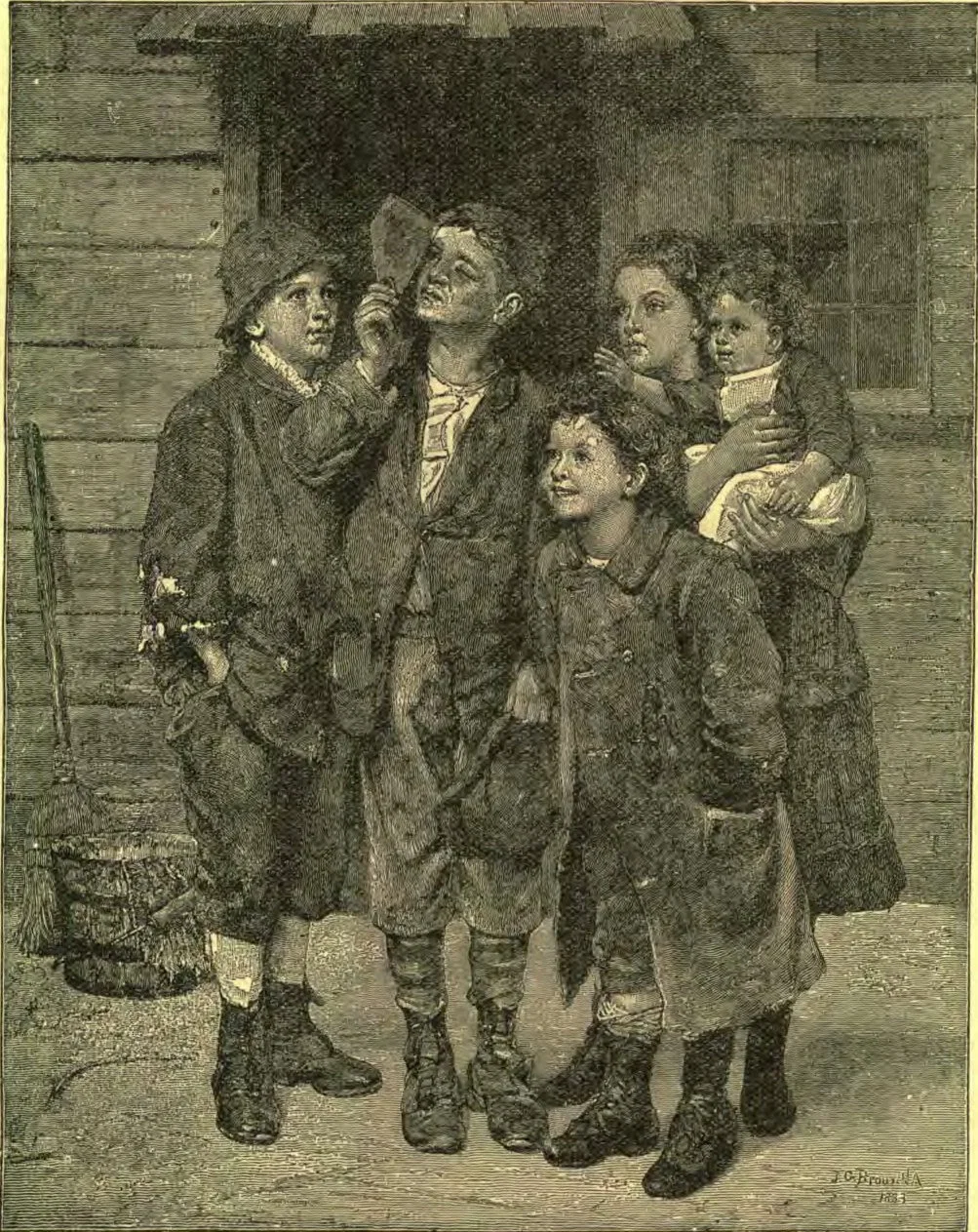
The little Bentleys all stood outdoors, looking up into the sky. There was something going on there that interested them. It was an eclipse of the sun. Jack and Harry had heard it talked about in the streets, and they had told it to the others at home. There had never been an eclipse since they could remember, and the thought that anything but a cloud could dim the bright sunshine, sent a little chill of terror over them.
With some trouble and a few burns of his fingers, Jack had succeeded in smoking a piece of window-glass; for the sun, even under an eclipse, was too bright to be looked at steadily.
“I smoked the glass,” said Jack, “and it’s my place to look first.”
“But Nettie’s the oldest, and she’s a girl,” said Elmer, who always wanted to see his sister treated kindly.
“Don’t care if she is,” Jack replied gruffly, “I’ve got the glass,” and he proceeded to look at the eclipse, holding the glass a great deal longer than he really cared to, because he was angry at Elmer.
“Nothing about an eclipse to make such a fuss over, after all,” said Jack, turning to hand the glass to Nettie.
But Nettie had had to go in. Master Teddie, who was Nettie’s especial care while mother was away to work all day, had set up his claims for attention, and before he could be quieted, the eclipse was all over; for the sun, way off in the heavens, couldn’t wait for a little girl to quiet a restless baby before he took the shadow off his face.
Jack felt mean when he saw Nettie’s disappointed face, but he did not say he was sorry. He only spoke crossly to Sam, who wanted him to come and see how funny everything looked through the blackened glass, and he hit his foot against the block house Elmer was making for the baby. The baby set up a wail, and Elmer said some angry words himself.
Then there were two eclipses in one afternoon; one was in the great sky of nature, and the other was in the household sky, and it shut out the sunshine of love. Jack blamed everybody but himself because things didn’t go smoothly; for he was looking through the smoked glass of selfishness. He was the oldest boy, and of course he had a right to the first use of things, he reasoned.
The next day, when Nettie had swept the room and put it to rights, and had got the fretful baby asleep in the cradle, she said to herself, “Now I can have time to finish my new apron,” and she went into the other room for her thimble and thread.
While she was gone, Jack came across the clean floor, with his shoes all covered with mud, and left great clumps of dirt behind him at every step. He had a branch of willow in one hand, and in one end he had made a whistle. The shrill shrieks he forced out of it waked up the baby, and brought Nettie in a hurry from the other room.
“O Jack!” she cried in dismay, as she went to take the baby up, and saw the muddy tracks on the floor, “Why can’t you remember to clean your boots? Now you’ve waked the baby up, and I can’t do anything more this forenoon but tend him!” Nettie looked as though she thought it was hard to be the only girl in a family of boys.
“That’s what girls are for,” Jack replied unkindly, “and I guess I can whistle if I want to.” And he gave another loud blast that was almost deafening.
Then Nettie cried. “I think you are the hatefulest boy I ever knew,” she said.
“And I think you are the silliest girl I ever knew,” he answered; “can’t look at you without your crying.”
And so the bright sunshine and home happiness were shut out another day by Jack’s selfishness.
I wonder how many of my little readers have eclipses at their houses. How many let selfishness and discontent shut out the happiness that might be theirs, and make other people unhappy also?
W. E. L.

SOME LITTLE PEOPLE OF ASIA.

WHEN your mamma is kissing your eyes open in the morning, these little people’s mammas are tucking them into their queer little beds. This is not because they have been naughty and have to be punished. Their home is right on the other side of this great round world, and when the earth turns over to bring us into the sunlight, it leaves them in the dark.
They live in a country of islands, and its name begins with J and ends with n. Now, can you guess what it is?
If you should visit their home, and wanted to be very polite, you would stand before the house, and clap your hands, and say, “I call.” Then, when some one came, you would take off your shoes on the veranda; for no one steps on the soft white mats in the houses with his shoes on. Then you would bow down very low, touching your forehead to the floor several times.
The little boys would say many things that would sound very queer to you; and then you would sit down on the mat, and have funny little bits of tables brought in, with sweetmeats and tiny cups of tea. When this was over, and you went into the pretty garden, with its little make-believe rivers and waterfalls, islands and bridges, you would find that little people are much the same the world over. They would show you their queer little playthings, and soon you would feel quite at home with them, and you would think that this was a very nice country to be in; and so it would be if it were not such a dark country, with a great black shadow over it. Can you tell what it is? —Sunbeam.

THE LORD'S MONEY.

“Bertie, Bertie, isn’t this a shame?” cried little Casper Hall, as he held up a silver quarter for his older brother to look at.
It was a bright quarter, and at first sight there was nothing the matter with it, but closer inspection showed that it had been bored, and the hole had been filled up.
“They wouldn’t take it where I bought my slate,” said Casper ruefully; “and then I tried to pass it at the candy store, but the lady shook her head; and when I offered it to the conductor of the car, he was quite cross, and asked me if I didn’t know how to read. When I said, ‘Yes, of course I do,’ he pointed to a notice in big letters, ‘No mutilated coins received here.’ What shall I do with it?” finished the little fellow with a sigh.
“You have no idea who gave it to you, have you, Casper?” said Bertie.
“Not the least. It is a part of the change I had from Uncle John’s Christmas gift to me.”
“Well, you must be sharper next time. Now, if I were you, I would put it into the missionary box. The society will work it off somehow.”
“But I don’t want to put a whole quarter into the box.”
“It is not a whole quarter, Casp; it’s a quarter that’s had a hole in it. Nobody’ll take it from you. You may just as well get rid of it in that way as in any other.”
Bertie and Casper Hall were in their father’s library when the conversation took place. They thought themselves alone. But just on the other side of a curtain which divided the room from the parlor, their little cousin Ethel was sitting. As Casper moved toward the mantle where the family missionary box stood in plain sight, Ethel moved the curtain aside, and spoke to him.
“Boys,” she said, “I did not mean to listen, but I could not help overhearing you; and, Casper dear, don’t drop that quarter into the box, please.”
“Why not, Ethel?”
“The Lord’s money goes into that box.”
Bertie looked up from his book to meet the glowing face of the little girl. Her eyes were shining, and her lip quivered a little, but she spoke bravely.
“It was the lamb without blemish, don’t you know, that the Hebrews were to offer to the Lord. If you saw Jesus here in this room, you wouldn’t like to say, ‘I give this to thee because nobody else will have it.’ It was gold, frankincense, and myrrh the wise men offered the infant Jesus.
“It isn’t much we can give to him who gave himself to us, but I believe we ought to give him our best. And don’t you think it seems mean to drop a battered coin into God’s treasury, just to get it out of sight?”
Casper and Bertie agreed with Ethel. They were about to do wrong for want of thought. Are there not others who should remember that the Lord’s money ought to be perfect and of our best?—Christian Giver.
Continue reading: MOTHER NATURE'S BABES IN THE WOOD