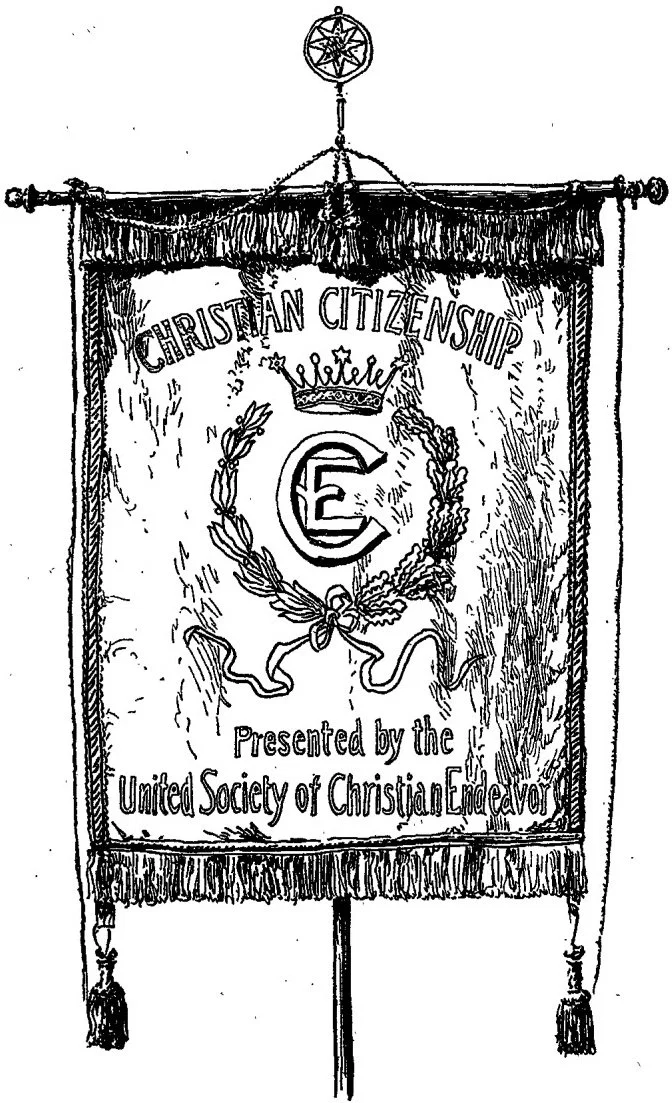
THE Protestant churches of the country, represented in the Christian Citizenship department of the Christian Endeavor Society and the National Christian Citizenship League, propose to establish the kingdom of God in the earth through the instrumentality of human legislation.
THE CHRISTIAN ENDEAVOR CHRISTIAN CITIZENSHIP BANNER.
For the benefit of those who have not read the recent issues of the AMERICAN SENTINEL, two quotations are reprinted to show the objects of the Christian Citizenship movement:—
“What is my work as a member of the good citizenship committee? It is to enthrone Christ in every town and city in the State, to have every mayor and every councilman a Christian, then Christ will rule.”—Official Report of the Fourteenth International Christian Endeavor Convention. (Boston, 1895.) p. 215.
“Not until the kingship of Jesus Christ is established over our land and the world, and his teachings made the rule in all public affairs will the Christian Citizenship League have achieved its purpose to prepare the way of the Lord. And then it shall be found that not only has the way for His coming been prepared, but that he has indeed and in truth come.”—The Christian Citizen (Dec. 1896), the official organ of the Christian Citizenship League.
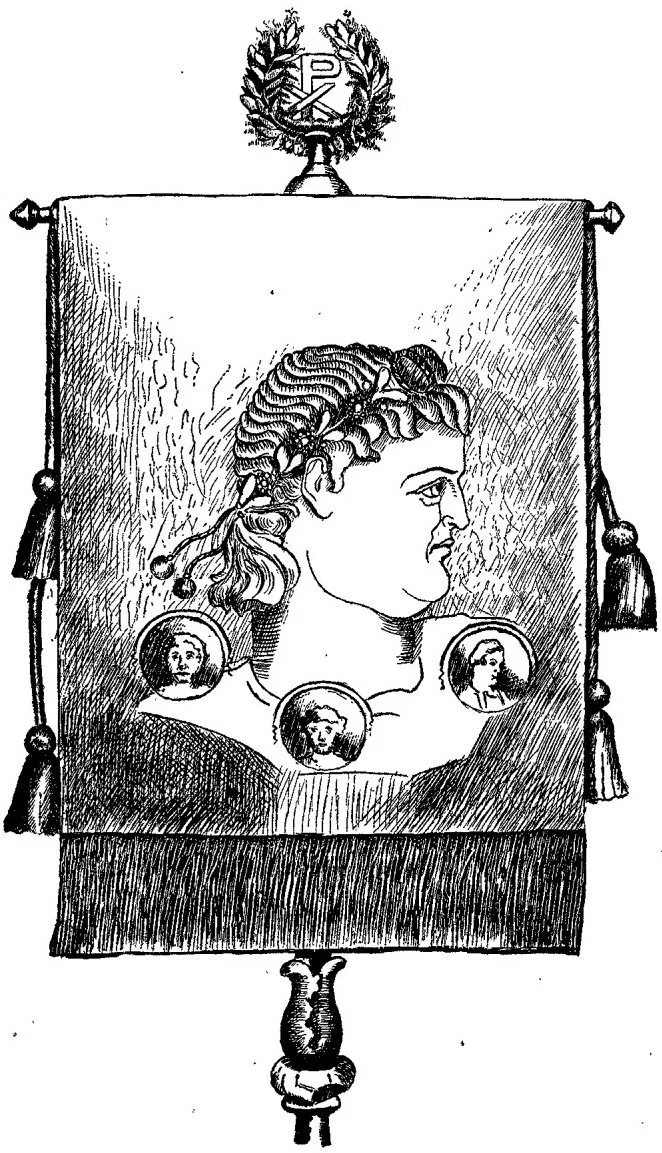
This method of establishing the kingdom of Christ on the earth is not new. It has been often tried and as often has failed. It was first attempted by Constantine and the bishops of his day. One would suppose that the terrible results both to Church and State of that first attempt would furnish an everlasting warning to Christians not to repeat the attempt, but instead of being warned, there are those connected with the Christian Endeavor movement who are so blind to the ruin wrought by that attempt, as to believe that when Church and State were united in the days of Constantine, it was really Christianity that wrapped itself in purple robes and ascended the throne of the Cæsars!
Here is the statement to that effect:—
“In less than three centuries from the ascension of Christ, Christianity, in the person of Constantine the Great, had ascended the throne of the Cæsars and wrapped itself in the royal purple, and ruled the Roman Empire.”—Id. p. 38.
Any man or organization of men that teaches that Christianity ascended the throne of the Cæsars as a result of the Christian citizenship schemes of Constantine and the bishops of his time, has wrong conceptions of both Christianity and citizenship. And in proportion as these teachings are accepted and acted upon by the people of the United States, just in that proportion will both Christianity and civil liberty disappear from the land.
There was a time in the history of Protestantism when the Christian citizenship movement of the Church in Constantine’s time was regarded as the destroyer of primitive Christianity and civil liberty.
After quoting that famous article in the Augsburg confession which condemns the confusion of religion with politics, the greatest Protestant historian says:—
“With what wisdom, in particular, the confessors of Augsburg protested against that confusion of religion and politics which, since the deplorable epoch of Constantine, had changed the kingdom of God into an earthly and carnal institution!”—D’Aubigne’s History of the Reformation, Book XIV., chap. VII., par. 34.
Inasmuch as Baptists are now so prominently connected with Christian Citizenship, a comment from one of their historians on the Christian Citizenship of Constantine’s time is here quoted to show how these Baptists are leaving the old landmarks.
Dr. Thomas Armitage in his “History of Baptists; Traced by their Vital Principles and Practices” has this to say of Constantine and Christian Citizenship:—
CONSTANTINE'S CHRISTIAN CITIZENSHIP BANNER.
“He is said to have seen the cross in the sky, but possibly his Christianity had borne a higher character had he discovered love for the true cross of Christ in his41soul: crosses in the firmament are of rather light moral worth. Unfortunately, it was years after this traditional vision that his nominal Christianity allowed him to kill his son, his second wife and others of his family. Full of ambition and passionate resentment, it would require considerably more to-day than a sky miracle, a sword in the hand, and a conquering army at the Malvian Bridge to give him membership ‘in good standing’ in the Baptist Church recently established at Rome. It is said that the cross in the heavens was attended with the inscription: ‘By this sign conquer!’ What, and whom? His own sin? His own soul? It seems not. But rather Maxentius and Rome and a throne. At the beginning Jesus had made himself king in Zion, to disallow all imperialism there; and did he now rise from his throne to hang his cross of peace an ensign of blood in the firmament, and to indicate that he turned over his universal lordship to an unregenerated heathen? This cross story needs revision.”—pp. 297, 298.
Inasmuch also, as Christian Citizenship, indorsed by so many Baptists, now proposes to have “his [Christ’s] teaching made the rule in all public affairs,” another quotation from Dr. Armitage is made to show how the bishops sought and obtained the national sanction of their views of Christ’s teachings, and its results as seen by a Baptist.
Describing the Council of Nicæa as it sat waiting for the entrance of Constantine, its Christian Citizenship chairman, Dr. Armitage makes use of this eloquent and truthful language:—
“Alas for them! with all their fortitude, the simplicity of the Upper Room, the ‘piece of broiled fish and the honeycomb,’ had given place to royal apparel, princely fare, and ‘kings’ houses;’ but there was no Son of man returning fresh from Edom. They sat waiting in solemn silence; but a new head of the church came in, and they rose to do him reverence. . . . The sword of nations and the shepherd’s crook lay at his side; but where was the Good Shepherd who laid down his life for the sheep? This is Cæsar, and not ‘another King, one Jesus!’ . . . How are the mighty fallen! Their lawful sovereign and good friend was hailed as their head, and they waited for his ‘image and superscription’ to attest their orthodoxy. For the first time the old Baptist churches of the world are found crouching at a monarch’s feet! Farewell, soul liberty, hie thee to the wilderness for a time!”—pp. 203, 204.
This is the Baptist view of that first attempt to establish the kingdom of God on the earth by means of “purified politics.” However, the contemporary Christian Citizenship view as expressed by Eusebius is that then was fulfilled “the prediction of the holy prophets, according to what they uttered ages before, ‘and the Saints of the Most High shall take the kingdom.’”—Oration in praise of Constantine, chap. iii.
So blind were the church leaders in the days of Constantine that when they had laid aside the pilgrim garb and donned the purple robe; when they had exchanged the “sword of the Spirit” for the scepter of civil power; they really thought the saints of the Most High possessed the kingdom. But instead, as Dr. Armitage says, there was “inflicted a blow upon the Christian system from which it has not yet recovered.”
And as surely as this was true of the Christian Citizenship movement in the fourth century, just as surely is it true of the Christian Citizenship movement of the nineteenth century. And as then so now the mournful warning will be given, “Farewell, soul liberty, hie thee to the wilderness for a time.” A. F. B.
Sunday Laws Versus the Spirit of Progress
A PROMINENT speaker at the recent compulsory Sunday observance convention in Chicago, said:—
“It has been the immemorial custom of our courts and legislatures to follow precedents, and from materials collected from the effete past, from decisions rendered and statutes enacted when the conditions of society were42wholly different from what they are under our newer civilization, to construct Procrustes beds upon which they seek to stretch the great issue of the present, chopping, cramping and straining them as mercilessly as did the legendary giant of Athens his fated victims. In this case the victim resists, and thereupon occurs a struggle between the hoary Procrustes of Conservatism and the youthful giant of Progress..”
This was not intended to describe the descent of Sunday legislation from the Church-and-State regimes of antiquity, and its conflict with the spirit of liberty and progress to-day; but it could not possibly apply to anything more perfectly.
Christian Citizenship.
By H. E. Giddings
BY H. E. GIDDINGS.
THIS new phrase, “Christian Citizenship,” is now claiming the field of discussion. To some it seems to present the remedy for all the great evils which threaten our national, social, and personal welfare. To others it appears to be the germ which, cultivated to a successful growth, will constitute an evil more far-reaching and destructive to the individual, society, and the nation, than any of the present or past evils which have stricken our political institutions with the mildew of corruption.
“Governments derive their just powers from the consent of the governed.” This being true, governments can justly exercise no power except derived power. This nation of ours is a “government of the people, by the people, and for the people.” Thus the people themselves are the Government.
This can properly be expressed in other words thus: The people acting together as a government, can exercise no power except what they have, as single individuals, consented to place at the disposal of the mass. The consent of the governed is expressed in the capacity of single individuals, by the exercise of the right of franchise in voting. In this way the individuals indicate what measures they favor, and pledge what power they have to carry them out. At the same time perhaps, and in the same way, they choose agents to accomplish their governmental desires.
The citizen as an individual thus gives his consent to the government, and the government in this way derives power or authority to act. What is termed an officer of government, only has a right to execute the will of the people expressed in the vote. If in attempting to do this as an agent, he finds it will not succeed because threatened by some element of discontent or the invasion of some foreign foe, he has a right to call upon the people who have exercised the power of franchise, in making him their executive, to make their pledges good by a strong police force, or an army sufficiently clothed with the real element of governmental power, which is the sword, to quell the disturbance or repel the invasion.
The governed can only delegate, pledge, or consent to furnish, to the government, physical power. That is the only power ever employed by civil government. In fact all the power that is needed in civil affairs is power to compel uncivil men to be civil.
But after a man becomes a Christian, he has two kinds of power—spiritual and physical. Can both become elements in his “citizenship”?
As the “citizenship” is the original factor and basis of civil government, and really constitutes it, whatever elements make up the citizenship determines the kind of government. The elements of citizenship are simply those represented in the power delegated to the government.
Otherwise there would be injustice. To illustrate: If Christianity were an element in citizenship and yet was to be controlled by the government without being derived from the consent of the governed, this would not be just; because “governments derive their just powers from the consent of the governed.”
If the government were to exercise authority with respect to Christianity without its being recognized as an element in citizenship nor derived through the consent of the citizens, this would be again to abandon the principle and exercise unjust power because not derived from the consent of the governed.
If Christianity were an element in earthly citizenship and delegated to the government yet not dominated by governmental power, then the government would be guilty of neglecting one of its functions, and violating the trust imposed in it.
Finally: Suppose, as the advocates of “Christian Citizenship” assume, that Christianity is an element in citizenship, and that it is delegated to the government, and the government does administer it. Then the responsibility is shifted from the individual to the nation: and instead of looking to God as the object of worship and obedience, as well as trust and confidence, he looks to the government. And this would be unchristian; because God has definitely forbidden it—“Put not your trust in princes, nor in the son of man, in whom there is no help.” Ps. 146:3.
Rockefeller Testimony Exposes Church Property Tax Evasion
There is a contest in this city over a piece of church property, in which Mr. John D. Rockefeller is one of the principals. The case was in court the other day, and in Mr. Rockefeller’s testimony the following passage occurred:—
“Who was the real owner of the lease obtained from the St. Mark’s Church?”
“I was,” he answered.
“But it was held in the name of the church; why was that?”
“The reason for that,” replied Mr. Rockefeller, “was to escape taxation. If I had held the lease in my name the property would have been taxed. If the church held it, it was exempt from taxation.”
This is an illustration of one of the many evils of exempting church property from taxation. Here was one of the richest men in the world, a professed Christian too, who was the real owner of a lease on property; but to43escape taxation the false pretense was made of holding the lease in the name of a church. And other testimony showed that the church management was a party to the trick.
The case was tried before Justice Pryor, who a short time ago refused a certificate of incorporation to a society whose annual meetings were to be held the last day of each year, because such meetings would thus sometimes fall on Sunday. He did not at once formally decide the case, but said that from what he could remember of it he should say that “Mr. Rockefeller’s part has been purely a benevolent one and will receive due recognition before a higher forum than this”!
But Justice Pryor’s “forum” decides questions of religion and men’s relation thereto; and how can there be a higher forum than that? Yet though he recognizes a higher forum than his, it is, to his mind such a one that he is satisfied that the “benevolence” of a man who resorts to a legal trick to show it “will receive due recognition” there. We wonder where that forum is.
The Problem of a Weekly Rest.
The religious and labor federations, the statesmen and theologians, who are laboring over the problem of securing a weekly rest for the toiling masses, are making much ado about nothing. There is no problem involved in the matter at all.
There is not a man on the face of the earth but is now, and has been all his life, supplied with a weekly day of rest. It is given him by none other than the Creator, and by the latter enjoined upon his observance. The only problem that can be connected with it is the problem of doing what the Lord commands.
It is true that some people—very many in fact—make a great problem of obedience to God. But this is because they do not want to obey Him, and do not obey Him in fact. Obedience itself is a very simple thing. Obedience to God, in just the way that God points out, is one of the simplest things in the world. But when men try to obey God in their own way, at once a problem arises; and so great is that problem that it is altogether beyond solution by any wisdom or power on earth. God cannot be obeyed by any man in man's way.
THE LORD'S REST.
What God says concerning a weekly rest is that “the seventh day is the Sabbath of the Lord thy God; in it thou shalt not do any work.” God is the author of the Sabbath; and by resting on the seventh day after six days of work and setting apart that day as a day of rest, He made the week. The Sabbath and the week stand in inseparable relation to each other. The very process of making the one, established the other.
The seventh day Sabbath is the seventh day of the week. God fixed it there at creation, and no human power can move it from its place. God commanded—and still commands—every person to keep it holy; and all that any one has to do in the matter is to do as the Lord directs.
But, it is said by many, “I cannot keep the weekly rest day, on my own responsibility, without a great sacrifice.” Possibly that is so. Possibly you would lose your job, and be brought into financial straits. But what of that? If you are willing to make a sacrifice to obey God, you can obey Him. You can take the rest day that He gives you, and get all the good from it that can be realized by any person in the world. If you are a Christian, you will not deny that it does not hurt any individual to lose his job or be brought into a strait place on account of obedience to God. From a Christian point of view, a strait place is not half as bad as a broad place where everything goes smoothly. And if you are not a Christian, you can derive no benefit from the Sabbath, anyway. The Sabbath benefits only those who obey God.
It is said that man needs one rest day in each week; and that is true. If man did not need the Sabbath, the Creator would not have made it. Unremitting toil is not good for the race. No one claims that it is. But the Lord, who made man, knew what kind of a rest man would need, and made the Sabbath to supply that need. The one who takes the Sabbath and keeps it as God has commanded, gets the rest, and the one who does not obey God in this respect, does not get it.
Seven days’ work in the week, it is loudly asserted, is contrary to God’s order. True; and disobedience to one of God’s commands is also contrary to God’s order. And the one is no more contrary, and no more hurtful, than the other.
GOD'S LAW IS ENOUGH.
Laws may be passed to enforce the observance of Sunday; the trades unions may adopt regulations to secure the workingmen a weekly day of rest; but all such work amounts to nothing, so far as securing benefit to men is concerned. It is wholly unnecessary. Why?—Because God himself has legislated on that very point, and his legislation covers the whole ground. No human legislation can add anything to the command of God; and any legislation that is not in harmony with God's command, would much better never have been enacted.
No matter what may be the needs of the human race; no matter how eloquently or convincingly the modern “reform” orator may be able to discourse on the evils of unremitting toil, the fact remains that the Creator has taken out of the hands of man all legislation touching a weekly rest, by legislating on the subject himself for every individual on the earth; and that legislation remains in full force to-day. If individuals do not heed it,—if they work seven days in the week themselves, or try to force their employees to work, the only remedy still lies in obedience to God's command. Man cannot legislate on the subject of a weekly rest without invading the prerogatives of God.
All men are bound by God's Sabbath law; and when man presumes to make a different law covering the same44point, or to re-enact God's law, he is guilty of nothing less than blasphemy.
These considerations make it clear why human Sabbath laws never benefitted the human race in the past, and why no possible benefit can be derived from them to-day.
Clerical Tyranny in Quebec.
Detroit Evening News, January 6, 1897.
ALL the experience of history seems to teach the French-Canadian hierarchy nothing. Like the Bourbon kings, who first established them in power upon the banks of the St. Lawrence, they seem incapable of compromise with facts until the facts overwhelm them and they lose all.
If any body of men ever received a lesson that should be a warning, the Quebec hierarchy received one in the last parliamentary elections, when they undertook to coerce their people, under grave religious penalties, to vote for the Conservative candidates on the Manitoba educational issue, and Laurier carried the province against them by an overwhelming majority.
This defeat has apparently only made them all the more desperately resolved to cling to their arrogant prerogative of dictating the political action of their people.
A French-Canadian author, M. David, recently wrote a small work on the subject of Church and State, in which he took the ground that the State was supreme in secular and political matters. As a loyal Catholic, he submitted the work to the authorities at Rome and it was forthwith put into the index of forbidden books. David meekly withdrew it from circulation, but a French Liberal paper, a warm supporter of Laurier, proceeded to publish it in its columns. Thereupon the bishops issued a mandament forbidding the people to read or support L'Electeur, the offending journal. M. Pacaud, the publisher, announced his intention to cease publishing his paper for lack of support, but to bring suit for damages against the bishops who had ruined him.
With some exceptions, the other French papers of Quebec condemn the action of the bishops, and encourage Pacaud in his efforts for redress. The English papers of the whole Dominion, as might be expected, denounce the course of the bishops as an attack upon civil liberty, which it is the duty of every Canadian, without respect to partisan or religious differences, to resent, and the hierarchy find themselves in the midst of a contest to which that over the Manitoba schools was trifling in its proportions. There will first be an appeal to Rome by the aggrieved editor, and failing there, an appeal to the courts and to Canadian public opinion, which will bring a pretty storm upon these arrogant prelates.
CHURCH PRIVILEGES IN QUEBEC.
When the storm has fully gathered, it will hardly be abated without a full review of the peculiar privileges of the church in the province of Quebec. Throughout the rest of the Dominion the clergy of all denominations depend for their support upon the voluntary contributions of their followers. They are consequently liberal in their treatment of the people and reasonably modest in their claims of prerogative.
The Catholic clergy of Ontario, while they have not openly taken issue with the hierarchy of Quebec, appear to be entirely contented with the compromise which the Laurier government effected in the Manitoba school matter, and never under any circumstances attempt to control the political action of their people by arbitrary mandament. But the French Catholic clergy of Quebec, deriving their rights and privileges, and especially their incomes, from law as established by treaty between France and England, which ceded Canada to the latter power, collect their tithes and fabriqué (the latter a tax for the construction of new churches), by process of law.
When the tax remains unpaid, it becomes a first lien upon the property of the delinquent. In many cases the burden has become so grievous that delinquents have thrown up their farms and emigrated to the States, preferring to take their chances penniless in a new and free country, to continuing the hardships to which they were subject under the tyranny of the clergy at home. New England has filled up with these refugees, who in their new homes have prospered and multiplied. Priests have followed them to minister to their religious wants who receive from them a generous and voluntary support.
The church property in Quebec also enjoys peculiar privileges in the way of exemption from taxation which is not confined to the church property proper, but is extended to all accumulations of money or real estate made by the religious bodies. These have naturally grown enormously rich, and the spectacle of their wealth in the midst of the general poverty of the people is now attracting the attention and provoking the resentment of Catholics and Protestants alike in the province of Quebec.
SHALL THE PEOPLE RULE?
These enormous privileges, as valuable to the bishops and as onerous to the people as were those enjoyed by the hierarchy and nobility of France before the great revolution, are regarded by the clergy as invulnerable to attack, because they are buttressed behind a solemn treaty made between England and France. But the rights of Catholic education in Manitoba were based upon the same warrant; yet the Manitobans found a way to sweep them aside and make their own school laws, and that with the cordial assistance of the Catholic voters of Quebec in the last elections. . . . Out of it all may grow a revolution which will be as sweeping against ecclesiastical prescription, although peaceful and bloodless, as was that which overturned the Gallician church and French aristocracy a hundred years ago.
Christian Endeavorer's Claimed Sabbath Discovery Examined
THE Christian Endeavorer announces the “great discovery” that the reason why the Sabbath was kept by God’s people prior to the day of Pentecost, was that God delivered the children of Israel out of Egyptian bondage. Possibly this may find credence with people who have45never read the fourth commandment; but anyone who knows how that commandment reads knows that it bases Sabbath observance upon the example of God during Creation week. Would it not be better to learn the prominent and important truths relating to Sabbath observance as set forth by Inspiration, than to overlook them; in the interests of a “great discovery”?
Sunday Observance Against Sabbath Observance.
By Rabbi M. Samfield
Rabbi M. Samfield, Editor Jewish Spectator.
MOTTO: “Eternal vigilance is the price of liberty.”
The evolution of the present Sunday law from the ecclesiastical institutions of the past has been amply proven, nor is there any doubt that the sole motive of its introduction into American State legislation was sectarian in its nature, and has as its object the rigid religious observance of the Christian Sunday, as taught in the Protestant Church.
It was not intended to be enacted as a civil institution, for the mere purpose of providing the laboring classes with a period of rest, recreation and amusement; the very letter of the law testifies against such hypothesis. On the contrary, any recreation and amusement: which was not sanctioned by the Church law, the State law would not permit on the Sunday.
For example, the principal prohibitions of the State of Massachusetts are at present:—
“Being present at any dancing, public diversion, show or entertainment, or being present at or taking part in any sport, game or play; fine not exceeding fifty dollars.”
“Keepers of places of public entertainment or refreshment not to entertain persons or suffer them to remain in the place drinking, or spending their time idly or at play, or in doing any secular business; fine at first conviction not exceeding fifty dollars; at second conviction, not exceeding one hundred dollars.”
“Travelling, except from necessity or charity; going visiting beyond the town limits and using horse cars within town limits is illegal travelling under this statute.”
And the Sunday law of the State of Tennessee, although not quite as blue as that of her New England sister, has enough of a bluish tint to demonstrate that it is begotten by the spirit of sectarian influence, and not by the science of political economy—“Any person who shall hunt, fish or play at any game of sport, shall be subject to a fine, etc.” (Section 1824, Code of Tennessee.)
These few quotations, to which we could add many more, furnish irrefutable testimony that the State is more anxious to maintain and enforce the religious observance of the first day of the week, in accordance with theological interpretation, than to defend a principle of political economy, and to give the laboring classes an opportunity to recuperate their minds and bodies by the exhilarating influence of social pleasure and amusement. The Puritan spirit has left such indelible sectarian traces in the construction and application of Sunday laws that every unbiased mind can decide at once that all efforts to construe it as a purely civil law must prove a failure. So oppressive are these regulations in certain States to the working classes, that a majority of them prefer the labors of Monday to the gloom of Sunday.
THE STRICTLY PHYSICAL ASPECTS.
Had the State Legislature considered only the physical aspects of a day of rest it would have enacted only such laws as are prohibitions of hard labor and fatiguing work. And instead of proscribing places of amusement and entertainment, it would have encouraged their use in a legitimate manner. It would have permitted all acts and deeds on Sunday which do not carry with them an undue waste of the physical forces and nervous energies of man, and which do not inflict direct injuries upon the life and property of other men.
Aye, the State could have done even more than that, provided the question of a day of rest had been considered upon the general grounds of necessity, and been based upon the science of political economy. Instead of consulting the traditions of the synagogue and church, the scientific men of our age should have been asked how much physical rest is necessary for man under the present conditions of society, with the amount of labor that is allotted to him now in the presence of the helpful mechanical inventions of the age.
Perhaps the conclusion would be reached that labor having increased and causing a larger waste of nerve and muscle, one day in five should be given as a day of rest to the laborer and mechanic; or, perhaps, the researches of competent political economists would prove, upon statistical evidence, that since the introduction of steam and electrical power human force is not taxed half as much in agricultural work and mechanical labor, and46that one day in twelve is the just proportion of physical rest to labor.
There is still another result to these observations: It may be discovered that if the eight-hour system is granted as a boon to the laboring classes, no day of physical rest is needed at all, because sixteen hours out of twenty-four are granted for that purpose, which would secure such rest and leisure to the working classes that no civil law of the land need be called in requisition to compel the observance of a special day of rest and repose for the body.
THE TRUE SABBATH IS SPIRITUAL.
God himself has written the law of daily rest in the very heart of creation. Whenever the sun sets at the close of the day the natural period of physical rest commences, then the sabbath of physical rest has come, bringing with it the angel of sleep, the greatest benefactor of the sons of toil. The body needs no special day of rest; each night is its sabbath.
It is the soul, the spirit, which needs a Sabbath, to gain spiritual consolation and religious instruction, and, to provide for this necessity is the office of religion, the mission of each church within its own borders. With this spiritual work the State has nothing to do, and this spiritual Sabbath must unfold its beauty and sanctity by the innate force of religion. The rose and the lily will unfurl their delicate bloom and pour out their sweet perfume only when they are allowed to grow and expand by the innate force which God has laid in root, stem and flower. They would wither in our hands should we make the rude attempt to force asunder their delicate fabric. Even so will the beauty and glory of a spiritual Sabbath fade away, when the hand of the law uses forcible measures to impose it upon man.
Turkish Authorities Restore Order at Holy Sepulchre
In view of the loud demand that the Turkish Government shall be wiped off the earth, the following dispatch to the New York Herald tells an interesting story:—
“CONSTANTINOPLE, Jan. 10, 1897.—Official advices received here from Jerusalem show that there has been further trouble among the worshipers at the Church of the Holy Sepulchre. It appears that the Roman Catholics were opposed to members of the Orthodox Greek Church entering the church by a certain door on the eve of January 6, the day observed by the Orthodox Church as Christmas.
“The latter insisted upon their right to enter, and the result was that the two factions became involved in a serious fight, which did not end until the Turkish authorities intervened to restore order. Some of the combatants were badly injured, but it is not known whether anybody was killed.”
Is it not rather a happy circumstance that the Turkish power does exist in order that these devout “worshipers” may be kept from tearing one another to pieces in “orthodox style” at “the Church of the Holy Sepulchre”?
“The Law Is Spiritual.”
By Ellet Joseph Waggoner
E. J. Waggoner, in Signs of the Times.
“FOR we know that the law is spiritual.” Then there can be no fulfilling of the law save in the Spirit. “God is a Spirit; and they that worship Him must worship Him in Spirit and in truth.”
God is Spirit; therefore they that worship Him must do so in the Spirit which he supplies. He provides the means, and does not ask us to worship Him in our spirit, or in our conception of His law.
We are not to worship God as we think Him to be, but as He is. And no one, as stated in the text just quoted, can comprehend God, or define the bounds and limits of His will. Then no man can lay down a rule for another, or even for himself. Here is the unlimited Word. No man can put a limit on the word of God, or say of any text that he has fathomed its depth, and that he has all the truth there is in it. No; the word is spiritual, and no man can fathom the depth of the mind of the Holy Spirit. For this reason no man, and no body of men, is at liberty to put any construction on the word of God; or to change it, or to hold or teach that it means anything different from exactly what it says.
The knowledge of this shuts out everything like religious coercion, persecution, or the laying down of rules for people to follow; for true worship must be rendered in the Spirit which God alone gives. The Word must be taken, not in our own spirit, but in the Spirit of God, and that must lead us into larger and larger ideas, and work in us that which we do not know ourselves.
Men have secret faults of which they are utterly unconscious. Not only so, but no man knows the depth of any sin which is brought to his attention, or the fullness of any command which is enjoined upon him. It is plain, therefore, that no man can measure his own righteousness, nor his own sin. He can simply know that he is a sinner, and that the righteousness of God is given to him. The more of the Lord he knows, the greater sinner he will realize himself in himself to be.
Therefore no man or body of men, whether in Church or State, can lay down rules by which a man must live; because the field of God’s requirements is as unbounded as his own life, and must therefore ever keep increasing to our vision; and though men filled the world with books in the attempt to define everything, there still would be something omitted.
The Spirit of God must work its own life in every man. This takes the matter out of the realm of civil government entirely. No human authority whatever can impose the Spirit upon any man, or define the mind of the Spirit.
TO OUR PATRONS:
By Editor
Write names plainly.
Remit by P. O. Money Order, or Express Order, or by Bank Draft on New York. Personal checks are not desired.
Make all Orders and Drafts payable to Pacific Press Publishing Co., not to the editor or any other individual.
We will receive Postage Stamp in small quantities and any kind of good money. Defaced coins will not be taken. If paper money or coin is sent, register the letter.
A Greek-English Lexicon to The New Testament
Revised and Enlarged by
THOMAS SHELDON GREEN, M. A.
WITH A PREFACE BY
H. L. HASTINGS,
Editor of the Christian, Boston, Mass.
AND A SUPPLEMENT BY
J. H. THAYER, D. D., LITT. D.
Professor of New-Testament Criticism and Interpretation in the Divinity School of—Harvard University.—
Containing additional Words and Forms to be found in one or another of the Greek Texts in current use, especially those of Lachmann, Tischendorf, Tregelles, Westcott, and Hort, and the Revisers of 1881.
“The best thing of the kind for the money.”
PAPER BINDING, Postpaid, 35c.
Address,
Pacific Press Publishing Co.,
39 BOND ST., NEW YORK CITY, N. Y.
DOLLARS FOR SPARE MOMENTS.
Spare Moments Turned into Cash,
In a manner both pleasant and profitable for all concerned. Steady employment also offered to old and young. If interested, send us your name and address on a postal card at once, and await reply.
Address. E. E. MILES,
South Lancaster, Mass.
Or, 324 Dearborn St., Chicago, Ill.