The Youth’s Instructor, Vol. 43, No. 43.

BUDDHISM IN JAPAN

The Youth’s Instructor

Oct 24, 1895

S. D. A. Publishing Association · Battle Creek, Mich. · Oct 24, 1895

BUDDHISM IN JAPAN.
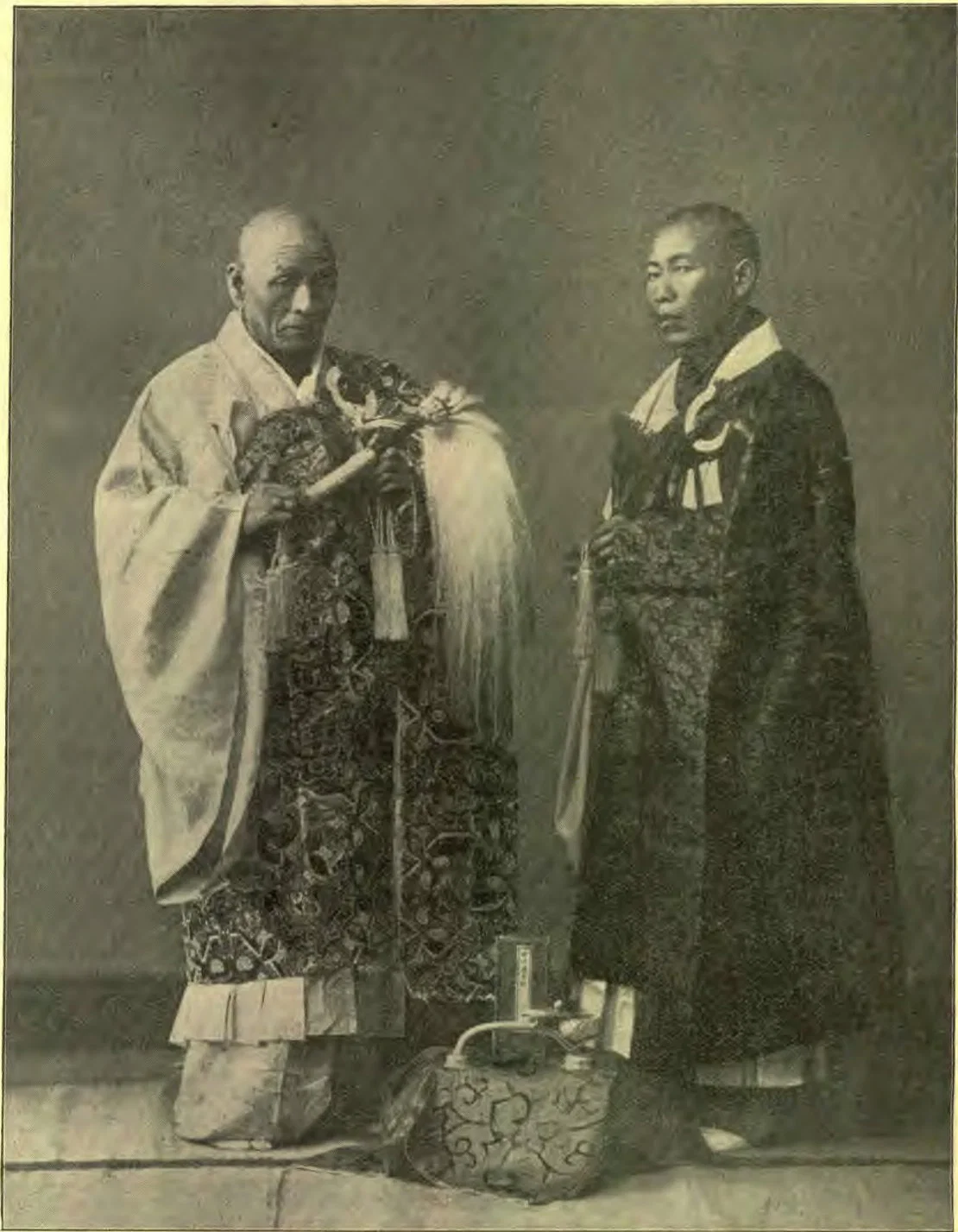
“Buddhism” is the name of a religion that originated in India almost five hundred years before Christ. It arose from the teachings of Gautama, who was the son of a raja. When Gautama was a young man, he became deeply impressed by the scenes of misery and woe that he saw about him, and resolved to seek for some panacea from the sorrows of life, for suffering humanity. He left his father’s home of wealth and splendor, and his wife and infant son, and went out into the world as a beggar, to seek enlightenment. For six years he gave himself up to fasting and self-torture, without being able to solve the problem, till at last he fell to the ground from weakness. He then ceased his severe penances, and took regular food.
He felt greatly discouraged, and sat down one day under a tree to rest and meditate. He wrestled with doubt all day; but the religious side of his nature predominated, and he came out from the struggle a buddha, or the enlightened one. He then became a teacher, and gathered about him many disciples, who followed him about to listen to his words of wisdom, and find out how to become enlightened like himself. By and by his doctrines spread, and finally became the religion of nearly all Asia. Many of the teachings of Buddha were pure and elevating in their character, and at first his adherents were real benefactors of mankind. But like all other man-made religions, Buddhism has become corrupt, and in consequence has degenerated into a system of superstitious rites and ceremonies.
Buddhism declares that all men are equally sinful and miserable, but that all are capable of being freed from sin and misery through knowledge. It teaches that the souls of all men lived in a previous state of existence, and that all trouble in this life is due to sin committed in a life prior to this, perhaps centuries ago; that after death the soul must be reborn into different conditions of life, at each birth rising higher and higher in the scale of being, until at last it is absorbed into Nirvana, and ceases to be, which is the greatest good that can come to man.
The commandments of Buddha prohibit lying, stealing, adultery, drunkenness, and murder. There are also precepts against hypocrisy, anger, pride, and many other vices. Buddhism spread from India to Ceylon, Siam, Burma, Tibet, China, Korea, and thence to Japan.
The native Japanese historians say that an image of Buddha and some books of Buddhist scriptures were proffered to the mikado Kimmei by the king of one of the Korean provinces, in A. D. 552. The mikado wanted to accept the gifts, but his council, who were Shintoists, insisted upon his rejecting them. He thereupon gave them to one Soga-no-Iname, who turned his own home into a Buddhist temple. Monks and nuns began to flock over from Korea in large numbers. Some of the princes and nobles embraced Buddhism, and it continued to spread until it became the chief religion of Japan. It was not established without a struggle, chiefly with the Shintoists, who sacrificed to the spirits of the dead, and did homage to the mikado as a god; but Buddhism finally became reconciled to all opposing cults through amalgamation, and accepted into its pantheon all Shinto deities, teaching that they were transmigrations of Buddha.
BUDDHIST PRIESTS.
BUDDHIST PRIESTS.
The Buddhists in Japan, as in other countries, are divided into numerous sects, who are greatly at variance with each other, and differ widely in their teachings. The chief sects now existing in Japan are the Tendai, Shingon, Jodo, and Zen, which are of Chinese origin. There are two more, which originated in Japan in about the thirteenth century, called the Nichiren and Shin sects.
The first bears the name of its founder, who was born about 1222 A. D. He spent a busy life in teaching and preaching his doctrines. He was greatly given to controversy, and his disciples have inherited the same spirit, for they are extremely bigoted, and openly abuse all who oppose them. Their meetings are very noisy. They beat drums, and sing out the same prayer over and over again, and shout until they are exhausted. They sometimes work themselves into such a state of excitement that it ends in insanity.
Shinran was the founder of the Shin sect. He taught by precept and example that celibacy was an invention of the priests, and not a part of the original teaching of Buddha. He regarded penances, fasting, pilgrimages, the wearing of chains, etc., as folly, and taught that prayer, purity, and trust in Buddha were the only means of salvation. The Shinshuists are called the Protestants of Japan. They hold a form of doctrine of justification by faith, believing in Buddha instead of Christ. This sect is very strong in Japan. They are among the strongest and most aggressive opponents of Christianity in the empire.
Like the Roman Catholics, most of the Buddhists believe in and practise asceticism, and make celibacy compulsory upon the priesthood. There are a great many monasteries and convents in Japan, well filled with priests, monks, and nuns, many of whom live lives that are far from saintly. In fact, the majority of the Buddhist priests are ignorant and immoral, and the better classes of the people have but little confidence in them.
In reality, Buddhism is losing its hold upon the upper classes; but the ignorant masses are still abject slaves to its superstitions. They buy amulets and charms at the temples, and wear them to ward off danger. They go through forms of conjuring to dispel evil spirits, and burn incense to propitiate the good ones. They live all their lives in abject bondage to fear.
The most enlightened Buddhist priests are waking up to a realization of the fact that Christianity is progressing in the Island Empire, and leaving Buddhism in the rear, as a thing of the past. They are advocating and adopting Christian methods, such as schools for the education of the youth, benevolent societies, and all modern means of reaching and keeping a hold upon the minds and hearts of the people. They teach their followers that Christianity is an evil religion, and that the Japanese who believe in it are disloyal to all the best interests of Japan.
But the pure, honest lives of the missionaries and native Christians are arguments known and read of all men, and such arguments cannot be controverted. They are bringing to the empire a better understanding of what genuine Christianity really is, and a kinder feeling is springing up in Japan toward the Christian and the religion which he professes. But one unconverted missionary will do more harm than a hundred Buddhists. O that all who go to heathen lands as Christ’s ambassadors might be so filled with his spirit that they would represent him in their lives, so that all coming within their influence would be made to feel that there is a power in the Christian religion that can change the sinful heart,—a power which has no place in that of Buddha, or any other religion invented by man!
MRS. J. A. BRUNSON.

CHRIST THE YOUTH'S SAFEGUARD.

If our youth understood their own weakness, they would go to God for strength; but if they give their minds up almost wholly to study, and do not make Christ their all in all, even while pursuing a course of education, they will lose all that enriches life. The first chapter of 2 Peter is full of instruction, and strikes the keynote of victory. The truth is impressively forced upon the mind by the way it is presented in this chapter. Let us more abundantly recommend the study of these words, and the practising of these precepts. The apostle writes, “To them that have obtained like precious faith with us through the righteousness of God and our Saviour Jesus Christ: Grace and peace be multiplied unto you through the knowledge of God, and of Jesus Christ our Lord, according as his divine power hath given unto us all things that pertain unto life and godliness, through the knowledge of him that hath called us to glory and virtue.”
What a grand theme this is for contemplation,—the righteousness of God and our Saviour Jesus Christ! Contemplating Christ and his righteousness, leaves no room for self-righteousness, for the glorifying of self. In this chapter there is no standstill. There is continual advancement in every stage in the knowledge of Christ. Through the knowledge of Christ is life eternal. In his prayer Jesus says, “This is life eternal, that they might know thee the only true God, and Jesus Christ whom thou hast sent.” In God we are to glory. The prophet says, “Thus saith the Lord, Let not the wise man glory in his wisdom, neither let the mighty man glory in his might, let not the rich man glory in his riches: but let him that glorieth glory in this, that he understandeth and knoweth me, that I am the Lord which exercise loving-kindness, judgment, and righteousness, in the earth: for in these things I delight, saith the Lord.” “But of him are ye in Christ Jesus, who of God is made unto us wisdom, and righteousness, and sanctification, and redemption: that, according as it is written, He that glorieth, let him glory in the Lord.” “Not boasting of things without our measure, that is, of other men's labors; but having hope, when your faith is increased, that we shall be enlarged by you according to our rule abundantly, to preach the gospel in the regions beyond you, and not to boast in another man's line of things made ready to our hand. But he that glorieth, let him glory in the Lord. For not he that commendeth himself is approved, but whom the Lord commendeth.” The testimony of prophets and apostles is in full accord on this subject. We are to glory in the Lord our God.
Peter continues, saying: “Whereby are given unto us exceeding great and precious promises; that by these ye might be partakers of the divine nature, having escaped the corruption that is in the world through lust.” We have been called to the knowledge of Christ, and that is to the knowledge of glory and virtue. It is a knowledge of the perfection of the divine character, manifested to us in Jesus Christ, that opens up to us communion with God. It is by the great and precious promises that we are to become partakers of the divine nature, having escaped the corruption that is in the world through lust.
What possibilities are opened up to the youth who lay hold of the divine assurances of God's word! Scarcely can the human mind comprehend what is the breadth and depth and height of the spiritual attainments that can be reached by becoming partakers of the divine nature. The human agent who yields obedience to God, who becomes a partaker of the divine nature, finds pleasure in keeping the commandments of God; for he is one with God; he holds as vital a relation with God as does the Son to the Father. He understands the oneness that Christ prayed might exist between the Father and the Son. Jesus prayed: “Neither pray I for these alone, but for them also which shall believe on me through their word; that they all may be one; as thou, Father, art in me, and I in Thee, that they also may be one in us: that the world may believe that thou hast sent me. And the glory which thou gavest me I have given them; that they may be one, even as we are one: I in them, and thou in me, that they may be made perfect in one; and that the world may know that thou hast sent me, and hast loved them, as thou hast loved me.”
MRS. E. G. WHITE.
(To be concluded.)

Real and Imagined Troubles in Life

We have in life many troubles, and troubles are of many kinds. Some sorrows, alas, are real enough, especially those we bring on ourselves; but others, and by no means the least numerable, are mere ghosts of troubles. If we face them boldly, we find that they have no substance or reality, but are mere creations of our own morbid imagination.—Sir John Lubbock.

“WHAT WOULD JESUS DO?”

It was in silver letters, on a black card in the shape of a shield, and a similar card hung in every room in the house,—halls, parlors, dining-room, and even the kitchen.
Such a home-like house it was, too, that watering-place boarding-house, with its large, cool rooms, filled with pleasant guests, and the cheery family of the host, who had the faculty of making one feel so much at home that it was really more like visiting than boarding, and the rides on horseback, and drives to places of interest, and picnics, and moonlight excursions! Ah, what a place to rest in!
But that card; what did it mean?
I knew that the elder daughter of the house was soon to go as a missionary to the foreign field, and wondered why she had not selected some Bible text for the home, instead of that strange question.
One day I came in feeling sad, perplexed, and cast down in spirit almost to despair. I knew not what to do or say, hardly what to think, and knew of no friend to whom I could look for counsel or aid.
Suddenly my eyes fell on the silver letters, “What Would Jesus Do?” Instantly their meaning flashed on me. What would he do if he were here now, and if my trouble were his trouble?
I remembered the garden, when his friends slept, and his, “Could ye not watch with me one hour?” and how they all deserted him at last, as earthly friends do when troubles come, for—
“Laugh, and the world laughs with you; Weep, and you weep alone!”
So I lost no time in asking him what to do, and he led me, step by step, through my Gethsemane.— The Mid-Continent.

Scriptural Repentance: A Radical Turning to God

SCRIPTURAL repentance is that deep and radical change whereby a sinner turns from the idols of sin and self unto God, and devotes every movement of the inner and outer man to the captivity of his obedience.— Chalmers.

Institutions Need Earnest and Capable Men

UNLESS institutions are souled by earnest and capable men, they have no more chance of prosperous and beneficent activity than dead bodies have of climbing mountains.—

Titles and Cash.

While the United States government is bracing up against England in regard to the Venezuelan question, a marriage alliance has been arranged between one of the young scions of the English nobility and a daughter of one of America’s millionaires. It is publicly announced that the Duke of Marlborough is to be married to Miss Consuelo Vanderbilt. The duke, whose real name is Charles Richard John Spencer Churchill, is the ninth duke of Marlborough, and is therefore of the bluest of English blue blood. Still he will marry an American, whose great-grandfather, a Dutchman of the Vanderbilt family, used to row a boat in New York harbor, and was glad to get the job to carry provisions to the United States soldiers stationed on an island in the bay. But he made money after that, and before he died, he laid the foundation for the greatness of his family, as far as wealth can do it.
The young duke seems to be a respectable young man; and if he had not had the fortune to be born a duke, he might have filled a place in some mercantile business in a fairly creditable manner. But he has the honor of being the descendant of the Duke of Marlborough who won the famous battle of Blenheim; and in England, to be descended from a great man is often of more consequence than to be great oneself. It is related of Mr. Lincoln that on one occasion a young German soldier, trained in the military tactics of his country, applied for a commission in the United States army. Lincoln was much pleased with the young man, and gave him a commission as lieutenant. Then the young officer, with a hearty grasp of the hand and warm thanks, made known that he was descended from one of the most noble families of Germany. “Oh, never mind,” said Mr. Lincoln, “that won’t stand in your way a bit over here!” The above story is a good illustration of the American idea of promotion and honor for merit alone; but we are compelled to admit that it does not always prevail, and that wealth and influential friends have as much to do here to procure honors and preferment as anywhere else.
But to return to the wedding. It is understood that Miss Vanderbilt’s father will give his daughter fifteen million dollars, which she will exchange with the duke for the title of Duchess of Marlborough! This money will release the mortgages and repair Blenheim, the paternal patrimony of the duke. This is a grand old palace in Oxford, sixty miles from London, with twenty-seven hundred acres of land. The young duke, in anticipation of Papa Vanderbilt’s money which he is to receive, is buying race-horses, and preparing to spend his big fortune after the fashion of the English nobility. We venture no prediction in regard to the happiness of this couple. They may be as happy as those whose wealth and training causes them to look only for their own gratification and high position in society, can be; but the future may be far worse even than that. It is, however, safe to say that there will be married this autumn many couples in the humblest walks of life, who will be obliged to work hard for a living, who will extract from life far more satisfaction and solid comfort than this couple whose wedding has set two continents agape with interest and wonder.

AN AMERICAN POLICY.

DURING the past year several things have arisen which have involved the government of the United States in contentions with other countries. American citizens have been attacked in China and in Turkey; a citizen of the United States, Mr. Waller, has been sentenced to twenty years’ imprisonment in a fortress near Paris, by a French court-martial, upon what is generally believed in this country to be very insufficient evidence. Then, nearer home, have been the contentions with Spain in regard to the “Mora claim,” now satisfactorily paid, and the discussion with Great Britain in regard to her claim to a large portion of territory supposed to belong to Venezuela. All these affairs, and many more, have given the administration plenty to think about and to do.
There has been quite a general complaint of the press of the country that the administration was not devoting that energy to the protection of the rights of American citizens abroad that it ought to give. This feeling was especially strong in reference to the case of Mr. Waller. It has been more than hinted that as Mr. Waller is a mulatto, and our ambassador to France, Mr. Eustis, is a gentleman from the South, he was not acting in Mr. Waller’s behalf as energetically as he would have acted had Waller been a white man. The demands that this government should assert itself in a stronger manner have evidently borne fruit, if we may believe the current reports in the public prints.
The Venezuelan question has been chosen as the point of departure of the administration from the policy of inaction to one of a positive declaration of what this government holds to be the right view of matters in that South American republic. The British government claims a large portion of Venezuelan territory, and has refused the suggestion of the United States to submit the ownership of the disputed territory to arbitration. It is now known that Mr. Olney, secretary of state, has addressed a letter to the British government, in which he holds that unless it can show plain evidence of occupancy and ownership of the territory in question before the promulgation of the “Monroe doctrine,” the United States will never consent to the alienation of this territory from Venezuela to England, unless it is adjudged to belong to her by an arbitration of disinterested powers. As it is very doubtful whether England can show any clear claim to the disputed country from such an early date, or whether any arbitration will give her the territory, and as the United States will not consent to the occupancy of the country by England without such proof or acknowledgment, the prospect that England will gain the coveted territory appears to be very remote. The sudden stiffening of the administration into what is called an “American policy” appears to be much more satisfactory to the people generally than the former course has been.

A NEW COMMANDER.

According to the law of this country, General John M. Schofield, commander-in-chief of the United States army, has been retired from the army, having reached the age limit of sixty-four years; and General Nelson A. Miles has, by order of the president, taken his place. Ever since the close of the civil war the commander-in-chief of the United States army has been some officer who bore a distinguished part in that war,—Grant, Sherman, Sheridan, Schofield. The last general commanded a corps under Sherman, who fully recognized his ability. The last change places a man at the head of the army who was not celebrated in the civil war; yet he served in that war, and laid the foundation of his military career between the years 1861 and 1865.
General Miles is a citizen soldier, never having studied at the United States military school at West Point, New York, as all his immediate predecessors did. He was born near Boston in 1839, and was a clerk in a drug store in that city when the war broke out. He went to the war as a lieutenant of the twenty-second Massachusetts volunteers. His promotion was rapid, and Oct. 21, 1865, he was made a major-general of volunteers.
At the close of the war General Miles determined to follow the profession of arms, and entered the United States service in the regular army as colonel of the fortieth infantry. He has seen much hard service in the Indian wars, and during his service Indian wars have practically ended. In many respects his career has been like that of General Wolseley, lately appointed commander-in-chief of the British army. Both began at the bottom, and have risen by distinguished merit to the positions they now occupy.

CONQUEST OF MADAGASCAR.

The French expedition which is operating in the island of Madagascar has taken the capital city of the government of the Hovas, Antananarivo, and Paris is almost as happy as though the French army had taken Berlin. Under Napoleon I the French armies marched into the capitals of almost every nation in Europe; but since that time they have not been so successful, and to take the capital of the Hovas is something to stir the mercurial French blood.
The Hovas are an independent tribe or nation of the Malay race; and during the last fifty years they have made a great advance in civilization and Christianity. Protestantism is the prevailing religion, and one of the incentives lying back of the French invasion is the introduction of the Roman Catholic religion. The French bishop and priests of the Catholic Church have publicly prayed for the success of the French arms, on the ground that the church(?) would be benefited thereby. The Hovas had counted on their natural defenses, which they denominated generals Forest and Fever, as their best means of defense. Fever did work havoc in the French army, some of the time as many as forty soldiers dying daily; but they have now reached a higher and healthier latitude, where the mortality will be much less. As far as fighting is concerned, the Hovas made no headway against the French forces.
It seems a pity that this young nation, so fast springing into line with the progressive nations of the world, and separated from all the other countries by the ocean, should not be allowed a national existence and independence, and the privilege to work out its own national problems, and develop its resources in its own way; but apparently this will not be the case. There are no bounds to the cupidity of the great nations. The conquest of the Hovas means an addition to French territory of two hundred and forty thousand square miles, or about thirty thousand square miles more than France. It is thought that this victory of the French forces will prevent the resignation of the French ministry, as the war was becoming quite unpopular; but victory cancels all mistakes, and conceals the blood of the thousands by whom it is won. M. E. K.

BLESSING TO THE MOURNERS.

“BLESSED are they that mourn: for they shall be comforted.” Matt. 5: 4. It is when we look at this text in the light of the preceding that we understand its meaning. It is not a promise that divine comfort shall be given to every one that mourns. People may mourn for many things,—because their plans of life are thwarted, their hopes unrealized, or they may mourn at the success of others. There are a host of things, arising from a selfish interest, which causes a vast amount of mourning in the world. But such mourners have no right to the promised blessing that the mourner shall be comforted. For God to comfort a mourner because of the failure of some selfish scheme, would make the Creator a partner in the sin. It is the very opposite of the selfish mourner whom God comforts.
The mourners whom God comforts are those who, having recognized their sinfulness, their unlikeness to God, “feel poor in spirit” and mourn their sinful condition. This is repentance, and by repentance they justify God; they place themselves upon his side; they take the first steps—all they can do—to return to him. Mourners of this kind will not mourn in vain. Their complaints reach unto the heavens, and enter the ear of the God who has declared himself to be a God of mercy, “forgiving iniquity and transgression and sin.”
Jesus came to earth for the express purpose of comforting sorrowing sinners. In one of his first discourses he announced himself as one sent to “heal the broken hearted.” It was charged against him by the Pharisees that he received sinners. His whole life while on earth was spent in offering to penitent sinners the comfort of God’s love. With kind words and with kinder deeds, he went about doing good, scattering comfort like a summer rain. Did a poor leper approach him and say, “Lord, if thou wilt, thou canst make me clean”? Jesus answered, “I will; be thou clean.” To the sinful woman he said that her sins, which were many, were forgiven. What is so comforting as to know that our sins are forgiven?
Not only did Jesus forgive sins while here, but he made provision to forgive sins after he went to heaven. Upon a throne of grace he dispenses favor, blessing, forgiveness, and comfort to all who seek him with all the heart; and as he could not be personally with all his disciples to comfort and bless them, he sent another to do it. This comforter is the Holy Spirit. Thus he said: “If ye love me, keep my commandments. And I will pray the Father, and he shall give you another Comforter, that he may abide with you forever; even the spirit of truth; whom the world cannot receive, because it seeth him not, neither knoweth him: but ye know him; for he dwelleth with you, and shall be in you.” John 14: 15–17. The “world” here means the majority of the people in the world, who reject Christ. They do not recognize themselves as sinners; or if they do, they are too proud to confess their sins. There is no comfort for them, no sweet knowledge of sins forgiven, no feeding with delight upon the promises of God.
For the truly penitent there is comfort. The only thing that separates us from God is sin, and by repentance, sin is removed, and we receive the smile of the sin-pardoning Saviour. O who can comfort like Jesus! What balm for the sorrowing heart is there like that of the Holy Spirit, which Jesus sends to us! “Blessed are they that mourn: for they shall be comforted.” Yes; here and hereafter. “And God shall wipe away all tears from their eyes; and there shall be no more death, neither sorrow, nor crying, neither shall there be any more pain: for the former things are passed away.” M. E. K.

A LESSON FROM THE FLOWERS

TALKS WITH BOYS AND GIRLS.—NO. 7.

A LESSON FROM THE FLOWERS.

DEAR CHILDREN: Although the season for the flowers is almost over, no doubt you have all enjoyed them so much that you have not forgotten their beautiful colors nor their pleasant odors. I think it is Cowper that says,—
“There's not a flower But shows some touch, in freckle, streak, or stain, Of His unrivaled pencil. He inspires Their balmy odors, and imparts their hues, And bathes their eyes with nectar, and includes, In grains as countless as the seaside sands, The forms with which he sprinkles all the earth.”
Many an instructive lesson may be learned from an examination of a common wayside flower. Put a violet or daisy under a magnifying-glass, and a world of beauty is revealed.
We are told by our Saviour “to consider the lilies of the field,” to learn from them the care which God extends to all his works. As we see the beautiful colors, we see that God is a master far above the world's masters, in the art of painting. If we observe form and its different parts, we see in the formation a skill that far surpasses that of man. But what is the lesson? “If God so clothe the grass of the field,” and takes care of the wayside flower, he will care much more for us, for whose benefit he made the flowers.
When we look at God's workmanship in the flowers, and recognize him as the workman, it should teach us to trust him for all our needs. We should remember that for the commonest flower that decks our fields or brightens our yards, God has provided the sunbeam, the dewdrop, and the rain-drop, to develop its character and unfold its beauties.
From the house plants we may learn still another lesson. When we take the flower from its native place and put it where God's rain, dew, or sun cannot reach it, we have to substitute something similar, or our flower will soon die. We have to put it in the window where the sun shines, and attend to watering it, or it will soon lose its fresh appearance, and die. Yet do all we can, we cannot make these potted plants grow with that life and color that they had where the Creator placed them. So it is with boys and girls. If they do all they can to make themselves beautiful, they will fail unless they follow God's laws in regard to their physical growth. By following the laws of your being in regard to food and exercise, you receive the color in the face that no cosmetics on earth can produce. God has provided laws for your growth, as well as for the growth of the flowers. If you obey them, he will care for you with the same tender care that he has for the flowers of the field.
Every time you pick a flower, let it teach you that the Creator is doing as much for you as he is for the plants. This may teach you to live so that the more closely human eyes may examine you, the more of the wondrous works of God they may see. J. H. D.

COMPANIONSHIP

There are not many people who do not love company. Although there may be an apparent exclusiveness, sometime and in some manner the love of companionship is bound to manifest itself. It is unnatural for the human heart always to keep its own secrets, or bear its own joys and sorrows. Detectives who are hunting for those guilty of crime, take advantage of this natural love for companionship, to draw from these lawbreakers a confession of the crimes of which they are guilty. This desire for the sympathy of friends is a law of nature, is universal; so the detective who makes himself the companion of a criminal is almost always successful in establishing conviction.
Individuals usually choose for companions those who are agreeable to themselves. It is a common saying that men are known by the company they keep. The sober take no pleasure in associating with the drunken, the refined with the coarse, or the decent with the dissolute. To associate with the low and vulgar not only gives a bad name, but will soon show itself in the language and actions. “The conversation of such persons,” says Seneca, “is very injurious; for even if it does no immediate harm, it leaves its seeds in the mind, and follows us when we have gone from the speakers—a plague sure to spring up in future resurrection.”
If those of low and depraved habits seek the companionship of those who are refined, to learn of them, they should not be refused. The refined and noble mind becomes the teacher, and re-molds the one seeking instruction, so that in time the latter becomes very much like the former. On the other hand, if the elevated mind seeks the companionship of the low and vulgar, the association will be fruitful in mischief only. “Live with wolves,” says a Spanish proverb, “and you will learn to howl.”
Association with even commonplace, selfish persons, may prove very injurious. It has a tendency to lead to a dull and selfish condition of mind, more or less detrimental to true manliness and breadth of character. The mind soon learns to run in narrow channels, and the moral nature becomes weak and faltering. This is lowering, and falling short of the object of our existence in this life.
In associating with those of more experience than ourselves, we are apt to be inspired with the same spirit that pervades them, and this enlarges our own knowledge of life. Our field of observation becomes larger by profiting by their experience. We not only learn from what they enjoyed, but from what they endured. Hence association with the wise, the learned, and the energetic never fails to have a very beneficial effect upon our characters. Our resources are increased, our resolves strengthened, and our aims elevated.
Then how important that young people be careful in choosing their companions! Life is too short for any one to be careless in regard to this matter. All have a duty to perform, and they need all the advantages that are given in this world, that they may be able to perform these duties in the right way. All will have companions of some kind, and this is right; yet we have the privilege of seeking those whom we can help and those who can help us. Good companions are a blessing; they add much to the comfort and happiness of life. They should be selected with the greatest care. Let this be the study of every young person, and there will be but little danger that life will not be a success.
J. H. D.

THE TENDERNESS OF GOD.

I WAS very much struck one summer with the effects of the unusually long continuance of dry weather. The streams everywhere shrank to the lowest; but I noticed that there was on the surface of the deepest pools an exceptional quantity of green scum. Most people would call this a filthy thing; but in reality it consists of the most beautiful threads of plants under the microscope. And its purpose is to purify the water and make it fitter for the use of the creatures that live in it. In spring this green scum lies in long, silken plumes at the bottom of the clear, full, rejoicing streams; but in summer, when the streams shrink under the hot sun, the scum floats on the surface. Thus it protects the water from too rapid evaporation, and prevents, as far as it can, the shrunken stream from sinking still lower, so that the creatures in it may be preserved. Now is not this a striking proof of God’s tender mercies over what many people would call the meanest of his works? And shall he deal less tenderly with the beings he has made in his own image, and redeemed by the blood of his own Son? “When thou passest through the waters, I will be with thee.” He will not go round on your sheaves with his heavy dispensations oftener than is required to separate the chaff from the wheat; and you may be certain that not one grain of good in you will be destroyed, not one element of lasting benefit will be injured; only the chaff will be blown away and the straw removed.— Dr. Mac Millan.

LESSON 6.—CHRIST OUR MASTER.

(November 9, 1895.)
1. Who is our master? Matt. 23 : 8-10.
2. If Christ is our Master, what are we? Eph. 6 : 6. (See note .)
3. Has any one a right to come in between a master and his servant? Rom. 14 : 4.
4. Therefore, when men step in and begin to dictate to their fellow men how, when, where, or whom they shall worship, what are they doing?—Putting themselves in the place of Christ.
5. Before whose judgment-seat are we all to stand? Rom. 14 : 10.
6. To whom, then, are we to give account? Verse 12.
7. What is religion? (See note .)
8. What are religious laws?—Laws that concern our relation of faith and obedience to God.
9. When the state makes religious laws, and punishes men for not obeying them, to whom does it hold them accountable?
10. What position does the state under such circumstances assume toward the individual?—That of God.
11. Did God ordain civil government to take his place in religious things?
12. What has man done? Isa. 52 : 3.
13. What has God done for man?—Bought him back, or redeemed him, from the service of self, sin, and Satan. 1 Peter 1 : 18, 19.
14. Then whose are we? Rom. 14 : 8.
15. Whom, therefore, should we serve? Luke 4 : 8; Rom. 12 : 1.
16. In religious things, whom should we not serve? 1 Cor. 7 : 23.
17. How should we regard rulers and those in authority? 1 Tim. 2 : 1, 2; 1 Peter 2 : 13-17. (See note .)
18. How should we do this?—“As the servants of God.” Verse 16. (See same note .)
19. And why should we do it?—“For so is the will of God.” Verse 15.
20. What will the Master finally say to his faithful servants? Matt. 25 : 21.

NOTES.

Continue reading: SABBATH-SCHOOL HINTS