The Youth’s Instructor, Vol. XLIX, No. 41

THE CATBIRD

The Youth’s Instructor

October 17, 1901

Review and Herald Publishing Company · Battle Creek, Mich. · October 17, 1901

THE CATBIRD

The Catbird is very wary, but can easily be tamed if given constantly kind treatment. Mr. Nehrling tells of a pair of Catbirds that would allow even the children to look at their nest and young without becoming in the least frightened. They knew there was no danger. But once let a stranger approach, and they screamed so loudly, and evinced such noisy distress, that the chickens in the barn-yard cackled, and the old hens hurried to get their broods to a place of safety.
It is said that the old birds begin preparing for the second family a few days after the first has left the nest; but while the female is thus engaged, the male takes care of the first brood. When the second brood are ready to claim the father's attention, the first can easily care for themselves.
The catbird has a peculiar mewing call, resembling in some respects the sound made by a cat; it is also swift and silent in its movements. For these reasons it has received its name. It is also a very gifted singer. Indeed, the mocking-bird, the brown thrasher, and the Catbird rank as the greatest triplet of singers in North America. Like the mocking-bird, the Catbird's power of mimicry is very great. On several occasions I have heard it sing until it seemed as if its little throat would burst with the power of the melody, during which time it interwove into its song, notes from almost every bird that frequented the neighborhood, even those of the whip-poor-will.
It has been complained that the Catbird destroys our fruit, but most such complaints come from parts of the country where there is little wild fruit, which the Catbird prefers to the cultivated product. It will be an easy matter to gain the aid of these birds in destroying insects. By planting wild berry-bearing bushes and trees along the hedges and fences, you will save your fruit from both birds and insects. Of the stomachs of five Catbirds examined, each was found to contain thirty grasshoppers. Fully one third of the bird's daily food consists of insects. Experiments have shown that he prefers red mulberries to cherries and strawberries, and the stomach examinations show that he eats twice as much wild fruit as cultivated. It has been suggested that where he does damage to cherries and strawberries, such crops can be protected by planting the prolific Russian mulberry, which also affords good food for domestic fowls.
The usefulness of a Catbird as a destroyer of innumerable noxious insects can not be estimated too highly. Its service in this particular is of inestimable importance compared with the small allowance of fruit it steals. From early morning until sunset it watches over the fruit trees, and kills the insects that would destroy them or their fruit. If it takes its share, especially of cherries, remember that for one cherry it kills thousands of insects. You may rest assured that where there are no small birds, there will be little fruit.
“The Catbird,” writes Olive Thorne Miller, “is one of the most intelligent birds in North America. He is inclined to be very friendly to man; and where he is well treated, and his confidence won, he likes to nest near our homes, showing himself delightfully familiar, coming around the doorstep, answering one’s calls and talk, and singing by the hour for our entertainment.
“The Catbird is generous and helpful to others of his kind in trouble of any sort, feeding or caring for deserted or orphaned young ones of any species, and always ready to aid distracted parents in the defense of their home and little ones.”
THE CATBIRD
THE CATBIRD
“He is of a lively and restless temperament. He is always tossing upward or spreading his tail, jerking his little body about, now crouching like a cat ready to spring, then straightening himself up very tall; one moment puffing his feathers out until he looks like a ball, and the next holding them closely against his body. He is very playful, full of droll pranks and quaint performances. I know of no bird better worth cherishing than the Catbird.”
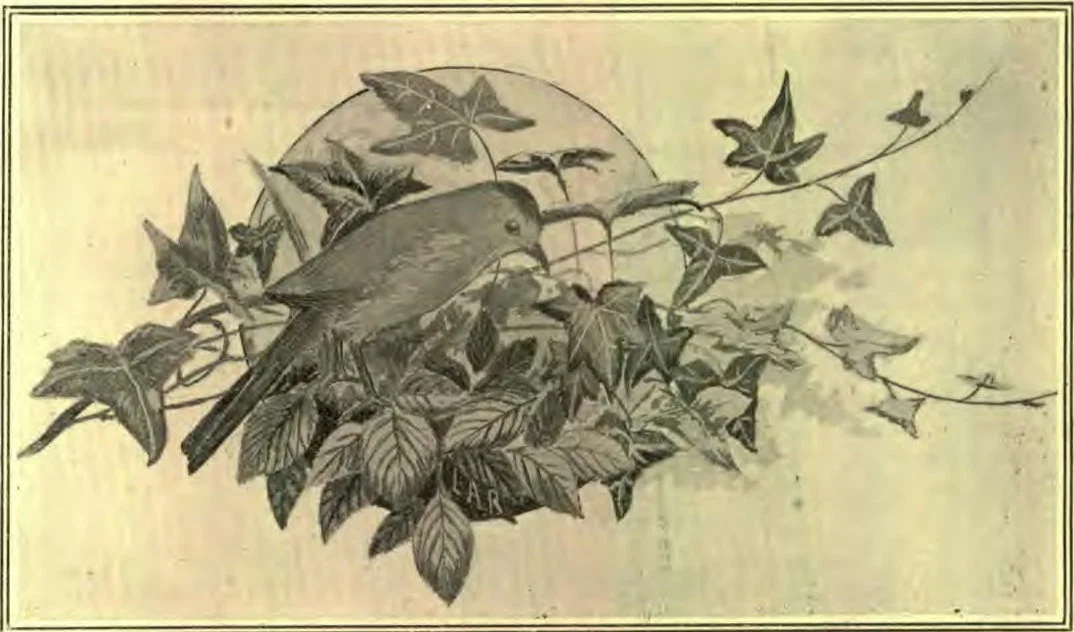
The crown and tail of the Catbird are black; under tail-coverts, chestnut; rest of plumage, slaty gray. The picture of course is much smaller than the natural size, as the bird is close to nine inches in length from tip of tail to point of beak.
L. A. REED.

BETTY, THE QUAIL

I WILL next tell you of my mother’s pet quail. Betty was captured when she was only four or five days old. She was a timid, shy little beauty, with a brown coat of fuzzy down, striped and marked with chocolate. She was so scared that her little heart beat as if it would burst, and she would not eat until forced to do so by hunger, and then only when alone. She soon got over this fear, however, and became very affectionate. She liked to cuddle down in one’s lap, and to ruff her head over one’s face. She would nestle up close, and murmur the most pleasant little song of content, especially if one would hold her in his hands, and blow his warm breath on her.
Her food was corn-meal, bits of bread, wheat, and any small seeds; and she soon learned to eat grains of corn. She grew rapidly, developing wing-feathers so that she could fly when only a baby. As she grew older, she would follow my mother about wherever she went, and we all had to be careful not to step on her. She had no idea of fear except when strangers were near.
The next spring she was wooed and won by a handsome Bob White from the neighboring woods. She was very happy, and extremely proud of her husband; but as she steadily refused to leave her home, she caused him a great deal of worry. He had been taught that men were to be avoided like hawks, and here his wife was trying to persuade him to risk his life by living with them. For several days she would try to coax him, flying back and forth from him to different members of the family, coaxing, and talking, and trying to convince him that humans were not so steeled to all emotions of pity and gentleness as he had supposed. He kept venturing nearer and nearer, till finally he would sit on the garden post and whistle.
Now Betty was ready to set up housekeeping, and to the disgust of her mate, made her nest in a large Shaker bonnet that chanced to have fallen on the floor under the bed in a spare bedroom . Bob finally mustered up sufficient courage to sit in the window and keep watch over his wife while she was on the nest, but was always plainly relieved when she joined him outdoors. Finally her nest was discovered, and transferred to an old, home-made shoe belonging to my grandfather, and set on the porch. Betty rather grudgingly consented to the change, but Bob was delighted.
Finally the nest contained fourteen eggs, and Mrs. Quail began to sit. Her mate spent most of his time sitting on the railing of the porch protecting her. He would warn her of the approach of strangers, and if a cat or the dog came near, he would bravely dash into the animal’s face, and flutter and scratch and peck, till he would be glad to retreat. You know a cat is always a coward, never attacking anything face to face.
One bright morning, Betty acted so happy that mother thought something had happened; and sure enough, there was a shoe full of baby quails—eleven in all. They were spry, active little fellows, and could literally run, with the shell yet sticking to their backs. They were as wild as any quails, instinct teaching them that man was an enemy. They were kept in a basket for three days, at the end of which time they were quite tame. They would be picking crumbs about the door, or wallowing in the dust, when Papa or Mama Quail would see a stranger, and would utter a peculiar clia! clia! and—quick as a wink—there were no baby quails to be seen. It is almost a mystery how little quails can hide where it looks as if there was nothing to hide under. No matter how long it might be, they would never move till they were called. Betty had the sweetest little love-call when the danger was over; and when she uttered it, small brown heads would cautiously peep out on all sides, and then all would run to their mother. At night they all sat in a row on the railing of the porch.
Papa Quail never wholly liked the idea of his family’s living at the house; and as his babies grew up, he gradually coaxed them away, till finally they were usually to be found in the orchard. Betty was not wholly happy in the change, but went with her family. Alas! they learned, as do most birds, that, after all, the friendship of man is a delusion. A stranger came along with his gun, and Betty and her happy family became an easy prey. Only two or three escaped, and only once or twice, when driven to it by the cold, snow, and hunger of winter, did they venture near their old home.
FLOYD BRALLIAR.

Faith and Obedience Bound Together

FAITH and obedience are bound up in the same bundle. He that obeys God, trusts God; and he that trusts God, obeys God.—C. H. Spurgeon.

LESSONS FROM THE LIFE OF JOSEPH

I

ONE would not risk a great deal were he to claim that the story of Joseph presents the most beautiful representation of character to be found in all history, except, of course, the one Life which forms the only perfect model. Perhaps one cause of its great beauty is that it is given more fully than those of Daniel and Enoch, men in whose lives even the Bible record reveals no flaw. But the real source of beauty in Joseph's life is the many points at which his experience comes into touch with the life and character of Jesus. No one who lived before him so strikingly illustrated and foreshadowed in character and circumstance the coming Redeemer as did Joseph.
His name means “the increaser.” It was given to him to express his mother's gratitude at having become the mother of a son. But it was prophetic. Through Joseph the house of Israel was preserved from extinction, and from his deliverance dates the rapid multiplication of the seed of Jacob. Immediately he was born, his father demanded his liberty. He was in servitude to Laban, who represented the prince of this world. The bonds which bound him to the service of another master than God were soon broken; and on his journey to his own country, Jacob passed to the true service of God. So the birth of Jesus was the signal for freedom for every oppressed soul. To this day, when Christ is born in the heart, liberty from the thrall of Satan is the first grand result.
As a boy, Joseph was disliked and mocked as one who had regard for virtue and truth. His brothers were rough, uncultivated, and unconverted youth, with ruffianish and wicked tendencies quite well developed. They had been brought up in a divided house containing four mothers, whose sons they were. Surely this is enough to account for their disregard for the rights of others, and their indifference to anything good. Joseph was much younger than his older brothers. His innocence and his purity of character excited the ridicule and animosity of the brothers. So purity is always hated by evil, which can not bear its approach. When Joseph in his simplicity told his brothers of his dreams, their bitter jealousy and enmity were awakened. So when Jesus told the people whom he came to bless and save of his heavenly origin and of his great work, they pronounced him a blasphemer, and sought to kill him. Joseph was among his brothers just what Jesus was among the Jews.
The great flocks of Jacob and his sons required such broad pasturage that they were led far away from home. Jacob sent his beloved son to his older sons with a load of comfort and blessing. The lad did not find them where he had expected; but instead of abandoning the search, and going back to his father, as most boys would have done, he followed them carefully. With what joy did the weary boy at last come in sight of their camp! How light was his heart as he thought of the happiness his coming would bring to the brothers he loved and wished to serve!
On their part, as soon as they saw him in the distance, they began to mock him: “Behold this dreamer cometh.” They conspired to kill him. Like the men in the parable, they said: “This is the heir; come, let us kill him, and the inheritance shall be ours.” Again, like Jesus, Joseph “came unto his own, and his own received him not.” Like Jesus, he was consigned to the darkness of the pit and the hopelessness of the grave. He was sold for silver into the enemy's hands.
But like Jesus, that which seemed to be the triumph of his enemies, proved to be the door to the greatest usefulness. It was his only way to success. To save others he must lose himself. Had he chosen to be like his brothers, reckless, wicked, and unsubdued, who can tell how much misery and loss would have resulted? Joseph's bondage was God's way to save Jacob and his family from utter ruin.
G. C. T.

OCTOBER

Idly blows the autumn wind, Summer days are over; Scarlet-leaved the sumach glows Above the withered clover.
Through the faded yellow grass In the meadow sleeping, All the slender brier-vines Like threads of fire are creeping.
Slowly in the frosty air Maple leaves are flushing, Slower still the little brook Its happy song is hushing.
Linger on, O golden days! Loiter in your glory! Heart of youth and heart of age Marvel at your story.
Joy, too full for human speech, Grief, for words too tender, Vague regret that is not pain, Peace that crowns the splendor.
Silvery seeds that whirl and sail, Fires that flame and quiver; Sunshine on the quiet fields, Sunshine on the river.
— Selected.

BREATHING AND PRAYING

If we do not get our breath, it matters very little what else we get. Food, warmth, sleep, are of no avail if we can not breathe. The entering into the presence of God and communing with him is the renewal of our spiritual atmosphere.
Set before your mind the case of the diver who has to go down to work in the depths under the sea. The water is the breath of the fish, but it is death to him. The condition of his life is that the air of this upper world be pumped down to him. Then he goes down without fear, careful beforehand to see that all is right with the atmosphere above him, and careful, however deep he goes, or however busy he is, to keep the communication open with that upper world to which he belongs. He is not always thinking about his breathing, but he can not do without it for a moment, and he knows better than to suffer any trifling with the apparatus that secures his safety.
So are we in this world; the atmosphere is too dense for our new life. And yet our duty lies down here. Well, fear not, go down; only, first of all be sure about the communication with that higher life to which we belong. If that be broken off or neglected, we die. Take not thy Holy Spirit from me! is a cry for every life, and this hiding of ourselves with God in prayer is the adjusting of the apparatus with that source whence comes the breath of life to us.
Nothing can take the place of this quiet walking with God. It were a mad folly to try to live without sleep or food; but what of the man who tries to live without breath? That is what you are doing if you suffer prayer to dry up into a mere set of phrases, which are repeated without any thought or heart.
Prayer is more than a kneeling and asking something from God—much more. What we need is to get into the presence of God. We want the hallowing touch of God’s own hand and the light of his countenance. Tarrying in his presence, we must have the breath of God breathed into us again, renewing the life which he created at the first. This is the first, the great need of the life of holiness.—Christian Advocate.

LIFE’S SETTING

Where drooping branches darkle The rivulet’s clear sparkle, We will linger for a moment in the shade, To scan the story olden, Where green has turned to golden, And the loveliest of visions is displayed.
We wander down the valley Where hosts of beauty rally Like gay battalions soon to muster out, Uniformed in red and yellow And colors soft and mellow— The summer seems to die with victor’s shout.
Adown the paths of ages We read, from pens of sages, How old years died, and new ones came instead; How, at each autumn’s story, The mountains dressed in glory, And all the woodlands put on gowns of red.
And so the years, in dying, Yield not to mournful sighing, But, glad, exult in faithful duty done; So may we, at life’s setting, Yield not to gloom’s regretting, But heavenward smile, like eve at set of sun.
B. F. M. SOURS.

TOM’S MISERABLE LUCK

“I don’t know how ’tis our Tom always has such miserable luck. I’m sure no boy tries harder for a chance to work, and no boy’s capabler than he is, but things always seem to go against him, somehow.”
Indeed, there seemed to be some ground for Mrs. Gill’s complaint. Tom certainly did have a great many falls in his wrestle with the world. He was bright and active, not vicious and not lazy. He found plenty of opportunities to work, but the opportunities did not last.
“Tom hasn’t got influence,” his mother would sigh, in explanation. “It takes influence to push a boy on, and how’s a poor boy to get any influence?”
When Tom was discharged from the Electrical Works, he assumed that his place was wanted for the son of some stockholder. The manager’s explanation was different.
As winter approached, the need at home was more urgent than ever, for the mother herself had fallen down the cellar stairs, and was woefully lame in consequence.
“I ought to have remembered that broken step,” she said, dolefully. “Tom was goin’ to fix it when it first got broke, but he kept puttin’ it off somehow.”
Under pressure of necessity, Tom announced himself as an odd jobber. He was handy and apt at many things; he could put an electric bell in order, rig up an electric gas-lighting attachment, put a new washer on a leaky spigot, contrive a kitchen shelf, mend a broken bracket, replace a shattered window-pane. All these things he undertook to do now.
Mrs. Byrd gave him his first trial. She was not rich, she did not even keep a servant, but her word of commendation went far with the many rich people among her friends. Being interested in Tom’s mother, she gave the boy two or three small jobs to do, and he did them well.
“You might try him,” she said to her friends, “but don’t promise any steady work till we see how he holds out. For he has had an unbroken run of what his mother calls ‘miserable luck.’ Perhaps his luck has changed now.”
So Tom was given a good many jobs. Presently winter was close at hand, and furnace fires must be started.
“Build mine at once,” Mrs. Byrd said to Tom. “I will tell you exactly how I wish it managed.”
And she concluded: “I take you on trial for two weeks. It depends on yourself whether the trial shall last longer than that.”
Then she was reminded that some boy had broken a pane of glass in the cellar window facing north.
“Put a whole pane of glass in there,” she said, “before the first freeze. It won’t do to have that water-pipe frozen.”
“I’ll put it in to-morrow morning,” said Tom. “Very well, I’ll trust you for that,” was the reply.
The mild weather lasted nearly a fortnight after this, and furnace fires were kept as low as possible. Tom had several of them to attend to, but not quite so many as at first. Already his miserable luck had caught up with him again. Several of his new employers had dispensed with him. Mr. Crane told him bluntly that, since he had “skipped” a day, he need not come back to finish weather-stripping the windows. When he went to lay Mrs. Wilson’s vestibule oilcloth, he found it already in place. It was discouraging, but still Tom did not give up.
The disappointment at Judge Grey’s came near making him do that, however. He was called there to put an electric bell in order, and to put new wires to the gas-lighting attachment. He soon had the bell working perfectly, but when he went back, three days later, with the wire for the other job, he found that a regular electrician had been called in, in his stead, and that the work was already done. Why? Certainly no electrician in the city could do that job better than Tom could do it; and just because he had put off doing it for a couple of days!
The cold weather came suddenly. People woke in the night shivering for more blankets, and the next morning all ponds were covered with ice. Then the wind rose, and came in an arctic gale straight from the north. It blew so all day and all night; and before the second morning dawned, the cold was bitter.
That second morning Tom was a full half-hour late in getting to Mrs. Byrd’s. She was in the kitchen to receive him, and he noticed something unusual in her manner.
“I ain’t just on the minute this morning,” he said, with a pleasant laugh. “Bed felt so good, I lay a little too long.”
“Just a little,” said Mrs. Byrd, smoothly. “Now that you mention it, I think you have been a little late every morning; a half-hour or so.”
Tom gave her an apprehensive look. “Well, you see them warm mornings I thought it wouldn’t make any difference. You see—”
“But isn’t a bargain a bargain?” she asked, calmly. “You know you agreed to be here every morning at half-past six, and don’t you think I had a right to expect you at that time? I may be wrong, but it seems to me it was none of your business what the weather was.”
“Oh, well, if you look at it that way—”
“And another thing,” she interrupted him, in the same even tone. “Yesterday morning you left the furnace with only a very little coal in it, saying you would come back after breakfast. I am afraid your mother was worse, or you certainly would have come, especially as it was such a cold day.”
“N-no, ma’am, mother wasn’t any worse, but—I’ll tell you. One of our neighbors came in and wanted me to put up her stove,—just a thank-you job,—and I thought just for once maybe it wouldn’t be any hardship for you to put on a shovelful or two, till—”
“No hardship at all I assure you, for I didn’t do it. I was out most of the day and all the evening. Didn’t you find the fire rather low when you came in the evening?”
“Yes, ma’am, but I coaxed it up as well as I could, and I thought it would be—”
“I imagined so, for the house seemed cold to me when I came in. Don’t you think it is a little below normal this morning, even?”
She led him into the dining-room; it was as cold as a sawmill. “Perhaps it would be as well to go down now and see what can be done to improve matters,” she said, as she opened the cellar door, and followed close behind him down the stairs.
“Oh! Oh! Oh!”
At the foot of the stairway Tom stopped, pale, speechless, overwhelmed. The cellar was flooded with water, and a small cataract was still pouring into it. The water-pipe had burst.
Mrs. Byrd, close beside him, uttered a cry of fresh dismay. Bad as the situation had been fifteen minutes earlier, it was worse now. Her voice roused Tom from his stupor, and he splashed away through the water to the cut-off, turned it, and so stopped the rush. Then he waded to the furnace; it was fireless, and had been so since the night before. There, staring him out of countenance, was the vacant space into which he had promised to put a pane two weeks ago.
“I—I thought a few more days wouldn’t matter—and I wasn’t expecting the freeze yet, and anyhow I put a board against it last night. It must have blown in,” he muttered, trying to excuse himself.
“And you are the one that never went back on a bargain!”
Some of Mrs. Byrd’s friends had never seen her angry, but she had her full share of human nature, and now she was fairly ablaze with wrath and scorn. Her tone and the look she gave Tom made him burn with shame. There could be no possible doubt about her opinion of him, and for the first time in his life he felt that it was the opinion he deserved.
“Never went back on a bargain!” she repeated. “You never did anything else. I knew your record, but I thought you might have learned a lesson at last, so I gave you one more chance; and this is the use you made of it! You have cheated every friend I recommended you to. Even patient Judge Grey could not put up with your dilly-dallying. You are an out-and-out swindler from first to last!”
“No, ma’am, I ain’t! Excuse me, but I ain’t!” He came and looked straight into her angry eyes. There was a new sort of dignity in his respectful tone and in his pale face. “I was, but I ain’t now.”
“Go! I have no patience for any more experiments. Go!”
He went meekly up the stairs. She followed him slowly, with the uncomfortable feeling every sensible person has after a fit of anger; she had said more than she had meant to say, although no more than the occasion called for. Besides, there had been a ring of sincerity in his voice and a look in his eyes that added to her discomfort.
When she reached the kitchen, Tom was at the door, ready to go out. He faced her, and in a businesslike tone said the most unexpected thing possible: “What plumber shall I go for? That pipe must be fixed right away.”
“What have you to do with that? Don’t you understand? You are discharged.”
“No, ma’am, I ain’t. Excuse me, but really I ain’t. You see it’s just this way. I’ve got to keep on working for you, and for all the rest of the folks that’s dropped me, so as to make up for the way I’ve been doing. I ain’t asking pay from you or from them; only to make it up to you. I can see now that I’m in debt, and I want to pay up, that’s all. And I want to prove that my luck’s changed.”
She wavered an instant, then laughed in spite of herself. “I really believe your luck has changed! It used to be that you wouldn’t stay in a situation, and now you won’t stay out of one! Well, run off and get Brown, the plumber, here as soon as you can. Then come back, and build that furnace fire. The house is as cold as a barn, and I want my breakfast.”
He went and came. And all winter he kept coming and going, not only to that house, but to one after another of the houses that had dispensed with him. His employers wondered if the reform would last; but long before spring all were convinced that his luck had changed indeed. Before another winter came, he was back in the Electrical Works, and there he has stayed ever since. —Selected.

OCTOBER

The month of carnival of all the year, When nature lets the wild earth go its way, And spend whole seasons on a single day. The springtime holds her white and purple dear; October, lavish, flaunts them far and near; The summer charily her reds doth lay Like jewels on her costliest array; October, scornful, burns them on a bier. The winter hoards his pearls of frost in sign Of kingdom: whiter pearls than winter knew, Or empress wore in Egypt's ancient line, October, feasting, ’neath her dome of blue, Drinks at a single draft, slow filtered through Sunshiny air, as in a tingling wine!
— Helen Hunt Jackson.

THY NEIGHBOR AS THYSELF

(October 20-26)
THE true law of life—
Love to God. Luke 10: 27, first part.
Love to neighbors. Id., last part; John 15: 17.
Christ our example of unselfish love. John 13: 34; Phil. 2: 6-8.
His love in the heart will lead to the doing of the same works that he did. John 14: 12.
These works are definite (Matt. 25: 34-36; Luke 4: 18)—
Feeding the hungry.
Refreshing those who thirst.
Clothing the naked.
Visiting the sick and unfortunate.
Preaching the gospel.
To love his neighbor as himself, the Christian must—
Bestow, as he has received, “freely.” Matt. 10: 8.
Be willing to give up even life itself. John 15: 12, 13; Acts 20: 24.
Jesus the real object of our ministry or our neglect. Matt. 25: 40.

SUGGESTIONS

In preparing this study, be sure to read Professor Prescott’s article on the same topic in the REVIEW of October 15. Many additional thoughts will thus be suggested, and the time devoted to the study at the regular meeting will be profitably filled.
In carrying out in a practical way the thought of Thy Neighbor as Thyself,—in working as you have opportunity for the poor and the sick and the heavy-hearted in your own neighborhood,—always try to put yourself in the place of the one who is to receive either bodily or spiritual aid. There are so many ways of hurting those who are already over-sensitive because of their poverty or their misfortunes. Study the life of the Master, and pray that his very spirit of gentleness may be upon you as you go out to work in his name. Remember, too, that in giving Jesus to us, the Father gave the most precious gift in heaven. And Christ, too, gave always of his best. But how often we, his professed children, excuse ourselves from following his example with the thought that we need our best ourselves,—that our second-best will do for him as he appeals to us in the form of some humble “neighbor.” Often, indeed,—how often to our shame be it acknowledged,—we give only what we do not want or can not use,—what we ourselves would feel insulted to receive. How must such gifts appear in the light of his sacrifice, by which are freely given to us “all things”!

NOTES FOR STUDY IN CONNECTION WITH THE TOPIC.

1. “Blessings, both temporal and spiritual, will accompany those who impart to the needy that which they receive from the Master.”
2. “Never should we pass by one suffering soul without seeking to impart to him of the comfort wherewith we are comforted of God.”—“Desire of Ages,” page 504.
3. “The fallen, the erring, and the sinful, Christ’s love embraces; and every deed of kindness done to uplift a fallen soul, every act of mercy, is accepted as done to him.”—Id., page 638.
4. “It should be written upon the conscience as with a pen of iron upon a rock, that he who disregards mercy, compassion, and righteousness; he who neglects the poor, who ignores the needs of suffering humanity, who is not kind and courteous, is so conducting himself that God can not co-operate with him in the development of character. . . . But all the attributes of Christ await the reception of those who will do the very work that God has appointed them to do, working in Christ’s lines.”—“Testimonies for the Church,” page 262.
5. “As the members of the church . . . learn to love God supremely, they will learn to love their neighbor as themselves. The power of the Lord is magnified when the human heart is tender, sensitive to another’s woe, and pitiful for his suffering. Angels of God are ready to co-operate with human instrumentalities in ministering to souls. When the Holy Spirit works upon our hearts and minds, we shall not shun duty and responsibility, and pass by on the other side, leaving the wounded, helpless soul to its misery.”—Id., page 303.
6. “God has placed among us the poor, the unfortunate, the sick, and the suffering. They are Christ’s legacy to his church, and they are to be cared for as he would care for them. . . . In placing among us the poor and the suffering, the Lord is testing us to reveal to us what is in our hearts. We can not with safety swerve from principle, we can not violate justice, we can not neglect mercy. When we see a brother falling into decay, we are not to pass him by on the other side, but are to make decided and immediate efforts to fulfill the word of God by helping him.”—Id., pages 261, 262.
7. “In full reliance upon God, Jesus took the small store of loaves; and although there was but a small portion for his own family of disciples, he did not invite them to eat, but began to distribute to them, bidding them serve the people. The food multiplied in his hands; and the hands of his disciples, reaching out to Christ, himself the Bread of life, were never empty. The little store was sufficient for all.”—“Desire of Ages,” page 360.

Young People's Company at Topeka, Kansas

FROM TOPEKA, KANSAS

The following encouraging letter has been received from the Young People's company at Topeka, Kan.: “Our meetings are held regularly every Sunday evening, the study from the Bible and ‘Steps to Christ’ printed in the YOUTH'S INSTRUCTOR being taken up. The average attendance is from twelve to fifteen. One of the members, a young man who lives in the country, is holding Bible readings each week in a schoolhouse, and another is giving some readings with families.”

HER RELIGION

IN the early part of June a little tribe of gypsies camped on the border of one of the boulevards leading from Boston into the country. For years, long before the country road was broadened and made a great electric thoroughfare, this same band had returned to the same spot with the regularity of birds in spring. The queen of the tribe is a woman of singular stateliness and beauty.
This spring she fell ill. Her fine, dark face took on the waxen hue of an incurable malady, and her eyes, expressive and queenly, were dulled with suffering. She finally sent for a lady who for years had bought baskets of her, and had done her many kindnesses.
“I think you had better see a doctor,” said the lady. “You need advice and care.”
The gypsy objected, but at last gave consent. The physician examined his new patient gravely. She was smitten with a mortal disease, and must surely die.
“I will take her to my house,” said the lady, for she was very fond of this stately gypsy queen.
“No,” the woman replied, with a wan smile. “Thank you, but I can’t do it. I have lived all my life out-of-doors, and shall die happier in my tent than even with you, dear lady.”
From day to day the lady visited the dying gypsy, and the talk naturally drifted upon sacred topics.
“I don’t know your religion,” said the gypsy, “but my religion is very simple. My mother died a Romany, just the same; but I will die a Burton.”
“A Burton? What do you mean?” exclaimed the lady, horrified at this new religion, of which she had never heard.
“Why, you see, when I was a little girl, we lived near Philadelphia. Nobody looked out for us, or cared much for me, but a woman who was a city missionary. Her name was Miss Burton. Every Sunday she came out to visit me. She taught me to read the New Testament.” The gypsy took from under her pillow a frayed, worn little volume.
“I was taught by her to read this print,” she said, “and I can’t read any other. This is the only book I can really read, and I read it every day. Miss Burton took me to Sunday-school, and gave me a penny to put in the contribution-box, and brought me back. She told me about Jesus, and how to love others more than myself, and that if I followed the teaching of Jesus, I should one day live with him in heaven.
“One Sunday Miss Burton did not come. I was about ten years old. She had died of overwork. I think she died a good deal for me. And wherever heaven is, I know Miss Burton will be there, and I have tried to live so that some day I may go and meet the best friend I ever had. This has been my prayer every day. Is this religion of mine the same as yours?”
The lady who told the story said that she broke down then, and in reply to the naïve question she could only say: “Yes, dear, my religion is the same that Miss Burton taught you. I wish I had taught and lived it so well. When the time comes, I have no doubt that you will not only meet your teacher, but the Great Teacher who taught her.”
We hear much about holding a mirror up to nature. It is a favorite quotation. To reflect the beauty of the world in a beautiful life is a fine art; but it is nobler to reflect Christ to lives that know him not. That is the noblest thing a person can do.—Youth’s Companion.

"STEPPING IN YOUR TRACKS"

Somebody’s always following,— Following in my track; If I lead him out of the pathway, Have I skill to bring him back? Watching where I was watchful, Sleeping where I have slept; Somebody’s always following, Stepping where I have stept.
If my feet faint and falter, Climbing up Difficult Hill, I shall leave devious footmarks That will serve my brother ill. And down Humility’s Valley, Slipping where I have slipt, Somebody’s always following, Stepping where I have stept.
Faithful be I or faithless, Feeble or slow to see, Always a somebody, weaker, Is following after me,— Falling where I have fallen, Creeping where I have crept, Somebody’s always following, Stepping where I have stept.
Loving the world and its pleasures,— Or turning away from sin; Pressing toward the kingdom, Seeking to enter in,— O, in the day that is coming, He will refuse or accept Me, and the somebody following,— Stepping where I have stept.
ELIZABETH ROSSER.
Continue reading: WHY THEY LOVED