“I love little Lucy,” sang Dickybird, as he swung in his cage; “she never forgets to give me fresh seed and water every day, and she keeps my cage neat and clean. When the days are fine, she always hangs me among the vines on the porch, where I sing for her my sweetest songs.”
“I love little Lucy,” purred old Tab from the rug by the fire. “Every morning and every evening she gives me a dish of nice, warm milk. She is kind to my kittens, too, and handles them gently. When I catch a fat mouse, I take it to Lucy, and she pets and praises me so that I feel very proud.”
“Cluck, cluck! I love little Lucy,” said Dozens, as she bustled about the yard, followed by her pretty brood. “She brings us our pan of corn-meal three times a day, and keeps fresh water in the yard for us to drink. Then she never frightens me by running after my chickens. I will lay my nicest eggs for Lucy.”
“Bow-wow-wow! I love Harry,” said Towser, “He keeps plenty of fresh, clean straw in my kennel, and never teases me when I am eating my dinner. When he goes for a walk, he takes me with him, and I will never let anything hurt him if I can help it.”
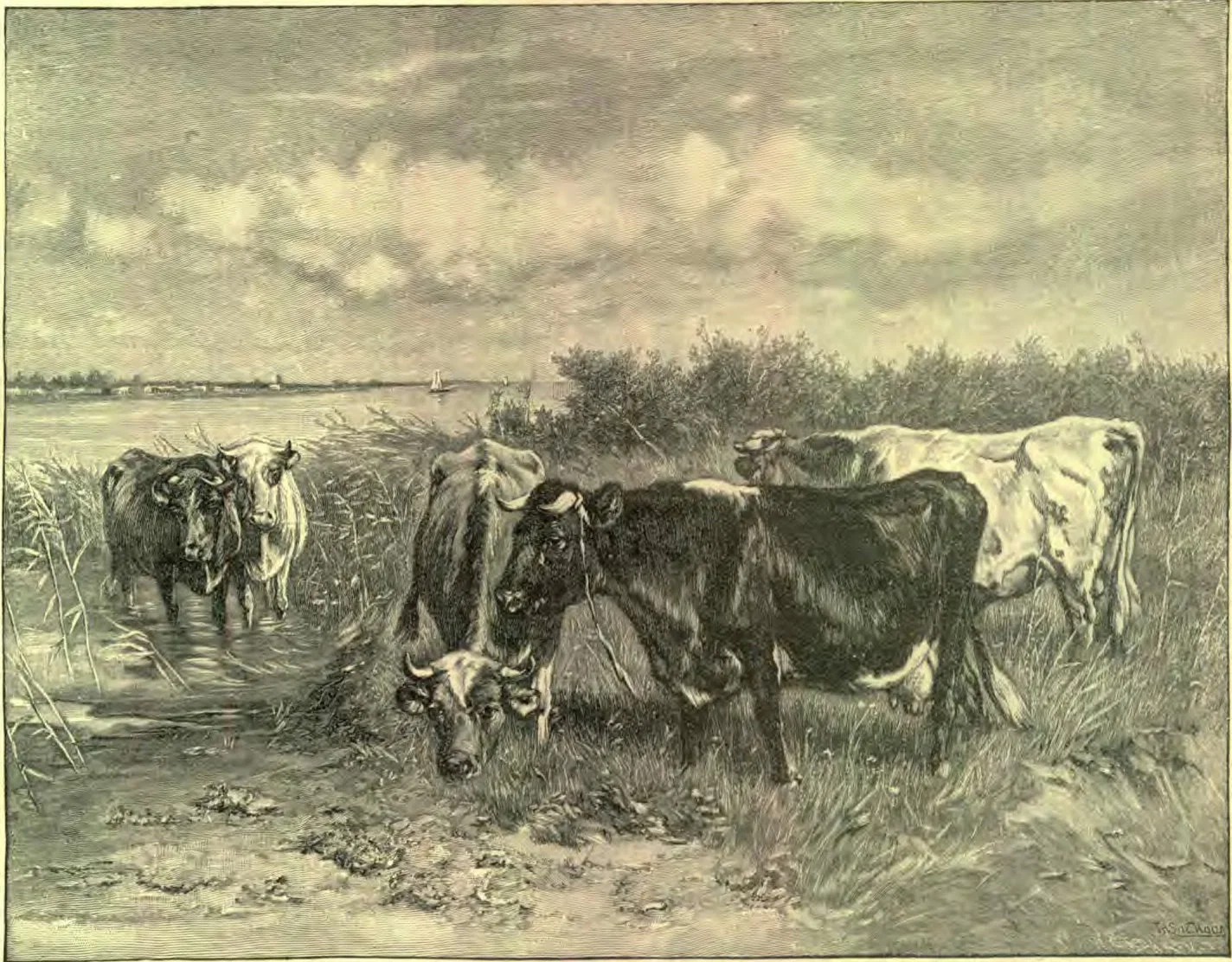
“Moo, moo!” said the gentle, big-eyed cows to one another in the pasture. “Moo, moo! we love Harry. In the winter he puts us in a warm stable, and in the hot summer he does not hurry us. When the flies and mosquitoes torment us, he throws a sheet over us while he milks, then we do not overturn the milk-pail by trying to keep the flies off.
“If some one carelessly leaves the garden gate open, and we go in (for we do not know any better), he drives us out quietly, and does not send his dog after us.”
“We love Harry,” neighed Whitefoot and Fleet. “If our load is heavy, he does not hurry nor whip us. He does not fasten our heads up in unnatural and painful positions. When he feeds us, he is careful to measure our oats, so that we may have enough, and yet not so much as to make us ill. “He never shouts angrily at us, and we are glad to travel our very best for Harry.”
AUNT BETTY.
THE REWARD
LAURA and Bessie Mason were spending a week at Grandma Strong’s. Grandma was a sprightly old lady, and although so aged, she did her own work; and almost the last thing Mama Mason said, when her daughters left her, was, “Now, girls, I hope you won’t be a care to your grandma; I’m sure if you try you can help her in many ways.”
The morning after their arrival, when they had finished a breakfast of golden corn-cakes with delicious syrup from grandma’s own maple grove, Bessie said, “Do let us help you do up the breakfast work, grandma; we’d just love to.”
IN A PLEASANT PASTURE
Grandma smiled. “I like to wash my china myself,” she said, “but I’ll tell you, my dears, if you really want to help me, I’d like to have you sweep up the kitchen and dining-room every morning. You can take turns at doing it.”
“Well, let me do it this morning, then,” said Laura. “Bessie is so poky particular about everything that it takes her forever and a day! And I’m in a hurry to run out and play!”
Laura went vigorously to work,—too vigorously, perhaps, for she tossed the broom so high that the dust rose in clouds, and set grandma sneezing, and she made the yellow cat seek refuge under the stove. He wasn’t troubled there; for I must confess that Laura didn’t sweep under the stove at all. She slighted other places, too. She let the big rocking-chair stay where it was, and merely swept around it; she never looked behind the door for bits of lint collected there; not a corner was swept, nor did she stir grandma’s footstool.
Grandma Strong said not a word, however. She went on washing her pretty pink-and-white china, and hummed her favorite hymn, “A Charge to Keep I Have.”
The next morning it was Bessie’s turn. First of all she dusted the chairs, and set them in a row out in the entry. Then she took a newspaper, and covered the stand of plants. “Mama says plants breathe through their leaves, and it isn’t good for them to get dusty,” she remarked.
She put a newspaper over the little table on which lay grandma’s work-basket and “Saints’ Rest.” She removed from the room the garments hanging there. Then she began to sweep, taking short, quick strokes. Not a spot was left untouched. All the corners, behind the lounge, under the stove. Last of all she lifted up grandma’s footstool.
“Why-ee!” she exclaimed in surprise, stooping and picking up a tiny round yellow—something. “Here’s money! a real gold dollar!”
“Yes,” said Grandma Strong, composedly, though her black eyes twinkled as she looked at Laura. “Yes, Bessie, I put it there yesterday morning for some little girl, who, in sweeping clean, should find it!”—Selected.
JUST A LITTLE LETTER
By Frank Walcott Hutt
What a rush, and what a hurry,
Every hour and everywhere!
Locomotives puff and scurry,
Horses gallop here and there.
There are men in gray who scatter,
Messengers who go and come,—
All night long a clash and clatter,
All day long a buzz and hum.
What a busy, brisk proceeding,
What a running to and fro!
But — a little letter’s speeding
Safe from Maine to Mexico.
FRANK WALCOTT HUTT.
Schooling Gap for Girls in India
In India one boy in five attends some school, but only every fiftieth girl.
DIVISION I — GEOLOGY
By Dr. O. C. Godsmark
Chapter VI — The Flood
§ 57. Not a portion of our land that does not speak distinctly of the terrible deluge that once overspread the earth. Hills and valleys, mountains, rivers, lakes, and plains,—all present to us the landscape as it was left by the surging of the billows that once overspread this world. The little hills we climb on our way to school were all washed there by the waters of the flood. The great, barren rocks that protrude from the earth’s surface in our mountainous districts were heaved up and laid bare at this same time. Not in the Bible alone, but in the writings and folk-lore of nearly every tribe and nation on the face of the whole earth, have we unmistakable evidence of their belief in, and understanding of, the flood.
§ 58. In the flood, and in the flood alone, we find the reasonable answer to nearly every geological problem that we, as Bible believers, have to meet. Therefore let us study our earth as it now is, as compared with what we have already learned of its condition before the flood.
At the present time, fully three fourths of the outer surface of our earth is covered with water; the land is, in many places, crowded together, broken, and piled up in ridges and mountain chains, exposing to view the internal rock foundations of this globe, giving undeniable proof that when the vast ocean beds sunk to their present level, these ridges were crowded up as a result. “The Lord also thundered in the heavens, and the Highest gave his voice; hailstones and coals of fire. Yea, he sent out his arrows, and scattered them; and shot out lightnings, and discomfited them. Then the channels of waters were seen, and the foundations of the world were discovered at thy rebuke, O Lord.” Ps. 18: 13–15.
§ 59. In Gen. 7: 11 we are told also that at that time “all the fountains of the great deep were broken up, and the windows of heaven were opened.” Now, what does it mean by “then the channels of waters were seen”? and “the fountains of the great deep were broken up”? Where was this water before the flood? In speaking of the creation of this earth, God says (Ps. 24: 2): “For he hath founded it upon the seas, and established it upon the floods.” And again, in Ps. 33: 7, speaking of the same event, he says, “He gathered the waters of the sea together as an heap; he layeth up the depth in storehouses.” Now if these waters that were “under the earth” (Ex. 20: 4), and upon which it is “founded,” were “broken up,” so that “the world that then was, being overflowed with water, perished” (2 Peter 3: 6), we can understand something about the source of the water that now rolls its briny billows over portions of the earth. Much of the water that was once on the inside of our earth now rests on its outer surface; and the foundations, that served as bones to the body, now protrude, forming rocky ledges and mountains, many of these rocks also lying scattered over its surface.
When the “fountains of the great deep were broken up,” immense quantities of water, stored within the bowels of the earth, gushed forth, covering the whole face of nature, and carried with it vast numbers of the lower forms of animal life, which, in the commotion of the storm, not being provided with powers of locomotion sufficient to swim and keep near the surface, were buried in the lower strata of mud and debris, forming a distinct layer, or strata, of remains by themselves. At this time also the salt within our globe was spread out over the earth, and settling to the bottom of that shoreless sea, sank into pits and layers, from which our salt wells of to-day obtain their endless supply.
§ 60. But what caused these briny floods, stored beneath the earth’s crust, to gush out and overflow the land, there to remain in such quantities as we see to-day? God always works by means. Let it be our happy task to search out the means in this interesting case. When the record says that “the windows [‘flood-gates,’ margin] of heaven were opened, and the rain was upon the earth,” it certainly refers to the bringing to this earth of an immense volume of water that did not previously exist here. The Lord declared (Gen. 6: 17): “And, behold, I, even I, do bring a flood of waters upon the earth.”
What effect, we ask, would the bringing to this earth of such a flood of waters have upon the surface of the earth itself? We have already learned (§ 43, 46) that prior to the flood, the atmosphere was so light that it did not admit of the mist that went up and watered the whole face of the ground reaching any considerable height, or of being condensed in the form of clouds and rain; therefore the atmospheric pressure upon the crust of this globe must have been far less than it now is, and must therefore have been greatly increased by the absorption and retention of such immense quantities of water as now float constantly over our heads. The atmosphere itself must also have been greatly increased in volume, as we shall learn when we reach that subject in our study.
§ 61. The present atmospheric pressure upon every square inch of our earth’s surface is known to be a trifle less than fifteen pounds; or, to be exact, 14.706 pounds at sea-level. On an ordinary village lot four rods wide by twelve rods deep, this pressure is 14,682 tons. On a one-acre lot the present atmospheric pressure amounts to 48,940 tons. At your leisure figure the exact pressure upon the lot, farm, or township where you live, and realize how small a portion this really represents of the whole surface of the earth.
§ 62. This great ocean of air, in which we live much as the fishes live in their sea of water, contains and transports from place to place millions of tons of water every day. To illustrate: An ordinary shower will precipitate one inch of water. This can be easily proved by catching the rain in a deep basin or can having perpendicular sides. The amount of water caught in such a vessel will be the rainfall as measured in inches and tenths of inches. One cubic foot of rain-water weighs exactly one thousand ounces. Observe the amount of rain precipitation at the next rainfall, and then determine the amount in pounds that fell upon your home lot or school yard.
The amount of water that will fall upon such a village lot as that described, the precipitation being one inch, will weigh 37 tons and 270 pounds; or on a whole acre, 123 tons and 1,566 pounds. This by no means relieves the air of all its load of moisture, merely a part of it.
§ 63. When the Lord brought this additional weight, in the form of clouds and rain upon our atmosphere, it evidently caused an actual sinking in of vast sections of our earth’s crust,—these parts that now form the beds of our oceans, which would of necessity cause the pent-up waters from within to gush out with tremendous force through the cracks thus formed, fulfilling the statements that “the fountains of the great deep were broken up,” “whereby the world that then was, being overflowed with water, perished.” Again we quote from that best of all geologies, next to the Bible,—“Patriarchs and Prophets,” page 99,—as follows: “Water appeared to come from the clouds in mighty cataracts. Rivers broke away from their boundaries, and overflowed the valleys. Jets of water burst from the earth with indescribable force, throwing massive rocks hundreds of feet in the air, and these, in falling, buried themselves deep in the ground.”
§ 64. The query now arises: Whence brought the Lord this vast flood of waters to our earth? Whence came this extra moisture-laden atmosphere that now wraps us in like a blanket, and is sufficiently heavy and dense to admit of immense quantities of water being suspended, in vapor-like clouds, several miles above the more dense strata where we move about and enjoy life? Many thinking minds have advocated the idea that both the water and the extra amount of atmosphere were brought bodily from our satellite, the moon, leaving that body, as we so well know it to be, without either moisture or atmosphere, where once there was evidently an abundance of both.
We do not personally advocate this theory; yet we can not cast it, with a sneer, aside; for it does present a plausible solution of the problem, and is subject to the least objection of any theory with which we are acquainted. Besides this, there are a number of hard facts connected with our moon’s present and past conditions that are extremely difficult to understand upon any other hypothesis, as we shall learn when we come to study our moon as a separate subject.
QUESTIONS
Point out all the evidences of the flood you can. Where were the waters of the great deep stored before the flood? Give Bible proofs. Where now are these waters found? Prove that before the flood the atmosphere was much more rare than now. What is our present atmospheric pressure at sea-level? How much water falls during an ordinary rain? Describe the manner in which the water seemed to come from the clouds. How was the earth’s crust affected by this extra pressure?
DR. O. C. GODSMARK.
2005 Magazine St., Louisville, Ky.
NOTE.—These lessons, comprising a brief study of Geology, Philosophy, Meteorology, and Astronomy have been prepared in response to the many calls that have come for a simple treatise on these subjects, that shall be free from the many infidel theories and deductions that are unscriptural and untrue. They have been written with special reference to the fireside, and the home- and church-school. The author would be pleased to receive, by correspondence, any criticisms or suggestions that will help to make them better adapted to this field of usefulness.
HEALING THE PARALYTIC
By W. S. Sadler
Behold, Men Brought in a Bed a Man.— We can not heal disease, either physical or spiritual, but we can help the afflicted one to come into harmony with Christ, who dwells within the man, and whose presence is a healing power. As Christian workers and medical missionaries, we can help him over the transgressions, doubts, and despair, which may intervene between the sufferer and the fount of healing. Like the four helpers of the paralytic, we may tear away the roof that separates from Christ, and otherwise assist the sufferer in coming into the presence of the Healer.
Could Not Bring Him because of the Multitude.— This is but another instance of the idle Christian standing in the way of the earnest seeker after Christ. It was the multitude that stood idly by, beholding the wonders of the Saviour, that kept this earnest seeker away from the Master's side. When we stand near the Saviour, let us remember that we are there not for the purpose of keeping others away from him, but that when we see the repentant sinner even a great way off, we should esteem it not only our duty but also our privilege to bring him quickly into the Saviour's presence. Let him reach Christ by our help, and not in spite of our presence.
They Went upon the Housetop, and Let Him Down.— It required four willing men to get the327sick man into the presence of the Healer,—one at each corner of his cot. So, in leading souls to Christ, we find that very often more than one person is needed to accomplish the work. There must be co-operation among Christians in leading men out of physical and spiritual darkness and ignorance into his marvelous light. There must be co-operation between the many societies and agencies within the church if we would meet with the greatest success in the work of saving souls and promulgating truth.
Extraordinary and unusual methods are sometimes justified by the urgency of getting a soul into the presence of the Master, and so the friends of the paralytic were undoubtedly justified in tearing up the roof in their efforts to bring the sick one to the Master's notice. And to-day Christian workers may often recognize the necessity for employing unconventional and unusual methods in their efforts to enlighten sinners, reclaim the lost, and uplift the fallen. Is not the emergency of a soul perishing enough to arouse the moral ingenuity of Christian workers, and so stir their activities as to lead them to accomplish by extraordinary methods that which they are unable to perform through the usual channels of Christian endeavor?
Thy Sins Are Forgiven.— Before healing the man of his paralysis, Jesus forgave his sins, thus illustrating how, in his healing, he always worked by first removing the cause. It was sin, directly or indirectly, that was responsible for the man's physical condition. “Be of good cheer; thy sins be forgiven thee,” are the first comforting words the Master speaks to the paralytic who has been so strangely lowered into his presence through a hole in the roof, and this is the message of divine love to every soul suffering from the effects of moral paralysis,—dead in trespasses and sins. “Come unto me, all ye that labor and are heavy laden, and I will give you rest,” the Master says.
There is a great lesson in perseverance in connection with the working of this miracle. The paralytic and his friends were willing to tear up the house and sacrifice anything to reach the feet of Jesus. Living faith is real. You can see it. It produces visible results.
6. Why is it that the wayside heart does not understand? Matt. 13:15.
7. Then if we shut our eyes and ears to God’s word, who comes into the heart?
8. Is it an evidence that the heart is a wayside one, if it does not understand the word of God? See note.
9. From what Christ said to his disciples in Mark 4:13, how necessary is it that we understand the parable of the sower?
10. The stony places represent what kind of heart?
11. What effect does this soil have upon the growth of the word?
12. Why did not the seed take root in stony ground? Why does not the word take root in a stony heart?
13. What happened to the seeds that sprang up with no root?
14. What becomes of men in whose hearts the word has no root?
15. What are the thorns?
16. What effect do they have upon the growth of the word?
17. A young man once asked Jesus what he should do to have eternal life. What thorn was in his heart? Matt. 19:22, 23.
18. The good ground represents what kind of heart?
19. What will be the result of hearing and understanding the word of God?
20. With what command did Christ begin to interpret the parable? Matt. 13:18. Have you heard?
NOTE
No, it is not; but it is dangerous to be in that ignorant condition long. Christ says, “My people are destroyed for lack of knowledge.” The disciples did not understand the parable of the sower at first, but they did just as we should do, they came and asked the Saviour about it. On the other hand, the Pharisees perceived the meaning of the parable, but to them its lesson was unwelcome. Therefore they pretended not to understand it. Of them Isaiah prophesied, “Hear ye indeed; but understand not.” Therefore the devil came and caught away even that which they had heard.
SELECTED PARAGRAPHS FROM “CHRIST’S OBJECT LESSONS”
The seed sown by the wayside represents the word of God as it falls upon the heart of an inattentive hearer. Like the hard-beaten path, trodden down by the feet of men and beasts, is the heart that becomes a highway for the world’s traffic, its pleasures and sins. Absorbed in selfish aims and sinful indulgences, the soul is “hardened through the deceitfulness of sin.” The spiritual faculties are paralyzed. Men hear the word, but understand it not. They do not discern that it applies to themselves. They do not realize their need or their danger. They do not perceive the love of Christ, and they pass by the message of his grace as something that does not concern them.
As the birds are ready to catch up the seed from the wayside, so Satan is ready to catch away the seeds of divine truth from the soul. He fears that the word of God may awaken the careless, and take effect upon the hardened heart. Satan and his angels are in the assemblies where the gospel is preached. While angels of heaven endeavor to impress hearts with the word of God, the enemy is on the alert to make the word of no effect.
Satan has many helpers. Many who profess to be Christians are aiding the tempter to catch away the seeds of truth from other hearts. Many who listen to the preaching of the word of God make it the subject of criticism at home. They sit in judgment on the sermon as they would on the words of a lecturer or a political speaker. The message that should be regarded as the word of the Lord to them is dwelt upon with trifling or sarcastic comment. The minister’s character, motives, and actions, and the conduct of fellow members of the church are freely discussed. Severe judgment is pronounced, gossip or slander repeated, and this in the hearing of the unconverted. Thus are destroyed respect for God’s messengers, and reverence for their message. And many are taught to regard lightly God’s word itself.
The seed sown upon stony ground finds little depth of soil. The plant springs up quickly, but the root can not penetrate the rock to find nutrition to sustain its growth, and it soon perishes. Many who made a profession of religion are stony-ground hearers. Like the rock underlying the layer of earth, the selfishness of the natural heart underlies the soil of their good desires and aspirations. The love of self is not subdued. They have not seen the exceeding sinfulness of sin, and the heart has not been humbled under a sense of its guilt.
The roots of the plant strike down deep into the soil, and hidden from sight nourish the life of the plant. So with the Christian; it is by the invisible union of the soul with Christ, through faith, that the spiritual life is nourished. But the stony-ground hearers depend upon self instead of Christ. They trust in their good works and good impulses, and are strong in their own righteousness. They are not strong in the Lord, and in the power of his might. Such a one “hath not root in himself;” for he is not connected with Christ.
The hot summer sun, that strengthens and ripens the hardy grain, destroys that which has no depth of root. So he who “hath not root in himself,” “dureth for a while;” but “when tribulation or persecution ariseth because of the word, by and by he is offended.”
Cares, riches, pleasures, all are used by Satan in playing the game of life for the human soul. The warning is given, “Love not the world, neither the things that are in the world. If any man love the world, the love of the Father is not in him. For all that is in the world, the lust of the flesh, and the lust of the eyes, and the pride of life, is not of the Father, but is of the world.” He who reads the hearts of men as an open book says, “Take heed to yourselves, lest at any time your hearts be overcharged with surfeiting and drunkenness and cares of this life.” And the apostle Paul by the Holy Spirit writes, “They that will be rich fall into temptation and a snare, and into many foolish and hurtful lusts, which drown men in destruction and perdition. For the love of money is the root of all evil; which, while some coveted after, they have erred from the faith, and pierced themselves through with many sorrows.”
The “honest and good heart” of which the parable speaks, is not a heart without sin; for the gospel is to be preached to the lost. Christ said, “I came not to call the righteous, but sinners to repentance.” He has an honest heart who yields to the conviction of the Holy Spirit. He confesses his guilt, and feels his need of the mercy and love of God. He has a sincere desire to know the truth, that he may obey it. The good heart is a believing heart, one that has faith in the word of God.
God's Work Within as a Sail
By Branne
REGARD not God's work within thee as an anchor to hold thy bark firmly to the shore, but as a sail which shall carry it to its port.—Branne.
Lady Agents Wanted for Health Garments
By W. S. Dann
LADY agents do splendidly selling my Health Garments. I have some new articles. Big sellers. No trash. I pay charges. Address W. S. Dann, 1916 Cuming St., Omaha, Neb.
GRAND TRUNK R'Y. SYSTEM.
By W. C. Cunliffe
Taking Effect June 2, 1901.
Trains leave Battle Creek.
WEST-BOUND.
No. 9, Mail and Express, to Chicago. 12.15 P. M.
No. 7, Limited Express, to Chicago. 7.00 A. M.
No. 1, Chicago Express, to Chicago. 9.23 A. M.
No. 3, Lehigh Valley Express, to Chicago. 3.50 P. M.
No. 5, International Express. 2.17 A. M.
No. 75, Mixed, to South Bend. 7.30 A. M.
Nos. 9 and 75, daily, except Sunday.
Nos. 1, 3, 5, and 7, daily.
EAST-BOUND.
No. 10, Mail and Express, East and Detroit. 3.45 P. M.
No. 8, Limited Express, East and Detroit. 4.50 P. M.
No. 4, Lehigh Express, East and Canada. 8.32 P. M.
No. 6, Atlantic Express, East and Detroit. 2.10 A. M.
No. 2, Express, East and Detroit. 7.00 A. M.
No. 74, Mixed (starts from Nichols yard). 7.15 A. M.
Nos. 10 and 74, daily, except Sunday.
Nos. 4, 6, 8, and 2, daily.
W. C. CUNLIFFE, Agent,
BATTLE CREEK.
Recommending the October Life Boat Magazine
By Editor
Have you seen the October number of the Life Boat? If you have, you have been interested and helped by reading it. If you have not, we would like to recommend that you secure a copy, and look it over. This number is an especially strong one, and should be in every Seventh-day Adventist home; not only so, but thousands of copies should be sent out to those who have no homes, or are shut away by their own act from home associations and privileges.
Our papers all have a place in the great work which we as a people represent. The Life Boat occupies a field distinctively its own, and has proved many times over that it is an instrument of blessing in the Lord’s hands to many who are groping in darkness. If into every home where the INSTRUCTOR goes this week, a copy of this little magazine might come, be read, and then sent out to carry its message of salvation to some poor heart, who can tell what the result might be? Let us place ourselves in sympathy with this work that is being done for the uplifting of the sorrowful, the suffering, the sin-sick, and give to it our loyal support.
Single copies of this number will be sent to any address on receipt of five cents. Yearly subscription price, only twenty-five cents. Address the Life Boat, 1926 Wabash Ave., Chicago.
A FIXED HEART
When we read or hear of a thing being “fixed,” immediately we think of it as firm, immovable, not disturbed by the ordinary displays of the forces of nature. “Fixed as the everlasting hills,” we say when we wish to attribute the quality of steadfastness.
This word “fixed” is the one used by David to express the degree of his trust in God. “My heart is fixed,” he exclaims, and then repeats the words, with exalted determination, “My heart is fixed: I will sing and give praise.” And this “fixed” heart, dear young Christians, of which David sang as he fled before those who sought his life, is the kind of heart the Lord loves, and can use to his glory.
How much we admire one who, having decided upon a course of action, goes steadily and unflinchingly forward, unmoved by distractions of any sort to abandon his purpose. His heart is fixed; his success is assured. But the uncertain man, halting forever between two opinions, driven first this way, then that, faltering, unstable in all his ways—is not Failure written irrevocably at the end of every path he enters?
It is not more true that a halting, wavering, up-one-day-and-down-the-other course will fail of the highest success in the worldly than in the Christian experience. The storms of life will buffet it, encouragement will cause it to lean one way, a temptation or failure will throw it off the track. But the heart that is “fixed”—what flattering words or adverse opinion, what alluring temptation or fiery trial, can move it?—None at all; for it is fixed on a Rock,—the Rock of Ages.
O dear young friends!—we who have so few days in which to work,—shall we allow our usefulness to be marred by a halting, irresolute, wavering course? Shall we not rather, realizing the honor and gravity of the work committed to our charge, make, each for ourselves, to be unchanged by any circumstances or combination of circumstances, the decision that, no matter what comes or does not come, “we will serve the Lord,”—will obey his truth, and will do all in our power to give it to others?
Only those of established purpose, of fixed heart, will endure in the days before us. Do not postpone the decision; make it now, and accept and rejoice in the peace that it brings.
FOR EVERY DAY OF THE WEEK
SUNDAY:
“There is always a crack in the barest life through which the stars shine, if we choose to look for it.”
MONDAY:
By patient and loving endurance of annoyances are we preparing ourselves gradually for the discipline of trials.—Dean Goulburn.
TUESDAY:
“No one, I say, is conquered till he yields;
And yield he need not while, like mist from glass,
God wipes the stain of life’s old battle-fields.
From every morning that he brings to pass.”
WEDNESDAY:
The refiner does not try base metals; his furnace is for gold and silver. Meaner metals can not stand his tests. So adversity is at times a mark of distinction.—Well Spring.
THURSDAY:
“The persistent habit of making the best of circumstances, the practice of noticing pleasant things, recognizing small services, and appreciating even fruitless efforts, will fringe a week-day dress with brightness.”
FRIDAY:
“It is possible to put under foot the old self. We may not become at a bound dead to self, but if we are praying and striving, we shall have the satisfaction—perhaps not in a week, perhaps not in a month or a year, but in God’s good time—of knowing that some of our former foes, which used to start up in rebellion upon the slightest provocation, have been forever routed.”
SABBATH:
“But unto every one of us is given grace according to the measure of the gift of Christ.”
A HAPPY CITY
A REMARKABLE statement is made concerning a certain city where Philip preached—remarkable because it tells so much in so few words. It was after the death of Stephen, and the resultant scattering abroad of the believers in Jerusalem, that Philip “went down to the city of Samaria, and preached Christ unto them.”
In many cities since that day has the meek and lowly Man of Nazareth been lifted up by his faithful messengers; but in how many, alas! even as in his own Jerusalem, has he been openly rejected. Not so in Samaria. Crowds flocked to hear Philip as he told of Jesus,—his lowly birth, his life of love, and his shameful death,—and of the martyrdom of his faithful servant Stephen; and “with one accord” the people “gave heed unto those things which Philip spake.”
Note the result, told in eight short words: “And there was great joy in that city.” A simple sentence, yet how full of meaning! Of course there was joy in that city. There is always joy where Jesus is enthroned, always joy in hearts where he rules,—a joy so deep, so perfect, so abiding, that no man nor influence nor power can take it away.
We are not told that to every one in this city of Samaria this “great joy” came; but it is certain that it came to every one who felt his need of it, and would receive it. Just so in our day. No matter where we are,—whether in city or country, at work or at rest, happy or troubled,—the joy that comes by giving heed to God’s messages, and making his will first in our lives, will be ours if we fulfill the conditions. And when this is done by us, as by the dwellers in that ancient town, those who are reading the “living epistle” of our lives will see therein a joy and peace that will attract and win them to give heed to the same truth.