The Youth’s Instructor, Vol. 37, No. 33.

HOW TO BE AN ANGEL

The Youth’s Instructor

Aug 14, 1889

S. D. A. Publishing Association · Battle Creek, Mich. · Aug 14, 1889

HOW TO BE AN ANGEL.
“I WANT to be an angel,” This was the song I heard; It was a child that sang it. Clear-voiced as any bird; And then a thought came ringing To me, which I will tell, How children may be angels While here with us they dwell.
I know them when I see them, Although they have no wings; Their words are full of sweetness, As when a cherub sings; Their ways are very gentle, Their hearts are very kind, They make the household happy, To deeds of love inclined.
When mother's hands are weary, They give her ready aid, They have a kiss for father, When cares his brow o'ershade; The baby knows their voices, And ceases its low cry, As if an angel, smiling, Were standing sweetly by. They kneel at night and morning, And fold in prayer their hands; The Lord our Father hears them, And when his word commands, They haste in love to do it; And thus, from day to day, They grow to be like angels, As they for blessings pray.
Angels at home in duty, Angels upon the street, Dear human children trying The best they know to meet The trials and the crosses Which boys and girls must know, Who, as they follow Jesus, Will like the angels grow.
Dear children, you may sing it, The little song I heard; We want the angels with us In deed and song and word: In weeping and in laughter, In weary work or play, This is the place for angels, Dear angels every day.
Then go with eyes of beauty, And go with hearts of love, But look away to Jesus, Look to his throne above: Be angels here I pray you, With hands and lips and eyes, Till in your home forever You take an angel's prize. —Christian Advocate.

HOW STEEL IS MADE.

If we were to look in the dictionary for an explanation of what steel is, all we would be able to learn would be that it is a combination of iron and carbon. But this is just what cast-iron, and even wrought-iron, is. The principal difference between any of these seems to be in the proportion of the ingredients in each, or in the manner of their combination.
As to what carbon is, we are told that it is a substance different from metal, which is found in all vegetable and mineral bodies, and is also the principal element which forms the several kinds of mineral coal. The diamond is said to be pure carbon in a crystallized form. The graphite, or black lead in our lead pencils, is carbon in which is a trace of iron.
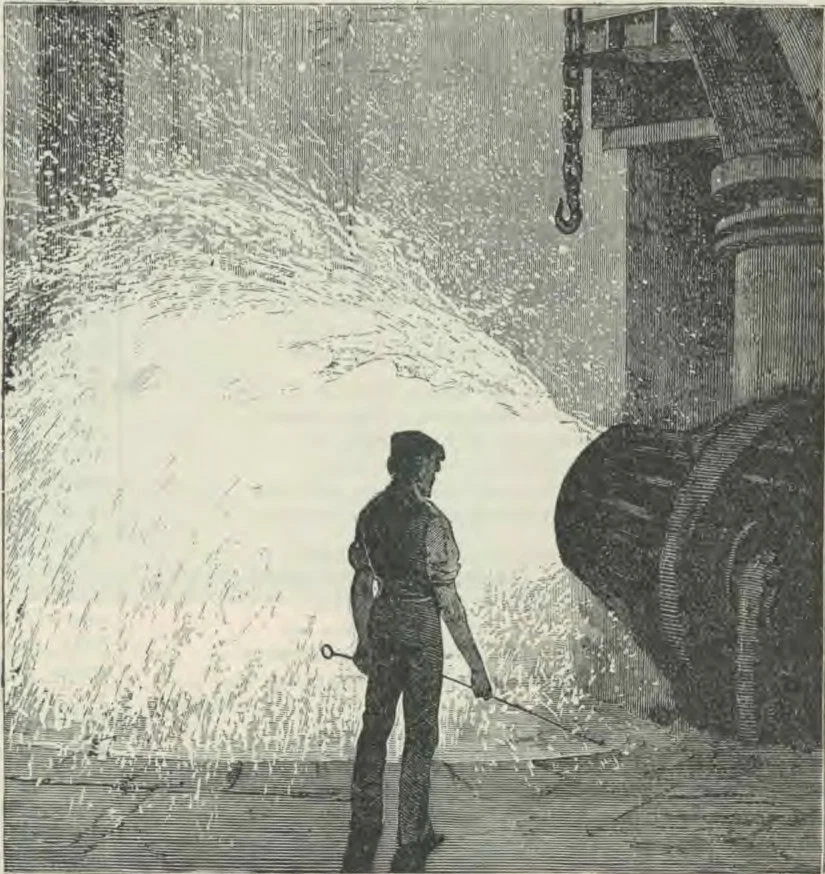
Steel has more carbon in it than wrought-iron, but much less than cast-iron. It is made from bar-iron, by a process which was first known in England about the middle of the last century. The bars to be converted into steel are put into a large conical furnace, or “converter,” like that in the picture, which is so arranged inside that the fire may burn all around the outside of the iron, and keep it at a high and regular heat.
At the bottom of the converter a layer of powdered charcoal is scattered, and on this is placed a row of the iron bars. On the top of these another layer of charcoal is scattered, and another row of iron bars, until the converter is full. Over the whole of this is laid a heavy coat of cement, to prevent the charcoal from burning away. The fire is then lighted, and kept fiercely burning by means of large bellows blown by machinery, which keeps up a constant roaring, and throws out fire and sparks.
When these bars are taken out, they are covered with blisters, like wood when freshly painted and exposed to the sun. They are then known as “blister steel,” and are fit for nothing but the coarsest kind of work. They must therefore go through further preparations, in order to make them into fine steel, fit to use in the manufacture of the best cutlery. So these bars of “blister steel” are put into large melting pots composed of indestructible materials. These are placed in a furnace, and subjected to the most intense heat, when, at a given time, the man who is tending the process, adds a mixture of carbon and manganese to refine the steel.
When certain signs appear in the condition of the metal, the pot is quickly removed, and its contents poured into large cast-iron molds, which were made ready while the steel was in the furnace. The molds are made in halves, to fit exactly together, and are coated on the inside with some kind of composition. Placed on end with the top open, the mold is ready to receive the liquid steel, which is poured straight down into it, with the care and nerve which only long practice can give. When the casting is cool enough to be taken out, the two halves of the mold are separated, and the contents are turned out ready to go to the large steam hammer.
Manganese, so much used in refining steel, is a grayish-white metal, having the appearance of hard cast-iron, brittle, and very difficult to melt, yet when oxidated, as it will become in the air, it drops down as a black powder. It is used to give the black color to certain pieces of china, and is employed in clearing flint-glass of impurities, and to give it a purple tint. It is largely found in France, Spain, and Portugal, where it lies scattered near the surface of the ground. It has also been found in great Britain.
When steel is highly refined, it has wonderful properties. If a thin strip of it is bent double, it easily returns to its former shape when the pressure is removed. In this condition it is made into steel pens, or springs for watches and clocks, and other delicate purposes. Much of the machinery now in use is made of steel, and all the rails used on our railroads are of the same material, because it is so much harder than common iron, and will last a great deal longer.
J. O. C.

MY FATHER’S LEGACY.

My father belonged to the “working class” in the usual as well as in the highest sense of the word, and when his long and useful life was ended, I knew that the value of his estate was very small. But his heart had hardly ceased to beat, before I began to learn that he had left me a legacy, written not upon parchment, but upon the hearts of men, exceedingly precious beyond gold; for “a good name is rather to be chosen than great riches.”
I went out upon the street of the country village, where my father had lived for many years, and an old Irishman came to me, and said, while his eyes filled with tears:— “And is it true that the father is gone? Sure, he was a good man, and he was the first man that gave me work when I came over from the old country. Many’s the dollar and the good word I got from the father.”
Just as I was passing one of the village stores, a young married woman came out, and anxiously inquired if the report of my father’s death was true; and when I told her that it was, the quick-springing tears showed that here was another who loved him. “For years,” she said, “until I had a home of my own, there was no place that seemed so much like home to me as your father’s house. I shall never forget how kind your parents have been to me.”
A few days afterward, a lady who is leading an honored, useful Christian life, said to me, “If my soul is saved, I believe my conversion will be a star in your father’s crown of rejoicing. At the time when I became interested in religion, special services were held at the church, but I lived at a distance, and was not able to walk so far through the snow. Your father often came with his team to carry me, and if I was not ready to go, he would wait for me, or come again. I wondered then why he was so anxious to have me go, but afterwards I knew that he was watching for my soul, and I have never ceased to thank him for it.”
A bank officer in a Western State wrote to me: “To his example and advice I owe much—how much I can never appreciate—of the character I have; and the memory of the days I have passed with him will last as long as my life.”
These are but a few examples of the good that he did for other persons, whatever might be their condition, wherever he might meet them, through his long life,—work done by a man comparatively uneducated, working with his hands day by day, but having in him the spirit of his divine Master.
Although he had nothing to give except advice and the help of a helpful spirit, such as he had he gave always, and thus scattered the seed of good wherever he went. The seed bore a rich harvest of love, which I inherited.
The lesson of such a life is not hard to read, though it may be difficult to practice it at all times. Yet it is the one best way of living, and it is dependent on no outward advantages of position or wealth.—Youth’s Companion.

THE AMERICAN INDIAN.

PART II.—HIS LANGUAGE AND RELIGION.

Competent authorities estimate that there is one language for about each one thousand Indians in the United States; yet one tribe never learns the language of another, even from their captives. For over sixty years the Cheyennes and Arapahoes were friends, living in the same camps, the children playing together, the warriors hunting and fighting together; yet not one in ten of the men, women, or children can converse together, although one of the languages is very difficult, and the other very simple. It would seem natural that all would acquire the easiest, but it was not so. Most of the tribes of Indians are now broken up into bands. As the more powerful neighbors were driven off, tribes broke up into bands to more readily procure food, etc.; and many of these bands have lost the mother tongue entirely, so that bands from the same tribe often cannot converse together, or understand each other.
There are a few words that the white man, in his travels among the Indians east of the Rocky Mountains, has made common to all tribes and bands; and the Indians, in conversing with white men, or Indians of other bands, make use of these, but not among themselves, using instead the expressions common to their own language. One of these words is “squaw,” the Narragansett Indian word for woman; “papoose,” child, and “chuck,” food, from the Algonquin dialect.
Indians used to think that if they were scalped, they lost their soul, and could never enter the “Happy Hunting Ground;” and for this reason they delighted in scalping white men, believing it kept their souls out of the white man’s paradise. They also believed that when they slew an enemy, and saved him from being scalped, that enemy would be their servant in the next world. Many marvelous acts of courage and daring have been witnessed in endeavors to save mighty warriors from disfigurement, that they might minister to the victor’s vanity, officiating as his servants hereafter.
If an Indian is strangled, he believes he cannot reach his paradise. He thinks the soul escapes at the mouth at the instant of death, because the jaw drops then; and if choked in any way, he believes the soul never leaves the body or its vicinity. For this reason, the Indian has a horror of becoming entangled in his lariat and dragged to death, or of being hung. He would rather choose the most exquisite mode of torture as a means of death.
The Indian has two gods, a “good” and a “bad.” To the first he pays no homage, because he believes he will do good at all times when able to do so; but he is constantly offering propitiatory sacrifices to his bad god to keep him in good humor. He is, therefore, always very anxious to know which god is the most powerful, as, it seems, sometimes one, then the other, is in the ascendency. To discover which controls, the Indian resorts to divination, and this we know by the name of “medicine,” which means with an Indian “mystery.” It came into use from the French fur traders, the French calling a doctor or physician médecine; and as Indian doctors are all magicians and diviners, the Indians fell into the habit of calling them “medicine,” meaning anything mysterious or unaccountable as applied to religion. With an Indian, then, it may be good medicine or bad medicine, according to which god is in the ascendency, because the term medicine includes also the mixture used in the divination.
Each Indian makes his own medicine; and though made according to a general rule of the tribe, taught from father to son, each Indian has one of the ingredients known only to himself, and jealously guarded from the knowledge and gaze of every other one. On coming of age, each male goes off into the wilderness, and starves himself into a kind of trance, when some article is presented to his mind, and is adopted by him as the secret ingredient. The other articles are various colored sands, and ashes of special bones, principally of birds, and the ashes of reptiles. These are mixed together and stirred. If the combination of colors turns out to be what his father taught him it should be, the good god is in the ascendency, and the Indian goes on his way rejoicing. If otherwise, the bad god prevails, and the Indian remains at home for another week.
Medicine is mixed generally once a week, and when it turns out bad, is carefully buried; but when good, is sewed up in small sacks of deer-hide, and hung in the warrior’s hair and the tail of his horse, and about the necks of his wife and children. After prolonged series of bad medicine, or “bad luck,” the Indian will often go again to the wilderness, starve himself, and thus procure the name of a new secret ingredient to change his medicine and his fortune. All tribes are not so particular, however, the amount of respect paid to such rites varying with the intelligence common to the tribe of Indians.
The “Digger” Indian, of the Pacific coast, for instance, is the lowest in point of intelligence, and the most miserable, subsisting on snakes, lizards, grasshoppers, and such roots as he can dig out with a sharp-pointed stick, always carried in the hand, ready for use. These have forgotten all religion, having remaining only a “hazy, undefined superstition.”
All religions require and have priests; so each tribe of Indians has one,—the Medicine Man. He is consulted only in sickness, because to an Indian, sickness is not disease, but the presence of the bad god. If, then, he can be exorcised, the patient will get well; so the priest is sent for. The treatment of wounds and fractures is well understood by all, and is attended to at home, not coming at all within the province of a priest, who holds a religious and not a medical office.
W. S. C.

THE LIFE-PRESERVING BIBLE.

A SMALL French army, among which were a few Germans, took by storm a German fortress. As pillaging the same had been promised the soldiers as a recompense for their six months’ deprivations, every soldier rushed into those houses where people of wealth seemed to be living. Edelreich, a German warrior, misled by the example of his fellow-soldiers, broke into the house of a widow in comfortable circumstances. As he stepped into the room, he saw the widow attired in her mourning garb, surrounded by four little children. The eldest of these, Gottlieb, a boy of six years, ran to meet the fierce warrior, and presented to him a picture Bible, with these words: “Here, good man, I will give you my dearest possession, only do nothing to my poor mother.” The soldier, perplexed, opened the Bible, and a passage met his gaze which went to his heart. “I will take nothing from you,” said he, with moistened eyes, to the terror-stricken mother, “only let me have this Bible.”
“God’s blessing be upon you, noble-hearted man,” said the widow, as he left the room.
The magnanimous soldier threw wide open the door of the house, seated himself upon a resting-stone near, and restrained his greedy companions from entering, by the assurance, “You’ll find nothing more in this house.” When the time for plundering was past, he closed the door and betook himself to his quarters. Afterwards, a division of the native army, by night, broke into the fortress unexpectedly, through its shattered walls, and poured a hail-storm of shot and shell upon the enemy, unprepared for an attack.
Whilst the entire circle in which Edelreich was standing was falling dead to the ground, two pieces of iron struck him directly upon the breast, and he fell unconscious to the earth. After a few minutes, he came to himself, put his hand to his breast, in which he had received the fearful blow, and found the pieces of iron sticking firmly in Gottlieb’s Bible, which Edelreich in his nightly watch carried there.
Seven years after, Edelreich, as commander-in-chief of a battalion, sent five hundred ducats as a present to the thirteen-year-old boy, in a note, with the following contents: “This trifle as a reward to the noble boy, who, seven years ago, gave his dearest possession as a ransom for his mother, and therewith saved the life of his grateful friend, Edelreich, commander-in-chief.”—From the German.

SAY, CAN YOU COUNT?

(From the German.)
SAY, can you count the clouds that fly So swift across the bright blue sky? Or tell how many a glittering star There shines above our heads afar? No, none but God can. He doth know All things he made, above, below.
Say, can you count up every bird Whose merry chirp in spring is heard, Or fishes, as they swim, leap, play, Within the deep seas far away? No; God can. He by name doth know All things that breathe, above, below.
Say, can you count up every child, Who, watched by tender mother mild, Lays down at night its little head, To sleep within its soft, warm bed, When said have been its simple prayers? God can. He numbers all our hairs. —Selected.

JOHNNIE

“O my son! I’m sure I cannot wonder people think you so disagreeable,” said poor Mrs. Rice; but Johnnie for answer only bounded out of the room and down the steps, slamming the street door after him.
“Disagreeable,—yes, I hear that word often enough,” muttered the boy. “I don’t care!” and he whistled loudly as he ran down the street. A little way on he stopped to whittle the fence, and his pretty neighbor, May Browne, came along. She made a pleasant picture this morning, with her neat costume, her soft dark eyes, the faint tinge of rose on her cheeks, and the air of goodness and sincerity about her. Johnnie’s eyes took this all in as he turned.
“Halloo, May!”
“Good morning, Johnnie!”
“’Spose you heard the high old racket?” said the boy, a little shamefacedly.
May, looking full into the bright face, answered frankly, “Yes, I did. I always do, for I can’t well help it,—we’re so near, you know. And I do wonder what ails you, Johnnie,—what you can be thinking of, to behave as you do at home. Why, you are a worse boy there, with your mother and sisters, than anywhere else.”
“O pshaw! that’s nothin’.”
“Johnnie,” said May earnestly, “don’t try not to care; for your heart might grow so hard you couldn’t care sometime when you want to. I wish you could see just how dreadful it is for you to go on so. Say, Johnnie, if you could have a new life given you, so that you could begin all over again, you would try to do better, so as not to stain the new life, wouldn’t you?”
“I know you think I’m awful mean, but there’s no use talkin’ about givin’ me a new life. Guess I’ll have to go on with the old one a while yet—ho! ho!” and practical Johnnie tried to laugh, but did not laugh very gaily, after all.
May’s eyes grew moist, as she said quickly, “Did you ever think of it, Johnnie, that you do have a fresh, new, pure life given you each morning as you wake; and if you were to live until a year from now, you would have the same as three hundred and sixty-five new lives to live? What a dreadful, dreadful thing for you to spoil each one of them as fast as it comes to you!”
The school-bell stopped ringing, and May turned the sweet, earnest face, with the tears still on it, toward him for a second, as he ran up the steps.
The boy looked after her with a queer twist to his mouth. “Ph-e-w!” he whistled, “a new life every morning! Three hundred and sixty-five new lives in a year. There’s an idea for you!”
Naughty, careless Johnnie—May had often before talked with him in her earnest fashion—why should he care so much now? Did some good angel bend tenderly over him this morning, pressing her words deep down into the thoughtless little heart? It must have been; for he took a very queer little sober face with him into the school-room.
And when he went home at noon, the angel must have gone right along, too; for the little fellow really ate his dinner that day, and got back to school again, without the usual uproar. And,—yes, I think the angel must have gone back and forth with Johnnie a good many times that summer, and must have spent some time at the Rice cottage, too; for I notice that all the family have grown more gentle and kind.
E. L. SHAW.

Seize Opportunity by the Forelock

“OPPORTUNITY has hair in front; behind she is bald. If you seize her by the forelock, you may hold her; but if suffered to escape, not Jupiter himself can catch her again.”

Good Deeds Shine Like Jewels

Good deeds flash like jewels, and no life can be obscure that is full of them.

BEPPO

Beppo was a donkey, or a burro, as the Mexicans called him. He lived in Colorado. He was little, and furry, and mouse-colored. He had great, sad eyes, with long, dark lashes. When I first knew him, he had no home. He wandered idly about the village. He was beaten and ridden by the school-boys, and lived on whatever he could find.
One day, when it was very cold, he came and stood by the fence, looking wistfully in. His big, sad eyes were sadder than ever, and his long ears hung meekly down beside his head.
“Are you hungry, old fellow?” I asked, as I opened the gate. He gave me a look which meant Yes, and I soon had the pleasure of seeing him eat a hearty meal.
After that, he came every day. He was very grateful for his food, and would rub his head against my hand as if to thank me. He soon grew very plump. Whenever I took a stroll, he would walk along beside me. If he saw a boy, he would come very close to me indeed.
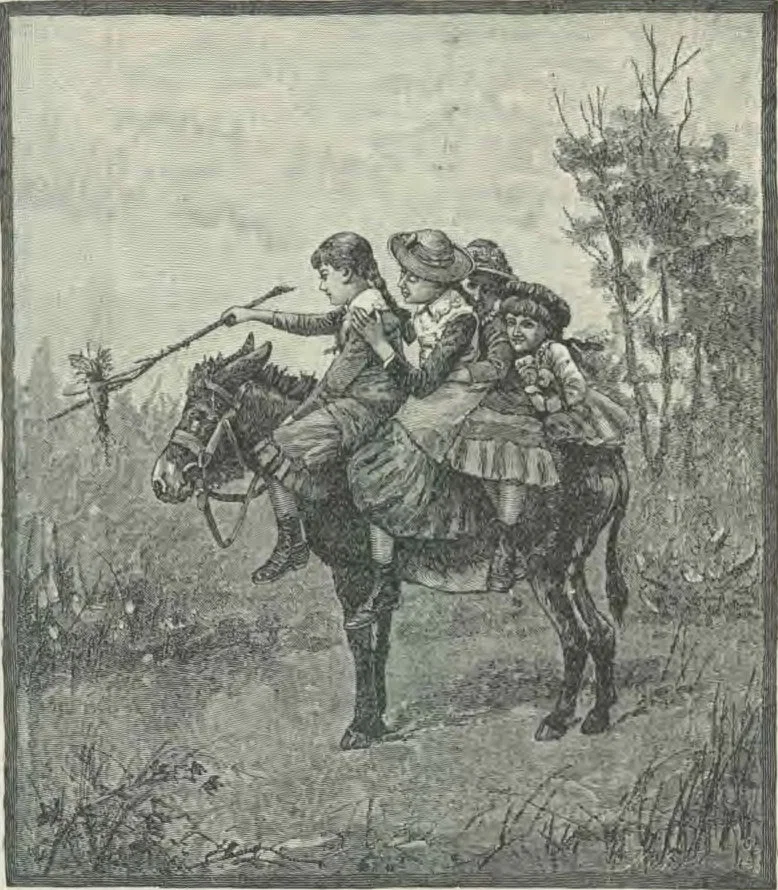
One morning I heard some merry voices near my window. I looked out, and saw Beppo walking slowly by, with four laughing, rosy-cheeked little girls on his back. Perhaps you will smile if I tell you they were not all riding lady-fashion, either!
“Where are you going, Susie, Ethel, Mabel, and Maud?” I cried.
“We are going a-riding,” three of the little ones answered in chorus. “A-widing,” echoed little Maud, who sat upon the tail, holding fast her dollie.
Alas! Beppo heard my voice, and not one step farther would he go! I gave Susie a large yellow carrot; she held this on a stick in front of his nose, and then he moved on.
He always walked so like a snail that I feared he was infirm. But one day when a pet mule was brought in from the ranche, I found I was mistaken.
Beppo at once made friends with this little colt. He was very playful, and I soon saw that Beppo could be quite as sprightly as the mule.
After that, whenever I took a ride on Beppo, I let the mule come too. We had lively runs over the broad, sunlit plains.
When I left Colorado, Beppo came to the depot to see me off. I am almost sure I saw tears in his big, sad eyes as I bade him good-by.—Our Little Ones.

GRANDPA'S FIGURES.

Vern and little Altha had scarcely become well acquainted with Grandpa Newton yet; for it had been only a short time since he came to live in his son's family; but they liked him very much.
He had helped Vern to rig his toy boat, and to mend his express wagon, and had cut queer patterns out of paper for little Altha, and had taught them some curious tricks, such as driving a pin through a copper, by putting it through a cork, and then striking the head very hard; or to make coins seem to float, by putting them into a cup, standing aside so that they were just out of sight, then pouring on water, which caused their reflection to be seen; and to make a spoon appear bent, by putting one end of it into water.
And grandpa had helped them about their work, too; he never did it alone, but he would help them, and sometimes show them a better way to do it than they had known before.
He could help them some about their lessons, but not very much; for he said that when he was a little boy like Vern, he didn't have such a good school to go to, nor such good books to study. He said there were no Sabbath-schools then, at least none where he lived, but that the children used to learn Bible verses; and he could still repeat whole chapters that he had learned when he was little.
But Vern and Altha were not the only ones grandpa helped; he found a great many things to do for both Papa and Mamma Newton, so that the children began to think perhaps they could help more; and when he had found something to do, they would often join him in the work, while he was kept busy teaching them how to do, and answering their questions, and telling the stories they always liked to hear, about what happened when he was a boy.
One day, when it was too rainy to be out-of-doors, and there seemed to be nothing at all to do, grandpa said to the children, “Well, if we can't do anything else, we can keep the hinges oiled!”
Vern was quiet for a minute; then he went to his mamma, and asked her, “What does grandpa want to put oil on the hinges for?”
Mamma smiled, and said she thought grandpa was speaking in figures.
“What's that—speaking figures?” asked Vern.
His mamma told him that to speak in figures was not to say just what one meant, but something that would make people understand what was meant.
“But what did grandpa mean?” asked Vern.
“Perhaps he will tell you,” she replied.
Then Vern went and asked him what he meant when he said they could keep the hinges oiled.
Grandpa asked the children if they had never heard a door creak as it was opened or closed, or wagon-wheels creak as they turned. Both the children had heard such sounds, and knew what would stop them—oil; and they remembered that mamma put oil into her sewing-machine when it ran hard, to make it go easier.
Then he asked if it would not be about the same as oiling the hinges and wheels if they should do all they could to make things pleasant, and to make mamma's work easier.
“I know of plenty of children,” said grandpa, “who slam a door nearly every time they shut it; and that sounds as bad as creaking hinges. I think those children better oil the hinges by closing the door quietly. And—would you believe it?—there are a great many children as large as you are who don't even know how to close a door!”
“Oh, grandpa!” exclaimed Vern, “even Altha knows how to do that; but she couldn't used to open the door before she was tall enough to reach the knob.”
“But there are children, and even men and women, who don't know what a door-knob is for!” urged grandpa.
Suddenly Vern exclaimed, “Grandpa, you are talking in figures now, aren't you?”
But grandpa insisted that if mamma had not washed the doors that very morning, there might have been seen on them the finger-prints of little people who had put their hands against the door to push it, letting it slam shut, instead of taking hold of the knob; which proved that they did not know how to close a door.
Are there any children at your house who do that way?
Then grandpa and Vern and little Altha all tried to think of things they could do “to keep the hinges from creaking,” as grandpa said.
Vern remembered that his mamma did not like to have him call to her when he wanted anything, because then she had to leave her work, and go to see what he wanted, or else talk very loud; she better liked to have him come where she was when he wished to speak to her.
Little Altha thought mamma would as lief hear a door creak, as to hear her tease after she had been told she could not have what she asked for, or that she must wait awhile.
Grandpa reminded them of the flies that had come into the house because every little while some one would stand a moment holding the screen open.
Vern thought of a number of things his mamma had tried to teach him about being polite; and he decided he would try pretty hard to remember them after that.
And now I wonder if you can think of any creaking hinges at your house that you can oil?
MRS. ADA D. WELLMAN.

HOW WE EARNED OUR APPLES.

When I was a little girl, Eastern Nebraska was a new country, and bearing orchards were very few and far between, so that apples were as scarce and highly prized in School District No. 10 as oranges are now.
They were sometimes bought at a good round price in the village, eighteen miles away, and if one of the children had an apple at school, the rest of us crowded around, and begged for the core.
By and by two orchards in the district came into bearing, and then we cared less for the cores, but we were still very hungry for the apples.
What we got seemed only to whet our appetites, and if we had not been fairly good children, I think we should have descended upon those apple-trees in a body, and devoured the whole crop.
One of the orchards belonged to Uncle Wilse and Aunt Ev, who lived just across the road from the school-house.
He was our teacher and playmate, and she was the particular friend of every sturdy little pioneer in District No. 10.
They had a good store of apples in the cellar, and if they could have spared them, they would have enjoyed supplying every one of us with all we could eat right along.
But of course you can see that would never have done. There were about twenty of us, I think, and we should have made short work of Uncle Wilse's winter supply.
We used to call on Aunt Ev in squads of six or eight, and sometimes one of the A B C scholars would remark, “Seems to me I smell apples!”
Most of us knew better than to hint our wishes so strongly; but even if we didn't ever say a word, Aunt Ev knew we thought apples, and she hated ever to deny us.
At last she and Uncle Wilse hit upon the best kind of a plan—a plan by which they could afford to supply all of us, and which made the apples taste uncommonly good, too.
It all came of Uncle Wilse's making brooms. He was really a wonderful man,—the best and kindest of teachers, the jolliest hand at blind-man's buff, the luckiest fruit-grower, and, besides all this, a first-class broom-maker.
Did you ever see broom-corn growing? It looks something like common corn, but at the top, instead of a tassel, is the plume, or brush, of which brooms are made. The ends of it are covered thickly with brown seeds; may be you have noticed now and then one still sticking to the brush of your broom.
In regular factories they have a quick and easy way to scrape off these seeds by machinery, but Uncle Wilse had to do it all by hand. So he proposed to hire all the children who wished to work at it, and pay them in apples.
You may be sure we all wished to work. Uncle Wilse spread the broom-corn along a narrow board walk in his backyard, and there was soon a long, busy row of us, scraping as if for dear life.
It was better fun than blind-man's buff. We laughed and chattered as little folks always do, and declared we should not play at noon and recess any more while the broom-corn and apples lasted. We stuck to it pretty well, most of us.
As we became more skillful, Uncle Wilse was obliged to raise the price of his apples, so that we should not get his whole stock. But he always kept it low enough so that a certain slow but very faithful little chap could earn at least one apple each day.
Whether he and Aunt Ev found our work any great help, I can't say. But they gained their main object, which was to teach us a good lesson, give us a good time, and see that we had apples to eat.
And what with the scarcity of apples, and the strength of our appetites, and the special relish we gained by earning them, I am sure there never was such fruit for us before, nor has been since.—Companion.

IN A MINUTE.

LITTLE Eddie boy always was slow to obey; When called, he would never come promptly away. But say, “In a minute, I’ll come in a minute!” Till mamma one day told the wrong that was in it; “For mamma knows best, dear,” she said to her son, “And a new state of things must at once be begun.” Then Eddie felt sulky, and said not a word, But went out-of-doors where he saw a young bird Who had ventured to hop from the nest to a twig, Where he fluttered and teetered, and felt very big. Eddie heard the brown mother-bird call her child home. But the little bird chirped, “In a minute I’ll come.” Then, in spite of the mother’s cries, flew to the ground, Where a crafty cat seized it, with one silent bound. Then Eddie’s cheeks reddened; he rescued the bird, And took it back home, saying never a word; But the leaves whispered soft, as he reached the high nest, “How strange ’tis that all kinds of mothers know best.” —Wide Awake.

GOOD ENDINGS.

I WELL remember the advice that a professor of theology once gave us before we left the seminary. “Young men,” he said, “at present the churches look upon you as young men of promise. That is well. But by and by they will expect you to be young men of performance.” That made a deep impression on me, as a very wise saying. There are to-day in the world thousands of young men and young women of “promise.” But presently the world will begin to look for a fulfillment of that promise. In many cases the world will be bitterly disappointed. Why? Because these same young people will rely on the good start that they have made. The favor with which they have been looked upon will blind them to the fact that it is a kind of favor “by way of anticipation.” They will fail to realize that it is only a start that they have made, and that a good start is only a part, and a very small part, of the battle of life. In our late war there was many a battle that began well for our armies, but which before the close was turned into dire defeat. And so it will be with many a boy and girl who now looks forward to life as holding out brilliant hopes of success. How is it that things turn out in this way? There are many reasons for this. Some are led astray through bad companions; others through lazy habits; others, again, fall a prey to strong drink, which ruins them. Multitudes merely let golden opportunities slip through their lax fingers, and in this way make shipwreck of their lives.
The better your advantages are at the start, the more the danger that they will not turn out well at the last. Every college man has seen some classmate who had an unusually good “fit” come to the class, and for a while distance his classmates. Then, after a while, that man begins to fall back, and at the last makes a very bad finish. Why?—Simply because he relied on his grand preparation. The same thing holds true in things more directly spiritual. Remember that to begin well is good; but, to insure success, there must be a good continuance. Thus only will there be a good finish in the race of life.—S. S. Times.
Continue reading: THE BIRD'S NEST