The Youth’s Instructor, Vol. 33, No. 6.

THEY LOVED NOT THEIR LIVES UNTO THE DEATH

The Youth’s Instructor

Feb 25, 1885

S. D. A. Publishing Association · Battle Creek, Mich. · Feb 25, 1885

THEY LOVED NOT THEIR LIVES UNTO THE DEATH.

ABOUT three hundred and forty years ago, Henry VIII. was king of England. At that time a terrible persecution was carried on against the Protestants of that country, and hundreds of them were put to death by the most cruel means that wicked men could devise. To give a detailed account of the cruelties practiced upon the people who ventured to have the Bible in their houses, or to question any of the doctrines held by the Roman Catholic church, would be revolting in the extreme; but as these martyrdoms are facts in history, and furnish some noble examples of constancy and faith in the hour of trial, it is intensely interesting to read about them.
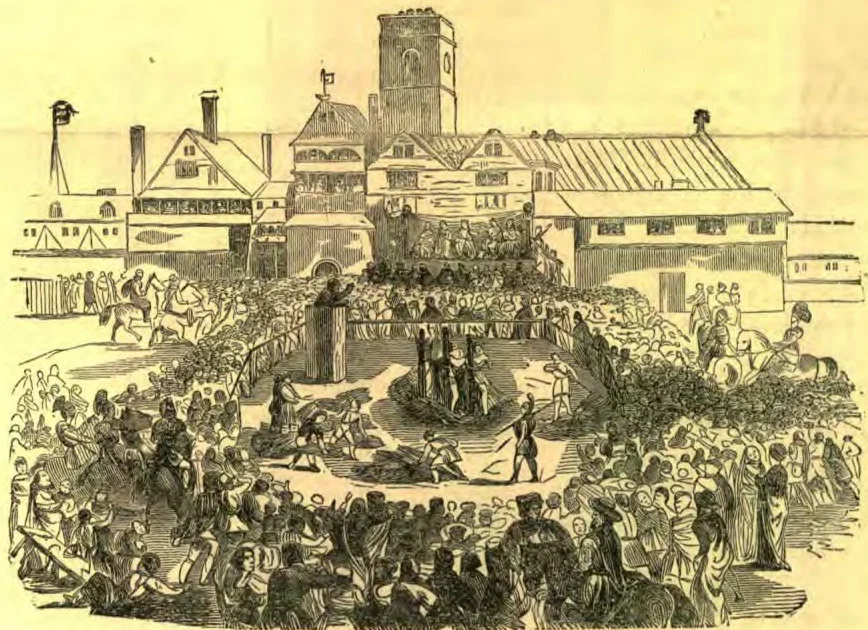
The most common method of punishing heretics, as they were called, was burning at the stake. In order to make them recant, they were made to suffer all the tortures which it would seem possible for any one to endure and live. Some were fastened upon a horrible machine called a rack, and their joints pulled apart. Others were suspended by their thumbs, and left hanging until almost dead with agony. And in every conceivable way that human fiends could invent, they were tortured; but if they still continued firm, they were taken to a place inclosed by a railing to prevent the crowds from coming too close, chained to a large stake, and burned to death.
One of the most foolish doctrines held by the Romish church, was the idea that the bread and wine used in the communion service were the literal body and blood of Christ; and a great many people lost their lives in consequence of renouncing this doctrine.
Among others who were burned at the stake because they would not accept this theory, was Mrs. Anne Askew, a woman of noble parentage, and of superior education. Her husband was a violent papist; and when he found that she favored the Reformation, he drove her out of his house. So she came to London, where charges of heresy were made against her, and she was put in prison. After an examination by the bishop of London, she was made to recant somewhat from what she had said, and was set at liberty. The bishop was not satisfied with her confession, in which she stated that she believed everything according to the Catholic faith, and not otherwise.
Shortly after, she was again brought before the king's council, then at Greenwich, where she seemed very indifferent as to what they should do with her. She answered them in such a way that they could charge nothing against her. She was then sent to Newgate. Nicholas Shaxton, bishop of Salisbury, who had been imprisoned on the same charge with herself, but had recanted when threatened with torture, was sent to Newgate for the purpose of prevailing upon her to recant. Instead of yielding, she charged his cowardice back upon him.
Finally, in order to extort a confession from her, she was sent to the Tower, and laid upon the rack; but she would confess nothing. Then the lord chancellor commanded the lieutenant of the Tower to stretch her more, but he positively refused to do it. At that the lord chancellor threw off his gown, and drew the rack so severely that he almost tore her body asunder; yet he could draw nothing from her, for she endured it with unusual courage. When the king heard this, he blamed the lord chancellor for his cruelty; yet her condition awoke no pity in the heart of the king, for he left her to be dealt with according to the sentence.
She was carried in a chair to Smithfield a little after that, being unable to stand alone on account of the suffering she had endured from the rack.
She was then tied with a chain to the stake. The coward Shaxton crowned his apostasy by preaching a sermon at the place of execution, Anne Askew listening, and confirming what he said that was true, but telling him that he spoke without the book, when he made a misstatement.
When the sermon was finished, the martyrs standing there, tied at three several stakes, were sent an offer of the king's pardon if they would recant. Anne Askew refused even to look at the messenger who brought the offer, saying that she did not come there to deny her Lord and Master. At this the lord mayor commanded fire to be put to the fagots, at the same time crying with a loud voice, “Let justice be done.”
Although the three who perished with her were men, it is said that the courage and fortitude which she manifested, and the words of encouragement which she gave them while the flames were raging about her, was all that enabled them to endure the fiery ordeal.
They loved not their lives unto the death, and gave themselves up, a sacrifice by fire unto God. But those terrible scenes are not now enacted. The rack, the thumb-screw, and the stake, together with all the other horrible modes of torture, are not now resorted to, and every one has the liberty to study the word of God as much as he chooses. Yet I have often wondered if the people of the present time are as familiar with the Bible as they were when it cost them their lives to become so.
E. L.

FIGS OF THISTLES.

As laborers set in a vineyard Are we set in life's field, To plant and to garner the harvest Our future shall yield.
And never since harvests were ripened, Or laborers born, Have men gathered figs of the thistle, Or grapes of the thorn!
Even he who has faithfully scattered Clean seed in the ground, Has seen, where the green blade was growing, Tares of evil abound.
Our labor ends not with the planting; Sure watch must we keep; For the enemy sows in the night-time While husbandmen sleep.
And sins, all unsought and unbidden, Take root in the mind, As the weeds grow, to choke up the blossoms Chance-sown by the wind.
But no good crop, our hands never planted, Doth Providence send; Nor doth that which we planted have increase Till we water and tend.
By our fruits, whether good, whether evil, At last are we shown; And he who has nothing to gather, By his lack shall be known.
And no useless creature escapeth His righteous reward; For the tree or the soul that is barren Is cursed of the Lord!
—Phebe Cary.

THE LOST DOLLAR.

“Hurrah! O ma, just guess what I've found right in the road, all myself. It's big, round, shiny, worth—oh, lots. Goodie! now I can get my horn, and skates, and knife, and—and—everything,” and Willie stopped only from sheer exhaustion.
“Why, Willie,” said Mrs. Mears, “you came in more like a whirlwind than like my orderly little boy. What has excited you so? Come here, and let me see.”
“Just look a-there. That's mine. I found it. An't I rich though? Guess Tom Neal never had that much;” and Willie danced around in high glee, holding up a bright, new silver dollar.
“Come here, Willie,” said his mother, “and let me inquire about this. Are you quite sure that it really belongs to you? Didn't some one lose it?”
Willie's countenance dropped, while he came very slowly and reluctantly to his mother's side, looking at the dollar to hide his feelings; for he felt uncomfortable at the idea that it might not be his own after all.
“But I found it, and I think it ought to be mine anyway,” said Willie.
“But, my boy, some one lost that,” said Mrs. Mears. “You should think how bad he will feel when he misses it. I fear there was selfishness in your rejoicing. Didn't Jesus tell us to do to others as we wish them to do to us? If you had lost a dollar, would you not want the finder to restore it to you?”
“But I don't know whose it is,” argued Willie.
“Do you want to know?” she inquired. “Have you tried to find out? The Lord says that when you find a lost thing, you shall restore it to the owner. (Deut. 22: 3.) If we love others as we do ourselves, we will think of their side of it,—of the loss and sorrow it will bring to them. I remember when I lost baby's nice woolen blanket, last fall, while riding along the road. I had had it so long, and needed it so much, that I cried when I found it was lost. Though we were tired, and it was a long way home, we turned around and went back, feeling very sad, but hoping we might possibly find it. We did, and how rejoiced I was. I thought then that if I ever found anything that another had lost, I would not rejoice at it, but feel sorry for them, and find whose it was if I could.”
Willie tried to be a good, conscientious little boy, but he had not thought of the matter in this light before. Now he felt ashamed, and tried to hide it by digging a hole in the carpet with his toes.
A rap at the door interrupted further conversation. Mrs. Reed, a near neighbor, came in. After a few general remarks, she said,—
“I felt so sorry for poor Mrs. Sage just now. I am poor myself, but I shall help make up her loss.”
“Why, what has happened?” anxiously inquired Mrs. Mears.
“Oh, no great thing, though a little is a good deal when it's all you've got. You know how poor she is, with five little children, and half sick herself. She had done two hard washings for Mrs. Lyon, and had just received a dollar for it. She calculated that would buy a pair of shoes for May, so she could go to school and to meeting; but going home, she lost it. She came clear back, looking all along the road for it. When she saw it was gone for good, she just sat right down and cried as if her heart would break. Poor thing! She said she didn't have strength to earn another one, and what should she do?”
“I know where it is,” broke in Willie. “I've got it; I found it. I'll take it to her. Where's my cap?” and off he bounded, before either of them could say a word. His mother then told Mrs. Reed the whole story, expressing the hope that it would be a good lesson to Willie. It wasn't long before he returned, whistling and jumping, as happy as a happy boy could be.
“What did she say, Willie?” inquired Mrs. Reed.
“Oh, you ought to see how her eyes stuck out when I gave her the dollar! She laughed and cried, and said I was a little angel, and oh, lots of things. I was glad I found it.”
“Willie didn't mean to be selfish,” said his mother, as she put her arm around him, and smoothed his hair, “but he forgot for a little bit about loving his neighbor.”
For days after this, Willie was often heard zealously advocating the sound doctrine that “any boy that found anything and was glad of it, and wanted to keep it for his own, was real selfish; and it wasn't right anyway, 'cause ma says so, and the Bible says so too.”
D. M. CANRIGHT.

A LIVE PAPER-CUTTER.

Many years ago an Indian Rajah, who was a great admirer of his English masters, and who had even learned the language after a fashion, frequently visited the Viceroy of Calcutta. On one occasion he noticed a copy of the Edinburgh Review on the Viceroy’s table, and borrowed it.
Some time after, he returned it; and upon the Viceroy’s inquiry whether he found anything interesting in it, he replied: “Oh! yes, many beautiful things; but also many disconnected articles.” “How so?” said the Viceroy. “See here,” said the Rajah. “This begins with ‘Hunting the Orang-outang,’ does it not? And now turn over the page, and here you have the ‘History of Mary Stuart.’” The Viceroy laughed.
The book was uncut, and his vassal had read it through without discovering it. He therefore took from the table an ivory paper-cutter, with a beautifully carved handle, and explained its use to the Rajah, who was much pleased, but could not help wondering how they contrived to print the inside of the leaves before they were cut open. This also was explained, and the Rajah departed, taking with him the paper-cutter, which the Viceroy had given him.
About a year after, when the matter was almost forgotten, the Viceroy saw from his window a gallant troop entering the court, in the center of which was the Rajah, mounted on a young elephant. As soon as the latter perceived the Viceroy, he cried, “Do you happen to have an uncut number of the Edinburgh Review? If so, please toss it to me.” The Viceroy threw out the book, which was caught by the elephant and placed between his tusks, which, to his surprise, the Viceroy saw had been turned into paper-cutters, even to the carved handles. In a moment the intelligent beast cut open the leaves, and then handed the book to the Viceroy. The Rajah dismounted, and, pointing to the elephant, said to the Viceroy: “He is yours. I return you your paper-cutter alive.”—The Christian Weekly.

A WISE CAPTAIN.

A NANTUCKET steamboat captain was once asked by a passenger on his boat how much ardent spirits he used. He replied:—
“I never drank a teaspoonful of rum, brandy, gin, cider, wine, or beer. I never smoked nor took snuff, and I never drank tea nor coffee.”
“But,” said the passenger, “what do you drink with your breakfast?”
“Cold water,” was the answer.
“And what with your dinner?”
“Cold water.”
“And for your supper?”
“Cold water.”
“Well,” said the passenger, “but what do you take when you are sick?”
“I never was sick in my life,” was the ready and glad reply.
He was a wise captain. He was accustomed to exposure in all sorts of bad weather, wind, and storm, and never believed in the foolish notion that he must take a drop of spirits to “keep out the cold.”—Selected.

AN ABYSSINIAN LIBRARY.

NEVER before were books so plenty and so cheap as at the present time; and it now needs no very large sum of money to procure quite an excellent collection. This cannot be said of every country, however; and the following facts concerning the labor required to make an Abyssinian book, as related in the Youth’s Companion, will help one better to appreciate the advantages of living in a civilized country:—
The Abyssinian alphabet consists of two hundred and eight characters, each of which is written distinctly and separately, like the letters of a European printed book. The labor required to write an Abyssinian book is therefore immense, and sometimes years are consumed in the preparation of a single volume. Mr. Cuzon, an English scholar, visited an Abyssinian monastery a few miles from Cairo, and was surprised to find therein one of the most unique of libraries.
In a room twenty-six feet by twenty, a number of long wooden pegs projected from the wall, and on them hung about fifty Abyssinian books in manuscript. As the entire literature of Abyssinia does not include more than one hundred volumes, the monks were proud of their library.
Each book was bound in red leather or in boards, and inclosed in a case tied up with leather thongs. To this case was attached a strap for the convenience of carrying the volume over the shoulders, and by these straps the books were hung to the wooden pegs, three or four to a peg.
The room thus fitted up also contained a number of long staves, for the monks to lean on at the time of prayer. It had the appearance of a guard-room, where the soldiers had hung their knapsacks and cartridge boxes against the wall.

TWO ENDS.

When a small boy, I was carrying a not very large ladder, when there was a crash. An unlucky movement had brought the rear end of my ladder against a window. Instead of scolding me, my father made me stop, and said very quietly, “Look here, my son, there is one thing I wish you to remember; that is, every ladder has two ends.” I never have forgotten it, though many years have gone. Do not we carry things besides ladders that have two ends? When I see a young man getting “fast” habits, I think he sees only one end of the ladder,—the one pointing toward pleasure, and that he does not know that the other is wounding his parents’ hearts. Ah, yes, every ladder has two ends, and it is a thing to be remembered in more ways than one.—Selected.

“OUT OF DOORS.”

Tired limbs and aching brain, Eyes looking through a mist of tears, Ah, take your griefs, your weary pain— Have you few or many years— Out of doors.
Let the fresh air blow away The cobwebs from your mental sky; November breeze, or breath of May, Let your cankering sorrows fly Out of doors.
Nature makes not one demand; Free gifts are hers, of earth and sky; Her bounty lies on every hand, And you need not gold to buy Out of doors.
Love nature, seek her aid; The more she gives, her gifts increase; In open field or woodland shade, Seek for wholesome rest and peace Out of doors. —The Well-Spring.

THE GREAT VICTORY.

One day, in the year 943, a little boy eight years old took part in two very solemn services in the city of Rouen. The first was the funeral of his father, the great and good Duke William of Normandy, who had been basely murdered by his enemy, the Count of Flanders; the second was his own coronation as his father’s successor.
The bewildered boy was taken directly from the funeral in the grand cathedral, to the church where he was to receive the ducal robe and coronet. His father and the good abbot who had been his friend and counselor, had taught him to pray; and overcome with grief, and the solemn oath he had taken to be “the good and true ruler of his people,” he whispered, softly, “O God, my father, help me to keep it!”
Dearly had his father loved him, and dearly had he been loved in return. The day before, while gazing on his murdered father, he had almost uttered a vow that, as soon as his arm was strong enough, he would avenge his death on the wicked Count of Flanders. But his rash words were interrupted by the good abbot, and his solemn reproof brought a shower of tears from the flashing blue eyes of the young duke.
Amid his sobs, Richard asked him if it could be right to let that cruel traitor go unpunished, while his noble father lay there, struck down by his murderous hand.
“Yes,” Abbot Martin said, “the Lord will punish Arnulf of Flanders for his crime in his own good time; the son of the murdered Duke of Normandy should be the very one to show him love and mercy in his day of need.”
The words sounded strange in the boy’s bitter sorrow; but had not his own dear father made him promise, the last time he saw him living, that, if he fell in some contest, he would not avenge him, except by forgiving his enemy? But how could he do it? he thought, as his tears fell fast,—how could he do it? And yet his Redeemer prayed on the cross for his murderers!
He earnestly wished to do right, but he was only a weak, sorrowful little boy; and, more wearied with his heavy robe and coronet and the long train of nobles who knelt in turn to kiss his hand as their liege lord, than pleased with the honor done him, he murmured at the close of that long day, “I am very, very tired of being Duke of Normandy!”
Kind friends and vassals were devoted to the little duke, who was a bright, fearless, and yet most lovable boy; but the different provinces of France were in a state of continual strife, and wicked men tried to make a prisoner of Richard, that they might get possession of his dukedom.
The King of France was the most powerful of these enemies; and, by fair words and a great show of affection for him, he got the boy into his palace, where he had promised him playmates in his two sons. But, once in his power, he treated him with coldness and neglect; and the queen was even more unkind. As for the two princes, Lothaire, who was about Richard’s age, was a cruel, domineering boy, in whom he could take no comfort; and the younger one, Carloman, was a weak, timid little fellow, whom his brother tyrannized over. Carloman soon came to love Richard, however, who was always kind and gentle to him; and the two were constant companions and playmates.
It was a dreary life, though, for the little Duke of Normandy, who was really a prisoner; but he had two faithful attendants with him, who were ready to defend him with their lives. At last, when the king was away on a journey, the boy fell sick; and his friends suspected that the food sent to him had been poisoned. It was quite time to get him away by some means; so his faithful squire, Osmond, rolled him in a bundle of straw, and carried it out to the stable as though he had been going to feed his horse.
They got off safely; and, after a weary journey, the young duke, though nearly dead with sickness and fatigue, found himself once more in his own domain, and surrounded by loving faces. He soon got well; but he was moved about for safety from one castle to another, while his friends were fighting for him against his enemies.
At length came news of a great victory, and the King of France was taken prisoner. But he was allowed, after a time, to return to his kingdom by placing his two sons in the hands of the Normans until he could pay his ransom. They were brought to the castle of Bayeux; and it seemed a fine opportunity for Richard to triumph over the evil Lothaire, who had made him suffer so much in France. But, instead of this, he was gentle and courteous to the ill-behaved prince, and most loving to the poor, little, sickly Carloman, whom he had led to his Saviour.
The little Duke of Normandy was practicing the beautiful lesson of forgiveness of injuries; and he had his reward. Carloman died there with the words of hope and trust on his lips; and even Lothaire, who was restored to his parents at Richard’s intercession, was touched by his generosity, and said that he never would forget what he had done for him.
Years passed; and the little duke had become a strong and noble man. The Count of Flanders had made many treacherous attempts to get possession of Normandy, and three times he had tried to assassinate Richard; but at last, bent and feeble with age, he fled from the French and Normans, who had vowed to slay him for the wrongs inflicted on the duke. He came unexpectedly upon the very man whom he had reason to dread, and fell at his feet praying for mercy; but “Richard the Fearless,” who was afraid of nothing but to do wrong, forgave even this enemy.
“Vengeance is mine, I will repay, saith the Lord.”—Well-Spring.

A SONG OF YOUTH.

EARLY seeking, early finding; Happy, happy we! Looking up in life's sweet morning, Looking up to thee. We begin our childhood days, Lord of glory, with thy praise.
Early asking, early getting; Happy, happy we! We would daily, blessed Jesus, Find our all in thee. In thy fullness is the store Of the life forevermore.
Early knocking, early opening; Happy, happy we! By the holy gate we enter, Lord, to dwell with thee, In the city of the blest, In the home of heavenly rest.
Early loving, early trusting; Happy, happy we! Looking upward, pressing onward, Day by day to thee; Leaving this poor world behind, All in thee, O Christ, to find.
—Christian Weekly.

IMPORTANT BIBLE SUBJECTS.

LESSON 33.—REVIEW.

[NOTE TO THE STUDENT.—Do not consider the lesson learned until you can give at least the substance of every text, with the correct reference for each. The references in black letter indicate those texts that should be committed to memory. A little diligent application each day will enable you to do this.]
1. How many classes of people does the Bible recognize?
2. When will the final separation between them take place?
3. With what will the righteous be rewarded?
4. What will be done with the wicked?
5. What can you say of the comparative duration of the reward of the righteous and the punishment of the wicked?
6. What is to be the punishment of the wicked?
7. What is the agent in the destruction of the wicked?
8. How complete will be this destruction?
9. To what perishable material are the wicked likened? Quote texts.
10. What will be the effect of the wrath of God abiding on the wicked?
11. How can you harmonize the theory that you have advanced, with Mark 9:43?
12. What is always accomplished by an unquenchable fire? Matt. 3:12.
13. Prove that Rev. 20:10 does not contradict the doctrine that the wicked are to become utterly extinct.
14. Of how many deaths does the Bible speak?
15. Explain the distinction between the first and the second death.
16. State the origin and effect of the doctrine that the wicked are not to die for their iniquity.
17. What do you learn from Rev. 5:13?

THE BEST SERVICE.

An army is not given power as an army, merely by new enlistments. It is the equipping, the arming, the drilling, the disciplining, that makes the soldiers effective; and a veteran battalion of two hundred men, trained and experienced in faithful service, is often more effective in the crisis of a battle, than two or three full regiments, of a thousand men each, made up of raw recruits and inexperienced officers, would prove. So it is in the Christian army. Trained and veteran soldiers are needed for the great Captain’s efficient service. It is for the Sabbath-school teacher to equip and train the Christian soldiers of his class, for the highest possible efficiency. “Herein is my father glorified,” says Jesus, “that ye bear much fruit;” not merely that the branches have a bare attachment to the Vine, but that they are abundant in fruit-bearing. It is because of the neglect of the ingrafted branches, by the under-gardeners in our Lord’s vineyard, that so many of these branches bear little fruit or none at all.
A pastor said, in my hearing, that a young Christian girl of his congregation was observed to be depressed in spirits, and she was asked the cause of her depression. Her answer was, in substance: “I’m almost sorry that I joined the church; for now no one seems to care for my soul. Before I was ‘converted,’ my teacher was always talking to me. But now that I’ve confessed Christ, no one has anything to say to me about religion; and I’m so lonely.” Was there not an offense against a little one who believed in Jesus, in that community? Is there no other place than that, where there would seem to be a danger of clinging millstones, to confront the neglectful Sabbath-school teacher?
Young Christians have peculiar trials and peculiar needs. They find the Christian life a life of struggle and of perils. Who does not? It is for the Sabbath-school teacher to recognize the necessities of the Christian scholars of his class, and to put himself down alongside of them in loving sympathy, and to give them counsel and aid as Christian disciples at all times, according to his opportunities and their requirements. This, indeed, is the pre-eminent work of the Sabbath-school teacher. This it is which best represents Christ, and which best pleases and honors him, as we are assured by his own often-reiterated words.—Teaching and Teachers.

A MODERN SPHINX.

In eastern lands a sentinel stands That's puzzled all the sages; With pyramids, it grimly bids Defiance to all ages.
This speechless sphinx, who never winks,— Most useless of all dummies,— Men built, we know, who long ago Have withered into mummies.
But still it stands, midst desert sands, And all those man-made boulders, A monster grim; with features dim It rears its head and shoulders.
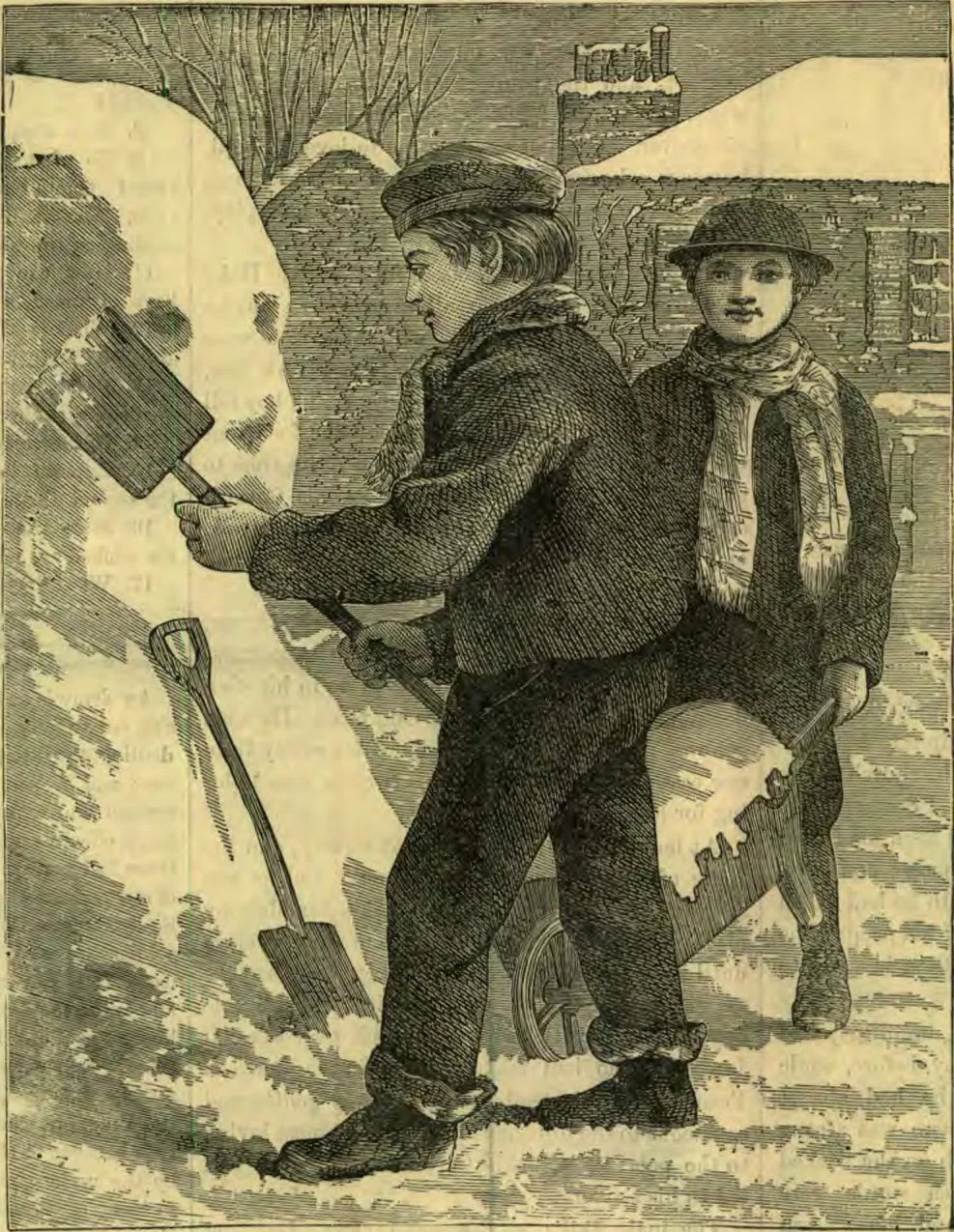
In modern times, in our own climes, Without the slightest warning, A sphinx will grow from heaps of snow, And we find it in the morning.
In the pale moonlight of a winter’s night, In a marv’lous mushroom manner, It springs to birth from the snowy earth, And flings abroad its banner.
“How came you here, O Specter queer? Your history we demand, sir. Who bade you rise before our eyes? Like the ancient sphinx—no answer. But the tracks all ’round, the bare-streaked ground, Spades, carts, and frozen mittens, Can witness well the tale they tell, Though the boys are still as kittens.
S. ISADORE MINER.

A DULL HATCHET.

“I can’t chop with this hatchet, mother,—it’s too dull for anything. We need a new one!”
“Can’t you sharpen it? I’d get you a new one if I could, but really—” and Mrs. Bennet shook her head in a way that John understood. Mother was “hard up;” and John, who since father’s death had been the man of the family, resolved to say nothing more about the dull hatchet.
“Oh, it’s not so bad as it might be,” said the boy, “and perhaps Jim Grant will let me use his grindstone, and turn for me on the next holiday.”
“It’s steel, anyway,” said Mrs. Bennet.
“To be sure, mother; you could not cut with anything but steel.”
“Oh, yes, you can; or rather, patient folks can. I’ve just been reading an account of the stone hatchets used until lately by the South Sea Islanders.”
“Tell me about it, mother, and perhaps my old hatchet will seem a great deal better.”
“In the first place, the Islander could not buy his hatchet, but had to make it. The hatchets were made out of basaltic stones, which were dug out of the earth by strong sticks, and then roughly chipped into shape with a heavy flint. Perhaps after the poor man had worked diligently for hours, the stone would break in two, and the work had all to be done again. It took several days of chipping with the flint; then a smaller flint was chosen, and the work had to be done still more carefully; and at last, when the stone was shaped into an axe, it had to be smoothed by such delicate touches as only removed fine dust.”
John drew a deep breath, as he balanced his hatchet on his hand.
“But even when smooth and shapely, the axe was not finished,” continued his mother. “Next it had to be polished with rough coral, sand, and water, and sharpened against a very hard rock.”
“And when it was done, could it cut well?”
“Well, it took several men from fifteen to thirty days to fell a tree,” she replied.
“Mother—I won’t complain of my hatchet!” and John ran off, thinking what a triumph of civilization even his little dull hatchet was.—Little Christian.

WHAT THEY FOUND.

Once the publishers of the Instructor thought they heard some little people say, “Oh dear! I wish I had a new book to read.” So they hunted around to see what could be found for them. They looked in a great many bookstores, and by and by they brought back some nice books. They said the children could have them providing—ah! that’s the trouble, isn’t it? But let us peep inside the covers; maybe we shall want some of them bad enough to do the “providing” part.
Here are three very pretty books, with red and blue and green covers, all trimmed in gilt and jet—books of travel and adventure. They are very nearly five inches wide, and seven inches long. There are about 260 pages, with from thirty-five to forty-five pictures.
One of them tells of the wonderful things to be seen in TRAVELS IN SOUTH AMERICA,—of the strange plants and animals, of the cities, of the people, and of the adventures travelers have had with the savages and wild beasts.
The second book tells us all about TRAVELS IN CENTRAL AMERICA; and the third one takes us on a JOURNEY AROUND THE WORLD, up the streets of quaint old towns, on board strange vessels, in India and China, in Calcutta and Bombay, in Persia, in Russia, around Constantinople and Athens, and many other old towns.
Who would not like to take a trip around the world, when he can do so without stirring from his own fireside; to see all that the traveler sees, without the discomfort of traveling? Any one of our little friends can take such a trip, “providing” they have a mind to work a little for it. For the publishers have promised to send any one of these very desirable books to those who will send us ten new subscribers. Do you want one of these valuable books? Who is willing to work a little to get one? W. E. L.

Better Budget.

HATTIE RANDALL, of Spink Co., Dak. Ter., writes: “I am twelve years old. I live about sixty miles from the Indian Reservation, west of the Missouri River. I have one brother, but no sister. I have taken the INSTRUCTOR three years by myself, and one year and a half in a club. I haven’t been to Sabbath-school in three years; and I never attended day school but two years and three months.”
The three years Hattie has not attended Sabbath-school, no doubt, are the three years that she has taken the INSTRUCTOR by herself, which doubtless means that she is not living near a Sabbath-school. When you write again, Hattie, please tell us if this is not so; and can you not tell us something about the Indians?
The following letter is from three young Christians, who, we trust, are trying faithfully to adorn their profession by a consistent life:—
“We three, Jennie Eriksen and Stella W. Cleary, both fifteen years of age, and Rosetta E. Wright, thirteen years old, are the three youngest sisters of a church of forty-five members, in Kossuth Co., Iowa. Some of the members have now moved away. We were brought into the truth and baptized by Eld. E. G. Olsen, who is now in Norway. Two of us were at the Iowa Camp-meeting last summer; it was very interesting. We have a prayer-meeting every Tuesday evening in private houses, and every Sabbath evening at the church. How good the Lord is in showing to his children his truth! Pray for us, that we may be faithful, and have a home in the earth made new.”

You have reached the end of this edition.

The Youth’s Instructor · Feb 25, 1885