Signs of the Times, Vol. 39, No. 18.

Question Corner

Signs of the Times

Apr 30, 1912

Pacific Press Publishing Association · Mountain View, California · Apr 30, 1912

Question Corner

"IF YE WILL INQUIRE, INQUIRE YE."
This Inquirers' Department is conducted for the purpose of helping those who are studying the Bible. The answers are oftentimes only suggestive. They are never to be considered infallible, only as they agree with the infallible Word. The writer who may answer them does not consider that his opinion is infallible. He will simply give the best that he has, and plead with the inquirer to search the Word. Such questions only will be answered as, to the editors, seem to minister to the good of the readers and to the mission of the paper. We can not answer repeatedly in the same volume questions upon the same scripture. The name and address must accompany question, not for publication, but as an evidence of good faith, and that answer may be made by letter if deemed advisable. No letters are answered which do not contain the name of the writer. It is well always to enclose stamp for reply.

3741 — The Matter of Divorce

Is it right for Christians to get divorced, if either party has not committed adultery — just to get divorced because they do not agree on everything? And after such persons get a divorce, has either one a right to marry some one else? And would it be right, if they get divorced, to marry each other again after they have become reconciled?
No Christian should get a divorce on any such grounds as that at all. We can understand how it is possible for people to get so selfish over some of the little things of life that those things fill their whole horizon. Each one is determined to have his or her way; and constant irritations and constant differences add fuel to the fire, until life seems unbearable, and a thing which began so small at first, gets to be a mountain at last, and hearts are separated and lives are separated, and the divorce court is the next thing. One of the great causes of this is that when the individuals themselves get married they do it for purely selfish purposes, the man to get a woman that just pleases him, and that will do just as he wants, and the wife to get a husband to support her, and so she can have an easy time of it, and who will respond to her whims. Such motives are wholly selfish. In the true married life there ought to be, of course, a standing for principle. The husband should not ask his wife to violate conscience in anything that he desires, nor should the wife ask the husband to do it. Conscientious convictions and scruples should be respected. If they can not agree concerning these things, they can agree to disagree. There is a general feeling on the part of every true husband and wife that the husband should stand at the head of the home, the responsible one to the world outside, the protector of his wife, the father of his children, one whose position in that respect should be respected. The wife is the head of the household within, and her wishes should be respected. She should not be considered a slave or a plaything, or one who is there simply and wholly for a husband's benefit; but he should render to her the same respect and deference in the home that he would expect as husband and the head of the family. She should have funds sufficient for her needs, just as he does for his. There should be agreement concerning this, and a proper division of income, counsel over matters concerning the home life, so that money could be expended in the best way. The wife should not have to belittle herself to go to her husband and plead for a few cents, or a dollar or so, or something of that kind, just as if she were a mere child or galley-slave. In matters of difference, each one should be willing to yield his or her own wishes, if it did not compromise conscience, or in his or her judgment seriously affect the family or themselves. A sensible Christian heart would find ways and means of passing over these little differences; and if they could not settle them in genial, kindly conversation, they would better seek the Lord over them — seek God together, and seek Him separately; try always to excuse the other, and be willing to confess faults, and differences could be healed. We believe that such differences as these should never be ground for divorce. It is a shame that Christians should permit them to be.
Secondly, we believe that it would be a perfectly proper thing for those who have been divorced from such causes, to get reconciled and married again, if they have not been married to others in the meantime. The Lord tells us that when a wife has gone from her husband and married another, she may not come back to the first husband and marry him, because such things beget shame and confusion. We hope that this is plain to our correspondent. It seems to us that the way outlined is the only true, logical, Christian, human way.

3742 — The Sin of One

Why did the whole company of Israel suffer defeat from the people of Ai because of the sin of one man, and why did his entire family suffer death by stoning and fire because of his sin? Why, in the same connection in the American revision, is the "accursed thing" called the "devoted thing"? It would seem as tho "accursed" and "devoted" were two opposite words. I have been a member of the Bible Band ever since it was started, and have received much comfort and blessing since following the readings. No. 698.
1. God would have His people understand that they are all bound together. As expressed by the apostle Paul in Romans 14, "None of us liveth to himself, and no man dieth to himself;" or in 1 Cor. 12:26, "Whether one member suffer, all the members suffer with it," etc. Cain thought to say that he was not his brother's keeper; he would throw off his responsibility by letting his brother care for himself. When the children of Israel entered Canaan, God rolled away the reproach of Egypt from them. They passed through the Jordan even as they had passed through the Red Sea, by His great power and mercy. The one thought which ought to have impressed them was to be clean from all sin. The first victory that was given them God gave wholly. The walls of Jericho were thrown down by the invisible army of God while the children of Israel were simply marching around it with the ark of God, in order that they might witness God's power.
Seemingly that victory, which was given by God alone, made them self-confident, and in substance they said: "Why, Ai is a little bit of a city; there is no need of a whole lot of us going up there. We can send simply a few men, and they will overthrow that city." What Israel ought to have done before going to Ai was to seek God to know what He would have them do. He had given them one city, doubtless He would have given them other cities in the same way that He gave Jericho. They wanted to do something of themselves, and those who were sent there and defeated may have been men who were entirely and wholly self-confident. So it may have been with all that were slain. Then, too, they ought to have sought God from the very first defeat, and learned just what was the cause. We may not be able to see all the particulars ourselves; but Israel had sinned. They were so bound together in one (and so ought God's church to be) that if one member suffered, the other members suffered because of it. If one sinned, others suffered in consequence of that sin. His family evidently were connected with him in it. We know that God is just; and we could come to no other conclusion than that his family stood with him in that sin in every respect, consequently perished with him.
2. The term "devoted" is the better term—devoted to God for whatever purpose God chose. Sometimes that purpose was destruction. So the Amalekites were devoted to destruction. Sometimes it was for use in the sanctuary service, devoted to God for that purpose; but when men perverted a thing which God had devoted, in their own service, or purpose, or work, it became an accursed thing, like all other blessings of God which are perverted; the blessing becomes a curse, righteousness becomes sin, life becomes death.
We wish that all our Bible Band readers would stay by the reading of the Band as has this dear soul. We are sure they would find it a constant blessing all the way.

3740 — The Filling Up of the Afflictions of Christ

Please explain Col. 1:24, second clause, where Paul says, "And fill up on my part that which is lacking of the afflictions of Christ." Did not Christ suffer a plenty? Did Christ leave behind all the sufferings of the 1,260 years?
We have presented before us in this very chapter the fact that Christ is the head, and the church is His body; and that as He has identified Himself with the church in all things, so the church is to identify herself with Christ. Christ has suffered for the church, and not only suffered for the church, but for the whole world; and His church can not come into true relationship with Him without also suffering for others. The whole world in a way is saved by vicarious suffering, some suffering for others. And so Christ has left His church in this world, with all its sin and evil and wo and misery, in order that that church may learn the truest fellowship with Him in the sufferings which she must undergo. You will notice that he does not simply say, "Fill up the afflictions of Christ," but "the afflictions of Christ in my flesh for His body's sake, which is the church." God calls us to suffer for others. He called Paul to do that in order that Paul might know the fulness of the blessing of Christ; and Paul yielded himself, that he might take his part of that, just as every other true Christian must yield himself. The sufferings of Christ were complete for all, in order that all might be saved from sin; but in order that all may joy in the Lord throughout all eternity, and thus enter into His joy, they must have fellowship with Him. And so Paul counts all things but loss, and pleads "that I may know Him, and the power of His resurrection, and the fellowship of His sufferings, becoming conformed unto His death; if by any means I may attain unto the resurrection from the dead," or out from among the dead. See Phil. 3:8-11.

3743 — Written in the Earth

Will you please tell us the meaning of "written in the earth," Jer. 17:13?
It would seem clearly from the Scripture itself that those who are written in the earth will perish with the cleansing of the earth. "All that forsake Thee shall be ashamed, and they that depart from Me shall be written in the earth, because they have forsaken the Lord, the fountain of living waters." Those written in the earth are those who have their hearts and hopes in the earth. Jesus told His disciples to rejoice because "your names are written in heaven." It would seem very clear that the expression marks destiny,—written in earth for destruction, written in heaven for life everlasting. Jesus tells us in John 3:3 that "except one be born from above, he can not see the kingdom of God." One's name is recorded, usually, where he is born. This is expressed in the beautiful Psalm 87: "Glorious things are spoken of thee, O city of God. I will make mention of Rahab and Babylon as among them that know Me: behold, Philistia, and Tyre, with Ethiopia: this one was born there." And those born in the earth and of the earth, and of these cities, and having their hearts here, would perish with their treasures. But the psalmist continues: "And of Zion it shall be said, This and that man was born in her: and the Highest Himself shall establish her. The Lord shall count, when He writeth up the people, that this man was born there."

3744 — Sodom and Samaria

What is meant by the captivity of Sodom and Samaria and Israel referred to in Ezekiel 16, and what does a return to their former estate signify?
Simply to the resurrection by which all the wicked of earth will be brought back and judged. God judges not for things that come after death, but for things which precede it; and when the Lord brings back for executive judgment those who have dwelt here upon the earth, they stand as they stood when they passed from life.
Schedule for Week Ending May 11, 1912
Sunday May 5 2 Chronicles 11-18
Schedule for Week Ending May 11, 1912 Sunday May 5 2 Chronicles 11-18

Schedule for Week Ending May 11, 1912

Sunday May 5 2 Chronicles 11, 12 Monday " 6 " 13, 14 Tuesday " 7 " 15, 16 Wednesday " 8 " 17, 18 Thursday " 9 " 19, 20 Friday " 10 " 21, 22 Sabbath " 11 Psalms 35, 36

Lessons From Second Chronicles

Our readings for the week lie wholly within Second Chronicles, save the Sabbath lesson. They begin in Rehoboam's reign, just after the revolt of the ten tribes, which he thought to bring back, but was prevented by the prophet Shemaiah. The loss was the fault of the king himself. Fearing Israel's attack, he built fortresses and strengthened the cities of Judah greatly. He at first humbled his heart before God, and afterward forsook Him. But finally he departed from God, and became a tribute vassal of Egypt.
Jeroboam, who might have been a king of good influence, became mighty for evil in the false worship of the golden calves, to which Chronicles only refers. He might have been a power for good, but his choice of evil was a curse to Israel to the end.
In Judah the reign of Rehoboam was followed by the good reigns of Abijah, Asa, and Jehoshaphat, and the weak reigns of the wicked kings Jehoram and Ahaziah, who fraternized with the wickeder house of Omri.
There are two great lessons, profitable for us, given to Asa and Jehoshaphat regarding union with unbelievers and dependence upon men. Our history lesson closes with the introduction of wicked Athaliah.
Psalm 35 does not express David's disposition or revenge, but God's justice. Psalm 36 is especially comforting and helpful.

Man in the Judgment

By Charles L. Taylor
We shall all stand before the judgment-seat of Christ. Rom. 14:10.
FROM the very beginning, when God's great life plan was first unfolded to man, it has been apparent that ultimately there must come a day when man shall render an account to his Maker. Probation presupposes final examination.
Nor should it be overlooked that, as probationary testing and trying have for their great object the development of godlikeness in matter of character, the supreme question of the final great day will be, What is the character?

Character Defined

But character is only the summing up of life. The original word signified "an instrument for marking, to cut into furrows, to engrave." Webster defines it as "the peculiar quality or sum of qualities, by which a person or thing is distinguished from others; the stamp impressed by nature, education, or habit; that which a person or thing really is." Also, "moral quality; the principles and motives which control the life."
Character, then, is only what one is as a result of what one does. Principles of right or wrong, motives of good or ill, find expression in life actions; actions repeated become habits; habits added together are character. Moral quality, what one really is, places its mark, its stamp, its impress, upon all deeds; and these in turn, by the law of reflex action, serve to deepen the channels, and fix the flow of the life current, whether it be good or bad.
Life results alone will come in review at the day of final accounting. Whatever man is at that time will tell the complete story of all that has gone before. If, as earth's inhabitants are brought face to face with "the Judge of all the earth," it is seen that in some there is nothing eternal or enduring, it will be recognized as prima facie evidence that during their earthly sojourn they have not been connected with eternal sources of life.

Only Eternal Morals Admitted

God is eternal. Deut. 33:27. His kingdom is everlasting. Dan. 7:27. To admit into that realm subjects who have characters that are not enduring, who have morals that are not eternal, who have life that is not everlasting, would be to destroy the realm and overthrow its Ruler.
The great ticket of admission into the heavenly country is a Christ character. Admission privileges are granted absolutely only beyond the judgment. As all are brought before the judgment-seat of the Christ, brought into the actual presence of the great Pattern, and character comparisons are made, then and then only will it be known fully who truly conforms to the great standard. Life measurement will then be [[FIGURE]] made; and those whose lives show the eternal length and the eternal quality, will enter into all fulness of life and immortality. They who have willingly and continuously borne the Spirit seal here, will forever bear that same seal, or mark, there.
The illustrations of Jesus give us clear views of this matter of life and character. In the figure of the sheep and the goats (Matt. 25:31-34), there is brought out most vividly the thought of character. How different is a sheep from a goat! And to those represented by the sheep He will say, "Come, ye blessed of My Father, inherit the kingdom prepared for you from the foundation of the world." The great life plan announced in Eden; the great character plan, with its eternal life power and resultant immortality; the blessed plan of obedience to divine law and rulership in God's earth kingdom,—this great plan is recognized and serves as the basis for decision at the last day.

The One Open Door to Immortality

Father Adam will be there, and will bear testimony to the truth that "the wages of sin is death; but the gift of God is eternal life through Jesus Christ our Lord." His very presence among the hosts of the redeemed will be standing evidence that God's life received, God's law obeyed, God's testings endured, God's mark impressed, God's character manifested, and all this known only by faith, is the single open door to immortality.
The account of the wedding-garment also throws much light upon this momentous life question. See Matt. 22:8-13. Among the many invited guests who came to the royal function, there was one "which had not on a wedding-garment; and he saith unto him, Friend, how camest thou in hither not having a wedding-garment? And he was speechless. Then said the king to the servants, Bind him hand and foot, and take him away, and cast him into outer darkness." Without the garment of righteousness (Rev. 19:7, 8), no one can find place in the kingdom of life, for righteousness is life. In that country only life can meet life.
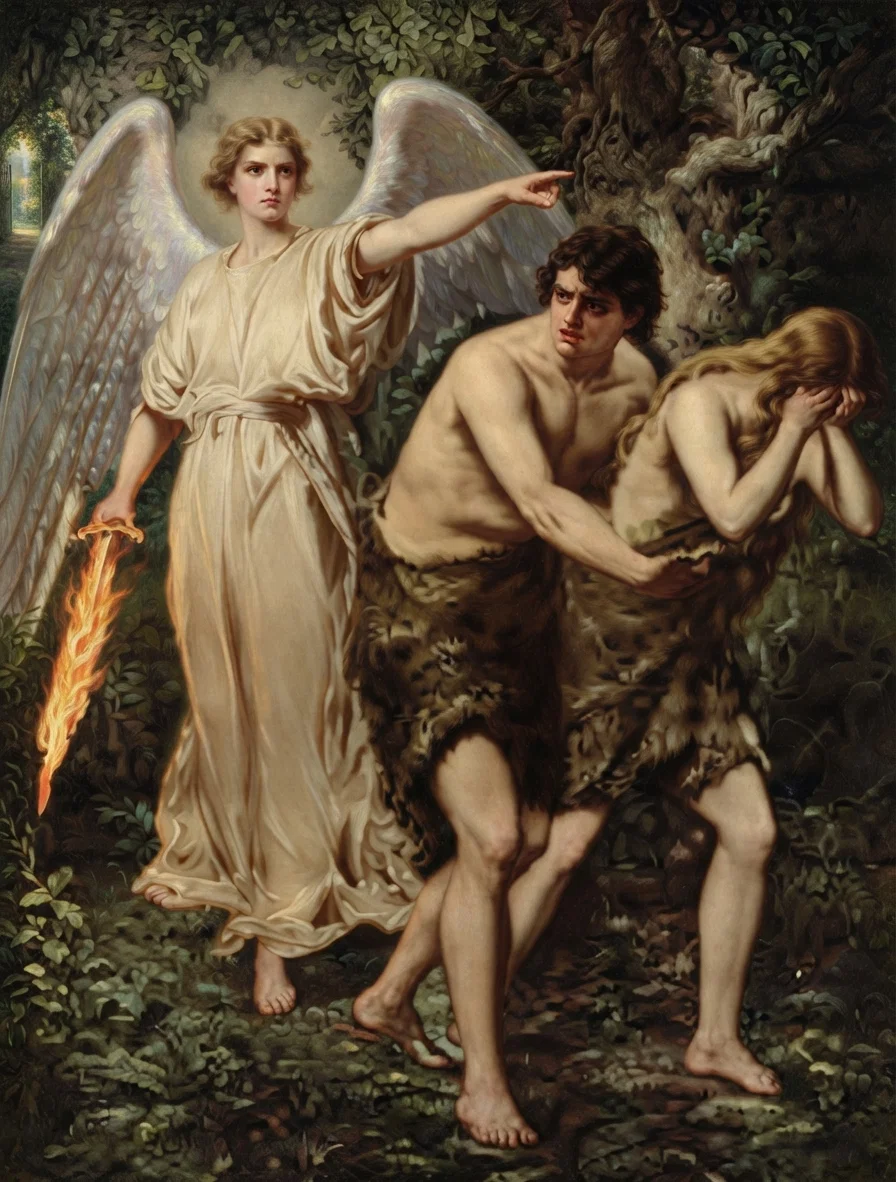
"Blessed are they that do His commandments, that they may have right to the Tree of Life, and may enter in through the gates into the city." God's Eden will be restored to man. The redeemed of the ages will again find access to the tree from which, by cherubim with flaming sword, they were one day driven away. But what opens the gate for their return?—Ah, nothing less than obedience to the great law of life to which Adam had been disloyal. God's everlasting law obeyed through the everlasting faith of the Son of God, gives clear title to an everlasting life in everlasting habitation.

Treasured Principles of Everlasting Life
This is the great reason why God's law is the standard of the judgment. Eccl. 12:13, 14. Within its bosom are treasured all the principles of everlasting life. To dwell in that law is to dwell in life. That law, written in the heart and mind, makes one know God. Heb. 8:10, 11. That law translated into flesh and allowed to operate in the daily life makes one a child of God. John 1:12-14; 1 John 3:2. That law was the life of Jesus Christ, and was by Him drawn out "in living characters." Thus, standing "before the judgment-seat of Christ," men are only standing in the presence of the divine statutes, and by them tested.
O, let it be known and heralded everywhere that God's ways are ways of wisdom. Just and right are all His plans. Nothing greater, nothing better, nothing more noble, could there be than His plan by which man shall be quickened, purified, and prepared for an eternal and immortal hereafter. And as righteousness of character alone is enduring, as it alone can finally receive the benediction of immortality, let us with all the heart submit our lives to our blessed Lord, and allow Him, by daily testing and helping, to bring our whole experience into harmony with God's eternal law of life and truth, and thus into perfect conformity with Himself, who is our everlasting Pattern.
“By cherubim with flaming sword, they were one day driven away”

The Resurrection of Christ

I HAVE been used for many years to study the history of other times, and to examine and weigh the evidence of those who have written about them, and I know of no fact in the history of mankind which is proven by better and fuller evidence of every sort, to the mind of a fair inquirer, than the great sign which God has given us, that Christ Jesus arose from the dead.—Arnold.

The Almighty to Save

"Come Ye Yourselves Apart, . . . and Rest a While"
And the apostles gathered themselves together unto Jesus, and told Him all things, both what they had done, and what they had taught. And He said unto them, Come ye yourselves apart into a desert place, and rest a while; for there were many coming and going, and they had no leisure so much as to eat.
The disciples had just returned from their first missionary tour. They came to Jesus and told Him all things. Their intimate relationship with Him encouraged them to lay before Him all their favorable and unfavorable experiences, their joy at seeing results from their labors, and their sorrow at their failures, their faults, and their weaknesses. They had committed errors in their first work as evangelists; and as they frankly told Christ of their experiences, He saw that they needed much instruction. He saw, too, that they had become weary in their labors, and that they needed to rest.

The Almighty to Save

But where they then were they could not obtain the needed privacy; "for there were many coming and going, and they had no leisure so much as to eat." The people were thronging after Christ, anxious to be healed, and eager to listen to His words. Many felt drawn to Him; for He seemed to them to be the fountain of all blessings. Mercy and truth and the very essence of love were expressed in His words. He was indeed the very fountain of all good, able to meet all the necessities of a fallen world and of a tried church. No one appealed to Him in vain. All that poor, suffering, helpless sinners need, is found in Him. He is not only mighty, that does not fully express it, but almighty to save, ready to take the sinner's load of guilt, and impute to him His righteousness.
The physical restoration of every soul that came to Christ to be healed is an assurance that He is fully able to take away sin, and to heal the diseased soul. He is "the Lamb of God, which taketh away the sin of the world." Many of those who then thronged about Christ to receive the precious boon of health, accepted Him as their Saviour. Many others, afraid then to confess Him, because of the Pharisees, were converted at the descent of the Holy Spirit, and before the angry priests and rulers, acknowledged Him as the Son of God.
But now Christ longed for retirement, that He might be with His disciples; for He had much to say to them. In their work they had passed through the test and trial of conflict, and had encountered opposition of all kinds. John the Baptist had just been beheaded; and his disciples, full of grief at his death, had taken up his body, and laid it in a tomb, and had then come and told Christ.
Hitherto the disciples had consulted Christ in everything; but for some time they had been alone, and at times they had been troubled to know what to do. They had found much encouragement in their work, for Christ did not send them away without His Spirit, and by faith in Him they worked many miracles; but they needed now to feed on the Bread of Life. They needed to go to a place of retirement, where they could hold communion with Jesus, and receive instruction for future work.

Duty to Rest

"And He said unto them, Come ye yourselves apart into a desert place, and rest a while." Christ is full of tenderness and compassion for all in His service. He would show His disciples that God does not require sacrifice, but mercy. They had been putting their whole souls into labor for the people, and this was exhausting their physical and mental strength. It was their duty to rest. Christ called them to rest that they might spend a few hours with Him. How thoughtful and tender was His love and care for them!
"And they departed into a desert place by ship privately." With His disciples, Jesus crossed the water, and chose a retired place away from the cities, away from the thoroughfares of travel, at a little distance from the lake, where they would be in seclusion, and away from the bustle and agitation of the city. The scenes of nature were in themselves a rest, a change grateful to the senses. Here they could listen to the words of Christ without hearing the angry interruptions, the retorts and accusations, of the scribes and Pharisees. Here they could enjoy a short season of rest and precious fellowship in the society of their Lord.
The rest which Christ and His disciples took was not self-indulgent rest. The time that they spent in retirement was not devoted to pleasure or frivolous amusement. They talked together regarding the work of God, and the possibility of bringing greater efficiency into the work. The disciples had been with Christ, and could understand Him; to them He need not talk in parables. He corrected their errors, and made plain to them the right way of approaching unbelievers. He opened more fully to them the precious treasures of divine truth. Important truths from the inexhaustible storehouse were presented to them. They were vitalized by divine power, and inspired with hope and courage.

Spoken for To-Day

Christ's words of compassion are spoken to His workers to-day just as surely as they were spoken to His disciples. "Come ye yourselves apart, . . . and rest a while," He says to those that are weary. He does not urge us to work to the utmost of our strength. We are to remember that there is important work to be done on the morrow, and for that reason we are to take care of our physical powers. There is much work to be done, day after day; but we must not strive to load ourselves with more burdens than we can carry.
Altho we are required to be self-denying, to make self-sacrificing efforts, yet God has fixed a limit. His workers are to show no presumption. God does not require His servants to ruin their health by continual taxation. This is not the fast that will glorify God. The mind can not act healthfully if the worker weakens his physical machinery by overexertion. God would have all study the laws of health, and then use reason when working for Him, that the life which has been given may be preserved.
The religion of Jesus Christ requires every human being to obey the laws of the physical organism. We may be fitted for the labors of to-morrow by the judicious exercise and care of our powers to-day. The servants of Jesus Christ are not to treat their health indifferently. The Lord remembers that we are but dust, and He does not expect more of us than we can do.
Let no one labor to the point of exhaustion, thereby disqualifying himself for other duties. Do not try to crowd two days' work into one. All should use their strength wisely, and at the end those who work carefully and wisely will be found to have accomplished as much as those who so expend their physical and mental strength that they have no deposit from which to draw in a time of need.

Take Time to Rest

God's work is world-wide; it calls for every jot and tittle of the ability and power that we have; but there is danger that God's workers will abuse their powers as they see that the field is ripe for the harvest. But God does not require this. After they have done their best, they may say, "The harvest truly is great, and the laborers are few; but God knoweth our frame; He remembereth that we are dust."
Christ's workers should take time to rest. I speak not this to those that are constitutionally tired, those who think they are carrying heavier burdens than any one else. Those who do not labor, have no need of rest. Those who can not show that they have been using their spiritual and physical powers for God, working earnestly and thoroly for Him, with mind, and soul, and strength, are not in need of the sympathy that Christ gave to His disciples. It was to those who were worn down in His service, not those who were always sparing themselves, who did no earnest, self-sacrificing work, that Christ addressed His tender, compassionate words. And to-day it is to the self-forgetful, those who work to the very extent of their ability, who are distressed because they can not do all they would do, and who in their zeal go beyond their strength, that Christ addresses the words, "Come ye yourselves apart, . . . and rest a while."
The disciples sought Jesus, and told Him "all things;" and He comforted and encouraged them. If to-day we would take time to go to Jesus with our troubles, we should be stronger. We should not be disappointed; for He would be at our right hand, and we should not be moved. We need more simplicity, more trust and confidence in our Saviour. "Ask, and it shall be given you," He has promised. "Come unto Me," He says, "all ye that labor and are heavy-laden, and I will give you rest. Take My yoke upon you, and learn of Me; for I am meek and lowly in heart: and ye shall find rest unto your souls."

The Pool of Siloam

By T. L. Waters
"Go, wash in the Pool of Siloam." John 9:7.
When the eyes of the spirit by sin are made blind, And groping for truth, no light can it find; When the darkness of error envelops the mind, And chains of tradition the inner man bind; Then go to the Pool of Siloam and wash.
When spiritual darkness the whole man enfolds, And creeds and confessions your actions control; When for Paul and for Cephas your thoughts you are giving, And your church to build up you are mightily striving; Then go to the Pool of Siloam and wash.
That pool is the Light of the world,—'tis God's Word, Whose truth must enlighten, and break the strong cord That fetters the spirit, that darkens the mind; 'Twill loosen the cords by error entwined, When you go to the Pool of Siloam and wash.
The works of our Saviour are manifest made, When the sword of the Spirit, with its mighty blade, Cuts us loose from the darkness which did truth disguise, And with power from above enlightens our eyes, When we go to the Pool of Siloam and wash.

A Misconception and Perversion

By Glenn K. Emmert
A FUNDAMENTAL misconception of society seems to be held by many leading religious men of the times. And this misconception manifests itself in practically all the present religio-political movements.
Government is primarily a contrivance to restrain evil men from their lawlessness, and to make those civil who will not be moral. In their blind, selfish desire to live by a rule that works wrong and injury to their fellows, they must be restrained. To restrain these predatory ones, and thus protect the jeopardized rights of the rest, is the truest office of government. Even the effort of a government to preserve its own continuance, that "first law of self-preservation," has no pre-eminence over this; it becomes a means to an end, the protection of individual rights. This may be a more or less commonplace ideal of government and of government's relation to society, but it has gained a good report wherever and whenever it has been in vogue. It works good and not evil. It secures equal consideration to the lowliest as well as to the highest member of society. As much of freedom, order, and justice as are attainable in our imperfect world are gained by this system.
But this leaves the State very simple in its purpose. It is not a soaring, ambitious system of control that would embrace every aspiration and duty known to mankind. It does not make the State a personal entity having moral responsibility; which it is not, as to the first, and can not have, as to the second.
Now there are impulses and purposes to whiten the aspect of society, to clear its blackened name, through influences that are planned to be exerted in the political field of society, through the institutions and departments of government. A new expression of this is the impulse, scarcely yet a movement, to bring the system of high schools into "vitalizing touch with Christianity," to make them a force to tell for Christian righteousness, since they are part of the political system.
And back of this all is the idea that the State, which is the political expression of society, should be the fostering parent, of moral reform. A consequence quick to follow is the plan for which numerous institutions, clubs, etc., are working,—for the State to direct the recreations of its young men so as to save them.

A Misconception

That the religious forces, addressing themselves to the morality of man; and the civil power, coercing to obedience; and all of society in its broadest sense, are parts of one whole system, is a misconception of things as they are or as they should be. But this misconception of the relations of Church and State is advanced as the basis of coming reform. The character of all the institutions of society is to be molded anew.
But the fatal point is that these leaders in social reform seek to take over in the Christian name the various institutions and social activities of this world. They seek to vitalize the community with religion, and thus to save the people to "the best that is in them," in the same large and easy way that they were lost.
But over all this splendid false dream God has written "Babylon." From Abraham to Lot, from Moses to the last converted soul that walks in newness of life, God has bidden them to separate from the life of the community wherein it was bad, and the old associations. The institutions of society were not brought over and reformed. All the clubs and pool-rooms, all the institutions of government, were relegated to the junk heap so far as the saving of any one was concerned.
It is still the same. The Lord works effectively through the yielded mind of the sin-stricken soul. But the human way of salvation is ever to reverse God's order, and that is ultimately to lose the soul, and incidentally to subvert the society, their agent of reform.
Continue reading: The Sanctuary
