The Youth’s Instructor, Vol. 31, No. 27.

THE SMITHSONIAN INSTITUTE

The Youth’s Instructor

Jul 4, 1883

S. D. A. Publishing Association · Battle Creek, Mich. · Jul 4, 1883

THE SMITHSONIAN INSTITUTE.

I WONDER how many of the INSTRUCTOR family have ever visited the city of Washington, the capital of our Union. Those who have not will be interested in a description of some of the public buildings which are situated there, and those who have seen these buildings may be glad to have their minds refreshed in regard to them.
We can speak particularly of only one of them this time, though we cannot pass the Capitol, with its halls where assemble three or four hundred senators and representatives, without quite a sacrifice of feeling; for what American youth has not felt an ambition to secure a seat among these distinguished statesmen when he becomes a man? But we hope the INSTRUCTOR boys are ambitious to secure a higher place than any that can be conferred upon them in this world, and one which cannot be taken from them,—a place in the kingdom of heaven.
Then there is the Patent Office, with its hundreds and thousands of miniature models of labor-saving machines. No doubt a description of many of these would be interesting to the boys; for we doubt if ever there was a boy who did not have an idea of making a patent something sometime. But we will let the boys examine these for themselves if they ever have the good fortune to visit the Patent Office, while we proceed to the description of another institution which will be fully as interesting if not more instructive.
In the heart of the city, and entered from the open street, are fifty-two acres of ground laid out with all the skill of which the landscape gardener is capable, and planted with more than one thousand and four hundred different varieties of native shade trees. Wandering through these grounds, and listening to the songs of wild birds in the branches of the trees which are found in his native state, one almost fancies himself strolling through the woodlot of his father's farm instead of being in the heart of a great city.
In the middle of these grounds is a large public building, which, in the style of its architecture, is different from any other public building in Washington. It is built of reddish brown stone, and is in striking contrast with the marble walls of the other public structures of the national capital. This building contains a library, a gallery of art, lecture rooms, etc. Beside this building is another, larger in size, but not so strongly built. The latter contains the national museum, which is noted for the extent and variety of its collections.
These buildings, together with the grounds, constitute the Smithsonian Institute. But what is the design of this institution, and how came it to be founded? I will tell you.
James Smithson, an Englishman who had devoted his entire life to the study of science, at his death bestowed upon the United States his entire fortune, amounting to $519,169, for the purpose of founding at Washington an establishment for the increase and diffusion of knowledge among men. This was to be known as the “Smithsonian Institute.” The terms of this bequest were made known to Congress in 1835, and three years later the amount was deposited with the government, where it remained on interest at six per cent till 1846, when it was finally decided how the money should be used. In the meantime the interest had amounted to $242,129, and it was thought that by extending the work over a series of years, it might be done with this interest money, thus leaving the original fund as a perpetual deposit. Acting upon this plan, the grounds were purchased and improved, and buildings constructed, the entire cost being about $325,000. The managers were thus enabled to save about $140,000 of the accrued interest. This was added to the original fund, which thus amounted to $655,000. The annual income from this amount is about $40,000, which is used in carrying out the plan of its founder.
The control of the institution is left to a board of regents composed of twenty-two members, among whom are the president of the United States and his cabinet, the chief justice of the United States, and other distinguished men. It is the duty of this board to make reports to Congress of the progress and workings of the institution; but the real manager is its executive officer, the secretary of the institution. Prof. Joseph Henry, of Princeton College, N. J., was selected to fill this office, and on the 21st of December, 1846, he entered upon its duties, which he continued to discharge until his death in May, 1878.
Prof. Henry was known no less for his kind and pleasant manner than for his great learning, for there was hardly a child in Washington who did not know him. He has so wisely carried out the design of the founder that under his management the institution has attained a high degree of perfection. Space will not permit a description of the plan upon which the institution is conducted, and we will close by giving the rule adopted by Prof. Henry soon after entering upon the duties of his office. It is this: “This institution will do nothing which can be equally well done by any other similar one.” EUGENE LELAND.

ONE OF OUR GRANDMOTHERS.

SEVENTY-FIVE years ago there lived in Connecticut a little girl by the name of Prudence. She was unlike some girls who lived then, and many who live to-day—unlike them in this, that she loved others almost as well as she loved herself, and did not try to please herself first and only and always.
She was not made any differently from the rest of us, but it must be that she learned when very young the secret that makes people unselfish; everybody does not know it.
However it be, she loved to help all who were in trouble. It would take too long to tell the kind and unselfish things she did when she was a little girl; of all the poor kittens she saved from being tormented to death by bad boys; of the birds she pleaded for when the hunters’ guns were abroad; of the ill-used, persecuted schoolmates she stood up for when they were picked and jeered at by the others.
She was a bright, strong girl, afraid of nothing and nobody; so many an unhappy child who was treated to taunts and sneers or rude neglect by her mean spirited schoolmates, was made glad when Prudence Crandall became her champion; for if anything roused Prudence to the very highest pitch of indignation, it was to see the strong trample upon the weak; and when she was thoroughly aroused, the other boys and girls had to “step around.”
She loved her books for the sake of “knowing things,” and when she had marched right through everything that was taught in the village school, her father sent her away to the very best school in the country. By the time she was twenty, she was not only a well-informed, but an accomplished young woman. She could speak in foreign tongues, and play brilliant music, as well as solve hard problems in mathematics.
Now all this knowledge must be used, for a New England girl could not allow anything to go to waste; so she resolved to become a teacher.
She went to Canterbury, and opened a boarding school for young ladies.
It prospered finely, for most things that Prudence set her hand to prospered, until one day a colored girl came, and asked to be allowed to attend school. She wanted to fit herself for a teacher among her own people.
Of course she could come. Was not that one of the very purposes Miss Prudence was created for,—to help the poor and oppressed?
Sarah Harris was the name of the girl whose skin was a trifle darker than some of the pretty brunettes in Miss Crandall’s school. She had been a slave, but was made free, and came North. She longed to get an education, for she did not feel as some felt about her, that she was fit only to be a slave.
She was neatly dressed and quiet; very willing to sit at her desk and study all day long, without a kind word from any of the other girls. She was only too happy to be there under any circumstances.
Not many days passed, though, before there was a stir and a flutter. Some people were not willing that their daughters should go to school with a colored girl, and one by one they dropped off, until the colored girl had the school all to herself.
Then Miss Prudence said: “Very well; if we can’t have a white school, let us have a black one.”
So she forthwith opened a school for colored girls only.
This made a greater stir than ever. The selectmen called a town meeting, and some of the foremost men of the town passed resolutions that it was wrong to teach colored children to read and write, and that the school ought not to be allowed to go on. Then they went to the Legislature, and got a law passed that nobody should teach colored children without getting permission of the people of the town.
Miss Crandall did not give up her school, though, and the next thing she knew she was in jail, shut up in a cell!
However, her friends got her released till it was time for the trial.
She was determined to do what little she could, so she went on teaching; but she had a sorry time of it.
When she met people in the street who knew her very well, they looked the other way. One day she wanted a drink of water, and she stopped into a neighbor’s yard to fill her pitcher at their well. What was her surprise when they told her that she could have no water from their well! But brave Miss Prudence could stand that; she could do without water from that particular well, even if it was cold and sweet, and that in her own well was bitter.
It was a little harder to bear, though, when the “storekeepers,” as they used to call them in those days, refused to sell anything to her, and harder still when, one evening after a long day’s work in school, she had a violent headache and sent to the doctor’s for some medicine, and he would not give her any! They would not even let her go to church if she brought any “niggers” with her, as they called them.
Times are changed now, of course, and even boys and girls have studied Webster’s Unabridged, and know that the word “nigger” does not of necessity mean a colored person; they may be black, and they may be white.
At last the trial came on. The brave girl stood up before the judge and jury to be tried. But the lawyers and the judge and the jury got all snarled up; they could not agree; some said the law was unconstitutional. (Ask your father what that means.) So it all amounted to nothing, and she was free again.
Back she went to her school. But the people were just as determined as she. Some of the rough bad ones came at night and set her house on fire. She found it out in time, though, and put it out.
At last, one dreadful night a mob came, and broke down her doors and windows; then she had to give up, and send away her scholars.
It is hard for us to see how good men and women, as many of them were, could be so blind and mistaken, but prejudice can do strange things; the meaning of the word, you know, is “An unreasoning predilection for or against anything.” If you do not know the meaning of that long word, look it up. Let us hope, though, that none of our grandfathers were among those who persecuted noble Prudence Crandall.
Whoever did it, if they were living to-day, would be ashamed of it, when they see the great change in the spirit of the people, and know all about Fisk University and Lincoln University, where many colored men and women have graduated and become teachers and preachers. How astonished they would be to know, too, that all the colored people in the United States are free, and that one of them has a seat in the United States Senate. —Mrs. C. M. Livingston.

THERE'S DANGER.

Write it on the liquor-store, Write it on the prison-door, Write it on the gunshop sign, Write—ay, write this truthful line: “Where there's drink, there's danger.”
Write it on the workhouse-gate, Write it on the schoolboy's slate, Write it in the copy-book, That the young may on it look: “Where there's drink, there's danger.”
Write it on the churchyard-mound, Where the drink-slain dead are found; Write it on the gallows high, Write it for all passers-by: “Where there's drink, there's danger.”
Write it underneath your feet, Up and down the busy street; Write it for the great and small, In the mansion, cot, and hall: “Where there's drink, there's danger.”
Write it on the ships which sail, Borne along by storm and gale; Write it in large letters plain, O'er our land and past the main: “Where there's drink, there's danger.”

THE YOUTHFUL MARTYR.

In the days of the young king, Edward VI., a Bible was placed on a desk in every church in England for the use of the people. But when Queen Mary, a stern papist, ascended the throne, she quickly ordered the removal of the Bibles. In a few places her commands were not received, or not obeyed, and so it came about that there still lay the old Bible on a stand just inside the porch of the church at Brentwood, in Essex.
It was in the spring of the year 1555, when a youth named William Hunter entered the church to read the book he loved. He was an apprentice to a London weaver, but was now on a visit to his native town. As he stood reading the holy book, a man of the name of Atwell, an officer of the popish bishop, came that way, and saw him so engaged.
“Why meddleth thou with the Bible?” said the officer. “Knowest thou how to read? and canst thou expound the Scriptures?”
The youth modestly replied, “Father Atwell, I take not upon me to expound the Scriptures; but finding the Bible here, I read it for my comfort.”
The officer then began to speak scornfully of the sacred word as a hurtful book.
But as Atwell could not prevail with the lad, he cried, “I see you are one who dislikes the queen’s laws. I have heard how you left London on that account; but if you do not turn, you, as well as many other heretics, will broil for your opinions.”
“God give me grace,” meekly replied William, “that I may believe his word, and confess his name, whatever may come of it.”
“Confess his name!” shouted old Atwell. “No, no; you will go to the evil one, all of you.”
Atwell quickly left the chapel, and meeting a priest, returned with him to where William was reading; when the priest began to upbraid and threaten him. The youth well knew what this meant; so he hastened to his father’s house, and taking a hasty leave of his parents, fled from the town.
A few days after William had gone, a justice sent for the father, and ordered him to produce his son, and upon this errand the poor father was obliged to depart. He rode about for two or three days, hoping to satisfy the justice without finding his son. The lad, however, saw his father at a distance, and went to meet him. On learning the danger of his parent, he said he would return, rather than place his father in any peril.
Early the next morning, William was taken before a justice of the peace, who ordered him to be carried to the old palace in the fields of Bethnal Green, where Bonner, the popish bishop of London, then resided. When he stood in the hall of the palace, the bishop first spoke to him gently, then sternly, and then roughly; but still the youth would not promise to give up the Bible. “Away with him, then, to the stocks!” cried the bishop.
To the stocks William was hurried. Two long days and nights he there lay, without any food except a crust of brown bread and a small supply of water.
The bishop then sent William to one of the London prisons, with strict orders to the jailer to put as many iron chains upon him as he could possibly bear. And in a dungeon he was confined for three quarters of a year, hoping, trusting, praying always.
Bishop Bonner one day thought of the Bible-loving lad in prison, and sent for him to his palace.
“If you recant,” said the bishop, “I will give you forty pounds ($200), and set you up in business.” This was a large sum of money in those days, and the offer was very tempting, but it was at once rejected.
“I will make you steward of my own house,” added Bonner, in a gentle and crafty manner.
“But, my lord,” was the reply, “if you cannot persuade my conscience by Scripture, I cannot find in my heart to turn from God, for the love of the world; for I count all worldly things but loss in comparison with the love of Christ.”
“Will neither threats nor promises avail? Then away with him to the fire!”
There was no prison in the little town, so the martyr youth was confined in an inn, and guarded by constables. His mother heard of his return, and with true love rushed to the place where he lay. And when she found him happy and content, she blessed God for such a son, and the more so when he said: “For the little pain which I shall suffer, Christ hath procured for me a crown of joy; are you not glad of that, mother?”
They then knelt down, and she prayed to God to strengthen her poor boy to the end.
At length the morning came that William was to die. As the young martyr was led along from the inn, his father rushed forward toward him in agony of parental feeling. Throwing his arms around the neck of his noble boy, he said, with flowing tears, “God be with thee, son William.”
The son replied, “God be with you, father; be of good comfort; I trust we shall meet again where we shall rejoice together.”
The fire was now lighted; and as the flames began to rise, William, who still held in his hand a book of Psalms, threw it into the hands of his brother, who had followed him to the place of death. His brother, calling to him, said, “William, think on the sufferings of Christ, and be not afraid.”
“I am not afraid,” replied the martyr. “Lord, Lord, receive my spirit.” These were his last words. The fire was lighted; the dry fagots burned briskly; and the flames soon wrapped around his body. In a few moments his sufferings were at an end forever.—Historical Tales.

DO IT NOW.

Lose this day loitering, ’twill be the same story To-morrow, and the next more dilatory. The indecision brings its own delays, And days are lost lamenting o’er lost days. Are you in earnest? Seize this very minute! What you can do, or think you can, begin it! Boldness has genius, power, and virtue in it! Only engage, and then the mind grows heated; Begin it, and the work will be completed.

WEARINESS IN WELL-DOING.

You are a parent, and you have been laboring and praying for years for your child's salvation, yet you do not see the hoped-for result. You are a teacher, and although you toil with all your might, you do not notice any impression on the lives of those you teach. Or you are a preacher, and you preach with all diligence and faithfulness; but men do not turn to the Lord, and you are heavy-hearted, and sometimes tempted to give it all up in despair.
But do you really know that your work is not blessed? Do you know that there are no results? Things are not what they seem. The quickest, most evident successes, as they appear to us, are often in reality the worst failures. The least comes of them in the end. In Christian work we have frequently to discount sudden and tropical growths, or at least to fear for their genuineness and permanence. The quiet and gradual growth is usually the truest.
We cannot measure spiritual results as we can those which are physical. The artist sees the picture growing upon his canvas as he works day by day. The builder sees the wall rising as he lays stone upon stone. But the spiritual builder is working with invisible blocks, is rearing a fabric whose walls he cannot see. The spiritual artist is painting away in the unseen. His eyes cannot behold the impressions, the touch of beauty, he makes.
Sometimes the results of work on human lives may be seen in the expansion and beautifying of character, in the conversion of the ungodly, in the comforting of sorrow, in the uplifting and ennobling of the degraded; and yet much of our work must be done in simple faith, and perhaps in heaven it will be seen that the best results of our lives have been from their unconscious influences, and our most fruitful efforts those we considered in vain.
The old water-wheel turns round and round outside the wall. It seems to be idle work that it is doing. You see nothing accomplished. But its shaft runs through the mill-wall, and turns a great system of machinery there, and makes bread to feed many a hungry mouth. So we toil away, many of us, and oftentimes see no rewards or fruits. But if we are true to God, we are making results somewhere for his glory and the good of others. The shaft runs through into the unseen, and turns wheels there, preparing blessings and food for hungry lives. No true work for Christ can ever fail. Somewhere, sometime, somehow, there will be results. We need not be discouraged or disheartened, for in due time we shall reap if we faint not. But what if we faint?—Week-day Religion.

“HE NEVER SAY ANYTHING THAT HURT.”

Shall I tell you a little about the good old man of whom these words were said? When a boy and a young man, his home was on a New England farm. But, when he was ready to preach the gospel, he started for the Hawaiian Islands, where his grand life-work was to be done. Forty-eight years ago he was on his way from Boston to the Island,—a six months’ voyage then, instead of the pleasant trip of less than three weeks that it is now.
I cannot tell you here the story of his life, only give you one happy thought from its close. He was called “Father Coan,” in these late years, by a large circle of friends; and you would say the name belonged to him, if you could have seen his happy face and kindly ways. He had seen the winters and summers of more than eighty years; and hundreds looked up to him as their spiritual father, the one who had taught them of our Father in heaven, and brought to them the knowledge of his love.
Early last December, before the time for Christmas gifts and greetings, the Saviour had given rest to his toilworn servant, whose life had been so faithfully spent in his service. The friends who had ministered to him and been comforted by him, could not mourn for him who had gone in such peace and joy from earth, for he was like a shock of corn fully ripe; but tears fell as they spoke together of what he had been to them, and how much they should miss him.
There was a Portuguese and his wife, who had been for many years in his employ; and the woman, in telling how much they loved him, said,—
“He never say anything that hurt.”
Wasn’t this a happy memory to leave, and a happy truth to know while he was yet with them?
Perhaps some bright-eyed boy is thinking, “Well, he was an old man. Boys cannot be so careful.”
No doubt it is true that in his many years of “learning of Jesus” he had grown in self-control and quietness of spirit, as well as in likeness to his Master in other ways. But the kind thought for others, that so guarded the door of his lips, is not beyond the reach of the youngest child who reads this story. I could tell you of one who went to his grave in the strength of his young manhood, after only a little more than twenty years of life here; and, in them all, from happy baby days till his last hours he did not leave, for those whose love held him the nearest, the memory of one unkind word or deed. Bright and sunny, and strong and brave, with willing hands to help as well as heart to care for others, he was such a glad-hearted boy as boys admire and love, as well as a pure and noble man, who could be depended upon in the hour of trial, and would obey the call of duty at whatever cost. It was in obeying that call that his young life was laid down.
The lesson for us from these lives is one for every-day use. At home or in school, on the playground or working to help the toil of the busy world around us, it will be a happy thing for us, and for others whose lives touch ours, if the door of our lips is so guarded and kept that it may be truly said of us, as that woman said in her broken English,— “He never say anything that hurt.”—Well-Spring.

Calmness Is the Mark of Greatness

Look at the sun, the moon, the stars; consider with what amazing velocity they move, and behold their calmness. Great men are the calmest men. Bustle is not power. Noise is not true energy. The deepest thoughts, and those that move us to the greatest deeds, come in the quietness of our chambers. Thunder may frighten, but the lightning kills.

NEW-TESTAMENT HISTORY.

LESSON 142.—REVIEW.
  1. Tell how Paul persecuted the church after the death of Stephen?
  2. What seems to have been the probable cause of his pushing this persecution with such vigor?
  3. How did Paul endeavor to put down the Christians at Damascus?
  4. Tell what befell him on his journey.
  5. What did the Lord Jesus say to him?
  6. What change was wrought in Paul by this miracle?
  7. What did he at once want to know?
  8. To whom was he directed for instruction?
  9. Relate Paul's experience for the next three days.
  10. How did the Lord prepare Ananias for the part he had to act in this matter?
  11. Describe the interview between Ananias and Paul.
  12. What did Paul do after he was baptized?
  13. Where did Paul go soon after his conversion? Gal. 1:17.
  14. Describe his work in Damascus after returning from Arabia.
  15. Tell how he was persecuted there.
  16. How did he finally escape from his persecutors?
  17. Where did he then go?
  18. What unexpected difficulty did he meet on arriving there?
  19. How did he finally gain the confidence of his brethren?
  20. What did he hope to accomplish in Jerusalem?
  21. How was he disappointed?
  22. When Paul was in a trance, what did the Lord say to him?
  23. Where did his brethren take him soon after this?
  24. To what place did he finally go?
  25. How may we suppose he would improve his time there?
  26. What caused the churches to have a period of rest about this time?
  27. What may be said of the date of many of the events of these times?
  28. How did Peter improve the period in which the churches had rest from persecution?
  29. What miracle did he perform at Lydda?
  30. Describe his marvelous miracle at Joppa.
  31. Describe the vision which was given him while he tarried there in the house of one Simon, a tanner.
  32. For what was this vision intended?
  33. Who called for Peter while he was yet on the house-top?
  34. What errand did they make known?
  35. What instruction did Peter have with reference to going with these men?
  36. How did Cornelius have any knowledge of Peter?
  37. Relate the vision which the Lord gave Cornelius.
  38. What preparation did Cornelius make for the reception of Peter?
  39. What took place when Peter arrived?
  40. Tell how Peter addressed the company that were assembled to hear him.
  41. After Cornelius had related his vision, what instruction did Peter give?
  42. What happened while Peter was yet speaking?
  43. What was Peter thus encouraged to do?
  44. What opposition did Peter have to meet when he went up to Jerusalem?
  45. What defense did he make?
  46. What effect did it produce upon the minds of his brethren?

THE TEACHER'S ACQUIREMENTS.

Special acquirements are the teacher's implements; his personal characteristics are parts of himself. As the soldier without his weapons, the mechanic without tools, and the farmer without seed, so is the teacher without knowledge, learning, wisdom. Four forms of knowledge make up and mark the true Sabbath-school teacher.
1. General knowledge of the Bible,—its histories, doctrines, precepts, and promises,—knowledge of God's works, will, and ways. This implies a study of Bible lands, Bible times, Bible peoples, Bible customs. All these throw brilliant side lights on the sacred pages, and make its dark places plain, its rough passages smooth. The teacher should be a fountain,—the fuller the better,—not to deluge the pupils with a continuous outpour, but to give resource and power to the instruction. The full teacher teaches easily and with a constant charm. He may say little, but it means much. The height and force of the fountain-head is felt in the tiniest outflow.
2. Knowledge of the day's lesson is knowledge of the task in hand. Its necessity needs no proof. How shall one walk who sees neither the path nor the end of his journey?
3. Picturesque knowledge. In this the power of illustration dwells. The world is full of similitudes—of subtle and beautiful correspondences. Each spiritual truth has its counterpart in the material. Every fact reflects the likeness of some other fact. It is by the key of resemblance that we unlock the door of the unknown, and enter ourselves, or lead in others.
4. Knowledge in speech is the last of these special acquirements. It is the power to clothe thought with fitting words, or, rather, to incarnate it in living speech. Clear speech is like clear glass; it lets in all the light and heat from without, and lets forth all the seeing power within.—Dr. J. M. Gregory.
[This is the model; but every teacher has not attained to it, nor can he expect to do so in a moment. If his aim is in that direction, and his steps tending thitherward, he need not be discouraged. No amount of “acquirements” without personal worth and character combined with true goodness and kindly sympathy, can ever make a model teacher. Yet the former are not to be despised; and if we aim high, we shall reach a higher standard than if our aim were lower.—Ed.]

ONE OF GRANDMA’S STORIES.

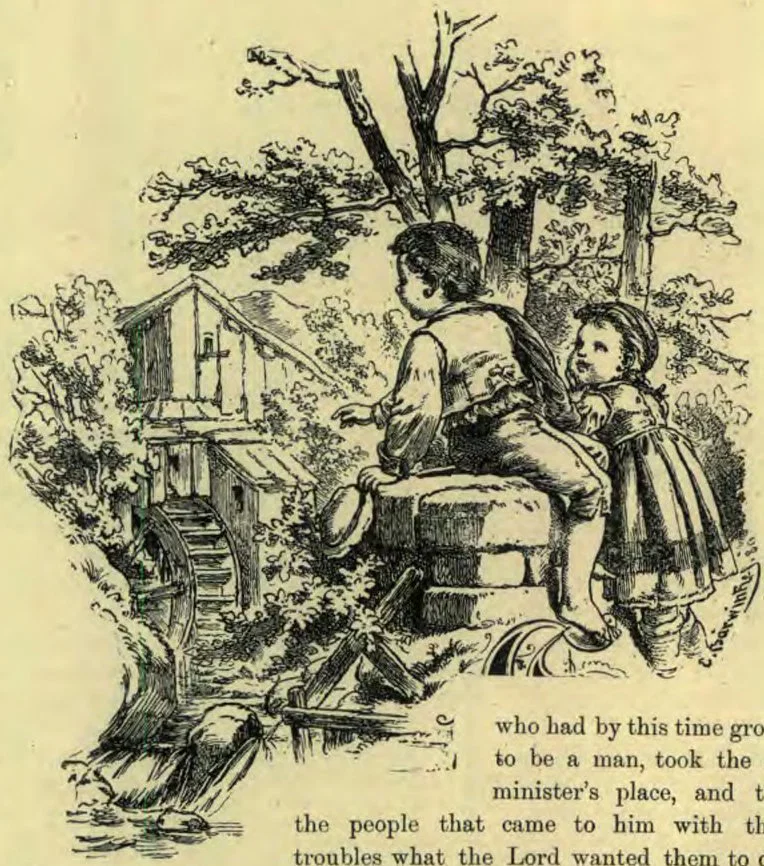
GRANDMA STRINGHAM was an old lady who lived in the house just beyond the grist-mill,—a silver haired, kindly-faced old lady, grandmother to all the neighborhood. She lived all alone with her son, a sturdy and thrifty young farmer. The children dearly loved to spend a day at her cosey little home, either listening to the tales of grandma’s early days, or watching from the broken stone fence the water dripping from the old mill-wheel, or the minnows darting in the brook below. Sometimes grandma would bring her knitting out under the trees with them, or would read them some story of the brave deeds of Bible heroes.
Mary and Frank never tired of listening to these tales; but to-day she did not tell them about the wars of the Israelites, but about a little boy. Grandma did not tell them what his name was, but said that they might see, when she finished, if they could not tell themselves.
“This little boy,” said grandma, “had no brother or sister. His mother thought a great deal of him, and no doubt wanted him to grow up to be a good and useful man; for she took him, when he was very small, to live with a good old minister.
“Every year she used to go to see him, and carry him a new suit of clothes. I think he must have been very glad to see his kind mother, and pleased to wear the clothes she had taken so much pains to make. He was good to the minister who took care of him, and was always ready to come when he called.
“One night, when he was sleeping quietly, he thought he heard the old minister calling him. He did not lie still and say,—
“‘I wonder what he wants to call me up in the night for; why can’t he let me sleep!’
“But he started right off to ask the minister what he wanted.
“‘My son, I did not call you,’ said the old man; ‘go and lie down again.’”
“By and by he heard the same call again; and after a while he heard it a third time. Each time he went to see what was wanted. The minister at last said,—
“‘It is the Lord calling to you, my son; and when you hear the voice again, say, “Speak, Lord; for thy servant heareth.”’
“So the boy did as he was bidden; and the Lord told him that both the old minister’s sons should die in one day, because he had not brought them up to fear the Lord.
“This made the lad feel very sorry, because he did not want to hurt the good man’s feelings by telling him what the Lord had said about these wicked young men. But when he was asked in the morning what the Lord had said to him, he fearlessly told it all to the minister, and hid not a thing.”
“Did these young men die?” Frank anxiously asked.
“Yes;” said grandma, “it all happened just as God had said; and one day when they were fighting with their enemies in battle, they were both slain. And the old minister felt so bad when he heard about it, that he fell over backward from his seat, and broke his neck, and died.”
“After that,” she continued, “this little boy, who had by this time grown to be a man, took the old minister’s place, and told the people that came to him with their troubles what the Lord wanted them to do; and sometimes he preached to them.”
Frank and Mary thought they had never heard a story half so nice, and they wondered who the little boy could be, for they were sure that they had never heard of him before.
Grandma wouldn’t tell them what his name was, but said that they might ask their mother about him when they got home; and next time when they came to see her, they might see how much they could tell her about him. W. E. L.

A QUEER ANIMAL.

WHEN I was a little girl, grandpapa gave me a book all about animals. How I liked that book! Mamma used to read it to me, just as your mamma reads to you.
There was a picture of one very queer animal in the book. He was not pretty one bit. He had a big hump on his back; he had long legs and a long neck, and such a homely head! But I used to like to hear about him.
He was a camel. Did you ever see a camel? In the countries where camels live, the people ride on them. They cross the great deserts of sand on the backs of camels. Do you think you would like to ride on one? The little children ride in a kind of basket.
The people often travel many days in the great deserts without finding water. They always carry water with them in great leather bottles. But the camels themselves can go many days without water. They do not get thirsty.
I wish you could see a baby camel. A baby camel is such a queer little thing. His body is small, and his legs are very, very long. He has big black eyes. His hair is fluffy and yellow.
It is a funny sight to see the camels eat. The driver spreads a cloth on the ground, and pours the grain upon it. Then all the camels sit down on the ground around the cloth and eat. It is just like a picnic.
They behave very well at their table. They bend their long necks down to the grain. They look as if they were bowing politely to each other. Sometimes a camel feels cross and will not eat at all. Do you ever feel so cross that you cannot eat?—Our Little Ones.

HOLD ON, BOYS.

Hold on to your tongue when you are just ready to swear, lie, or speak harshly, or use an improper word.
Hold on to your hand when you are about to punch, strike, scratch, steal, or do any improper act.
Hold on to your foot when you are on the point of kicking, running off from study, or pursuing the path of error, shame, or crime.
Hold on to your temper when you are angry, excited, or imposed upon, or others are angry with you.
Hold on to your heart when evil associates seek your company, and invite you to join in their mirth, games, and revelry.
Hold on to your good name; for it is of more value than gold, high places, or fashionable attire.
Hold on to the truth; for it will serve you well, and do you good throughout eternity.
Hold on to your virtue; it is above all price to you in all times and places.
Hold on to your good character; for it is, and ever will be, your best wealth.—Christian Weekly.

MUSIC BOOKS.

Pearly Portals for the Sabbath-school. By D. S. Hakes. The music in this work is new. The words from the best authors. 160 pp. Boards, 35 cents per copy. Cloth, .50
Song Anchor for the Sabbath-school, praise-service and fireside. 164 pp. Boards, 35 cents. Cloth, .50
Temperance and Gospel Songs. For the use of Temperance Clubs and Gospel Temperance Meetings. Price, .30
Better than Pearls. A new collection of the best Gospel Songs, Hymns, and Tunes for use in Tent and Camp-Meetings, as well as in Revivals, Social and Praise Service. Cloth, 40 cents. Board, .30
Songs for Class and School. For Singing-School, Day-School, Convention and Fireside. 169 pp. $.35
Hymn Book. “Hymns and Tunes for those who keep the Commandments of God and the Faith of Jesus.” It has 537 hymns, and 147 tunes, 416 pages. Muslin Bound, $1.00. Morocco, gilt edges, $1.50
All of the above works will be sent by mail, post-paid, on receipt of prices named. Address,
REVIEW & HERALD, Battle Creek, Mich.

MORNING-GLORIES

Hurry! hurry! hurry! Don't you see the sun, Pretty Morning-Glories— Work not yet begun?
Don't you know the morning Is your little hour, And how soon you're drooping If a cloud should lower?
Open quick your petals, Swift to greet the day. Higher! higher! higher! Catch the first bright ray.
So be up and doing, Children of the sun; For your chief adorning All his beams are spun.
—Elizabeth A. Davis.

You have reached the end of this edition.

The Youth’s Instructor · Jul 4, 1883