Review and Herald, Vol. 93, No. 39.

Life Only in Christ
Earlier text: Life Only in Christ

Angels: Their Ministry

A Higher Order Than Man

The one verse of Scripture which, perhaps, most comprehensively sums up the ministry of the angels of God, is this:—
“Are they not all ministering spirits, sent forth to minister for them who shall be heirs of salvation?” Heb. 1:14.
This scripture shows us how truly all heaven is engaged in working for the salvation of this poor world, which has wandered from the fold of God’s universe. It will surely be a time of rejoicing among all the angelic host when Christ, the Good Shepherd, brings back this lost world, cleansed from sin, once more to the fold of God’s perfect creation.
The angels rejoiced when this world was created. The Lord said to Job:—
“Where wast thou when I laid the foundations of the earth? . . . when the morning stars sang together, and all the sons of God shouted for joy?” Job 38:4, 7.
Before ever this world was created or man upon it, the angels had been created by the eternal Son, in whom all things consist. For angels are not redeemed men, neither do the redeemed in the world to come ever become angels. Angels are a different order of beings from men, a higher order in creation. The psalmist says:—
“What is man, that thou art mindful of him? and the son of man, that thou visitest him? For thou hast made him a little lower than the angels, and hast crowned him with glory and honor.” Ps. 8:4, 5.
In the life to come, by the wondrous power of Christ’s transforming grace, redeemed men are to be made equal to the angels, as Christ stated:—
“Neither can they die any more; for they are equal unto the angels; and the children of God, being the children of the resurrection.” Luke 20:36.
This lifting of sinful man to an equality with the angels, at least in the possession of life and immortality, is an illustration of the gospel principle, “Where sin abounded, grace did much more abound.” Rom. 5:20. But the declaration of equality with angels is a denial of identity with angels. Angels existed before man, and redeemed man will still be man, distinct from the angelic order, though the associate of angels in the service of God.

Attendants at the Throne of God

When the prophet Isaiah was given a view of the heavenly temple, he saw different orders of angels attending the throne of God:—
“I saw also the Lord sitting upon a throne, high and lifted up, and his train filled the temple. Above it stood the seraphim: each one had six wings; with twain he covered his face, and with twain he covered his feet, and with twain he did fly. And one cried unto another, and said, Holy, holy, holy, is the Lord of hosts.” Isa. 6:1-3.
Ezekiel beheld them in glory, attending the moving throne of the Almighty. “And the living creatures ran and returned as the appearance of a flash of lightning.” Ezek. 1:14. Daniel beheld the angelic host gathered in the most holy of the temple above, as the time came for the opening of the work of the investigative judgment, the cleansing of the sanctuary. As the throne of God was set for this final work of Christ’s ministry, the prophet says:—
“Thousand thousands ministered unto him, and ten thousand times ten thousand stood before him: the judgment was set, and the books were opened.” Dan. 7:10. Appropriately enough, the angels are associated with the opening of the books of judgment; for they have been the scribes recording the words and deeds and lives of men in the books above.

God’s Messengers

The word “angel” means messenger. To and fro these angelic messengers have gone in the service of their Creator. A view of their ever-watchful service is given in the words of the psalmist:—
“Bless the Lord, ye his angels, that excel in strength, that do his commandments, hearkening unto the voice of his word.” Ps. 103:20.

Bearers of Tidings

They visited Abraham’s tent with warning of Sodom’s overthrow. Genesis 18. They visited Lot in the city, and urged him to get his family out. Genesis 19.
As Jacob, in fear but repentance, was about to meet Esau, whom he had wronged, “the angels of God met him.” Genesis 32. “This is God’s host,” he said, and he knew that the God of Abraham and Isaac, and his God also, had not forsaken him.
At a discouraging time in the history of Israel, an angel appeared to Gideon, bringing the message, “The Lord is with thee,” and calling him to the work of delivering his people. Judges 6.
As Daniel’s prayer reached heaven, even while he still prayed, the angel Gabriel, “being caused to fly swiftly,” touched him, and said:—
“O Daniel, I am now come forth to give thee skill and understanding. At the beginning of thy supplications the commandment came forth, and I am come to show thee.” Dan. 9:21-23.
So close is the communication between heaven and earth.
The gladdest tidings ever brought from heaven to earth since the promise of the Deliverer to Adam in Eden, were brought by angels to the shepherds of Bethlehem. One angel appeared first, saying:—
“I bring you good tidings of great joy . . . For unto you is born this day in the city of David a Saviour, which is Christ the Lord.”
Such tidings earth could never be the mission of one lone angel, when all heaven longed to cry the news to a lost world.
“Suddenly there was with the angel a multitude of the heavenly host praising God, and saying, Glory to God in the highest, and on earth peace, good will toward men.” Luke 2:13, 14.

Unseen in Halls of Governments

One incident related in the book of Daniel draws aside the curtain, and shows how angels doubtless often have worked unseen in kingly courts or halls of legislation. Daniel had prayed for three weeks for light in certain matters that the angel Gabriel had begun to unfold to him. When at last the angel came, overpowering the prophet with the glory of his presence, it was nevertheless with a statement of the reason for the delay in responding to his prayer. The angel said:—
“From the first day that thou didst set thine heart to understand, and to chasten thyself before thy God, thy words were heard, and I am come for thy words. But the prince of the kingdom of Persia withstood me one and twenty days: but, lo, Michael, one of the chief princes, came to help me; and I remained there with the kings of Persia. Now I am come to make thee understand what shall befall thy people in the latter days.” Dan. 10:12-14.

Messengers of Deliverance

The story of deliverance wrought by angels is too long to tell. One need only think of the angels taking slow-moving Lot by the arms and setting him out of Sodom (Genesis 19); of the angel finding Elijah under a bush in the desert, and first baking a cake for the hungry man before speaking the word to his discouraged heart (1 Kings 19); of Elisha praying that the young man’s eyes might be opened to see that there were more angels round about them than all the Syrians encamped against them:—
“And the Lord opened the eyes of the young man; and he saw: and, behold, the mountain was full of horses and chariots of fire round about Elisha.” 2 Kings 6:17.
Angels shut the mouths of the lions when Daniel was cast into their den. Daniel 6. An angel smote off Peter’s irons from the prison at Jerusalem, opened the doors, and led him forth. Acts 12. Amid the dashing spray sweeping over the foundering ship in the Adriatic, Paul the apostle bade the despairing crew be of good courage, “for there stood by me this night the angel of God, whose I am, and whom I serve, saying, Fear not.” Acts 27:23, 24.
All through the ages, the angels of God have been standing by. Daniel, and Peter, and Paul are dead; but the angels still live. “Are they not all ministering spirits, sent forth to minister for them who shall be heirs of salvation?” Heb. 1:14.

Guardian Angels

That means that every child of God is under the guardianship of the angels. “The angel of the Lord encampeth round about them that fear him, and delivereth them.” Ps. 34:7.
Thank God, we are never left alone. Every child of God has a guardian angel commissioned by the loving Father to watch over him. Christ said:—
“Take heed that ye despise not one of these little ones; for I say unto you, That in heaven their angels do always behold the face of my Father which is in heaven.” Matt. 18:10.
This does not mean that trials never will come, or troubles. In the midst of the trial, the angel of the Lord will stand by to strengthen and to bring help from the God of all comfort. It was in the midst of the fiery furnace that the “form of the Fourth” appeared, walking with the three Hebrew children:—
“Jesus himself treading the fiery way with them.” And when Jesus, in the days of his flesh, was sinking under the crushing burden in Gethsemane, “there appeared an angel unto him from heaven, strengthening him.”
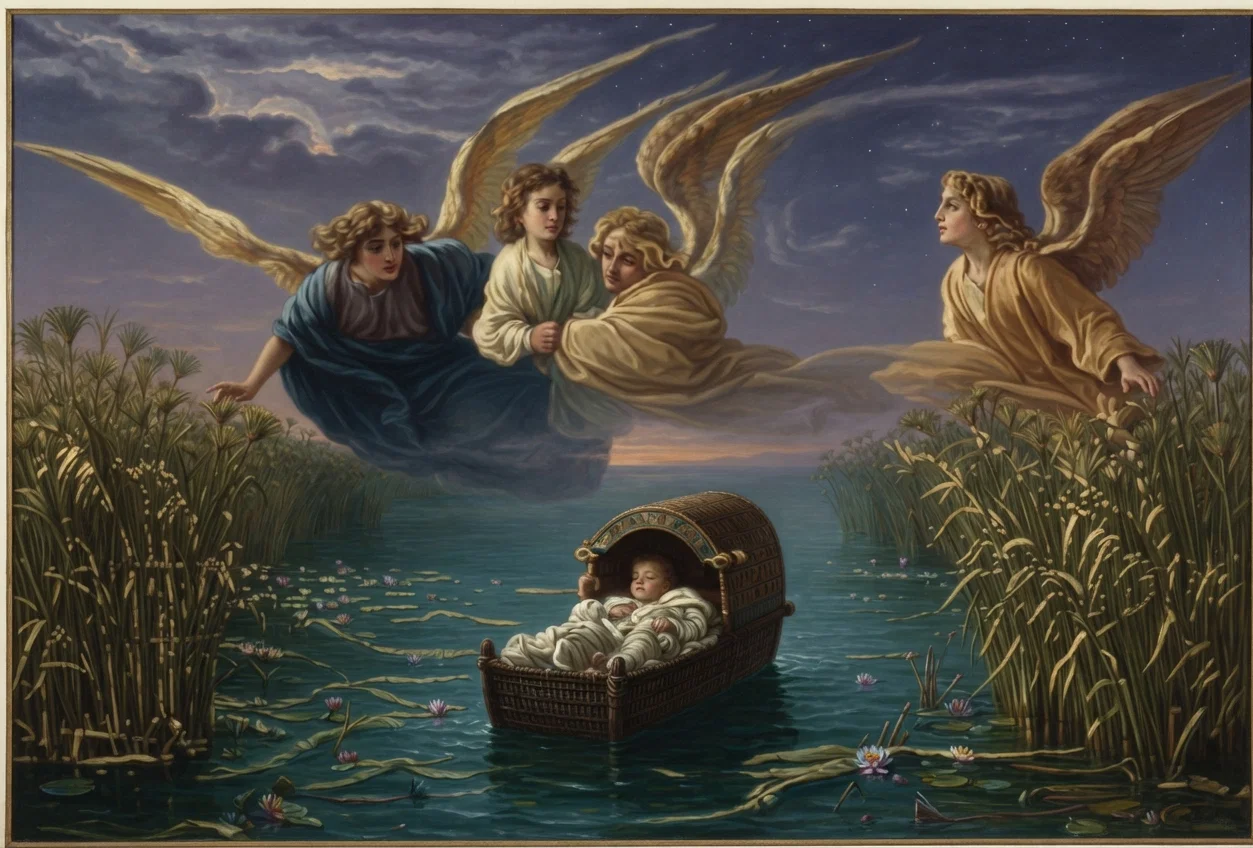
GUARDIAN ANGELS WATCHING OVER THE INFANT MOSES
Our Saviour, who knows the comforting power of angel ministry, is the Captain of the heavenly host, and has commissioned them all as ministering spirits to the heirs of salvation.
When he comes in glory for his people, he will have “all the holy angels with him.” At the voice of Jesus awaken his sleeping saints, and they rise immortal from the opened graves, “he shall send his angels, . . . and they shall gather together his elect from the four winds, from one end of heaven to the other.” Matt. 24:31.
The angels who have watched over the heirs of salvation through all the ages, know where they are, and they know how to gather them, with their loved ones, to meet the Lord.
The angels who rejoiced when the Lord laid the foundation of the earth, who mourned when man fell, who have all along been working with Christ, their leader, to rescue the lost, will yet rejoice when the Lord brings home his own. What a day will that be in heaven!

Conditional Immortality

BIBLE STUDIES

The Nature of Man

1. How is man's nature defined? “Shall mortal man be more just than God?” Job 4:17. Mortal: “Subject to death.”—Webster.
2. What is God's nature? “Now unto the King eternal, immortal, invisible, the only wise God, be honor and glory forever and ever. Amen.” 1 Tim. 1:17. Immortal: “Exempt from liability to die.”—Webster.
3. In what condition was man created? “Thou madest him a little lower than the angels.” Ps. 8:5.
4. Of what was man formed in the beginning? “The Lord God formed man of the dust of the ground.” Gen. 2:7.

A Living Soul

5. What act made him a living soul? “And [God] breathed into his nostrils the breath of life; and man became a living soul.” Same verse, last part.
NOTE.—The living soul was not put into the man; but the breath of life which was put into man, made him—the man, made of the earth—a living soul, or creature. The original for “living soul” in this text is nephesh chayyah. On the use of this expression in Gen. 1:24, translated “living creature,” Dr. Adam Clarke says: “A general term to express all creatures endowed with animal life, in any of its infinitely varied gradations, from the half-reasoning elephant down to the stupid potto, or still lower, to the polyp, which seems equally to share the vegetable and animal life.”
6. Are other creatures besides man called “living souls”? “The second angel poured out his vial upon the sea; and it became as the blood of a dead man: and every living soul died in the sea.” Rev. 16:3. See also Gen. 1:20, margin.

The Breath of Life

7. Do others besides man have the “breath of life”? “All flesh died that moved upon the earth, both of fowl, and of cattle, and of beast, and of every creeping thing that creepeth upon the earth, and every man: all in whose nostrils was the breath of life.” Gen. 7:21, 22.
8. Is their breath the same as man's? “As the one dieth, so dieth the other; yea, they have all one breath; so that a man hath no preeminence above a beast: for all is vanity.” Eccles. 3:19.
NOTE.—That is, here men, as well as beasts, die. This present life, with them, as with the rest of the animal creation, is dependent upon their breath. When this is gone, they, the same as beasts, die. In this respect they have no preeminence over beasts. But men have a future, unending life held out before them, and may if they will, die in hope of eternal life, which is a very great preeminence over the rest of the animal creation.
9. What does Job call that which God breathed into man's nostrils? “All the while my breath is in me, and the spirit of God is in my nostrils.” Job 27:2.
10. When man gives up this spirit, what becomes of it? “Then shall the dust return to the earth as it was: and the spirit shall return unto God who gave it.” Eccl. 12:7. NOTE.—That is, the spirit of life by which man lives, and which is only lent him of God, at death goes back to God, the great Author of life. Having come from him, it belongs to God, and man can have it eternally only as a gift from God, through Jesus Christ. Rom. 6:23. When the spirit goes back to God, the dust, from which man was made a “living soul” in the beginning, goes back as it was, to the earth, and the individual no longer exists as a living, conscious, thinking being except as he exists, in the mind, plan, and purpose of God through Christ and the resurrection. In this sense “all live unto him” (Luke 20:38), for all are to be raised from the dead. Acts 24:15; Rom. 4:17.

Eternal Life Through Christ

11. What is the wages of sin? “The wages of sin is death.” Rom. 6:23.
12. Through whom only is there salvation from sin? “Neither is there salvation in any other: for there is none other name under heaven given among men, whereby we must be saved.” Acts 4:12. NOTE.—If men do not die, why should Christ die to save them from death? And what need of the resurrection and the second advent?
13. Why did God send his only begotten Son to this world? “That whosoever believeth in him should not perish, but have everlasting life.” John 3:16.
14. What does Christ declare himself to be? “I am the way, the truth, and the life.” John 14:6.
15. Upon what is the possession of this life conditioned? “Except ye eat the flesh of the Son of man, and drink his blood, ye have no life in you.” John 6:53.
16. In whom is the life eternal? “This is the record, that God hath given to us eternal life, and this life is in his Son.” 1 John 5:11.
17. With whom is the Christian's future life hid? “Ye are dead, and your life is hid with Christ in God.” Col. 3:3.
18. Who only have this life? “He that hath the Son hath life; and he that hath not the Son of God hath not life.” 1 John 5:12.

Brought to Light Through the Gospel

19. Through whom has immortality been brought to light? “But is now made manifest by the appearing of our Saviour Jesus Christ, who hath abolished death, and hath brought life and immortality to light through the gospel.” 2 Tim. 1:10.
20. To whom is eternal life promised? *“To them who by patient continuance in well-doing seek for glory and honor and immortality, eternal life.”* Rom. 2:7.
NOTE.—One does not need to seek for a thing which he already possesses.
21. Who only possesses inherent immortality? “Who is the blessed and only Potentate, the King of kings, and Lord of lords; who only hath immortality.” 1 Tim. 6:15, 16.

Immortality Bestowed upon the Children of God at the Resurrection

22. When will this life be bestowed upon the believer? “When Christ, who is our life, shall appear, then shall ye also appear with him in glory.” Col. 3:4. NOTE.—God is the only being who possesses original life or immortality in himself. John 5:26; 10:10, 27, 28; Rom. 6:23; 1 John 5:11. The word “immortal” occurs but once in the English Bible (1 Tim. 1:17), and is there applied to God.
23. When will the faithful be changed to immortality? “Behold, I show you a mystery: We shall not all sleep, but we shall all be changed, in a moment, in the twinkling of an eye, at the last trump: for the trumpet shall sound, and the dead shall be raised incorruptible, and we shall be changed.” 1 Cor. 15:51, 52.
24. What is then to be swallowed up? “So when this corruptible shall have put on incorruption, and this mortal shall have put on immortality, then shall be brought to pass the saying that is written, Death is swallowed up in victory.” Verse 54. See verse 57.

The End of the Wicked

Eternal Death

1. What question does Peter ask regarding the wicked? “The time is come that judgment must begin at the house of God: and if it first begin at us, what shall the end be of them that obey not the gospel of God?” 1 Peter 4:17.
2. What does the Bible say is the wages of sin? “The wages of sin is death.” Rom. 6:23. “The soul that sinneth, it shall die.” Eze. 18:4. Die: “To pass from physical life; to suffer a total and irreparable loss of action of the vital functions; to become dead; to expire; perish.”—Webster.
3. What will be the character of this death? “Who shall be punished with everlasting destruction from the presence of the Lord, and from the glory of his power.” 2 Thess. 1:9. Destroy: “To unbuild; to break up the structure and organic existence of; to demolish; to spoil utterly; to bring to naught; to put an end to; to annihilate.”—Webster.
4. How complete will be the destruction of the wicked? “Fear him which is able to destroy both soul and body in hell.” Matt. 10:28.
Compared to All That is Perishable and Worthless
5. To what are the wicked in their punishment compared? “The wicked shall perish, and the enemies of the Lord shall be as the fat of lambs: they shall consume; into smoke shall they consume away.” Ps. 37:20. Consume: “To destroy; as by decomposition, dissipation, waste, or fire.”—Webster.
6. How does John the Baptist describe the destruction of the wicked? “He that cometh after me is mightier than I, . . . whose fan is in his hand, and he will throughly purge his floor, and gather his wheat into the garner; but he will burn up the chaff with unquenchable fire.” Matt. 3:11, 12.
7. Will any part of the wicked be left? “Behold, the day cometh, that shall burn as an oven; and all the proud, yea, and all that do wickedly, shall be stubble; and the day that cometh shall burn them up, saith the Lord of hosts, that it shall leave them neither root nor branch.” Mal. 4:1.
8. What will then be their condition? “As ye have drunk upon my holy mountain, so shall all the heathen drink continually, yea, they shall drink, and they shall swallow down, and they shall be as though they had not been.” Obadiah 16.

Even His Place Shall Not Be

9. Where will the place of the wicked then be? “Yet a little while, and the wicked shall not be: yea, thou shalt diligently consider his place, and it shall not be.” Ps. 37:10. NOTE.—It would be difficult to keep the wicked in eternal torment without any place for them, even, in which to exist.
10. Where are both the righteous and the wicked to be recompensed? “Behold, the righteous shall be recompensed in the earth: much more the wicked and the sinner.” Prov. 11:31.

Destroyed at the Final Judgment

11. Do the wicked go directly to their punishment at death, or wait till the day of judgment? “The Lord knoweth how to deliver the godly out of temptations, and to reserve the unjust unto the day of judgment to be punished.” 2 Peter 2:9.
12. What will be the result of the fires of the last day? “Looking for and hasting unto the coming of the day of God, wherein the heavens being on fire shall be dissolved, and the elements shall melt with fervent heat.” “The earth also, and the works that are therein shall be burned up.” 2 Peter 3:12, 10.
13. Whence will come the fire that will destroy them? “They went up on the breadth of the earth, and compassed the camp of the saints about, and the beloved city; and fire came down from God out of heaven, and devoured them.” Rev. 20:9. NOTE.—This is called God’s “strange act” and his “strange work,”—the work of destruction. Isa. 28:21. But by this means God will utterly and forever cleanse the universe of sin and all its sad results. Death itself will then be at an end—cast into the lake of fire. Rev. 20:14.

This is the Second Death

14. To what will this fire reduce the wicked? “Ye shall tread down the wicked; for they shall be ashes under the soles of your feet in the day that I shall do this, saith the Lord of hosts.” Mal. 4:3. NOTE.—The wicked are to be utterly destroyed—consumed away into smoke, brought to ashes. Having inseparably allied themselves with sin, they have forfeited the right to life and an immortal existence, and chosen the way of death and destruction. By their choice they have proved themselves worthless. For this reason they are compared to chaff, briers, thorns, etc. Their destruction will consequently be no real loss. They themselves will have lost their opportunity to obtain eternal life; but by the way in which they used their probationary time they proved themselves unworthy of it. Their destruction will, in fact, be an act of love and mercy on the part of God; for to perpetuate their lives would be only to perpetuate sin, sorrow, suffering, and misery. Terrible, therefore, as this judgment will be, there will, in consequence of it, be nothing of value lost,—nothing worth saving. The experiment of sin will be over, and God’s original plan of peopling the earth with a race of holy, happy beings will be carried out. 2 Peter 3:13.
15. What is this final destruction of the wicked called? “This is the second death.” Rev. 20:14. 15. After the burning day, what will appear? “Nevertheless we, according to his promise, look for new heavens and a new earth, wherein dwelleth righteousness.” 2 Peter 3:13.

The Condition of Man in Death

“Asleep in Jesus”

1. By what figure does the Bible represent death?
“I would not have you to be ignorant, brethren, concerning them which are asleep, that ye sorrow not, even as others which have no hope.” 1 Thess. 4:13. See also 1 Cor. 15:18, 20; John 11:11-14.
NOTE.— In sound sleep one is wholly lost to consciousness; time goes by unmeasured; and the mental functions which are active during consciousness are suspended for the time being.
2. Where do the dead sleep?
“Many of them that sleep in the dust of the earth shall awake.” Dan. 12:2. See also Eccl. 3:20; 9:10.
3. How long will they sleep there?
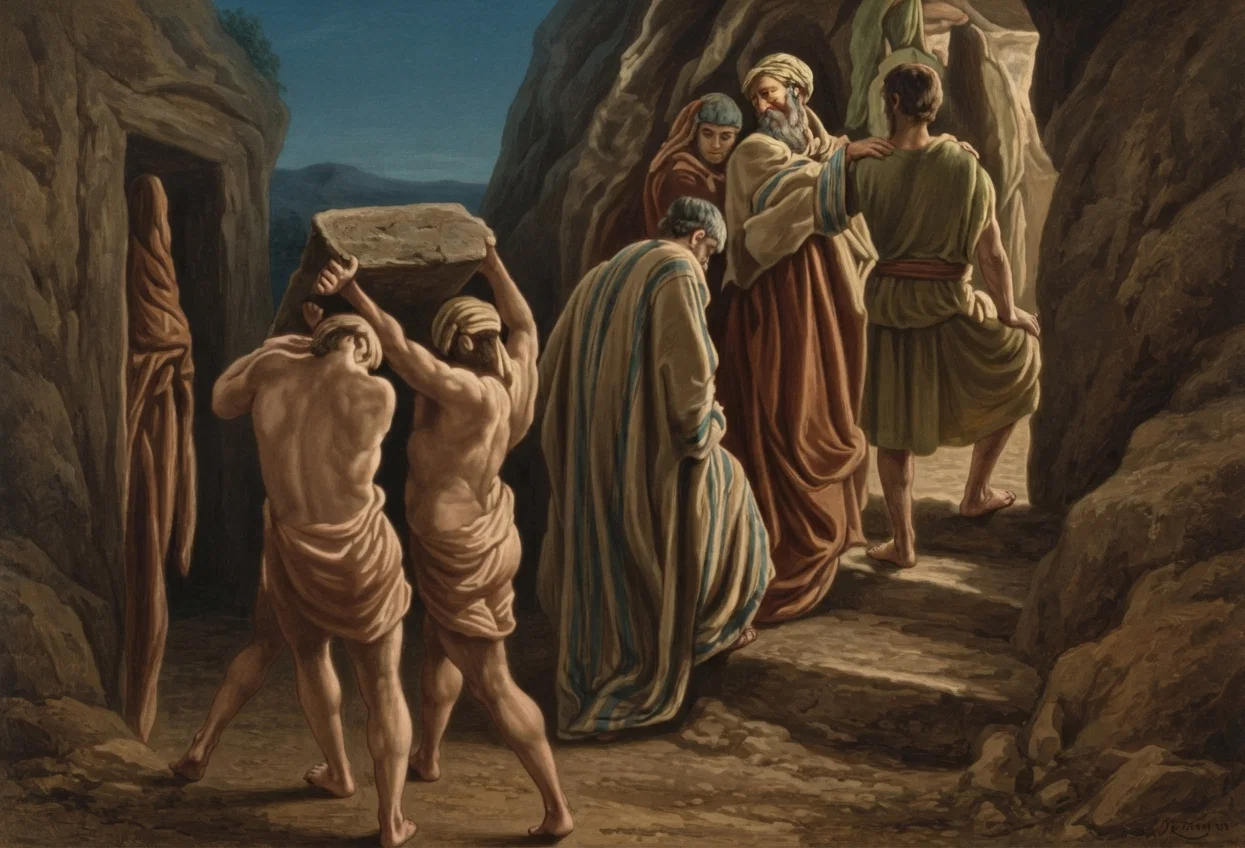
THE BURIAL OF SARAH—“IF I WAIT, THE GRAVE IS MINE HOUSE”
“So man lieth down, and riseth not: till the heavens be no more, they shall not awake, nor be raised out of their sleep.” Job 14:12.
4. For what did Job say he would wait after death?
“If a man die, shall he live again? all the days of my appointed time will I wait, till my change come.” Verse 14.
5. Where did he say he would wait?
“If I wait, the grave is mine house; I have made my bed in the darkness.” Job 17:13.

No Knowledge in Death

6. While in this condition, how much does one know about those he has left behind?
“His sons come to honor, and he knoweth it not; and they are brought low, but he perceiveth it not of them.” Job 14:21.
7. What becomes of man's thoughts at death?
“His breath goeth forth, he returneth to his earth; in that very day his thoughts perish.” Ps. 146:4.
8. Do the dead know anything?
“The living know that they shall die; but the dead know not anything, neither have they any more a reward; for the memory of them is forgotten.” Eccl. 9:5.
9. Do they take any part in earthly things?
“Also their love, and their hatred, and their envy, is now perished; neither have they any more a portion forever in anything that is done under the sun.” Verse 6.
NOTE.— If one continued in consciousness after death, he would know of the promotion or dishonor of his sons. But Job says the dead do not know this. Not only so, but in death one loses all the attributes of mind,—love, hatred, envy, etc. Thus it is plain that his thoughts have perished, and that he can have nothing more to do with the things of this world. But if, as taught and held by some, man's powers of thought continue after death, he lives; and if he lives, he must be somewhere. Where is he? Is he in heaven, or in hell? If he goes to either place at death, what then is the need of a future judgment, or of a resurrection, or of the second coming of Christ? If the judgment does not take place at death, but men go to their reward at death, then their rewards precede their awards, and there would arise the possibility that some have at death gone to the wrong place, and must needs be sent to the other, after having been in bliss or torment for ages, perhaps.
10. How much does one know of God when dead?
“In death there is no remembrance of thee.” Ps. 6:5.
NOTE.— There is not even a remembrance of God. As already seen, the Bible everywhere represents the dead as asleep. If they were in heaven or hell, would it be fitting to represent them thus? Was Lazarus, whom Jesus loved, in heaven when the Saviour said, “Our friend Lazarus sleepeth”? John 11:11. If so, calling him to life was really robbing him of the bliss of heaven that rightly belonged to him. The parable of the rich man and Lazarus, recorded in Luke 16, was given to teach, not consciousness in death, but that in the judgment riches will avail nothing unless rightly and beneficently used, and that poverty will not keep one out of heaven.
11. But are not the righteous dead in heaven?
“David is not ascended into the heavens.” Acts 2:34.

Awake from Sleep at the Resurrection

12. What must take place before the dead can praise God?
“Thy dead men shall live, together with my dead body shall they arise. Awake and sing, ye that dwell in dust: for thy dew is as the dew of herbs, and the earth shall cast out the dead.” Isa. 26:19.
13. When did David say he would be satisfied?
“As for me, I will behold thy face in righteousness ; I shall be satisfied, when I awake, with thy likeness.” Ps. 17:15.
14. Were there to be no resurrection of the dead, what would be the condition of those fallen asleep in Christ?
“If the dead rise not, then is not Christ raised; and if Christ be not raised, your faith is vain; ye are yet in your sins. Then they also which are fallen asleep in Christ are perished.” 1 Cor. 15:16-18.
15. When is the resurrection of the righteous to take place?
“The Lord himself shall descend from heaven with a shout, with the voice of the archangel, and with the trump of God: and the dead in Christ shall rise first.” 1 Thess. 4:16.
NOTE.— If, as stated in Eccl. 9:5, the dead know not anything, then they have no knowledge of the lapse of time. Six thousand years in the grave to a dead man is no more than a wink of the eye to the living. To them, consciousness, our only means of measuring time, is gone; and it will seem to them when they awake that absolutely no time has elapsed. And herein lies a most comforting thought in the Bible doctrine of the sleep of the dead, that in death there is no consciousness of the passing of time. To those who sleep in Jesus, their sleep, whether long or short, whether one year, one thousand years, or six thousand years, will be but as if the moment of sad parting were followed instantly by the glad reunion in the presence of Jesus at his glorious appearing and the resurrection of the just.
It ought also to be a comforting thought to those whose lives have been filled with anxiety and grief for deceased loved ones who persisted in sin, to know that they are not now suffering in torment, but, with all the rest of the dead, are quietly sleeping in their graves. Job 3:17.
Again, it would mar the felicity of one's enjoyment in heaven could he look upon the earth and see his friends and relatives suffering from persecution, want, cold, or hunger, or sorrowing for the dead. God's way is best,—that all sentient life, animation, activity, thought and consciousness should cease at death, and that all should wait till the resurrection for their future life and eternal reward. See Heb. 11:39, 40.

The World's Crisis in the Light of Prophecy

A TIMELY publication explaining from the prophecies of the Bible the meaning of the great and momentous events now transpiring in the world. “Surely the Lord God will do nothing, but he revealeth his secret unto his servants the prophets.” The events now troubling the world were prophesied of centuries ago. This book contains the following chapters:—
The Portrait of the Times The Eastern Question in Prophecy Approaching Armageddon Waymarks to the Kingdom The Primitive Faith Christ’s Second Coming Signs of the Approaching End The Gospel for This Generation The Home of the Redeemed
Over 400,000 sold in one year. 128 pages, illustrated. Paper cover, 25 cents; cloth, 50 cents.

THE BEREAN LIBRARY

ALL who desire to study further the important Bible subjects presented in this series of Extras should order from this list of valuable books put up in paper covers, postpaid, at the following very low prices:—
Steps to Christ, 144 pages........................$ .25 Thoughts on Daniel, 345 pages...................... .30 Thoughts on Revelation, 430 pages.................. .35 Religious Liberty in America, 448 pages............. .35 The Sabbath in the Scriptures, 216 pages............ .25 The Sabbath in History, 600 pages................... .50 Capital and Labor, 208 pages........................ .25 Here and Hereafter, 360 pages....................... .30 The full set of eight volumes, boxed...............$2.50
Order from the publishers, whose address is given below

You have reached the end of this edition.

Review and Herald · Aug 7, 1916