THE Superintendent of Public Instruction of the State of Washington, sometime since submitted the following in reference to the reading of the Bible in the public schools, to the Attorney General of the State, for his official opinion:—
“Can a teacher employed in the common schools of this State, without violating any law of the State, or any provisions of the State Constitution, conduct devotional or religious exercises at the opening of the school day, or during any part of the school day as prescribed by law, by the singing of hymns or other sacred music, or by reading passages from the Bible, without comment, or by repeating or causing to be repeated (without comment), what is usually known as the Lord’s Prayer?”
In his reply Attorney General Jones says:—
The question which you have submitted to me is one of so much interest to the people of the State at large, and is fraught with so much consequence to the present and future weal of our common school system, that I have felt justified in taking considerable length of time to make a rather extended and careful investigation of the subject.
The provisions of our own State Constitution which have a bearing on this question are:—
Section 11, Article 1, of the Constitution which is as follows: “Section 11. Absolute freedom of conscience in all matters of religious sentiment, belief and worship shall be guaranteed to every individual, and no one shall be molested or disturbed in person or property, on account of religion; but the liberty of conscience hereby secured shall not be so construed as to excuse acts of licentiousness, or justify practices inconsistent with the peace and safety of the State. No public money or property shall be appropriated for, or applied to, any religious worship, exercise or instruction, or the support of any religious establishment. No religious qualification shall be required for any public office or employment, nor shall any person be incompetent as a witness or juror, in consequence of his opinion on matters of religion, nor be questioned in any court of justice touching his religious belief to affect the weight of his testimony.”
Section 4, of Article 9, as follows: “Section 4.—All schools maintained or supported wholly or in part by the public funds shall be forever free from sectarian control or influence.”
The first subdivision of the compact with the United States, found in article 26, as follows:
“First—That perfect toleration of religious sentiment shall be secured and that no inhabitant of this State shall ever be molested in person or property on account of his or her mode of religious worship.”
And the fourth subdivision of said compact, as follows:
“Fourth.—Provision shall be made for the establishment and maintenance of systems of public schools free from sectarian control, which shall be open to all the children of said State.”
From an examination of the provisions on the subject of religion found in the Constitution of the United States, and in the Constitutions of the several States of the Union, it will be noticed that at the very outset the people of this country declared with singular unanimity against the union of religion with the Government.
It was, no doubt, with a full consideration of the heterogeneous elements composing our Nation, and the memory of the persecutions of their ancestors, that the people of all the States adopted constitutional safeguards against religious intolerance, and all but two of the original thirteen States declared a complete divorce between the Government and creed.
An examination of all the State Constitutions will disclose the further fact that the sentiment of the people to make the divorce between Church and State, between government and creed, between politics and religion, more complete and absolute, has been one of constant and unvarying growth. While the early Constitutions were not very radical upon this question, some of them even countenancing a limited union between Church and State, the later Constitutions have, in almost every instance, incorporated into themselves provisions and declarations more radical, sweeping, and comprehensive than their predecessors.
This marked and constant growth indicates with great emphasis that the people were not satisfied with the loose and indefinite provisions of the early Constitutions, and were unwilling to leave open a way for the insidious invasion of public affairs by religious sectarianism through the avenue of judicial construction and interpretation.
This growth of public sentiment has continued until the adoption of our own Constitution, the provisions of which on this subject are as broad, if not broader and more positive and more comprehensive, than similar provisions in any of the other State Constitutions.
This growth does not, however, indicate a decrease in religious sentiment among the people; these provisions have not been the work of the enemies, but of the friends of religion. It is not that the men who framed and the people who adopted these constitutional enactments were wanting in reverence for the Bible, and respect and veneration for the sublime and pure morality taught therein, but because they were unwilling that any avenue should be left open for the invasion of the right of absolute freedom of conscience in religious affairs; because they were unwilling that any man should be required directly or indirectly, to contribute toward the promulgation of any religious creed, doctrine or sentiment to which the conscience did not lend full assent.
It was with this idea in view that the provisions of Section 11 (supra) were framed. There can be no doubt that the word “religion” and “religious,” as used in that section, apply to all forms of religion and religious worship and belief, and that as a test of qualification for public office, or to affect the weight of his testimony as a witness in judicial proceedings, its provisions equally protect the disciple of Abraham, of Mohammed, of Confucius, and of Jesus; and that within the meaning of that section each is a member of a distinct religious sect or denomination.
The fact that the great majority of the people of this State are Christians can not in any way affect this question; for if there were only one Christian in the State, that one Christian would be equally entitled to the constitutional guaranty as he is under existing circumstances, and it would be a cowardly court that would refuse to extend it to him simply because he was in the minority.
But does the conclusion, that the stated reading of the Bible in the public school is religious worship and instruction, lead to the further conclusion that it is in violation of any part of the constitutional provisions above cited?
The Attorney General continues at length, and gives his official opinion that the holding of religious exercises in the public schools of the State of Washington is unconstitutional. Upon this point he says the language of the Constitution of the State is remarkably clear.
Knights of Labor Reject WCTU Sunday Fair Resolution
THE Woman’s Christian Temperance Union has received the retort courteous from the Knights of Labor convened in their General Assembly at Toledo, Ohio. The Union transmitted to the Assembly a series of resolutions in which it was asked to concur. One of them was in regard to the closing of the World’s Fair on Sunday. The Knights resolved to the contrary and declared in favor of the opening of the Fair on Sunday.
Christian Statesman Moves Publication to Pittsburgh
The Christian Statesman will be published hereafter in Pittsburgh, Pennsylvania, under the management of Wilbur F. Crafts.
Lima Ministers Crusade Against Sunday Newspapers
THE ministers of Lima, Ohio, have organized a “Sabbath Association” and a crusade against Sunday papers. They make the Sunday paper the head and front of all irreligious offense because, as they say; “the Sunday barber shop, Sunday baseball, the Sunday saloon etc., all point to the Sunday newspaper by which to justify themselves.”
Grand Juries Criticize Sunday Law League Actions
The Grand Jury of Rome, Georgia, has found it necessary to criticise with severity the action of the Law and Order League of that city. In Newark, New Jersey, the Grand Jury has likewise mentioned unfavorably the course taken by this legal sword arm of the American Sabbath Union. How long will it be before the authorities and the people will realize the mighty federation of leagues, associations, and societies which exists for the purpose of overthrowing civil liberty in religious affairs?
Portland Petition Demands Enforcement of Sunday Laws
A PETITION, demanding the enforcement of the State Sunday laws in Portland, Oregon, and signed by 2,000 voters of the city has been presented to the common council of Portland. The spokesman for the committee of citizens and clergymen of all denominations was Archbishop Gross of the Roman Catholic Church. Three Catholic Fathers were present and five clergymen of Protestant denominations.
Such incidents as this mark the beginning of the fusion of Protestants and Roman Catholics for the acceptance and enforcement of a political Christianity.
The example of the Swine Breeders’ Association in attempting to remove the ancestral curse from American pork by resolving that the Chicago hog is and by right must be compelled to be a Sunday-keeper, has been followed by the American Short-Horn Breeders’ Association at their annual meeting in Chicago. American pork and short-horn beef must hereafter be the strong meat of all-true National Reformers and Sabbath Unionists.
The Buffalo News remarks of these “Sabbatarian extremists:” “Doesn’t the Association think it would be a good thing to have religious exercises for the animals too?”
Nebo Kentucky Correspondent on Sunday Law Enforcement
A CORRESPONDENT from Nebo, Kentucky, writes that the people in that locality quite generally consider that the decision of Judge Hammond in the case of R. M. King is just. He says, further, that the ministers of all denominations, both white and colored, are preaching that everybody, regardless of their observance of another day, or whether they believe that any day should be kept or not, should be compelled to obey the laws of the land by keeping Sunday.
This is another instance showing that the only possible use that can be made of Sunday laws is for zealots to take advantage of them to annoy their inoffensive friends and neighbors, who would like the privilege of disposing of their own time, while other people are doing the same.
University of Michigan Athenæum Society Discussions
The Detroit Free Press prints, in its notes from the University of Michigan, an item which shows the existence of a society among the students of that institution, the members of which are giving their attention to questions of living moment. Students who are now investigating along the lines of thought denoted by these subjects will find themselves fitted to cope with the problems of the deepest import—social, legal, legislative, religious,—that will present themselves for final decision in the coming years. The item says:—
. The meeting of the Athenæum on Monday evening, was noticeable for the discussions on “The Bible in the U. of M.,” “Sunday and the World’s Fair,” “Madison on Socialism,” and “Thanksgiving Proclamations.” A paper on “The Importance of Maintaining American Principles” was read by W. A. Blakely. Selections were read from “Spartacus,” by Fred. A. Howe, “Virginia,” by Jessie Opal Barber, “The Celebrated King Case,” by Leon A. Smith.
NATIONAL Religious Liberty Association
DECLARATION OF PRINCIPLES.
We believe in the religion taught by Jesus Christ.
We believe in temperance, and regard the liquor traffic as a curse to society.
We believe in supporting the civil government, and submitting to its authority.
We deny the right of any civil government to legislate on religious questions.
We believe it is the right, and should be the privilege, of every man to worship according to the dictates of his own conscience.
We also believe it to be our duty to use every lawful and honorable means to prevent religious legislation by the civil government; that we and our fellow-citizens may enjoy the inestimable blessings of both religious and civil liberty.
OFFICES:
43 Bond St., New York City.
1225 T St., N. W., Washington, D. C.
28 College Place, Chicago, Ill.
12th and Castro Sts., Oakland, Cal.
267 West Main St., Battle Creek, Mich.
R. C. PORTER . . . . PRESIDENT.
A. F. BALLENGER . . . . SECRETARY.
PACIFIC HEALTH JOURNAL
And Temperance Advocate.
A thirty-two page monthly magazine, devoted to the dissemination of true temperance principles, and instruction in the art of preserving health. It is emphatically
A JOURNAL FOR THE PEOPLE,
Containing what everybody wants to know, and is thoroughly practical. Its range of subjects is unlimited, embracing everything that in any way affects the health. Its articles being short and pointed, it is specially adapted to farmers, mechanics, and house-keepers, who have but little leisure for reading. It is just the journal that every family needs, and may be read with profit by all.
PRICE, $1.00 PER YEAR,
or with the 300-page premium book—“Practical Manual of Hygiene and Temperance,” containing household and cooking recipes—post-paid $1.40.
Address, PACIFIC HEALTH JOURNAL, Oakland, California.
IS THE PAPACY IN PROPHECY?
BY THE
Rev. Thomas W. Haskins, M. A.,
Rector Christ Church, Los Angeles, Cal.
The above is the title of a treatise written by the author at the request of the Ministerial Union of Los Angeles, California. It grew out of a discussion upon the present aspect and aims of the Roman Catholic Church in the United States, the author taking the ground that the rise, progress, present and future condition of the temporal power known as the Papacy, or Vaticanism, is outlined in the prophecies of Holy Scriptures with sufficient accuracy to determine what the “Papacy” is, and what is to be its future development and ultimate end.
PAPER COVERS, . . . . . . . . . . 25 CENTS.
CLOTH COVERS, . . . . . . . . . . 60 CENTS.
Mailed, post-paid, on receipt of price.
Address,
Pacific Press Publishing Co.,
43 BOND STREET, NEW YORK;
12TH & CASTRO STS., OAKLAND, CAL.,
Or, LOS ANGELES CHURCHMAN, 35 California Bank Building, Los Angeles, Cal.
DO YOU USE A FOUNTAIN PEN?
Then you need the COMBINED INK BOTTLE AND PEN FILLER, consisting of a bottle holding ink sufficient to fill a pen 8 or 10 times, with a Patent Rubber Cork and Filler, all inclosed in a neat wooden case with a screw top, making the safest, most complete, compact, and convenient article for the use of traveling men and others now extant. Weighs when filled with ink less than three ounces.
Imitation Rose-wood case, 25c.
Real Box-wood, “ 50c.
Sent post-paid on receipt of price.
Address,
PACIFIC PRESS PUB. CO.,
43 BOND STREET, NEW YORK.
OR OAKLAND, CAL.
SIBERIA AND THE NIHILISTS.
By William Jackson Armstrong
Why Kennan Went to Siberia.
By William Jackson Armstrong.
This is one of the most INTENSELY INTERESTING and thoroughly reliable contributions to literature on Russia and the Nihilists ever published. Everybody should read this book, because no one can be intelligent upon the subject of which it treats without familiarity with its contents.
190 PAGES, PAPER COVERS, 25 CENTS, POST-PAID.
PACIFIC PRESS PUB. CO., NEW YORK. Or Oakland, California.
CIVIL GOVERNMENT AND RELIGION
By A. T. Jones
In English, German, Danish, and Swedish.
BY A. T. JONES,
Editor of THE AMERICAN SENTINEL.
Scriptural, Logical, Plain, and Forcible.
This Important Work Shows Clearly the Relation that Should Exist Between Church and State at the Present Time, as Proven by the Bible, and the History of the Past Twenty-five Centuries.
CHAP. I. Outlines vividly the relation that existed between “Christianity and the Roman Empire.”
CHAP. II. Distinguishes between “What is due to God and what to Cæsar.”
CHAP. III. Shows for what purpose the “Powers that Be” are ordained.
CHAP. IV. Ably discusses “The Religious Attack upon the United States Constitution.”
CHAP. V. Unmasks “Religious Legislation.”
CHAP. VI. Is devoted to the “Sunday-Law Movement in the Fourth Century, and its Parallel in the Nineteenth.”
CHAP. VII. Shows the workings of Sunday laws when they are enforced.
CIVIL GOVERNMENT AND RELIGION
Is a Pamphlet of 182 Large Octavo Pages, in English, Price, 25 cents; and in German, Danish, and Swedish, over 200 pages, Price, 35 cents, (Illustrated).
THOUSANDS OF COPIES
Should be placed in the hands of thinking people at once. It clearly defines what position American citizens should sustain toward the efforts now on foot to secure Religious Legislation. Address,
PACIFIC PRESS PUBLISHING CO.,
43 BOND STREET, NEW YORK, OR, OAKLAND, CAL.
RELIGIOUS LIBERTY SHEET MUSIC.
“THE PRISONER, or a Mansion for a Cell.”
A touching narration of prison experience, resulting from oppressive religious enactments. The words are adapted to that universally loved selection by Lady Carew, entitled, “The Bridge.” Illustrated title page. Five pages. Price, 15 cents.
“WHAT HAS PAPA DONE? or, the Prisoner’s Daughter.”
A companion poem to “The Prisoner,” representing a child’s plaintive remonstrance on hearing of the imprisonment of her father for the violation of oppressive religious laws, and a mother’s response, adapted to the well-known Scotch melody, “We’d Better Bide a Wee,” with an illustrated title page. Three pages. Price, 10 cents.
“AN ANGEL PASSED BY.”
An original solo and quartet chorus, written and composed by F. E. Belden, and portraying in pathetic and forcible verse the imaginary visit of an angel to the prison, the home, the church, and the State-house. Illustrated title page, in colors. Two pages. Price, 10 cents.
The three songs, ordered together, 30 cents, postpaid.
ADDRESS ALL ORDERS TO
THE NATIONAL RELIGIOUS LIBERTY ASSOCIATION,
43 Bond Street, New York City; 26 College Place, Chicago, Ill.; 251 West Main Street, Battle Creek, Mich.
GOOD FOR ALL TIME!
THE NATIONAL SUNDAY LAW
This pamphlet contains the arguments in behalf of the rights of American citizens, and in opposition to the Blair Sunday-Rest Bill, which Mr. Jones presented before the Senate Committee on Education and Labor, December 13, 1888.
Mr. Crafts has pronounced the report as published
“MIGHTY INTERESTING READING.”
And Mr. Jones’ comments make it more so. His argument is enlarged to what it would have been without Senator Blair’s interruptions, objections, and counter-arguments, and is accompanied with answers to all of his objections and counter-arguments. As the Sunday question is now a living issue, this treatise will be interesting to all classes, especially Legislators, lawyers, judges, and other public men. The argument is based on Scripture and history, constitution and law, showing the limits of the civil power, the unconstitutionality of the Sunday bill, an analysis of the Sunday laws and other religious legislation of the different States, the
Sunday-Law Movement of the Fourth Century,
AND THE
Sunday-Law Movement of the Nineteenth Century.
The Methods Used in Securing Indorsements to the Petition for the Blair Bill, and the Workings of Such Sunday Laws as are Proposed for the United States.
The Work Contains 192 Pages and will be Sent Post-paid on Receipt of 25c.
Send for it! Read it! Send it to Your Friends!
Address all Orders to
PACIFIC PRESS PUBLISHING CO.,
43 Bond Street, New York.
Or Oakland, Cal.
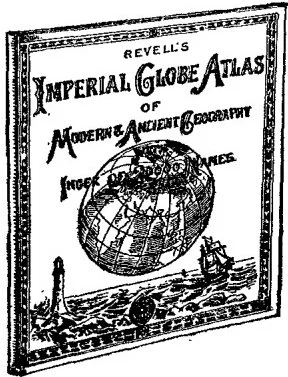
DO YOU WANT THE BEST ATLAS PUBLISHED?
IF SO SEND TO US FOR
This Atlas contains thirty-three imperial quarto maps, 12 x 14 inches, and an index of 20,000 geographical names, so arranged as to show the latitude and longitude of each place named and the number of the map on which it will be found.
This Atlas is a most attractive volume, and is by far the cheapest fine Atlas ever published. Dr. A. T. Pierson, in Missionary Review, says of it:—
“In convenient folio form at the amazingly low price of one dollar. We recommend all students to procure a copy to place on their tables for constant reference. We have found it invaluable. It has a copious index by which easily and rapidly to find any city or town or district.”
We will send this Atlas prepaid to any address in the United States or Canada for $1.25.