The Youth’s Instructor, Vol. 30, No. 18.

FINGAL'S CAVE

The Youth’s Instructor

May 3, 1882

S. D. A. Publishing Association · Battle Creek, Mich. · May 3, 1882

FINGAL'S CAVE.
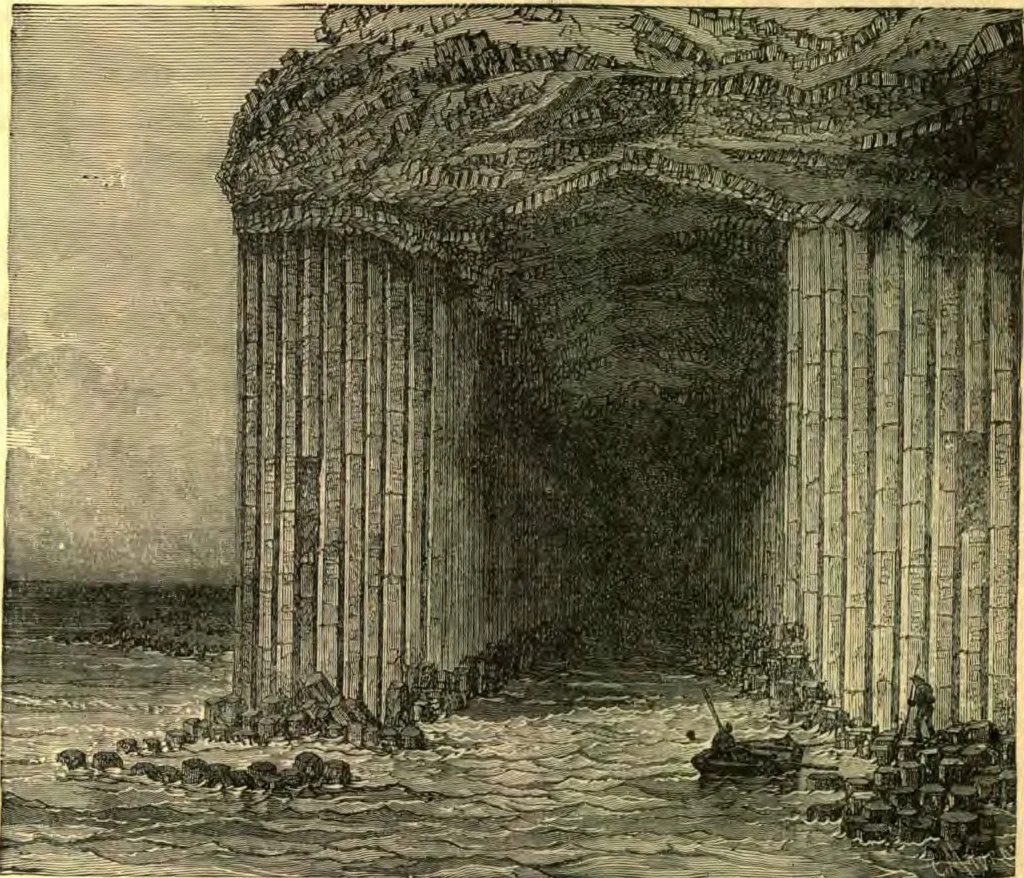
In the Atlantic Ocean, off the northwest coast of Scotland, is a small island known as the Isle of Staffa. It is one of the group of islands called the Hebrides, but it is such a rocky, barren place that no one lives there.
In the hard basaltic rock of which the island is composed, are numerous strange caves, which give to the place its only interest. The most remarkable of these is Fingal’s Cave, of which we have a representation in our picture. This opens into the rugged coast of the island with a noble gateway, the height of which, from the rocky floor to the top of the arch, is 177 feet, and the breadth nearly 54 feet. The depth of the cave from the entrance to the farther end is 227 feet, and for the whole distance the sides are supported by massive columns of rock, of different forms and sizes, many of them being from two to four feet in diameter. From the roof of the cavern hang numerous whitened stalactites, sparkling with crystals.
The sea at all times flows into the cave, covering the rocky floor, at the entrance, to the depth of eighteen or twenty feet, but the water becomes shallower as you go in, until at the farther end it is not more than eight or nine feet deep. The action of the waves has broken many of the columns near the entrance of the cavern. The whole cave is lighted from without, so that it is easy to see the entire length of it. People often go in there in boats, and they say the air is dry and wholesome, and not at all damp and foul, as it is in many caves. It must be grand and solemn to float away into this great natural cathedral, with its innumerable pillars, its vaulted roof, whose beautiful lights of purple and gold are reflected in the water; and to listen to the waves surging always in deep and measured tones against the rocky sides. It is to this cave that the poet Scott refers in his “Lord of the Isles”, when he says:—
“The shores of Mull on the eastward lay, And Ulva dark, and Colonsay, And all the groups of islets gay That guard famed Staffa round. Then all unknown its columns rose, Where dark and undisturbed repose The cormorant had found, And the shy seal had quiet home, And welter’d in that wondrous dome, Where, as to shame the temples deck’d By skill of earthly architect, Nature herself, it seem’d, would raise A Minster to her Maker’s praise! Not for a meaner use ascend Her columns, or her arches bend; Nor of a theme less solemn tells That mighty surge that ebbs and swells, And still between each awful pause From the high vault an answer draws, In varied tone prolong’d and high, That mocks the organ’s melody.” E. B.

WORK BEFORE BREAKFAST.

It was a lovely spring morning. The birds were all in a twitter, getting ready to build their nests and set up housekeeping.
Hannah came across the lawn on her way to the milk-room, her big pail in her hand, and butter-bowl under her arm, and stopped a minute to breathe the freshness of the soft air. But she looked very grim. It would take more than the song of birds and the smell of spring flowers to make Hannah feel happy this morning. In fact, it was a long time since she had felt happy. All night she had been lying awake, thinking of her boy John, who was going wrong in many ways, and was writing home to her for money to get him out of foolish debts, instead of earning enough to help her, as a boy who loved his mother should. She had made up her mind to write him a sharp letter, and tell him she washed her hands of him entirely. She would send him no more money to help him go to ruin, and she did not want to hear from him again until he had made up his mind to behave himself. No wonder poor Hannah looked grim, and cared nothing about the birds.
A light step sounded behind her, and little Grace came down the grassy path in a fresh spring dress, with a black ribbon tied around her waist. Grace had been at the old farm-house with her auntie only a few days, but she was already a friend of Hannah’s, and loved to follow her around at her work. She had many questions to ask about the cows and the milking and the churning and the little pats of shining butter. Hannah liked the sound of her voice. She was able to stop thinking about John for awhile, and listen to Grace.
“Are you going to churn again this morning?” Gracie asked, following her from one pan of rich creamy milk to another.
Hannah shook her head. “No; this is baking day. I’ve got bread, pies, and I don’t know what to tend to. You come down to the kitchen after breakfast, and I’ll show you how to make a little pie for your uncle’s dinner. Would you like that?”
“Oh yes!” Grace said, with happy eyes; that would be so nice; she would ask auntie if she might come, just as soon as she wrote her letter. “I must write to Jerry this morning,” she continued, her merry eyes assuming a graver look.
Then did Hannah give so sudden a start that she almost overturned her bowl of cream.
“Jerry who,” she said sharply.
“Why, Jerry Brown. Don’t you know?” Gracie spoke in a low, sad tone.
“It can’t be that you write to him!”
“Every week,” said Gracie quietly. “Every Friday he watches for my letter.”
“And he killed your father! Why, Grace Cameron, how can you write to him? I should think you would hate him.”
“Oh no!” and a shocked look came into Gracie’s brown eyes.
“He is so sorry, Hannah. He didn’t mean to kill papa, you know; if he had not been drinking, he would not have done it; and papa forgave him with his last breath; and Jerry is in prison, and feels so terribly, that they are afraid he will die.”
But Hannah shut her grim lips together. “There’s reason in all things,” she said. “It’s against nature for you to forgive that man, I don’t care how sorry he is! He needn’t have swallowed the poison that took his brains away. I don’t see how you can forgive him.”
“But, Hannah, I’ve got to, you know.”
Gracie’s voice was low and her lips were trembling. “The Bible says you must forgive seventy times seven; and it says you must forgive your enemies, and you know Jesus said on the cruel cross, ‘Father, forgive them.’ Papa said I couldn’t ask Jesus to forgive me if I did not forgive Jerry. At first I couldn’t; I had to ask Jesus about it a great many times. But at last, when I went to see Jerry, he asked me to forgive him, and of course I had to then.”
Hannah turned away suddenly, to hide her face. Just then she saw a line in John’s letter: “Dear mother, I know I have done wrong; will you forgive me and help me out this time? I promise you I’ll never get caught in this way again.”
It was more than an hour afterward that Mrs. Cameron, Gracie’s aunt, met Hannah as she came in from the milk-room with the cream for breakfast.
“Well, Hannah,” she said pleasantly, “outside work all done?”
“Yes’m,” said Hannah; “and some of the inside work.”
That meant a good deal more than Mrs. Cameron knew anything about.
The afternoon mail took two letters away from the farm-house. One was to poor Jerry Brown in his prison cell, the other was to poor John Barton, Hannah’s son. In that letter was this sentence: “John, poor boy, your mother forgives you; try again.”
Gracie Cameron had helped to do some of the “inside work” that morning; but she didn’t know anything about it.—The Pansy.

THE FIRST ROBIN.

HARK! Is it spring? I waked, and heard a robin sing,— Only a shower of silvery notes, that dropped In tremulous outpouring, and then stopped; While from the window nigh I saw the little singer flitting by, As scorning to retreat, Although the sullen winds that moaned and beat, Had frozen the tears of morning, as they fell, to sleet.
With steadfast claim, This messenger of gladness came To welcome with joy the tardy spring; And, from the winter's cold farewell to bring One measure of delight; Foretelling miracles of sound and sight; Of south winds blowing strong, When the white apple-blossoms drift along, And for this one faint lay, the whole world steeped in song.
O Robin! you In your belief are strong and true; By storms undaunted, with your notes of cheer, You sing, and we grow blither as we hear; Till, echoing your content, With larger faith, we lift our heads low bent, And by past sorrows know What may have seemed life's desolating snow, Only prepares the soul for summer's flowers to grow.
—Boston Transcript.

Take Your Stand on the Rock of Ages

TAKE your stand on the Rock of Ages. Let death, let the Judgment come: the victory is yours through Him.

EXISTING RELICS OF NORMAN TIMES.

During the reign of William, the Norman conqueror of England, there was much done in the building of cathedrals and churches. Many of these still remain, though to some extent reconstructed and restored.
Ethelbert’s St. Paul’s church of London being burnt down, William had a cathedral constructed in its place; this covered three and a half acres of ground. In those early times there seemed to be a great strife as to whose building should be the highest. Henry III. carried the spire of St. Paul’s to 493 feet.
In 1666, the year after the plague in London, which carried off sixty-nine thousand of the inhabitants, there was a great fire which destroyed thirteen thousand two hundred houses, and eighty-six churches, including St. Paul’s Cathedral. So the present St. Paul’s, though on the same site, is of modern date. The top of the dome is four hundred four feet high. The building was finished in 1710, and cost $3,740,000. It stands on about the highest ground in London. The entire length of the edifice is five hundred feet. It is in the form of a Latin cross, and the width at the transepts is two hundred eighty-two feet. Many of the most famous of England’s countrymen lie buried in this cathedral; among others, Lord Nelson and the Duke of Wellington.
The western towers are two hundred twenty feet high, and one of them contains the great bell which is only tolled on the death of a member of the royal family. In this cathedral is a great eight-day clock, with three dials, each fifty-one feet in circumference; and the hammer which strikes the hours on the bell weighs one hundred forty-five pounds.
One of the great curiosities of this cathedral is the Whispering Gallery. It is the one which surrounds the concave surface of the interior dome; here a person speaking in a whisper near the surface of the vault is heard distinctly by a person also near the surface just at the opposite extremity of a diameter—persons in any other part being unable to hear the sound.
Quite a portion of the Tower of London, especially “the keep” or “white tower,” ninety-two feet in height, was constructed by William. This keep is surrounded by various smaller buildings, the whole being inclosed by a high wall and surrounded by a moat, now kept dry, the inclosure comprising thirteen acres of ground.
This tower, situated on the north bank of the Thames, was originally used as a fortress. Sometimes it was used as a royal palace. For centuries it was the state prison of the country. It has contained one thousand prisoners at a time. It is now used as a government store and armory. It is exceedingly interesting to pass through the armory. Here are horses and riders of life size, clothed with the very steel armor, helmets, coats of mail, etc., that were worn by the kings and knights of olden times.
J. N. LOUGHBOROUGH.

God Knows Our Secret Actions

God knows our secret actions, and that is sufficient; for his reward is better than that of men.

A LESSON FROM NATURE.

“In honor preferring one another.”
I took a walk on a bright spring day (Such as Eden must have known), And myriad voices reached my ear, Though I seemed to be alone.
“How brilliant the Maple blossoms are,” Said the Oak so grim and gray. The Maple admired the century Oak, On the hill a mile away.
The sweet Wild Pear looked across the field To the Spruce and Pine’s dark room, And said, “They are always fresh and green; My beauty’s but leafless bloom.”
The Evergreens did not swell with pride; No, they sighed and bowed to say, “See how white and pure the Wild Pear looks! What fragrance she sends this way?”
The Moss in the nook admired the Elm, That far toward heaven could go. The Elm felt, “The Moss is a beautiful child, Though it live in a home so low.”
Just then all joined in a chorus sweet— (What matter who led the van?) “Though we cannot be what others are, Let each do the best he can.
“For this we know, whether high or low, In foreground, or distance dim, If we fill our place with modest grace— Our Maker—it will please him.”
MARY MARTIN.

GRANDMA'S ANSWER.

DEAR Grandma Benson was a beautiful old lady,—beautiful as a picture, with her snow-white cap and soft, gray hair, and the sweet, placid face beneath it, so full of smiles and pleasant things for everybody.
What the world said of her was more beautiful than all,—that she was never known to speak ill of any one. Three-score years and ten she had lived in this world of vexations and cares, yet only kindly words for others and their faults, had escaped her, so full of loving charity was this dear old heart.
One day the children talked it over, how grandma never spoke ill of any one, and, holding deliberations on it in childish council, resolved to ask her what she thought of the devil, the evil one.
Now, they said, as the result of their young wisdom, she must speak ill of that wicked person. So with this snare laid to trap grandma's guileless tongue, they present themselves before her, and put the question, confident she cannot speak well of him who is the source of every evil.
“Grandma, what do you think about the devil?”
Grandma Benson looked wisely at the little group of questioners, and then quietly answered,—
“I think we would all do well if we had his perseverance.”
Dear, precious old heart, full of divine love. She had woven early through the warp and woof of her life the blessed text: “Keep thy tongue from evil, and thy lips that they speak no guile.”
—Aunt Margaret.

MOTHER'S LOVE.

One day, on the street, I met a lady. Just before reaching me, her whole face lighted up with a bright smile. Joy and love were visible upon every feature. She was a stranger to me, and I could see that she was looking beyond me. I wondered what brought the happy expression to her countenance so suddenly. In an instant, I heard a voice behind me, saying,—
“Oh, there's my own dear, dear mamma! I knew I'd meet her. O mamma, I'm so glad you've come!”
Turning, I saw a beautiful little girl, with sparkling eyes, flowing curls, and outstretched arms, running rapidly to meet her mother. The mother saw her child first as it turned the corner, and her face instantly lighted up with love. As the child called impulsively, the mother opened her arms, and in a moment more received her little birdling safe within their shelter.
If a mother's heart is so filled with joy at the trust, love, and faith of her child, and its eager desire to be in her presence, how our good Father in heaven must rejoice, when we, his children, turn to him in faith and trust, making manifest that we love him, and desire to be ever in his presence! Ay, truly he is ever waiting with outstretched arms to receive us tenderly into the fold.—Children's Friend.

SCENES IN THE LIFE OF CHRIST.

LESSON 67.—JESUS TEACHES HIS DISCIPLES TO PRAY.

One day after Jesus had been praying with his disciples, one of them said to him, “Lord, teach us to pray, as John also taught his disciples. And he said unto them, When ye pray, say, Our Father which art in heaven, Hallowed be thy name. Thy kingdom come. Thy will be done, as in heaven, so in earth. Give us day by day our daily bread. And forgive us our sins; for we also forgive every one that is indebted to us. And lead us not into temptation; but deliver us from evil.”
Jesus then tried to show them how willing God is to hear those who pray to him earnestly, by relating the following parable:—
“And he said unto them, Which of you shall have a friend, and shall go unto him at midnight, and say unto him, Friend, lend me three loaves; for a friend of mine in his journey is come to me, and I have nothing to set before him? And he from within shall answer and say, Trouble me not; the door is now shut, and my children are with me in bed; I cannot rise and give thee. I say unto you, Though he will not rise and give him because he is his friend, yet because of his importunity he will rise and give him as many as he needeth. And I say unto you, Ask, and it shall be given you; seek, and ye shall find; knock, and it shall be opened unto you. For every one that asketh receiveth; and he that seeketh findeth; and to him that knocketh it shall be opened.”
And he said further unto them, “If a son shall ask bread of any of you that is a father, will he give him a stone? or if he ask a fish, will he for a fish give him a serpent? or if he ask an egg, will he offer him a scorpion? If ye then, being evil, know how to give good gifts unto your children; how much more shall your heavenly Father give the Holy Spirit to them that ask him?”
And a certain Pharisee who had been listening to Jesus, asked him to go to his house to dinner. And Jesus went with him, and sat down to eat. Now it was a custom among the Pharisees to go through with a long ceremony of washing of the hands several times before eating, and they thought it a sin not to do so. So it was not strange that this Pharisee wondered when he saw Jesus sit down to eat without first washing. The Saviour knew this man’s thoughts, and perhaps, too, some one at the table said something to call out the remark; for he said, “Woe unto you, scribes and Pharisees, hypocrites! for ye make clean the outside of the cup and the platter, but within they are full of extortion and excess. Thou blind Pharisee! cleanse first that which is within the cup and platter, that the outside of them may be clean also.” Now we are not to think from this that Jesus meant to forbid the washing of the hands or of dishes before eating; but the Pharisees had many traditions and customs which they were very particular to obey, while in their hearts they were proud and wicked, and made their living by wronging their neighbors. He took this way to show them what he thought of their wicked course, and quite likely he sat down without washing his hands, knowing that they would say something about it, and thus give him a chance to teach a useful lesson.
Jesus then went on to tell the Pharisees that while they had been very careful about doing their duty in little things, they had entirely neglected “the weightier matters of the law,—judgment, mercy, and faith.” “These,” said he, “ought ye to have done, and not to leave the other undone.” He told them that they had taken care to appear very religious, but this they had done, not because they really wanted to be right, but rather to be seen of men, and because they loved the greetings in the market place, and to be called Rabbi, or Master. And he said to them, “But be ye not called Rabbi; for one is your Master, and all ye are brethren. . . . But he that is greatest among you shall be your servant; and whosoever shall exalt himself shall be abased; and he that shall humble himself shall be exalted.”

QUESTIONS.

1. What request did one of the disciples of Jesus make of him? Luke 11 : 1.
2. Repeat the prayer which he taught them.
3. How did the Saviour illustrate to them God’s willingness to hear those who pray to him earnestly?
4. With what request did he suppose a man to go to his friend at midnight? Verses 5, 6.
5. What answer would “he from within” be likely to return?
6. What might finally cause the man to rise and give his friend what he desired? Verse 8.
7. By what promises did Jesus encourage his followers to ask his Father for what they needed? Verses 9, 10.
8. How did he teach them that God is more willing to give his blessing to those who seek it than earthly parents are to give good gifts to their children? Verses 11–13.
9. Who invited Jesus to take dinner with him? Verse 37.
10. What were the Pharisees accustomed to do before eating?
11. How important did they regard this ceremony?
12. What did the Pharisee who had bidden Jesus, do when he saw him sit down to eat with unwashed hands?
13. What did the Saviour say in answer to this man’s thoughts? Matt. 23 : 25.
14. What did he bid these blind Pharisees do? Verse 26.
15. How had many of them been in the habit of getting their living?
16. What did the Saviour mean to have them understand from his words to them?
17. Why had Jesus probably sat down to eat without washing his hands?
18. What did he say further to these Pharisees about their way of doing?
19. What did he tell them they had neglected? Verse 23.
20. In what words did he point out to them the right course to have taken?
21. Why did he say they had taken care to appear religious?
22. Why were not the followers of Christ to be called Rabbi, or Master? Verse 8.
23. How did he warn them against being anxious to gain the honor of men? Verses 11, 12.
24. What will be the reward of the humble?

NOTE.

Offer him a scorpion.—The scorpion is a small animal, which is found in the warm countries near the equator. They are seldom longer than four inches, and have eight feet, eight eyes, and a long tail, which is full of joints and ends in a sting. One of these creatures is often found rolled up in a ball, and when of a white color, looks very much like an egg; but if taken in the hand, it will poison a person severely, sometimes causing death.

NEW-TESTAMENT HISTORY.

LESSON 30.—AMBITION REPROVED.

“Then came to him the mother of Zebedee’s children with her sons, worshiping him, and desiring a certain thing of him. And he said unto her, What wilt thou? She saith unto him, Grant that these my two sons may sit, the one on thy right hand, and the other on the left, in thy kingdom. But Jesus answered and said, Ye know not what ye ask. Are ye able to drink of the cup that I shall drink of, and to be baptized with the baptism that I am baptized with? They say unto him, We are able. And he saith unto them, Ye shall drink indeed of my cup, and be baptized with the baptism that I am baptized with; but to sit on my right hand, and on my left, is not mine to give, but it shall be given to them for whom it is prepared of my Father. And when the ten heard it, they were moved with indignation against the two brethren. But Jesus called them unto him, and said, Ye know that the princes of the Gentiles exercise dominion over them, and they that are great exercise authority upon them. But it shall not be so among you; but whosoever will be great among you, let him be your minister; and whosoever will be chief among you, let him be your servant; even as the Son of man came not to be ministered unto, but to minister, and to give his life a ransom for many.”
“And as they departed from Jericho, a great multitude followed him. And, behold, two blind men sitting by the way-side, when they heard that Jesus passed by, cried out, saying, Have mercy on us, O Lord, thou son of David. And the multitude rebuked them, because they should hold their peace; but they cried the more, saying, Have mercy on us, O Lord, thou son of David. And Jesus stood still, and called them, and said, What will ye that I shall do unto you? They say unto him, Lord, that our eyes may be opened. So Jesus had compassion on them, and touched their eyes; and immediately their eyes received sight, and they followed him.”
“And Jesus entered and passed through Jericho. And, behold, there was a man named Zacchæus, which was the chief among the publicans, and he was rich. And he sought to see Jesus, who he was; and could not for the press, because he was little of stature. And he ran before, and climbed up into a sycamore tree to see him; for he was to pass that way. And when Jesus came to the place, he looked up, and saw him, and said unto him, Zacchæus, make haste, and come down; for to-day I must abide at thy house. And he made haste, and came down, and received him joyfully. And when they saw it, they all murmured, saying, That he was gone to be guest with a man that is a sinner. And Zacchæus stood, and said unto the Lord; Behold, Lord, the half of my goods I give to the poor; and if I have taken anything from any man by false accusation, I restore him fourfold. And Jesus said unto him, This day is salvation come to this house, forasmuch as he also is a son of Abraham. For the Son of man is come to seek and to save that which was lost.”

QUESTIONS.

1. What mother came to Jesus with her two sons? Matt. 20: 20.
2. How did she present herself to him?
3. What request did she make?
4. What did Jesus say to the anxious mother?
5. What question did he ask her sons? See note on Lesson 54, INSTRUCTOR, Vol. 30, No. 5.
6. How did they answer him?
7. What did Jesus promise them?
8. What did he say about granting the place of honor which they desired?
9. How did the other ten disciples feel when they knew what request had been made in behalf of James and John? Verse 24.
10. When Jesus had called his disciples together, what did he say to them about the princes of the Gentiles?
11. What entirely different rule of action did Jesus lay down for his disciples?
12. How did his own life illustrate this principle?
13. As Jesus passed through Jericho, how did the people show their anxiety to hear him? Verse 29.
14. Who were sitting by the wayside a short distance from Jericho?
15. What did they say when they were told that Jesus of Nazareth was passing by?
16. How was their action regarded by the multitude?
17. What effect did rebukes have upon the blind men?
18. How did Jesus show his willingness to help them?
19. What did the men say when Jesus asked them what he should do for them?
20. Describe the miracle that followed.
21. Who was at this time the chief among the publicans in Jericho? Luke 19: 1, 2.
22. How did he manifest great anxiety to see Jesus?
23. As Jesus passed by, what did he say to Zacchæus?
24. How did Zacchæus respond to these words of our Lord? Verse 6.
25. How did those who stood by manifest their displeasure?
26. What did Zacchæus say to show that he had genuine repentance? Verse 8.
27. How did Jesus show that he was willing to forgive this man’s sins?
28. What remark did he make concerning the work that he had come to do?
Continue reading: GOING TO SEE THE QUEEN