The Youth’s Instructor, Vol. 28, No. 19.

SUSIE'S EXAMINATION

The Youth’s Instructor

May 5, 1880

S. D. A. Publishing Association · Battle Creek, Mich. · May 5, 1880

SUSIE'S EXAMINATION.

“Well, Susie,” said Uncle Joseph, as he came into the parlor in the evening, “how did you pass your examination? But I hardly think I need ask, for your face tells me you were successful and received your certificate.”
“Yes indeed, uncle, and I suppose I do feel happy, though I am very sorry for some who failed.”
“Were there many to be examined?”
“Oh, yes; a large number, and several of them my school-mates. I was most sorry of all for Lizzie Brown. She was very anxious to teach, and needed the employment, and her friends had obtained the promise of a situation for her. I own I was afraid for her, for she has been somewhat careless about her studies some of the time; and in examination she failed to pass, just by a fraction.”
“By a fraction! What do you mean?”
“Why, the examiner marks the degree of proficiency in each study, and then adds all together and divides by the number of studies. One hundred is perfect, and seventy-five is required to get a certificate. When Lizzie’s average was made out, it was seventy-four and a fraction, and she failed.”
“That was unfortunate, indeed. And how did your record stand?”
“Eighty-six, on the average.”
“Then you had eleven credit marks beyond what you needed to get your certificate?”
“Why, yes, if that is the way you put it. I should have barely passed if I had had eleven less.”
“But you could not tell beforehand just how the examiner would rank you?”
“Certainly not.”
“What a pity you could not! You might have saved so much unnecessary study, which you have spent in gaining the eleven points you did not need.”
“Why, Uncle Joseph! What do you mean? I believe I am not afraid of study. You know it has long been my ambition to be a teacher, and I want to be one of the best. I would have been glad to stand one hundred in every study if it had been possible, and I was willing to work for it, too. What made you speak in that way?”
“I must have been thinking of the question you asked me a few days ago. You remember you were very anxious to know whether dancing and card-playing were positively wicked, so that a person who practiced them could not be a Christian. What could I think but that you wanted to guard against self-denial and separation from the world just as far as you possibly could, and barely pass? And how could I know but the same principle would apply to your ambition for teaching? Why should it not?”
“O uncle, how strangely you do talk! I never thought of it in that way; but you know some of my young friends practice those things.”
“And they ask you to join them?”
“Yes, sometimes.”
“And you would like to do so if you could quiet your conscience so far as to believe that you could and still be a Christian. Are any of your friends better Christians because of their indulgence in these things?”
“I cannot say that they are.”
“Do you know of any who would rank one hundred as followers of Christ, if only they did not lack these particular Christian graces?”
“No, I do not think anything of the kind.”
“Then where is the occasion for such a question as I have spoken of, if your ambition for the Christian life is like your ambition for teaching, and you aspire to be one of the best?”
“Are the cases, then, so much alike?”
“There is a difference, certainly. If you had failed in this examination, you might have gone back to your studies, and at another time you might have succeeded. But a time is coming when those who are ready will go in, and the door will be shut. Yes, there is a difference. Also for those who are trying to walk as close as possible to the line which separates the church from the world! God save my dear niece from coming to the great examination, only to rank seventy-four and a fraction!”

THE MAELSTROM.

[Few illustrations of the nature and power of temptation are more impressive than that derived from the Norwegian Maelstrom.]
JUST off the coast of Norway, Two tides of ocean sweep, And they make a terrific whirlpool, With vortex fierce and deep. Inward and inward ever The circling waves go round, Swift and more swift, with fearful rush, They seek the abyss profound.
Oh! woe to the helpless ship, That enters that treacherous tide; At first, on the outer circle, It seems secure to ride; But now, in the boiling current, ’Tis tossed like a plaything weak, And the air is rent with the piercing note Of the mariner’s dying shriek.
There lieth a treacherous whirlpool, Off the coast of human life, Whose waters are seething and rushing, Like demons of evil and strife; And like the Norwegian maelstrom, The outermost circle seems fair, But woe to him who is hopelessly plunged In its vortex of guilt and despair.
O youth, beware of the current— The current of folly and sin, Approach not its farthest circle, Lest you reach the abyss within; For worse than the shriek of the dying, That rings from the Norway coast, Is the wail of a perishing human soul, At last and forever lost!

WHAT BECAME OF THE POLARIS?

In the preceding numbers the readers have learned about the separation of the crew of the Polaris, and how a part of them lived for over six months on cakes of ice, and were, at last, all saved. We will now tell what became of the Polaris, and the remnant of the crew that remained with her.
After the separation, the captain called all hands together, when it was found that only fourteen men remained on board. The crew gazed for a few moments on each other in silence, when the duties of the ship were resumed. The vessel was rapidly driven through the water, and after some time ran into pack ice, and her progress was stayed. The ship was found to be leaking badly, but steam was gotten up, and the pumps gained on the leak.
In the morning, anxious eyes were on the lookout for the company who had been separated from them in the night; but they were obliged to attend at once to their own personal safety, as the ship was in a sinking condition. Under these circumstances they decided to run the vessel ashore, and abandon her. Having by the aid of steam and sail thrust the ship into the land, active preparations were made for leaving her. This was October 17, 1872.
They now built huts on the shore, and began to remove their effects. Soon they were visited by some Esquimaux, who came to the ship with a small sled drawn by dogs. These natives were dressed in dog and bear skins. They were a good-natured set of fellows, and helped the seamen to move to the shore, which was some twenty rods distant. It was surprising to see what great loads their dogs could draw. Four of them would trot off gaily with a burden which as many sailors could barely move!
About this time the sun disappeared, and was out of sight till April; but they had twilight, and some of the time, most beautiful auroras. The crew were well off for provisions, but were very poorly provided with clothes, their goods being on the floe. They had also only a limited supply of ammunition for their fire-arms.
It was soon decided to live as well as they could through the winter, and then build small boats out of the Polaris, and in the summer sail down the coast of Greenland, hoping to reach the Danish settlements, or better still, fall in with some whalemen.
During the winter, they were visited by more than a hundred Esquimaux, with their families and sleds and dogs. The natives often furnished them with seals and walrus, which they were very skillful in capturing. The seamen also made very many excursions, to hunt and to explore the coast, and to take observations; for which last object they were provided by our government with the most approved instruments. Several of the party also were thoroughly scientific men. In their hunting excursions they shot numerous rabbits and foxes, geese, and other Arctic birds. During the winter, by their constant intercourse with the natives, they had good opportunities for learning much in regard to their habits, religion, and ways, as a people.
By the first of January, the twilight had so increased that at noon observations were made without artificial light. At this time the grinding of the bergs in the Straits resembled continued thunder. The mate of the ship now commenced the construction of two boats, with which to escape from this land of ice. Several weeks were occupied in building them, and furnishing them with sails made of sheets and towels.
On the 2d of June they commenced their perilous voyage amid the floating ice. For over three weeks they coasted southward, moving through the water by the aid of sails and oars, and hauling up on the shore ice, or rocks, to rest, as they were compelled. But on the 28th, the company were electrified by hearing one of the men cry at the top of his voice, “Ship ahoy!” Joy thrilled every breast! Away to the south, some ten miles distant, were seen the three masts and smoke-stack of a vessel. This was one of the Scotch whalers which they had hoped to fall in with. The flag was now hoisted on two oars, lashed together. Soon the ship’s ensign was run up, showing that the signal was seen. The Polaris men now dispatched two of their number to communicate with the strange vessel. When about half way, they were met by ten sailors, who had come out to render assistance. From them was learned the grateful intelligence that the party on the floe had been picked up.
By midnight all hands were on board the vessel, which proved to be the Ravenscraig, of Scotland, Captain Allen commander. Here they were treated with the utmost kindness. By a prosperous passage, the entire crew in a few weeks reached the city of Washington, and one of the boats was preserved and exhibited at the great Centennial of 1876. G. W. AMADON.

COME UNTO ME.

A STILL small voice comes to me evermore, The while I walk life's hills and valleys o'er; I stay and listen for it wistfully— “Come unto Me.”
I would not miss it for all sweetest sounds Of music with which happy earth abounds; The words are full of tenderest melody— “Come unto Me.”
Full well I know who speaks them day by day; I cannot often see along the way The Friend whose voice I love; but still he saith, “Come unto Me.”
It is a whisper in the hush of night, It is the greeting of the morning light, And all day long I hear it thankfully— “Come unto Me.”
It is not drowned by all the noise of throngs, And in the peaceful sounds of even songs I catch the sweet words spoken tenderly— “Come unto Me.”
I am bewildered oftentimes by life, And long to steal away from all the strife; And then how precious the dear words can be— “Come unto Me.”

TRUST IN JESUS.

It is safe to trust in Jesus, for he is our best friend. We know from the testimony of others, if we have no experience of our own, that those who have trusted in him were never disappointed.
When Christ walked upon this earth, a man among men, many trusted in him, although thousands turned from him. A marked example of belief in Jesus is the case of Jairus. You have all doubtless read of how his little daughter was very sick, and that the doctors could do nothing for her; but her father knew that the Great Physician was in the neighborhood, and he believed that he could heal her. So Jairus went to him, and knelt down before him, and prayed him to come and heal his daughter. Jesus at once started for the house.
By and by a servant came to meet them, and told Jairus that his daughter was dead, and that there was no need to trouble the Master further. But Jesus went on, simply saying to the father, “Be not afraid, only believe.” On reaching the house, he went into the room where the dead child lay, and, taking her by the hand, he said, “Maid, arise,” and the little girl arose and walked.
Oh, how happy and thankful the father and mother must have been! Was it not proven to Jairus that it was safe to trust in Jesus? Yes, truly. And as he left their home, how their hearts must have gone out in love to him!
Jesus’ words to Jairus we may take to our own hearts,—“only believe,” trust in me. He is just as ready to listen to prayer now as then, for he loves us just as much as he did the people among whom he lived more than eighteen hundred years ago. That we cannot see him makes no difference; he can see us and knows what we want, and what is best for us to have.
We may tell him all our troubles, and trust in him for help. Perhaps he may not answer our prayers just as we have asked him, but we may believe and trust him to give us just what we need; for he is too wise to err and too good to be unkind.
V. A. M.

LESSONS FOR CHILDREN.

LESSON LXXI.—THE SHUNAMMITE’S SON.

A CERTAIN woman, the wife of one of the sons of the prophets, came to Elisha, saying, “My husband is dead; . . . and the creditor is come to take unto him my two sons to be bondmen.” Her husband was in debt when he died, and the man that he owed was going to take the widow’s two sons, and make them work for him as servants until the debt was paid.
“And Elisha said unto her, What shall I do for thee? tell me, what hast thou in the house? And she said, Thine handmaid hath not anything in the house, save a pot of oil. Then he said, Go, borrow thee vessels abroad of all thy neighbors, even empty vessels: borrow not a few. And when thou art come in, thou shalt shut the door upon thee and upon thy sons, and shalt pour out into all those vessels, and thou shalt set aside that which is full. So she went from him, and shut the door upon her and upon her sons, who brought the vessels to her; and she poured out. And it came to pass, when the vessels were full, that she said unto her son, Bring me yet a vessel. And he said unto her, There is not a vessel more. And the oil stayed. Then she came and told the man of God. And he said, Go, sell the oil, and pay thy debt, and live thou and thy children of the rest.”
There was in Shunem a house where Elisha always stopped for food and rest, whenever he passed that way. The woman of the house was a good woman, and always glad to have the prophet come. So she talked with her husband, and they fitted up a room with just such things as they thought he would want. Now these people had no children, but after a time the Lord gave them a son. When this little boy had grown large enough, he went out one day to his father, who was in the field with the reapers. The day must have been very hot; for the little boy said to his father, “My head, my head!” And when he was carried to the house, he sat on his mother’s knees until noon, and then died. “And she went up, and laid him on the bed of the man of God, and shut the door upon him, and went out.”
Then she took an ass, and went with all haste to Mount Carmel, where Elisha was, and told him what had happened. This was a long journey, but she did not know what else to do. When Elisha heard her story, he gave his cane to Gehazi, and told him to go, and lay it upon the child’s face. Then Elisha and the woman followed on, and when they had come to the house, Elisha went up to his room, and shut the door. There he prayed to the Lord, and the child was brought to life. “And he called Gehazi, and said, Call the Shunammite. So he called her. And when she was come in unto him, he said, Take up thy son. Then she went in, and fell at his feet, and bowed herself to the ground, and took up her son, and went out.”

QUESTIONS.

  1. What trouble caused the wife of one of the prophets to go to Elisha? 2 Kings 4:1.
  2. What did she say to him?
  3. What is meant by the “creditor”?
  4. How did she come to be owing him?
  5. What was the creditor going to do?
  6. What did Elisha say to her?
  7. What did she say she had in the house?
  8. What did he tell her to do?
  9. What was she to do with the vessels that she had borrowed?
  10. Describe the miracle that was then performed.
  11. What did the man of God then tell her to do with the oil?
  12. Where did Elisha find food and rest whenever he passed through Shunem?
  1. What did the good woman and her husband finally do for the man of God?
  2. How many children had these people?
  3. What happened to the son which the Lord gave them?
  4. After the child died, what did his mother do with him?
  5. Where did she then go?
  6. When Elisha had heard her story, what did he tell his servant to do?
  7. What did Elisha do when he himself had come to the house?
  8. What happened when he had shut himself in the room with the dead body of the little boy?
  9. When Elisha had called Gehazi, what did he tell him to do?
  10. What did the prophet say to the woman when she came into the room?
  11. How did the woman show that she was thankful?

BIBLE LESSONS FOR YOUTH.

LESSON XVII.—THE RESTORATION OF JERUSALEM.

  1. What caused the Babylonians to rebel against the Persians?
  2. When did the revolt take place?
  3. To what extremity were the Babylonians driven during the siege?
  4. What made it nearly impossible to capture the city?
  5. How was it finally taken?
  6. To what extent did Darius destroy the fortifications of the city?
  7. What may be said of its strength and glory?
  8. About what time did this literal fall of the great city take place?
  9. What caused Darius to make war with Greece?
  10. What was the result of his expedition against that country?
  11. When did this defeat take place?
  12. What preparation did Darius make for another invasion of Greece?
  13. How was he prevented from carrying out his purposes?
  14. By whom was Darius Hystaspes succeeded?
  15. With how large an army did Xerxes invade Greece?
  16. What was the result of his expedition?
  17. What remarkable feat of bravery was performed during this invasion?
  18. Who succeeded Xerxes?
  19. What important event took place in the seventh year of this king? Ezra 7.
  20. Who accompanied Ezra when he went up to Jerusalem? Verse 7; also chap. 8: 1–20.
  21. How long had the temple been completed?
  22. On arriving at Jerusalem what did Ezra learn in regard to the conduct of the Jews at that place? Ezra 9.
  23. What course did he pursue, and with what result? Chap. 10.
  24. What did he do to guard the people against relapsing into their former evil practices?
  25. What other improvements was he instrumental in bringing about?
  26. When did Nehemiah go up to Jerusalem? Neh. 2.
  27. What important work did he have permission to do?
  28. What opposition did he meet?
  29. How did he carry forward the work?
  30. How soon was it completed? Neh. 6: 15.
  31. In what were he and Ezra united?
  32. What did he do at the expiration of twelve years?
  33. What services did he afterward render his people?

SYNOPSIS.
Babylon, from the first, was very unwilling to submit to the Persians; and when the seat of government was removed to Susa (Shushan), in the province of Susiana (Elam), they were so enraged that they began to make secret preparations for breaking away from the Persian rule. The revolt took place in the first years of Darius Hystaspes. During the siege, the Babylonians suffered terribly from famine. They finally sacrificed most of the women and children, rather than yield to their enemies. It seemed impossible to take the city, for Cyrus had so fortified it as to make it much stronger than it had ever been before. At last, one of the Persian generals, having obtained admission to the city, as a pretended deserter, betrayed it into the hands of its enemies.
Darius then took away its gates and reduced its walls to one-fourth their original height. Thus the strength of Babylon was broken, and its glory departed to return no more. This literal fall of the great city took place about the time when the Jews were rejoicing at the completion of the temple at Jerusalem.
Soon after this, Darius opened a war with Greece for the recovery of some revolted colonies. His vast army was defeated on the plains of Marathon by the Athenians under Miltiades. This was B. C. 490, twenty-five years after the temple was completed. Darius then spent three years in collecting an immense host for a new invasion of Greece, but was hindered from carrying out his purpose, first by a revolt in Egypt, and soon after by his death.
Darius was succeeded by his son Xerxes, B. C. 486. Xerxes invaded Greece with an army said by Herodotus to number five million, or more than ten times as many as the largest army ever raised by Napoleon Bonaparte. The discipline and valor of the Greeks, however, was more than a match for this mighty host, and the Persians were driven back into Asia with immense loss of life, shipping, and stores. It was in this war that three hundred Spartans held the pass of Thermopylae till they had slain twenty thousand of their foes.
Xerxes was succeeded by his son, Artaxerxes Longimanus, who reigned forty-one years. It was in the seventh year of this king that Ezra obtained a decree for the complete restoration of Jerusalem. He went up to the land of his fathers, accompanied by about six thousand of his countrymen. It was now nearly eighty years since the first company went up with Zerubbabel, and fifty-eight since the temple was completed.
When Ezra arrived at Jerusalem, he found that even the leaders among his people had intermarried with the idolatrous nations around them, and had departed in many respects from the pure precepts of the law of their God. He was very zealous in correcting these errors, and soon effected a decided reform. In order to guard against a relapse, he read the law to the assembled people, causing it to be so carefully explained that all could understand it. It was chiefly through the labors and influence of Ezra, also, that the books of the law were arranged, edited, and multiplied. Provisions were likewise made for the reading of the Word of God to the people every Sabbath.
In the twentieth year of Artaxerxes, B. C. 445, and nearly thirteen years after Ezra obtained his decree, Nehemiah went up to Jerusalem, with permission to rebuild the walls of the city. This work he undertook, and pushed forward with singular courage and pertinacity. He was violently opposed by the Samaritans, prominent among whom were Sanballat the Horonite, Geshem the Arabian, and Tobiah the Ammonite.
Much of the time half of the men were obliged to stand guard while the others worked, and sometimes they worked with a warlike weapon in one hand while laboring at the wall with the other. The work was carried on with such energy as to be completed in the almost incredibly short period of fifty-two days.
Nehemiah and Ezra were united in teaching and enforcing the “laws of their God,” according to the decree of Artaxerxes.
When the twelve years for which Nehemiah obtained leave of absence had expired, he returned to the Persian palace at Shushan, but revisited Jerusalem at different times, correcting many abuses, and introducing important reforms.
NOTE.—No one should fail to read thoroughly the books of Ezra and Nehemiah while studying these lessons.

OVERCOMING

MRS. NORRIS sat by the window one beautiful Sabbath morning, explaining the lesson for the day to her two little ones.
“I don’t believe I know just what overcoming means, mamma,” said flaxen-haired Gracie.
“Well,” said her mother, after a moment’s thought, “just suppose that Willie had done something to vex you, and you felt like speaking cross to him, but should keep back your angry feelings, and take no notice of his offense, that would be overcoming. Do you understand now?”
“Yes’m, I think so,” said the little one brightly.
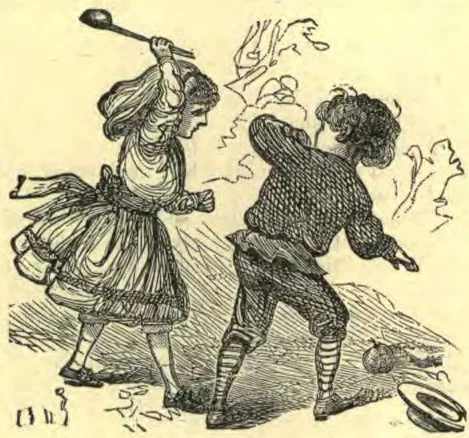
Not many days after, as Mrs. Norris was sitting sewing, she heard a great outcry, and Willie came running to her with a pitiful story of how “Gracie had struck him real hard.”
“Why, Gracie, did you strike your little brother?” said her mother. “I thought you were the little girl who was to overcome.”
“I forgot all about it,” said Gracie. “But I’m real sorry, and I won’t do it again, because I can overcome if I try.”
Ah, confident little Gracie, look out! It is not as easy as you imagine to overcome. You will have to keep on trying. “He that ruleth his spirit is greater than he that taketh a city,” you know.
A short time had passed away when another noise was heard, and again Willie flew to mamma for refuge.
“Gracie pushed me down,” he sobbed.
This time Mrs. Norris said nothing to her little daughter, but oh, such a reproachful look as she gave her! It was worse than any reproof could have been, and went right to Gracie’s heart. Her little arms were soon thrown around Willie’s neck, and fond words were spoken to heal the wound.
“I love you, Willie,” she said; “I’ll ask Jesus this time to help me overcome, and then I guess I shall.”
The little petition that went up from mamma’s knee was worded thus: “Dear Jesus, won’t you please help me to overcome, and help Willie too, and everybody. Amen.”
I doubt not that Gracie has had many trials of her patience since then, for Willie is a little tease sometimes, like all other wide-awake, fun-loving boys; but let us hope that she has tried hard to overcome. — Young Pilgrim.

LETTER BUDGET.

WEST LIBERTY, MICH.
Dear Editors: I have taken the INSTRUCTOR three years and like it very much. I am eleven years old. I keep the Sabbath with my parents. I would like to see all the INSTRUCTOR family. I have never written for the paper before. Pray for me that I may be an overcomer.
Yours truly, Vina E. McGraw.
WEST HALLOCK, ILL.
Dear Editors: I thought that I would write a letter for the “Budget,” as I have never written one. I am nine years of age. I am keeping the Sabbath with my parents. I had a little sister who liked to attend Sabbath-school with me, but now she is dead. I have one brother. I am trying to serve the Lord, and hope to meet the INSTRUCTOR family in Heaven. Pray for me that I may be faithful.
Ella G. Brown.
LEON, WIS.
Dear Editors: I go to Sabbath-school every Sabbath. I learn the lessons in the INSTRUCTOR. I keep the Sabbath and am trying to do right. I was baptized when Eld. Olsen was here. How I would like to see all the INSTRUCTOR family. I want to be an overcomer. Pray for me.
Yours in hope of eternal life, Jennie M. Snow.

FASHIONS

THE Misses Robin, with their numerous relatives, have returned from their Southern residences and are beginning to twitter about what they will wear for the coming cherry festival.
They have about concluded to wear their brown suits of last year, trimmed in front with red, and trail of usual length.
I don't know why they have decided on this economy, unless it is because they have to spend much of their time in building new houses, and repairing their old ones, which they find much damaged by storms and broken into by thieves; and besides, much of their time will be occupied in rehearsing their songs for their one thousandth centennial.
Their country cousins, the Lark family, will wear knickerbocker, with a black necktie, and a bunch of feathers on the back part of the cap to match the suit.
The Sparrow “set” will not change much from last season; drab is their favorite color, and nothing will induce the modest little maidens to appear in any other color.
But the Pigeon family cannot agree so well upon one color; while some contend for black and white, intermixed with a flaring pull-back and heavy ruffles at the throat, others are quite satisfied with the dove color.
Among our little foreigners, the Canary family, there will not be much display at dress, and no attempt at parties, as many of their relatives are in prison, on seed and water, for offenses they cannot understand, and from which they can contrive no means of escape. The prison dress will be green, buff, and yellow, as these colors will be the most suitable to the shady condition of their confinement, nor will they fade in the hot sunshine, if, by neglect, their prisons are left too long hanging on the wall of the house.
The little Swallow and Martin “clique” will not be on until late in the season.
They will wear close-fitting, brown riding coats, cut swallow-tail; as they will move about a great deal in society, the Ulster or Chesterfield would be too inconvenient.
Our birds are all from the “first families;” proud, yet not vain, of their suits, given by Him who knew so well the wants and circumstances of all His little creatures.
In fact, many of our girls might pattern after our modest little songsters, and leave off their unnecessary frills, flounces, and bias folds.—Christian Child.

Comparing the Strength and Agility of Insects

The locust can be heard a sixteenth of a mile. An ordinary man will outweigh 15,000 of them. Were his voice proportioned to his weight, in ratio of the locusts, he could be heard about 1000 miles. A flea weighs less than a grain, and jumps a yard and a half. Were a man of 150 pounds possessed of equivalent agility, he could spring from the dome of the Capitol to China, and almost go round the world in two jumps.

You have reached the end of this edition.

The Youth’s Instructor · May 5, 1880