The dispensation which was instituted by our Saviour, and formally inaugurated on the day of Pentecost, has been designated “the dispensation of the Spirit.” It is properly so called. By thus denominating the dispensation in which we live, we do not imply that there was no Spirit of God in former dispensations. Such an implication would be a serious error. Nor does the change of dispensations imply any change in fundamental principles. To assert that it did would impute partiality to an impartial God.
The very beginning of the sacred record brings to view the Spirit of God as an active agent in the work of creation; and it has ever been an active force in the divine operations. But men have not always recognized its agency, or perceived the presence of the heavenly representative. But whether perceived and appreciated or not, the Spirit of God has ever done its office work in the hearts and lives of men; and such as yielded to its control learned to feel their dependence upon its influence. In the prophetical writings we have frequent references to the third person of the Deity. The Psalms also abound in allusions to the divine Spirit. Indeed, we may conclude that men have ever been as dependent upon the Holy Spirit for every good motion and impulse as they are now.
Why, then, is the latter dispensation distinguished as that of the Spirit? Since the flood, the history of God’s people may be divided into three chapters, or dispensations, having their distinguishing geniuses, or leading characters. In the first we have the patriarchs, or fathers, to whom the Lord communicated his word directly or by the visits of angels. Sacrifices and offerings were presented by the individuals or heads of households, as visible, tangible representations of heavenly things; and for guidance men depended upon direct revelations of God’s will. In the next, or Mosaic, dispensation, Moses was the leading character; and the Lord caused a miniature representation of the work of propitiation to be established upon earth in the sight of his people. Here he located the Shekinah, or sign of his presence. Around these he established a very complete code of laws, which formed the genius of that age. The practical operation of those laws was designed to convey to his people a knowledge of spiritual things. To those who studied them, the rites, ceremonies, and sacrifices of those times bore rich lessons of spiritual truth.
As the coming of the Saviour drew near, there were tokens of the dawning of a clearer day. Joel prophesied in the name of the Lord that in those days God would pour out of his Spirit. The Saviour taught of the Leader, Advocate, Teacher, or Comforter, which he would send after his departure; and upon the day of Pentecost that promise was fulfilled. But the outpouring of the Spirit was not for that day alone. That was the beginning of a work which was to continue to the end of time, yes, forever.
By object-lessons, as we teach the kindergarten, God had held up to the view of his little children the unseen world. To his older children he reveals the agency of his own representatives, and bids us look beyond the seen to the unseen. We have fully reached a time when, by the aid of faith, and in the full light of the teachings and experiences of the past, the operation and power of the Holy Spirit are clearly revealed. While God may in justice wink at the times of ignorance that are long since past, he now expects that every child of his will realize his utter dependence upon the guidance and help of his own appointed guide and teacher. He who lives devoid of the Holy Spirit has absolutely no connection with God. He is without a divine guide, or teacher. He may have the law in printed form, he may have the whole Bible; but it is useless to him for good without the Spirit of God to accompany it. On this account there are many who have made the study of the Scriptures a lifelong work, and have no knowledge of God, and none of the characteristics of his children. He who does despite to the Spirit of God cuts himself off from all hope. He cannot repent, because there is nothing to draw him to repentance. He cannot cease from sin, because there is nothing to prompt a single impulse for a holy life.
Those who are trying to gain heaven without the constant aid and guidance of the Spirit are following a vain pursuit. How blest are we who behold the grand truth of the Spirit’s mediation! What a privilege to know his indwelling power! There is but one step higher, and that is to be brought into the immediate presence of the Father from whom all blessings flow. In the coming dispensation God himself will be our leader and companion. There, associated with God the Father, the Son, and the Holy Spirit, we shall delight to study the wonderful plan by which the infinite God has revealed himself to finite man.
G C T.
WHERE IS THE WORLD AT?
By Uriah Smith
The slang of this heading will be pardoned in view of the subject it is intended to bring to view. Men are accustomed in these days to congratulate themselves on the improved age of the world in which they live. They feel that the world was never so enlightened; that men have never before reached so high a state of development; that general information is widespread; that the past were ages of ignorance, superstition, credulity, and cruelty, but that the present is an age of wisdom, intelligence, freedom, truth, culture, refinement, sound minds, and kind hearts; and that the nineteenth century can look upon all preceding ages, especially the less remote, with pity and contempt, on account of the low and ignoble beliefs and customs to which mankind were slaves.
But is it so? Has the present age so much of which to boast over the past? Have not all the ills — mental, moral, and physical — with which the world has been afflicted, sprung from the evil one? and is he not more experienced and more active to-day than ever before? Is not human nature the same in every age? and aside from divine help and influence, is it on any higher level than in ages past?
Within the sixty centuries which have elapsed since the days of Adam, how far back are we obliged to go to find an exhibition of the worst characteristics of the human heart?—Only through one of these centuries, only a hundred years, to the French Revolution, which Brother Magan has been describing so graphically in these columns. The thought that such scenes could occur within so short a distance from our own time, and in a nation standing in the forefront of all the nations of the earth in everything which is considered to be a mark of modern advancement, culture, and refinement, is a most instructive object-lesson to all those who think the world has reached a stage in which the evil passions and weaknesses of human nature cannot again show themselves as they have done in the past.
A brother has sent us a column clipped from a Boston (Mass.) paper, filled with advertisements of palmists, clairvoyants, fortune-tellers, etc. It is not strange that there should be at any time, a few people, ignorant, weak-minded, and superstitious enough to patronize, to a limited extent, such characters; but the astonishing feature about this is that they should find patronage enough to warrant such expensive advertisements, and above all, that they should be obliged, as some of them declare, to increase their facilities and enlarge their quarters to accommodate the growing demands made upon them. All take pains to state that they are able to give each one's future in regard to love and marriage, point out lucky ventures in business, etc., which sufficiently indicates the nature of their work and the element of curiosity upon which they play. One says she “is the seventh daughter of a seventh daughter,” and adds that “it is a well-known fact that only a seventh daughter can predict future events truthfully.”
To what depths of heathenish and idiotic superstition will people descend? That anything of this kind should be found in any community claiming to be civilized is bad enough; but that it should be increasing at the rapid rate at which it seems to be doing, is the sickening feature of the situation.
In the REVIEW of last week, mention was made of another “holy relic” trumped up by the Roman Catholic Church, and claimed to be a part of the skeleton of the apostle Paul (!), sent here to the United States to filch untold sums of money out of the pockets of the deceived votaries of that church. Could anything be more disgusting than that a church claiming to be divinely ordained and heaven inspired, should keep its millions of adherents in such a condition of abject superstition that they would be crazy, at cost to themselves, to worship a bit of old bone, which is more likely than otherwise to be the same part of the anatomy, out of a similar animal, as that with which Samson slew the Philistines, and then call it a part of the apostle Paul!
In view of the bloody wrath of the French Revolution only so short a time ago; in view of the growth of the fraud and imposition of the modern fortune-teller and clairvoyant; in view of the dark and colossal cloud of ignorance and superstition fostered by the Roman Catholic Church, and a like condition in the Greek Catholic Church; and in view of the fact that many Protestants are tumbling over one another to get back to Rome, may it not well be asked, in reference to our times, after the style of the drunken congressman, “Where is the world at? What sort of times are we living in? Where is boasting?”457
“When the Son of Man cometh, shall he find faith on the earth?” A few will have it. Let every reader see that he is among the number.
U. S.
A CALL TO OUR YOUTH.
By G. O. T.
The communication in another column from Brother Stauffer, of Brazil, does not come from a source that we call “official,” and yet it is worthy of careful thought. The conditions existing in our South American missions are remarkable; and yet they are typical of the world-wide situation. It was but recently that our first workers went to that continent. They found a comparatively new and unknown world, ripe for the great harvest. The calls for help have ever been more than could be filled; and the workers have, in each of the countries, found many honest souls waiting for the message that God has given us to give to the world. Companies and churches have sprung up as by magic. The success that has attended the efforts put forth in Chile, Argentina, Brazil, and other places shows clearly that God has been at work with the laborers—that his Spirit has preceded the proclamation of the truth. From the very first there have come from those countries earnest calls for additional help.
South America is not peculiar in its readiness for the word and work of God. “The field is the world;” and, “The fields . . . are white already to harvest.” With differences in minor details only, the situation is the same in all parts of the earth. The isles wait for his law; and while darkness and error prevail, there never was a time when the world stood more in need of, or more ready to receive, the help of the Christian laborer than now.
How can we meet the call of God and mankind that is now upon us? We can do so by the assistance of omnipotent grace, which will co-operate with consecrated service even when our efforts are weak and unworthy. The third angel’s message, with its great works of reform that minister to the bodies and souls of humanity, contains the very truths of which the world stands in perishing need. The Christian worker, when equipped with the practical knowledge to be obtained in our various institutions of training and education, is prepared to do a work that but few can accomplish. The trained physician, teacher, nurse, or helper finds opportunities everywhere. And the religious truths we cherish form a complement that gives to our workers a fitting out that is precious and timely.
But where are the workers? Here, again, we are not lost for an answer. There are in our ranks thousands of young men and young women who are now looking eagerly to discover what the future has for them. They have aspirations for a life of usefulness and influence. One of the most encouraging features of our work is that so many of our sons and daughters are seeking a place in the Lord’s vineyard. It is true we have no Epworth League, no Christian Endeavor Society, no Union; but whether we have an organization for our youth, or not, there is no class of youth in the world before whom better opportunities for training and preparation are placed, or to whom more effectual doors are open.
There is a timidity, a distrust of self, that prevents many from doing what they see ought to be done, and causes very many to look to the conference or Mission Board or some of our institutions for support and backing. But this, we feel sure, is not necessary. The call of God is, “Go ye also into the vineyard, and whatsoever is right I will give you.” God is the only backing that men need. If he calls, it is safe to go. Not that promiscuous and independent work would be advisable; we would counsel all to go forth under the call of God and the sanction of the boards appointed to have the oversight of the work. But God is a faithful employer. “Whatsoever is right” he will surely give. Young men and young women with no one dependent upon them should study such calls as are coming to us from all parts of the earth. With a knowledge of the truth, qualified as a teacher or a nurse, or better, as both; qualified to go into homes and teach cooking, sewing, and other points of domestic economy; and best and most necessary of all, qualified to exhibit the real genuine spirit of the blessed Jesus,—why should not thousands of our young people soon enter the field as active, and yet perhaps silent, workers, sowing the seed of Christ’s saving gospel by a quiet, consistent life of unselfish devotion?
Some may feel called to go to Africa, some to Europe, some to South America, some to Mexico or to the islands of the sea. All right, go; and God be with you. How shall you go? Ask God to open the way. Get a commendation from some minister who knows you; write to the workers in that field; write to the secretary of the Foreign Mission Board if it be a foreign field. But where shall you get the means? Well, if God wants you to go, he will help you; and when you are ready, tell some good brothers or sisters that you want to go, and that all you lack is some money. In some way it will come. But go, not expecting the conference or board to support you. The knowledge and training you have should give you a support.
We long to see a move all along the line. We want to see this work close in power. But if everybody continues to wait for everybody else, when are we going to see it? God lays responsibilities upon individuals rather than conferences or boards; and the legitimate use of our organizations is to foster the work, and assist individuals in getting at it. But our work must be done as unto the Lord. Where are five hundred young workers for South America?
G. O. T.
TURKEY
By H. P. R.
ALTHOUGH agitated by the troubles in Crete and excited by the war with Greece, Turkey has been a fruitful field for our laborers during the last winter and spring. Besides Brother Baharian, who spends all his time in the work, four Armenians and one Greek devote part of their time to spreading the truth while working at their regular trades. Brother Baharian has spent the winter and spring at Constantinople and in the province of Nicomedia, where there are now several companies of believers. This time he was able to remain several weeks at Ovajuk, the village just across the bay from the city of Nicomedia; this is the village which, at the introduction of the truth, made such a great uproar, and twice drove away the workers, and stoned the house where they lodged and held meetings. At last the truth has gained the victory.
Writing of his last visit there, Brother Baharian says: “At Ovajuk five were baptized, four of them young people. The testimony of all was that a real change had taken place in this, their lives. One of them, who had derided and scoffed at his mother’s baptism, saying, ‘Have you been washed? have you been washed?’ now was so much changed as to surprise all. When I asked these young people as to the significance of baptism, they answered: ‘It is to die with Christ and to live with Christ; and we have committed ourselves into his hands to be so.’”
The Greek who has been laboring at Samsoun, on the shore of the Black Sea, in company with another Greek, went to Marsovan, some distance to the south in the interior; but they were not long there before being arrested, and at the last news were still in prison. Farther to the south, the Armenian who was in Cilicia, laboring in Tarsus, went to Smyrna; soon after his arrival he was arrested and kept in ward three days; after quite a long examination the pasha released him, being convinced of his sincerity. His effort will be the first in behalf of present truth in Smyrna. Next to Constantinople, this is the largest and most important center in Turkey for trade with Europe, and European influence is almost more marked here than at any other point.
Last October one of our Armenian brethren, a sculptor, went from Constantinople to Egypt to find work; he now reports that another Armenian in Egypt has begun to obey the truth, and they both call for help for that field. There are also calls from Brusa, and from Adrianople; at the latter place, one has been keeping the Sabbath for more than a year, and is calling earnestly for some one to come there in behalf of the truth. Several new ones are now attending the meetings at Constantinople.
It seems quite worthy of note that at just the time when our Sabbath-schools are about to donate means for the extension of the work in this field, interests should be springing up in so many places in widely separated portions of the field. Is not this a reminder from the Lord that the field is white to the harvest? And should we not in consequence make the greater efforts to extend the work there? While we are donating means for this field, let us not forget to pray the Lord to prepare workers for it. The Lord has gone before us, opening the way; let us follow as he leads. H. P. R.
A “FAR CRY.”
By M. E. K.
THE Interior, commenting upon and discrediting a tract which referred to the prophecy of Joel as affording evidences of Christ’s soon coming, says that this is what a Scotchman would call a “far cry.” But it may be remarked that God’s thoughts are far thoughts. He sees the end from the beginning. Peter, on the day of Pentecost, referred to the prophecy of Joel, and said that certain things predicted by that prophet were being fulfilled. That was a “far cry;” but was not Peter right in his application of the prophecy? Other things in that same prophecy were not fulfilled on the day of Pentecost. The sun was not turned into darkness then. Christ refers to the same darkening of the sun and other celestial phenomena, and says that they shall be evidences that his coming is near. All the Scriptural prophecies may be called “far cries;” but they are God’s thoughts, and we shall do well to take heed to them. The prophets had predicted the chief events in the life of Christ, and the Jews, though seeing them taking place, did not believe. Those prophets, who spoke and wrote so long ago, could not have predicted anything about this son of the carpenter Joseph. So reasoned the rulers of the Jews. “For they that dwell at Jerusalem, and their rulers, because they knew him not, nor yet the voices of the prophets which are read every Sabbath day, they have fulfilled them in condemning him.” Acts 13:27. So it has ever been, so it will be in the last days. Now, as then, may God say, “Behold, ye despisers, and wonder, and perish: for I work a work in your days, a work which ye shall in no wise believe; though a man declare it unto you.” Verse 41. M. E. K.
THE CHURCH IN KINGSTON, JAMAICA.
By T.
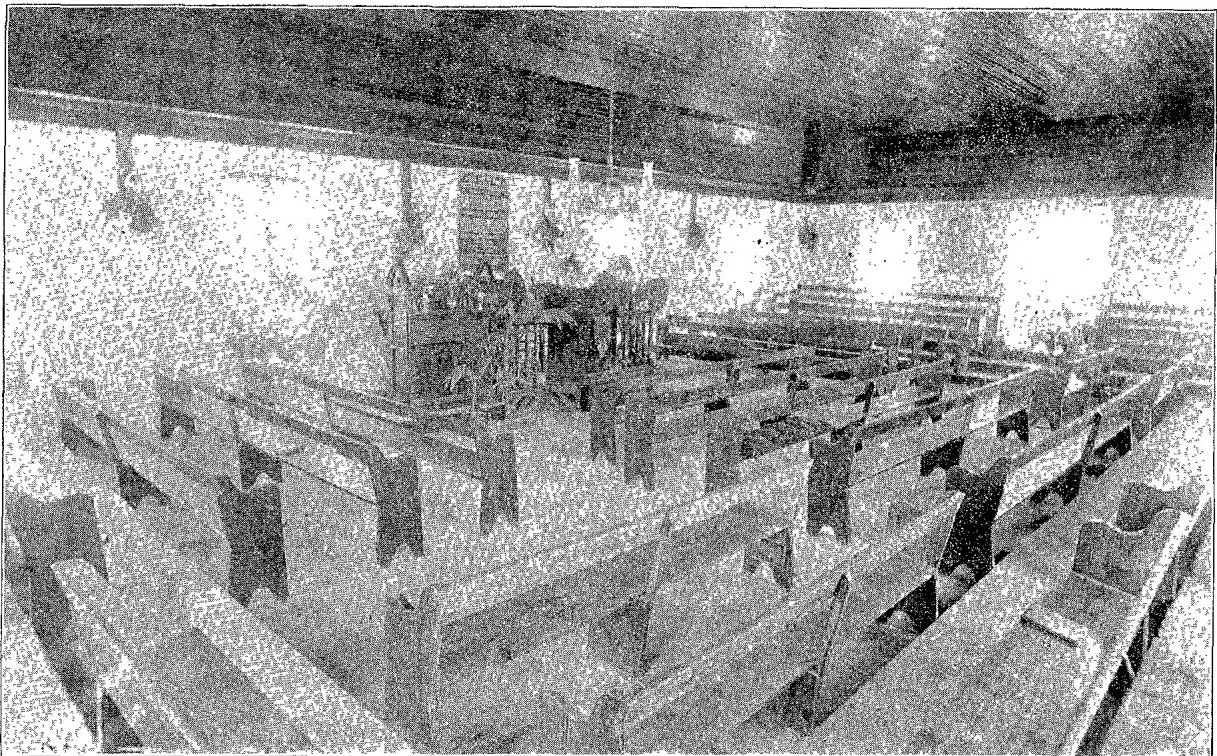
The illustrations that appear on this page are from photographs of the meeting-house recently erected by our people in Kingston, Jamaica. One is the front view, and the other shows the interior. We are happy to be able to show such signs of progress in the West Indies. Such buildings give a permanent character to the work. The pictures should have appeared some weeks ago, but were delayed in the mail. T.
OUR TONGAN SCHOOL.
By E. Hilliard
After we were temporarily settled in rented rooms, I canvassed the village of Nukualofa, in which we live, to see what the prospects were for starting a school. I visited none but Europeans and a few half-castes, as I was unable to make my business known in the native tongue. Most of the families seemed pleased with the idea of having a school in English, as there was none in the village, and the nearest was the Catholic school at Maofaga, one mile away. Some Protestants were sending their children there rather than not have them attend school at all. I succeeded in getting the promise of the attendance of twelve, which number included nearly all the white children.
It was a little over a month before we were settled in permanent quarters, ready to begin our little school. The fourth day of November was appointed for its commencement, and the pupils were notified. A day or so before the time arrived, we learned that a man had been to the families that had promised to send their children to our school, telling them that his wife was going to start a school, and had succeeded in getting all but two to attend their school, which was to begin on the same day as ours. The day arrived, and Mrs. Hilliard opened school with one scholar. The next day another was added, and this was all that came for about two months, when a third was added. In a short time some were dissatisfied with the other school, and took their children from it, sending them to our school. That school soon closed. The attention of a native, who lives neighbor to us, was attracted to the school, and he sent his little boy of nine years. This child had attended the school but three months when his father desired us to take him into our home. This we did, thinking that it would be a help to us in learning the Tongan language. He learned English much faster than we could learn Tongan. Of course this pleased his father, and also advertised our school among the natives more than anything else we could have done. He is very handy as an interpreter for us, his father, and some of the natives.
We have been visited time and again by native parents with their children, urging us to take them into our home; but have had to refuse the most of them, as our room is too limited properly to accommodate them. We have promised to take one more the first of July, which will make three that we have taken into our home, and will try to educate in right principles as well as in book knowledge. They pay us $10 per quarter, and furnish their food. The regular tuition is $7.50 for each, per quarter, except where three attend from one family, when a reduction of one third is made. The present enrolment is twenty-two.
Some in adjacent villages are sending their children to our school, and one is in attendance from the island of Haapai. The interest in the school seems to be increasing and spreading. The Lord has blessed the efforts in this line; for which we feel very thankful. It requires patience and wisdom to deal wisely with these Tongan children, who can understand but very little that is said to them in English. We feel that we have failed in some respects, but this makes us feel like seeking God all the more; for the heavenly boon of wisdom is promised to all liberally, and the Lord knows that the ones who are ignorant are the very ones who need it most.
These Tongan parents take a deeper interest in the education and improvement of their children than do many American fathers and mothers. Their co-operation is a great help and encouragement to us. They often visit the school, and it is gratifying to see their faces light up with a smile while listening to their children as they recite their lessons.
All who attend the school seem to feel under obligation to attend our Sabbath-school. The close union of church and state that exists here has so thoroughly inculcated, in the native mind, the idea that religious and secular matters should be inseparably interwoven, that they naturally seek to blend them in whatever enterprise they undertake. This is why they promise that if we will take their children into our school, they shall attend our Sabbath-school. One native said to me, "If you will take my little nephew to live with you, I will give you $10 a quarter, furnish his food, and when you start your church, I will see that he becomes a member of it." Poor man! How little he understands the transforming power of the Holy Spirit! While we appreciated his kindness and good motive, we could not help seeing that his perceptions of Christianity were superficial and formal only. How much we desire that these poor natives may become enlightened459and transformed by the power of Christ! We trust that the school is a beginning in this direction, and with your prayers we shall try to be more faithful in our work.
We feel quite encouraged with the size of the school when we consider that the population of the island is only a little over seven thousand, and that there are four schools in this village, two of which teach English. There are also small schools in nearly all the villages, in which the Tongan language is taught. The Catholics have just completed a large building, a portion of which is to be used for the teaching of the English language by the sisters. Just a little before this school was to open, the government started a free school in the English language in its church building. Since then the government has erected a schoolhouse, and the enterprise looks like a permanent one. There are two hundred and fifty pupils in attendance. We feared that this would affect our school, as no tuition was required. It did take two of our pupils, but the father of one soon came back, and asked us to take his boy into our school again, and also asked us if we would not take him into our home. We agreed to this, and he paid the boy's schooling in advance. The law demands that every Tongan boy, between certain years, shall attend the government school at least one day in the week. We gave the boy the privilege of doing this, and the father paid us full tuition, upon his own offer. The boy is now living in our family. Occasionally one is added to the school, while now and then one is dropped. On the whole, the school is increasing notwithstanding the difficulties. E. HILLIARD.
BRAZIL
By A. B. Stauffer
It is just four years this month since personal labor has been put forth in spreading the message in this country. The Lord has blessed from the beginning. Over two hundred persons are now keeping the Sabbath in Brazil. This country has been overlooked, and it seems as if our people do not realize the importance of the work in this field; yet the Lord has a work to be done here, and a people to be saved for his name. In many places, souls are longing for the truth; and when it comes to them, they receive it with joy. At one place where a few honest souls have been praying for help, there was great rejoicing when it came, and they recognized the answer to their prayers. Some thirty took their stand for the truth at this place. Among them are some with a burden to engage in spreading the message; but they lack the necessary training, and no one is here to give them the proper education. It is our aim to develop native talent, so we shall not have to look so much for help from outside. But we need trained workers to do the developing for us. Do not the Testimonies say that “workers are to be sent out from our colleges to all parts of the world”? Now, is not Brazil a part of the world? Is it not entitled to at least two such workers? Could we have one German teacher and one medical missionary speaking the same tongue (for the work as yet is principally among the Germans), we might content ourselves, and look with a little more satisfaction into the future.
If you, our German brethren, who read these lines and are qualified for this work, feel a burden to respond to the call, please make your desire known to the Mission Board in charge of this field. We had hoped to receive this help from the General Conference, but now may the Spirit of God so impress the Mission Board with the importance of our need, that they will grant us some help at once. Brethren, remember the work in Brazil. A. B. STAUFFER.
May 30, 1897.
KANSAS
By W. S. Hyatt
The work in this State is moving steadily onward. We have seven tents in the field, and another will start in a few days. Reports show that some success is attending the labor put forth. Elder Stebbins and I. F. Thorn are at Larned, where several have begun to obey the truth. From June 9-13 a local camp-meeting was held at this point in connection with the tent-meeting. Over one hundred and fifty of our people were in attendance, and it was a very profitable gathering. Elder Westphal was present, and labored for the German speaking people.
At Arkansas City, Elder Brock reports six or eight who have recently begun to obey the truth, and many more who are interested. The company there have recently moved their tent to another part of the city. The work at Leavenworth has been greatly blessed. Last January two Bible workers went there, and began the paper and Bible work. They each had one hundred and twenty-five paper readers, and a large number of these have become interested. Elders Gregory and Fortner pitched a tent there this spring, and a good work is being done. Twelve or fourteen have been added to the church, and still the work is moving onward. We began selling the Signs in Kansas City, Kan., about nine months ago. The workers there report that a goodly number have read the papers all this time, and are deeply interested. The outlook is very encouraging there also.
Elder G. G. Rupert held a meeting in Topeka, and nineteen were added to the church as the result. These persons became interested through reading the Signs. The church at that place used, during the winter, six hundred and fifty of these papers, and as a result a general interest has sprung up all over the city. For all these blessings we are thankful.
During the year our agents have sold, in value, as many books as were sold altogether last year, although we have been compelled to put our strength into selling the small books. A few have been at work for “Daniel and the Revelation,” and have succeeded well. I am certain that this good book will sell if we can get men to work for it who love the truths it contains. We hope to see a number take up this work after the camp-meeting.
July 2. W. S. HYATT.
THE QUEBEC CAMP-MEETING.
By P. F. Bicknell
I ARRIVED on the camp-ground, Monday, June 21, the fourth day of the meeting, and found the large tent down for safety on account of the rain and wind that prevailed. During the day the services were held in a large building on the grounds. The weather was quite unfavorable for the meeting, most of the time being so rainy and cold that the public did not venture out to any great extent. One favorable omen was apparent,—the same ones were in constant attendance, and it was very evident that they were seeking for light. After my arrival, the preaching was largely done by Elder Leland and myself. The Spirit of God was manifested in a large degree, witnessing to the truth proclaimed and the individual work in the camp. Some difficulties which have long existed in the conference, and have been very detrimental to the work here, disappeared. As the tender, loving Spirit of God came in, confessions were freely made, and all rejoiced in the Lord. From many sources was heard the expression, “This is the best meeting that I ever attended.” Certainly the power of love was seen upon this camp, and it will remain as an object-lesson to all in attendance.
The fifth day of the meeting, Brother Morse, who represents the book work in the provinces, arrived, and immediately entered upon his work, giving some very timely and instructive talks upon the necessity of getting our literature before the public. He also perfected an arrangement with the conference whereby the Toronto office assumes the tract society work, and furnishes literature direct to all our people in the conference, at about fifty per cent. discount from regular prices. The brethren and sisters seemed to appreciate this, and bought over one hundred dollars’ worth on the ground. Certainly it seems that if a little self-denial is practised, the province of Quebec can be covered with our literature the coming year, and that each one can have a part in this glorious work.
Although the conference is numerically small, and funds are scarce, we were greatly encouraged as the brethren came forward and paid old pledges, and expressed a determination to be faithful in paying tithes in the future. We were glad to see Elder Rickard, who has borne so many burdens in this conference, and has been suffering from the hand of disease, sufficiently recovered to engage in the work again.
The business meetings passed off harmoniously. Elder Leland was chosen president of the conference, and Elders Rickard and Blake were placed on the committee with him. After the closing service, Sunday evening, an ordination service was held, and Brother Walter Blake was set apart to the gospel ministry. May the blessing of God rest upon his labors. There were four conversions to our faith during this meeting, and four were baptized. Two tent companies are to be in the field this summer, one conducted by Elders Leland and Blake, and the other by Elder Rickard and Brother Carroll Drown. These have already entered their fields of labor. May the blessing of God rest upon these laborers and this conference. P. F. BICKNELL.