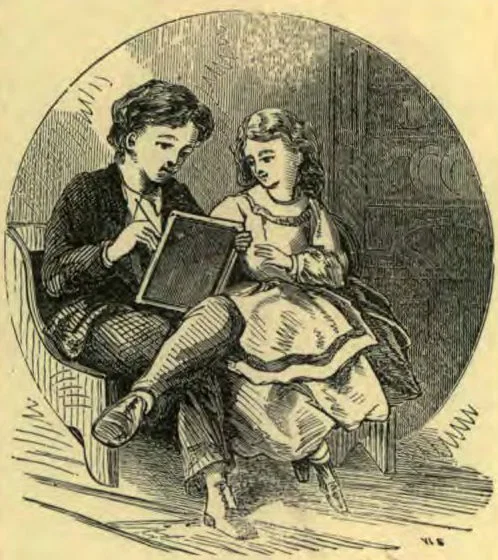
The Youth’s Instructor, Vol. 28, No. 39.

ROB'S MAGIC MIRROR

The Youth’s Instructor

Sep 22, 1880

S. D. A. Publishing Association · Battle Creek, Mich. · Sep 22, 1880

ROB'S MAGIC MIRROR.

Rob waked up cross on Monday morning. To be sure there was nothing uncommon about that, except that he was crosser than usual. The first thing he said was, “Dear me; I wish that old bell wouldn't ring. I don't want to get up.” Nevertheless he got up and dressed, pouting all the while.
Breakfast was on the table, and father and mother were taking their seats as Rob came in. Who would believe that a boy could be cross in such a bright, sunshiny room, and with so nice a meal before him? But Rob did not even say “Good-morning,” in answer to his mother, but only this instead: “There, now, mother, you said you would have some buckwheat cakes!”
“They are coming, Robbie; Jane is frying them now,” said his mother; “wait a minute.”
“Yes, ‘wait,’” he grumbled, “I always have to wait. I want my breakfast.”
“Robert!” said his father warningly.
When father said, “Robert!” it was best to be careful; and as the cakes were just then brought, Robert contented himself with looking sulky while he ate them.
By and by he broke out again: “Father, can't I have a new ball?”
“Another ball? Where is the one you had?”
“Oh, I lost that last week!”
“Then I think it will not pay to buy another for you to lose.”
“O father, I should think I might have one! All the boys do but me.”
“No, Rob,” returned his father; “not till you can be more careful and more—” “pleasant,” he was going to say, but Rob snapped out,
“I don't care; you never let me do anything!” and marched out of the room.
“What shall we do with the boy?” sighed his mother.
“He is growing crosser every day. He needs a lesson,” said his father.
School went ill that morning with poor Rob. He failed in one lesson, and blundered in another, and was reprimanded by the teacher. He came home in bad humor, but was surprised and mollified to find lying by his plate a pretty pocket-case containing comb, brush, and a dear little looking-glass.
“Oh! thank you sir,” cried Rob, smiling up at his father. “I've wanted one this long time.”
“Don't lose it,” replied his father; “Rob, that is a sort of magic glass.”
Rob looked doubtfully first at the glass, then at his father, and asked, “But what will it do?”
“Oh, never mind, you'll find out. All you have to do is to be sure to look into it whenever anything goes wrong.”
Rob ran back to school, his gift safe in his pocket, and his mind so full of curiosity about it that he almost wished something would go wrong, to give him a chance to make a trial of its powers.
He had not long to wait. Proud of his new possession, he made haste to display it to the boys, who were all admiring the neat case and pretty toilet articles, when Ben Barlow came up. Ben was the bully of the school,—a rough, coarse lad. No sooner had he seen the toilet-case than he exclaimed, “Pooh! that's nothing great;” and with a quick movement, tossed it into the muddy street.
“For shame, Ben Barlow,” cried half a dozen voices, as Rob, white with anger, ran to pick up the case. It was covered with mud, and scratched by a rough stone, pretty and new no longer.
“You coward!” muttered Rob, shaking his fist at his tormentor, “I'll—I'll—” But words failed, and Rob was not ready for deeds. Instead, he began to examine his case, drawing out, one by one, the brush, comb, and glass, to see if each was safe. As his eye fell on the last, his father's words came to mind, and Rob eagerly scrutinized the shining surface. Nothing remarkable happened, however; but while Rob gazed, he noticed the disagreeable scowl on the face he saw reflected. It was not a pleasant sight, and it changed the current of his thoughts.
“Whew! I didn't know I looked like that,” he whistled under his breath.
Just then the school-bell rang, and the boys hurried to their seats. Once again that afternoon Rob stole a glance at his magic mirror. He had failed in the spelling-lesson and had gone down two places. Now things were going wrong, if ever, and he quickly drew out the glass, but with no better result than before. “H'm!” pondered Rob, “I don't see what father meant.”
At the tea-table he asked for explanations, but his father only said with a very knowing smile, “You follow directions, Rob, and you'll see before long what the magic is.” So Rob went to bed more curious than ever.
Next morning everything went smoothly till about half-past eight, when, as Rob was counting his best marbles, he heard his mother's voice calling, “Robbie, where are you? I want you to run to the store for some butter.”
“O mother!” Rob called back, “I can't; I shall be late.”
“Not if you hurry. Come, quick.”
“I shan't,” muttered Rob, with emphasis.
Now what do you suppose put it into Rob's head to pull out his glass just then? You don't suppose he called that a case of “things going wrong,” do you? Do you suppose that the magic was beginning to work?
Whatever the reason was, Rob did pull out the glass, and take a good look. Then he put it back and went into the house. In a minute more, out he came with the butter-pail in hand, and marched over to the store.
“What is there about that glass?” he thought as he went along. “I don't see anything ever, but just my own face, same's I should in any looking-glass. Don't see's that's any magic. 'Tisn't very handsome. Wonder if I do look like that much of the time. Wonder if I shouldn't look better if I kept pleasant.”
Once admitted, that last thought was not to be easily banished. It took firm hold of Rob, and resulted in a stout resolve that he would keep pleasant henceforward. Poor boy! when any one has a habit of being cross, that resolve is not so easily kept. He fell into the habit of peeping into his glass on all occasions, not now to look for magical results,—he had forgotten all about that,—but to see if he looked any better.
So day after day went by. Rob thought he had never passed so unhappy a week. By Saturday night he was utterly discouraged. He had been very cross that day, and he cried himself to sleep.
Sunday morning he told the whole story to his mother, with many chokings and a stray tear-drop or two, in spite of his efforts at self-control.
“And there never were so many things to vex me,” he ended, “as since I tried to be pleasant; and—oh, dear! it isn't one bit of use.”
“Robbie,” said his mother, “once there was a man in a boat floating down a river. He did not have to work at all. But after a while he took up his oars to row back. He tugged and tugged, but still the current drifted him along. ‘Why!’ said the man, ‘the current was not half so strong before I began to row.’”
“How foolish!” said Rob. “It was just as strong, only he didn't feel it when he was floating the same way.”
“Yes,” said his mother; then she stopped.
“But why”—began Rob. “Oh yes, I see! You mean that things were just as bad before I tried, only I didn't notice. But that doesn't make it any easier,—does it, mother? And I can't be good; it's no use at all,” wailed poor Rob.
“No, my darling; you can't,—all alone,” she answered; and there the conversation dropped, for Rob's father called that it was time for church.
It would be useless to tell Rob that the sermon he heard was not made for him. He knew it was, though how his minister had found out about him, he could not guess. And I think he was right. To be sure, the minister did not know about Rob, but God knew,—and he sent the message, didn't he?
A part of what Rob took home was this: “Some of you are trying to do the work yourselves. You are asking, ‘What shall I do?’ and you think that you are to make yourselves better, before you can come to Jesus. But Christ's work is finished. You cannot add to it. All he wants of you is to take it, and own that it is his work, not yours.”
“That's what I want,” thought Rob, with a glad bound of heart. “I'm willing, I know I'm willing to have Jesus do it all.” So the great load was lifted.
Not many days after, came Rob's birthday, and such a happy one! His presents delighted him. From his mother there was a pretty illuminated text, “My Grace is Sufficient for Thee;” from his father, the much-desired new ball, and a little Bible. On a fly-leaf of the latter were Rob's name, the date, and below, this text: “But we all, with open face beholding as in a glass the glory of the Lord, are changed into the same image from glory to glory, even as by the Spirit of the Lord.”
“O father!” cried Rob with sparkling eyes, “now I know what you meant by saying there was magic in my little glass.”
—PEARL FOREST, in S. S. Times.

WORDS AND DEEDS.

'Tis good to speak in kindly guise, And soothe where'er we can; Fair speech should bind the human mind, And love link man to man. But stop not at the gentle words, Let deeds with language dwell; The one who pities starving birds Should scatter crumbs as well. The mercy that is warm and true Must lend a helping hand; For those who talk, yet fail to do, But “build upon the sand.” — Eliza Cook.

VARIETIES OF SEA LIFE.

After a restless, sea-sick night, we are glad to remain in our berths the second day of our voyage. This terrible sea-sickness is much like the sickening sensation produced by swinging too long. In case of the swing, however, one may get upon firm ground and soon recover, but in this case the “bounding billows” do not cease their motion,—our swing does not stop.
While lying in our berths, we witness a snow-squall through the window. This leaves two inches of snow for the sailors to clear from the deck; and an interesting pastime they find it, we judge, by their good cheer at their work.
We are able to be up to-day only long enough to go to the upper saloon and learn the result of the noon observation. We have made two hundred and eighty-eight miles since yesterday noon. We are now five hundred and fifty-six miles from New York City, and about one hundred miles southeast of Nova Scotia.
On the morning of the third day, we find the sea more calm, and having enjoyed a good night’s rest, we are able to spend quite a portion of the day in the upper saloon and upon deck. As the clouds lift, we see a steamer and two sailing vessels in the distance. It seems good to see anything to break the monotony of life on shipboard. I presume it was a sense of this monotony that caused a wag to write these words on the cabin window:—
“VARIETY OF SEA LIFE.—Sometimes we ship a sea; sometimes we see a ship.”
This desire to see something leads to all manner of speculations. As we have ample time to think of all the sea-monsters of which we have ever read, it is not strange that some of our passengers are keeping a sharp lookout in every direction for whales. Inexperienced passengers do not always understand that whales, like some kinds of birds, migrate. We are told that it is the wrong season of the year to look for whales in this part of the ocean.
While we are talking of the whale, an objection is raised to the Bible story that Jonah was swallowed by one. There are some who claim that a whale’s throat is not large enough to swallow a man. I once heard a lecture on whale-fishing. In reply to the question, “What is the size of a whale’s throat?” the speaker said, “That depends upon where you are.” So it does. Mr. Chambers, in his Encyclopedia, Vol. X, p. 151, says of the Greenland, or bone whale, “The gullet is not more than one inch and a half in diameter, even in a large whale.” Of the South-Sea, or sperm whale, he says, “The head is enormously large, forming about one-half of the entire bulk of the animal, and occupying more than one-third of the entire length. The mouth is very large and wide, and the throat, unlike that of the Greenland whale, is very wide, sufficiently so to admit the body of a man.” Vol. II, pp. 450, 480.
But while thus musing and talking of the monsters of the deep, another observation has been made and reported. The distance made since yesterday is two hundred and ninety miles. We are now eight hundred and forty-six miles from New York, and are directly south of New Foundland. We are nearing the New Foundland Banks; and as this is one of the dangerous places of the Atlantic Ocean, we pray God to give us a safe passage over these banks. J. N. L.

THE CROSS.

Blessed they who seek, While in their youth, With spirit meek, The way of truth.
To them the Sacred Scriptures now display Christ as the only true and living way. His precious blood on Calvary was given To make them heirs of endless bliss in Heaven. And e’en on earth the child of God can trace The glorious blessings of his Saviour’s grace.
For them he bore His Father’s frown; For them he wore The thorny crown; Nailed to the cross, Endured its pain, That his life’s loss Might be our gain. Then haste to choose That better part, Nor e’er refuse The Lord thy heart, Lest he declare, “I know you not,” And deep despair Should be your lot.
Now look to Jesus who on Calvary died, And trust in Him who there was crucified.

TWO SOMEBODIES.

I know somebody who always appears to be miserable, and this is the way she contrives to be so: thinking always about herself; constantly wishing for what she has not got; idling her time; fretting and grumbling.
I know somebody who is much happier, and this is the way she contrives to be so: thinking of others; satisfied with what her Heavenly Father has judged best for her; working, caring for somebody else besides herself, and thinking how she can make others happy.
My little “Somebody,” which kind of a “somebody” are you?

LESSONS FOR CHILDREN.

LESSON XCI.—BELSHAZZAR'S FEAST.

In going from the fourth chapter of Daniel to the fifth, we skip over a period of about twenty-four years, according to the common reckoning. The fifth chapter opens with these words: “Belshazzar the king made a great feast to a thousand of his lords, and drank wine before the thousand.” Belshazzar was Nebuchadnezzar’s grandson, and it seems that his grandmother, the wife of Nebuchadnezzar, was still living.
At this feast, Belshazzar brought forth the gold and silver vessels that Nebuchadnezzar had taken from the temple at Jerusalem, and he and his princes, his wives and his concubines, drank wine in them. As they drank, they praised the gods of gold, and of silver, of brass, of iron, of wood, and of stone. This greatly displeased the Lord, and “In the same hour came forth fingers of a man’s hand, and wrote over against the candlestick upon the plaster of the wall of the king’s palace; and the king saw the part of the hand that wrote.” This made the king so afraid that his knees smote together, and he called in the wise men of his kingdom to read the writing and tell its meaning, offering a great reward to the one who should do so.
When none of the wise men were able to read or interpret the writing, the king was greatly troubled; but his grandmother remembered how Daniel had interpreted Nebuchadnezzar’s dreams, and advised that he should be sent for.
When the aged prophet was brought in before the king, he said, “O thou King, the most high God gave Nebuchadnezzar thy father [grandfather] a kingdom, and majesty, and glory, and honor. And for the majesty that he gave him, all people, nations, and languages, trembled and feared before him: whom he would he slew, and whom he would he kept alive; and whom he would he set up, and whom he would he put down. But when his heart was lifted up, and his mind hardened in pride, he was deposed from his kingly throne, and they took his glory from him. And he was driven from the sons of men; and his heart was made like the beasts, and his dwelling was with the wild asses. They fed him with grass like oxen, and his body was wet with the dew of heaven; till he knew that the most high God ruled in the kingdom of men, and that he appointed over it whomsoever he will.”
“And thou his son, O Belshazzar, hast not humbled thine heart, though thou knewest all this; but hast lifted up thyself against the Lord of Heaven; and they have brought the vessels of his house before thee, and thou, and thy lords, thy wives, and thy concubines, have drunk wine in them; and thou hast praised the gods of silver and gold, of brass, iron, wood, and stone, which see not, nor hear, nor know: and the God in whose hand thy breath is, and whose are all thy ways, hast thou not glorified. Then was the part of the hand sent from him, and this writing was written.”
Then Daniel read the writing on the wall, and gave its meaning. He said, “This is the interpretation of the thing: MENE; God hath numbered thy kingdom and finished it.
“TEKEL; thou art weighed in the balances, and art found wanting.
“PERES; thy kingdom is divided, and given to the Medes and Persians.”
“In that night was Belshazzar the king of the Chaldeans slain. And Darius the Median took the kingdom.”
Since God has such power over the mightiest kings of the earth, we may be sure that he is able to care for us, and that he will fulfill his promises to the humblest of his children.

QUESTIONS.

1. How long a period do we skip in going from the fourth chapter of Daniel to the fifth?
2. With what words is the fifth chapter opened?
3. Who was Belshazzar?
4. What sacred vessels did Belshazzar have brought in at this feast?
5. How did he defile them?
6. How did the Lord regard this impious action?
7. What did the Lord cause to take place that same hour?
8. How did Belshazzar feel when he saw the hand writing on the wall?
9. How did he try to find out the meaning of the writing?
10. How did Daniel come to be called in when all Belshazzar’s wise men had failed?
11. Of whom did the prophet begin to talk as soon he was brought before the king?
12. What did he say the most high God gave to Nebuchadnezzar?
13. How did all nations regard this great king?
14. What did Nebuchadnezzar have power to do?
15. What effect did it have upon him to be raised to such a pitch of power?
16. What was then taken from him?
17. Where was he driven?
18. What change took place in him?
19. Where did he dwell?
20. How was he fed?
21. What was he taught by this experience?
22. Did Belshazzar know all this?
23. What had he failed to do?
24. What kind of spirit had he manifested?
25. How was he just then showing contempt for the Lord of Heaven?
26. What had he praised?
27. How are these gods described?
28. What God had he neglected to glorify?
29. What words were written on the wall?
30. How did Daniel interpret the first word? The second? The third?
31. What was the fate of Belshazzar?
32. Who took his kingdom?
33. Of what may we be sure, since God has such power over the kings of the earth?

BIBLE LESSONS FOR YOUTH.

LESSON CXVII.—THE PREACHING OF JOHN.

The Sacred Record gives us but a single event in the early life of our Saviour from the time his parents returned to Nazareth to his baptism by John at the age of thirty. Every year Joseph and Mary attended the feast of the passover at Jerusalem. On one occasion, as they set out on their journey homeward, Jesus tarried behind at Jerusalem. Supposing him to be in the company, they felt no uneasiness till, at the close of the day, they discovered upon a diligent search, that he was nowhere to be found. Returning in haste to Jerusalem, they found him in the temple, conversing with the learned doctors of the law, who were astonished at the wisdom and judgment manifested in his questions and answers; for he was then but twelve years of age. His anxious mother expressed her surprise at his being contented to remain away from them for three whole days; but he quietly replied, “Wist ye not that I must be about my Father's business?” He went with his parents, however, to Nazareth, where, to use the simple words of inspiration, he was subject unto them. It were well if this brief but touching testimony could be truly applied to the youth and children of the present day.
Archelaus, the son of Herod the Great, reigned about ten years, when he was removed by the Roman government, on account of the many complaints that had been made against him. An important change now took place in the government of Judea. It was reduced to a Roman province, brought more immediately under the authority of Roman laws, and controlled by a Roman governor. The chief seat of government for that part of the country was removed from Jerusalem to Cæsarea, a new city built on the sea-coast by Herod in honor of Cæsar. Thus it was that the scepter departed from Judah, and a lawgiver from between his feet; for Shiloh had come, and the prophetic words of the dying patriarch had been fulfilled.
Augustus Cæsar died A. D. 14, and was succeeded by Tiberius, his adopted son. During the last years of Augustus, Tiberius had been associated with him in conducting the affairs of the empire; and it is from the time of his beginning to reign with Augustus, that Luke reckons in giving the date of John's public ministry.
It was in the fifteenth year of Tiberius Cæsar's reign that “the word of God came unto John, the son of Zacharias, in the wilderness; and he came into all the country about Jordan, preaching the baptism of repentance for the remission of sins;” “and saying, Repent ye, for the kingdom of Heaven is at hand. For this is he that was spoken of by the prophet Esaias, saying, The voice of one crying in the wilderness, Prepare ye the way of the Lord, make his paths straight. And the same John had his raiment of camel's hair, and a leathern girdle about his loins; and his meat was locusts and wild honey. Then went out to him Jerusalem, and all Judea, and all the region round about Jordan, and were baptized of him in Jordan, confessing their sins. But when he saw many of the Pharisees and Sadducees come to his baptism, he said unto them, O generation of vipers, who hath warned you to flee from the wrath to come?” “Bring forth therefore fruits worthy of repentance, and begin not to say within yourselves, We have Abraham to our father; for I say unto you, That God is able of these stones to raise up children unto Abraham. And now also the axe is laid unto the root of the trees; every tree therefore which bringeth not forth good fruit is hewn down and cast into the fire. And the people asked him, saying, What shall we do then? He answereth and saith unto them, He that hath two coats, let him impart to him that hath none; and he that hath meat, let him do likewise. Then came also publicans to be baptized, and said unto him, Master, what shall we do? And he said unto them, Exact no more than that which is appointed you. And the soldiers likewise demanded of him, saying, And what shall we do? And he said unto them, Do violence to no man, neither accuse any falsely; and be content with your wages. And as the people were in expectation, and all men mused in their hearts of John, whether he were the Christ, or not, John answered, saying unto them all, I indeed baptize you with water; but One mightier than I cometh, the latchet of whose shoes I am not worthy to unloose; he shall baptize you with the Holy Ghost and with fire: whose fan is in his hand, and he will thoroughly purge his floor, and will gather the wheat into his garner; but the chaff he will burn with fire unquenchable.”

QUESTIONS.

  1. How full is the Sacred Record in regard to the early life of Christ?
  2. Where did Joseph and Mary celebrate the passover every year? Luke 2:41.
  3. What anxiety did they experience on one of these occasions? Verses 42, 43.
  4. How long did they search for him?
  5. Where did they find him?
  6. How was he engaged?
  7. How did these sage counselors regard him?
  8. At what did his mother express her surprise?
  9. How did Jesus answer her?
  10. How did he honor his earthly parents? Verse 51.
  11. How long did Archelaus reign?
  12. How was he deposed, and for what reason?
  13. What important change took place in the government of Judea?
  14. To what place was the chief seat of government moved?
  15. What prophecy was thus fulfilled? Gen. 49:10.
  16. When did Augustus Cæsar die?
  17. By whom was he succeeded?
  18. How had Tiberius been favored during the last years of the reign of Augustus?
  19. From what point of time does Luke reckon when he tells us that John began to preach in the fifteenth year of the reign of Tiberius Cæsar?
  20. Where did John preach? Luke 3:2, 3.
  21. What did he exhort men to do? Matt. 3:2.
  22. What prophecy did he claim to be fulfilling? Isa. 40:3.
  23. Describe his food and raiment. Matt. 3:4.
  24. What degree of interest was awakened by John's preaching?
  25. How did he address the Pharisees and Sadducees who came to be baptized by him?
  26. What admonition did he give them? Luke 3:8.
  27. By what figure did he show that it is character and not pedigree that secures the favor of God? Verse 9.
  28. What answer did he make when the people said, “What shall we do?”
  29. What did he say to the publicans, who, on coming to be baptized, asked the same question?
  30. What did he say to the soldiers?
  31. How did he satisfy the curiosity of the people in regard to his being the Christ?

HOW LONG IT TAKES TO MAKE A SLICE OF BREAD.

“Oh, I'm so hungry!” cried Paul, running in from play; give me some bread and butter quick, mother!”
“The bread is baking, so you must be patient,” said his mother.
Paul waited two minutes, and then asked if it was not done. “No,” answered his mother, “not quite yet.”
“It seems to take a long time to make a slice of bread,” said Paul.
“Perhaps you don't know, Paul, how long it does take,” said his mother.
“How long?” asked the little boy.
“The loaf was begun in the spring”—Paul opened his eyes wide—“and was doing all summer; it could not be finished till the autumn.”
Paul was glad that it was autumn, if it took all that while; for so long a time to a hungry little boy was rather discouraging.
“The farmer dropped his seed in the ground in April,” his mother went on to say, partly to make waiting time shorter, and more, perhaps, to drop good seed by the wayside, “but the farmer could not make them grow. All the men in the world could not make a grain of wheat, much less make a stalk of wheat grow. An ingenious man could make something that looked like wheat. Indeed, you often see ladies’ bonnets trimmed with sprays of wheat made by the milliners, and at first sight you can hardly tell the difference.”
“Put them in the ground and see,” said Paul.
“That would certainly decide. The make-believe wheat would be as still as bits of iron. The real grain would soon make a stir, because the real seeds have life within them, and God only gives life.”
“The farmer drops the seed into the ground and covers it up (that is his part), and then leaves it to God. God takes care of it. It is he who sets mother earth nourishing it with her warm juices. He sends the rain, he makes the sun shine, he makes it spring up, first the tender roots, and then the blades; and it takes many weeks with fair and foul weather to ripen the grain. If little boys are starving, the wheat grows no faster. God does not hurry his work; he does all things well.”
By this time, Paul had lost all his impatience. He was thinking.
“Well,” he said at last, “that's why we pray to God, ‘Give us this day our daily bread.’ Before now I thought that it was you, mother, that gave us daily bread; and now I see that it was God. We should not have a slice if it were not for God, would we, mother?”—Child at Home.

THE WILDERNESS OF JUDEA.

In the Scriptures, the term wilderness seems to be applied to any uninhabited or uncultivated tract of land. Some of these were entirely dry and barren, while others afforded good pasturage, and in some instances were really beautiful, especially in spring, when they were covered with an endless profusion of bright flowers.
The wilderness of Judea was the most noted in Palestine. It extends southward, from near Bethel, some thirty-five or forty miles along the eastern slope that falls off into the Jordan valley and the Dead Sea.
Jerusalem, Hebron, Bethlehem, and Tekoah are situated along the highest part of a mountainous ridge, in what is called the “hill country of Judea.” This region, though hilly and somewhat rocky, abounded in fertile spots, and was rich in pasturage, olive-groves, fig-orchards, and vineyards. Between this hill country and the Dead Sea lies the main part of the wilderness of Judea, where David wandered when pursued by Saul, and where John came preaching “the baptism of repentance for the remission of sins.”
It is best described in the words of those who have visited it. Dr. Fish represents it as “ghostly, treeless, grassless, breathless.” He says, “It is only needful for one to ride a day through these sterile wastes, where eternal silence reigns, and the sun pelts so pitilessly, to appreciate God’s gift in green pastures, and babbling brooks, and dewy lawns.” In the words of Mr. Porter: “The eastern declivities of the ridge, so fertile and picturesque in Samaria, are here a wilderness—bare, white, and absolutely desolate; without trees, or grass, or stream, or fountain. Naked slopes of white gravel and white rock descend rapidly and irregularly from the brow of the ridge, till at length they dip in frowning precipices into the Jordan valley or Dead Sea. Naked ravines, too, like huge fissures, with perpendicular walls of rock often several hundred feet in height, furrow these slopes from top to bottom.” He says that the wild and savage grandeur of some of the ravines, or wadys, is almost appalling. It is described by Van de Velde as “a bare, arid wilderness; an endless succession of shapeless yellow and ash-colored hills, without grass or shrub, without water, and almost without life.”
Mr. Prime, in his “Tent Life in the Holy Land,” says: “We crossed the Kedron, and struck across the wild, mountainous district which lies on the west side of the Dead Sea. No picture can convey an idea of the utter desolation of this country. Not a tree is visible, nor any vegetation, except low shrubs of a dry, harsh, rush-like plant, which the Bedouin women were gathering for fuel. The face of the country was as if a thousand conical hills had been let fall on it, and we were finding our way around and over them. There was no regularity about them.” He says, “The most remarkable feature of these hills was the immense quantity of snails which covered the ground, oftentimes making acres of it white.”
The deep ravines and gorges abound in caves. Some of these caves must be the very ones in which David hid away from his cruel pursuers; and, indeed, many of them are now inhabited by monks, who have sought to hide away from the world in this region of awful solitude. Of one of these valleys a writer says: “The grave was not more profound in its seclusion to him who fled from the courts of Europe to forget and be forgotten.”
Since John baptized in Jordan, his preaching must have been mainly in the north-eastern part of the wilderness, which was scarcely less wild and barren than that part already described. In some of its gorges, however, a few shrubs were found, and in the rainy season, flowers are still sufficiently abundant to afford honey, which numerous swarms of bees deposit along the sides and in the clefts of overhanging rocks. Some think that the locusts on which John subsisted were the insects of that name, which settle upon the bushes in great numbers at nightfall; but many now suppose that his food was the nutrient fruit of a species of locust, still found in that vicinity.
G. H. BELL.

LETTER BUDGET.

Henry J. Hess, in a letter for the “Budget,” says: “I have never written for our little paper before. I have taken the INSTRUCTOR one year, and intend to take it next year. There are no Sabbath-keepers near here, and no Sabbath-school nearer than thirty miles. I hope to meet all the INSTRUCTOR family in Heaven.”
George W. Freer says that he has written once before, but his letter was not printed, and he thought that he would write again. He likes the weekly INSTRUCTOR because it has such nice lessons in it. He belongs to a family Sabbath-school. He is trying to be a Christian.
Martha E. Butler, of Mendon, Michigan, writes us that she has taken the INSTRUCTOR one year, and is very much pleased with it. She is trying to live out the truth. She has not the privilege of attending Sabbath-school.
Next we will read a letter from L. W. Babcock, of Uniopolis, Ohio: “We have a Sabbath-school here, and I get the INSTRUCTOR every week. I love to read it very much. I often find pieces in it that touch my heart. I am trying to keep all of God’s commandments. Pray for me.”
We received a long, interesting letter from Amanda Chester, of Niantic, R. I., but can give our readers only a small portion; she says: “I send greeting to the INSTRUCTOR family. The truth has been preached here within two years past. I was baptized last winter. We have built a new church, which was dedicated the first Sunday in April. Yours in hope of eternal life.”

HARRY TO MARY.

LOOK over my shoulder, and see what a letter I've written. Could you have done better? There isn't a place where a break or a pause Isn't put, according to all the best laws. For, Mary, a boy that attends the High School, Shouldn't fail, when his chance comes to do things by rule.
My teachers have faithfully taught me the way, And I have been practicing, day after day. And now it turns out, as it always must turn, That a boy who is faithfully trying to learn, Will appear to advantage, whenever he's tried, And can show his “well done” with a measure of pride. —Sel.

You have reached the end of this edition.

The Youth’s Instructor · Sep 22, 1880