The Youth’s Instructor, Vol. 31, No. 18.

THE RAIN-TREE

The Youth’s Instructor

May 2, 1883

S. D. A. Publishing Association · Battle Creek, Mich. · May 2, 1883

THE RAIN-TREE.
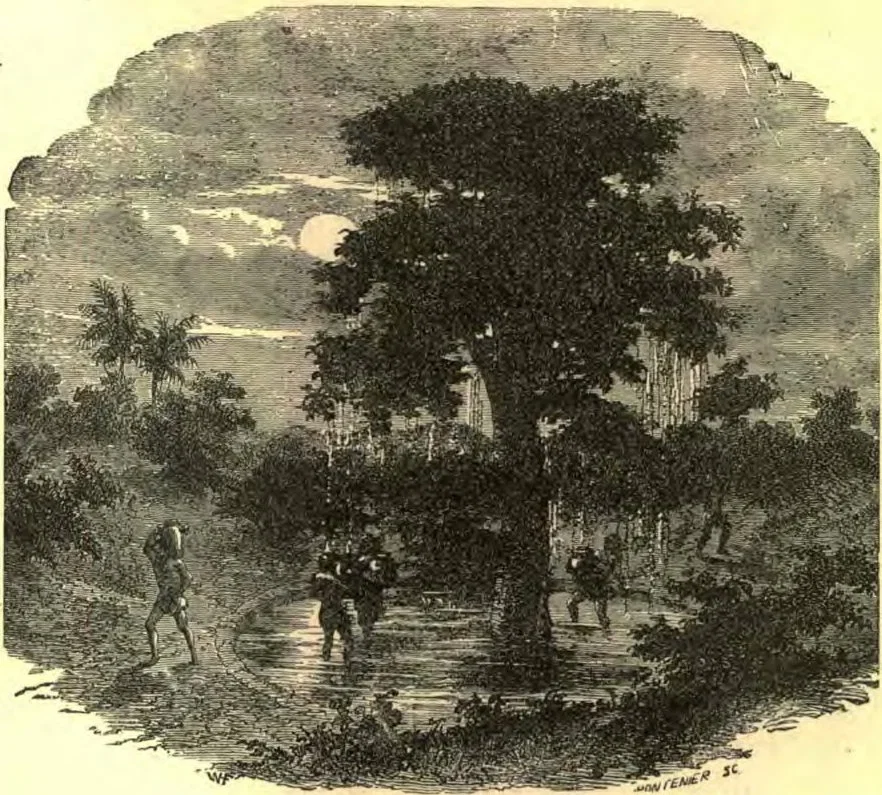
SOME travelers in South America, in traversing an arid and desolate tract of country, were struck with a strange contrast. On one hand there was a barren desert, on the other a rich and luxuriant vegetation. This remarkable contrast was due to the presence of the Tamai Caspi, or the Rain-tree. This tree often grows to the height of sixty feet, with a diameter of three feet at its base, and possesses the power of strongly attracting, absorbing and condensing the moisture of the atmosphere. Water is always to be seen dripping from its trunk and branches in such quantities as to convert the surrounding soil into a veritable marsh.
This tree also grows in the Canary Islands and other tropical climates, where it seems like a Godsend to the poor people, who must almost perish from thirst during the dry season, were it not for this curious water supply. And what seems most remarkable of all is that during the hot season, when the streams and lakes are almost or quite dried up, this tree is most active, and sends forth abundant supplies of water. The tree represented in the picture is situated in the Canary Islands. The natives seem to have dug a kind of reservoir around the tree to contain the water.
In this wonderful tree we see but another instance of the care of the great Father, who so carefully provides for the wants of even his humblest children, whoever and wherever they may be.

PREPARING TO SEE THE KING.

“Thine eyes shall see the King in his beauty.”—Isa. 3:17.
HAVE you thought much about that verse, dear friends, and of all that it implies? Has it come home to you that it is your eyes which are one day to behold the “King;” that it is to you the words are spoken? Your eyes may be often tired now, or dim with tears; it may be your portion day after day to meet the glances of other eyes which flash no sympathy back to yours, or to miss the response of eyes which once made a sunshine in your home. I do not know your lives, but this I know, that all who have their faces turned Zionward shall one day behold “the King!”
Is not this enough to brighten us when our days seem dull? Why do we let the clouds come between us and the promise which shines like a line of light on the far-away horizon?
Meanwhile, we are not left without beauty. “God hath given us all things richly to enjoy;” let us go through his world with seeing eyes; let us accustom ourselves to look for beauty. And I do not mean only the beauty of nature—that of the trees bending to whisper in the wind, or of the mountain-stream eddying over the rocks, or the beauty and hush of the twilight when day is done; neither do I mean only that of art, of delicate statuary, and pictures where eyes laugh back to you from the canvas; but I mean also the beauty in the characters of those around us. As we go through life, I think we should keep before us what our eyes are one day to see; it might help us to blind them to the unpleasant things of life, and open them more to the beautiful things there are.
I have read books sometimes which speak of this world as a wilderness, and poems which call it a desert; I do not agree with them. There is sorrow in this world, and sin, but there is beauty too, and our King hath given us “richly all things to enjoy”!
There are beauties familiar to all of us, and which any who live in the country may see every day. Is there not beauty in the sheen upon the water as it changes in cloud and sunshine; in the lights and shadows chasing each other as the wind passes among the trees; in the cool, quiet shade, with the sunbeams flickering beyond, by the pond where every fern is reflected; in the tall and stately garden flowers, and in the violets and primroses by the roadside; in the broad, level plains, with the ripening corn-fields, and a line of heathery hills sloping away to the blue beyond? There is the beauty of the day, and the mysterious beauty of the night, when familiar things change and gleam in the moonlight; there is the loveliness of youth girding on its armor for the battle, and the beauty of old age which has been through the fire and come out purified, whose eyes wear a dreamy, expectant look, as if they knew they were nearing “the King.”
I think, too, people may live beautiful lives, I mean by doing their duty; and this is within the power of us all. The humblest little maid who does a thing because it is right, not merely because she may wish to do it, or because her companions say it is the thing to do, is a servant of that “King” whom she will one day see.
There is a beauty, not visible to our eyes, but very plainly seen by our King, in resisting the temptation to wrong-doing, in the gentle patience which answers a harsh and perhaps unjust rebuke with kindly words.
Our eyes are one day to behold “the King;” do we behave as if we remembered this? Do we not sometimes misconstrue motives, or seem not to see what is meant, when the recollection of what is coming ought to fill these eyes of ours with such a light of love and gratitude that the anger would be all quenched? Let us try what keeping these words before us will do!—Sabbath Reading.

Prayer: The Key of the Day

PRAYER should be the key of the day, and the lock of the night.

The Spring Walk.

We had a pleasant walk to-day Over the meadows and far away, Across the bridge by the water-mill, By the woodside, and up the hill; And if you listen to what I say, I'll tell you what we saw to-day.
Amid a hedge, where the first leaves Were creeping from their sheaths so sly, We saw four eggs within a nest, And they were blue as a summer sky.
An elder branch dipped in the brook; We wondered why it moved, and found A silken-haired smooth water-rat Nibbling, and swimming round and round.
Where daisies opened to the sun, In a broad meadow, green and white, The lambs were racing eagerly— We never saw a prettier sight.
We saw upon the shady banks Long rows of golden flowers shine, And first mistook for buttercups The star-shaped yellow celandine.
Anemones and primroses, And the blue violets of the spring, We found, while listening by a hedge To hear a merry plowman sing.
And from the earth the plow turned up, There came a sweet, refreshing smell, Such as the lily of the vale Sends forth from many a woodland dell.
We saw the yellow wall-flower wave Upon a moldering castle wall, And then we watched the busy rooks Among the ancient elm-trees tall.
And leaning from the old stone bridge, Below we saw our shadows lie, And through the gloomy arches watched The swift and fearless swallows fly.
We heard the speckle-breasted lark As it sang somewhere out of sight, And tried to find it; but the sky Was filled with clouds of dazzling light.
We saw young rabbits near the wood, And heard a pheasant’s wings go “whirr,” And then we saw a squirrel leap From an old oak-tree to a fir.
And many pretty birds we saw, Which had come o’er the stormy main, To build their nests, and rear their young, And sing in our old woods again.
We came back by the village fields, A pleasant walk it was across ’em, For all behind the houses lay The orchards, red and white with blossom.
Were I to tell you all we saw, I’m sure that it would take me hours; For the whole landscape was alive With bees and birds, and buds and flowers.
—Book of Songs.

“STRAIGHTENING OUT FURROWS.”

Captain Crofts, or Cap’n Sam, as he was familiarly called, was a great favorite among the boys of Seaport. Who else would harness up the sturdy horse into a big wagon, and give them such grand rides? Then the great hickory and chestnut trees at the foot of his lot were free for the boys to visit as often as they liked, only they must never damage in any way the fine old branches; and when it came to telling stories, it was hard to find his equal.
One day the boys, quite a little crowd of them, found Cap’n Sam on the rocks at the beach. There were breakers that afternoon, and at such times it was a favorite diversion of the seafaring man to sit high on the rocky beach, and listen to the sounding sea. On this particular afternoon the captain seemed to be thinking very soberly, and he couldn’t throw off the mood, even at the approach of the merry boys.
At length, looking up from his brown study, the captain said, “Boys, do you know what I’ve been trying to do every day for the last ten years? I’ve been trying, every day of my life, to straighten out furrows, and I can’t do it.”
One boy turned his head in surprise toward the captain’s neatly kept place.
“Oh, I don’t mean that kind, lad; I don’t mean land furrows,” answered the captain, so soberly that the attention of the boys became breathless as he went on:—
“When I was a lad about the age of you boys, I was what they called a ‘hard case,’—not exactly bad or vicious, but wayward and wild. My dear mother used to coax, pray, and punish. My father was dead, which made it all the harder for her, but she never became impatient. How she bore with all my stubborn, vexing ways so patiently will always be a mystery to me. I knew my course was troubling her,—knew it was changing her pretty face, making it look anxious and old. After a while, tiring of all restraint, I ran away,—went off to sea; and a rough time I had of it at first. Still I liked the water, and liked journeying around from place to place. Then I settled down to business in a foreign land, and soon became prosperous; now I began sending her something besides empty letters. And such beautiful letters as she wrote me during those years of cruel absence! At length I noticed how she longed for the presence of the son who used to try her so, and I determined to go back to her. And such a welcome as I received!
“My mother was not then a very old lady, boys; but the first thing I noticed was the whiteness of her hair, and the deep furrows on her brow; and I knew that I had helped blanch that hair to its snowy whiteness, and had drawn those lines in that smooth forehead. And those are the furrows I’ve been trying to straighten out.”
“Last night, while mother was sleeping in her chair, I sat thinking it all over, and looked to see what progress I had made. Her face was very peaceful, and the expression as contented as possible; but the furrows were still there. I hadn’t straightened them all out—and I never shall—never! When they lay my mother in her coffin, there will be furrows in her brow. Remember, lads, that the neglect you offer your parents’ counsels now, and the trouble you cause them, will abide.”
“But,” broke in Freddie Hollis, with great troubled eyes, “I should think if you’re kind and good now, it needn’t matter so much.”
“Ah, Freddie, my boy,” said the quavery voice of the strong man, “you cannot undo the past. You may do much to atone for it,—do much to make the rough path smooth; but you cannot straighten out the old furrows, my laddies—remember that!”
“Guess I’ll go and chop that wood mother spoke of,” said lively Jimmy Hollis, in a strangely quiet tone for him.
“Yes, and I’ve got some errands to do,” suddenly remembered Billy Bowles.
“Touched and taken,” said the kindly captain to himself, as the boys trooped off, keeping step in a thoughtful, soldier-like way.—Harriet A. Cheever.

“THOMAS, REMEMBER THAT I AM YOUR MOTHER.”

The late Dr. Chalmers was in his boyhood of a hasty temper, and self-willed. He often wished to have his own way, even when his parents’ wishes were different. His mother was a woman of few words, but from her lips a few were enough to check him. It is said that she seldom had occasion to say to him at such times more than this sentence: “Thomas, remember that I am your mother.”
Whether the mother says it or not, the child should “remember” that he owes obedience and reverence to both his parents. He should ask no questions why or wherefore. The commandment is, “Honor thy father and thy mother.” It is not said that he is to honor them at such times as are convenient to him, but he is always to be respectful to father and mother, and attentive to their advice and their commands.
God has so ordered. Just as he has said, “Remember the Sabbath-day,” he has said, “Remember the fifth commandment.” When the Sabbath comes, what we have to do is to remember to keep it holy. We have no right to say we will keep it only when we choose to do so. It is the Sabbath; that is enough.
“He is my father;” “she is my mother.” This is enough for any child or youth to know. “They command; I must cheerfully obey. I know what will please them; I must try to do it. I know what offends them; I must try to avoid it. I must remember what my parents have done for me. I must remember their age and experience as compared with mine. I must remember how anxious they are for my good, and how much their happiness depends on my conduct.”—Selected.

OBEDIENCE REWARDED.

“I NEVER could understand why Daniel chose to eat only pulse and water when he might have had good meat and wine,” said Tom Mason.
“Oh, I can,” said his sister Clara. “He thought it would be more pleasing to God.”
“As if God would have cared what he ate!” said Tom, somewhat scornfully.
“God did care,” said Clara. “He did not wish the Hebrews to defile themselves by eating the meat and drinking the wine of the heathen king who had taken them captive. Daniel knew it, and so did the other three young lads who were his fellow-prisoners. The king would have fed them with dainties and have had them treated well, because they were fine-looking men and had ability. He wanted to train them to serve his own purposes. But Daniel knew the laws which God had given to his own people, and it was his first care to keep those laws. He might have enjoyed himself very much in the king’s palace. He might have found good excuses for doing it. But he did not wish to find such excuses. It would have given him no pleasure to have a share in the good things which were forbidden to him. Do you not think it was a noble example for such very young men to come out and take the firm stand that they did?”
“It may have been noble, and all that,” said Tom, “but it must have been very hard to do it. Some of the others did not seem to be so particular as these were, and no special harm seemed to come to them.”
“Nor any special blessing, either,” said Clara. “These four young men were finer-looking than the others, and had more wisdom, and gained more favor with the king’s servants, and even with the king himself.”
“Much good it did them in the end!” said Tom. “Daniel was thrown into the den of lions, and Shadrach, Meshach, and Abednego were cast into a burning fiery furnace. You see I know the whole story, miss; and it must have been pretty hard lines for every one of the four.”
“If you know the whole story,” said Clara, smiling at the earnestness of her small brother, “you know that God sent his angel to shut the lions’ mouths, so that no harm came to Daniel; and the three men who were cast into the midst of the fiery furnace not only came out without harm, but there was not even the smell of fire upon their hair or clothing.”
“I say, that was a wonderful thing, now,” said Tom.
“It was,” said Clara; “but our God is a wonderful God in power and in love. He never forsakes those who put their trust in him.”
“Oh, well,” said Tom, “no such things happen to any one in these days.”
“No,” said Clara; “but there is the same God, who will appear for us and help us, if we choose to obey him; even a boy or a very young man can take a firm stand for the right and hold to it, and he may be sure that God will sustain and bless him.”—Mrs. A. K. Dunning.

HOW DO YOU KEEP YOUR ROOM?

A look into the chamber of a boy or girl will give one an idea of what kind of man or woman he or she will probably become. A boy who keeps his clothes hung up neatly, or a girl whose room is always neat, will be apt to make a successful man or women. Order and neatness are essential to our comfort, as well as that of others about us. A boy who throws down his cap or boots anywhere will never keep his accounts in shape, will do things in a slovenly, careless way, and not be long wanted in any position. A girl who does not make her bed till after dinner,—and she should always make it herself, rather than have a servant do it—and throws her dress or bonnet down on a chair, will make a poor wife in nine cases out of ten. If the world could see how a girl keeps her dressing-room, some unhappy marriages would be saved.—Congregationalist.

NEW-TESTAMENT HISTORY.

LESSON 133.—REVIEW.

1. What course was pursued by the apostles immediately after the ascension of their Lord?
2. Relate the circumstances under which Peter addressed the assembled disciples?
3. What steps did he say should be taken?
4. How did he show from the Scriptures that such steps were necessary?
5. How were his suggestions received and carried out?
6. Tell how the Holy Ghost descended upon the disciples at Pentecost.
7. What astonished those who were assembled from different nations?
8. How did they express their astonishment?
9. What unreasonable assertion was made by some of the native Jews?
10. How was this foolish assumption refuted by Peter?
11. What prophecy did he say was now fulfilling before them?
12. To what does the last part of that prophecy have reference?
13. How long a period is covered by this prophecy?
14. Of what crime did Peter accuse the Jews?
15. How did he show that the resurrection of Jesus had fulfilled the words of the Psalmist?
16. What bold statement did he make with reference to the exaltation which God had conferred upon Jesus? Acts 2: 32, 33.
17. How did some of the listening multitude show that they were convinced and convicted by Peter’s words?
18. What instruction and encouragement did Peter give them?
19. What was the immediate fruit of this discourse?
20. Describe the state of unity and mutual confidence in which the early Christians dwelt together.
21. Tell how Peter and John healed the lame man at the Beautiful gate of the temple.
22. What excitement did this miracle cause among the people?
23. How did Peter take advantage of this opportunity?
24. How did he faithfully set before the people the enormity of their sin in rejecting their Saviour?
25. What did he say concerning the miracle that had just been wrought?
26. How did he endeavor to keep these guilty people from falling into utter despair? Acts 3: 17, 18.
27. What admonition did he give them? Verse 19.
28. What promise did he make them? Verses 20, 21.
29. How did he further speak of Jesus? Verses 22–26.
30. What did the apostles bring upon themselves by preaching Christ thus boldly?
31. What good was accomplished by their preaching?
32. Tell how the apostles were brought before the Jewish council to answer for their conduct.
33. What was the first question asked them?
34. Who answered them, and how?
35. How did this bold disciple set forth Jesus as the only means of salvation?
36. What astonished the high priest and all the council?
37. How were the priests perplexed in regard to answering the apostles?
38. What counsel did they take after sending out the apostles?
39. What did Peter and John say when the council gave them charge not to teach in the name of Jesus?
40. Why did the priests let the apostles go unpunished?
41. How did the disciples express their joy when Peter and John told them what had happened?
42. For what did they pray?
43. How was their prayer answered?
44. How did they dwell together?
45. Relate the story of Ananias and Sapphira. Acts 5.
46. Give some account of the miracles performed by the apostles at this time. Verses 12–16.
47. What did these things provoke the high priests to do?
48. How were the council brought into consternation when on the next day they sent to the prison to have the apostles brought before them?
49. How were they troubled?
50. What course did they pursue on hearing that the apostles were teaching in the temple?
51. What fault did they find with the apostles?
52. How did Peter take advantage of this opportunity to preach Christ to the council?
53. How were the council affected by these bold declarations?
54. Who quelled their excitement, and gained their attention?
55. How did he persuade them to take a different course?
56. How was his advice carried out?
57. What course was afterward taken by the apostles?

DO YOUR BEST.

THERE are thousands of men in the world to-day, working for poor pay and occupying uncertain positions, liable to be thrown out of employment at any moment, simply because they have not done their best. They have been contented to do their work in a slipshod way; they have not improved their opportunities; they know no more this year than they did last year; they are unfaithful to their employers; and in consequence of this, are at the mercy of circumstances, and are liable at any time to be set adrift upon the world. They see men around them, having no greater ability than they have, who occupy important positions, who earn twice their wages for doing half their work, simply because they have improved their opportunities, have tried to do their best, have been faithful in whatever work has been appointed to them, and so have won the approval and the confidence of their employers, and have become so indispensable that they cannot do without them.
Young persons should take a lesson from such things. I heard of two men who worked side by side, one of whom employed his spare time in teaching tricks to a dog! He taught the dog to stand up like a soldier, and perform several curious tricks. The other man, during the same time, studied and improved his spare hours, and invented and secured a patent on a most important machine, for his right in which he was offered many thousands of dollars. One man had spent his time on a dog; the other had attended to his business; and here were the results of the two courses.
There are to-day boys and girls, and young men and women, who are fooling away their time and money, which, if improved and saved, would soon place them in a position of independence, where they might be both prosperous and useful. They spend their time in playing games, in reading novels and similar trash; and consequently will always be ignorant, poor, despised, and at the bottom of the hill, and complaining about the hard times and bad work.
The times are mostly what men make them to be. Not long ago, one Saturday night, some employers in a certain village paid out to their workmen seven hundred dollars, in new, bright, clean, bank-bills, on every one of which they had put a mark, by which they could identify them. The next Monday morning it was found that four hundred and fifty dollars of these same marked bills were deposited in the bank by the saloon keepers, into whose hands they had fallen between Saturday night and Monday morning. This told pretty clearly what caused the hard times in that part of the country; and a similar experiment in other regions would no doubt show similar results. And if the wages of these workmen had been twice as large, it would simply have furnished the rum-sellers with larger dividends.
The man who studies diligently, works hard, lives temperately, takes care of his earnings, and serves the Lord, has the promise of the life that now is, and of that which is to come. The man who serves the devil, has a hard master in this world, and a poor prospect for the world to come.—Selected.

“I DIDN’T HAVE TIME.”

Did you ever hear the above excuse for a poor lesson? Indeed you have, if you ever taught in a Sabbath-school a month. Though everybody knows it by heart, I will not ask if you ever made it, for few employ it quite truthfully. Those who reasonably might use the excuse, rarely do; they learn what we perhaps may, to “take time” or “make time.” The Great Teacher required of us but a pleasant duty when he said, “Search the Scriptures.” He gives us all our time too, and if we do not use a little of it as directed, our excuse becomes a very poor one.
Are you a teacher? Show your class by a perfect lesson that you have found time. Meet them at the homes of the different scholars once a week for study. Not all your class will come at first perhaps, but make your next week’s visit at the home of some one who did not come the last time. Sing, as well as study. Make yourself friendly, and never think of being discouraged, even if they withstand your efforts for a long time. They are learning to respect you (if you deserve it), and will quite likely adopt such truths as you best illustrate in your own life.
After having the lesson carefully and slowly read once or twice by members of the class, lay by all books or papers, and ask the one who paid the least attention to repeat just one thing which he remembers about the lesson. Ask a more attentive one to tell you something more of the subject named. Question others on points which he left out; then ask for other points while the interest holds good. Read the lesson again in parts, and answer such questions as the class may ask, and call their attention to the leading points. Having fixed the general outline well in mind, tell them that you will give a synopsis of the lesson; then leave out one or two or more leading points, and you will perhaps be surprised to see how many can supply them. These plans are applicable in home study, rather than in the recitation at the Sabbath-school, before which the lesson should have been thoroughly learned.
This idea of weekly class-meetings is no mere theory, but has been tried with marked success, especially with children and youth. Many pleasant and profitable hours have been spent in such study, as numbers will testify. Such meetings, if properly conducted, must of necessity result in an increased interest in the Sabbath-school itself.
In conclusion it may be said: If scholars urge lack of time, visit them, taking a supply of your own, as it were, improving and sharing it with them in ennobling study. You will reap a present reward, and another “after many days.” GEORGE R. AVERY.

A Teacher's Preparation for the Sabbath Lesson

LET the teacher come to his class, not doubtful as to where the lesson is, or what it is about, or what he shall say about it, and full of apprehension lest the time may be all too long for his scanty resources to occupy it properly; but, having during the week earnestly sought all the help that he could get from both God and man, let him come to the lesson with the comforting consciousness, not only that there is something in the lesson, but something in him—of which he shall not, indeed, be foolishly proud, but for which he may well be humbly thankful.

DOG STORIES.

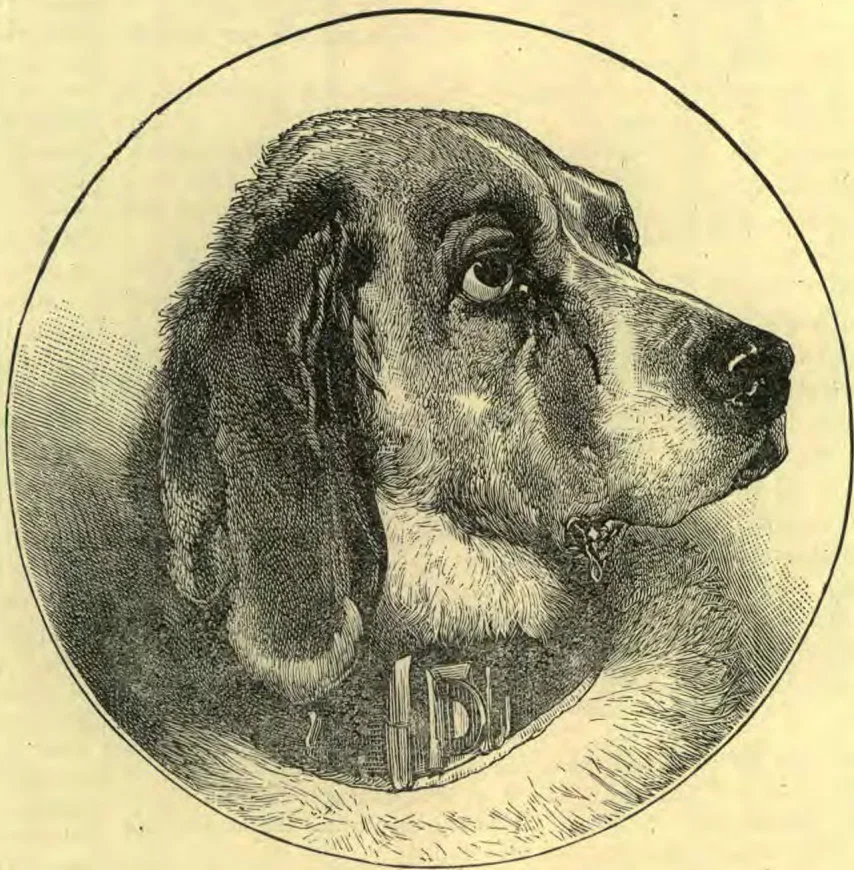
WHAT a noble-looking dog this is! He looks up at you with his great brown eyes just as if he were ready to speak. He looks something like a hound; for his ears are long and drooping, his nose is quite long, and the shape of his head and mouth is like a hound’s. A full-blooded hound, however, has close, short hair. All dogs do not look like this one. The greyhound has a longer and more pointed nose, and a narrow head. His hair is short and fine, and of a gray color. The Italian greyhound is small and delicate; and many ladies have him for their pet parlor dog.
The blood-hound is larger and stronger than the greyhound, and is quite savage. These dogs are noted for their keen scent, and when they once get on the track of game, they do not give up until they have found what they are looking for. When the people who lived in the South kept slaves, they had large packs of blood-hounds with which they used to hunt out and capture slaves who tried to run away to the North for their freedom. These dogs are so strong and run so fast that they can tire out a horse. If they are looking for some lost person, and have had a smell of his shoes or clothes, away they go, sniffing along the ground till they find him, no matter how many people have walked over the same ground since that person has.
Another very useful dog is the St. Bernard, or Alpine dog. The monks who live in the convent of St. Bernard on a high mountain in Switzerland, where the snow is deep, find these dogs very useful in hunting for travelers who have lost their way on the mountains. The dogs start from the convent in pairs, one having a cloak strapped to his back, and the other a small flask of wine fastened to his neck. When they find the traveler half perishing with the cold, they arouse him, and lead him back to the convent. If he has fallen, and been covered up by the snow, they can find him by their keen scent, and will paw him out, all the while barking till the monks in the convent a mile off hear and come to help them. One of these dogs, who died in trying to save a frozen man, had saved twenty-two lives.
Far to the north, in the Arctic regions, where there is snow and ice all the year, people use dogs for horses. These dogs look so much like wolves that even their owners can hardly tell the difference. They are not gentle like the dogs we have. Six or more of these dogs are hitched to a sledge, and are guided by the voice of their leader. One traveler says that six of these dogs drew him on a heavily loaded sledge, in two weeks, between seven and eight hundred miles. He says he never heard the Esquimaux speak in any but sharp, harsh tones to their dogs, and that for this reason the dogs are cross and hard to manage.
In hilly countries where a great many sheep are raised, the shepherd dog is very common. These are large, shaggy dogs, very courageous and powerful. They have been so carefully trained that two such dogs could take care of a large flock of sheep, bringing them all back to the fold safely at night-fall. They will even kill a large wolf if he tries to harm any of their sheep.
Then there is the well-known Newfoundland dog. These are fine dogs to have, because they are so good-natured and patient. They are large and shaggy, and of a black and white color. They know a great deal, and many interesting stories are told about them. A lady who had one of these Newfoundland dogs, was one day taken very sick. She was alone, and did not know how to let her husband know that she wanted him. At last she wrote a note, and putting it in the dog’s mouth told him to take it to the store where her husband worked. In a few minutes he came back with the gentleman and a doctor. This same dog was very careful not to let any stranger touch his master’s things, and one day when a wood-cutter came to split the wood, he had to leave the work undone because the dog would not let him touch the axe.
The people who lived in Egypt when the Israelites were there, used to worship the dog. They built the city of Cynopolis in his honor, and worshiped him there. They used to sacrifice certain kinds of dogs, and then wrap their bodies in linen cloth with rich spices, thus embalming them the same as they did the people when they died. Some of these dog-mummies are still to be seen in Egypt.
W. E. L.
Continue reading: WHAT AILED A PILLOW