Last July there went into effect in Illinois a law compelling the closing of barber-shops on Sunday. In Chicago there has been war on the subject since. A Barbers’ Protective Association was formed to prosecute all offenders. Ministers, churches, and leagues have upheld the law, while a few have bidden it defiance. The manager of the Great Northern Hotel has been in the lead in this matter. A case was appealed to the District Court, where on the 16th inst. a decision was rendered by Judge Gibbons, that the law was unconstitutional, and consequently invalid. This decision has created no little stir. The Barbers’ Association will carry the matter to the Supreme Court. Immediately after it was rendered, several arrests were made in defiance of the decision.
The action of the higher court will be awaited with interest. The present decision is contrary to that of the Michigan Supreme Court, where a similar law was sustained. The principal basis of Judge Gibbons’s decision was that the law was partial. It was “class legislation.” It selected a class of tradesmen of honorable and useful employment, and made them the subjects of restrictive law. The judge stated that a Sunday law that was impartial in its application would be upheld. He had considerable to say in favor of such a law.
This matter, though but a side issue to the real crisis toward which the country is rapidly drifting, is of serious significance, because it deeply stirs the elements, arousing the energies of those who are destined soon to act an important part in this great controversy. It shows the strong trend of the public mind in the direction indicated by the prophecy. The way is thus being prepared for the speedy fulfillment of the remaining particulars of this earthly story.
Extracts from the Above Decision.—To show the tenor of Judge Gibbons’s decision, we present the following passages taken from the published reports:—
“The courts cannot take cognizance of the moral aspect of the case, even though a seventh day of rest seems to be established by divine decree or natural necessity. Whether we accept the account of creation so graphically given in Genesis, as literally true, or757We adopt the theories of scientists, that the creation was the result of successive evolutions, extending through numberless cycles, long antedating the Mosaic period, we cannot but recognize that the economy of all creation proclaims the wisdom and necessity of rest.”
“Reading aright the so-called religious history of the past, we cannot but the more keenly appreciate and approve the wisdom that inspired the fathers of the republic in incorporating into its natal polity the absolute and unalterable separation of Church and State.”
“I should gladly uphold impartial legislation, ordaining one day of rest in every seven, and if that day of rest should fall on Sunday, it would meet with hearty approval from the great majority of the American people; but I could never willingly assent to a law which would single out one class of citizens and visit it with penalties and punishments for actions which are innocent in themselves, from which all others are exempted. Nor should I willingly assent to legislation which would place the ban of outlawry upon persons who believe in innocent and lawful recreation combined with rest on the sabbath day, or which shall deprive persons pursuing a particular profession or vocation of their property, unless there was something in the nature of the property aimed at, or in the vocation pursued, hurtful to society.”
“With all due respect to that court [Michigan], we cannot subscribe to any pronouncement, from whatever source uttered, which would exalt the police power of the State above and beyond all constitutional restraints, and which would endow a State legislature with an omnipotence greater than that ever arrogated by the British Parliament. I repeat here the significant commentary of one of the ablest and purest jurists of the Michigan court, Mr. Justice Cooley, in his dissenting opinion in the State tax-law cases, 54 Michigan, 330: ‘Personally,’ he says, ‘I have little care how this case shall be decided. But it seems to me that in constitutional questions the court is drifting to this position: That those statutes are constitutional which suit us, and those are void which do not.’”
“If the legislature of Michigan had passed an act prohibiting barbers from conducting their business on Wednesdays or any other week-day, would the courts of that State hesitate to declare it a flagrant abuse of legislative power? Why, then, have they upheld the law in question? Was not the court unconsciously influenced by its desire to promote Sunday observance? ‘It is hard entirely to throw off human nature.’”
“It must be apparent to every one that if the law under consideration is to be upheld, the action of the court can be justified upon no other theory than that the law promotes Sunday observance. Based upon such a theory, it finds no warrant in the constitution, State or federal. It is not within the province of the legislature to enforce an observance of religious duty on the sabbath.”
“The first article of amendment of the Federal Constitution and the third section of article 2 of our own constitution, guarantee the exercise of religious worship to all, and prohibit any preference from being given by law to any denomination or mode of worship. In this respect the line of demarkation between Church and State is clearly drawn, and the perfect equality of all persons before the law so clearly recognized, that it is only necessary for us to walk in the path marked out by the founders of the republic to enjoy the fruitage of the best and wisest government ever devised by man.”
“The law in question is class legislation, and deprives barbers of their property without due process of law. This must be so unless it is proved that the business, or vocation, of a barber, is hurtful to the community, tends to promote pauperism and crime, or to provoke a breach of the peace. Muscle and its labor are property. The faculties of the mind and their productions are property, and are as securely protected under the law as any other species of property.”
“The late Justice Miller says: ‘It must be conceded that there are rights in every free government beyond the control of the State. A government which acknowledges no such rights, which holds the lives, liberty, and property of its citizens subject at all times to the absolute control of even the most democratic depository of power, is, after all, but a despotism. It is true it is a despotism of the many, of the majority, if you choose to call it so, but it is none the less a despotism. It may well be doubted if a man is to hold all that he is accustomed to call his own, all on which he has placed his happiness and the security of which is essential to that happiness, under the unlimited dominion of others, whether it is not wiser that this power should be exercised by one man than by many.’”
“When the legislature of this State shall, in its wisdom, enact a law based upon a wise public policy to promote rest from labor on Sunday, a law applicable alike to all classes of citizens, and operating upon all businesses and vocations, then shall it be upheld; otherwise it must receive the seal of judicial disapproval as partial and arbitrary in its nature and an unwarrantable exercise of legislative power.”
“The Court of Appeals of New York said: ‘The term “liberty,” as used by the Constitution, is deemed to embrace the right of every man to be free in the enjoyment of the faculties with which he has been endowed by his Creator, subject only to such restraints as are necessary for the common welfare.’”
PASSING EVENTS AND COMMENTS.
By T.
Progress in Educational Methods.—
Educational matters, like the rest of the world, “do move.” A pupil of fifteen years ago would hardly know his location if he were to attempt to take his place in the classes of to-day. Principles rather than theory, facts rather than rules, phenomena rather than hypotheses, are sought for now-a-days. The methods employed for children often remind us of the Irishman’s plan to begin at the top to build his chimney, so as to be sure he would be able to get it high enough. Little tots talk of meteorology and botany, of Longfellow and George Washington, of “ology” and “osophy” before they can write or spell their names. Well, it must be all right, for our most progressive men say so, and they know. And once in a while there appear in these new and advanced ideas, glimpses of light that are for common eyes. In the report of the Tuskegee Institute, the principal, Booker T. Washington, says:— “The great thing to be kept in mind in our educational work in the South, is to make it effective as soon as possible in relieving the condition of the ignorant masses. With this in view, I have recently spent several weeks with the senior class in studying men instead of books. Each member of the class has gone into the country and studied a family; finding out the number and age of the family; whether in debt or free from debt; whether or not the crop was mortgaged; whether the land was owned or rented; how many acres cultivated; the kinds of crops; whether or not it was one or a variety; the kind of food consumed; whether or not the cultivation was poor or good; the number of fowls, cattle, pigs, dogs, cats, etc., owned; the educational conditions and opportunities; the moral and religious condition, noting especially to what extent poverty affected the moral and religious life. Some of the class have gone into the city of Montgomery and made the same kind of study of twenty-seven families there in the lower strata of life, making a special study of the methods of religious worship in certain churches in Montgomery, especially with a view of finding out how much connection there is between the loud ‘Amen’ and ‘Hallelujahs’ in church and the moral, industrial, and family life of the individual. This whole study has proved intensely interesting and profitable, especially the sound, healthy remedies that individuals in the class suggested for present weakness and evils. It is proposed to extend the investigation next year still further.”
Too Free with the Pistol.—
Some members of Berry’s detective agency of Chicago were trying to arrest a criminal named Clarence White, for whom one of their number held a State warrant. Seeing two men passing along in a buggy, one of whom they believed to be the man they wanted, they endeavored to stop them, but did not succeed. There was a lively fusilade with revolvers, in which it is claimed by the detectives that the men in the buggy participated, though this is denied by other witnesses. The result of the shooting is that one of the men in the carriage was killed; and he was the brother of the man wanted, a peaceable citizen, against whom there is no charge. Eight of the detectives, including the manager of the agency and others not on the ground, were arrested and locked up to await the action of the grand jury on the coroner’s charge of murder.
There is not much room for doubt that there is a good deal of spite work with the regular officers in the locking up of so many men, but the case illustrates a practice far too common of drawing firearms on very slight pretext, and sacrificing human life without trial. Another case occurred in Michigan in which a man suspected of a crime was shot down while trying to defend himself in his own house, or that of a relative. It afterward transpired that he was not the perpetrator of the deed. Officers of the law should remember that they are not public executioners.
Monkey Performances.—
It is a pity that some people have no employment and no sense to prevent their acting the monkey in the sight of all them that dwell on earth. Continually we are reading of some new freak, or performance, the object of which is to attract attention. The following are a few samples of what we allude to: Lately a woman has been jumping from the Brooklyn bridge; a young man and woman undertake to walk from Chicago to Atlanta selling polish, and are to be married when they get there. Several have bicycled around the world (on cars and steamers we suppose). Now a man and a woman set out to wheel each other around the world by turns in a wheel-barrow. The latest freak is that a couple of men undertake to roll kegs of beer from Green Bay, Wis., to St. Louis. It seems too bad that people who are so full of activity have n’t the sense to set themselves at some useful employment when the world is full of good deeds that need to be done.
Death in the Pot.—
The city of Watertown, N. Y., has been suffering from a terrible scourge of typhoid fever. Over two hundred deaths have occurred there in the last few weeks from that cause. The origin of the disease has been traced to impure milk. Microscopic examination revealed germs of typhoid and tuberculosis. People have for centuries and ages been dying from causes more or less obvious. Typhoid, diphtheria, consumption, and a long catalogue of ills have become sadly familiar terms to us all. But it is the work of the modern bacteriologist to discover death lurking and hiding in every nook and cranny along the path in which we tread. Boiling, poisoning, burning, scalding, scrubbing, and drowning, right and left, before and behind,—in these seems to be our only hope of surviving the fearful gauntlet of grim specters that grin upon us from cesspool, cellar, and bedroom; from carpet, curtain, and cupboard; from sink, closet, field, or street; from pot and kettle, pan and skillet, yea, even from the sparkling water glass, and the innocent looking cream-pitcher. “There is death in the pot,” exclaimed the old-time prophet. “There is death everywhere,” cries the modern microscopist. And as the conflict deepens, living becomes more and more precarious, until at last we shall all have to walk on tiptoe, breathe, eat, and drink, in sterilized retorts, out of which we gaze through a glass darkly upon the little demons that are surely working their way to us through glass and iron. Death as an enemy is becoming more and more tangible. Instead of being simply a condition, death is an active foe, existing in a thousand forms, seizing upon us continually. We may shake him off, guard our vitals with care, fight with desperation; but it is only a question of time when the argus-eyed, multiform enemy will find our weak spot, and death will be our conqueror. T.
THE EVOLUTION OF THE HOME—3.
By T.
The ideal home is the abode of love and refinement. It is a place where the tender plants of virtue may grow in the genial atmosphere of purity and kindly sympathy. Such homes are found only in lands where Christianity has shed its light, and exerted its beneficent influences. Selfishness produces nowhere a more baneful effect than in the home. Where pure heavenly love is unknown, the home is as desolate as a desert. The stronger trample upon the weaker. No consideration is shown for suffering; no sympathetic arm supports the weak; no hearts respond to beams of sunshine or love; no beauty springs up. There are four desolate blank walls, an unyielding floor beneath, a cheerless ceiling above. Fault-finding, crimination, retort, contention, snarling, crying, tears, and regrets,—these are the prevailing elements of a home where tyranny and not love presides.
To constitute an ideal home, it is requisite that each member be in perfect accord with the spirit which must pervade the place. There can be no exception. One incongenial inmate is like a broken tooth or a foot out of joint, which destroys the peace of the entire body. A peevish, willful child; a fretful, impatient mother; a hasty, overbearing husband; will render a household exceedingly unpleasant. One such individual will perhaps blight all the heavenly influences that are shed upon a home. It is absolutely necessary that father, mother, and children understand the several duties, the part they should each act, the blessings they should each contribute, and also have a willing disposition at all times to do faithfully and patiently the parts devolving upon them. Parents should learn what their duties are by thoughtful study of God’s word, and by carefully observing their opportunities. They should be prepared to teach to their children by precept and example the true art of home making.
Where love, purity, and beauty dwell in the hearts of the members of the home, they will show themselves everywhere,—in the countenances, in the person, in the neatness and order of the house and premises, in little works of decoration and affectionate tokens, on the walls and center table. Everywhere we look, we shall see convincing testimony that this is the abode of peace and love. It does not require wealth to manifest love. Love is ingenious, and seeks a thousand ways in which to express its sentiments without words. It finds its satisfaction in the eyes that beam with grateful pleasure in witnessing the comfort and happiness of its objects.
A CHRISTIAN HOME.
We do not say that happiness is never found in homes where Christianity is not professed. The influences of Christ’s life and Spirit are reflex as well as direct. The blessings which flow from the world’s Redeemer are spread abroad over the whole race. Of them the good and the evil partake, even as they both receive the sunshine and the shower. “Love is of God.” Every beneficent influence, every good and perfect gift, is from above. It is to God, through faith in him and the gracious guardianship of heavenly beings, that we owe the happiness, the attractions, of our homes. T.
“I KICKS AGIN IT, SAH!”
By A. J. Gordon
Such was the vehement exclamation of brother Moses. My first acquaintance with Moses began thus:—
Soon after the close of the war, a neighbor said to me one day: “I wish you would call in and see my colored man, who has recently come to me from the South. I assure you he is a character.”
I called one morning according to request, and after a pleasant introduction, I said: “Brother Moses, I wish you would tell me your Christian experience, if you can spare time for it.”
“I allers has time enough for dat, sah,” he replied. “It was on de 6th day of October, 1853, at three o’clock in de morning, in massa’s cornfield in ole Virginny, that the Lord spoke peace to my soul. I had been a mournin’ for weeks, yet all de while more or less confidential in myself, and settin’ store by de heaps of good works and prayers and repentin’s I’d done. But at last dese deceitful refuges began to gib way, and de foundations of de great deep broke up in my soul, and for three days and nights I could neither eat nor drink nor sleep, a-mournin’ and a-wailin’ for my sins. At last, nigh sunrise, in de third day, out in de cornfield, I says, ‘Lord, you must save dis despairing sinner, or he’ll die. I know I’s wicked and vile and rebellious, but den you’s all merciful and forgiving.’ He reached out his hand edgeways toward me; and if dat hand had been a sharp two-edged sword, it couldn’t cut me open quicker’n it did; separatin’ de jints and de marrer, and layin’ bare de corruption of my heart. I never dreamed what a heap of blackness dar was in dat heart till dat mornin’. Den, quicker’n I can tell, he reached out his hand ag’in, so kinder soft and tender, and closed me up, and didn’t leave a rent or a scar or a sore place in my heart, and he says to me, ‘Son, dy sins, which is many, is forgiven dee.’ Den I know’d I’d been born again; dat old things was passed away, and all things had become new. From dat day I’s been surer dat I’s born’d again dan I am dat I was born’d de fust time. Dat’s my experience. Some folks don’t believe it; but I knows it, for it’s what I’s tasted and seen.”
Now I dare say that my readers will conclude that one capable of such highly wrought enthusiasm as this would have very little sober sense or solid judgment for the ordinary affairs of the church of Christ. On the contrary, Moses, becoming a deacon in a colored church, not long after my first acquaintance with him, has used the office so well, and gained for himself such a good degree, that by general consent he is now regarded as a very pillar and stay among his brethren. Certainly he must have been profoundly taught of the Spirit; and I can say sincerely that I am always spiritually refreshed by my wayside conversations with him, and that if I should ever be in great affliction or darkness of mind, I can think of no one to whom I should more readily turn for consolation than to black Moses.
“Have you any special religious interest in your church?” I asked Moses.
“No room for any interest,” he replied. “De church is so lumbered up wid fairs and festibals and jollifications, dat the Sperit’s got no chance to work among us. Leastwise dat’s my solemn ’pinion, dough some says I’s heady and setful. But I’s sick of it, sah! I goes to church Sunday, and de fust thing de minister gets up and reads a long program of de worldly doin’s and goin’s for de week—de music and de supper, and de gramatic readings, and what not,—twenty-five cents admission, and all must come. I tell ye, I kicks agin it, sah, and will, long’s I hab bref in my body.”
“What do you mean by saying that you kick against it?” I asked.
“I rebukes it, sah, in de name of de Lord. Last Sunday I spoke out in meetin’ and said, ‘Bredren, what’s ye been redeemed for, and brought into the church? Didn’t de Lord tell you dat you’s to be de light ob de world, and de salt ob de earth? Well, when I sees how much time some of you gibs to fairs and festibals, and den you can’t come to de prayer-meeting ’cause you’s so busy, I says, If you ever was de Lord’s true salt, you’ve lost your flavor; and if you don’t look out, you’ll be cast out and trodden under foot of men.’”
“But, brother Moses,” I asked, wishing to draw out further wisdom from this deep fountain,759“don’t you think these things are necessary for making the church attractive to the masses, and inviting to the young?”
“No, sah,” he replied, with great warmth; “no, sah; Christians is de salt of de world, and dey is put into de world to preserve it from corruption. But some’s got de idee dat you must bring corruption into de church so’s to preserve the salt, as dough de gospel is going to die out unless it’s sugared and seasoned wid carnal ’musements. Dat’s de pop’lar notion. But I kicks agin it, sah.”
“Yes; but people say there is no harm in a social gathering and a plain supper, and a little music and reading for entertaining the people,” I continued.
“Well, dat’s de question,” replied Moses. “I takes de Scriptures for my standpoint of faith and practice, and I have searched in vain to find where de ’postles and elders ever got up suppers of turkey and chickens and sandwiches and cold tongue, and den invited de breddren to come to church and eat ’em at twenty-five cents a head. No, brudder, ’musements in de church is unsanctifying, howsoever folks may think ’bout it. We had a festival in our meeting-house two weeks back. I looks in a few minutes, and sees de crowds dere and de doin’s. Fust de pianny and de fiddle strikes up, and den all the young folks’ feet begin to shuffle and scrape under de seat, like de unthinkin’ horse rushin’ into battle. And sez I, ‘Take off the ’straint, and how long ’fore dis whole company’d be a dancin’ and a waltzin’ in the house of God?’ Den dey had de guess cake, and de waffles, and waffled off a calico quilt to de one dat drawed de prize; and, sez I, ‘What’s dis but educating people to gamblin’ and lotteries?’ Den the gramatic reader comes on, all dressed up wid ribbons an’ furbelows, an’ when I seed her rollin’ her eyes an’ pintin’ her fingers, sez I ag’in, ‘What’s dis but jus’ nussin’ our young ’uns for de stage and de theater?’ I tell you, I kicks agin it, sah, and allers shall.”
“Well, next night was prayer-meeting; only twenty out, an’ all as mum as if de Lord had never opened their mouths; and when I warns ’em about it, dey says, ‘Brodder Moses, de Spirit didn’t move us.’ I’s praying ’bout it night and day. It’s ’cause de Lord’s children don’t think, dat dey does so. You remember how he says, ‘My people don’t consider.’”
Reader, Moses is a real character, and not a myth. He was born in slavery, and if he is able to read, it is only a recent acquirement. But his mind is saturated with the Scripture as he has caught its phraseology from the rude preachers of his race. May it not be that he is one of the “babes,” to whom the Father has revealed some things which he has hid “from the wise and prudent”?—A. J. Gordon, D.D., in the Watchword.
A GIFT OF LOVE.
By Elizabeth Rosser
BY ELIZABETH ROSSER.
(Fruitland, Ore.)
Our children unto thee we yield;
Our sons and daughters forth we send
To sow and reap and glean the field,—
Be thou their constant Guide and Friend.
Our prayers for them while thou dost hear,
As homeless wanderers they roam,
Our aching hearts support and cheer,—
O comfort those who stay at home.
Their faces ’round our board we miss;
The loving word, the tender care,
The morning greeting, evening kiss,
The youthful voice in song and prayer.
And yet at morn and eve we kneel
To pray beneath the same blue dome;
The same sweet Spirit still they feel
That comforts those who stay at home.
But thou didst send thine only Son,
And he was banished from thy face,
To save a people lost, undone;
And there was none to fill his place
In heaven’s courts; he, joyful, came,
A homeless wand’rer here to roam.
Then yield we all for his dear name,
Until we meet again, at home.
KINDERGARTEN TRAINING A HELP TO THE MOTHER.
By Mina Rumery
BY MINA RUMERY.
(Haskell Orphans' Home.)
[By the kindness of the author we are permitted to publish portions of an essay read by Miss Rumery, kindergarten teacher in the Orphans' Home, at the recent annual exercises of the Missionary Mothers' Class. “Kindergarten,” as has been often explained, is a compound German word, meaning “children garden.” In it child life is regarded and treated as tender plants. By objects and illustrations the tender minds are led to strike their roots downward into the reason and relation of things, thus forming an intelligent basis for all education.—Ed.]
To tell all the ways in which the kindergarten work would be a help to mothers, would require more than one evening; and each mother would have a different experience, since each one's needs would be different, just as we each get from a sermon those points which come closest home. I will mention only a few of the most obvious ways in which it will help every ordinary mother with the ordinary education, yet full of mother-love and that indescribable something which motherhood alone can bring.
The greatest foe with which the kindergartner has to contend is the idea among people at large that her little domain is simply a safe place of entertainment for the children,—a place where the child usually loves to be,—and best of all, where he requires none of the mother's thought or care. If the mother understood the real kindergarten thought, this evil would be eradicated, and she would cease to regard her child's time wasted because he was not learning to read and write and spell, for she would comprehend the fact that he was learning to read and write and spell in the great book of nature, becoming acquainted with its Author, and learning to recite those lessons in a material way. The kindergarten is not a school in the common acceptation of the term, but a mediator between the home and the school,—a place where the mental, moral, and physical natures are developed simultaneously.
The mother who understands the principles of the kindergarten will value the work the child brings home, not for its intrinsic worth, but for the skill acquired in its making, the motive that prompted it, and the spiritual truth it was meant to emphasize. She will appreciate the little games in which he imitates the different occupations, animals, etc., not because they keep him out of mischief, but because they afford exercise in his threefold development, because by them he is trying to feel like the person or thing he is imitating, thus getting into sympathy with them, and consequently being drawn closer to their Creator. His mental powers are being cultivated, for he is observing and classifying.
Now the mother who understands the kindergartner's efforts can carry on the same work in the home, where she is with the child twenty-one hours instead of three, by leading him out in conversation along the lines that are being emphasized that week in kindergarten, and when possible, surrounding him with circumstances that will help to remind him of his kindergarten, thus connecting it with his home life.
The old proverb, “In union there is strength,” never applied more truly to anything than to the forces brought to bear upon a child's character; and only when the kindergartner and the mother can work together harmoniously, can we expect the highest results. We know that a change of light in the conservatory will blast a geranium bud, but what about the delicate little human buds in our child garden? The mother needs a thorough kindergarten course, in order to work in the most perfect harmony with the teacher. She will then understand the value of play as a factor in the education of her child, and improve every opportunity of binding him closer to herself by her interest in his play. Instead of loading him down with playthings, which will tend to make him fickle and restless, she will provide him with material into which he may put a part of himself, and then help him to do that, even at the expense of time and a tidy room.
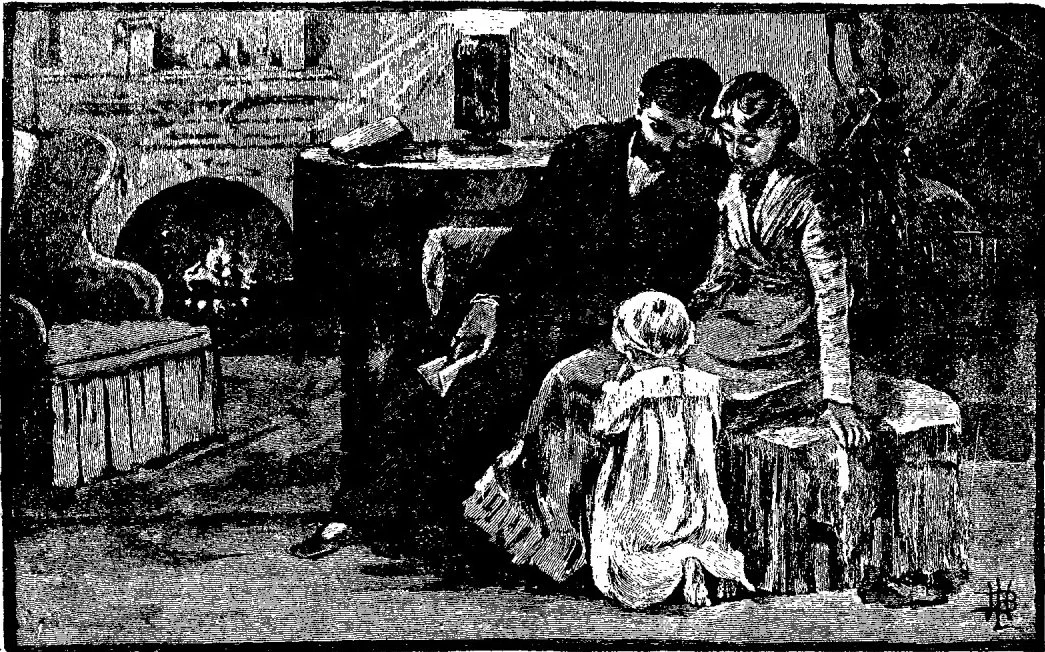
The mother who has caught the real Froebel [the originator of kindergarten methods] spirit, regards her work as a holy, sacred one; for she always looks from the material to the spiritual, from the cause to the effect, from the act to the result upon the character; and whether she is building block houses for her little one, washing his dirty little dimpled hands, or teaching him to lisp his first prayer as the little white figure bows at her knee, she realizes she is sowing seeds in her darling's heart, and helping to mold his character. And if she has lived long enough with that earnest teacher “who saw into the heart of childhood as never man saw before” (I mean Froebel), she will find a way to appeal to the threefold needs of her darling in every lesson, thus giving him a perfect and symmetrical development which one writer calls a “sacred legacy,” which “will win for its possessors untold riches in the eternal future.”
(Concluded next week.)
WHAT WE NEED.
By Mrs. D. A. Fitch
BY MRS. D. A. FITCH.
(Sanitarium Cooking-school.)
The body is composed of different kinds of tissue, some portions of each being continually broken down in muscular action, breathing, and even in the act of thinking. They are more or less highly vitalized, the nervous and muscular being more so than the bony. There being so great diversity in these tissues, there must of necessity be different elements in our food to repair the waste occurring in each.
The young must support growth as well as repair, and therefore require more of the nitrogenous, or building material, than do adults. The average normal body requires only about three ounces daily, to replace the waste occasioned by ordinary action. Consequently there must be other elements which go to make up the bulk of our food; for the daily need of food is about twenty-one ounces of solid aliment, or water-free food. The elements required are starch, sugar, and fat, known as the carbonaceous, or heat- and force-producing elements, and of them we require six times as much as of the nitrogenous; and they are related to the system as coal or wood is to the stove or engine, both in quantity and office. They are the elements which afford us our energy.
The nitrogenous elements are principally derived from legumes, as peas, beans, and lentils, fibrine of lean flesh, casein of milk, albumen of egg, and gluten of wheat. This last is the substance obtained when wheat is chewed. The albumen of an egg is principally in the white. The casein of milk is the part coagulated by the introduction of acids, as rennet, lemon, or vinegar. Albumen is also in milk. From these food elements the body, with its various tissues, is built up, and thus we see the necessity of studying the body and our foods, that we may make the best use of the things a beneficent Creator has given us.
USEFUL RECIPES.
Corn and Tomato Soup.—Two cups each of cooked corn and tomatoes run through a colander. Three cups boiling water, salt to taste, and thicken with one tablespoonful of browned flour.
Macaroni with Lentil Gravy.—Break a cupful of good macaroni into inch lengths; put it into boiling salted water and cook until tender, or until it has increased to twice its original size. Have ready a gravy made by taking one cup of boiled lentils after they have been put through the colander; thin with one cup of milk, and thicken to the consistency of thick cream with flour braided in a little cold milk. Heap the macaroni in the center of a serving dish, and pour the gravy around it. Serve while hot.
For Burns.—For a slight burn or scald apply olive-oil, fresh butter, or cover the place with a cloth wrung out in about a pint of tepid water, in which a piece of common washing soda, of about the size of a walnut, has been dissolved. For a bad burn or scald use linseed oil and lime-water, mixed in equal parts, known as “carron oil,” soaked into a piece of lint, and laid on. In the absence of these remedies, flour the burn well with the kitchen flour dredger, and cover up quickly.—Pacific Health Journal.
THANKSGIVING THOUGHTS.
By G. C. T.
Early in the history of this country the custom of setting apart a day for special thanksgiving to divine Providence was formed. The time appointed was at the close of the year's ingathering of the fruits of the ground. This custom has been preserved; and through the goodness of God we are brought to another period when we are called upon especially to remember the bounty of Heaven. It is true that to a great extent the day has lost whatever elements of sacredness or devout gratitude it may have possessed. It has degenerated into a season of riotous gluttony when people undertake to show their appreciation of their temporal blessings by devouring as many of them as their stomachs will hold. It is true that in many instances, so far as the Lord is concerned, he is better honored in the breach than in the observance of it.
But notwithstanding that the enemy has sowed tares here also, there is to every heart that is susceptible to a sense of continuous loving-kindness, received from the Source of all good gifts, an impressive fitness attached to such an occasion. Ingratitude is a grievous sin, not only against a bountiful Giver, but against our own souls. Gratitude is the response of kindly feeling for favors received. It cheers the giver, and is the least return he can expect.
Have we as a people any special reasons for thanksgiving? The question produces a spontaneous answer in all our hearts. We have shared with others the good things of life. Seedtime and harvest have come to us with their opportunity and reward. Peace broods over the land, light and knowledge are increasing, faith is being confirmed, prosperity attends the work of our hands; indeed, we cannot number our blessings. Though we have some trials, nothing can harm us if we be followers of the good. The evidences that establish the truthfulness of our position are increasing in number and emphasis. We see the conflict approaching like a dark cloud in the west. The storm will soon break; but beyond the storm is the glory. Truly we have infinite cause for gratitude.
In what manner can we best show our appreciation of these favors? The best way is to be truly thankful. Let us not forget that God regards the heart and not the outward show. In the harvest feast of the Jews we have the prototype of the Thanksgiving feast. And while we do not approve of gluttony or intemperance as a medium of expressing gratitude, we believe that a thankful and appropriate use of good cheer is proper, with true gratitude as a prompting motive.
It is a poor manifestation of gratitude that consumes the gifts of God on our lusts. The true principle is that as we have freely received, so we should freely give. If God has blessed us, it is that we may be a blessing. As we are dependent upon God, and he supplies our wants bountifully, others are dependent upon our benevolence, and we should gladly discharge our duty to them. At no season of the year is it more proper to remember the poor and suffering than now when the rigor of winter is being felt. How many there are about us who can only look to God for clothing, fuel, or food. And our Heavenly Father looks to us to act as channels through which to bless his needy poor.
Then, too, we have much to be thankful for in view of what the truth has done for us. It has conferred inestimable good upon every soul that has received it in the love of it. Have we no gratitude for this? Others need it; the call is urgent. Again the word comes, “Freely ye have received, freely give.” G. C. T.